Integrated Crop
Management
Biologicals
Today & Future
Trends & Challenges
Peter Jens
Global Alliance Manager
(Agtivist and Registered Lobbyist)
-Develop novel organic
techniques, out-of-soil,
for protected crops.
-Change or influence
EU organic regulations
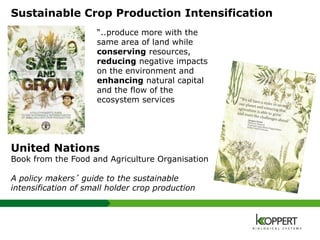
Sustainable Crop Production Intensification
“..produce more with the
same area of land while
conserving resources,
reducing negative impacts
on the environment and
enhancing natural capital
and the flow of the
ecosystem services
United Nations
Book from the Food and Agriculture Organisation
A policy makers’ guide to the sustainable
intensification of small holder crop production
Soil health
Agriculture must, literally, return to its roots by
rediscovering the importance of healthy soil,
drawing on natural resources of plant nutrition,
and using mineral fertilizer wisely.
Crops and Varieties
Farmers will need a genetically diverse portfolio of
improved crop varieties that are suited to a range of agro-
ecosystems and farming practices, and resilient to climate
change
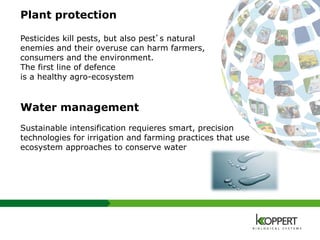
Plant protection
Pesticides kill pests, but also pest’s natural
enemies and their overuse can harm farmers,
consumers and the environment.
The first line of defence
is a healthy agro-ecosystem
Water management
Sustainable intensification requieres smart, precision
technologies for irrigation and farming practices that use
ecosystem approaches to conserve water
Promising directions in
Integrated Pest & Disease
Management that require further
research
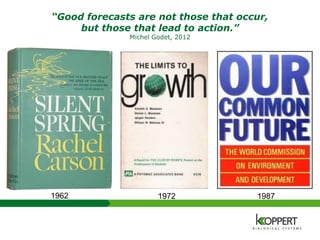
“Good forecasts are not those that occur,
but those that lead to action.”
Michel Godet, 2012
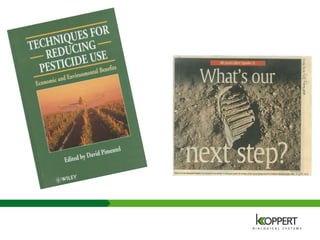
1962 1972 1987
New Roads to New Goals
 The Market demands residu-poor or even residu-free produce
(food safety)
- Retailers impose extra-legal requirements on farmers
 More attention for worker safety of the farmer and his personel
 Society and Legislator want less impact on the environment
and public health
- Stronger regulatory requirements have lead to less and safer
pesticides
- IPM has to lead to reduced use of pesticides (National Action
Plans)
- No emission of pesticides into the environment (Water
Framework)
 Sustainable Food Production : more production with less
input and less impact.
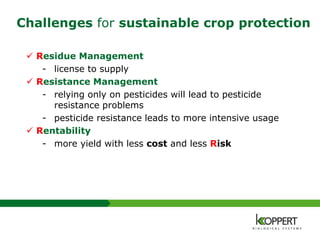
Challenges for sustainable crop protection
 Residue Management
- license to supply
 Resistance Management
- relying only on pesticides will lead to pesticide
resistance problems
- pesticide resistance leads to more intensive usage
 Rentability
- more yield with less cost and less Risk
Focus for the future?
 Chemical pesticides will no longer be the only basis for crop
protection.
 Integrated Pest and Disease Management is raised to a higher
level.
 Resilience against climate change and invasive alien pests and
diseases
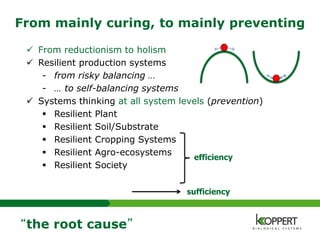
From mainly curing, to mainly preventing
 From reductionism to holism
 Resilient production systems
- from risky balancing …
- … to self-balancing systems
 Systems thinking at all system levels (prevention)
 Resilient Plant
 Resilient Soil/Substrate
 Resilient Cropping Systems
 Resilient Agro-ecosystems
 Resilient Society
“the root cause”
efficiency
sufficiency
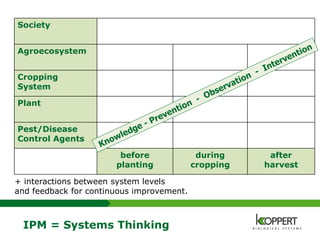
Society
Agroecosystem
Cropping
System
Plant
Pest/Disease
Control Agents
before
planting
during
cropping
after
harvest
IPM = Systems Thinking
+ interactions between system levels
and feedback for continuous improvement.
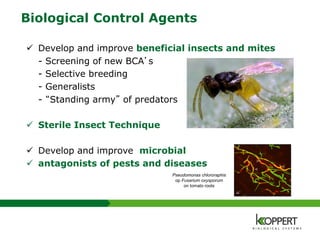
Biological Control Agents
 Develop and improve beneficial insects and mites
- Screening of new BCA’s
- Selective breeding
- Generalists
- “Standing army” of predators
 Sterile Insect Technique
 Develop and improve microbial
 antagonists of pests and diseases
Pseudomonas chlororaphis
op Fusarium oxysporum
on tomato roots
Resilient Plants
 Breeding for Resistance
- (partial) resistance, multi gene resistance
- more adapted for beneficial insects and mites
 Induced Systemic Resistance (ISR)
Systemic Acquired Resistance (SAR)
- activators
- micro-organisms : seed treatment
- predatory bugs
 Endophytes : “systemic” micro-organisms
 Resistance Inducing Substrates
 Low doses of pesticides to slow down pest development
 Preventive release of predators and parasites (“standing
army”)
 …
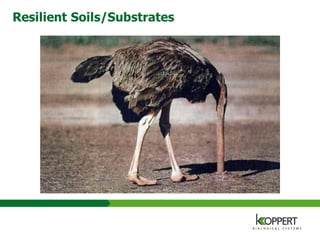
Resilient Soils/Substrates
a.k.a. “suppressive soils”
1. Respecting (microbial) soil life
- avoid harmful pesticides
- improve the physical/abiotic conditions in the soil
2. Increasing the quantity of (microbial) soil life
- soil organic material (SOM), compost, green manure, …
- biostimulants
3. Increasing the diversity of (microbial) soil life
- soil organic material (SOM), compost, green manure, …
4. Adding specific antagonists
- Trichoderma spp., Bacillus spp., Pseudomonas spp., etc.
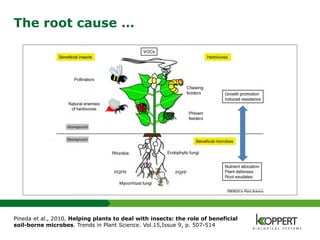
The root cause …
Pineda et al., 2010, Helping plants to deal with insects: the role of beneficial
soil-borne microbes. Trends in Plant Science. Vol.15,Issue 9, p. 507-514
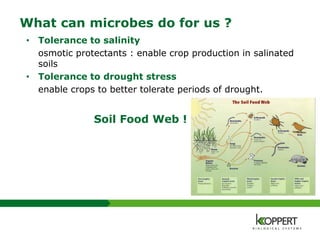
What can microbes do for us ?
• Tolerance to salinity
osmotic protectants : enable crop production in salinated
soils
• Tolerance to drought stress
enable crops to better tolerate periods of drought.
Soil Food Web !
Crop Protection & Productivity
 Increased production when intensive use of chemical
pesticides is stopped.
 Plant growth promoting (PGP) effect of antagonistic micro-
organisms (“biofertilizers”).
 Reduction of use of chemical fertilizers by applying micro-
organisms (“biofertilizers”).
 Protection against salt stress and drought stress by using
micro-organisms.
 Convergence of Integrated Pest & Disease Management
(IPM) and Integrated Soil & Nutrient Management (INM).
Plant Protection Policy Paradox
Succesful European policy aimed at reducing the number of
chemical PPP’s and the use of chemical PPP’s.
BUT: Policy is not sufficiently aimed at enabling the
development and availability of alternatives:
1.Registration requirements for microbials.
2.Very long registration proces for microbial biological control
agents due to insufficient expertise of the examiners.
3.Declining support of research into non-chemical alternatives.
Tunnelvision with regards to genetics only.
4.Regulation of biostimulants and biofertilisers, now
considered as PPP’s under 1107/2009.
“We are now on the threshold of a third
phase in the development of IPM systems
that recognizes pests not as enemies,
but as indicators of problems in the design
and management of systems”
Hill (1985)
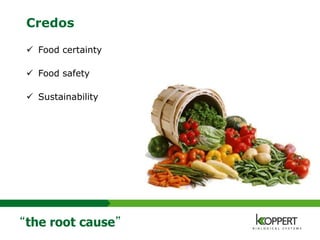
Credos
 Food certainty
 Food safety
 Sustainability
“the root cause”
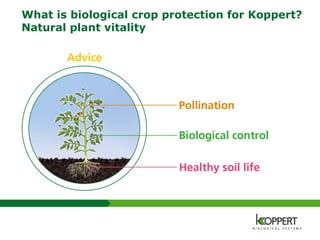
What is biological crop protection for Koppert?
Natural plant vitality
Advantages of biological crop protection
 Safer than chemical products for the grower,
employee and consumer
 Pests cannot become resistant to natural
enemies
 Better for the environment
 Natural enemies actively search for the prey
 Eliminates pesticide residues
 Improves marketability
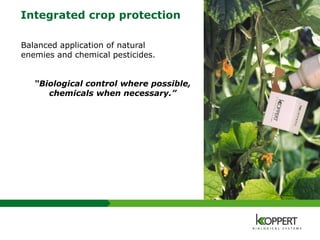
Integrated crop protection
Balanced application of natural
enemies and chemical pesticides.
“Biological control where possible,
chemicals when necessary.”
Thank you !
pmaes@koppert.nl
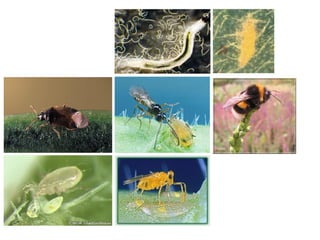
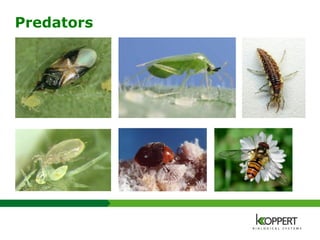
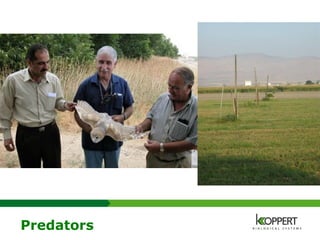
Predators
Predators
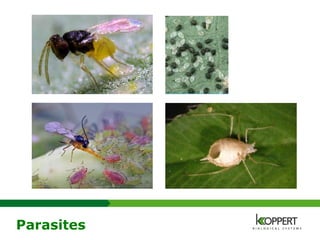
Parasites
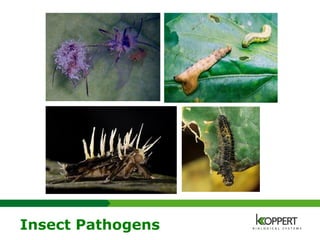
Insect Pathogens
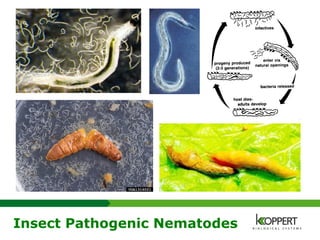
Insect Pathogenic Nematodes
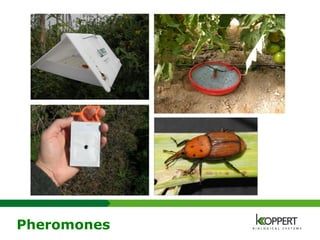
Pheromones

Peter Jens

  • 1.
    Integrated Crop Management Biologicals Today &Future Trends & Challenges Peter Jens Global Alliance Manager (Agtivist and Registered Lobbyist)
  • 2.
    -Develop novel organic techniques,out-of-soil, for protected crops. -Change or influence EU organic regulations
  • 3.
    Sustainable Crop ProductionIntensification “..produce more with the same area of land while conserving resources, reducing negative impacts on the environment and enhancing natural capital and the flow of the ecosystem services United Nations Book from the Food and Agriculture Organisation A policy makers’ guide to the sustainable intensification of small holder crop production
  • 4.
    Soil health Agriculture must,literally, return to its roots by rediscovering the importance of healthy soil, drawing on natural resources of plant nutrition, and using mineral fertilizer wisely. Crops and Varieties Farmers will need a genetically diverse portfolio of improved crop varieties that are suited to a range of agro- ecosystems and farming practices, and resilient to climate change
  • 5.
    Plant protection Pesticides killpests, but also pest’s natural enemies and their overuse can harm farmers, consumers and the environment. The first line of defence is a healthy agro-ecosystem Water management Sustainable intensification requieres smart, precision technologies for irrigation and farming practices that use ecosystem approaches to conserve water
  • 6.
    Promising directions in IntegratedPest & Disease Management that require further research
  • 7.
    “Good forecasts arenot those that occur, but those that lead to action.” Michel Godet, 2012 1962 1972 1987
  • 8.
    New Roads toNew Goals  The Market demands residu-poor or even residu-free produce (food safety) - Retailers impose extra-legal requirements on farmers  More attention for worker safety of the farmer and his personel  Society and Legislator want less impact on the environment and public health - Stronger regulatory requirements have lead to less and safer pesticides - IPM has to lead to reduced use of pesticides (National Action Plans) - No emission of pesticides into the environment (Water Framework)  Sustainable Food Production : more production with less input and less impact.
  • 9.
    Challenges for sustainablecrop protection  Residue Management - license to supply  Resistance Management - relying only on pesticides will lead to pesticide resistance problems - pesticide resistance leads to more intensive usage  Rentability - more yield with less cost and less Risk
  • 10.
    Focus for thefuture?  Chemical pesticides will no longer be the only basis for crop protection.  Integrated Pest and Disease Management is raised to a higher level.  Resilience against climate change and invasive alien pests and diseases
  • 12.
    From mainly curing,to mainly preventing  From reductionism to holism  Resilient production systems - from risky balancing … - … to self-balancing systems  Systems thinking at all system levels (prevention)  Resilient Plant  Resilient Soil/Substrate  Resilient Cropping Systems  Resilient Agro-ecosystems  Resilient Society “the root cause” efficiency sufficiency
  • 13.
    Society Agroecosystem Cropping System Plant Pest/Disease Control Agents before planting during cropping after harvest IPM =Systems Thinking + interactions between system levels and feedback for continuous improvement.
  • 14.
    Biological Control Agents Develop and improve beneficial insects and mites - Screening of new BCA’s - Selective breeding - Generalists - “Standing army” of predators  Sterile Insect Technique  Develop and improve microbial  antagonists of pests and diseases Pseudomonas chlororaphis op Fusarium oxysporum on tomato roots
  • 16.
    Resilient Plants  Breedingfor Resistance - (partial) resistance, multi gene resistance - more adapted for beneficial insects and mites  Induced Systemic Resistance (ISR) Systemic Acquired Resistance (SAR) - activators - micro-organisms : seed treatment - predatory bugs  Endophytes : “systemic” micro-organisms  Resistance Inducing Substrates  Low doses of pesticides to slow down pest development  Preventive release of predators and parasites (“standing army”)  …
  • 18.
    Resilient Soils/Substrates a.k.a. “suppressivesoils” 1. Respecting (microbial) soil life - avoid harmful pesticides - improve the physical/abiotic conditions in the soil 2. Increasing the quantity of (microbial) soil life - soil organic material (SOM), compost, green manure, … - biostimulants 3. Increasing the diversity of (microbial) soil life - soil organic material (SOM), compost, green manure, … 4. Adding specific antagonists - Trichoderma spp., Bacillus spp., Pseudomonas spp., etc.
  • 19.
    The root cause… Pineda et al., 2010, Helping plants to deal with insects: the role of beneficial soil-borne microbes. Trends in Plant Science. Vol.15,Issue 9, p. 507-514
  • 20.
    What can microbesdo for us ? • Tolerance to salinity osmotic protectants : enable crop production in salinated soils • Tolerance to drought stress enable crops to better tolerate periods of drought. Soil Food Web !
  • 21.
    Crop Protection &Productivity  Increased production when intensive use of chemical pesticides is stopped.  Plant growth promoting (PGP) effect of antagonistic micro- organisms (“biofertilizers”).  Reduction of use of chemical fertilizers by applying micro- organisms (“biofertilizers”).  Protection against salt stress and drought stress by using micro-organisms.  Convergence of Integrated Pest & Disease Management (IPM) and Integrated Soil & Nutrient Management (INM).
  • 22.
    Plant Protection PolicyParadox Succesful European policy aimed at reducing the number of chemical PPP’s and the use of chemical PPP’s. BUT: Policy is not sufficiently aimed at enabling the development and availability of alternatives: 1.Registration requirements for microbials. 2.Very long registration proces for microbial biological control agents due to insufficient expertise of the examiners. 3.Declining support of research into non-chemical alternatives. Tunnelvision with regards to genetics only. 4.Regulation of biostimulants and biofertilisers, now considered as PPP’s under 1107/2009.
  • 23.
    “We are nowon the threshold of a third phase in the development of IPM systems that recognizes pests not as enemies, but as indicators of problems in the design and management of systems” Hill (1985)
  • 24.
    Credos  Food certainty Food safety  Sustainability “the root cause”
  • 25.
    What is biologicalcrop protection for Koppert? Natural plant vitality
  • 26.
    Advantages of biologicalcrop protection  Safer than chemical products for the grower, employee and consumer  Pests cannot become resistant to natural enemies  Better for the environment  Natural enemies actively search for the prey  Eliminates pesticide residues  Improves marketability
  • 27.
    Integrated crop protection Balancedapplication of natural enemies and chemical pesticides. “Biological control where possible, chemicals when necessary.”
  • 28.
  • 29.
  • 30.
  • 31.
  • 32.
  • 33.
  • 34.