Integrated Pest Management
What is IPM Uses a combination of Best management Practices Reduce pest damage Least disruption to the environment Keep pest populations below the economic or aesthetic injury level  Protect humans, animals, plants & the environment
Phases of IPM Phase I - Action threshold is the predetermined level when pest control is needed The losses due to pests are equal to the cost of control Phase II – Evaluate possible control measures Chemical Biological Mechanical
Best Management Practices Combine scientific research with practical knowledge Optimize yields and increase quality Maintain environmental integrity Eliminate the risk of unwanted materials having a negative affect on the environment
Examples of BMPs To Manage surface and subsurface water runoff Erosion control Soil testing Timing & placement of fertilizers Irrigation management Cultural control of pests Etc…
What is a Pesticide? Any material used to control pests. Man made or natural Classified by the insect they control
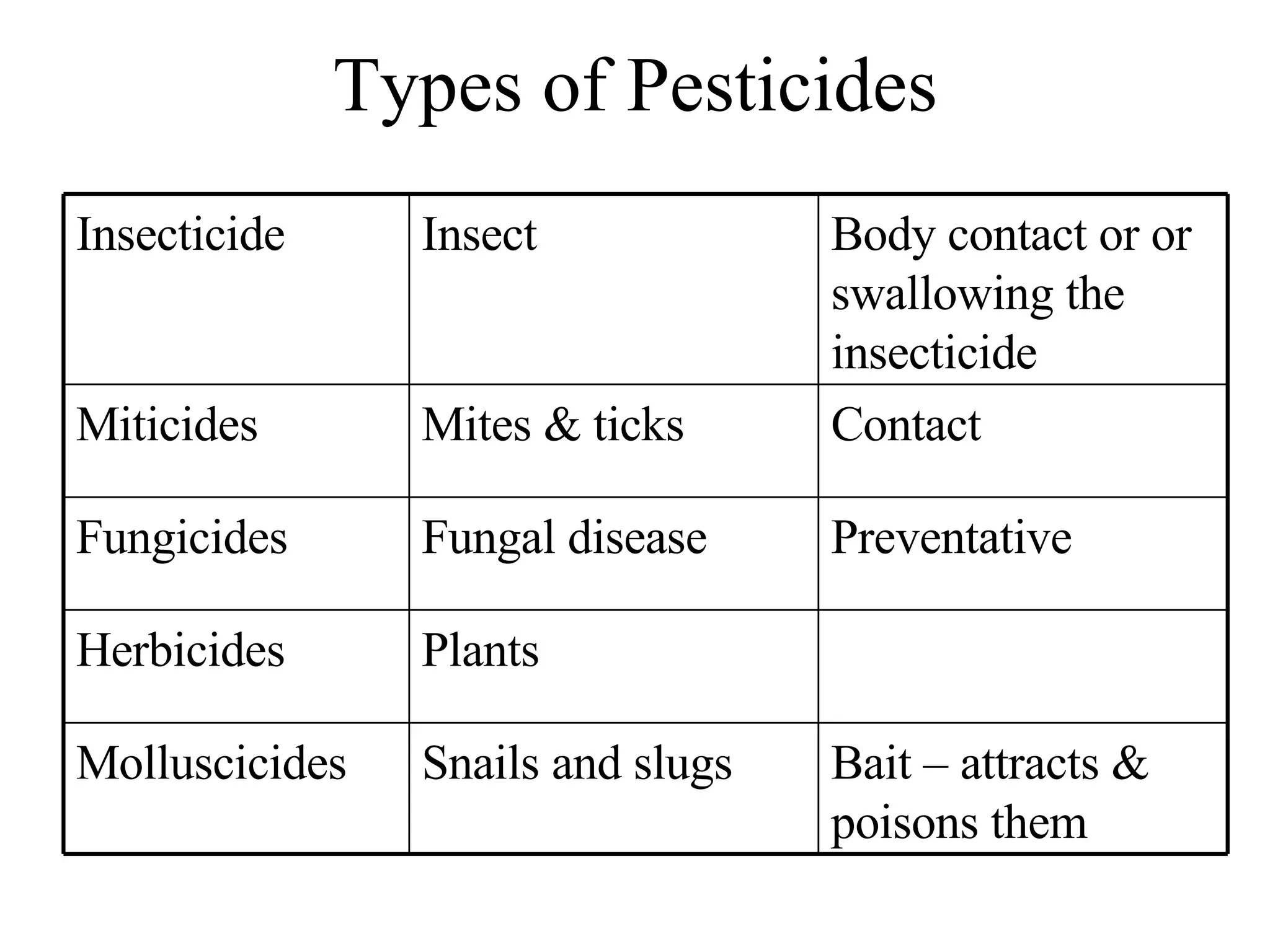
Types of Pesticides Bait – attracts & poisons them Snails and slugs Molluscicides Plants Herbicides Preventative Fungal disease Fungicides Contact Mites & ticks Miticides Body contact or or swallowing the insecticide Insect Insecticide
Classification of Herbicides (5.2) Selective herbicide – kills only certain plant species and not others Non-selective herbicide kills all plants Contact herbicide – kills by exposure Growth regulators – kills by altering growth or metabolic processes Roots, stems or leaves absorb the chemical May take a week or more Soil sterilant – prevents the growth of plants in the soil
Classification of Insecticides Contact absorbed through the skin or exterior of an insect Chemical must be applied directly on the insect Normally used with sucking insects Stomach  Affective when eaten Applied to the plant Affective on chewing insects Respiratory  Fumigants, used in enclosed places
Using Pesticides Safely (5.3) Pesticides are classified according to toxicity The degree of poison in the material General use pesticides Used by following the label Less hazardous to the environment Restricted use pesticides Higher toxicity level Must have special training in the safe use and handling of these chemicals
Types of Exposure Oral  through the mouth and digestive system Usually from carelessness Dermal exposure  Through the skin Can happen anytime working with chemicals
Inhalation Exposure Through the nose and respiratory system Can be more dangerous than oral or dermal due to the uptake of blood via the lungs and other membranes  Eye exposure Eyes are very sensitive to most pesticide materials
How is Toxicity Measured LD 50  Lethal dose – amount to cause death 50 means 50 percent of the test animals are killed at this dose The lower the number the more poisonous it is Values given in milligrams of substance per kilogram of test animal body weight Equal to parts per million
Inhalation toxicity LC 50 LC – lethal concentration Measured in milligrams per liter Lower the number the more poisonous
Worker Protection Standard (WPS) Use only approved pesticides Applicator (person) must be informed Do not use pesticides for uses that they were not intended for Follow the label Use a pesticide with low toxicity Use only when needed
WPS Do not contaminate resources Wear protective clothing Dispose of empty containers properly Apply in good weather, when most effective, reduce drift Use the right equipment Know the right emergency measures
Interpreting Pesticide Labels Provides information about the Active Ingredient Read the label Understand the label Follow the label directions Can be subject to both civil & criminal penalties for not following the label directions
Pesticide Label (5.4) Front panel- only basic information Use classification General use Restricted use Trade (Brand) Name Formulation Cannot be sold in pure form
Inert ingredients Surfactants Emulsifying agents Liquid emulsifiable concentrates (E or EC) Wettable powders (W or WP) Dry flowables (DF) Solutions (S) Granules (G) Dusts (D)
Front Label contents Common Name for the active ingredient Ingredients  All the ingredients For inert only the combined total concentration must be stated Net contents of Container
Signal Words Words to designate the degree of toxicity and potential danger Based of LD 50 Danger or Danger-Poison  with skull & cross bones (all red) must appear on all highly toxic pesticides Warning – moderately toxic Caution – low or very low Keep Out of Reach of Children – on all, regardless of toxicity
Front Label Precautionary statements  First aid treatment Potential environmental and human hazards Flammability or explosion hazards Establishment Number EPA identifies the plant where the pesticide was manufactured, packaged, or formulated Name, address, phone of Manufacturer
Hazardous Materials Warning Required by US Department of Transportation Symbol to denote the nature of the chemicals Small number in lower portion of the symbol indicates the class of the hazardous material
Directions for Use Sites which can be treated Target pest(s) Amount of chemical to use pre acre Type of equipment and application methods  Proper mixing procedures When they should be applied Reentry limitations Guidelines for storage and disposal Limitations on its use
Notice of Limitations Condition of sale Warranty limitation Inherent risks Liability limitations
When should the label be read? Before purchase Make sure you have the proper equipment Before mixing  note warnings and first aid measures Determine the proper protective clothing Before applying Before storing Before disposing of excess
Time of Applications (5.5) When applied relative to the stage of growth of the crop Preplant applications  Preemergence – before plant has emerged or broken through the soil surface Postemergence – after plants growing and when pests are present
Area of Application Extent of coverage Band application – narrow strips – 10-12 inches wide Broadcast – entire area Directed – only selected plants, applied where pests are present, tiny amount Spot application – only certain areas with high concentrations of pests
Calibration Setting the equipment to meter the exact amount of herbicide needed Nozzle flow rate size of the tip Nozzle pressure Ground speed – rate travel across the ground Spray width per nozzle
Potential Environmental Problems (5.6) Non-target area Drift Surface runoff Leaching Not-biodegradable Accumulate in groundwater, plants, or animals Careless disposal
Pesticide persistence How long it takes to biodegrade or break down Rapid decomposers Accumulative pesticides – can build up in bodies of animals and humans Persistent pesticides break down slowly Do not react readily with sunlight, oxygen or heat Not broken down by soil organisms
Proper Disposal Resource Conservation and Recovery Act (RCRA) in 1976 to management hazardous toxic materials and their containers Avoid inventory of unnecessary pesticides  Some can be buried in landfills (small amounts) Some in licensed sites that can receive hazardous wastes
Container rinsing – Triple rinse method Drain container into the spray tank, hold vertical for 30 seconds Add water until container ¼ full, close container Shake or roll to rinse all interior, drain remaining into the spray tank Repeat 2 more times
Disposal Puncture plastic or metal triple rinsed containers to prevent reuse Crush the container

10 Integrated Pest Management

  • 1.
  • 2.
    What is IPMUses a combination of Best management Practices Reduce pest damage Least disruption to the environment Keep pest populations below the economic or aesthetic injury level Protect humans, animals, plants & the environment
  • 3.
    Phases of IPMPhase I - Action threshold is the predetermined level when pest control is needed The losses due to pests are equal to the cost of control Phase II – Evaluate possible control measures Chemical Biological Mechanical
  • 4.
    Best Management PracticesCombine scientific research with practical knowledge Optimize yields and increase quality Maintain environmental integrity Eliminate the risk of unwanted materials having a negative affect on the environment
  • 5.
    Examples of BMPsTo Manage surface and subsurface water runoff Erosion control Soil testing Timing & placement of fertilizers Irrigation management Cultural control of pests Etc…
  • 6.
    What is aPesticide? Any material used to control pests. Man made or natural Classified by the insect they control
  • 7.
    Types of PesticidesBait – attracts & poisons them Snails and slugs Molluscicides Plants Herbicides Preventative Fungal disease Fungicides Contact Mites & ticks Miticides Body contact or or swallowing the insecticide Insect Insecticide
  • 8.
    Classification of Herbicides(5.2) Selective herbicide – kills only certain plant species and not others Non-selective herbicide kills all plants Contact herbicide – kills by exposure Growth regulators – kills by altering growth or metabolic processes Roots, stems or leaves absorb the chemical May take a week or more Soil sterilant – prevents the growth of plants in the soil
  • 9.
    Classification of InsecticidesContact absorbed through the skin or exterior of an insect Chemical must be applied directly on the insect Normally used with sucking insects Stomach Affective when eaten Applied to the plant Affective on chewing insects Respiratory Fumigants, used in enclosed places
  • 10.
    Using Pesticides Safely(5.3) Pesticides are classified according to toxicity The degree of poison in the material General use pesticides Used by following the label Less hazardous to the environment Restricted use pesticides Higher toxicity level Must have special training in the safe use and handling of these chemicals
  • 11.
    Types of ExposureOral through the mouth and digestive system Usually from carelessness Dermal exposure Through the skin Can happen anytime working with chemicals
  • 12.
    Inhalation Exposure Throughthe nose and respiratory system Can be more dangerous than oral or dermal due to the uptake of blood via the lungs and other membranes Eye exposure Eyes are very sensitive to most pesticide materials
  • 13.
    How is ToxicityMeasured LD 50 Lethal dose – amount to cause death 50 means 50 percent of the test animals are killed at this dose The lower the number the more poisonous it is Values given in milligrams of substance per kilogram of test animal body weight Equal to parts per million
  • 14.
    Inhalation toxicity LC50 LC – lethal concentration Measured in milligrams per liter Lower the number the more poisonous
  • 15.
    Worker Protection Standard(WPS) Use only approved pesticides Applicator (person) must be informed Do not use pesticides for uses that they were not intended for Follow the label Use a pesticide with low toxicity Use only when needed
  • 16.
    WPS Do notcontaminate resources Wear protective clothing Dispose of empty containers properly Apply in good weather, when most effective, reduce drift Use the right equipment Know the right emergency measures
  • 17.
    Interpreting Pesticide LabelsProvides information about the Active Ingredient Read the label Understand the label Follow the label directions Can be subject to both civil & criminal penalties for not following the label directions
  • 18.
    Pesticide Label (5.4)Front panel- only basic information Use classification General use Restricted use Trade (Brand) Name Formulation Cannot be sold in pure form
  • 19.
    Inert ingredients SurfactantsEmulsifying agents Liquid emulsifiable concentrates (E or EC) Wettable powders (W or WP) Dry flowables (DF) Solutions (S) Granules (G) Dusts (D)
  • 20.
    Front Label contentsCommon Name for the active ingredient Ingredients All the ingredients For inert only the combined total concentration must be stated Net contents of Container
  • 21.
    Signal Words Wordsto designate the degree of toxicity and potential danger Based of LD 50 Danger or Danger-Poison with skull & cross bones (all red) must appear on all highly toxic pesticides Warning – moderately toxic Caution – low or very low Keep Out of Reach of Children – on all, regardless of toxicity
  • 22.
    Front Label Precautionarystatements First aid treatment Potential environmental and human hazards Flammability or explosion hazards Establishment Number EPA identifies the plant where the pesticide was manufactured, packaged, or formulated Name, address, phone of Manufacturer
  • 23.
    Hazardous Materials WarningRequired by US Department of Transportation Symbol to denote the nature of the chemicals Small number in lower portion of the symbol indicates the class of the hazardous material
  • 24.
    Directions for UseSites which can be treated Target pest(s) Amount of chemical to use pre acre Type of equipment and application methods Proper mixing procedures When they should be applied Reentry limitations Guidelines for storage and disposal Limitations on its use
  • 25.
    Notice of LimitationsCondition of sale Warranty limitation Inherent risks Liability limitations
  • 26.
    When should thelabel be read? Before purchase Make sure you have the proper equipment Before mixing note warnings and first aid measures Determine the proper protective clothing Before applying Before storing Before disposing of excess
  • 27.
    Time of Applications(5.5) When applied relative to the stage of growth of the crop Preplant applications Preemergence – before plant has emerged or broken through the soil surface Postemergence – after plants growing and when pests are present
  • 28.
    Area of ApplicationExtent of coverage Band application – narrow strips – 10-12 inches wide Broadcast – entire area Directed – only selected plants, applied where pests are present, tiny amount Spot application – only certain areas with high concentrations of pests
  • 29.
    Calibration Setting theequipment to meter the exact amount of herbicide needed Nozzle flow rate size of the tip Nozzle pressure Ground speed – rate travel across the ground Spray width per nozzle
  • 30.
    Potential Environmental Problems(5.6) Non-target area Drift Surface runoff Leaching Not-biodegradable Accumulate in groundwater, plants, or animals Careless disposal
  • 31.
    Pesticide persistence Howlong it takes to biodegrade or break down Rapid decomposers Accumulative pesticides – can build up in bodies of animals and humans Persistent pesticides break down slowly Do not react readily with sunlight, oxygen or heat Not broken down by soil organisms
  • 32.
    Proper Disposal ResourceConservation and Recovery Act (RCRA) in 1976 to management hazardous toxic materials and their containers Avoid inventory of unnecessary pesticides Some can be buried in landfills (small amounts) Some in licensed sites that can receive hazardous wastes
  • 33.
    Container rinsing –Triple rinse method Drain container into the spray tank, hold vertical for 30 seconds Add water until container ¼ full, close container Shake or roll to rinse all interior, drain remaining into the spray tank Repeat 2 more times
  • 34.
    Disposal Puncture plasticor metal triple rinsed containers to prevent reuse Crush the container