ORGANIC PEST MANAGEMENT 
Submitted to 
• Keshar Singh Solanki 
Submitted by 
• Dr. L.J. Desai 
An 
Assignment 
on
General 
• Immense commercialisation of agriculture has had a 
very negative effect on the environment. The use of 
pesticides has led to enormous levels of chemical 
build-up in our environment, in soil, water, air, in 
animals and even in our own bodies. Fertilisers have a 
short-term effect on productivity but a longer-term 
negative effect on the environment where they remain 
for years after leaching and running off, contaminating 
ground water and water bodies. The use of hybrid 
seeds and the practice of monoculture has led to a 
severe threat to local and indigenous varieties, whose 
germplasm can be lost for ever. All this for 
"productivity".
In the name of growing more to feed the earth, it 
has taken the wrong road of unsustainability. The 
effects show - farmers committing suicide in 
growing numbers with every passing year; the 
horrendous effects of pesticide sprays, pesticide 
contaminated bottled water and aerated 
beverages are only some instances. The bigger 
picture that rarely makes news however is that 
millions of people are still underfed, and where 
they do get enough to eat, the food they eat has 
the capability to eventually kill them.
Losses due to Pests 
Insect pests, diseases and weeds are the major constraints 
limiting agricultural productivity growth. It is estimated that 
herbivorous insects eat about 26 percent of the potential 
food production. Emerging problems of insecticide 
resistance, secondary pest outbreak and resurgence further 
add to the cost. 
India are estimated to be 18 percent of the agricultural 
output. Losses caused by specific pests may be higher. 
Helicoverpa spp. in cotton causes losses up to 50 percent. 
According to Raheja and Tewari (1996), H. Armigera 
(American bollworm) alone causes an annual loss of about 
Rs1000 crores.
• Another negative effect of this trend has been on the fortunes of 
the farming communities worldwide. Despite this so-called 
increased productivity, farmers in practically every country around 
the world have seen a downturn in their fortunes. This is where 
organic farming comes in. Organic farming has the capability to take 
care of each of these problems. Besides the obvious immediate and 
positive effects organic or natural farming has on the environment 
and quality of food, it also greatly helps a farmer to become 
selfsufficient in his requirements for agro-inputs and reduce his 
costs. Modern farming affects our world, by the way of land 
exhaustion, nitrate run off, soil erosion, soil compaction, loss of 
cultivated biodiversity, habitat destruction, contaminated food and 
destruction of traditional knowledge systems and traditions. Thus 
to overcome the ill effects of modern agriculture, can be delineated 
by adopting organic farming.
The production losses have shown an increasing trend over 
the years. In 1983, the losses due to insect pests were 
estimated worth ₨ 6,000 crores (Krishnamurthy Rao and 
Murthy, 1983), which increased to ₨ 20,000 crores in 1993 
(Jayaraj,1993) and to 29,000 crores in 1996 (Dhaliwal and 
Arora, 1996). New pests have appeared due to the changes 
in the cropping patternsand the intensive agricultural 
practices.
Pest resistant varieties: 
• Breeding for pest resistance is a continuous process. At the same 
time the pests also, particularly the plant pathogens, co-evolve with 
their hosts. Thus, gene transfer technology is useful in developing 
cultivars resistant to insects, plant pathogens and herbicides. An 
example of this is the incorporation of genetic material from 
Bacillus thuringiensis (Bt), a naturally occurring bacterium, in 
cotton, corn, and potatoes, which makes the plant tissues toxic to 
the insect pests. Scientific community is impressed by its huge 
potential in managing the pests, but is also concerned about the 
possibility of increased selection pressure for resistance against it 
and its effects on non-target natural fauna. However, due to ethical, 
scientific and social considerations, this potential technology has 
been surrounded by controversies.
Physical or mechanical controls 
These are based on the knowledge of pest behaviour. 
• Placing plastic-lined trenches in potato fields to trap 
migrating Colorado potato beetles is one example of the 
physical control. 
• Shaking of the pigeonpea plant to remove Helicoverpa 
larvae is a common practice in pigeonpea growing areas. 
• Hand picking of insect pests is perhaps the simplest pest 
control method. 
• Installation of dead as well as live bird perches in cotton 
and chickpea fields has proved effective in checking the 
bollworm infestation. 
• Using mulches to smother weeds and providing row covers 
to protect plants from insects are other examples.
Cultural pest control 
It includes crop production practices that make crop environment 
less susceptible to pests. Crop rotation, fallowing, manipulation of 
planting and harvesting dates, manipulation of plant and row 
spacing, and destruction of old crop debris are a few examples of 
cultural methods that are used to manage the pests. Planting of 
cover crops, nectar producing plants and inter-planting of different 
crops to provide habitat diversity to beneficial insects are important 
management techniques. Cover crops, often legume or grass 
species, prevent soil erosion and suppress weeds. A cover crop can 
also be used as a green manure, which is incorporated in the soil to 
provide nitrogen and organic matter to the subsequent crop. When 
incorporated in the soil, some cover crops of the Brassica family 
have the ability to suppress nematode pests and wilt diseases. Left 
in the field as residues, rye and wheat provide more than 90 
percent weed suppression. Cultural controls are selected based on 
knowledge of pest biology and development.
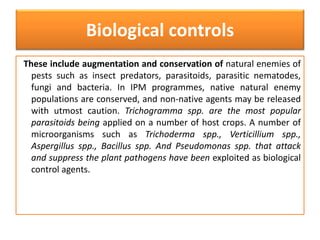
Biological controls 
These include augmentation and conservation of natural enemies of 
pests such as insect predators, parasitoids, parasitic nematodes, 
fungi and bacteria. In IPM programmes, native natural enemy 
populations are conserved, and non-native agents may be released 
with utmost caution. Trichogramma spp. are the most popular 
parasitoids being applied on a number of host crops. A number of 
microorganisms such as Trichoderma spp., Verticillium spp., 
Aspergillus spp., Bacillus spp. And Pseudomonas spp. that attack 
and suppress the plant pathogens have been exploited as biological 
control agents.
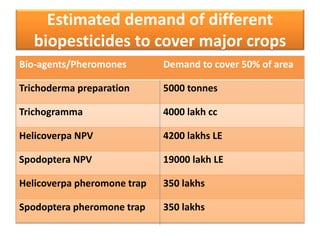
Estimated demand of different 
biopesticides to cover major crops 
Bio-agents/Pheromones Demand to cover 50% of area 
Trichoderma preparation 5000 tonnes 
Trichogramma 4000 lakh cc 
Helicoverpa NPV 4200 lakhs LE 
Spodoptera NPV 19000 lakh LE 
Helicoverpa pheromone trap 350 lakhs 
Spodoptera pheromone trap 350 lakhs
REFERENCES 
• http://anrcatalog.ucdavis.edu/pdf/7251.pdf

Organic pest management

  • 1.
    ORGANIC PEST MANAGEMENT Submitted to • Keshar Singh Solanki Submitted by • Dr. L.J. Desai An Assignment on
  • 2.
    General • Immensecommercialisation of agriculture has had a very negative effect on the environment. The use of pesticides has led to enormous levels of chemical build-up in our environment, in soil, water, air, in animals and even in our own bodies. Fertilisers have a short-term effect on productivity but a longer-term negative effect on the environment where they remain for years after leaching and running off, contaminating ground water and water bodies. The use of hybrid seeds and the practice of monoculture has led to a severe threat to local and indigenous varieties, whose germplasm can be lost for ever. All this for "productivity".
  • 3.
    In the nameof growing more to feed the earth, it has taken the wrong road of unsustainability. The effects show - farmers committing suicide in growing numbers with every passing year; the horrendous effects of pesticide sprays, pesticide contaminated bottled water and aerated beverages are only some instances. The bigger picture that rarely makes news however is that millions of people are still underfed, and where they do get enough to eat, the food they eat has the capability to eventually kill them.
  • 4.
    Losses due toPests Insect pests, diseases and weeds are the major constraints limiting agricultural productivity growth. It is estimated that herbivorous insects eat about 26 percent of the potential food production. Emerging problems of insecticide resistance, secondary pest outbreak and resurgence further add to the cost. India are estimated to be 18 percent of the agricultural output. Losses caused by specific pests may be higher. Helicoverpa spp. in cotton causes losses up to 50 percent. According to Raheja and Tewari (1996), H. Armigera (American bollworm) alone causes an annual loss of about Rs1000 crores.
  • 5.
    • Another negativeeffect of this trend has been on the fortunes of the farming communities worldwide. Despite this so-called increased productivity, farmers in practically every country around the world have seen a downturn in their fortunes. This is where organic farming comes in. Organic farming has the capability to take care of each of these problems. Besides the obvious immediate and positive effects organic or natural farming has on the environment and quality of food, it also greatly helps a farmer to become selfsufficient in his requirements for agro-inputs and reduce his costs. Modern farming affects our world, by the way of land exhaustion, nitrate run off, soil erosion, soil compaction, loss of cultivated biodiversity, habitat destruction, contaminated food and destruction of traditional knowledge systems and traditions. Thus to overcome the ill effects of modern agriculture, can be delineated by adopting organic farming.
  • 6.
    The production losseshave shown an increasing trend over the years. In 1983, the losses due to insect pests were estimated worth ₨ 6,000 crores (Krishnamurthy Rao and Murthy, 1983), which increased to ₨ 20,000 crores in 1993 (Jayaraj,1993) and to 29,000 crores in 1996 (Dhaliwal and Arora, 1996). New pests have appeared due to the changes in the cropping patternsand the intensive agricultural practices.
  • 7.
    Pest resistant varieties: • Breeding for pest resistance is a continuous process. At the same time the pests also, particularly the plant pathogens, co-evolve with their hosts. Thus, gene transfer technology is useful in developing cultivars resistant to insects, plant pathogens and herbicides. An example of this is the incorporation of genetic material from Bacillus thuringiensis (Bt), a naturally occurring bacterium, in cotton, corn, and potatoes, which makes the plant tissues toxic to the insect pests. Scientific community is impressed by its huge potential in managing the pests, but is also concerned about the possibility of increased selection pressure for resistance against it and its effects on non-target natural fauna. However, due to ethical, scientific and social considerations, this potential technology has been surrounded by controversies.
  • 8.
    Physical or mechanicalcontrols These are based on the knowledge of pest behaviour. • Placing plastic-lined trenches in potato fields to trap migrating Colorado potato beetles is one example of the physical control. • Shaking of the pigeonpea plant to remove Helicoverpa larvae is a common practice in pigeonpea growing areas. • Hand picking of insect pests is perhaps the simplest pest control method. • Installation of dead as well as live bird perches in cotton and chickpea fields has proved effective in checking the bollworm infestation. • Using mulches to smother weeds and providing row covers to protect plants from insects are other examples.
  • 9.
    Cultural pest control It includes crop production practices that make crop environment less susceptible to pests. Crop rotation, fallowing, manipulation of planting and harvesting dates, manipulation of plant and row spacing, and destruction of old crop debris are a few examples of cultural methods that are used to manage the pests. Planting of cover crops, nectar producing plants and inter-planting of different crops to provide habitat diversity to beneficial insects are important management techniques. Cover crops, often legume or grass species, prevent soil erosion and suppress weeds. A cover crop can also be used as a green manure, which is incorporated in the soil to provide nitrogen and organic matter to the subsequent crop. When incorporated in the soil, some cover crops of the Brassica family have the ability to suppress nematode pests and wilt diseases. Left in the field as residues, rye and wheat provide more than 90 percent weed suppression. Cultural controls are selected based on knowledge of pest biology and development.
  • 10.
    Biological controls Theseinclude augmentation and conservation of natural enemies of pests such as insect predators, parasitoids, parasitic nematodes, fungi and bacteria. In IPM programmes, native natural enemy populations are conserved, and non-native agents may be released with utmost caution. Trichogramma spp. are the most popular parasitoids being applied on a number of host crops. A number of microorganisms such as Trichoderma spp., Verticillium spp., Aspergillus spp., Bacillus spp. And Pseudomonas spp. that attack and suppress the plant pathogens have been exploited as biological control agents.
  • 11.
    Estimated demand ofdifferent biopesticides to cover major crops Bio-agents/Pheromones Demand to cover 50% of area Trichoderma preparation 5000 tonnes Trichogramma 4000 lakh cc Helicoverpa NPV 4200 lakhs LE Spodoptera NPV 19000 lakh LE Helicoverpa pheromone trap 350 lakhs Spodoptera pheromone trap 350 lakhs
  • 13.