An Update
Dr SHARDA JAIN
Still Birth:
CHALLENGES IN
FIELD OF
STILLBIRTH
ARE VAST
BUT FRESH
POSSIBILITIES
UNFURL !!
TRAINING
TRAINING
TRAINING
INDIA STILLBIRTH RATE 2021
12.4 (3.7- 22.5 ) /1000 BIRTHS (MOHFP)
OTAL 340600 /1.4 BILLION POPULATION
22 /1000-- 2009
AIM :- 10/1000
BY 2030
Overview
•Definition
•Epidemiology
•Etiology
•Approach to management
of subsequent pregnancy
AIM :- 10/1000
BY 2030
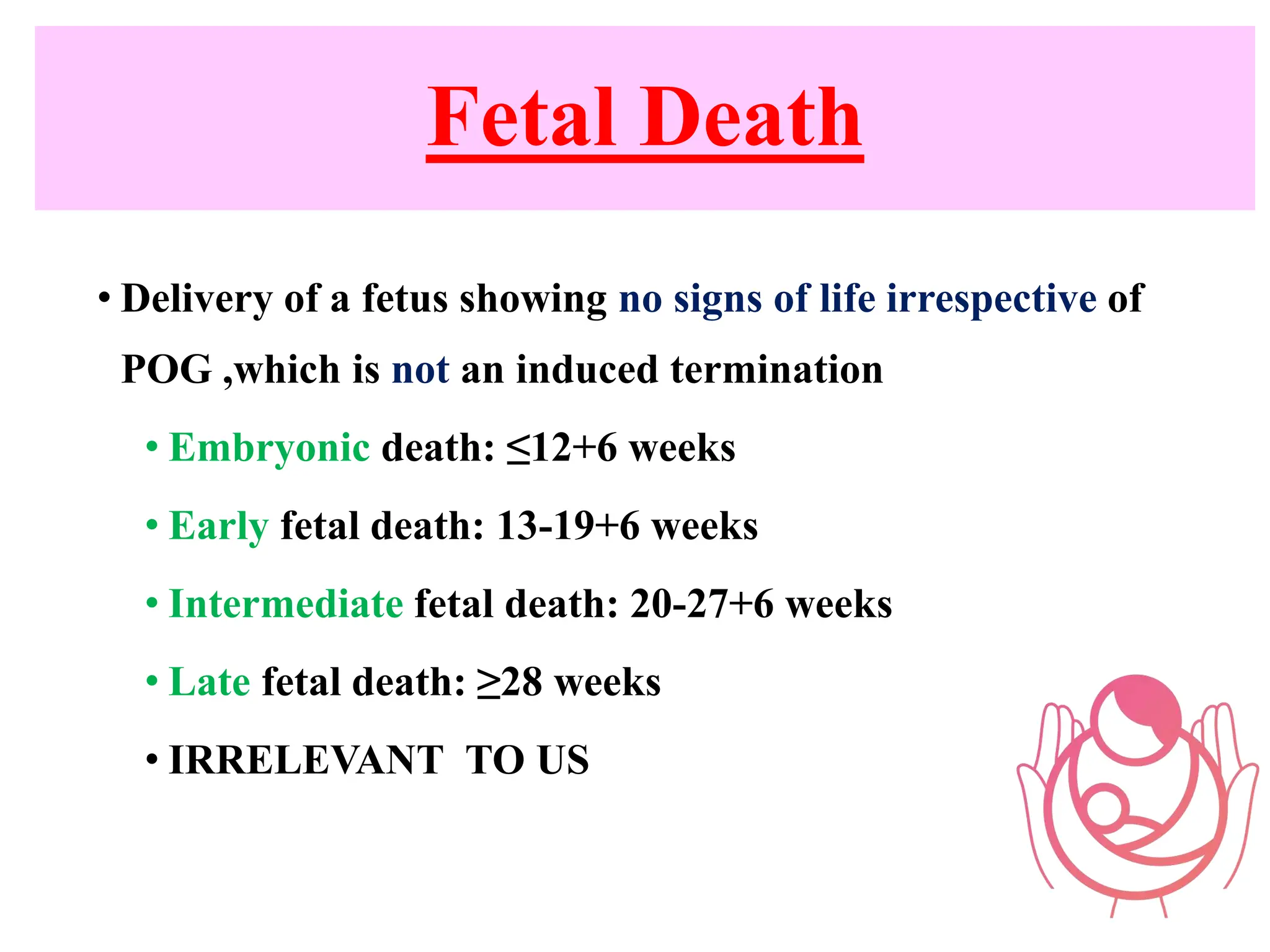
Fetal Death
• Delivery of a fetus showing no signs of life irrespective of
POG ,which is not an induced termination
• Embryonic death: ≤12+6 weeks
• Early fetal death: 13-19+6 weeks
• Intermediate fetal death: 20-27+6 weeks
• Late fetal death: ≥28 weeks
• IRRELEVANT TO US
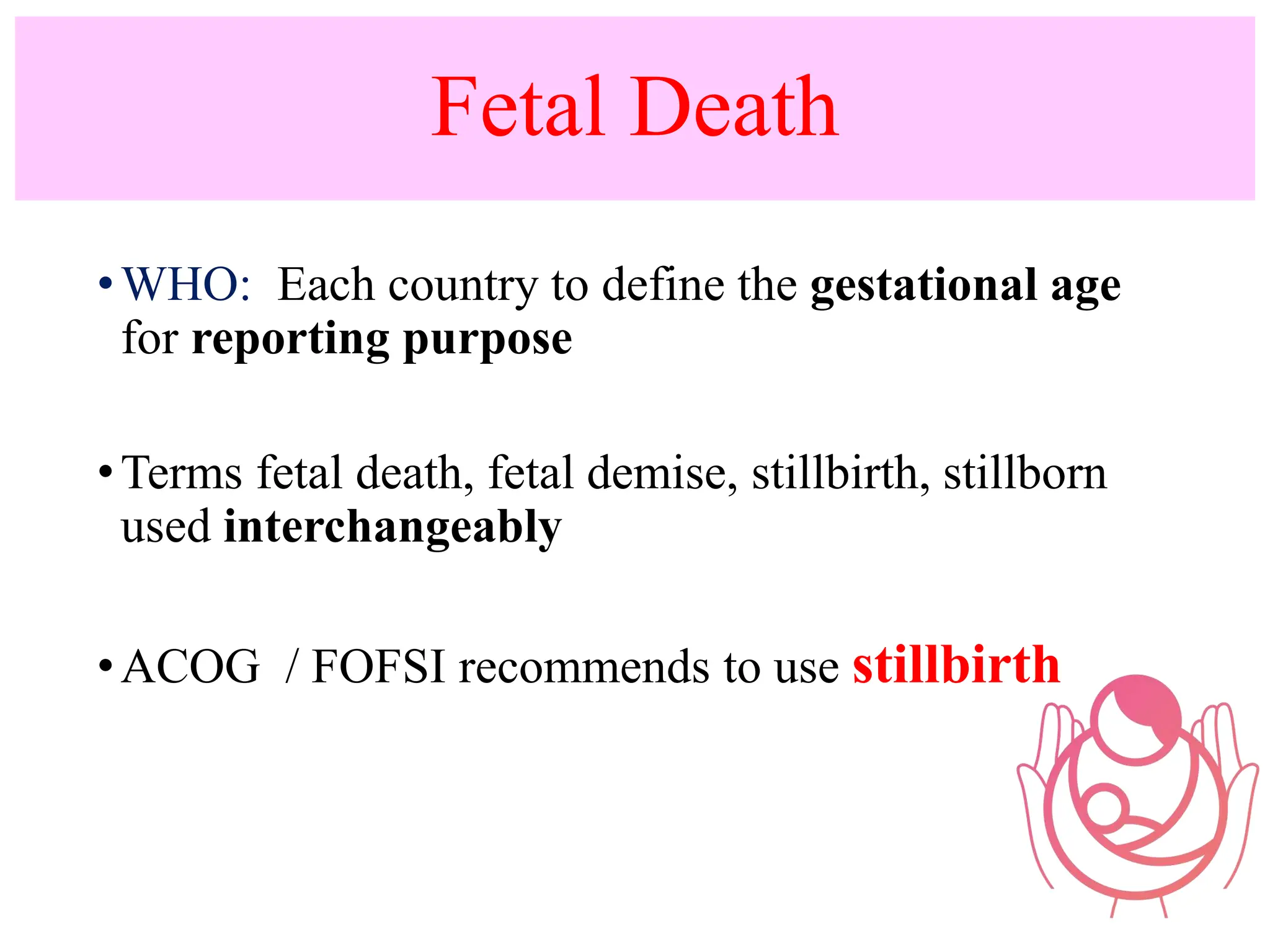
Fetal Death
•WHO: Each country to define the gestational age
for reporting purpose
•Terms fetal death, fetal demise, stillbirth, stillborn
used interchangeably
•ACOG / FOFSI recommends to use stillbirth
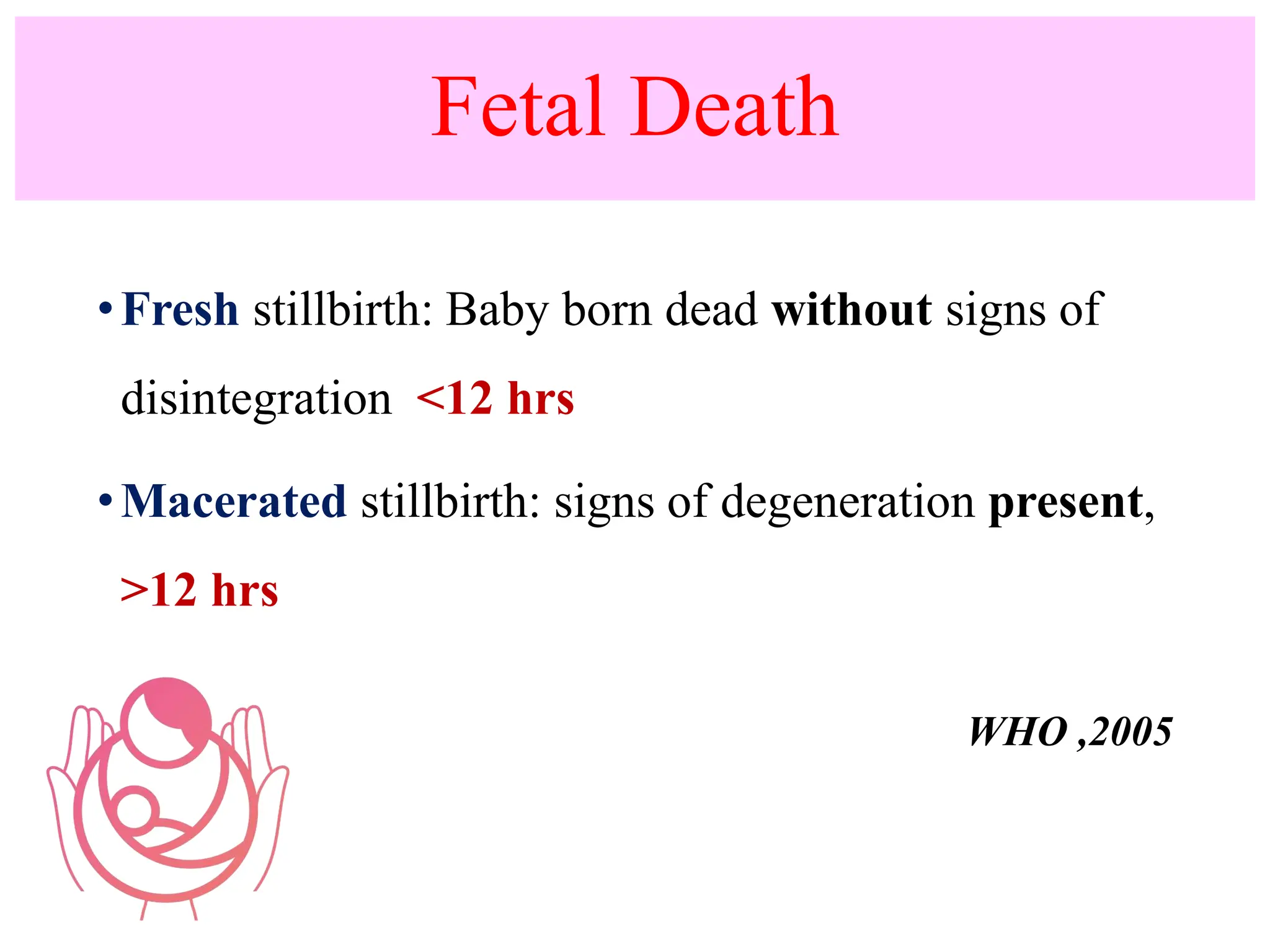
Fetal Death
•Fresh stillbirth: Baby born dead without signs of
disintegration <12 hrs
•Macerated stillbirth: signs of degeneration present,
>12 hrs
WHO ,2005
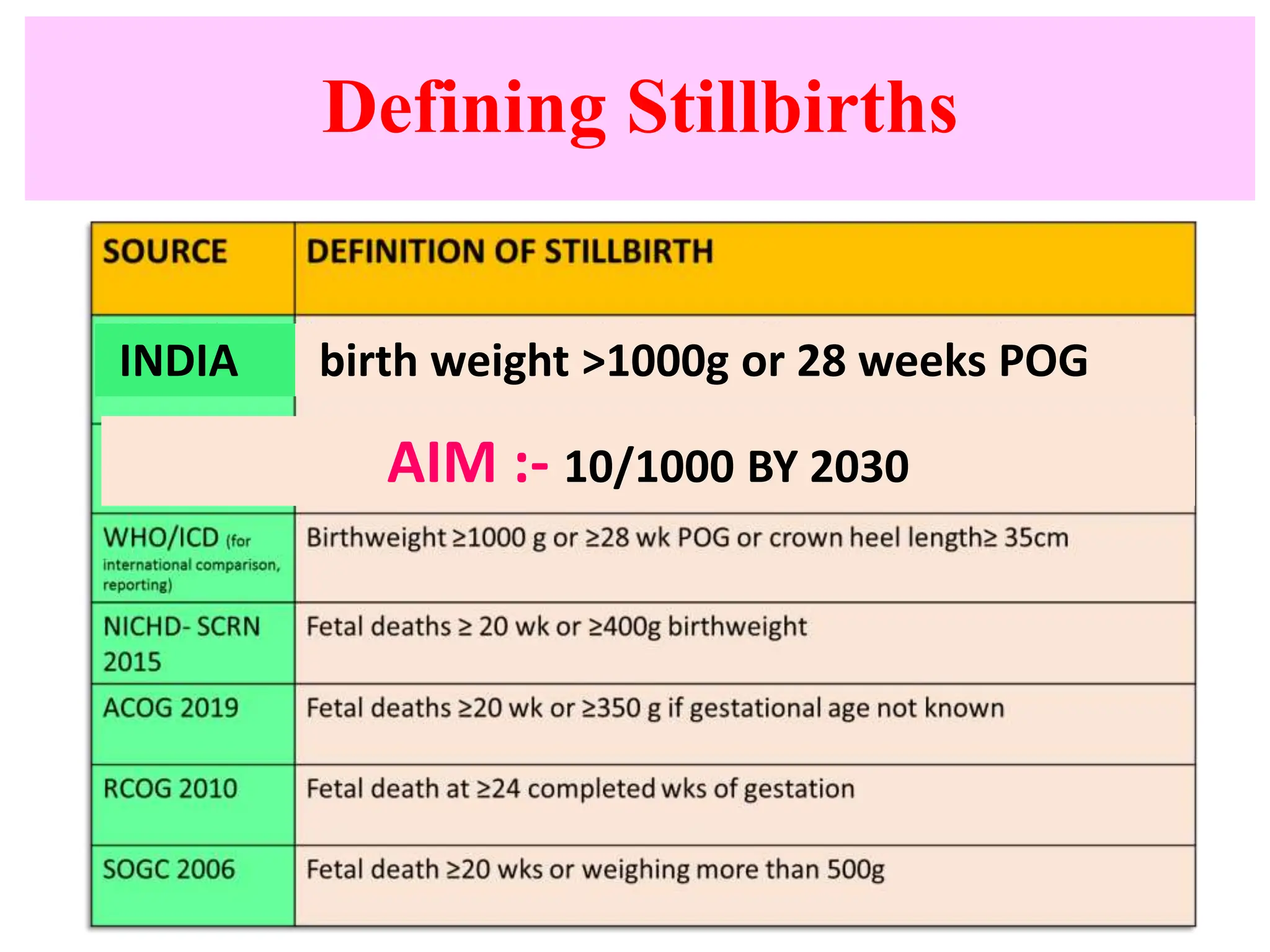
Defining Stillbirths
birth weight >1000g or 28 weeks POG
INDIA
AIM :- 10/1000 BY 2030
Defining Misscarriage /Stillbirths
Miscarriage
Defining StillbirthsDefining Stillbirths
Stillbirth
Epidemiology of Stillbirth
• 2021: 2 million stillbirths globally, 1 IN 16 SECS
• INDIA 3.4 /20 LAC= 17 %
• 50% intrapartum / 50 % NO cause found
• 3/4th occurred in south Asia & sub-Saharan Africa
*WHO 2021
• India stillbirth rate: 12/1000 births in21
*LANCET 2022
USA : 2.95 /1000
NO CHANGE IN LAST 2 DECADES
What is the issue?
•Devastating event for parents.
•For preventing stillbirths Understand why they
occur and identify preventable causes.
•Understanding
• Cope with grief
• Plan for future pregnancies
Etiology of Stillbirth
Multifactorial
Maternal Placental Fetal
Infections:
Maternal
& fetal
Unexplain
ed
CAUSES
MATERNA5-10 %
FETAL 25-40 %
PLACENTAL20-35 %
UNEXPLAINED15-25 %
Maternal causes
Fetal
causes:4X
Alloimmunisation- red
cell/platelet
Chromosomal/ genetic
abnormalities/
congenital
malformations
Complications of
multifetal gestation
Fetal Hydrops
FGR
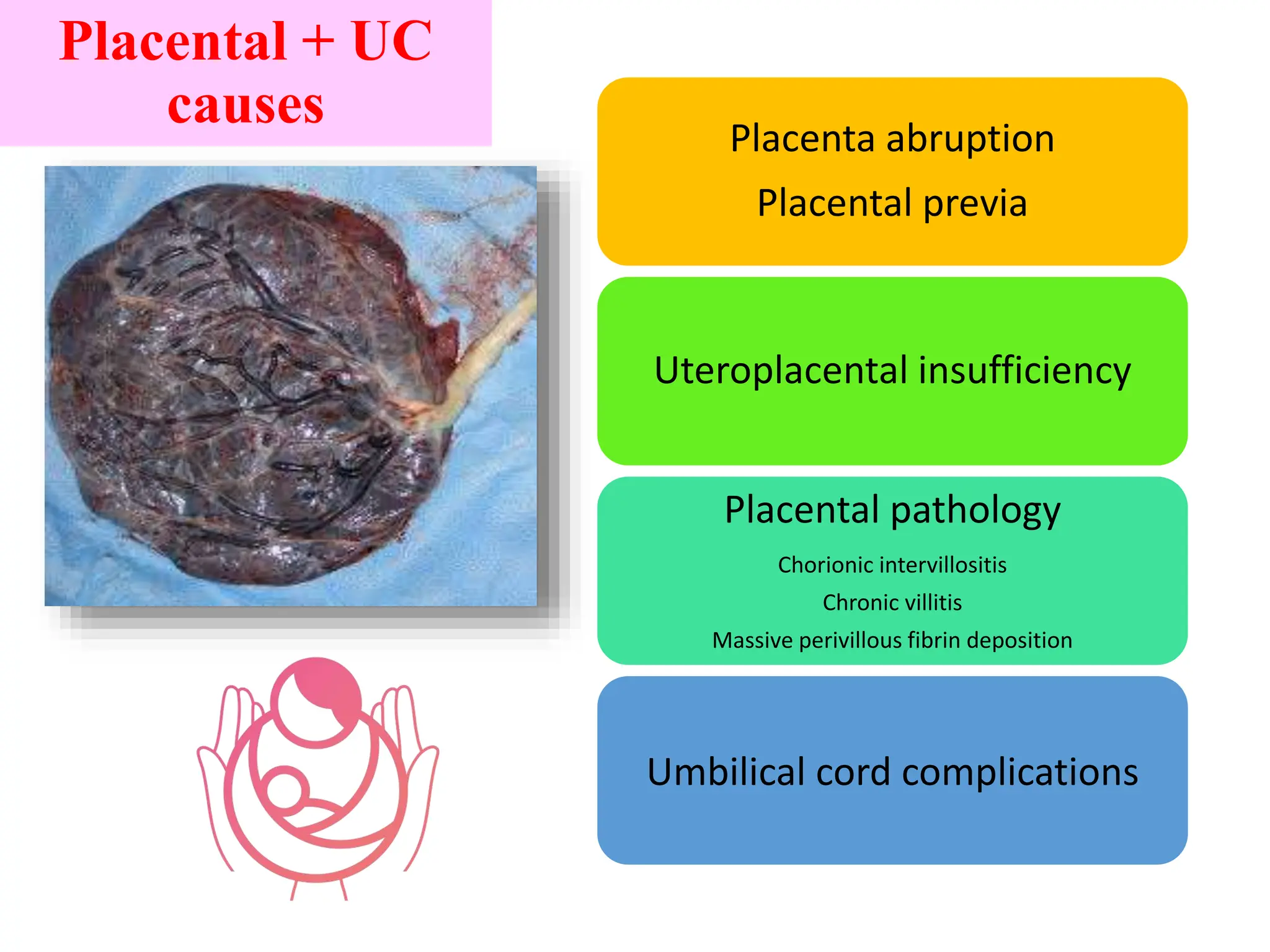
Placental + UC
causes Placenta abruption
Placental previa
Uteroplacental insufficiency
Placental pathology
Chorionic intervillositis
Chronic villitis
Massive perivillous fibrin deposition
Umbilical cord complications
Infections
Bacterial
• Listeria
• Treponema
• Group B
streptococci
• E coli
• Ureaplasma
• Mycoplasma
• H Influenza
• Chlamydia
• Klebsiella
Viral
• CMV
• Parvovirus B19
• Enterovirus
• HSV-1,2
• Echovirus
• Rubella
• HIV
• Coxsackie
Parasitic
• Toxoplasma
gondii
• Malaria
Infections
Transplacental
CMV
Syphillis
Parvovirus B19
Listeria
Rubella
Toxoplasma
HSV
Coxsackie
Leptospira
Q fever
Lyme disease
Malaria parasitemia
Ascending infections
 E. Coli
 Klebsiella
 Group B streptococci
 Enterococci
 Mycoplasma
 Ureaplasma
 Haemophilus
influenzae
 Chlamydia
Unexplained stillbirth
•50% of the stillbirths
•Not attributed to an identifiable fetal, maternal,
placental or obstetrical etiology
•Common at near term
*WHO 2020
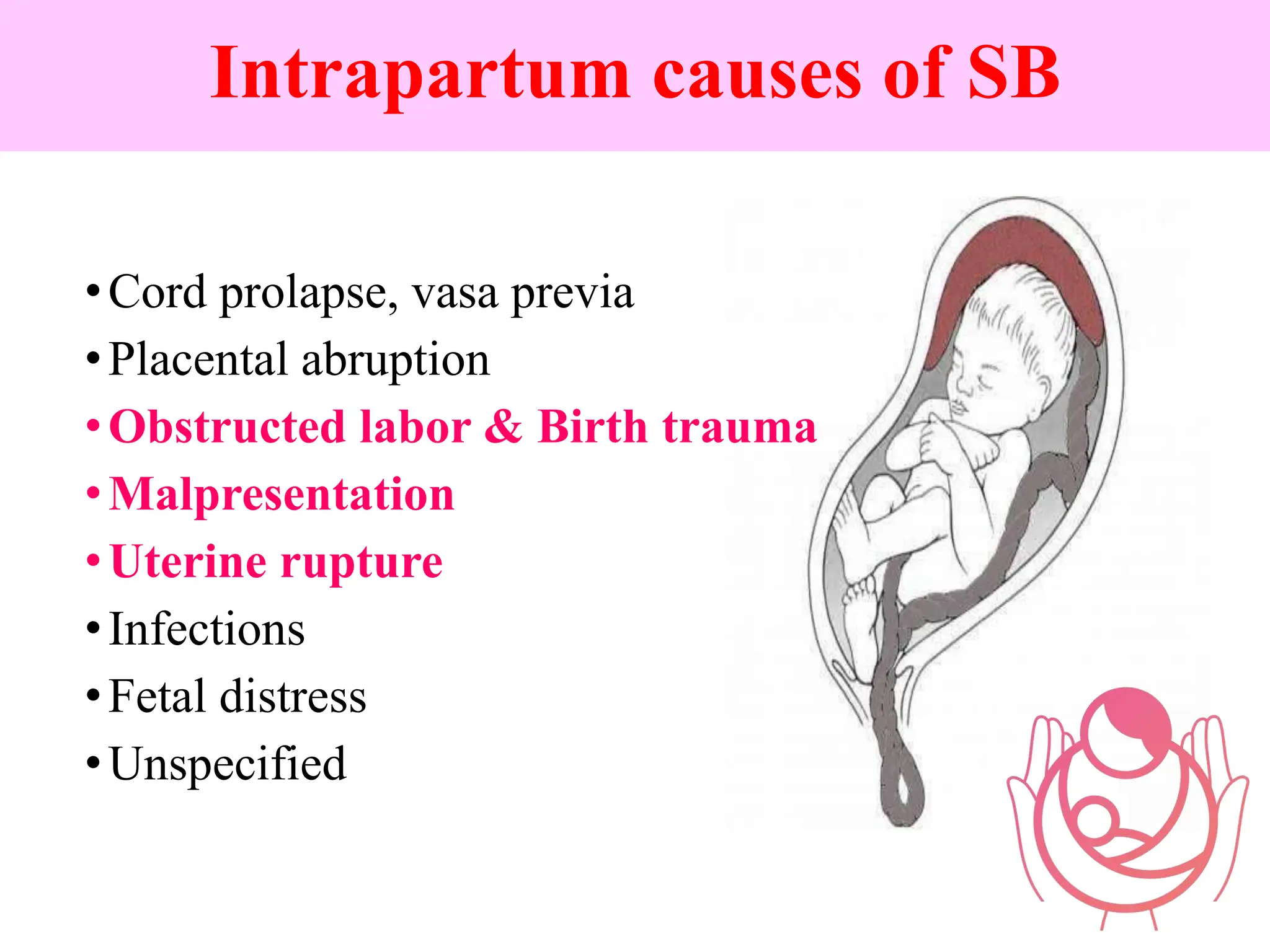
Intrapartum causes of SB
•Cord prolapse, vasa previa
•Placental abruption
•Obstructed labor & Birth trauma
•Malpresentation
•Uterine rupture
•Infections
•Fetal distress
•Unspecified
Classification: Etiologies
There are many many Classification systems used for
stillbirth
•WHO-ICD-PM, 2016
•CODAC (Causes Of Death and Associated
Condition), 2009
•ReCoDe ( Relevant Condition at Death), 2005
ReCoDe classification (Relevant Condition at Death)
Group Causes
A Fetus Lethal Congenital Anomaly, Infection(acute, chronic), Non
Immune Hydrops, Isoimmunization, Fetomaternal Hemorrhage,
complication of multifetal gestation , FGR
B Umbilical cord Prolapse, Constricting Loop Or Knot, Velamentous Insertion,
Others
C Placenta Abruption, Previa, Vasa Previa, Other Placental Insufficiency
D Amniotic fluid Chorioamnionitis, Oligohydramnios, Polyhydramnios
E Uterus Rupture, Uterine Anomalies
F Mother Diabetes, Thyroid Diseases, Hypertension, Hypertensive
Disorders In Pregnancy, Lupus Or Antiphospholipid Syndrome,
Cholestasis, Drug Misuse
G Intrapartum Asphyxia, Birth Trauma
H Trauma External, Iatrogenic
I Unclassified No relevant condition identified, no information available
*Gardosi et al, BMJ 2005
WHO – ICD-10
2016
PERINATAL CAUSES OF DEATH SEPARATED BY TIMING OF DEATH
2016
Maternal condition
•M1 :- Complications of placenta, cord and membranes
•M2 :- Maternal complications of pregnancy
•M3 :- Other complications of labour and delivery
•M4 :- Maternal medical and surgical conditions
•M5 :- No maternal condition
2016
CAUSES  in INDIA / DEV COUNTRIES
• OBSTETRIC CONDITION --30%
• PLACENTAL -- 23%
• FETAL ( GENETIC / STRUCTURAL ) --14 %
• INFECTIONS 13% - MORE PRETERM THAN TERM
• UMBLICAL CORD ABNORMALITIES -- 1O%
• HDP -10%
• MATERNAL MEDICAL CONDITIONS ie GDM--1O%
Approach to a case of stillbirth
•Establish the diagnosis
•Patient & relatives counselling & psychological
support
•Investigate the cause
•Delivery
•Management in subsequent pregnancy
Establish the Diagnosis
Accurate Diagnosis
Absent Fetal
Movements
ULTRASOUND,
Overlapping Skull
Bones & Skin Edema
Placental localization
& retroplacental clot
Establish the Diagnosis
Auscultation
CTG
Real time
USG
Mother may
percieve
passive fetal
movements
Offer repeat scan if
passive fetal
movements
Counselling  Emotional reactions
Disbelief
Anger
Shock
Guilt
Denial
Despair
Fear
Anxiety
Crying
Counselling: Breaking the news!
*RCOG 2010
Confirm
diagnosis
Private
space
Unhurried
manner
Counselling: Make them aware!
•No specific cause in ½ cases
•If cause found: Planning for future
•Further investigation if necessary
•Explain about fetal autospy
•Complications of fetal death
Investigating the cause
If obvious cause present- no further testing
(cord prolapse, anencephaly)
History
Maternal investigations
Evaluation of still born
Fetal investigations
Placental investigations
Investigating the cause
General Physical Examination
• General well being &mental state
• Vitals
• Systemic examination
• Per vaginum
Investigating the cause
Maternal Investigations
• Blood group, CBC,LFT,KFT, TFT ,RBS
• Coagulation test & DIC profile
• Urine: albumin/sugar/ketones
• USG: fetal presentation, lie, placenta position, RPC
Investigating the cause: Maternal investigations
RCOG GTG 2010
Test Purpose
CBC, LFT, KFT, CRP, DIC profile Maternal well being
Pre-eclampsia & complications
Sepsis
Bile salts ICP
Kleihauer betke test Feto-maternal haemorrhage
Decide dose of Anti-D
Repeat in case of Rh-D neg mother
Cultures Suspected infections
Prolonged IUFD
Viral screen
Syphillis
Tropical infections
Occult maternal-fetal infections
TORCH recommended
H/o Travel to endemic area
RBS, HbA1C Occult DM
TFT Occult maternal thyroid disease
Investigating the cause:
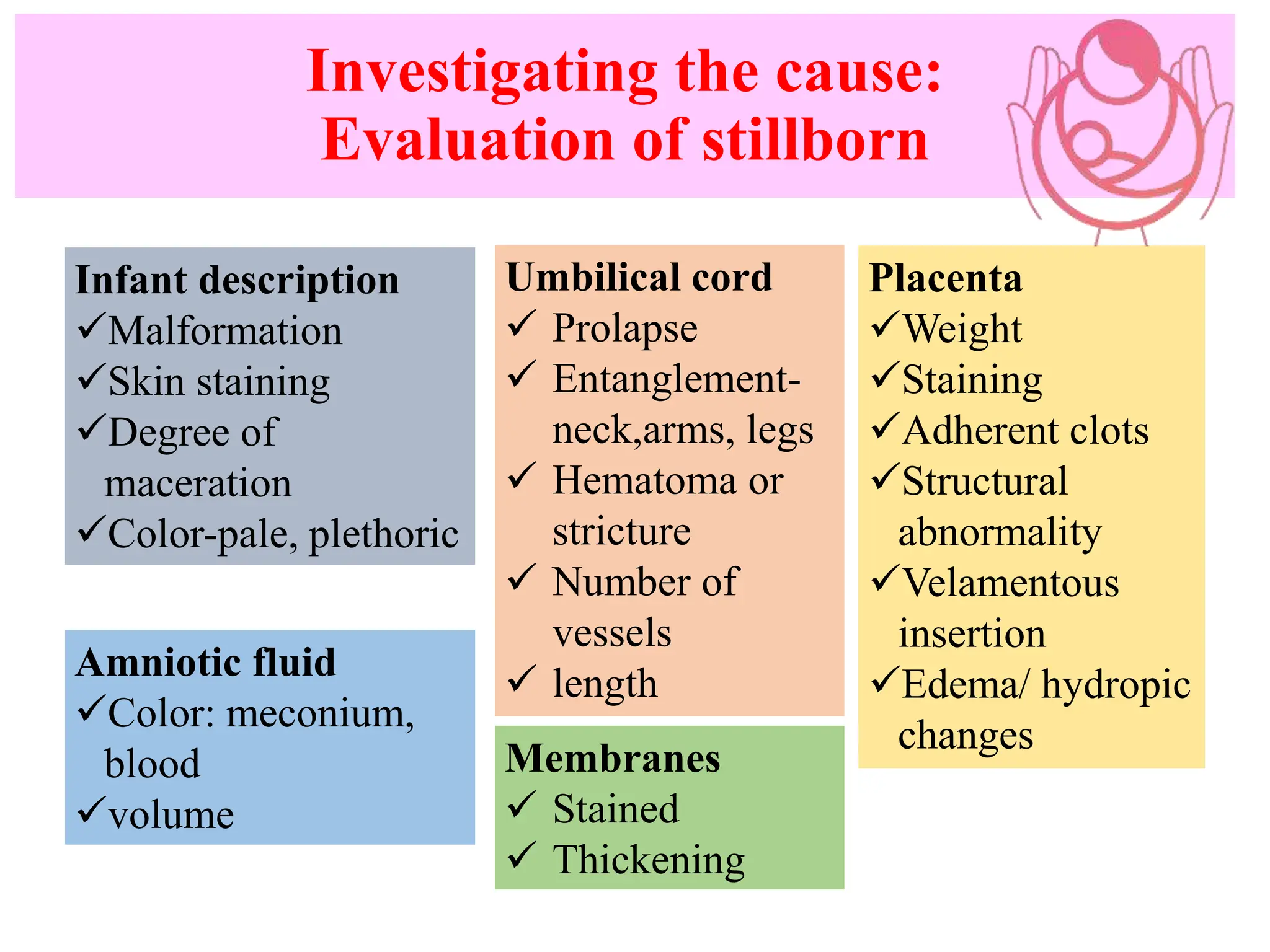
Evaluation of stillborn
Infant description
Malformation
Skin staining
Degree of
maceration
Color-pale, plethoric
Umbilical cord
 Prolapse
 Entanglement-
neck,arms, legs
 Hematoma or
stricture
 Number of
vessels
 length
Amniotic fluid
Color: meconium,
blood
volume
Membranes
 Stained
 Thickening
Placenta
Weight
Staining
Adherent clots
Structural
abnormality
Velamentous
insertion
Edema/ hydropic
changes
Test Purpose Remarks
Fetal & placental micobiology
Fetal blood
Fetal swabs
Placental swabs
Fetal infections More informative than
maternal serology for viral
infections
Fetal & placental tissue karyotyping
Deep fetal skin
Fetal cartilage
Placenta below cord insertion
Aneuploidy
Single gene
disorder
Consent
Postmortem examination
External
Autopsy
Microscopy
X-ray
Placenta & cord
Highest diagnostic
yield
Consent
RCOG 2010
Investigating the cause
Fetal and Placental investigations
Investigating the cause
• AUTOPSY :Gross & HPE of placenta ,Umblical cord
& FETAL MEMB by trained pathologist is most
important.
• If consent is not given for full autopsy of baby
A limited autopsy!
(external or internal examination limited to brain, spinal
cord, chest organ, tissue biopsy, USG, MRI, X-ray,
photographs, blood samples)
*ACOG practice Bulletin no 102, 2016
Investigating the cause
Indication for cytogenetic studies
•Congenital malformation
•FGR
•Non Immune Hydrops
•Ambiguous genitalia
•Dysmorphic features
•Parent carrier of balanced chromosomal
rearrangement
*ACOG Practice Bulletin no.102, 2016
Investigating the cause
At the time of diagnosis
Ultrasound scan
Maternal blood tests
Maternal toxicology
Maternal microbiology
After delivery
External examination
Infant blood tests
Infant microbiology
Placenta, membrane and cord
histopathology
Cytogenetic investigations
Postmortem examination
Postmortem Radiological
imaging
When to do?
Investigating the cause: Summary
Labour & Delivery
Timing &
Mode
Mother’s
preference
Previous intra-
partum history
Medical
condition
Delivery  Induce Or Wait?
Offer Both Options
• Spontaneous onset of labour will occur in 80% in 2 weeks
• Only 10% remain undelivered for > 3 weeks
• Delivery should not be delayed:
• Ruptured membranes
• Abruption
• Pre-eclampsia
• Sepsis
Delivery  Induce Or Wait?
If Mother Choose Expectant Management –
• Periodic follow up:
• Temperature
• Bleeding
• pain abdomen
• Labour
• emotional status
• CBC and coagulation profile twice in a week
10% Chance of maternal DIC within 4 weeks from
date of fetal death
( J Postgrad med ;1992)
Delivery: Induction
Unscarred Uterus Scarred uterus
Mifepristone – 1st line Mifepristone alone 200 mcg TDS x 48 hrs
Labor occurred in 63% vs 17 %(placebo)
Intravenous oxytocin vaginal misoprostol
Intravenous oxytocin vs vaginal misoprostol- Misoprostol more
effective
Dosage
• <26+6 wks: 100 mcg 6 hrly
• >27 weeks 25-50 mcg 4 hrly up to 24 hrs
• Caesarean delivery only for maternal indication
• Delivery plan: patient’s health, Obs history &
preferences
Delivery: Intrapartum management
Antibiotics
• Broad spectrum therapy if sepsis +
• Routine prophylaxis not recommended
Pain
• Pethidine
• Assess DIC & sepsis before considering regional
anesthesia
Support
• Heed emotional & practical needs
• Away from other women & babies
Post Delivery Care
•Patient & family allowed to see/hold the baby
•Grief counselling
•Lactation suppression
•Contraception
Subsequent pregnancy after
stillbirth
• Overall recurrence risk is increased to 2-10 folds
• Counselling ON prevention/ prediction
Unexplained 20-37 wk POG: 10 /1000 birth
Unexplained >37 wk POG: 2 /1000 birth
Preterm FGR live birth : 20/1000 birth
Probability: Subsequent pregnancy
Etiology with previous still birth Recurrence risk
Congenital anomalies Depends on Types of anomaly
Abruption 9-15%
Vasa previa/Umbillical cord abnormality Un determined
Turner syndrome Sporadic
Trisomy -21,18,13 Full mutation-1-2%
Autosomal recessive disorders 25%
X-linked disorders Increase in male offsprings
Infections Varies
Pre eclampsia 14%
IUGR 20%
Diabetes/chronic HTN EVERY CASE HAS POTENTIAL
Thrombophillia
APLA , Isoimmunisation
Management: Subsequent pregnancy
Preconception appointment/ Initial prenatal visit
• Review records
• Discuss possible etiologies and work up of previous SB
• Determine recurrence risk
• Detailed medical/obstetric history
• Optimise maternal medical conditions
• Change potentially modifiable factors
Smoking/illicit substance/alcohol cessation
Weight loss in obese
• Genetic counselling if family genetic condition
• Support & reassurance
Management: Subsequent pregnancy
Pregnancy –
•First Trimester
•Second Trimester
•Third Trimester
•Delivery
Management: Subsequent pregnancy
First trimester
• Dating USG- CRL
• IST TRIM SCREENING :PAPP-A & hCG, Nuchal
translucency
• Diabetes screen
• APLA/thrombophilia work up (only if indicative)
• TLC :Support & reassurance
Management: Subsequent Pregnancy
Second trimester
• Fetal anatomical survey at 18-20 weeks (level 2 USG)
• Quad screen – MSAFP, hCG, estriol, inhibin A IF
MISSED EARLY
• TLC :Support & reassurance
Management: Subsequent Pregnancy
Third trimester
• Rule out FGR
• Daily fetal kick Count starting 28 weeks
• Antepartum fetal surveillance - 32 weeks onwards
1-2 weeks earlier than GA of prev SB
• Support & reassurance
Management: Subsequent Pregnancy
Delivery
• No risk factor Elective induction at 39 weeks
• As per Medical indication
• Avoid scheduled delivery before 39 wks if previous still
birth is unexplained and previous delivery is uncomplicated
Management: Subsequent pregnancy
• Detection & management of
Hypertensive disorders & Diabetes
of pregnancy
• Syphilis detection and treatment
• Skilled birth attendant (SBA) at birth
• Availability of basic emergency
obstetric care
• Availability of comprehensive
emergency obstetric care
• Periconceptional folic acid
fortification
• Prevention of malaria
• FGR detection & management
• Post term pregnancy (≥41 wk)
identification & induction
To ↓ stillbirth
Summary of Preventing strategies
Take home message…
• STILLBRTH RATE 12/1000 incidence in india
• RISK FACTORS : < 15 ,>35 ,NULLIPARITY , BMI>30 ,SMOKING , MULTIPLE
GESTATION ,BOH ,PRETERM,FGR,STILLBIRTH
• CAUSES : OBSTETRIC-30 % ,PLACENTAL-24 %FETAL/GENETIC AB- 12, INFECTION-
10 %- &HDP- / DM --10 --20%
• NO CAUSE FOUND IN 50 %
• MOST IMPORTANT PART OF EVALUATION—MEDICAL / OBST HISTORY
GROSS/HPE OF PLACENTA /UMB CORD & FETAL MEMBRANES by trained person
• FEAL AUTOPSY BY TRAINED PATHOLOGIST
Take home message…
• FETO-MATERNAL HGE TESTING IN ALL
• CHROMOSOMAL MICROARRAY—FIRST LINE TESTING .COSTS—NO ISSUE
• APLA STUDY- DO IN ALL
• PARENTS SHOULD SEE & HOLD CHILD / PHOTO /HANDPRINTS+
PSYCHOLOGIC COUNCELLING
• SUBSQUENT PREGNANCY– SERIAL USD FOR FETAL GROWTH &
SURVEILLANCE
• ELECTIVE DELIVERY AT 39 WEEKS
Each Baby counts!!!
Each one of us can
make a difference!
Still Birth:An Update : Dr Sharda Jain

Still Birth:An Update : Dr Sharda Jain

  • 1.
    An Update Dr SHARDAJAIN Still Birth:
  • 2.
    CHALLENGES IN FIELD OF STILLBIRTH AREVAST BUT FRESH POSSIBILITIES UNFURL !!
  • 3.
  • 4.
    INDIA STILLBIRTH RATE2021 12.4 (3.7- 22.5 ) /1000 BIRTHS (MOHFP) OTAL 340600 /1.4 BILLION POPULATION 22 /1000-- 2009 AIM :- 10/1000 BY 2030
  • 5.
    Overview •Definition •Epidemiology •Etiology •Approach to management •Approachto management of subsequent pregnancy AIM :- 10/1000 BY 2030
  • 6.
    Fetal Death • Deliveryof a fetus showing no signs of life irrespective of POG ,which is not an induced termination • Embryonic death: ≤12+6 weeks • Early fetal death: 13-19+6 weeks • Intermediate fetal death: 20-27+6 weeks • Late fetal death: ≥28 weeks • IRRELEVANT TO US
  • 7.
    Fetal Death •WHO: Eachcountry to define the gestational age for reporting purpose •Terms fetal death, fetal demise, stillbirth, stillborn used interchangeably •ACOG / FOFSI recommends to use stillbirth
  • 8.
    Fetal Death •Fresh stillbirth:Baby born dead without signs of disintegration <12 hrs •Macerated stillbirth: signs of degeneration present, >12 hrs WHO ,2005
  • 9.
    Defining Stillbirths birth weight>1000g or 28 weeks POG INDIA AIM :- 10/1000 BY 2030
  • 10.
    Defining Misscarriage /Stillbirths Miscarriage DefiningStillbirthsDefining Stillbirths Stillbirth
  • 11.
    Epidemiology of Stillbirth •2021: 2 million stillbirths globally, 1 IN 16 SECS • INDIA 3.4 /20 LAC= 17 % • 50% intrapartum / 50 % NO cause found • 3/4th occurred in south Asia & sub-Saharan Africa *WHO 2021 • India stillbirth rate: 12/1000 births in21 *LANCET 2022
  • 12.
    USA : 2.95/1000 NO CHANGE IN LAST 2 DECADES
  • 13.
    What is theissue? •Devastating event for parents. •For preventing stillbirths Understand why they occur and identify preventable causes. •Understanding • Cope with grief • Plan for future pregnancies
  • 14.
    Etiology of Stillbirth Multifactorial MaternalPlacental Fetal Infections: Maternal & fetal Unexplain ed
  • 15.
    CAUSES MATERNA5-10 % FETAL 25-40% PLACENTAL20-35 % UNEXPLAINED15-25 %
  • 16.
  • 17.
  • 18.
    Placental + UC causesPlacenta abruption Placental previa Uteroplacental insufficiency Placental pathology Chorionic intervillositis Chronic villitis Massive perivillous fibrin deposition Umbilical cord complications
  • 19.
    Infections Bacterial • Listeria • Treponema •Group B streptococci • E coli • Ureaplasma • Mycoplasma • H Influenza • Chlamydia • Klebsiella Viral • CMV • Parvovirus B19 • Enterovirus • HSV-1,2 • Echovirus • Rubella • HIV • Coxsackie Parasitic • Toxoplasma gondii • Malaria
  • 20.
    Infections Transplacental CMV Syphillis Parvovirus B19 Listeria Rubella Toxoplasma HSV Coxsackie Leptospira Q fever Lymedisease Malaria parasitemia Ascending infections  E. Coli  Klebsiella  Group B streptococci  Enterococci  Mycoplasma  Ureaplasma  Haemophilus influenzae  Chlamydia
  • 21.
    Unexplained stillbirth •50% ofthe stillbirths •Not attributed to an identifiable fetal, maternal, placental or obstetrical etiology •Common at near term *WHO 2020
  • 22.
    Intrapartum causes ofSB •Cord prolapse, vasa previa •Placental abruption •Obstructed labor & Birth trauma •Malpresentation •Uterine rupture •Infections •Fetal distress •Unspecified
  • 23.
    Classification: Etiologies There aremany many Classification systems used for stillbirth •WHO-ICD-PM, 2016 •CODAC (Causes Of Death and Associated Condition), 2009 •ReCoDe ( Relevant Condition at Death), 2005
  • 24.
    ReCoDe classification (RelevantCondition at Death) Group Causes A Fetus Lethal Congenital Anomaly, Infection(acute, chronic), Non Immune Hydrops, Isoimmunization, Fetomaternal Hemorrhage, complication of multifetal gestation , FGR B Umbilical cord Prolapse, Constricting Loop Or Knot, Velamentous Insertion, Others C Placenta Abruption, Previa, Vasa Previa, Other Placental Insufficiency D Amniotic fluid Chorioamnionitis, Oligohydramnios, Polyhydramnios E Uterus Rupture, Uterine Anomalies F Mother Diabetes, Thyroid Diseases, Hypertension, Hypertensive Disorders In Pregnancy, Lupus Or Antiphospholipid Syndrome, Cholestasis, Drug Misuse G Intrapartum Asphyxia, Birth Trauma H Trauma External, Iatrogenic I Unclassified No relevant condition identified, no information available *Gardosi et al, BMJ 2005
  • 25.
  • 26.
    PERINATAL CAUSES OFDEATH SEPARATED BY TIMING OF DEATH 2016
  • 27.
    Maternal condition •M1 :-Complications of placenta, cord and membranes •M2 :- Maternal complications of pregnancy •M3 :- Other complications of labour and delivery •M4 :- Maternal medical and surgical conditions •M5 :- No maternal condition 2016
  • 28.
    CAUSES  inINDIA / DEV COUNTRIES • OBSTETRIC CONDITION --30% • PLACENTAL -- 23% • FETAL ( GENETIC / STRUCTURAL ) --14 % • INFECTIONS 13% - MORE PRETERM THAN TERM • UMBLICAL CORD ABNORMALITIES -- 1O% • HDP -10% • MATERNAL MEDICAL CONDITIONS ie GDM--1O%
  • 29.
    Approach to acase of stillbirth •Establish the diagnosis •Patient & relatives counselling & psychological support •Investigate the cause •Delivery •Management in subsequent pregnancy
  • 30.
    Establish the Diagnosis AccurateDiagnosis Absent Fetal Movements ULTRASOUND, Overlapping Skull Bones & Skin Edema Placental localization & retroplacental clot
  • 31.
    Establish the Diagnosis Auscultation CTG Realtime USG Mother may percieve passive fetal movements Offer repeat scan if passive fetal movements
  • 32.
    Counselling  Emotionalreactions Disbelief Anger Shock Guilt Denial Despair Fear Anxiety Crying
  • 33.
    Counselling: Breaking thenews! *RCOG 2010 Confirm diagnosis Private space Unhurried manner
  • 34.
    Counselling: Make themaware! •No specific cause in ½ cases •If cause found: Planning for future •Further investigation if necessary •Explain about fetal autospy •Complications of fetal death
  • 35.
    Investigating the cause Ifobvious cause present- no further testing (cord prolapse, anencephaly) History Maternal investigations Evaluation of still born Fetal investigations Placental investigations
  • 36.
    Investigating the cause GeneralPhysical Examination • General well being &mental state • Vitals • Systemic examination • Per vaginum
  • 37.
    Investigating the cause MaternalInvestigations • Blood group, CBC,LFT,KFT, TFT ,RBS • Coagulation test & DIC profile • Urine: albumin/sugar/ketones • USG: fetal presentation, lie, placenta position, RPC
  • 38.
    Investigating the cause:Maternal investigations RCOG GTG 2010 Test Purpose CBC, LFT, KFT, CRP, DIC profile Maternal well being Pre-eclampsia & complications Sepsis Bile salts ICP Kleihauer betke test Feto-maternal haemorrhage Decide dose of Anti-D Repeat in case of Rh-D neg mother Cultures Suspected infections Prolonged IUFD Viral screen Syphillis Tropical infections Occult maternal-fetal infections TORCH recommended H/o Travel to endemic area RBS, HbA1C Occult DM TFT Occult maternal thyroid disease
  • 39.
    Investigating the cause: Evaluationof stillborn Infant description Malformation Skin staining Degree of maceration Color-pale, plethoric Umbilical cord  Prolapse  Entanglement- neck,arms, legs  Hematoma or stricture  Number of vessels  length Amniotic fluid Color: meconium, blood volume Membranes  Stained  Thickening Placenta Weight Staining Adherent clots Structural abnormality Velamentous insertion Edema/ hydropic changes
  • 40.
    Test Purpose Remarks Fetal& placental micobiology Fetal blood Fetal swabs Placental swabs Fetal infections More informative than maternal serology for viral infections Fetal & placental tissue karyotyping Deep fetal skin Fetal cartilage Placenta below cord insertion Aneuploidy Single gene disorder Consent Postmortem examination External Autopsy Microscopy X-ray Placenta & cord Highest diagnostic yield Consent RCOG 2010 Investigating the cause Fetal and Placental investigations
  • 41.
    Investigating the cause •AUTOPSY :Gross & HPE of placenta ,Umblical cord & FETAL MEMB by trained pathologist is most important. • If consent is not given for full autopsy of baby A limited autopsy! (external or internal examination limited to brain, spinal cord, chest organ, tissue biopsy, USG, MRI, X-ray, photographs, blood samples) *ACOG practice Bulletin no 102, 2016
  • 42.
    Investigating the cause Indicationfor cytogenetic studies •Congenital malformation •FGR •Non Immune Hydrops •Ambiguous genitalia •Dysmorphic features •Parent carrier of balanced chromosomal rearrangement *ACOG Practice Bulletin no.102, 2016
  • 43.
    Investigating the cause Atthe time of diagnosis Ultrasound scan Maternal blood tests Maternal toxicology Maternal microbiology After delivery External examination Infant blood tests Infant microbiology Placenta, membrane and cord histopathology Cytogenetic investigations Postmortem examination Postmortem Radiological imaging When to do?
  • 44.
  • 45.
    Labour & Delivery Timing& Mode Mother’s preference Previous intra- partum history Medical condition
  • 46.
    Delivery  InduceOr Wait? Offer Both Options • Spontaneous onset of labour will occur in 80% in 2 weeks • Only 10% remain undelivered for > 3 weeks • Delivery should not be delayed: • Ruptured membranes • Abruption • Pre-eclampsia • Sepsis
  • 47.
    Delivery  InduceOr Wait? If Mother Choose Expectant Management – • Periodic follow up: • Temperature • Bleeding • pain abdomen • Labour • emotional status • CBC and coagulation profile twice in a week 10% Chance of maternal DIC within 4 weeks from date of fetal death ( J Postgrad med ;1992)
  • 48.
    Delivery: Induction Unscarred UterusScarred uterus Mifepristone – 1st line Mifepristone alone 200 mcg TDS x 48 hrs Labor occurred in 63% vs 17 %(placebo) Intravenous oxytocin vaginal misoprostol Intravenous oxytocin vs vaginal misoprostol- Misoprostol more effective Dosage • <26+6 wks: 100 mcg 6 hrly • >27 weeks 25-50 mcg 4 hrly up to 24 hrs • Caesarean delivery only for maternal indication • Delivery plan: patient’s health, Obs history & preferences
  • 49.
    Delivery: Intrapartum management Antibiotics •Broad spectrum therapy if sepsis + • Routine prophylaxis not recommended Pain • Pethidine • Assess DIC & sepsis before considering regional anesthesia Support • Heed emotional & practical needs • Away from other women & babies
  • 50.
    Post Delivery Care •Patient& family allowed to see/hold the baby •Grief counselling •Lactation suppression •Contraception
  • 51.
    Subsequent pregnancy after stillbirth •Overall recurrence risk is increased to 2-10 folds • Counselling ON prevention/ prediction Unexplained 20-37 wk POG: 10 /1000 birth Unexplained >37 wk POG: 2 /1000 birth Preterm FGR live birth : 20/1000 birth
  • 52.
    Probability: Subsequent pregnancy Etiologywith previous still birth Recurrence risk Congenital anomalies Depends on Types of anomaly Abruption 9-15% Vasa previa/Umbillical cord abnormality Un determined Turner syndrome Sporadic Trisomy -21,18,13 Full mutation-1-2% Autosomal recessive disorders 25% X-linked disorders Increase in male offsprings Infections Varies Pre eclampsia 14% IUGR 20% Diabetes/chronic HTN EVERY CASE HAS POTENTIAL Thrombophillia APLA , Isoimmunisation
  • 53.
    Management: Subsequent pregnancy Preconceptionappointment/ Initial prenatal visit • Review records • Discuss possible etiologies and work up of previous SB • Determine recurrence risk • Detailed medical/obstetric history • Optimise maternal medical conditions • Change potentially modifiable factors Smoking/illicit substance/alcohol cessation Weight loss in obese • Genetic counselling if family genetic condition • Support & reassurance
  • 54.
    Management: Subsequent pregnancy Pregnancy– •First Trimester •Second Trimester •Third Trimester •Delivery
  • 55.
    Management: Subsequent pregnancy Firsttrimester • Dating USG- CRL • IST TRIM SCREENING :PAPP-A & hCG, Nuchal translucency • Diabetes screen • APLA/thrombophilia work up (only if indicative) • TLC :Support & reassurance
  • 56.
    Management: Subsequent Pregnancy Secondtrimester • Fetal anatomical survey at 18-20 weeks (level 2 USG) • Quad screen – MSAFP, hCG, estriol, inhibin A IF MISSED EARLY • TLC :Support & reassurance
  • 57.
    Management: Subsequent Pregnancy Thirdtrimester • Rule out FGR • Daily fetal kick Count starting 28 weeks • Antepartum fetal surveillance - 32 weeks onwards 1-2 weeks earlier than GA of prev SB • Support & reassurance
  • 58.
    Management: Subsequent Pregnancy Delivery •No risk factor Elective induction at 39 weeks • As per Medical indication • Avoid scheduled delivery before 39 wks if previous still birth is unexplained and previous delivery is uncomplicated
  • 59.
    Management: Subsequent pregnancy •Detection & management of Hypertensive disorders & Diabetes of pregnancy • Syphilis detection and treatment • Skilled birth attendant (SBA) at birth • Availability of basic emergency obstetric care • Availability of comprehensive emergency obstetric care • Periconceptional folic acid fortification • Prevention of malaria • FGR detection & management • Post term pregnancy (≥41 wk) identification & induction To ↓ stillbirth Summary of Preventing strategies
  • 60.
    Take home message… •STILLBRTH RATE 12/1000 incidence in india • RISK FACTORS : < 15 ,>35 ,NULLIPARITY , BMI>30 ,SMOKING , MULTIPLE GESTATION ,BOH ,PRETERM,FGR,STILLBIRTH • CAUSES : OBSTETRIC-30 % ,PLACENTAL-24 %FETAL/GENETIC AB- 12, INFECTION- 10 %- &HDP- / DM --10 --20% • NO CAUSE FOUND IN 50 % • MOST IMPORTANT PART OF EVALUATION—MEDICAL / OBST HISTORY GROSS/HPE OF PLACENTA /UMB CORD & FETAL MEMBRANES by trained person • FEAL AUTOPSY BY TRAINED PATHOLOGIST
  • 61.
    Take home message… •FETO-MATERNAL HGE TESTING IN ALL • CHROMOSOMAL MICROARRAY—FIRST LINE TESTING .COSTS—NO ISSUE • APLA STUDY- DO IN ALL • PARENTS SHOULD SEE & HOLD CHILD / PHOTO /HANDPRINTS+ PSYCHOLOGIC COUNCELLING • SUBSQUENT PREGNANCY– SERIAL USD FOR FETAL GROWTH & SURVEILLANCE • ELECTIVE DELIVERY AT 39 WEEKS
  • 62.
    Each Baby counts!!! Eachone of us can make a difference!

Editor's Notes

  • #7 Criteria for SB do not imply point of viability, chosen to facilitate uniform data
  • #26 WHO launches new tools to help countries address stillbirths, maternal and neonatal deaths Counting and reviewing every birth and death is key to preventing future tragedies brings together the causes of perinatal death, separated by timing of the death, with the maternal conditions that contribute to perinatal death. This way the mother–baby dyad is recognised, and areas where programmatic interventions that could benefit both mother and baby become more clear
  • #27 WHO launches new tools to help countries address stillbirths, maternal and neonatal deaths Counting and reviewing every birth and death is key to preventing future tragedies brings together the causes of perinatal death, separated by timing of the death, with the maternal conditions that contribute to perinatal death. This way the mother–baby dyad is recognised, and areas where programmatic interventions that could benefit both mother and baby become more clear
  • #28 WHO launches new tools to help countries address stillbirths, maternal and neonatal deaths Counting and reviewing every birth and death is key to preventing future tragedies brings together the causes of perinatal death, separated by timing of the death, with the maternal conditions that contribute to perinatal death. This way the mother–baby dyad is recognised, and areas where programmatic interventions that could benefit both mother and baby become more clear
  • #31 Facilitates visualization of other secondary features- fetal hydrops, Detection of placental abruption & volume of hematoma