Barrier Nursing and
 Infection Control


        By
        Dr.(Mrs.)S.Valliammal
        College of Nursing
        NIMHANS
        Bangalore
                                1
Barrier Nursing &Infection Control
Introduction


 The nursing technique by which a patient
 with an infectious disease is prevented from
 infecting other people is called barrier
 nursing


                                                2
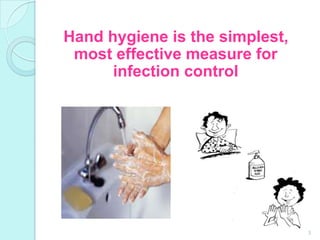
Hand hygiene is the simplest,
 most effective measure for
      infection control


                                3
Types of Precautions - Barrier
Nursing
1. Contact Precautions
2. Airborne Precautions
3. Droplet Precautions
4. Three more elements have been added to
   standard precautions. They are:
  4.1 Respiratory hygiene/cough etiquette
  4.2 Safe injection practices
  4.3Use of masks for insertion of
   catheters or injection into spinal or
   epidural areas
                                            4
1. Contact Precautions
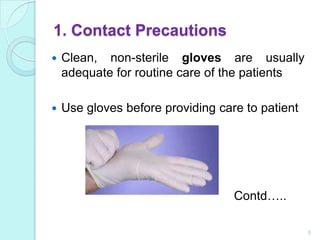
   Clean, non-sterile gloves are usually
    adequate for routine care of the patients

   Use gloves before providing care to patient


                                   Contd…..

                                                  5
   Change gloves after contact with infective
    material.

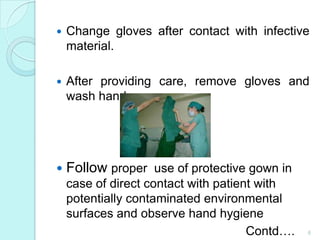
   After providing care, remove gloves and
    wash hands


   Follow proper use of protective gown in
    case of direct contact with patient with
    potentially contaminated environmental
    surfaces and observe hand hygiene
                                      Contd….   6
   Limit the movement or transport of the
    patient from the room.

   Make sure any infected or colonized areas
    are contained or covered.

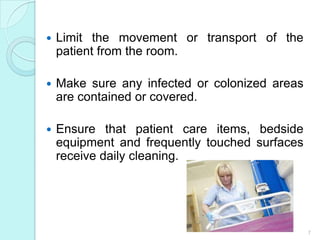
   Ensure that patient care items, bedside
    equipment and frequently touched surfaces
    receive daily cleaning.


                                                7
2. Airborne Precautions
   Used to prevent or reduce the transmission
    of micro-organisms that are airborne in small
    droplet nuclei (5 or smaller in size) or dust
    particles containing the infectious agent.


                                    Contd…..


                                                8
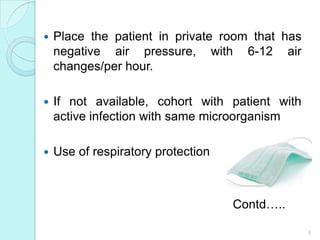
   Place the patient in private room that has
    negative air pressure, with 6-12 air
    changes/per hour.

   If not available, cohort with patient with
    active infection with same microorganism

   Use of respiratory protection


                                    Contd…..

                                                 9
   Limit movement and transport of the patient.

   Use a mask on the patient if they need to be
    moved

   Keep patient room door closed.


                                                   10
3. Droplet Precautions
   Used to reduce the risk of transmission of
    microorganisms transmitted by large
    particle droplets (larger than 5 in size).

   Droplets usually travel 3 feet or less within
    the air and thus special air handling is not
    required, however newer recommendations
    suggest a distance of 6 feet be used for
    safety.

                                     Contd….
                                                    11
   Place the patient in a private room

    Use of respiratory protection such as a
    mask       when   entering    the     room
    recommended and definitely if within 3 feet
    of patient

   Limit movement and transport of the patient


                                     Contd….
                                                  12
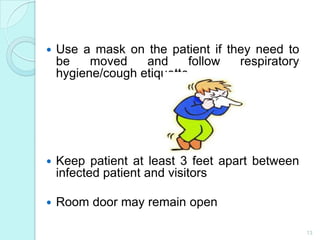
   Use a mask on the patient if they need to
    be    moved    and     follow  respiratory
    hygiene/cough etiquette


   Keep patient at least 3 feet apart between
    infected patient and visitors

   Room door may remain open

                                                 13
4.1 Respiratory Hygiene/Cough
    Etiquette

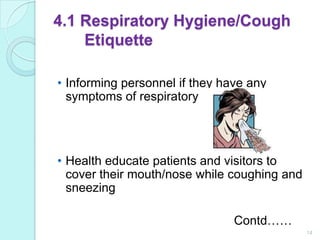
• Informing personnel if they have any
  symptoms of respiratory infection


• Health educate patients and visitors to
  cover their mouth/nose while coughing and
  sneezing

                                Contd……
                                              14
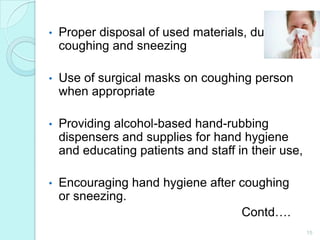
•   Proper disposal of used materials, during
    coughing and sneezing

•   Use of surgical masks on coughing person
    when appropriate

•   Providing alcohol-based hand-rubbing
    dispensers and supplies for hand hygiene
    and educating patients and staff in their use,

•   Encouraging hand hygiene after coughing
    or sneezing.
                                   Contd….
                                                     15
• Separating coughing persons at least 3 feet
  away from others in a waiting room or have
  separate locality.


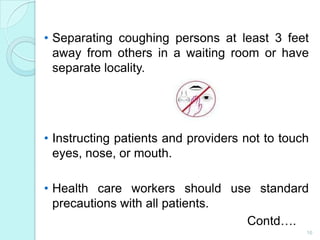
• Instructing patients and providers not to touch
  eyes, nose, or mouth.

• Health care workers should use standard
  precautions with all patients.
                                 Contd….
                                                16
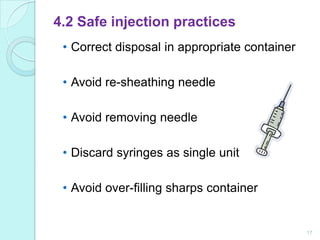
4.2 Safe injection practices
 • Correct disposal in appropriate container

 • Avoid re-sheathing needle

 • Avoid removing needle

 • Discard syringes as single unit

 • Avoid over-filling sharps container


                                               17
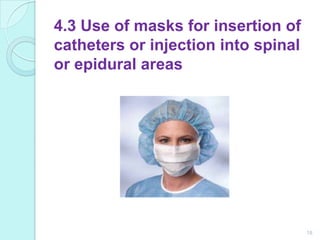
4.3 Use of masks for insertion of
catheters or injection into spinal
or epidural areas


                                     18
Barrier Techniques
           Infection Control
1.   Aseptic technique
2.   Isolation
3.   Safer Handling of Sharps
4.   Linen handling and disposal
5.   Waste disposal
6.   Handling Biological Spills
7.   Environmental cleaning
8.   Risk assessment
9.   Staff health
                                   19
Barrier Techniques
             Infection Control

1.    Aseptic technique
     ◦ Medical Asepsis – Clean technique;
       procedures used to reduce & prevent
       spread of microorganisms ** Hand
       washing**

     ◦ Surgical Asepsis – Sterile technique;
       procedures used to eliminate
       microorganisms **Sterilization**
                                      Contd….
                                                20
2. Isolation
 Source or protective


   Source - isolation of infected patient
    ◦ mainly to prevent airborne transmission via
      respiratory droplets
    ◦ Patients with SARS, pulmonary tuberculosis
      etc

   Protective - isolation of immune-suppressed
    patient
                                     Contd…
                                                  21
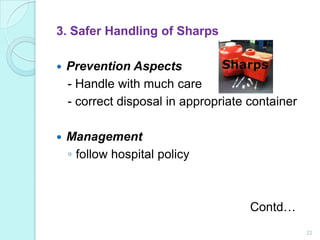
3. Safer Handling of Sharps

   Prevention Aspects
    - Handle with much care
    - correct disposal in appropriate container

   Management
    ◦ follow hospital policy


                                      Contd…
                                                  22
4. Linen handling and disposal

   Bed making and linen changing techniques

   Appropriate laundry bags


   Hazards of on-site ward-based laundering

                                   Contd…..

                                               23
5.Waste disposal

   Clinical waste - HIGH risk
    ◦ potentially/actually contaminated waste
      including body fluids and human tissue
    ◦ yellow plastic sack, tied prior to incineration

   Follow hospital policy

                                         Contd…...


                                                        24
6. Handling Biological Spills
 Cover area with hypochlorite solution for
  several minutes
 Clean area with warm water and detergent,
  then dry
 Treat waste as clinical waste - yellow plastic
  sack
 Follow hospital policy


                                   Contd…      25
7. Environmental cleaning
“Hospitals should do the sick no harm”
                              (Nightingale,
  1854)
 A study conducted by Moore etal ,2011- High
  touched sites in an hospital environment

 Bedside rails: 100%
 Blood pressure cuff: 88    ‘High-touch
  sites’
 Bedside Table: 63%
 Toilets: 63%
                                               26
8.Risk assessment
 No risk
  - routine care

   Low or moderate risk
     - wear gloves and plastic apron

   High risk (Contact/splashing)
    - wear gloves, plastic apron, gown, eye/face
     protection
                                   Contd….
                                                   27
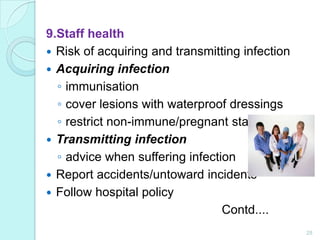
9.Staff health
 Risk of acquiring and transmitting infection
 Acquiring infection
  ◦ immunisation
  ◦ cover lesions with waterproof dressings
  ◦ restrict non-immune/pregnant staff
 Transmitting infection
  ◦ advice when suffering infection
 Report accidents/untoward incidents
 Follow hospital policy
                                 Contd....
                                                 28
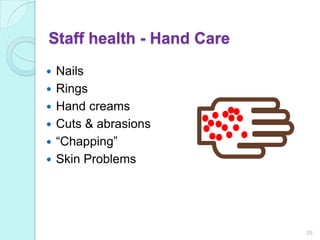
Staff health - Hand Care
   Nails
   Rings
   Hand creams
   Cuts & abrasions
   “Chapping”
   Skin Problems


                           29
Successful Promotion 
           Infection control
   Continuous Nursing Education programme

   Routine observation & feedback

   Engineering controls
    ◦ Location of hand basins
    ◦ Possible, easy & convenient
    ◦ Alcohol-based hand rubs

   Patient education
                                     Contd...   30
Successful Promotion 

   Reminders in the workplace

   Promote and facilitate skin care

   Avoid understaffing and excessive
    workload


                                        31
32
Core references
 Davies, H. and Rees, J. (2000) Psychological effects
  of isolation nursing (1): mood disturbance. Nursing
  Standard. 14, 28, 35-38.
 May, D. (2000) Infection control. Nursing Standard.
  14, 28. 51-57.
 ICNA (1998) Guidelines for hand hygiene. Belper:
  ICNA.
 NHS       Executive    (1995)    Hospital   laundry
  arrangements for used and infected linen - HSG (95)
  18. London: DoH.
 Nightingale, F. (1854) Notes on nursing. Edinburgh:
  Churchill Livingstone
                                                     33
Internet sites
   http://www.icna.co.uk/
   http://www.nursing-standard.co.uk/
   http://www.medscape.com/
   http://www.anes.uab.edu/medhist.htm
   http://www.shef.ac.uk/~nhcon/
   http://medweb.bham.ac.uk/nursing/
   http://www.healthcentre.org.uk/hc/library/defa
    ult.htm


                                                     34

Dr.s.valliammal. barrier nursing & infection control

  • 1.
    Barrier Nursing and Infection Control By Dr.(Mrs.)S.Valliammal College of Nursing NIMHANS Bangalore 1
  • 2.
    Barrier Nursing &InfectionControl Introduction The nursing technique by which a patient with an infectious disease is prevented from infecting other people is called barrier nursing 2
  • 3.
    Hand hygiene isthe simplest, most effective measure for infection control 3
  • 4.
    Types of Precautions- Barrier Nursing 1. Contact Precautions 2. Airborne Precautions 3. Droplet Precautions 4. Three more elements have been added to standard precautions. They are: 4.1 Respiratory hygiene/cough etiquette 4.2 Safe injection practices 4.3Use of masks for insertion of catheters or injection into spinal or epidural areas 4
  • 5.
    1. Contact Precautions  Clean, non-sterile gloves are usually adequate for routine care of the patients  Use gloves before providing care to patient Contd….. 5
  • 6.
    Change gloves after contact with infective material.  After providing care, remove gloves and wash hands  Follow proper use of protective gown in case of direct contact with patient with potentially contaminated environmental surfaces and observe hand hygiene Contd…. 6
  • 7.
    Limit the movement or transport of the patient from the room.  Make sure any infected or colonized areas are contained or covered.  Ensure that patient care items, bedside equipment and frequently touched surfaces receive daily cleaning. 7
  • 8.
    2. Airborne Precautions  Used to prevent or reduce the transmission of micro-organisms that are airborne in small droplet nuclei (5 or smaller in size) or dust particles containing the infectious agent. Contd….. 8
  • 9.
    Place the patient in private room that has negative air pressure, with 6-12 air changes/per hour.  If not available, cohort with patient with active infection with same microorganism  Use of respiratory protection Contd….. 9
  • 10.
    Limit movement and transport of the patient.  Use a mask on the patient if they need to be moved  Keep patient room door closed. 10
  • 11.
    3. Droplet Precautions  Used to reduce the risk of transmission of microorganisms transmitted by large particle droplets (larger than 5 in size).  Droplets usually travel 3 feet or less within the air and thus special air handling is not required, however newer recommendations suggest a distance of 6 feet be used for safety. Contd…. 11
  • 12.
    Place the patient in a private room  Use of respiratory protection such as a mask when entering the room recommended and definitely if within 3 feet of patient  Limit movement and transport of the patient Contd…. 12
  • 13.
    Use a mask on the patient if they need to be moved and follow respiratory hygiene/cough etiquette  Keep patient at least 3 feet apart between infected patient and visitors  Room door may remain open 13
  • 14.
    4.1 Respiratory Hygiene/Cough Etiquette • Informing personnel if they have any symptoms of respiratory infection • Health educate patients and visitors to cover their mouth/nose while coughing and sneezing Contd…… 14
  • 15.
    Proper disposal of used materials, during coughing and sneezing • Use of surgical masks on coughing person when appropriate • Providing alcohol-based hand-rubbing dispensers and supplies for hand hygiene and educating patients and staff in their use, • Encouraging hand hygiene after coughing or sneezing. Contd…. 15
  • 16.
    • Separating coughingpersons at least 3 feet away from others in a waiting room or have separate locality. • Instructing patients and providers not to touch eyes, nose, or mouth. • Health care workers should use standard precautions with all patients. Contd…. 16
  • 17.
    4.2 Safe injectionpractices • Correct disposal in appropriate container • Avoid re-sheathing needle • Avoid removing needle • Discard syringes as single unit • Avoid over-filling sharps container 17
  • 18.
    4.3 Use ofmasks for insertion of catheters or injection into spinal or epidural areas 18
  • 19.
    Barrier Techniques Infection Control 1. Aseptic technique 2. Isolation 3. Safer Handling of Sharps 4. Linen handling and disposal 5. Waste disposal 6. Handling Biological Spills 7. Environmental cleaning 8. Risk assessment 9. Staff health 19
  • 20.
    Barrier Techniques Infection Control 1. Aseptic technique ◦ Medical Asepsis – Clean technique; procedures used to reduce & prevent spread of microorganisms ** Hand washing** ◦ Surgical Asepsis – Sterile technique; procedures used to eliminate microorganisms **Sterilization** Contd…. 20
  • 21.
    2. Isolation  Sourceor protective  Source - isolation of infected patient ◦ mainly to prevent airborne transmission via respiratory droplets ◦ Patients with SARS, pulmonary tuberculosis etc  Protective - isolation of immune-suppressed patient Contd… 21
  • 22.
    3. Safer Handlingof Sharps  Prevention Aspects - Handle with much care - correct disposal in appropriate container  Management ◦ follow hospital policy Contd… 22
  • 23.
    4. Linen handlingand disposal  Bed making and linen changing techniques  Appropriate laundry bags  Hazards of on-site ward-based laundering Contd….. 23
  • 24.
    5.Waste disposal  Clinical waste - HIGH risk ◦ potentially/actually contaminated waste including body fluids and human tissue ◦ yellow plastic sack, tied prior to incineration  Follow hospital policy Contd…... 24
  • 25.
    6. Handling BiologicalSpills  Cover area with hypochlorite solution for several minutes  Clean area with warm water and detergent, then dry  Treat waste as clinical waste - yellow plastic sack  Follow hospital policy Contd… 25
  • 26.
    7. Environmental cleaning “Hospitalsshould do the sick no harm” (Nightingale, 1854) A study conducted by Moore etal ,2011- High touched sites in an hospital environment  Bedside rails: 100%  Blood pressure cuff: 88 ‘High-touch sites’  Bedside Table: 63%  Toilets: 63% 26
  • 27.
    8.Risk assessment  Norisk - routine care  Low or moderate risk - wear gloves and plastic apron  High risk (Contact/splashing) - wear gloves, plastic apron, gown, eye/face protection Contd…. 27
  • 28.
    9.Staff health  Riskof acquiring and transmitting infection  Acquiring infection ◦ immunisation ◦ cover lesions with waterproof dressings ◦ restrict non-immune/pregnant staff  Transmitting infection ◦ advice when suffering infection  Report accidents/untoward incidents  Follow hospital policy Contd.... 28
  • 29.
    Staff health -Hand Care  Nails  Rings  Hand creams  Cuts & abrasions  “Chapping”  Skin Problems 29
  • 30.
    Successful Promotion  Infection control  Continuous Nursing Education programme  Routine observation & feedback  Engineering controls ◦ Location of hand basins ◦ Possible, easy & convenient ◦ Alcohol-based hand rubs  Patient education Contd... 30
  • 31.
    Successful Promotion   Reminders in the workplace  Promote and facilitate skin care  Avoid understaffing and excessive workload 31
  • 32.
  • 33.
    Core references  Davies,H. and Rees, J. (2000) Psychological effects of isolation nursing (1): mood disturbance. Nursing Standard. 14, 28, 35-38.  May, D. (2000) Infection control. Nursing Standard. 14, 28. 51-57.  ICNA (1998) Guidelines for hand hygiene. Belper: ICNA.  NHS Executive (1995) Hospital laundry arrangements for used and infected linen - HSG (95) 18. London: DoH.  Nightingale, F. (1854) Notes on nursing. Edinburgh: Churchill Livingstone 33
  • 34.
    Internet sites  http://www.icna.co.uk/  http://www.nursing-standard.co.uk/  http://www.medscape.com/  http://www.anes.uab.edu/medhist.htm  http://www.shef.ac.uk/~nhcon/  http://medweb.bham.ac.uk/nursing/  http://www.healthcentre.org.uk/hc/library/defa ult.htm 34