Transmission based precautions?
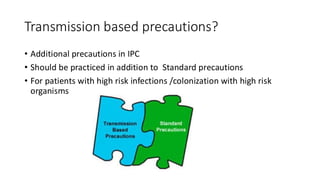
•Additional precautions in IPC
• Should be practiced in addition to Standard precautions
• For patients with high risk infections /colonization with high risk
organisms
4.
High risk infectionsand high-risk organisms
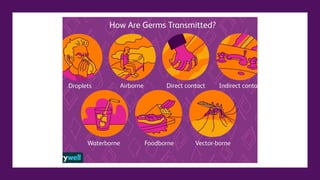
• Infections rapidly spread by droplets /
air born particles
Viral –
Influenza A/B, Parainfluenza, RSV, SARS-
COV-2, MERS Corona, SARS CoV-1,
chickenpox, measles
Bacterial – TB
Contact precautions
For infectionsspread by direct or indirect contact
• Diarrheal illnesses/ faecal incontinence
• Open wounds / draining wounds
• Excessive secretions from any site
• Acute respiratory illnesses
• Presence of infected skin condition
• Presence of infection with a significant pathogen with risk of contact
spread
• Presence of colonization with resistant organism – MRSA, CRE
Contact precautions
• Patientplacement - single patient room / cohort isolation
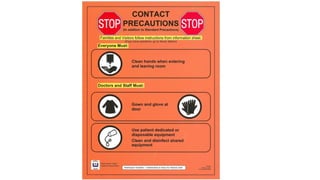
• HH before PPE – hand washing or alcohol hand rub
Hand washing facility and alcohol hand rub placed at the entrance and
inside the room/cubicle
• Use personal protective equipment (PPE) before entry
Should be kept on the anteroom, corridor
gloves and long sleeve disposable gown / reusable gown ( should be disinfected
separately)
properly discarding PPE before exiting the patient room
Bins should be inside the room
• HH after patient care – inside the room after removal of PPE and after coming
out of the isolation facility
10.
Contact precautions
• Limittransport and movement of patients outside of the room
If transport is needed cover the infected or colonized areas of the patient’s
body
Remove and dispose of contaminated PPE and patient to perform hand
hygiene prior to transporting. Don clean PPE to handle the patient at the
transport location.
• Use disposable or dedicated patient-care equipment (e.g.blood pressure
cuffs). If common use of equipment for multiple patients is unavoidable, clean
and disinfect such equipment before use on another patient.
• Cleaning and disinfection of the rooms of patients on contact precautions
ensuring rooms are frequently cleaned and disinfected (e.g., at least daily or
prior to use by another patient if outpatient setting) focusing on frequently-
touched surfaces and equipment in the immediate vicinity of the patient.
12.
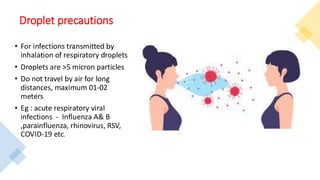
Droplet precautions
• Forinfections transmitted by
inhalation of respiratory droplets
• Droplets are >5 micron particles
• Do not travel by air for long
distances, maximum 01-02
meters
• Eg : acute respiratory viral
infections - Influenza A& B
,parainfluenza, rhinovirus, RSV,
COVID-19 etc.
13.
Droplet precautions
• Sourcecontrol: put a mask ( surgical or cloth mask) on the patient if no respiratory
compromise.
• Ensure appropriate patient placement in a single room/cohort isolation
Instruct patients to follow Respiratory Hygiene/Cough Etiquette recommendations
• Hand hygiene when entering and leaving the room
• Use personal protective equipment (PPE) appropriately. Don surgical mask +/-
Face shield upon entry into the patient room or patient space.
if contact/splash with body fluid anticipated – long sleeve gown,gloves,
goggles/face shield
• Limit transport and movement of patients outside of the room
If transport or movement is needed, instruct patient to wear a mask and follow
Respiratory Hygiene/Cough Etiquette
HCW accompanying can wear a mask
15.
Airborne precautions
• Forpatients known or suspected to be infected with pathogens
transmitted by the airborne route (e.g., tuberculosis, measles,
chickenpox, disseminated herpes zoster, ventilated COVID-19 or
influenza patient )
16.
Airborne precautions
• Sourcecontrol: put a mask on the patient if no respiratory compromise
• Ensure appropriate patient placement in an airborne infection isolation
room
Negative pressure room ideally
masking the patient and placing the patient in a private room with
the door closed
• Restrict susceptible healthcare personnel from entering the room of
patients known or suspected to have measles, chickenpox, disseminated
zoster, if other immune healthcare personnel are available.
• Use personal protective equipment (PPE) appropriately, including a fit-
tested N95 mask
17.
Airborne precautions –additional measures
• Limit transport and movement of patients outside of the room
If transport or movement is necessary, instruct patients to wear a surgical
mask, and instruct on Respiratory Hygiene/Cough Etiquette. Healthcare
personnel transporting can wear a N95 mask during transport
• Immunization – pre-exposure ( COVID-19, Chicken pox, Measles)
• Immunize susceptible persons as soon as possible following unprotected
contact with vaccine-preventable infections (e.g., varicella).
• Post exposure immunoglobulins for high risk groups – pregnant and
immunocompromised