SAFETY PROTOCOL
55 (SORT, SET IN ORDER,
SHINE,STANDARDIZE SUSTAIN)
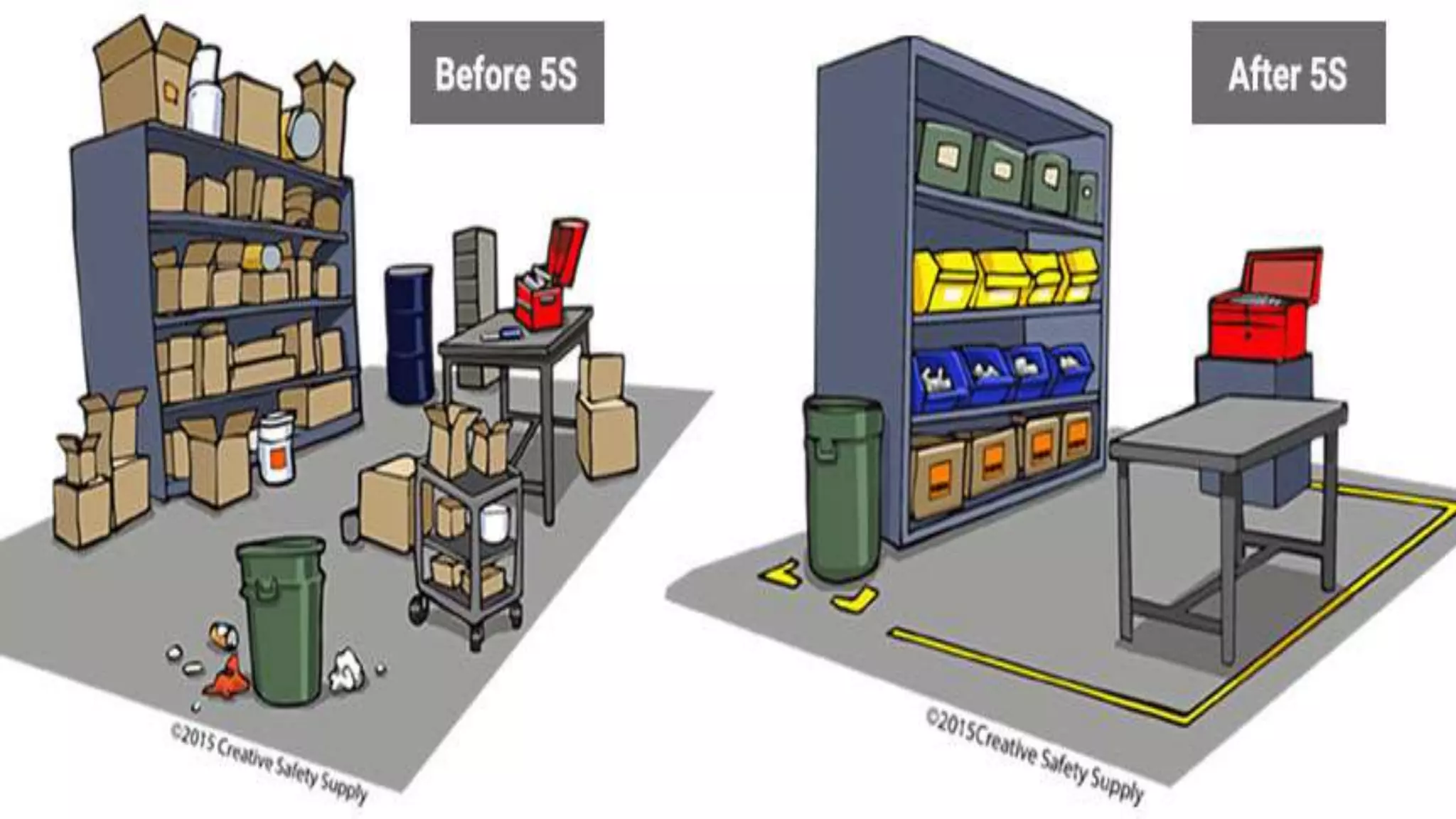
 The 5S principle is a structured and cost-effective method
that involves the application of the following sequential
steps in order to improve the health care facility’s
efficiency and also in order to maintain the effectiveness
of the various safety protocols by improving the physical
aspects which in turn enhance the better functional and
the psychological aspects of the healthcare infrastructure.
SORT (DECLUTTER)
 The healthcare facility must be well-organized that can
be achieved by eliminating the unnecessary materials like
the unused, waste or the unwanted things from the
working areas within the healthcare facility. Adopt the
“Reduce, Reuse & Recycle” concept too, along with the
sorting of the objects in various departments of the
healthcare facility.
SET IN ORDER (ORDERLINESS)
 A proper order must be maintained by correctly organizing
the requisite materials for ensuring quick access and easy
conduct of the activities in a hospital environment.
SHINE
 The hospital environment must be highly clean.
 Clean and inspect each area regularly.
STANDARDIZED (HOMOGENIZE)
 All the areas in a health care facility must be kept and
utilized as per the sort, set and shine protocols, i.e., all
the areas must be uniformly homogenized without any
neglect and for strict compliance, proper rules and
regulations must be issued by the hospital management.
Regular trainings can be done to ensure the
implementation of such rules.
SUSTAIN (DUPLICATE)
 The standard protocols involving the sort, set, shine and
standardization must be maintained in the Hospital which can
be done by ensuring that the staff members are being able to
work in an absolute disciplined environment.
SIGNIFICANCE OF 5’s
 Better organization in the hospital
 Reduction of the unnecessary materials.
 Better communication due to the visual ease.
 Improved efficiency
 Cost effectivity.
 Absence of any difficult terminology
 Improved procedure efficiency
RADIATION SAFETY
 Although the radiations are used for improving the health
of individuals and for saving lives in the healthcare
settings, worldwide, yet a consistent or a high level of
radiation exposure can lead to very hazardous outcomes
like cancer formation, in a long run, in the exposed
persons and much more
 Therefore, the radiation safety protocols have been
applied to the various direct and indirect applications,
involving the radiations, as a part of diagnosis or therapy
procedures, in a hospital or any clinical setting, for the
overall safety of patients and the healthcare workers.
RADIATION SAFETY PROTOCOL
APPLICATIONS IN A HEALTHCARE SETTING
RADIATION USAGE CRITERIA
 The occupational deep exposure dose limit for the whole body must be
less than or equal to 5000 mrem/50 mSV per year at a tissue depth of 1
cm.
 The Non-occupational deep exposure dose Limit for the whole body
should be less than or equal to 100 mrem/1mSV/year (2% of the
occupational dose limit) at a tissue depth of 0.1 cm.
 The Occupational Deep Exposure dose limit for the lens of the
eye must be less than or equal 15,000 mrem/150 mSV per
year at a tissue depth of 0.3cm.
 The Occupational Shallow Exposure Dose limit for the whole
body/skin/extremities should be less than or equals to 50,000
mrem/500mSV per year at a tissue depth of 0.007 cm with an
area of 10 cm².
 The Occupational Deep Exposure Dose Limit for the whole
Body in case of pregnant woman is less than or equal to 500
mrem/5 mSV during the whole gestation period and 50
mrem/0.5 mSV near the abdomen every month.
Radiation area guidelines
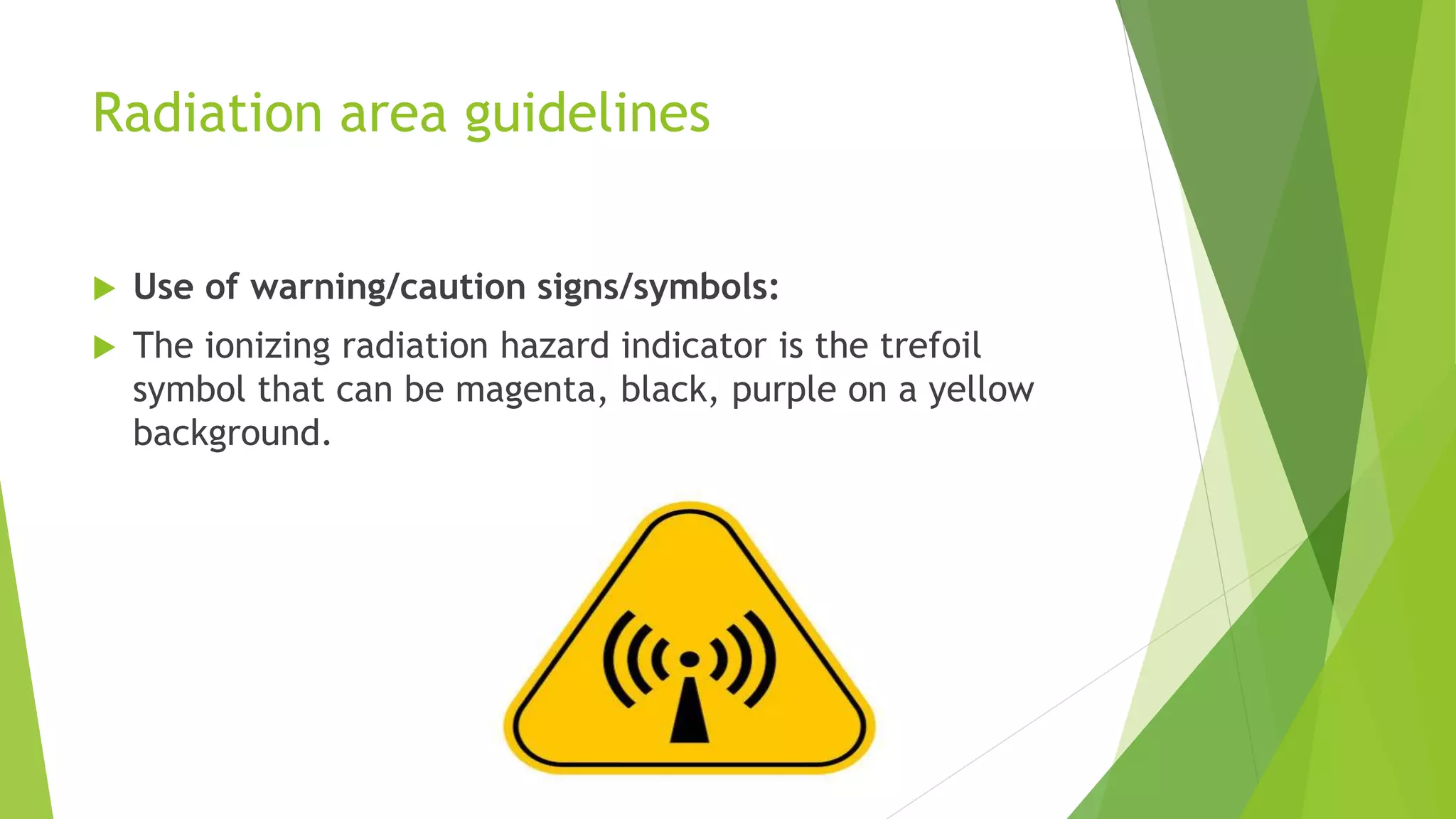
 Use of warning/caution signs/symbols:
 The ionizing radiation hazard indicator is the trefoil
symbol that can be magenta, black, purple on a yellow
background.
 The symbols are put in order to alert the personnel as well as people so
as the unauthorized may not enter in the radiation areas.
 The symbols must be put in a conspicuous place in the radiation area.
 Labelling requirement: The containers with any kind of radioactive
material must be labelled with words “Caution, radioactive material”
along with the radiation trefoil symbol on it.
 Radioactive package receipt guidelines: The damaged packets or the
packets showing exceeded limit of the radioactive material inside, must
be reported to the concerned authorities immediately.
MONITORING CRITERIA
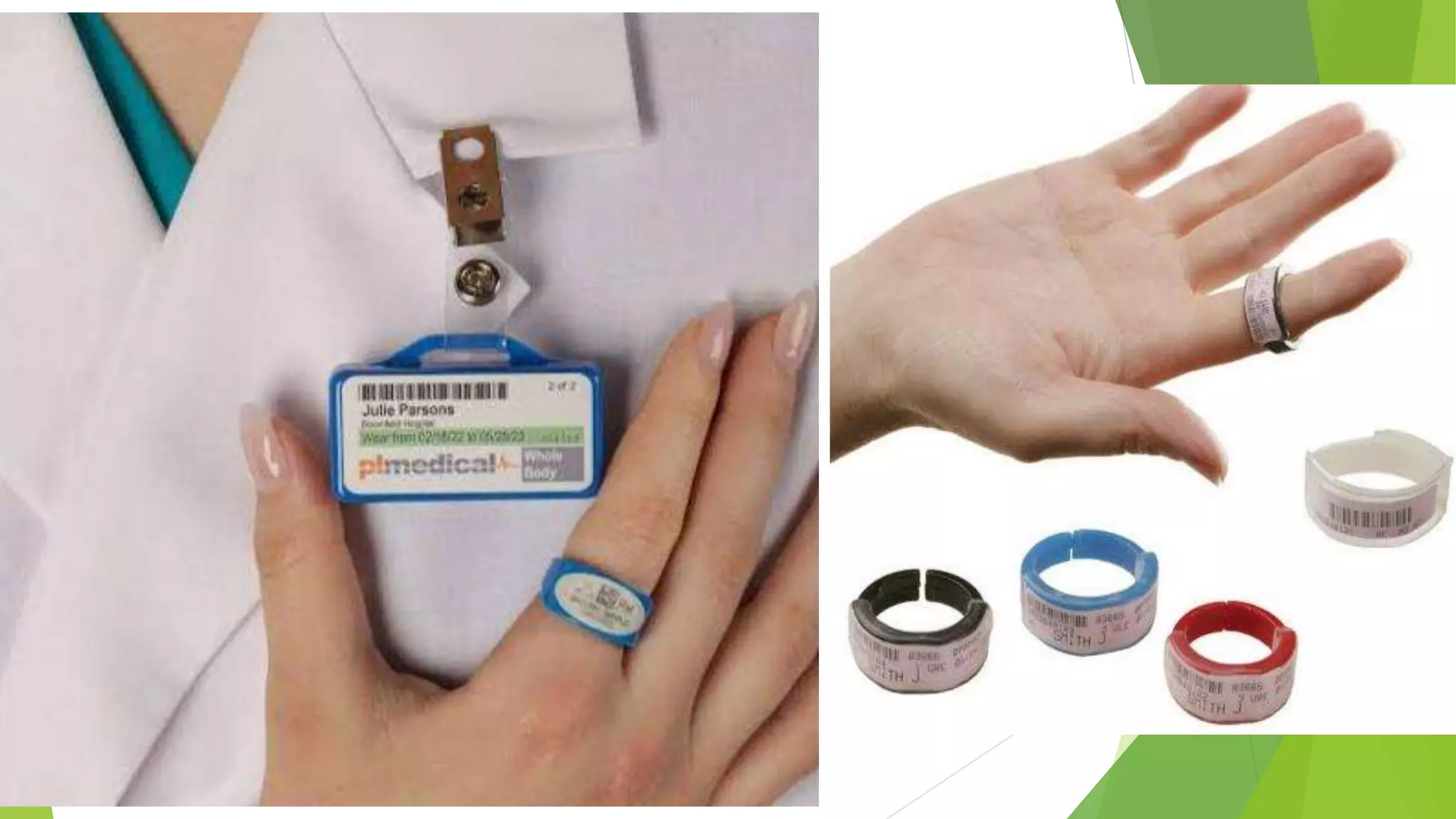
 Radiation monitoring badges/rings
 The radiation received by a healthcare worker during the
patient handling in a radiation prone environment can be
measured by using the radiation monitoring badges/rings
by the HCW.
 These badges/rings are known as the dosimeters.
 The dosimeters can measure the exact amount of the
radiation exposure.
 The badges or the radiation rings are given to only
those HCWs who are likely to get more than 10% of
the permissible occupational limits of the radiation
exposure during the working hours annually as well as
to the declared pregnant HCWs.
 The badges are to be tied to the collar.
 the finger rings are worn under the gloves.
 The badge provides the lifetime accumulated
radiation exposure legal record of the HCW.
LASER (LIGHT AMPLIFICATION BY STIMULATED
EMISSION OF RADIATIONS) SAFETY
Meaning of laser
The term LASER is an acronym that stands for “light amplification by
stimulated emission of radiations”.
It is a device that acts as a source for producing the laser light
(electromagnetic) which is the high intensity light that is completely
different from any other illuminating light in being highly amplified,
coherent and monochromatic in nature.
TYPES OF LASER
 The laser can be categorized into the following types based on
the type of the living medium used in the laser device:
 Solid-state lasers (e.g., neodymium- YAG (Yttrium aluminum
garnet) laser etc.)
 Gas lasers (e.g., CO2 gas lasers, Argon gas laser, Krypton gas
laser etc.)
 Chemical lasers (e.g., COIL (Chemical oxygen iodine laser) etc.)
 Excimer lasers (e.g., ArF (193nm), KrCl (222 nm), XeCl (308 nm)
and XeF (351 nm) etc).
 Dye lasers (e.g., Rhodamine 6G laser)
 Metal vapour lasers (e.g., copper vapour laser).
 Semi-conductor lasers/diode lasers (e.g., gallium arsenide
diode laser (840 nm) commonly used in the medical
practices).
 FELs i.e., free electron lasers (commonly used in the
medical practices
Five important laser safety measures
are:
1. Wear laser safety glasses: As lasers can cause
significant damage to the eyes, wearing laser
safety glasses is a must.
2. Ensure proper storage
3. Follow standards and regulation
4. Work with trained personnel
5. Use warning signs boards.
FIRE SAFETY
 The hospital fires must be prevented with all due
safety measures in order to provide complete care to
the patients as well as to ensure the protection of the
hospital staff and others.
 Keep exits and passageways clear at all times for easy
evacuation in case of fire accidents.
MAIN CAUSES OF HOSPITAL FIRE
 Cooking equipment (majority)
 Contained waste
 Electrical cause
 Heating, law shows and dryers
 Smoking substances
TYPES AND CLASSIFICATION OF FIRE
 Class A Fire (Solid Type): In this class, The source of fire is the
solid substances like wood, paper or fabric material etc.
 Class B Fire (Liquid Type): in this class, the source of fire is the
liquid substances that are flammable like petrol, diesel etc.
 Class C Fire (Gas/electrical type): In this class, The source of fire
is either some gaseous substances or any live electrical appliance.
 Class D Fire (Metal Type): In this class, The source of fire is the
metallic substances.
 Class K Fire (Cooking Oil Type): In this class, the source of fire is
the substances like cooking oils used in the fryers etc.
FIRE ALARMS
 The fire alarms are generally the sound/visual signals,
produced by specific devices, in a building, which is
equipped with such alarms along with the other
associated equipment like heat/smoke detectors and fire
sprinklers etc., in order to indicate the occurrence of any
fire incidences, at anytime to the public as a last to the
concerned authorities, for immediate implementation of
the safety measures.
 A fire alarm system warns people when smoke, fire,
carbon monoxide or other fire-related emergencies are
detected.
FIRE FIGHTING EQUIPMENT
 Fire extinguishers
 Sprinklers (automatic)
 Fire hoes reels
 Hydrant systems
 Smoke/heat detectors
 Fire alarm
 Exit/Emergency signs
FIRE EXTINGUISHERS
 Features of a fire extinguisher: it is the device used to extinguish the
fire by spring the required fluid as per the class/type of fire to be
controlled.
 Choosing a fire extinguisher
 On each floor of a hospital, the different types of fire extinguishers are
fitted. Depending on the type of Fire, the extinguisher is chosen
carefully.
 The water extinguisher must not be used for extinguishing the Class C
fire (Electrical type) but can be used if the means are switch off.
 With the electric current on, CO2 fire extinguishers can be used to
extinguish the electrical fire.
Using a fire extinguisher
 Use “PASS” while using a fire extinguisher which stands for,
 P-Pull
 A-Aim
 S- Squeeze
 S-Sweep
 Stop, drop and role if one close catch on the Fire.
HAZMAT (HAZARDOUS MATERIALS) SAFETY
 The hazardous materials are also known as the dangerous
goods which can be a solid, (powder form usually), liquid or
gas.
 In common terminology, hazardous material is known as
HAZMAT/HAZCHEM and can be very dangerous if spilled
accidentally and thus requires a trained staff for any such
emergency spills and their clean ups.
A hazardous chemical (HAZCHEM) possesses
any of the following characteristics
 Is carcinogenic and highly toxic in nature.
 Is combustible liquid/gas.
 Is capable of releasing fumes, smoke, dust
etc.
TYPES OF HAZMAT SPILLS
 Common Hospital spills
 Biological spill: it includes the body fluids and blood spills that
can be in the form of just a spot, a small spill or even a larger
spill in terms of quantity of the spill.
 Mercury spill: it is the spell of mercury liquid that need special
care.
 Radioactive spill: it is the spell of any radioactive material
which can be in the form of a Solid, liquid or gas.
 Chemical spell: the chemical scale includes the chemical
substances that are hazardous in nature if get spilled.
SPILLAGE MANAGEMENT
 Human error, broken or faulty equipment's often
lead to the spillage of the blood, body fluids or
chemicals in a hospital which can be very
hazardous for the patients, Hospital staff and the
visitors. It therefore makes It very that the spills
must be immediately cleaned by the trained
personnel in an appropriate manner.
 Reagent spills should be washed with copious amounts of
water
 Spillages of non-hazardous materials, such as water or saline,
onto the floor can make the floor slippery and thus a
potential danger of causing injury due to falling. Clean up
such spills immediately
 If an inflammable spill is large, contact Maintenance
Department. Arrange to isolate the electrical supply. Do not
use switches in the immediate area as a spark from the
switch may ignite a spill. Provide adequate ventilation and
open the doors/ windows wherever possible. Do not cross the
spill or move further into the room
 In case of urine spill, do not use a chlorine releasing
agent directly on a urine spill, as it promotes the
release of free chlorine from the treated area
• Place a mop cloth/gauze pad over the spill area, to
allow urine and debris to get absorbed
• Clean the surface thoroughly using detergent and
water and dry thoroughly
• Decontaminate the area with a solution of 1,000
ppm available chlorine solution.
MSDS (MATERIAL SAFETY DATA SHEETS)
 MSDS i.e., the Material Safety Data Sheets are the documents
that serve as a single reference for getting every kind of
information about a HAZMAT.
 The MSDS are formulated by the manufacturers/suppliers.
 Physical & chemical characteristics of the hazardous
material/chemical (HAZMAT/HAZCHEM).
 The potential hazards of the chemical.
 Safe working procedures with such chemicals
 Storage, handling and emergency actions required
for such a chemical.
 The MSDS provision is intended mainly for those
personnel who tend to work with the HAZCHEMS in
their professional areas.
 Every three years, the MSDS for every particular
HAZCHEM must be updated.
 Any new additional information can be included in
the MSDS even before the completion of three
years.
 The MSDS content format regulations for the
chemicals usually vary slightly country wise all over
the world.
Safety protocol .pptx

Safety protocol .pptx

  • 1.
  • 2.
    55 (SORT, SETIN ORDER, SHINE,STANDARDIZE SUSTAIN)  The 5S principle is a structured and cost-effective method that involves the application of the following sequential steps in order to improve the health care facility’s efficiency and also in order to maintain the effectiveness of the various safety protocols by improving the physical aspects which in turn enhance the better functional and the psychological aspects of the healthcare infrastructure.
  • 3.
    SORT (DECLUTTER)  Thehealthcare facility must be well-organized that can be achieved by eliminating the unnecessary materials like the unused, waste or the unwanted things from the working areas within the healthcare facility. Adopt the “Reduce, Reuse & Recycle” concept too, along with the sorting of the objects in various departments of the healthcare facility.
  • 4.
    SET IN ORDER(ORDERLINESS)  A proper order must be maintained by correctly organizing the requisite materials for ensuring quick access and easy conduct of the activities in a hospital environment. SHINE  The hospital environment must be highly clean.  Clean and inspect each area regularly.
  • 5.
    STANDARDIZED (HOMOGENIZE)  Allthe areas in a health care facility must be kept and utilized as per the sort, set and shine protocols, i.e., all the areas must be uniformly homogenized without any neglect and for strict compliance, proper rules and regulations must be issued by the hospital management. Regular trainings can be done to ensure the implementation of such rules.
  • 6.
    SUSTAIN (DUPLICATE)  Thestandard protocols involving the sort, set, shine and standardization must be maintained in the Hospital which can be done by ensuring that the staff members are being able to work in an absolute disciplined environment.
  • 8.
    SIGNIFICANCE OF 5’s Better organization in the hospital  Reduction of the unnecessary materials.  Better communication due to the visual ease.  Improved efficiency  Cost effectivity.  Absence of any difficult terminology  Improved procedure efficiency
  • 10.
    RADIATION SAFETY  Althoughthe radiations are used for improving the health of individuals and for saving lives in the healthcare settings, worldwide, yet a consistent or a high level of radiation exposure can lead to very hazardous outcomes like cancer formation, in a long run, in the exposed persons and much more  Therefore, the radiation safety protocols have been applied to the various direct and indirect applications, involving the radiations, as a part of diagnosis or therapy procedures, in a hospital or any clinical setting, for the overall safety of patients and the healthcare workers.
  • 11.
    RADIATION SAFETY PROTOCOL APPLICATIONSIN A HEALTHCARE SETTING RADIATION USAGE CRITERIA  The occupational deep exposure dose limit for the whole body must be less than or equal to 5000 mrem/50 mSV per year at a tissue depth of 1 cm.  The Non-occupational deep exposure dose Limit for the whole body should be less than or equal to 100 mrem/1mSV/year (2% of the occupational dose limit) at a tissue depth of 0.1 cm.
  • 12.
     The OccupationalDeep Exposure dose limit for the lens of the eye must be less than or equal 15,000 mrem/150 mSV per year at a tissue depth of 0.3cm.  The Occupational Shallow Exposure Dose limit for the whole body/skin/extremities should be less than or equals to 50,000 mrem/500mSV per year at a tissue depth of 0.007 cm with an area of 10 cm².  The Occupational Deep Exposure Dose Limit for the whole Body in case of pregnant woman is less than or equal to 500 mrem/5 mSV during the whole gestation period and 50 mrem/0.5 mSV near the abdomen every month.
  • 13.
    Radiation area guidelines Use of warning/caution signs/symbols:  The ionizing radiation hazard indicator is the trefoil symbol that can be magenta, black, purple on a yellow background.
  • 14.
     The symbolsare put in order to alert the personnel as well as people so as the unauthorized may not enter in the radiation areas.  The symbols must be put in a conspicuous place in the radiation area.  Labelling requirement: The containers with any kind of radioactive material must be labelled with words “Caution, radioactive material” along with the radiation trefoil symbol on it.  Radioactive package receipt guidelines: The damaged packets or the packets showing exceeded limit of the radioactive material inside, must be reported to the concerned authorities immediately.
  • 15.
    MONITORING CRITERIA  Radiationmonitoring badges/rings  The radiation received by a healthcare worker during the patient handling in a radiation prone environment can be measured by using the radiation monitoring badges/rings by the HCW.  These badges/rings are known as the dosimeters.  The dosimeters can measure the exact amount of the radiation exposure.
  • 17.
     The badgesor the radiation rings are given to only those HCWs who are likely to get more than 10% of the permissible occupational limits of the radiation exposure during the working hours annually as well as to the declared pregnant HCWs.  The badges are to be tied to the collar.  the finger rings are worn under the gloves.  The badge provides the lifetime accumulated radiation exposure legal record of the HCW.
  • 18.
    LASER (LIGHT AMPLIFICATIONBY STIMULATED EMISSION OF RADIATIONS) SAFETY Meaning of laser The term LASER is an acronym that stands for “light amplification by stimulated emission of radiations”. It is a device that acts as a source for producing the laser light (electromagnetic) which is the high intensity light that is completely different from any other illuminating light in being highly amplified, coherent and monochromatic in nature.
  • 19.
    TYPES OF LASER The laser can be categorized into the following types based on the type of the living medium used in the laser device:  Solid-state lasers (e.g., neodymium- YAG (Yttrium aluminum garnet) laser etc.)  Gas lasers (e.g., CO2 gas lasers, Argon gas laser, Krypton gas laser etc.)  Chemical lasers (e.g., COIL (Chemical oxygen iodine laser) etc.)  Excimer lasers (e.g., ArF (193nm), KrCl (222 nm), XeCl (308 nm) and XeF (351 nm) etc).
  • 20.
     Dye lasers(e.g., Rhodamine 6G laser)  Metal vapour lasers (e.g., copper vapour laser).  Semi-conductor lasers/diode lasers (e.g., gallium arsenide diode laser (840 nm) commonly used in the medical practices).  FELs i.e., free electron lasers (commonly used in the medical practices
  • 21.
    Five important lasersafety measures are: 1. Wear laser safety glasses: As lasers can cause significant damage to the eyes, wearing laser safety glasses is a must. 2. Ensure proper storage 3. Follow standards and regulation 4. Work with trained personnel 5. Use warning signs boards.
  • 22.
    FIRE SAFETY  Thehospital fires must be prevented with all due safety measures in order to provide complete care to the patients as well as to ensure the protection of the hospital staff and others.  Keep exits and passageways clear at all times for easy evacuation in case of fire accidents.
  • 23.
    MAIN CAUSES OFHOSPITAL FIRE  Cooking equipment (majority)  Contained waste  Electrical cause  Heating, law shows and dryers  Smoking substances
  • 24.
    TYPES AND CLASSIFICATIONOF FIRE  Class A Fire (Solid Type): In this class, The source of fire is the solid substances like wood, paper or fabric material etc.  Class B Fire (Liquid Type): in this class, the source of fire is the liquid substances that are flammable like petrol, diesel etc.  Class C Fire (Gas/electrical type): In this class, The source of fire is either some gaseous substances or any live electrical appliance.  Class D Fire (Metal Type): In this class, The source of fire is the metallic substances.  Class K Fire (Cooking Oil Type): In this class, the source of fire is the substances like cooking oils used in the fryers etc.
  • 25.
    FIRE ALARMS  Thefire alarms are generally the sound/visual signals, produced by specific devices, in a building, which is equipped with such alarms along with the other associated equipment like heat/smoke detectors and fire sprinklers etc., in order to indicate the occurrence of any fire incidences, at anytime to the public as a last to the concerned authorities, for immediate implementation of the safety measures.  A fire alarm system warns people when smoke, fire, carbon monoxide or other fire-related emergencies are detected.
  • 26.
    FIRE FIGHTING EQUIPMENT Fire extinguishers  Sprinklers (automatic)  Fire hoes reels  Hydrant systems  Smoke/heat detectors  Fire alarm  Exit/Emergency signs
  • 27.
    FIRE EXTINGUISHERS  Featuresof a fire extinguisher: it is the device used to extinguish the fire by spring the required fluid as per the class/type of fire to be controlled.  Choosing a fire extinguisher  On each floor of a hospital, the different types of fire extinguishers are fitted. Depending on the type of Fire, the extinguisher is chosen carefully.  The water extinguisher must not be used for extinguishing the Class C fire (Electrical type) but can be used if the means are switch off.  With the electric current on, CO2 fire extinguishers can be used to extinguish the electrical fire.
  • 29.
    Using a fireextinguisher  Use “PASS” while using a fire extinguisher which stands for,  P-Pull  A-Aim  S- Squeeze  S-Sweep  Stop, drop and role if one close catch on the Fire.
  • 32.
    HAZMAT (HAZARDOUS MATERIALS)SAFETY  The hazardous materials are also known as the dangerous goods which can be a solid, (powder form usually), liquid or gas.  In common terminology, hazardous material is known as HAZMAT/HAZCHEM and can be very dangerous if spilled accidentally and thus requires a trained staff for any such emergency spills and their clean ups.
  • 33.
    A hazardous chemical(HAZCHEM) possesses any of the following characteristics  Is carcinogenic and highly toxic in nature.  Is combustible liquid/gas.  Is capable of releasing fumes, smoke, dust etc.
  • 34.
    TYPES OF HAZMATSPILLS  Common Hospital spills  Biological spill: it includes the body fluids and blood spills that can be in the form of just a spot, a small spill or even a larger spill in terms of quantity of the spill.  Mercury spill: it is the spell of mercury liquid that need special care.  Radioactive spill: it is the spell of any radioactive material which can be in the form of a Solid, liquid or gas.  Chemical spell: the chemical scale includes the chemical substances that are hazardous in nature if get spilled.
  • 35.
    SPILLAGE MANAGEMENT  Humanerror, broken or faulty equipment's often lead to the spillage of the blood, body fluids or chemicals in a hospital which can be very hazardous for the patients, Hospital staff and the visitors. It therefore makes It very that the spills must be immediately cleaned by the trained personnel in an appropriate manner.
  • 36.
     Reagent spillsshould be washed with copious amounts of water  Spillages of non-hazardous materials, such as water or saline, onto the floor can make the floor slippery and thus a potential danger of causing injury due to falling. Clean up such spills immediately  If an inflammable spill is large, contact Maintenance Department. Arrange to isolate the electrical supply. Do not use switches in the immediate area as a spark from the switch may ignite a spill. Provide adequate ventilation and open the doors/ windows wherever possible. Do not cross the spill or move further into the room
  • 37.
     In caseof urine spill, do not use a chlorine releasing agent directly on a urine spill, as it promotes the release of free chlorine from the treated area • Place a mop cloth/gauze pad over the spill area, to allow urine and debris to get absorbed • Clean the surface thoroughly using detergent and water and dry thoroughly • Decontaminate the area with a solution of 1,000 ppm available chlorine solution.
  • 38.
    MSDS (MATERIAL SAFETYDATA SHEETS)  MSDS i.e., the Material Safety Data Sheets are the documents that serve as a single reference for getting every kind of information about a HAZMAT.  The MSDS are formulated by the manufacturers/suppliers.  Physical & chemical characteristics of the hazardous material/chemical (HAZMAT/HAZCHEM).  The potential hazards of the chemical.  Safe working procedures with such chemicals
  • 39.
     Storage, handlingand emergency actions required for such a chemical.  The MSDS provision is intended mainly for those personnel who tend to work with the HAZCHEMS in their professional areas.  Every three years, the MSDS for every particular HAZCHEM must be updated.  Any new additional information can be included in the MSDS even before the completion of three years.  The MSDS content format regulations for the chemicals usually vary slightly country wise all over the world.