CARE OF DYING PATIENT
Rohini Pandey
1st Year M.Sc Nursing
KGMU Institute of Nursing 14/14/2016
CONTENTS
• Introduction
• Definition
• Signs of approaching death
• Symptomatic management
• Signs of clinical death
• Summarization
• Conclusion
24/14/2016
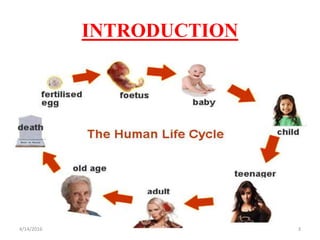
INTRODUCTION
34/14/2016
DEFINITION
A medical/nursing intervention defined
as promotion of physical comfort and
psychological peace in the final phase of
life.
44/14/2016
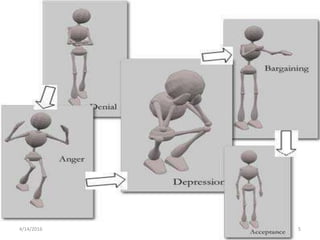
STAGES OF LOSS & GRIEF
54/14/2016
SIGNS OF APPROACHING DEATH
Facial appearance.
Changes in sight, speech, and hearing.
Respiratory system.
Circulatory system.
Gastro intestinal system.
Genito urinary system.
Skin and musculo skeletal system.
Central nervous system. 64/14/2016
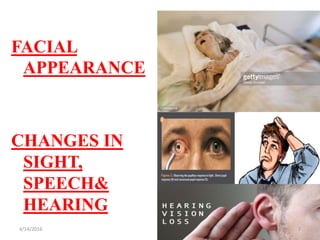
FACIAL
APPEARANCE
CHANGES IN
SIGHT,
SPEECH&
HEARING
74/14/2016
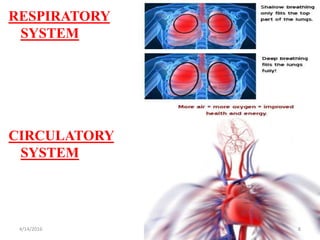
RESPIRATORY
SYSTEM
CIRCULATORY
SYSTEM
84/14/2016
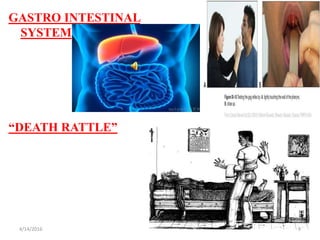
GASTRO INTESTINAL
SYSTEM
“DEATH RATTLE”
94/14/2016
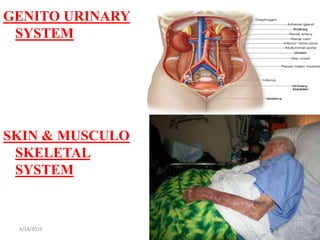
GENITO URINARY
SYSTEM
SKIN & MUSCULO
SKELETAL
SYSTEM
104/14/2016
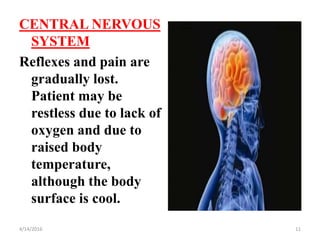
CENTRAL NERVOUS
SYSTEM
Reflexes and pain are
gradually lost.
Patient may be
restless due to lack of
oxygen and due to
raised body
temperature,
although the body
surface is cool.
114/14/2016
CARE OF THE DYING PATIENT
 Psychological support
 Advance Planning For Imminent Death
 Financial Concerns
 Legal and Ethical Concern
 Helping the Patient Transition
 Pain Management
 The Patient's Right to Information
 Symptomatic Management
124/14/2016
SYMPTOMATIC MANAGEMENT
 Problem associated with breathing:
Oxygen inhalation to remove his discomfort.
 Elevation of the patient’s head and
shoulders may make breathing easier.
Keep the room well ventilated and keep
crowed away.
Periodic suctioning is necessary.
134/14/2016
 Problem associated with eating and drinking:
Anorexia, nausea, and vomiting are commonly
seen in dying patient. They are unable to take any
form of food and if they taken, they are unable
to retain the food.
I.V fluids.
Sips of water is given with teaspoon.
Give frequent oral hygiene.
Apply emollients to the dry lips.
The denture are removed and kept safely.
144/14/2016
 Problem associated with sense organ:
Since the patient loses sight, before given any
care to the patient, the nurse should touch the
patient and say what she is going to do.
Since the hearing is retained longer, speak only
what is appropriate.
Avoid whispering any thing in patient room.
Speak distinctly so that patient may
understand what is done for him.
Since the eyes are opened, protect the eyes
from corneal ulceration with protective
ointment.
154/14/2016
 Problem associated with cleanliness and
grooming:
Cleanliness and appearance are important until the
end.
Cleanliness of the skin, hair, mouth, and cloth has to
be maintained.
 Problem associated with communication
Confusion
Withdrawal
164/14/2016
 Problem associated with rest and sleep:
Patient should not be disturbed while
sleeping.
The visitors should be instructed not to
disturbed the patient during his resting.
Maintain calm and quit environment.
 Pharmacological management
Anti-pyretic
Analgesic
Anti-emetic
Lifesaving drug if required 174/14/2016
SIGNS OF CLINICAL DEATH
Absence of pulse, heart beat and respirations
Pupil becoming fixed and not reacting to light
Absence of all reflex.
Rigor mortis: Stiffing of the body after death. The
arms & legs cannot be bent or straightened while
rigor mortis is present unless the tendons are torn.
 POSTMORTEM HYPOSTASIS- It is a dark red or
bluish discoloration due to the settling of the
blood.
184/14/2016
NURSING MANAGEMENT
A. Role of Nurse
B. Assessment
I. History taking
II. Physical Examination
C. Nursing Diagnosis
194/14/2016
204/14/2016
SUMMARIZATION
214/14/2016
224/14/2016
4/14/2016 23