“MICROPARTICULATE DRUG
DELIVERY SYSTEM”
“Microparticulate drug delivery system”
Dissertation submitted to Rajasthan University of Health
Sciences, Jaipur, in the partial fulfillment of the
requirements
For the degree of BACHELOR OF PHARMACY
Submitted by
Student Name : ISHFAQ AHMAD RATHER
Roll. No: 413017
B.PHARMACY PART- IV
(Enrollment No. 2012 /1071 )
Under the Guidance of
(Supervisor Name) : Mr. GURPREET SINGH
Qualification : M.Pharma , Ph.D*
Désignation : Asst.professor (pharmaceutics)
CONTENTS
(1) INTRODUCTION
MORPHOLOGY OF MICROPARITCLE
IMPORTANT FEATURES OF
MICROCAPSULES
ADVANTAGES
DISADVANTAGES
(2) APPLICATIONS Microparticulate
(3) RELEASE MECHANISM
(4) CARRIERS USED IN
PREPARATION OF
MICROPARTICLES
FACTORS INFLUENCING
ENCAPSULATION
(5) EVALUATION OF
MICROPARTICLES:
(6) CONCLUSION
MICROPARTICULATE DRUG
DELIVERY SYSTEM
INTRODUCTION
ORAL DRUG ADMINISTRATION IS BY FAR THE MOST
PREFERABLE ROUTE FOR TAKING MEDICATIONS.
HOWEVER, THEIR SHORT CIRCULATING HALF LIFE AND
RESTRICTED ABSORPTION VIA A DEFINED SEGMENT OF
INTESTINE LIMITS THE THERAPEUTIC POTENTIAL OF
MANY DRUGS.
MICROPARTICLES
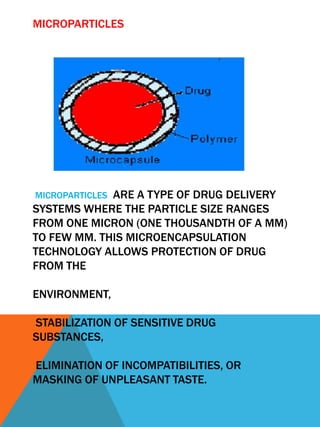
MICROPARTICLES ARE A TYPE OF DRUG DELIVERY
SYSTEMS WHERE THE PARTICLE SIZE RANGES
FROM ONE MICRON (ONE THOUSANDTH OF A MM)
TO FEW MM. THIS MICROENCAPSULATION
TECHNOLOGY ALLOWS PROTECTION OF DRUG
FROM THE
ENVIRONMENT,
STABILIZATION OF SENSITIVE DRUG
SUBSTANCES,
ELIMINATION OF INCOMPATIBILITIES, OR
MASKING OF UNPLEASANT TASTE.
MORPHOLOGY OF MICROPARITCLE
Microencapsulation is a technology
used to entrap solids, liquids, or
gases inside a polymeric matrix or
shell. Microparticles are :
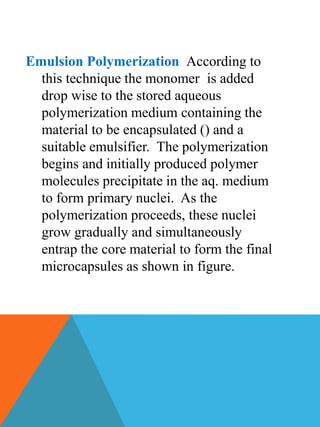
Microcapsule is a system in which drug
containing core is completely
surrounded by a polymer shell. .
Microsphere is a system in which the drug
substance is either homogenously
dissolved or dispersed in a polymeric
matrix.
IMPORTANT FEATURES OF
MICROCAPSULES
The most significant feature of microcapsules is
their microscopic size that allows for a huge
surface area, The total surface area is
inversely proportional to the diameter. This
large surface area is available for sites of
adsorption and desorption, chemical
reactions, .
ADVANTAGES This type of drug delivery
systems mainly provides the encapsulated
material to reach the area of action without
getting adversely affected by the environment
through which it passes. Pharmaceutical and
biomedical advantages of microparticle
include:
1. Taste and odor masking.
2. . Protection of drugs from environment.
3. 3. Particle size reduction for enhancing
solubility of the poorly soluble drug
4. . 4. Sustained or controlled drug delivery Eg:
KCl, Ibuprofen.
5. 5. Targeted release of encapsulated
material. .
DISADVANTAGES
:
1. The costs of the materials and processing of
the controlled release preparation, which
may be substantially higher than those of
standard formulations.
2. . Process conditions like change in
temperature, pH, solvent addition, and
evaporation/agitation may influence the
stability of core particles to be encapsulated.
3. The environmental impact of the
degradation products of the polymer matrix
produced in response to heat, hydrolysis,
oxidation, solar radiation or biological
agents .
RELEASE MECHANISM
l Generally there are three different
mechanisms by which the core
material is released from a
microcapsule
Mechanical rupture of the capsule
wall
Dissolution or melting of the wall
and
Diffusion through the wall .
Diffusion: On contact with aqueous
fluids in the gastrointestinal tract
(GIT), water diffuses into the
interior of the particle. Drug
dissolution occurs and the drug
TECHNIQUES OF
MICROENCAPSULATION:
A variety of techniques are employed for the
entrapment of solids or liquids
The preparation method can be broadly
divided into 2 categories:
Chemical methods and
physical methods.
Chemical Methods This method uses
monomers/prepolymers as starting
materials. These methods involve
chemical reactions along with microsphere
formation. These include
suspension polymerization, emulsion
polymerization, dispersion and interfacial
methods.
Among them emulsion polymerization
method is widely used in drug delivery
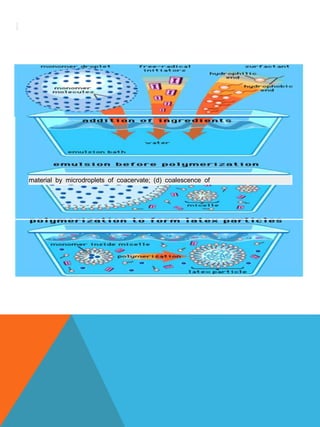
Emulsion Polymerization According to
this technique the monomer is added
drop wise to the stored aqueous
polymerization medium containing the
material to be encapsulated () and a
suitable emulsifier. The polymerization
begins and initially produced polymer
molecules precipitate in the aq. medium
to form primary nuclei. As the
polymerization proceeds, these nuclei
grow gradually and simultaneously
entrap the core material to form the final
microcapsules as shown in figure.
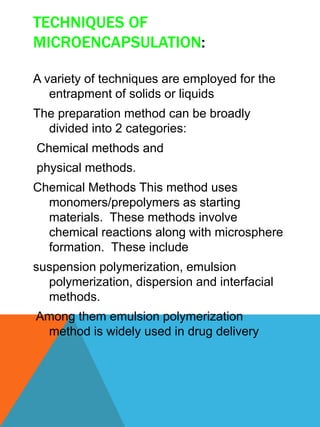
FIGURE: 1. MICROPARTICLES
FIGURE: 2 MICROPARTICLES
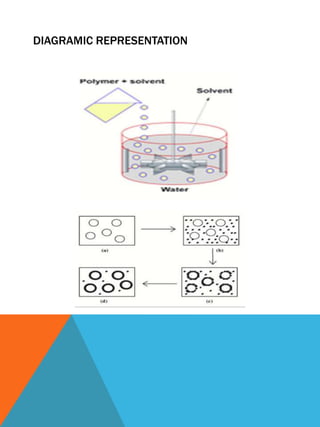
Figure: 11. schematic representation of the coacervation process.(a) core material dispersion in solution of shell polymer; (b)separation of coacervate from solution; (c) coating of corematerial by microdroplets of coacervate; (d) coalescence of
DIAGRAMIC REPRESENTATION
,CONCLUSION
. These delivery systems offer numerous
advantages compared to conventional
dosage forms, which include
Efficacy,
Reduced toxicity, and
Improved patient compliance
..
Although toxicity problems may exist, they will
be resolved by modifying the factors that
influence these systems.
REFERENCES
1. Gattani YS. Floating Multiparticulate drug delivery
systems: An overview International Journal of
Pharma and Biosciences, 6(2), 2010, 35-40.
2. Rama Dubey, Shamc TC and Bhaskar Rao KV.
Microencapsulation technology and applications.
Defense Science Journal, 59(1), 2009, 82-83.
3. Edith Mathiowitz, Mark R.Kreitz, Lisa Brannon-
Peppas. Microencapsulation. Outline, 5(2), 2008,
495-496.
4. Frederic Jewes, Frank Boury, Jean-Pierre Benoit
Inserm U 646, Ingenierie Da La Vectorisation
Particulaire, Universite D Angers, France.
Biodegradable microspheres: Advances in
production technology: Microencapsulation:
methods and industrial applications. Second
edition, 158, 1988, 1-23.
5. Kinam Park, Yoon Yeo. Microencapsulation
technology encyclopedia of pharmaceutical
technology GEPT, 6(2), 2002, 67-85.
6. James Swar Brick, James E. Boylan, Mercel
dekkar. Microencapsulation technology and
applications. Encyclopedia of pharmaceutical
Technology,10, 1988, 245-286.
microparticulate drug delivery system ppt