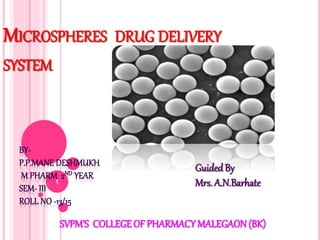
MICROSPHERES DRUG DELIVERY
SYSTEM
GuidedBy
Mrs. A.N.Barhate
SVPM’S COLLEGEOF PHARMACYMALEGAON (BK)
1
2
• The oral route is considered as the most promising route of drug
delivery. Conventional drug delivery system achieves as well as
maintains the drug concentration within the therapeutically effective
range needed for treatment, only when taken several times a day.
• There are various approaches in delivering a therapeutic susbstance to
the target site in sustained controlled release fashion using
microspheres as carrier for drug
• Administration of drugs in the form of microspheres usually improves
the treatment by providing the localization of the active substances at
the site of action & by prolonging the release of drugs.
3
DEFINATIONOF MICROSPHERES:-
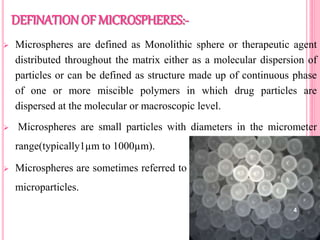
 Microspheres are defined as Monolithic sphere or therapeutic agent
distributed throughout the matrix either as a molecular dispersion of
particles or can be defined as structure made up of continuous phase
of one or more miscible polymers in which drug particles are
dispersed at the molecular or macroscopic level.
 Microspheres are small particles with diameters in the micrometer
range(typically1µm to 1000µm).
 Microspheres are sometimes referred to as
microparticles.
4
I. It should incorporate reasonably high concentrations of the drug.
II. Stability of the preparation after synthesis with acceptable shelf
life.
III. Controlled particle size and solubility in aqueous vehicles for
injection.
IV. Release of active pharmaceutical reagent with a good control over
a wide time scale.
V. Compatibility with a controllable biodegradability.
VI. Susceptible to chemical modification.
5
I. Microspheres provide constant and prolonged
therapeutic effect.
II. Reduces the dosing frequency and there by improve the
patient compliance.
III. They could be injected into the body due to the
spherical shape and smaller size.
IV. Better drug utilization will improve the bioavailability
and reduce the incidence or intensity of adverse effects. 6
I. The release rate of the controlled release dosage form
may vary from a variety of factors like food and the rate
of transit though gut.
II. Differences in the release rate from one dose to another.
III. Controlled release formulations generally contain a
higher drug load and thus any loss of integrity of the
release characteristics of the dosage form may lead to
potential toxicity.
IV. Dosage forms of this kind should not be crushed or
chewed.
7
 For Taste and odour masking.
 To delay the volatilization.
 For Separation of incompatible substances.
 For Improvement of flow properties of powders.
 To Increase the stability of the drug against the external
conditions.
 To Increase half life of drug.
8
 For Safe handling of toxic substances.
 To improve the solubility of water insoluble substances by
incorporating dispersion of such material in aqueous media.
 To reduce the dose dumping potential compared to large
implantable devices.
 For conversion of oils and other liquids to solids for ease of
handling.
9
 Synthetic Polymers
 Non-biodegradable
 PMMA
 Acrolein
 Epoxy polymers
 Biodegradable
 Lactides and Glycolides copolymers
 Polyalkyl cyanoacrylates
 Polyanhydrides
 Natural Materials
 Proteins
 Albumins
 Gelatin
 Collagen
 Carbohydrates
 Starch agarose
 Carrageenan
 Chitosan
 Chemically modified carbohydrates
 Poly (acryl) dextran
 Poly(acryl)starch
 DEAE cellulose
10
11
POLYMER MECHANISM
Modified starch, HPMC, Carbopol Slower release of drug
Ethyl cellulose Controlled release for longer period of
time
PLGA, Chitosan Vaccine delivery
Magnetic polystyrene microspheres Specific cell labeling
Chitosan coated PIGA microspheres Targeted drug delivery
11
-
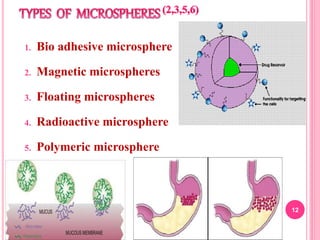
1. Bio adhesive microsphere
2. Magnetic microspheres
3. Floating microspheres
4. Radioactive microsphere
5. Polymeric microsphere
12
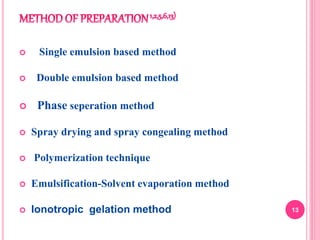
 Single emulsion based method
 Double emulsion based method
 Phase seperation method
 Spray drying and spray congealing method
 Polymerization technique
 Emulsification-Solvent evaporation method
 Ionotropic gelation method 13
14
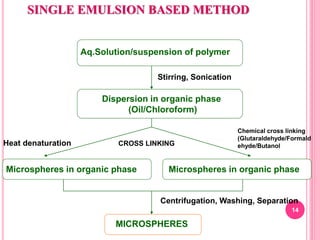
SINGLE EMULSION BASED METHOD
Aq.Solution/suspension of polymer
Dispersion in organic phase
(Oil/Chloroform)
Microspheres in organic phase Microspheres in organic phase
MICROSPHERES
Stirring, Sonication
CROSS LINKING
Chemical cross linking
(Glutaraldehyde/Formald
ehyde/ButanolHeat denaturation
Centrifugation, Washing, Separation
15
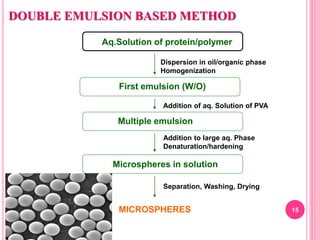
Aq.Solution of protein/polymer
First emulsion (W/O)
MICROSPHERES
Dispersion in oil/organic phase
Homogenization
Separation, Washing, Drying
Addition of aq. Solution of PVA
Addition to large aq. Phase
Denaturation/hardening
Multiple emulsion
Microspheres in solution
DOUBLE EMULSION BASED METHOD
16
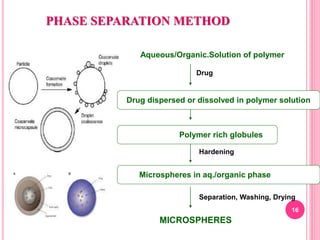
PHASE SEPARATION METHOD
Aqueous/Organic.Solution of polymer
Drug dispersed or dissolved in polymer solution
MICROSPHERES
Drug
Separation, Washing, Drying
Hardening
Polymer rich globules
Microspheres in aq./organic phase
SPRAY DRYING AND SPRAY
CONGEALING METHOD
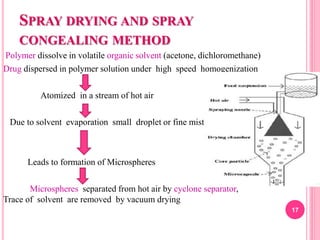
Polymer dissolve in volatile organic solvent (acetone, dichloromethane)
Drug dispersed in polymer solution under high speed homogenization
Atomized in a stream of hot air
Due to solvent evaporation small droplet or fine mist form
Leads to formation of Microspheres
Microspheres separated from hot air by cyclone separator,
Trace of solvent are removed by vacuum drying
17
INTERFACIAL POLYMERIZATION TECHNIQUE
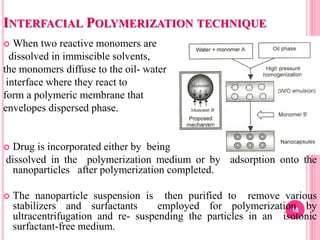
 When two reactive monomers are
dissolved in immiscible solvents,
the monomers diffuse to the oil- water
interface where they react to
form a polymeric membrane that
envelopes dispersed phase.
 Drug is incorporated either by being
dissolved in the polymerization medium or by adsorption onto the
nanoparticles after polymerization completed.
 The nanoparticle suspension is then purified to remove various
stabilizers and surfactants employed for polymerization by
ultracentrifugation and re- suspending the particles in an isotonic
surfactant-free medium.
18
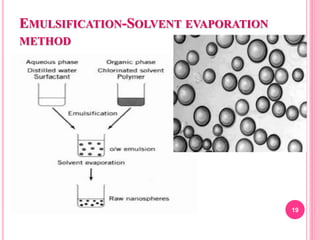
EMULSIFICATION-SOLVENT EVAPORATION
METHOD
19
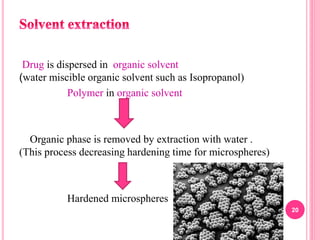
Drug is dispersed in organic solvent
(water miscible organic solvent such as Isopropanol)
Polymer in organic solvent
Organic phase is removed by extraction with water .
(This process decreasing hardening time for microspheres)
Hardened microspheres
20
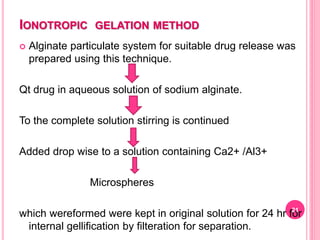
IONOTROPIC GELATION METHOD
 Alginate particulate system for suitable drug release was
prepared using this technique.
Qt drug in aqueous solution of sodium alginate.
To the complete solution stirring is continued
Added drop wise to a solution containing Ca2+ /Al3+
Microspheres
which wereformed were kept in original solution for 24 hr for
internal gellification by filteration for separation.
21
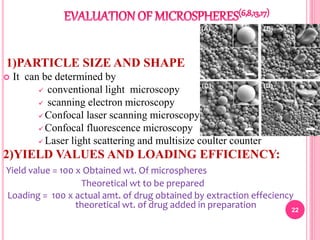
1)PARTICLE SIZE AND SHAPE
 It can be determined by
 conventional light microscopy
 scanning electron microscopy
 Confocal laser scanning microscopy
 Confocal fluorescence microscopy
 Laser light scattering and multisize coulter counter
2)YIELD VALUES AND LOADING EFFICIENCY:
Yield value = 100 x Obtained wt. Of microspheres
Theoretical wt to be prepared
Loading = 100 x actual amt. of drug obtained by extraction effeciency
theoretical wt. of drug added in preparation 22
3) DENSITY DETERMINATION
Measured by using a Multivolume psychnometer.
4) ISOELECTRIC POINT
The microelectrophoresis is an apparatus used to
measure the electophoretic mobility of microspheres
from which isoelectric point can be determined.
5) RELEASE STUDIES
1)Rotating paddle apparatus
2)Dialysis method
6)ANGLE OF CONTACT
 Determine wetting property of microparticulate carrier.
23
7) X-ray diffraction
Change in crystalinity of drug can be determined by this
technique. Scanning range angle between 8 0C - 70 0C. Scan
speed -4o/min Scintillation
8) Stability studies:-
microspheres in screw capped glass container and stored
them at following conditions:
1. Ambient humid condition
2. Room temperature (27+/-2 0C)
3. Oven temperature (40+/-2 0C)
4. Refrigerator (5 0C -80C).
It was carried out of a 60 days and the drug content of the
microsphere was analysed.
24
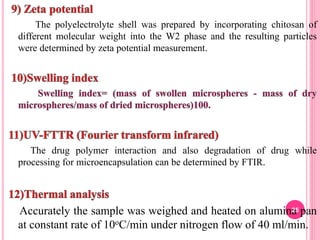
The polyelectrolyte shell was prepared by incorporating chitosan of
different molecular weight into the W2 phase and the resulting particles
were determined by zeta potential measurement.
The drug polymer interaction and also degradation of drug while
processing for microencapsulation can be determined by FTIR.
Accurately the sample was weighed and heated on alumina pan
at constant rate of 10oC/min under nitrogen flow of 40 ml/min.
25
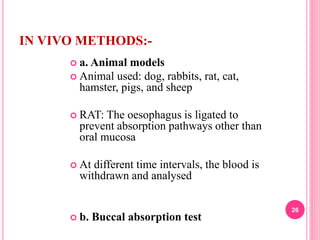
IN VIVO METHODS:-
 a. Animal models
 Animal used: dog, rabbits, rat, cat,
hamster, pigs, and sheep
 RAT: The oesophagus is ligated to
prevent absorption pathways other than
oral mucosa
 At different time intervals, the blood is
withdrawn and analysed
 b. Buccal absorption test
26
27
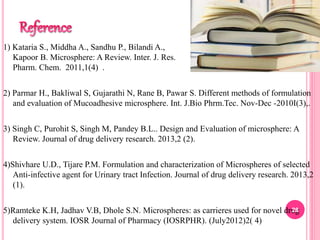
1) Kataria S., Middha A., Sandhu P., Bilandi A.,
Kapoor B. Microsphere: A Review. Inter. J. Res.
Pharm. Chem. 2011,1(4) .
2) Parmar H., Bakliwal S, Gujarathi N, Rane B, Pawar S. Different methods of formulation
and evaluation of Mucoadhesive microsphere. Int. J.Bio Phrm.Tec. Nov-Dec -2010I(3),.
3) Singh C, Purohit S, Singh M, Pandey B.L.. Design and Evaluation of microsphere: A
Review. Journal of drug delivery research. 2013,2 (2).
4)Shivhare U.D., Tijare P.M. Formulation and characterization of Microspheres of selected
Anti-infective agent for Urinary tract Infection. Journal of drug delivery research. 2013,2
(1).
5)Ramteke K.H, Jadhav V.B, Dhole S.N. Microspheres: as carrieres used for novel drug
delivery system. IOSR Journal of Pharmacy (IOSRPHR). (July2012)2( 4)
28
6)Prasanth v.v., Chakraborthy Moy A, Sam T Mathew, Mathapan R. Microspheres - An
Overview. Inter J Res Pharm Biomedical Sci.2012,89-96.
7)Sigimol J, Jacob E, Mathew M, Sharon Anna Babu, SS. Anju. Formulation and
evaluation of Diclofenac sodium loaded albumin microsphere. Inter J Res Pharm N
Scie. 2014, 3(1), 6 - 11.
8)Alagusundaram.M, Chetty.C, Umashankari.K, Lavanya.C, Ramkanth.S. Microsphere
as a Novel drug delivery system- a Review. Inter J Chem Tech Res CODEN (USA):
IJCRGG. 1, No.3, ppJuly-Sept 2009 526-534,.
9)Deshmukh V, Warad S, Solunke R, Walunj S, Palve S, Jagdale G. Microspheres: As
new drug delivery system. W. J. Pharm. Pharma. Scie.:2013, 2(6),.
10) Nikam V. K.,. Gudsoorkar V.R,. Hiremath S.N, Dolas R.T.,. Kashid V.A.
Microspheres - A Novel Drug Delivery System: An Overview. Inter. J. of Pharma.
Che Scie.; Jan – Mar 2012,Vol. 1 (1).
11)Patel N. R., Patel D. A., Bharadia P. D., Pandya V.. Microsphere as a novel drug
delivery. Inter. J. Pharm. L. scie.; Aug., 2011.56-78.
29
12) Soni M L, Kumar M Namdeo, K P. Sodium alginate microspheres for extending
drug release: formulation and in vitro evaluation. Inter.J. D.D. 2 (2010) 64-68.
13) Yadav V., Varshney H. M.. Microsphere: A Review. J. D. D. Therapeutics 1 (7)
2013, 23-33.
14) Pachuau L, Sarkar S, Mazumder B. Formulation and evaluation of matrix
microspheres for simultaneous delivery of salbutamol sulphate and theophylline.
Tropical Journal of Pharmaceutical Research, June 2008; 7 (2): 995-1002.
15) Kyekyoon “Kevin” Kim, Daniel W. Pack. Microspheres for Drug Delivery.
16) Chandra D., Chaurasia S.,. Singh V.K, Yadav K. K.. Chitosan based Mucoadhesive
Microsphere: Versatile Carrier for nasal drug delivery system. W. J. Pharm. Res. ;3(
6), 2014.
17) Remington (2000). The Science and Practice of Phrmacy. 21st edition, volume 2,
Edited by Alfanso R Gennaro, Published by Lippincott Williams and Wilkins
Philadelphia; p 316.
30
18)Jain N.K.. Controlled and Novel Drug Delivery. CBS Publication. p 236.
19) Vyas S.P.., R.K.Khar, International Journal for Targeted & Controlled Drug
Delivery Novel Carrier Systems.,First Edition :2002.,Reprint :2007 page
no:417,453.
20) www.wikipedia.org
31

Microspheres drug delivery system

  • 1.
    MICROSPHERES DRUG DELIVERY SYSTEM GuidedBy Mrs.A.N.Barhate SVPM’S COLLEGEOF PHARMACYMALEGAON (BK) 1
  • 2.
  • 3.
    • The oralroute is considered as the most promising route of drug delivery. Conventional drug delivery system achieves as well as maintains the drug concentration within the therapeutically effective range needed for treatment, only when taken several times a day. • There are various approaches in delivering a therapeutic susbstance to the target site in sustained controlled release fashion using microspheres as carrier for drug • Administration of drugs in the form of microspheres usually improves the treatment by providing the localization of the active substances at the site of action & by prolonging the release of drugs. 3
  • 4.
    DEFINATIONOF MICROSPHERES:-  Microspheresare defined as Monolithic sphere or therapeutic agent distributed throughout the matrix either as a molecular dispersion of particles or can be defined as structure made up of continuous phase of one or more miscible polymers in which drug particles are dispersed at the molecular or macroscopic level.  Microspheres are small particles with diameters in the micrometer range(typically1µm to 1000µm).  Microspheres are sometimes referred to as microparticles. 4
  • 5.
    I. It shouldincorporate reasonably high concentrations of the drug. II. Stability of the preparation after synthesis with acceptable shelf life. III. Controlled particle size and solubility in aqueous vehicles for injection. IV. Release of active pharmaceutical reagent with a good control over a wide time scale. V. Compatibility with a controllable biodegradability. VI. Susceptible to chemical modification. 5
  • 6.
    I. Microspheres provideconstant and prolonged therapeutic effect. II. Reduces the dosing frequency and there by improve the patient compliance. III. They could be injected into the body due to the spherical shape and smaller size. IV. Better drug utilization will improve the bioavailability and reduce the incidence or intensity of adverse effects. 6
  • 7.
    I. The releaserate of the controlled release dosage form may vary from a variety of factors like food and the rate of transit though gut. II. Differences in the release rate from one dose to another. III. Controlled release formulations generally contain a higher drug load and thus any loss of integrity of the release characteristics of the dosage form may lead to potential toxicity. IV. Dosage forms of this kind should not be crushed or chewed. 7
  • 8.
     For Tasteand odour masking.  To delay the volatilization.  For Separation of incompatible substances.  For Improvement of flow properties of powders.  To Increase the stability of the drug against the external conditions.  To Increase half life of drug. 8
  • 9.
     For Safehandling of toxic substances.  To improve the solubility of water insoluble substances by incorporating dispersion of such material in aqueous media.  To reduce the dose dumping potential compared to large implantable devices.  For conversion of oils and other liquids to solids for ease of handling. 9
  • 10.
     Synthetic Polymers Non-biodegradable  PMMA  Acrolein  Epoxy polymers  Biodegradable  Lactides and Glycolides copolymers  Polyalkyl cyanoacrylates  Polyanhydrides  Natural Materials  Proteins  Albumins  Gelatin  Collagen  Carbohydrates  Starch agarose  Carrageenan  Chitosan  Chemically modified carbohydrates  Poly (acryl) dextran  Poly(acryl)starch  DEAE cellulose 10
  • 11.
    11 POLYMER MECHANISM Modified starch,HPMC, Carbopol Slower release of drug Ethyl cellulose Controlled release for longer period of time PLGA, Chitosan Vaccine delivery Magnetic polystyrene microspheres Specific cell labeling Chitosan coated PIGA microspheres Targeted drug delivery 11 -
  • 12.
    1. Bio adhesivemicrosphere 2. Magnetic microspheres 3. Floating microspheres 4. Radioactive microsphere 5. Polymeric microsphere 12
  • 13.
     Single emulsionbased method  Double emulsion based method  Phase seperation method  Spray drying and spray congealing method  Polymerization technique  Emulsification-Solvent evaporation method  Ionotropic gelation method 13
  • 14.
    14 SINGLE EMULSION BASEDMETHOD Aq.Solution/suspension of polymer Dispersion in organic phase (Oil/Chloroform) Microspheres in organic phase Microspheres in organic phase MICROSPHERES Stirring, Sonication CROSS LINKING Chemical cross linking (Glutaraldehyde/Formald ehyde/ButanolHeat denaturation Centrifugation, Washing, Separation
  • 15.
    15 Aq.Solution of protein/polymer Firstemulsion (W/O) MICROSPHERES Dispersion in oil/organic phase Homogenization Separation, Washing, Drying Addition of aq. Solution of PVA Addition to large aq. Phase Denaturation/hardening Multiple emulsion Microspheres in solution DOUBLE EMULSION BASED METHOD
  • 16.
    16 PHASE SEPARATION METHOD Aqueous/Organic.Solutionof polymer Drug dispersed or dissolved in polymer solution MICROSPHERES Drug Separation, Washing, Drying Hardening Polymer rich globules Microspheres in aq./organic phase
  • 17.
    SPRAY DRYING ANDSPRAY CONGEALING METHOD Polymer dissolve in volatile organic solvent (acetone, dichloromethane) Drug dispersed in polymer solution under high speed homogenization Atomized in a stream of hot air Due to solvent evaporation small droplet or fine mist form Leads to formation of Microspheres Microspheres separated from hot air by cyclone separator, Trace of solvent are removed by vacuum drying 17
  • 18.
    INTERFACIAL POLYMERIZATION TECHNIQUE When two reactive monomers are dissolved in immiscible solvents, the monomers diffuse to the oil- water interface where they react to form a polymeric membrane that envelopes dispersed phase.  Drug is incorporated either by being dissolved in the polymerization medium or by adsorption onto the nanoparticles after polymerization completed.  The nanoparticle suspension is then purified to remove various stabilizers and surfactants employed for polymerization by ultracentrifugation and re- suspending the particles in an isotonic surfactant-free medium. 18
  • 19.
  • 20.
    Drug is dispersedin organic solvent (water miscible organic solvent such as Isopropanol) Polymer in organic solvent Organic phase is removed by extraction with water . (This process decreasing hardening time for microspheres) Hardened microspheres 20
  • 21.
    IONOTROPIC GELATION METHOD Alginate particulate system for suitable drug release was prepared using this technique. Qt drug in aqueous solution of sodium alginate. To the complete solution stirring is continued Added drop wise to a solution containing Ca2+ /Al3+ Microspheres which wereformed were kept in original solution for 24 hr for internal gellification by filteration for separation. 21
  • 22.
    1)PARTICLE SIZE ANDSHAPE  It can be determined by  conventional light microscopy  scanning electron microscopy  Confocal laser scanning microscopy  Confocal fluorescence microscopy  Laser light scattering and multisize coulter counter 2)YIELD VALUES AND LOADING EFFICIENCY: Yield value = 100 x Obtained wt. Of microspheres Theoretical wt to be prepared Loading = 100 x actual amt. of drug obtained by extraction effeciency theoretical wt. of drug added in preparation 22
  • 23.
    3) DENSITY DETERMINATION Measuredby using a Multivolume psychnometer. 4) ISOELECTRIC POINT The microelectrophoresis is an apparatus used to measure the electophoretic mobility of microspheres from which isoelectric point can be determined. 5) RELEASE STUDIES 1)Rotating paddle apparatus 2)Dialysis method 6)ANGLE OF CONTACT  Determine wetting property of microparticulate carrier. 23
  • 24.
    7) X-ray diffraction Changein crystalinity of drug can be determined by this technique. Scanning range angle between 8 0C - 70 0C. Scan speed -4o/min Scintillation 8) Stability studies:- microspheres in screw capped glass container and stored them at following conditions: 1. Ambient humid condition 2. Room temperature (27+/-2 0C) 3. Oven temperature (40+/-2 0C) 4. Refrigerator (5 0C -80C). It was carried out of a 60 days and the drug content of the microsphere was analysed. 24
  • 25.
    The polyelectrolyte shellwas prepared by incorporating chitosan of different molecular weight into the W2 phase and the resulting particles were determined by zeta potential measurement. The drug polymer interaction and also degradation of drug while processing for microencapsulation can be determined by FTIR. Accurately the sample was weighed and heated on alumina pan at constant rate of 10oC/min under nitrogen flow of 40 ml/min. 25
  • 26.
    IN VIVO METHODS:- a. Animal models  Animal used: dog, rabbits, rat, cat, hamster, pigs, and sheep  RAT: The oesophagus is ligated to prevent absorption pathways other than oral mucosa  At different time intervals, the blood is withdrawn and analysed  b. Buccal absorption test 26
  • 27.
  • 28.
    1) Kataria S.,Middha A., Sandhu P., Bilandi A., Kapoor B. Microsphere: A Review. Inter. J. Res. Pharm. Chem. 2011,1(4) . 2) Parmar H., Bakliwal S, Gujarathi N, Rane B, Pawar S. Different methods of formulation and evaluation of Mucoadhesive microsphere. Int. J.Bio Phrm.Tec. Nov-Dec -2010I(3),. 3) Singh C, Purohit S, Singh M, Pandey B.L.. Design and Evaluation of microsphere: A Review. Journal of drug delivery research. 2013,2 (2). 4)Shivhare U.D., Tijare P.M. Formulation and characterization of Microspheres of selected Anti-infective agent for Urinary tract Infection. Journal of drug delivery research. 2013,2 (1). 5)Ramteke K.H, Jadhav V.B, Dhole S.N. Microspheres: as carrieres used for novel drug delivery system. IOSR Journal of Pharmacy (IOSRPHR). (July2012)2( 4) 28
  • 29.
    6)Prasanth v.v., ChakraborthyMoy A, Sam T Mathew, Mathapan R. Microspheres - An Overview. Inter J Res Pharm Biomedical Sci.2012,89-96. 7)Sigimol J, Jacob E, Mathew M, Sharon Anna Babu, SS. Anju. Formulation and evaluation of Diclofenac sodium loaded albumin microsphere. Inter J Res Pharm N Scie. 2014, 3(1), 6 - 11. 8)Alagusundaram.M, Chetty.C, Umashankari.K, Lavanya.C, Ramkanth.S. Microsphere as a Novel drug delivery system- a Review. Inter J Chem Tech Res CODEN (USA): IJCRGG. 1, No.3, ppJuly-Sept 2009 526-534,. 9)Deshmukh V, Warad S, Solunke R, Walunj S, Palve S, Jagdale G. Microspheres: As new drug delivery system. W. J. Pharm. Pharma. Scie.:2013, 2(6),. 10) Nikam V. K.,. Gudsoorkar V.R,. Hiremath S.N, Dolas R.T.,. Kashid V.A. Microspheres - A Novel Drug Delivery System: An Overview. Inter. J. of Pharma. Che Scie.; Jan – Mar 2012,Vol. 1 (1). 11)Patel N. R., Patel D. A., Bharadia P. D., Pandya V.. Microsphere as a novel drug delivery. Inter. J. Pharm. L. scie.; Aug., 2011.56-78. 29
  • 30.
    12) Soni ML, Kumar M Namdeo, K P. Sodium alginate microspheres for extending drug release: formulation and in vitro evaluation. Inter.J. D.D. 2 (2010) 64-68. 13) Yadav V., Varshney H. M.. Microsphere: A Review. J. D. D. Therapeutics 1 (7) 2013, 23-33. 14) Pachuau L, Sarkar S, Mazumder B. Formulation and evaluation of matrix microspheres for simultaneous delivery of salbutamol sulphate and theophylline. Tropical Journal of Pharmaceutical Research, June 2008; 7 (2): 995-1002. 15) Kyekyoon “Kevin” Kim, Daniel W. Pack. Microspheres for Drug Delivery. 16) Chandra D., Chaurasia S.,. Singh V.K, Yadav K. K.. Chitosan based Mucoadhesive Microsphere: Versatile Carrier for nasal drug delivery system. W. J. Pharm. Res. ;3( 6), 2014. 17) Remington (2000). The Science and Practice of Phrmacy. 21st edition, volume 2, Edited by Alfanso R Gennaro, Published by Lippincott Williams and Wilkins Philadelphia; p 316. 30
  • 31.
    18)Jain N.K.. Controlledand Novel Drug Delivery. CBS Publication. p 236. 19) Vyas S.P.., R.K.Khar, International Journal for Targeted & Controlled Drug Delivery Novel Carrier Systems.,First Edition :2002.,Reprint :2007 page no:417,453. 20) www.wikipedia.org 31