JOURNAL OF DRUG DELIVERY RESEARCH
eISSN 2319-1074
Volume 6 Issue 4 2017 www.earthjournals.in 1
RESEARCH ARTICLE
FORMULATION AND EVALUATION STUDY OF
AZITHROMYCIN TABLETS BY VARIOUS NATURAL
POLYMERS AND THEIR COMPARATIVE
PREFORMULATION STUDY
SUNIRMAL BHATTACHARJEE*1
, PRADIP KUMAR KARAR1a
,
SUSANTA PAUL1b
, SIDDHESWAR MAITI1c
, GOURANGA DUTTA2
,
NILAYAN GUHA2a
1
Department of Pharmaceutics & Pharmaceutical Chemistry, Pharmacognosy. School of
Pharmacy ( Seacom Skills University), Kendradangal, Bolpur, Birbhum-731236
2
Department of Pharmaceutics, Guru Nanak Institute of Pharmaceutical Science and
Technology, Kolkata-West Bengal 700110
Corresponding author: SUNIRMAL BHATTACHARJEE, Kendradangal, bolpur, shantiniketan, Pin-731236
ABSTRACT
The present study was to formulate Azithromycin matrix tablet using Xanthan gum, and guar gum as natural
polymers and to elucidate the effect of type of polymers and its concentration on release pattern of drug from
sustained release matrix tablets. Azithromycin matrix tablets were prepared in two batches (batch number F1 to F2)
by direct compression method using xanthan gum and guar gum as natural polymers and microcrystalline cellulose
as a binder and pyrolidone as a water soluble polymer. The in vitro drug release studies of all the batches indicated
that optimized formulation pertaining to Batch no. F2 was a promising system to provide sustained release effect of
drug. The release pattern of the above formulation was best fitted to zero-order model and first order model.
Mechanism of drug release followed was non-Fickian (super case-II) transport mechanism. Based on the above
studies it can be concluded that this Azithromycin drug can be effectively formulated using different classes of
natural polymers which can have greater bioavailability with less dose related side effects having better patient
compliance.
KEYWORDS: Azithromycin, Guar gum, Xanthan gum, microcrystalline cellulose, Pyrolidone, Talc.
INTRODUCTION
Drug delivery is the method or process of administering a pharmaceutical compound to achieve a
therapeutic effect in humans or animals.[1][2]
Drug delivery technologies modify drug release
profile, absorption, distribution and elimination for the benefit of improving product efficacy and
safety, as well as patient convenience and compliance. Drug release is from: diffusion,
degradation, swelling, and affinity-based mechanisms.[3]
Most common routes of administration
include the preferred non-invasive peroral (through the mouth), topical (skin), transmucosal
(nasal, buccal/sublingual, vaginal, ocular and rectal) and inhalation routes.[4][5]
Many drugs,
peptide and protein, antibody, vaccine and gene based, in general may not be delivered using
these routes because they might be susceptible to enzymatic degradation or cannot be absorbed
JOURNAL OF DRUG DELIVERY RESEARCH
eISSN 2319-1074
Volume 6 Issue 4 2017 www.earthjournals.in 2
into the systemic circulation efficiently due to molecular size and charge issues to be
therapeutically effective. For this reason many protein and peptide drugs have to be delivered by
injection or a nano-needle array.
To achieve and maintain the concentration of administered drug within the therapeutically
effective range needed for a medication, it is often necessary to administer conventional dosage
forms several times a day. These results in rise of drug level after each administration with
subsequent fall which results in fluctuated drug level. [20][29][25]
The concept of sustained release was introduced in the early 1950s and the first patent on
sustained release was obtained by Israel Lipowski who worked on coated pellets. There has-been
more than 50 years of research and development on sustained release dosage forms to prolong
drug levels in the body[17,21,23]
. Successful fabrication of sustained release product is usually very
difficult and involves consideration of physico-chemical parameters and pharmacokinetic
behavior of drug, route of administration, disease state to be treated and, most important
placement of the drug in the dosage form that will provide the desired temporal and spatial
delivery pattern for the drug. Types of sustained release formulations include liposome’s, drug
loaded biodegradable microspheres and drug polymer conjugates. Basically there are three basic
modes of drug delivery, i.e. targeted delivery, controlled release and modulated release.
MATERIALS AND METHOD:
Materials Azithromycin was gift sample by Medico Remedies Pvt.Ltd.Juhu, Mumbai. Guar
gum, Xanthan gum was procured by Merck Specialties private Limited., India. Talc, Magnesium
stearate was purchased from Apex Chemicals, Ahmadabad, India. Microcrystalline cellulose
(MCC) Polyvinyl pyrolidone was purchased from Loba chemie Private Ltd. Mumbai.
Method
Method for preparation matrix tablet of Azithromycin
The controlled release matrix tablets of azithromycin were prepared by the direct compression
method. The drug, polymers and other excipients were passed through sieve # 80. The controlled
release tablets containing drug, matrix materials, diluents, binder and lubricants were mixed
uniformly and compressed on 10 station tablet machine using 8 mm round and flat punches with
hardness between 5-7 kg cm-2.
Table 1: Formulation trials of 250 mg azithromycin matrix tablets
Formulation
Code
Drug
(mg)
Xanthan
gum
(mg)
Guar
gum
(mg)
MC
C
PVP Talc Magnesi
um
Stearate
Total
F1 250 mg 100
mg-
208
mg
30
mg
6
mg
6 mg 600
F2 250 mg 100 mg 208
mg
30
mg
6
mg
6 mg 600
Each formulation contains 10 tablets.
Table: 2 Micromeritic properties of formulation blends.
Formulation
Code
Angle of
Repose
Bulk Density Tapped
Density
Carr’s Index Hauner’s
Ratio
F1 24.03 ± 0.78 0.425 ±0.03 0.512 ±0.017 16.99 ±2.25 1.20 ±0.03
F2 26.61 ± 0.98 0.467 ±0.1 0.551 ±0.1 15.24 ±1.68 1.17 ±0.02
JOURNAL OF DRUG DELIVERY RESEARCH
eISSN 2319-1074
Volume 6 Issue 4 2017 www.earthjournals.in 3
The obtained micromeritic properties are given in Table no.5.The value of Angle of repose of
formulation within the range of 30˚, indicating good flow properties for the granules. The tapped
density values ranged between 0.510 ±0.08 to 0.608 ±0.04 g/ cm3
and the bulk density values
ranged between 0.425 ±0.03 to 0.516 ±0.07 g/ cm3
. The result of Carr’s Index range from 14.09
±0.86 to 17.69 ±1.95 % suggests good flow characteristics of the granules. Hausner’s Ratio
range from1.16 ±0.01 to1.21 ±0.09 % which indicates good flow property of microspheres.
RESULT AND DISCUSSION
Preformulation Studies
1. Standard Calibration Curve
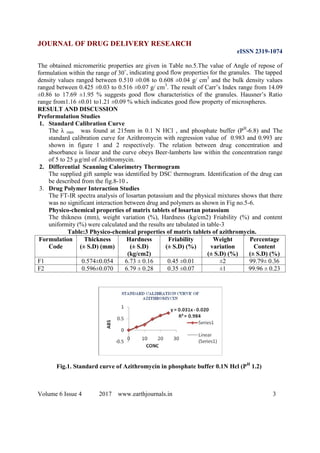
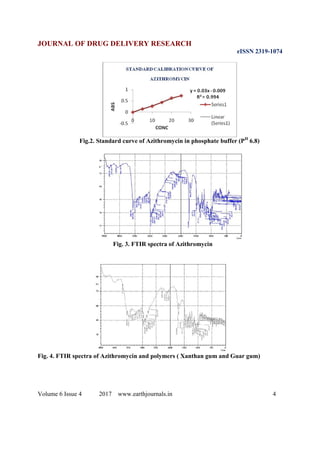
The λ max was found at 215nm in 0.1 N HCl , and phosphate buffer (PH
-6.8) and The
standard calibration curve for Azithromycin with regression value of 0.983 and 0.993 are
shown in figure 1 and 2 respectively. The relation between drug concentration and
absorbance is linear and the curve obeys Beer-lamberts law within the concentration range
of 5 to 25 µg/ml of Azithromycin.
2. Differential Scanning Calorimetry Thermogram
The supplied gift sample was identified by DSC thermogram. Identification of the drug can
be described from the fig.8-10 .
3. Drug Polymer Interaction Studies
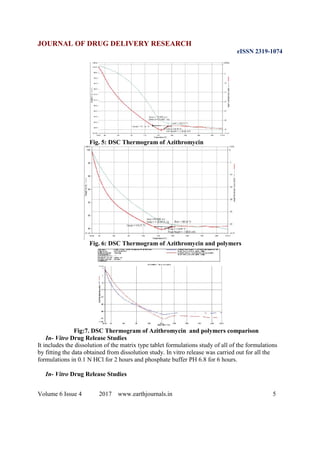
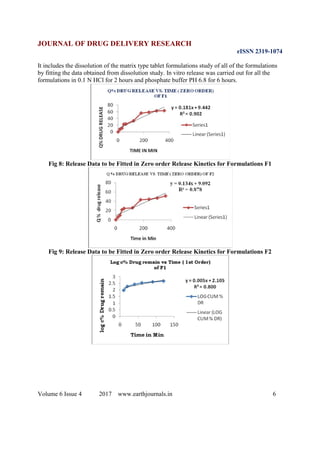
The FT-IR spectra analysis of losartan potassium and the physical mixtures shows that there
was no significant interaction between drug and polymers as shown in Fig no.5-6.
Physico-chemical properties of matrix tablets of losartan potassium
The thikness (mm), weight variation (%), Hardness (kg/cm2) Friability (%) and content
uniformity (%) were calculated and the results are tabulated in table-3
Table:3 Physico-chemical properties of matrix tablets of azithromycin.
Formulation
Code
Thickness
(± S.D) (mm)
Hardness
(± S.D)
(kg/cm2)
Friability
(± S.D) (%)
Weight
variation
(± S.D) (%)
Percentage
Content
(± S.D) (%)
F1 0.574±0.054 6.73 ± 0.16 0.45 ±0.01 ±2 99.79± 0.36
F2 0.596±0.070 6.79 ± 0.28 0.35 ±0.07 ±1 99.96 ± 0.23
Fig.1. Standard curve of Azithromycin in phosphate buffer 0.1N Hcl (PH
1.2)
JOURNAL OF DRUG DELIVERY RESEARCH
eISSN 2319-1074
Volume 6 Issue 4 2017 www.earthjournals.in 4
Fig.2. Standard curve of Azithromycin in phosphate buffer (PH
6.8)
Fig. 3. FTIR spectra of Azithromycin
Fig. 4. FTIR spectra of Azithromycin and polymers ( Xanthan gum and Guar gum)
JOURNAL OF DRUG DELIVERY RESEARCH
eISSN 2319-1074
Volume 6 Issue 4 2017 www.earthjournals.in 5
Fig. 5: DSC Thermogram of Azithromycin
Fig. 6: DSC Thermogram of Azithromycin and polymers
Fig:7. DSC Thermogram of Azithromycin and polymers comparison
In- Vitro Drug Release Studies
It includes the dissolution of the matrix type tablet formulations study of all of the formulations
by fitting the data obtained from dissolution study. In vitro release was carried out for all the
formulations in 0.1 N HCl for 2 hours and phosphate buffer PH 6.8 for 6 hours.
In- Vitro Drug Release Studies
JOURNAL OF DRUG DELIVERY RESEARCH
eISSN 2319-1074
Volume 6 Issue 4 2017 www.earthjournals.in 6
It includes the dissolution of the matrix type tablet formulations study of all of the formulations
by fitting the data obtained from dissolution study. In vitro release was carried out for all the
formulations in 0.1 N HCl for 2 hours and phosphate buffer PH 6.8 for 6 hours.
Fig 8: Release Data to be Fitted in Zero order Release Kinetics for Formulations F1
Fig 9: Release Data to be Fitted in Zero order Release Kinetics for Formulations F2
JOURNAL OF DRUG DELIVERY RESEARCH
eISSN 2319-1074
Volume 6 Issue 4 2017 www.earthjournals.in 7
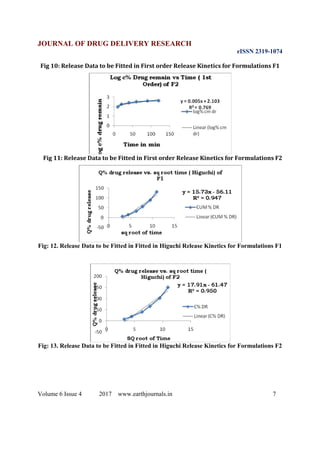
Fig 10: Release Data to be Fitted in First order Release Kinetics for Formulations F1
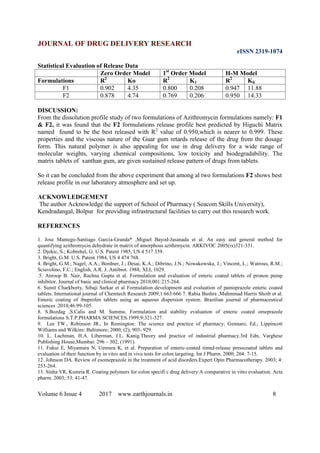
Fig 11: Release Data to be Fitted in First order Release Kinetics for Formulations F2
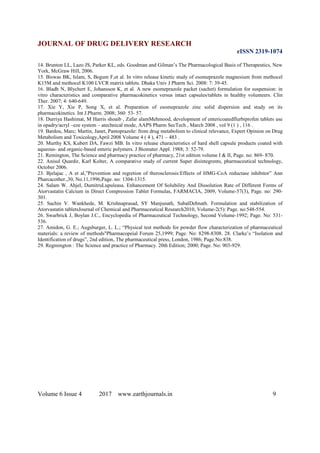
Fig: 12. Release Data to be Fitted in Fitted in Higuchi Release Kinetics for Formulations F1
Fig: 13. Release Data to be Fitted in Fitted in Higuchi Release Kinetics for Formulations F2
JOURNAL OF DRUG DELIVERY RESEARCH
eISSN 2319-1074
Volume 6 Issue 4 2017 www.earthjournals.in 8
Statistical Evaluation of Release Data
Zero Order Model 1st
Order Model H-M Model
Formulations R2
Ko R2
K1 R2
Kh
F1 0.902 4.35 0.800 0.208 0.947 11.88
F2 0.878 4.74 0.769 0.206 0.950 14.33
DISCUSSION:
From the dissolution profile study of two formulations of Azithromycin formulations namely: F1
& F2, it was found that the F2 formulations release profile best predicted by Higuchi Matrix
named found to be the best released with R2
value of 0.950,which is nearer to 0.999. These
properties and the viscous nature of the Guar gum retards release of the drug from the dosage
form. This natural polymer is also appealing for use in drug delivery for a wide range of
molecular weights, varying chemical compositions, low toxicity and biodegradability. The
matrix tablets of xanthan gum, are given sustained release pattern of drugs from tablets.
So it can be concluded from the above experiment that among al two formulations F2 shows best
release profile in our laboratory atmosphere and set up.
ACKNOWLEDGEMENT
The author Acknowledge the support of School of Pharmacy ( Seacom Skills University),
Kendradangal, Bolpur for providing infrastructural facilities to carry out this research work.
REFERENCES
1. Jose Mantego-Santiago Garcia-Granda* ,Miguel Bayod-Jasanada et al. An easy and general method for
quantifying azithromycin dehydrate in matrix of amorphous azithrmycin. ARKIVOC 2005(ix)321-331.
2. Djokic, S.; Kobrehel, G. U.S. Patent 1985, US 4 517 359.
3. Bright, G.M. U.S. Patent 1984, US 4 474 768.
4. Bright, G.M.; Nagel, A.A.; Bordner, J.; Desai, K.A.; Dibrino, J.N.; Nowakowska, J.; Vincent, L.; Watrous, R.M.;
Sciavolino, F.C.; English, A.R. J. Antibiot. 1988, XLI, 1029.
.5. Anroop B. Nair, Rachna Gupta et al. Formulation and evaluation of enteric coated tablets of pronon pump
inhibitor. Journal of basic and clinical pharmacy 2010;001:215-264.
6. Sumit Charkborty, Sibaji Sarkar et al Formulation development and evaluation of pantoprazole enteric coated
tablets. International journal of Chemtech Research 2009;1:663:666 7. Rabia Bushra ,Muhmmad Harris Shoib et al.
Enteric coating of ibuprofen tablets using an aqueous dispersion system. Brazilian journal of pharmaceutical
sciences .2010;46:99-105.
8. S.Bozdag ,S.Calis and M. Summu. Formulation and stability evaluation of enteric coated omeprazole
formulations S.T.P.PHARMA SCIENCES.1999;9:321-327.
9. Lee TW., Robinson JR., In Remington: The science and practice of pharmacy; Gennaro, Ed.; Lippincott
Williams and Wilkins: Baltimore; 2000; (2); 903- 929.
10. L. Lachman, H.A. Liberman, J.L. Kanig.Theory and practice of industrial pharmacy.3rd Edn, Varghese
Publishing House,Mumbai: 296 – 302, (1991).
11. Fukui E, Miyamura N, Uemura K, et al. Preparation of enteric-coated timed-release presscoated tablets and
evaluation of their function by in vitro and in vivo tests for colon targeting. Int J Pharm. 2000; 204: 7-15.
12. Johnson DA. Review of esomeprazole in the treatment of acid disorders.Expert Opin Pharmacotherapy. 2003; 4:
253-264.
13. Sinha VR, Kumria R. Coating polymers for colon specifi c drug delivery:A comparative in vitro evaluation. Acta
pharm. 2003; 53: 41-47.
JOURNAL OF DRUG DELIVERY RESEARCH
eISSN 2319-1074
Volume 6 Issue 4 2017 www.earthjournals.in 9
14. Brunton LL, Lazo JS, Parker KL, eds. Goodman and Gilman’s The Pharmacological Basis of Therapeutics, New
York, McGraw Hill, 2006.
15. Biswas BK, Islam, S, Begum F,et al. In vitro release kinetic study of esomeprazole magnesium from methocel
K15M and methocel K100 LVCR matrix tablets. Dhaka Univ J Pharm Sci. 2008: 7: 39-45.
16. Bladh N, Blychert E, Johansson K, et al. A new esomeprazole packet (sachet) formulation for suspension: in
vitro characteristics and comparative pharmacokinetics versus intact capsules/tablets in healthy volunteers. Clin
Ther. 2007; 4: 640-649.
17. Xie Y, Xie P, Song X, et al. Preparation of esomeprazole zinc solid dispersion and study on its
pharmacokinetics. Int J.Pharm. 2008; 360: 53- 57.
18. Durriya Hashimat, M Harris shoaib , Zafar alamMehmood, development of entericoatedflurbiprofen tablets use
in opadry/acryl –eze system – atechnical mode, AAPS Pharm SecTech , March 2008 , vol 9 (1 ) , 116 .
19. Bardou, Marc; Martin, Janet, Pantoprazole: from drug metabolism to clinical relevance, Expert Opinion on Drug
Metabolism and Toxicology,April 2008 Volume 4 ( 4 ), 471 – 483 .
20. Murthy KS, Kubert DA, Fawzi MB. In vitro release characteristics of hard shell capsule products coated with
aqueous- and organic-based enteric polymers. J Biomater Appl. 1988; 3: 52-79.
21. Remington, The Science and pharmacy practice of pharmacy, 21st edition volume I & II, Page. no: 869- 870.
22. Anisul Quardir, Karl Kolter, A comparative study of current Super disintegrents, pharmaceutical technology,
October 2006.
23. Bjelajac , A et al,”Prevention and regretion of therosclerosis:Effects of HMG-CoA reductase inhibitor” Ann
Pharcacother.,30, No.11,1996,Page. no: 1304-1315.
24. Salam W. Ahjel, DumitruLupuleasa. Enhancement Of Solubility And Dissolution Rate of Different Forms of
Atorvastatin Calcium in Direct Compression Tablet Formulas, FARMACIA, 2009, Volume-57(3), Page. no: 290-
301.
25. Sachin V. Wankhede, M. Krishnaprasad, SY Manjunath, SubalDebnath. Formulation and stabilization of
Atorvastatin tabletsJournal of Chemical and Pharmaceutical Research2010, Volume-2(5): Page. no:548-554.
26. Swarbrick J, Boylan J.C., Encyclopedia of Pharmaceutical Technology, Second Volume-1992; Page. No: 531-
536.
27. Amidon, G. E.; Augsburger, L. L.; “Physical test methods for powder flow characterization of pharmaceutical
materials: a review of methods"Pharmacopeial Forum 25,1999; Page. No: 8298-8308. 28. Clarke’s “Isolation and
Identification of drugs”, 2nd edition, The pharmaceutical press, London, 1986; Page.No:838.
29. Regmington : The Science and practice of Pharmacy. 20th Edition; 2000; Page. No: 903-929.

Jddr 188

  • 1.
    JOURNAL OF DRUGDELIVERY RESEARCH eISSN 2319-1074 Volume 6 Issue 4 2017 www.earthjournals.in 1 RESEARCH ARTICLE FORMULATION AND EVALUATION STUDY OF AZITHROMYCIN TABLETS BY VARIOUS NATURAL POLYMERS AND THEIR COMPARATIVE PREFORMULATION STUDY SUNIRMAL BHATTACHARJEE*1 , PRADIP KUMAR KARAR1a , SUSANTA PAUL1b , SIDDHESWAR MAITI1c , GOURANGA DUTTA2 , NILAYAN GUHA2a 1 Department of Pharmaceutics & Pharmaceutical Chemistry, Pharmacognosy. School of Pharmacy ( Seacom Skills University), Kendradangal, Bolpur, Birbhum-731236 2 Department of Pharmaceutics, Guru Nanak Institute of Pharmaceutical Science and Technology, Kolkata-West Bengal 700110 Corresponding author: SUNIRMAL BHATTACHARJEE, Kendradangal, bolpur, shantiniketan, Pin-731236 ABSTRACT The present study was to formulate Azithromycin matrix tablet using Xanthan gum, and guar gum as natural polymers and to elucidate the effect of type of polymers and its concentration on release pattern of drug from sustained release matrix tablets. Azithromycin matrix tablets were prepared in two batches (batch number F1 to F2) by direct compression method using xanthan gum and guar gum as natural polymers and microcrystalline cellulose as a binder and pyrolidone as a water soluble polymer. The in vitro drug release studies of all the batches indicated that optimized formulation pertaining to Batch no. F2 was a promising system to provide sustained release effect of drug. The release pattern of the above formulation was best fitted to zero-order model and first order model. Mechanism of drug release followed was non-Fickian (super case-II) transport mechanism. Based on the above studies it can be concluded that this Azithromycin drug can be effectively formulated using different classes of natural polymers which can have greater bioavailability with less dose related side effects having better patient compliance. KEYWORDS: Azithromycin, Guar gum, Xanthan gum, microcrystalline cellulose, Pyrolidone, Talc. INTRODUCTION Drug delivery is the method or process of administering a pharmaceutical compound to achieve a therapeutic effect in humans or animals.[1][2] Drug delivery technologies modify drug release profile, absorption, distribution and elimination for the benefit of improving product efficacy and safety, as well as patient convenience and compliance. Drug release is from: diffusion, degradation, swelling, and affinity-based mechanisms.[3] Most common routes of administration include the preferred non-invasive peroral (through the mouth), topical (skin), transmucosal (nasal, buccal/sublingual, vaginal, ocular and rectal) and inhalation routes.[4][5] Many drugs, peptide and protein, antibody, vaccine and gene based, in general may not be delivered using these routes because they might be susceptible to enzymatic degradation or cannot be absorbed
  • 2.
    JOURNAL OF DRUGDELIVERY RESEARCH eISSN 2319-1074 Volume 6 Issue 4 2017 www.earthjournals.in 2 into the systemic circulation efficiently due to molecular size and charge issues to be therapeutically effective. For this reason many protein and peptide drugs have to be delivered by injection or a nano-needle array. To achieve and maintain the concentration of administered drug within the therapeutically effective range needed for a medication, it is often necessary to administer conventional dosage forms several times a day. These results in rise of drug level after each administration with subsequent fall which results in fluctuated drug level. [20][29][25] The concept of sustained release was introduced in the early 1950s and the first patent on sustained release was obtained by Israel Lipowski who worked on coated pellets. There has-been more than 50 years of research and development on sustained release dosage forms to prolong drug levels in the body[17,21,23] . Successful fabrication of sustained release product is usually very difficult and involves consideration of physico-chemical parameters and pharmacokinetic behavior of drug, route of administration, disease state to be treated and, most important placement of the drug in the dosage form that will provide the desired temporal and spatial delivery pattern for the drug. Types of sustained release formulations include liposome’s, drug loaded biodegradable microspheres and drug polymer conjugates. Basically there are three basic modes of drug delivery, i.e. targeted delivery, controlled release and modulated release. MATERIALS AND METHOD: Materials Azithromycin was gift sample by Medico Remedies Pvt.Ltd.Juhu, Mumbai. Guar gum, Xanthan gum was procured by Merck Specialties private Limited., India. Talc, Magnesium stearate was purchased from Apex Chemicals, Ahmadabad, India. Microcrystalline cellulose (MCC) Polyvinyl pyrolidone was purchased from Loba chemie Private Ltd. Mumbai. Method Method for preparation matrix tablet of Azithromycin The controlled release matrix tablets of azithromycin were prepared by the direct compression method. The drug, polymers and other excipients were passed through sieve # 80. The controlled release tablets containing drug, matrix materials, diluents, binder and lubricants were mixed uniformly and compressed on 10 station tablet machine using 8 mm round and flat punches with hardness between 5-7 kg cm-2. Table 1: Formulation trials of 250 mg azithromycin matrix tablets Formulation Code Drug (mg) Xanthan gum (mg) Guar gum (mg) MC C PVP Talc Magnesi um Stearate Total F1 250 mg 100 mg- 208 mg 30 mg 6 mg 6 mg 600 F2 250 mg 100 mg 208 mg 30 mg 6 mg 6 mg 600 Each formulation contains 10 tablets. Table: 2 Micromeritic properties of formulation blends. Formulation Code Angle of Repose Bulk Density Tapped Density Carr’s Index Hauner’s Ratio F1 24.03 ± 0.78 0.425 ±0.03 0.512 ±0.017 16.99 ±2.25 1.20 ±0.03 F2 26.61 ± 0.98 0.467 ±0.1 0.551 ±0.1 15.24 ±1.68 1.17 ±0.02
  • 3.
    JOURNAL OF DRUGDELIVERY RESEARCH eISSN 2319-1074 Volume 6 Issue 4 2017 www.earthjournals.in 3 The obtained micromeritic properties are given in Table no.5.The value of Angle of repose of formulation within the range of 30˚, indicating good flow properties for the granules. The tapped density values ranged between 0.510 ±0.08 to 0.608 ±0.04 g/ cm3 and the bulk density values ranged between 0.425 ±0.03 to 0.516 ±0.07 g/ cm3 . The result of Carr’s Index range from 14.09 ±0.86 to 17.69 ±1.95 % suggests good flow characteristics of the granules. Hausner’s Ratio range from1.16 ±0.01 to1.21 ±0.09 % which indicates good flow property of microspheres. RESULT AND DISCUSSION Preformulation Studies 1. Standard Calibration Curve The λ max was found at 215nm in 0.1 N HCl , and phosphate buffer (PH -6.8) and The standard calibration curve for Azithromycin with regression value of 0.983 and 0.993 are shown in figure 1 and 2 respectively. The relation between drug concentration and absorbance is linear and the curve obeys Beer-lamberts law within the concentration range of 5 to 25 µg/ml of Azithromycin. 2. Differential Scanning Calorimetry Thermogram The supplied gift sample was identified by DSC thermogram. Identification of the drug can be described from the fig.8-10 . 3. Drug Polymer Interaction Studies The FT-IR spectra analysis of losartan potassium and the physical mixtures shows that there was no significant interaction between drug and polymers as shown in Fig no.5-6. Physico-chemical properties of matrix tablets of losartan potassium The thikness (mm), weight variation (%), Hardness (kg/cm2) Friability (%) and content uniformity (%) were calculated and the results are tabulated in table-3 Table:3 Physico-chemical properties of matrix tablets of azithromycin. Formulation Code Thickness (± S.D) (mm) Hardness (± S.D) (kg/cm2) Friability (± S.D) (%) Weight variation (± S.D) (%) Percentage Content (± S.D) (%) F1 0.574±0.054 6.73 ± 0.16 0.45 ±0.01 ±2 99.79± 0.36 F2 0.596±0.070 6.79 ± 0.28 0.35 ±0.07 ±1 99.96 ± 0.23 Fig.1. Standard curve of Azithromycin in phosphate buffer 0.1N Hcl (PH 1.2)
  • 4.
    JOURNAL OF DRUGDELIVERY RESEARCH eISSN 2319-1074 Volume 6 Issue 4 2017 www.earthjournals.in 4 Fig.2. Standard curve of Azithromycin in phosphate buffer (PH 6.8) Fig. 3. FTIR spectra of Azithromycin Fig. 4. FTIR spectra of Azithromycin and polymers ( Xanthan gum and Guar gum)
  • 5.
    JOURNAL OF DRUGDELIVERY RESEARCH eISSN 2319-1074 Volume 6 Issue 4 2017 www.earthjournals.in 5 Fig. 5: DSC Thermogram of Azithromycin Fig. 6: DSC Thermogram of Azithromycin and polymers Fig:7. DSC Thermogram of Azithromycin and polymers comparison In- Vitro Drug Release Studies It includes the dissolution of the matrix type tablet formulations study of all of the formulations by fitting the data obtained from dissolution study. In vitro release was carried out for all the formulations in 0.1 N HCl for 2 hours and phosphate buffer PH 6.8 for 6 hours. In- Vitro Drug Release Studies
  • 6.
    JOURNAL OF DRUGDELIVERY RESEARCH eISSN 2319-1074 Volume 6 Issue 4 2017 www.earthjournals.in 6 It includes the dissolution of the matrix type tablet formulations study of all of the formulations by fitting the data obtained from dissolution study. In vitro release was carried out for all the formulations in 0.1 N HCl for 2 hours and phosphate buffer PH 6.8 for 6 hours. Fig 8: Release Data to be Fitted in Zero order Release Kinetics for Formulations F1 Fig 9: Release Data to be Fitted in Zero order Release Kinetics for Formulations F2
  • 7.
    JOURNAL OF DRUGDELIVERY RESEARCH eISSN 2319-1074 Volume 6 Issue 4 2017 www.earthjournals.in 7 Fig 10: Release Data to be Fitted in First order Release Kinetics for Formulations F1 Fig 11: Release Data to be Fitted in First order Release Kinetics for Formulations F2 Fig: 12. Release Data to be Fitted in Fitted in Higuchi Release Kinetics for Formulations F1 Fig: 13. Release Data to be Fitted in Fitted in Higuchi Release Kinetics for Formulations F2
  • 8.
    JOURNAL OF DRUGDELIVERY RESEARCH eISSN 2319-1074 Volume 6 Issue 4 2017 www.earthjournals.in 8 Statistical Evaluation of Release Data Zero Order Model 1st Order Model H-M Model Formulations R2 Ko R2 K1 R2 Kh F1 0.902 4.35 0.800 0.208 0.947 11.88 F2 0.878 4.74 0.769 0.206 0.950 14.33 DISCUSSION: From the dissolution profile study of two formulations of Azithromycin formulations namely: F1 & F2, it was found that the F2 formulations release profile best predicted by Higuchi Matrix named found to be the best released with R2 value of 0.950,which is nearer to 0.999. These properties and the viscous nature of the Guar gum retards release of the drug from the dosage form. This natural polymer is also appealing for use in drug delivery for a wide range of molecular weights, varying chemical compositions, low toxicity and biodegradability. The matrix tablets of xanthan gum, are given sustained release pattern of drugs from tablets. So it can be concluded from the above experiment that among al two formulations F2 shows best release profile in our laboratory atmosphere and set up. ACKNOWLEDGEMENT The author Acknowledge the support of School of Pharmacy ( Seacom Skills University), Kendradangal, Bolpur for providing infrastructural facilities to carry out this research work. REFERENCES 1. Jose Mantego-Santiago Garcia-Granda* ,Miguel Bayod-Jasanada et al. An easy and general method for quantifying azithromycin dehydrate in matrix of amorphous azithrmycin. ARKIVOC 2005(ix)321-331. 2. Djokic, S.; Kobrehel, G. U.S. Patent 1985, US 4 517 359. 3. Bright, G.M. U.S. Patent 1984, US 4 474 768. 4. Bright, G.M.; Nagel, A.A.; Bordner, J.; Desai, K.A.; Dibrino, J.N.; Nowakowska, J.; Vincent, L.; Watrous, R.M.; Sciavolino, F.C.; English, A.R. J. Antibiot. 1988, XLI, 1029. .5. Anroop B. Nair, Rachna Gupta et al. Formulation and evaluation of enteric coated tablets of pronon pump inhibitor. Journal of basic and clinical pharmacy 2010;001:215-264. 6. Sumit Charkborty, Sibaji Sarkar et al Formulation development and evaluation of pantoprazole enteric coated tablets. International journal of Chemtech Research 2009;1:663:666 7. Rabia Bushra ,Muhmmad Harris Shoib et al. Enteric coating of ibuprofen tablets using an aqueous dispersion system. Brazilian journal of pharmaceutical sciences .2010;46:99-105. 8. S.Bozdag ,S.Calis and M. Summu. Formulation and stability evaluation of enteric coated omeprazole formulations S.T.P.PHARMA SCIENCES.1999;9:321-327. 9. Lee TW., Robinson JR., In Remington: The science and practice of pharmacy; Gennaro, Ed.; Lippincott Williams and Wilkins: Baltimore; 2000; (2); 903- 929. 10. L. Lachman, H.A. Liberman, J.L. Kanig.Theory and practice of industrial pharmacy.3rd Edn, Varghese Publishing House,Mumbai: 296 – 302, (1991). 11. Fukui E, Miyamura N, Uemura K, et al. Preparation of enteric-coated timed-release presscoated tablets and evaluation of their function by in vitro and in vivo tests for colon targeting. Int J Pharm. 2000; 204: 7-15. 12. Johnson DA. Review of esomeprazole in the treatment of acid disorders.Expert Opin Pharmacotherapy. 2003; 4: 253-264. 13. Sinha VR, Kumria R. Coating polymers for colon specifi c drug delivery:A comparative in vitro evaluation. Acta pharm. 2003; 53: 41-47.
  • 9.
    JOURNAL OF DRUGDELIVERY RESEARCH eISSN 2319-1074 Volume 6 Issue 4 2017 www.earthjournals.in 9 14. Brunton LL, Lazo JS, Parker KL, eds. Goodman and Gilman’s The Pharmacological Basis of Therapeutics, New York, McGraw Hill, 2006. 15. Biswas BK, Islam, S, Begum F,et al. In vitro release kinetic study of esomeprazole magnesium from methocel K15M and methocel K100 LVCR matrix tablets. Dhaka Univ J Pharm Sci. 2008: 7: 39-45. 16. Bladh N, Blychert E, Johansson K, et al. A new esomeprazole packet (sachet) formulation for suspension: in vitro characteristics and comparative pharmacokinetics versus intact capsules/tablets in healthy volunteers. Clin Ther. 2007; 4: 640-649. 17. Xie Y, Xie P, Song X, et al. Preparation of esomeprazole zinc solid dispersion and study on its pharmacokinetics. Int J.Pharm. 2008; 360: 53- 57. 18. Durriya Hashimat, M Harris shoaib , Zafar alamMehmood, development of entericoatedflurbiprofen tablets use in opadry/acryl –eze system – atechnical mode, AAPS Pharm SecTech , March 2008 , vol 9 (1 ) , 116 . 19. Bardou, Marc; Martin, Janet, Pantoprazole: from drug metabolism to clinical relevance, Expert Opinion on Drug Metabolism and Toxicology,April 2008 Volume 4 ( 4 ), 471 – 483 . 20. Murthy KS, Kubert DA, Fawzi MB. In vitro release characteristics of hard shell capsule products coated with aqueous- and organic-based enteric polymers. J Biomater Appl. 1988; 3: 52-79. 21. Remington, The Science and pharmacy practice of pharmacy, 21st edition volume I & II, Page. no: 869- 870. 22. Anisul Quardir, Karl Kolter, A comparative study of current Super disintegrents, pharmaceutical technology, October 2006. 23. Bjelajac , A et al,”Prevention and regretion of therosclerosis:Effects of HMG-CoA reductase inhibitor” Ann Pharcacother.,30, No.11,1996,Page. no: 1304-1315. 24. Salam W. Ahjel, DumitruLupuleasa. Enhancement Of Solubility And Dissolution Rate of Different Forms of Atorvastatin Calcium in Direct Compression Tablet Formulas, FARMACIA, 2009, Volume-57(3), Page. no: 290- 301. 25. Sachin V. Wankhede, M. Krishnaprasad, SY Manjunath, SubalDebnath. Formulation and stabilization of Atorvastatin tabletsJournal of Chemical and Pharmaceutical Research2010, Volume-2(5): Page. no:548-554. 26. Swarbrick J, Boylan J.C., Encyclopedia of Pharmaceutical Technology, Second Volume-1992; Page. No: 531- 536. 27. Amidon, G. E.; Augsburger, L. L.; “Physical test methods for powder flow characterization of pharmaceutical materials: a review of methods"Pharmacopeial Forum 25,1999; Page. No: 8298-8308. 28. Clarke’s “Isolation and Identification of drugs”, 2nd edition, The pharmaceutical press, London, 1986; Page.No:838. 29. Regmington : The Science and practice of Pharmacy. 20th Edition; 2000; Page. No: 903-929.