International Research Journal of Engineering and Technology (IRJET) e-ISSN: 2395-0056
Volume: 06 Issue: 04 | Apr 2019 www.irjet.net p-ISSN: 2395-0072
© 2019, IRJET | Impact Factor value: 7.211 | ISO 9001:2008 Certified Journal | Page 4776
INTELLIGENT STUDENT TRACKING AND MONITORING FOR COLLEGE
INFRASTRUCTURE BY USING RFID
S.Priyadharshini1, J. Sujatha2
1PG Scholar, Department of MCA, Arulmigu Meenakshi Amman College of Engineering, Anna University,
Vadamavandal (near Kanchipuram), India.
2Assistant Professor, Department of MCA, Arulmigu Meenakshi Amman College of Engineering, Anna University,
Vadamavandal (near Kanchipuram), India.
----------------------------------------------------------------------***---------------------------------------------------------------------
ABSTRACT:-This project is developed by using Radio
Frequency Identification (RFID) system and student card to
get student attendance. There were a lot of problems when
using as student attendance such as cheating. The project
system was running by get the code of card student to
compare with the database in Access. Graphical User
Interface (GUI) was developed using Embedded C to make
the database easier to access. This part is important because
we need the information in this part to use in the next
interface. After the reader was ready, process to get
attendant will started. Students need to swap their card on
the reader and the code from the card will use to compare
with database in Access. When the code is match with
database, the student information like name and ID number
will show on interface and that information will trigger into
a list. This list will use as a student attendance. This project
will help lecturer taking the student attendance more easily
and automatically. As theconclusion,RFIDtechnologycanbe
used in student attendance application.
1. INTRODUCTION
This embedded system for monitoring and
controlling the student is based on measuring the humidity
and temperature by sensor that located at different places.
The sensors sense the change and the microcontroller reads
this from the data at its input ports afterbeingconvertedtoa
digital form by the ADC. The microcontroller then performs
the needed actions by employing relaysuntil thestrayed-out
parameter has been brought back to its optimum level.
As the system also employs an LCD display for
continuously alerting the user about the conditioninsidethe
student, the entire set-up becomes user friendly. Thus, this
system eliminates the drawbacks of the existing set-ups and
is designed as an easy to maintain, flexible and low cost
solution.
Student monitoring system is technical intransitiveinwhich
the control of student environment continuous monitoring
and recording of these environmental variables gives
information to the grower better understand. The
monitoring method can be implemented in various
situations such as monitoring qualities. Wireless sensor
network (WSN) can form a useful part of the automation
system architecture in modern students.
2. SYSTEM ANALYSIS
2.1 Existing System
RFID is an automated identification and data collection
technology, that ensures more accurate and timely data
entry. RFID combines radio frequency and microchip
technologies to create a smart system that can be used to
identify, monitor, secure and do objectinventory. Topresent
an intelligent RFID based lecture attendance access control
and management system.
Drawback in existing System
1. Insufficient budget available, complexity of
technology and systems.
2. Cost still very high for providers Prohibitivecosts
and Privacy concerns.
2.2 Proposed System
By incorporating a facial recognition application
that would serve to furtherincreasethe biometricsecurityof
the system against impersonation by erring students. Usage
of High Frequency (HF) active RFID tagsagainstpassiveLow
frequency (LF) RFID tags for better performance and
flexibility of users Performance evaluationofcombination of
thumbprint, facial recognition and RFID technology to
students’ attendance monitoring problem.
3. SYSTEM SPECIFICATION
3.1 HARDWARE REQUIREMENTS
 Microcontroller
 LM 35 Temperature sensor
 Humidity sensor
 Light sensor
 GSM
International Research Journal of Engineering and Technology (IRJET) e-ISSN: 2395-0056
Volume: 06 Issue: 04 | Apr 2019 www.irjet.net p-ISSN: 2395-0072
© 2019, IRJET | Impact Factor value: 7.211 | ISO 9001:2008 Certified Journal | Page 4777
 Relay
 Dc motor
 Transformer
 Diode
 Resistor
 Capacitor
3.2 SOFTWARE REQUIREMENTS
 Keil Compiler
 Language: Basic Embedded C
4. MODULES AND DESCRIPTION
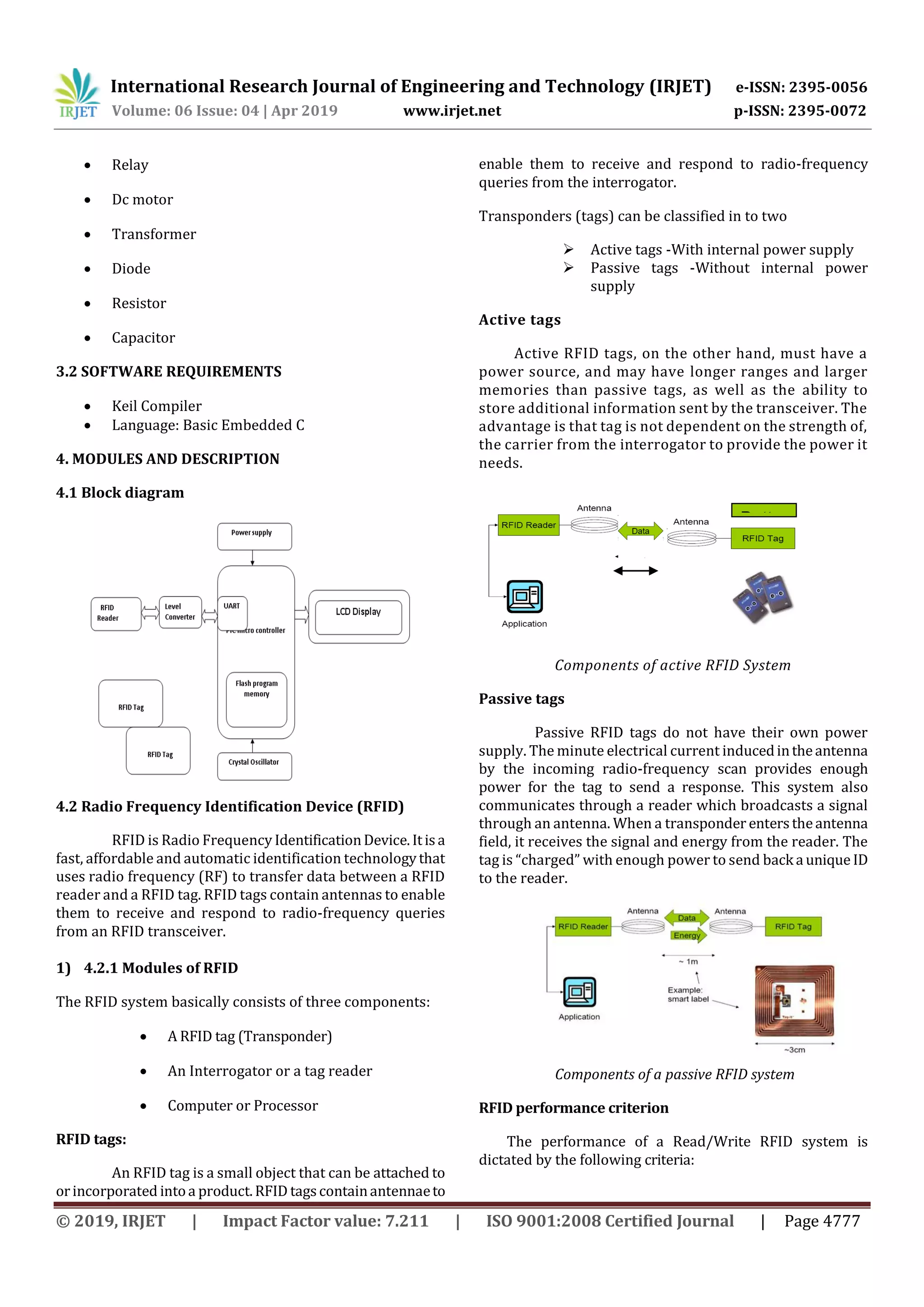
4.1 Block diagram
4.2 Radio Frequency Identification Device (RFID)
RFID is Radio Frequency IdentificationDevice.Itisa
fast, affordable and automatic identification technologythat
uses radio frequency (RF) to transfer data between a RFID
reader and a RFID tag. RFID tags contain antennas to enable
them to receive and respond to radio-frequency queries
from an RFID transceiver.
1) 4.2.1 Modules of RFID
The RFID system basically consists of three components:
 A RFID tag (Transponder)
 An Interrogator or a tag reader
 Computer or Processor
RFID tags:
An RFID tag is a small object that can be attached to
orincorporated intoa product.RFID tagscontainantennaeto
enable them to receive and respond to radio-frequency
queries from the interrogator.
Transponders (tags) can be classified in to two
 Active tags -With internal power supply
 Passive tags -Without internal power
supply
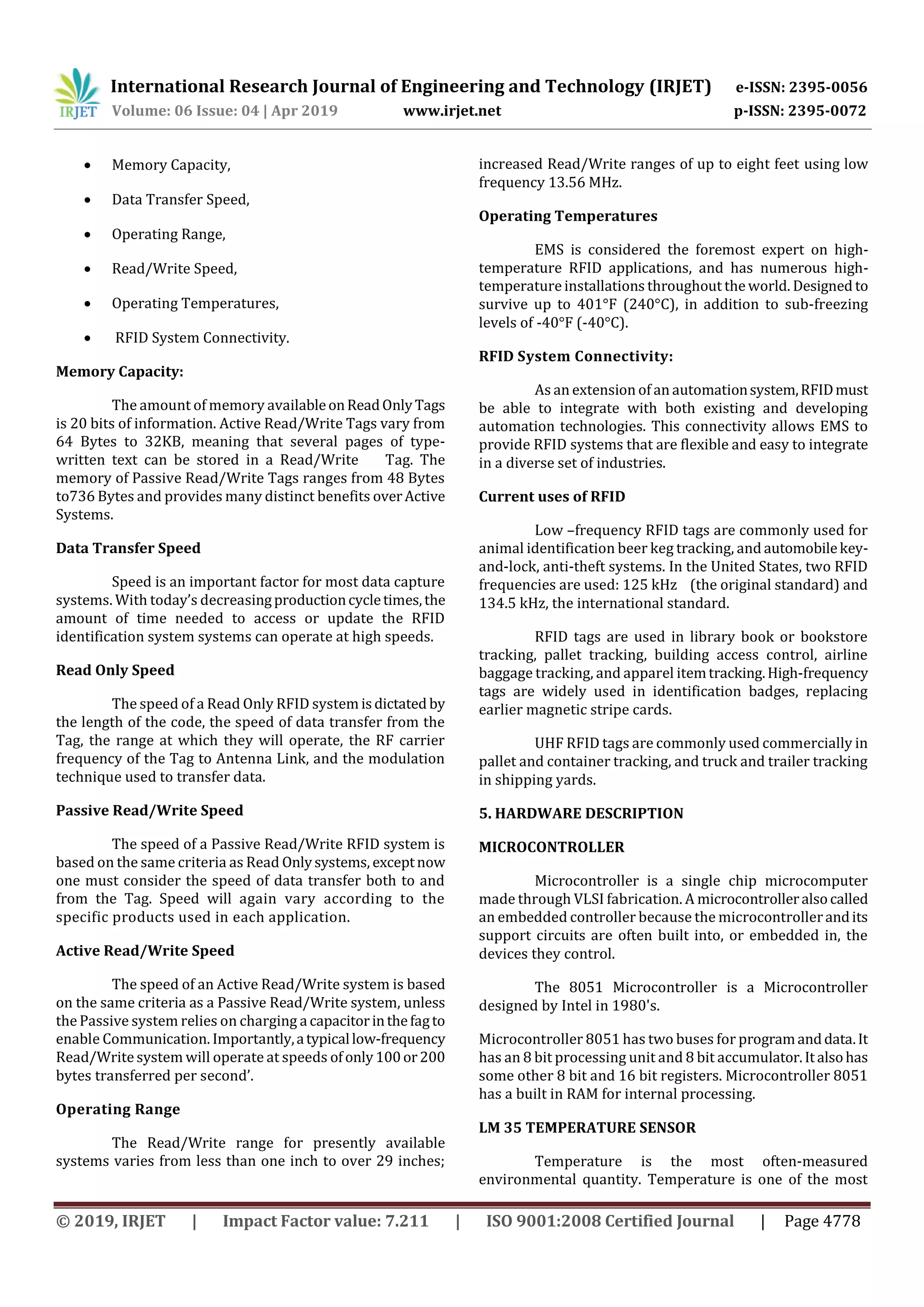
Active tags
Active RFID tags, on the other hand, must have a
power source, and may have longer ranges and larger
memories than passive tags, as well as the ability to
store additional information sent by the transceiver. The
advantage is that tag is not dependent on the strength of,
the carrier from the interrogator to provide the power it
needs.
Components of active RFID System
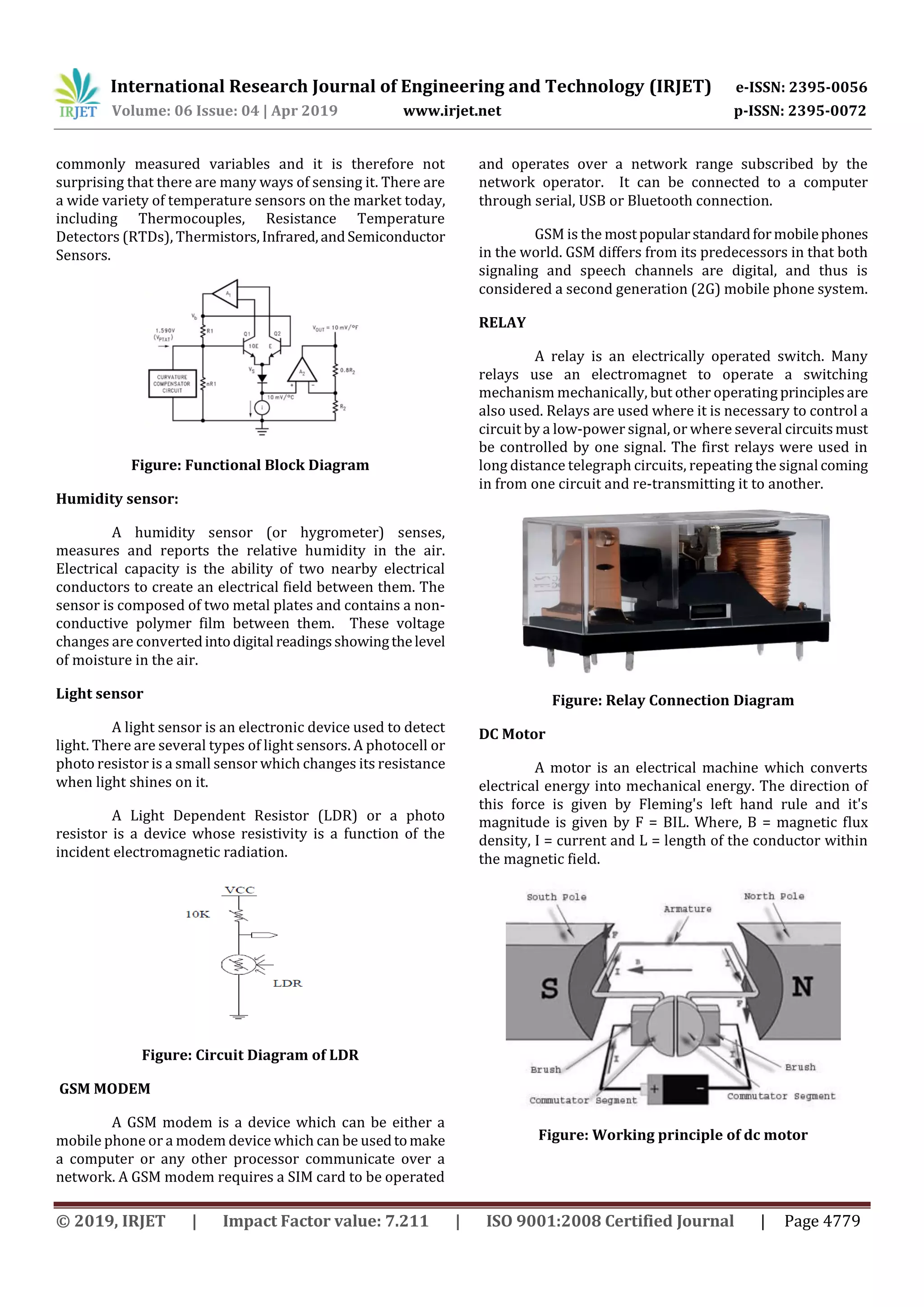
Passive tags
Passive RFID tags do not have their own power
supply. The minute electrical current inducedintheantenna
by the incoming radio-frequency scan provides enough
power for the tag to send a response. This system also
communicates through a reader which broadcasts a signal
through an antenna. When a transponder enterstheantenna
field, it receives the signal and energy from the reader. The
tag is “charged” with enough power to send back a unique ID
to the reader.
Components of a passive RFID system
RFID performance criterion
The performance of a Read/Write RFID system is
dictated by the following criteria:
Batter
y
~1
00
m
International Research Journal of Engineering and Technology (IRJET) e-ISSN: 2395-0056
Volume: 06 Issue: 04 | Apr 2019 www.irjet.net p-ISSN: 2395-0072
© 2019, IRJET | Impact Factor value: 7.211 | ISO 9001:2008 Certified Journal | Page 4778
 Memory Capacity,
 Data Transfer Speed,
 Operating Range,
 Read/Write Speed,
 Operating Temperatures,
 RFID System Connectivity.
Memory Capacity:
The amount of memory availableonReadOnlyTags
is 20 bits of information. Active Read/Write Tags vary from
64 Bytes to 32KB, meaning that several pages of type-
written text can be stored in a Read/Write Tag. The
memory of Passive Read/Write Tags ranges from 48 Bytes
to736 Bytes and provides many distinct benefits overActive
Systems.
Data Transfer Speed
Speed is an important factor for most data capture
systems. With today’s decreasingproductioncycletimes,the
amount of time needed to access or update the RFID
identification system systems can operate at high speeds.
Read Only Speed
The speed of a Read Only RFID system isdictated by
the length of the code, the speed of data transfer from the
Tag, the range at which they will operate, the RF carrier
frequency of the Tag to Antenna Link, and the modulation
technique used to transfer data.
Passive Read/Write Speed
The speed of a Passive Read/Write RFID system is
based on the same criteria as Read Onlysystems, exceptnow
one must consider the speed of data transfer both to and
from the Tag. Speed will again vary according to the
specific products used in each application.
Active Read/Write Speed
The speed of an Active Read/Write system is based
on the same criteria as a Passive Read/Write system, unless
the Passive system relies on charging a capacitorinthefagto
enable Communication. Importantly,atypicallow-frequency
Read/Writesystem will operate at speeds ofonly100or200
bytes transferred per second’.
Operating Range
The Read/Write range for presently available
systems varies from less than one inch to over 29 inches;
increased Read/Write ranges of up to eight feet using low
frequency 13.56 MHz.
Operating Temperatures
EMS is considered the foremost expert on high-
temperature RFID applications, and has numerous high-
temperatureinstallations throughout the world. Designed to
survive up to 401°F (240°C), in addition to sub-freezing
levels of -40°F (-40°C).
RFID System Connectivity:
As an extension of an automationsystem,RFIDmust
be able to integrate with both existing and developing
automation technologies. This connectivity allows EMS to
provide RFID systems that are flexible and easy to integrate
in a diverse set of industries.
Current uses of RFID
Low –frequency RFID tags are commonly used for
animal identification beer keg tracking, and automobilekey-
and-lock, anti-theft systems. In the United States, two RFID
frequencies are used: 125 kHz (the original standard) and
134.5 kHz, the international standard.
RFID tags are used in library book or bookstore
tracking, pallet tracking, building access control, airline
baggage tracking, and apparel itemtracking.High-frequency
tags are widely used in identification badges, replacing
earlier magnetic stripe cards.
UHF RFID tags are commonly used commercially in
pallet and container tracking, and truck and trailer tracking
in shipping yards.
5. HARDWARE DESCRIPTION
MICROCONTROLLER
Microcontroller is a single chip microcomputer
made through VLSI fabrication. A microcontrolleralsocalled
an embedded controller because the microcontrollerandits
support circuits are often built into, or embedded in, the
devices they control.
The 8051 Microcontroller is a Microcontroller
designed by Intel in 1980's.
Microcontroller 8051 has two buses for programanddata.It
has an 8 bit processing unit and 8 bit accumulator.Italsohas
some other 8 bit and 16 bit registers. Microcontroller 8051
has a built in RAM for internal processing.
LM 35 TEMPERATURE SENSOR
Temperature is the most often-measured
environmental quantity. Temperature is one of the most
International Research Journal of Engineering and Technology (IRJET) e-ISSN: 2395-0056
Volume: 06 Issue: 04 | Apr 2019 www.irjet.net p-ISSN: 2395-0072
© 2019, IRJET | Impact Factor value: 7.211 | ISO 9001:2008 Certified Journal | Page 4779
commonly measured variables and it is therefore not
surprising that there are many ways of sensing it. There are
a wide variety of temperature sensors on the market today,
including Thermocouples, Resistance Temperature
Detectors (RTDs), Thermistors,Infrared,andSemiconductor
Sensors.
Figure: Functional Block Diagram
Humidity sensor:
A humidity sensor (or hygrometer) senses,
measures and reports the relative humidity in the air.
Electrical capacity is the ability of two nearby electrical
conductors to create an electrical field between them. The
sensor is composed of two metal plates and contains a non-
conductive polymer film between them. These voltage
changes are convertedintodigital readingsshowingthelevel
of moisture in the air.
Light sensor
A light sensor is an electronic device used to detect
light. There are several types of light sensors. A photocell or
photo resistor is a small sensor which changes its resistance
when light shines on it.
A Light Dependent Resistor (LDR) or a photo
resistor is a device whose resistivity is a function of the
incident electromagnetic radiation.
Figure: Circuit Diagram of LDR
GSM MODEM
A GSM modem is a device which can be either a
mobile phone or a modem device which can be usedtomake
a computer or any other processor communicate over a
network. A GSM modem requires a SIM card to be operated
and operates over a network range subscribed by the
network operator. It can be connected to a computer
through serial, USB or Bluetooth connection.
GSM is the mostpopularstandardformobilephones
in the world. GSM differs from its predecessors in that both
signaling and speech channels are digital, and thus is
considered a second generation (2G) mobile phone system.
RELAY
A relay is an electrically operated switch. Many
relays use an electromagnet to operate a switching
mechanism mechanically, but other operating principlesare
also used. Relays are used where it is necessary to control a
circuit by a low-power signal, or where several circuitsmust
be controlled by one signal. The first relays were used in
long distance telegraph circuits, repeating the signal coming
in from one circuit and re-transmitting it to another.
Figure: Relay Connection Diagram
DC Motor
A motor is an electrical machine which converts
electrical energy into mechanical energy. The direction of
this force is given by Fleming's left hand rule and it's
magnitude is given by F = BIL. Where, B = magnetic flux
density, I = current and L = length of the conductor within
the magnetic field.
Figure: Working principle of dc motor
International Research Journal of Engineering and Technology (IRJET) e-ISSN: 2395-0056
Volume: 06 Issue: 04 | Apr 2019 www.irjet.net p-ISSN: 2395-0072
© 2019, IRJET | Impact Factor value: 7.211 | ISO 9001:2008 Certified Journal | Page 4780
TRANSFORMER
Figure: Transformer working diagram
A transformer can be defined as a static device
which helps in the transformation of electric power in one
circuit to electric power of the same frequency in another
circuit. The voltage can be raised or lowered in a circuit, but
with a proportional increase or decrease in the current
ratings.
Most of the alternating flux developed by this coil is
linked with the other coil and thus produces the mutual
induced electro-motive force.
DIODES
A diode is a device which only allows unidirectional
flow of current operated within a rated specified voltage
level. The diode acts as a valve in theelectrical andelectronic
circuit. So a particular arrangement of diodes can convert
AC to pulsating DC, and hence, it is sometimesalsocalledasa
rectifier. The name diode is derived from "diode" which
means a device having two electrodes.
Symbol of Diode
Figure: Symbol of Diode
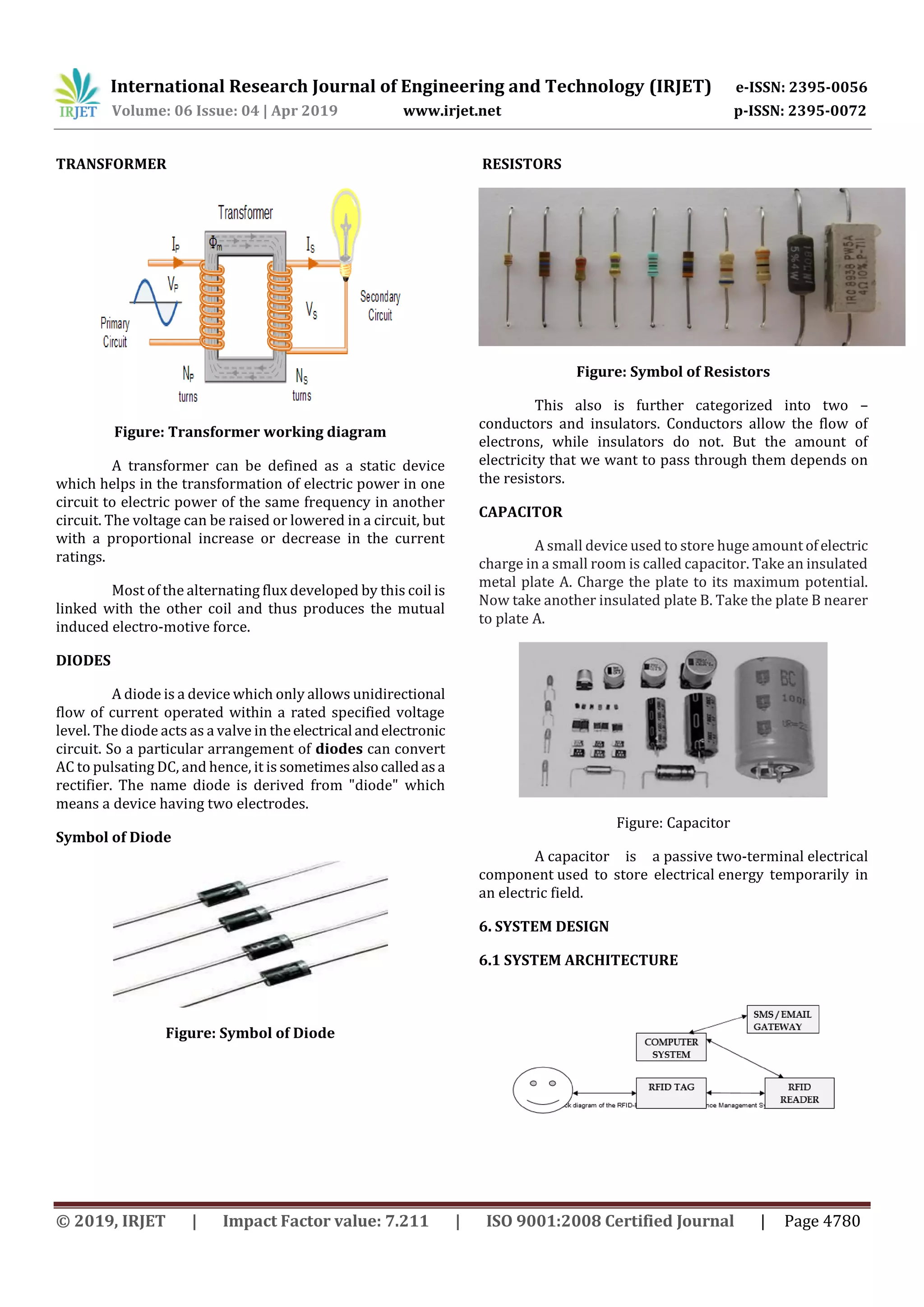
RESISTORS
Figure: Symbol of Resistors
This also is further categorized into two –
conductors and insulators. Conductors allow the flow of
electrons, while insulators do not. But the amount of
electricity that we want to pass through them depends on
the resistors.
CAPACITOR
A small device used to store huge amount ofelectric
charge in a small room is called capacitor. Take an insulated
metal plate A. Charge the plate to its maximum potential.
Now take another insulated plate B. Take the plate B nearer
to plate A.
Figure: Capacitor
A capacitor is a passive two-terminal electrical
component used to store electrical energy temporarily in
an electric field.
6. SYSTEM DESIGN
6.1 SYSTEM ARCHITECTURE
International Research Journal of Engineering and Technology (IRJET) e-ISSN: 2395-0056
Volume: 06 Issue: 04 | Apr 2019 www.irjet.net p-ISSN: 2395-0072
© 2019, IRJET | Impact Factor value: 7.211 | ISO 9001:2008 Certified Journal | Page 4781
7. CONCLUSION
In this system, Smart Attendance System utilizing
RFID can support the manual framework thatchangeofdata
can be convey effortlessly. The system is successfully built
and run in reality based on Technology Acceptance
Modeling. After development is finished, test for sensor’s
work is done and device is working properly. The testing
that has done shows that condition in datasheet of sensor
and in system is appropriate. Despite the fact that there are
distinctive strategies for following understudy yet our
framework is anything but difficult to handle and extremely
advantages for college level.
8. FUTURE ENHANCEMENT
In this system, we can replace the manual system
that transformation of information can be delivered without
a hitch. This system will ease is college to monitor the
student .The system can reduces manpower, Although there
are different methods of tracking student but out system is
very easy to handle and very convenient for college level.
This system gives time savings, easy control and reliability.
In future, we can add voice announcement system to this
project, so whenever the user logs in, we can announce
message like, Your attendance has been logged in, so please
come forward and we can implement GSM technology.
9. REFERENCES
[1] HerdawatieBt Abdul Kadir, Mohd HelmyAbd.
Wahab and Siti Nurul Aqmariah Bt Mohd Kanafiah
―Boarding School Students Monitoring Systems(EID)Using
Radio Frequency Identification‖ ―Faculty of Electrical and
Electronic Engineering, University Tun Hussein Onn
Malaysia, 86400 Parit Raja, BatuPahat, Johor, Malaysia,
Journal of Social Sciences 5(3):206- 211 2009
[2] Abdul Kadir1, Mohd Helmy Abd Wah Ab2, Zarina
Tukiran3, Ariffin AbdulMutalib4 ―Tracking Student
Movement using Active RFIDHERDAWATIE‖1,2,3Facultyof
Electrical and Electronic EngineeringUniversitiTunHussein
Onn Malaysia P.O. Box 101, Pt. Raja, Batu Pahat, Johor,ISSN:
1790-5117,ISBN:978-960-474-166-3MALAYSIA
[3] Amin A. Al-Zarouni, Nassar H. Fakhro ―Mobile RFID
Tracking System‖ Computer Engineering Department
American University of Sharjah, UAE
[4] Member), Z. Chalhoub, and S. EI Dahdaah, ―An RFID
Attendance and Monitoring System for University
Applications ‖Department of Electrical and computer and
communication Engineering Notre DameUniversityLouaize
Zouk Mosbeh, 978-1-4244-8157- 6/102010.
[5] Dawes A.T. (2004),‖Is RFID Right for Your Library‖,
Journal of Access Services, Volume 2(4), pp 7-13.

IRJET- Intelligent Student Tracking and Monitoring for College Infrastructure by using RFID

  • 1.
    International Research Journalof Engineering and Technology (IRJET) e-ISSN: 2395-0056 Volume: 06 Issue: 04 | Apr 2019 www.irjet.net p-ISSN: 2395-0072 © 2019, IRJET | Impact Factor value: 7.211 | ISO 9001:2008 Certified Journal | Page 4776 INTELLIGENT STUDENT TRACKING AND MONITORING FOR COLLEGE INFRASTRUCTURE BY USING RFID S.Priyadharshini1, J. Sujatha2 1PG Scholar, Department of MCA, Arulmigu Meenakshi Amman College of Engineering, Anna University, Vadamavandal (near Kanchipuram), India. 2Assistant Professor, Department of MCA, Arulmigu Meenakshi Amman College of Engineering, Anna University, Vadamavandal (near Kanchipuram), India. ----------------------------------------------------------------------***--------------------------------------------------------------------- ABSTRACT:-This project is developed by using Radio Frequency Identification (RFID) system and student card to get student attendance. There were a lot of problems when using as student attendance such as cheating. The project system was running by get the code of card student to compare with the database in Access. Graphical User Interface (GUI) was developed using Embedded C to make the database easier to access. This part is important because we need the information in this part to use in the next interface. After the reader was ready, process to get attendant will started. Students need to swap their card on the reader and the code from the card will use to compare with database in Access. When the code is match with database, the student information like name and ID number will show on interface and that information will trigger into a list. This list will use as a student attendance. This project will help lecturer taking the student attendance more easily and automatically. As theconclusion,RFIDtechnologycanbe used in student attendance application. 1. INTRODUCTION This embedded system for monitoring and controlling the student is based on measuring the humidity and temperature by sensor that located at different places. The sensors sense the change and the microcontroller reads this from the data at its input ports afterbeingconvertedtoa digital form by the ADC. The microcontroller then performs the needed actions by employing relaysuntil thestrayed-out parameter has been brought back to its optimum level. As the system also employs an LCD display for continuously alerting the user about the conditioninsidethe student, the entire set-up becomes user friendly. Thus, this system eliminates the drawbacks of the existing set-ups and is designed as an easy to maintain, flexible and low cost solution. Student monitoring system is technical intransitiveinwhich the control of student environment continuous monitoring and recording of these environmental variables gives information to the grower better understand. The monitoring method can be implemented in various situations such as monitoring qualities. Wireless sensor network (WSN) can form a useful part of the automation system architecture in modern students. 2. SYSTEM ANALYSIS 2.1 Existing System RFID is an automated identification and data collection technology, that ensures more accurate and timely data entry. RFID combines radio frequency and microchip technologies to create a smart system that can be used to identify, monitor, secure and do objectinventory. Topresent an intelligent RFID based lecture attendance access control and management system. Drawback in existing System 1. Insufficient budget available, complexity of technology and systems. 2. Cost still very high for providers Prohibitivecosts and Privacy concerns. 2.2 Proposed System By incorporating a facial recognition application that would serve to furtherincreasethe biometricsecurityof the system against impersonation by erring students. Usage of High Frequency (HF) active RFID tagsagainstpassiveLow frequency (LF) RFID tags for better performance and flexibility of users Performance evaluationofcombination of thumbprint, facial recognition and RFID technology to students’ attendance monitoring problem. 3. SYSTEM SPECIFICATION 3.1 HARDWARE REQUIREMENTS  Microcontroller  LM 35 Temperature sensor  Humidity sensor  Light sensor  GSM
  • 2.
    International Research Journalof Engineering and Technology (IRJET) e-ISSN: 2395-0056 Volume: 06 Issue: 04 | Apr 2019 www.irjet.net p-ISSN: 2395-0072 © 2019, IRJET | Impact Factor value: 7.211 | ISO 9001:2008 Certified Journal | Page 4777  Relay  Dc motor  Transformer  Diode  Resistor  Capacitor 3.2 SOFTWARE REQUIREMENTS  Keil Compiler  Language: Basic Embedded C 4. MODULES AND DESCRIPTION 4.1 Block diagram 4.2 Radio Frequency Identification Device (RFID) RFID is Radio Frequency IdentificationDevice.Itisa fast, affordable and automatic identification technologythat uses radio frequency (RF) to transfer data between a RFID reader and a RFID tag. RFID tags contain antennas to enable them to receive and respond to radio-frequency queries from an RFID transceiver. 1) 4.2.1 Modules of RFID The RFID system basically consists of three components:  A RFID tag (Transponder)  An Interrogator or a tag reader  Computer or Processor RFID tags: An RFID tag is a small object that can be attached to orincorporated intoa product.RFID tagscontainantennaeto enable them to receive and respond to radio-frequency queries from the interrogator. Transponders (tags) can be classified in to two  Active tags -With internal power supply  Passive tags -Without internal power supply Active tags Active RFID tags, on the other hand, must have a power source, and may have longer ranges and larger memories than passive tags, as well as the ability to store additional information sent by the transceiver. The advantage is that tag is not dependent on the strength of, the carrier from the interrogator to provide the power it needs. Components of active RFID System Passive tags Passive RFID tags do not have their own power supply. The minute electrical current inducedintheantenna by the incoming radio-frequency scan provides enough power for the tag to send a response. This system also communicates through a reader which broadcasts a signal through an antenna. When a transponder enterstheantenna field, it receives the signal and energy from the reader. The tag is “charged” with enough power to send back a unique ID to the reader. Components of a passive RFID system RFID performance criterion The performance of a Read/Write RFID system is dictated by the following criteria: Batter y ~1 00 m
  • 3.
    International Research Journalof Engineering and Technology (IRJET) e-ISSN: 2395-0056 Volume: 06 Issue: 04 | Apr 2019 www.irjet.net p-ISSN: 2395-0072 © 2019, IRJET | Impact Factor value: 7.211 | ISO 9001:2008 Certified Journal | Page 4778  Memory Capacity,  Data Transfer Speed,  Operating Range,  Read/Write Speed,  Operating Temperatures,  RFID System Connectivity. Memory Capacity: The amount of memory availableonReadOnlyTags is 20 bits of information. Active Read/Write Tags vary from 64 Bytes to 32KB, meaning that several pages of type- written text can be stored in a Read/Write Tag. The memory of Passive Read/Write Tags ranges from 48 Bytes to736 Bytes and provides many distinct benefits overActive Systems. Data Transfer Speed Speed is an important factor for most data capture systems. With today’s decreasingproductioncycletimes,the amount of time needed to access or update the RFID identification system systems can operate at high speeds. Read Only Speed The speed of a Read Only RFID system isdictated by the length of the code, the speed of data transfer from the Tag, the range at which they will operate, the RF carrier frequency of the Tag to Antenna Link, and the modulation technique used to transfer data. Passive Read/Write Speed The speed of a Passive Read/Write RFID system is based on the same criteria as Read Onlysystems, exceptnow one must consider the speed of data transfer both to and from the Tag. Speed will again vary according to the specific products used in each application. Active Read/Write Speed The speed of an Active Read/Write system is based on the same criteria as a Passive Read/Write system, unless the Passive system relies on charging a capacitorinthefagto enable Communication. Importantly,atypicallow-frequency Read/Writesystem will operate at speeds ofonly100or200 bytes transferred per second’. Operating Range The Read/Write range for presently available systems varies from less than one inch to over 29 inches; increased Read/Write ranges of up to eight feet using low frequency 13.56 MHz. Operating Temperatures EMS is considered the foremost expert on high- temperature RFID applications, and has numerous high- temperatureinstallations throughout the world. Designed to survive up to 401°F (240°C), in addition to sub-freezing levels of -40°F (-40°C). RFID System Connectivity: As an extension of an automationsystem,RFIDmust be able to integrate with both existing and developing automation technologies. This connectivity allows EMS to provide RFID systems that are flexible and easy to integrate in a diverse set of industries. Current uses of RFID Low –frequency RFID tags are commonly used for animal identification beer keg tracking, and automobilekey- and-lock, anti-theft systems. In the United States, two RFID frequencies are used: 125 kHz (the original standard) and 134.5 kHz, the international standard. RFID tags are used in library book or bookstore tracking, pallet tracking, building access control, airline baggage tracking, and apparel itemtracking.High-frequency tags are widely used in identification badges, replacing earlier magnetic stripe cards. UHF RFID tags are commonly used commercially in pallet and container tracking, and truck and trailer tracking in shipping yards. 5. HARDWARE DESCRIPTION MICROCONTROLLER Microcontroller is a single chip microcomputer made through VLSI fabrication. A microcontrolleralsocalled an embedded controller because the microcontrollerandits support circuits are often built into, or embedded in, the devices they control. The 8051 Microcontroller is a Microcontroller designed by Intel in 1980's. Microcontroller 8051 has two buses for programanddata.It has an 8 bit processing unit and 8 bit accumulator.Italsohas some other 8 bit and 16 bit registers. Microcontroller 8051 has a built in RAM for internal processing. LM 35 TEMPERATURE SENSOR Temperature is the most often-measured environmental quantity. Temperature is one of the most
  • 4.
    International Research Journalof Engineering and Technology (IRJET) e-ISSN: 2395-0056 Volume: 06 Issue: 04 | Apr 2019 www.irjet.net p-ISSN: 2395-0072 © 2019, IRJET | Impact Factor value: 7.211 | ISO 9001:2008 Certified Journal | Page 4779 commonly measured variables and it is therefore not surprising that there are many ways of sensing it. There are a wide variety of temperature sensors on the market today, including Thermocouples, Resistance Temperature Detectors (RTDs), Thermistors,Infrared,andSemiconductor Sensors. Figure: Functional Block Diagram Humidity sensor: A humidity sensor (or hygrometer) senses, measures and reports the relative humidity in the air. Electrical capacity is the ability of two nearby electrical conductors to create an electrical field between them. The sensor is composed of two metal plates and contains a non- conductive polymer film between them. These voltage changes are convertedintodigital readingsshowingthelevel of moisture in the air. Light sensor A light sensor is an electronic device used to detect light. There are several types of light sensors. A photocell or photo resistor is a small sensor which changes its resistance when light shines on it. A Light Dependent Resistor (LDR) or a photo resistor is a device whose resistivity is a function of the incident electromagnetic radiation. Figure: Circuit Diagram of LDR GSM MODEM A GSM modem is a device which can be either a mobile phone or a modem device which can be usedtomake a computer or any other processor communicate over a network. A GSM modem requires a SIM card to be operated and operates over a network range subscribed by the network operator. It can be connected to a computer through serial, USB or Bluetooth connection. GSM is the mostpopularstandardformobilephones in the world. GSM differs from its predecessors in that both signaling and speech channels are digital, and thus is considered a second generation (2G) mobile phone system. RELAY A relay is an electrically operated switch. Many relays use an electromagnet to operate a switching mechanism mechanically, but other operating principlesare also used. Relays are used where it is necessary to control a circuit by a low-power signal, or where several circuitsmust be controlled by one signal. The first relays were used in long distance telegraph circuits, repeating the signal coming in from one circuit and re-transmitting it to another. Figure: Relay Connection Diagram DC Motor A motor is an electrical machine which converts electrical energy into mechanical energy. The direction of this force is given by Fleming's left hand rule and it's magnitude is given by F = BIL. Where, B = magnetic flux density, I = current and L = length of the conductor within the magnetic field. Figure: Working principle of dc motor
  • 5.
    International Research Journalof Engineering and Technology (IRJET) e-ISSN: 2395-0056 Volume: 06 Issue: 04 | Apr 2019 www.irjet.net p-ISSN: 2395-0072 © 2019, IRJET | Impact Factor value: 7.211 | ISO 9001:2008 Certified Journal | Page 4780 TRANSFORMER Figure: Transformer working diagram A transformer can be defined as a static device which helps in the transformation of electric power in one circuit to electric power of the same frequency in another circuit. The voltage can be raised or lowered in a circuit, but with a proportional increase or decrease in the current ratings. Most of the alternating flux developed by this coil is linked with the other coil and thus produces the mutual induced electro-motive force. DIODES A diode is a device which only allows unidirectional flow of current operated within a rated specified voltage level. The diode acts as a valve in theelectrical andelectronic circuit. So a particular arrangement of diodes can convert AC to pulsating DC, and hence, it is sometimesalsocalledasa rectifier. The name diode is derived from "diode" which means a device having two electrodes. Symbol of Diode Figure: Symbol of Diode RESISTORS Figure: Symbol of Resistors This also is further categorized into two – conductors and insulators. Conductors allow the flow of electrons, while insulators do not. But the amount of electricity that we want to pass through them depends on the resistors. CAPACITOR A small device used to store huge amount ofelectric charge in a small room is called capacitor. Take an insulated metal plate A. Charge the plate to its maximum potential. Now take another insulated plate B. Take the plate B nearer to plate A. Figure: Capacitor A capacitor is a passive two-terminal electrical component used to store electrical energy temporarily in an electric field. 6. SYSTEM DESIGN 6.1 SYSTEM ARCHITECTURE
  • 6.
    International Research Journalof Engineering and Technology (IRJET) e-ISSN: 2395-0056 Volume: 06 Issue: 04 | Apr 2019 www.irjet.net p-ISSN: 2395-0072 © 2019, IRJET | Impact Factor value: 7.211 | ISO 9001:2008 Certified Journal | Page 4781 7. CONCLUSION In this system, Smart Attendance System utilizing RFID can support the manual framework thatchangeofdata can be convey effortlessly. The system is successfully built and run in reality based on Technology Acceptance Modeling. After development is finished, test for sensor’s work is done and device is working properly. The testing that has done shows that condition in datasheet of sensor and in system is appropriate. Despite the fact that there are distinctive strategies for following understudy yet our framework is anything but difficult to handle and extremely advantages for college level. 8. FUTURE ENHANCEMENT In this system, we can replace the manual system that transformation of information can be delivered without a hitch. This system will ease is college to monitor the student .The system can reduces manpower, Although there are different methods of tracking student but out system is very easy to handle and very convenient for college level. This system gives time savings, easy control and reliability. In future, we can add voice announcement system to this project, so whenever the user logs in, we can announce message like, Your attendance has been logged in, so please come forward and we can implement GSM technology. 9. REFERENCES [1] HerdawatieBt Abdul Kadir, Mohd HelmyAbd. Wahab and Siti Nurul Aqmariah Bt Mohd Kanafiah ―Boarding School Students Monitoring Systems(EID)Using Radio Frequency Identification‖ ―Faculty of Electrical and Electronic Engineering, University Tun Hussein Onn Malaysia, 86400 Parit Raja, BatuPahat, Johor, Malaysia, Journal of Social Sciences 5(3):206- 211 2009 [2] Abdul Kadir1, Mohd Helmy Abd Wah Ab2, Zarina Tukiran3, Ariffin AbdulMutalib4 ―Tracking Student Movement using Active RFIDHERDAWATIE‖1,2,3Facultyof Electrical and Electronic EngineeringUniversitiTunHussein Onn Malaysia P.O. Box 101, Pt. Raja, Batu Pahat, Johor,ISSN: 1790-5117,ISBN:978-960-474-166-3MALAYSIA [3] Amin A. Al-Zarouni, Nassar H. Fakhro ―Mobile RFID Tracking System‖ Computer Engineering Department American University of Sharjah, UAE [4] Member), Z. Chalhoub, and S. EI Dahdaah, ―An RFID Attendance and Monitoring System for University Applications ‖Department of Electrical and computer and communication Engineering Notre DameUniversityLouaize Zouk Mosbeh, 978-1-4244-8157- 6/102010. [5] Dawes A.T. (2004),‖Is RFID Right for Your Library‖, Journal of Access Services, Volume 2(4), pp 7-13.