International Research Journal of Engineering and Technology (IRJET) e-ISSN: 2395-0056
Volume: 06 Issue: 3 | Mar 2019 www.irjet.net p-ISSN: 2395-0072
© 2019, IRJET | Impact Factor value: 7.211 | ISO 9001:2008 Certified Journal | Page 5065
An IoT based Remote HRV Monitoring System for Hypertensive
Patients
M.Chandana1, S.P Siva Reddy2, N.Niranjan Reddy3 , C.Dharma Teja4, M.Roshini5
1234 Student, Dept. Of Computer Science & Engineering, Mother Theresa Institute of Engineering and Technology,
Palamaner, Andhra Pradesh, India.
5 Associate. Professor, Dept of Computer Science & Engineering, Mother Theresa Institute of Engineering and
Technology, Palamaner, Andhra Pradesh, India.
---------------------------------------------------------------------***---------------------------------------------------------------------
Abstract - In many countries, the important public health issueisthatpatientswithchronic diseasesareincreasing rapidly. This
accelerated many studies on a healthcare system that can whenever and wherever, extract and process patient data. Foreffective
care, a patient with a chronic disease conducts self- management at the hospital environment and particularly at home
environment. So it is necessary to provide integrated and personalized healthcare services. A service flow and a new model for
personalized healthcare system architecture supporting an at-home and at-hospital environments are proposed to provide
effective care for chronic disease patients. The system provides various chronic disease care services considering the different
characteristics of at-hospital and at-home environments. The effectiveness of the system is shown by providing a prototype
implementation, and a predicted cost model. An at-hospital environment and personalized self-managementofchronic diseasein
an at-home environment that supports cost-effective disease care is proposed at the personalized healthcare system.
Key Words: Chronic, Environment, Healthcare, Personalize.
1.INTRODUCTION
Continuously monitoring and observing the health parameterslikeglucosecontent,temperature,heartbeat,etcisverydifficult
today. It requires manpower to monitor. If In case the human being careless or engaged in different work or tiredness they
can't monitor. So in this situation death is also possible. We are living in the 21st century in this century year science and
technology evolves a vital role. In this project embedded technology has beenused.Thehealthparametersare beingmeasured
by using different types of sensors. These values are given to the input of the ARDUINO controller. An ARDUINO controller
compares the values from the sensors and takes the necessary action on that.
2.EXSISTING SYSTEM
In many applications, wireless technology has propagated the use of sensor networks. In general purpose computing
components, sensor networks join small sized sensors and actuators. Such networks comprise hundreds and sometimes
thousands of self-functioning, low power, inexpensive wireless nodes to observe and influence the surroundings.Unlikemost
of the existing methods with systems, there are many wireless technologiesareavailabletomonitorbuttherange ofdistance is
limited.
2.1 DISADVANTAGES OF EXISTING SYSTEM:
 It requires manpower to monitor
 Continuously monitoring and observing the health parameters like temperature, heartbeat, etc is very difficult.
3.PROPOSED SYSTEM
In this session, we are using IOT for monitoring. In IOT there is no limit to distance. We can monitor the patient heartbeat and
temperature from anywhere through the internet. Our approach is to monitor real-time temperature and heart rate through
the cloud. The collected temperature and heart rate can be stored and analyzed in real time through an IOT technology for
prognosis and diagnosis. The proposed hardware system consists of a single chip microcontroller embedded with GPRS to
International Research Journal of Engineering and Technology (IRJET) e-ISSN: 2395-0056
Volume: 06 Issue: 3 | Mar 2019 www.irjet.net p-ISSN: 2395-0072
© 2019, IRJET | Impact Factor value: 7.211 | ISO 9001:2008 Certified Journal | Page 5066
connect the internet. Results shown at the proposed system could be comparable to medical-grade services. By using thing
speak server account we can analyze those signals directly in our mobile phone usingtheinternetatanywherefromtheworld.
3.1 ADVANTAGES OF PROPOSED SYSTEM:
 Very compatible it is very useful in medical camps.
 Useful in hospitals it reduces the heavy equipment.
 Very use full in taking care of disabled persons.
 Low power consumption, more reliable, more compatible, less cost.
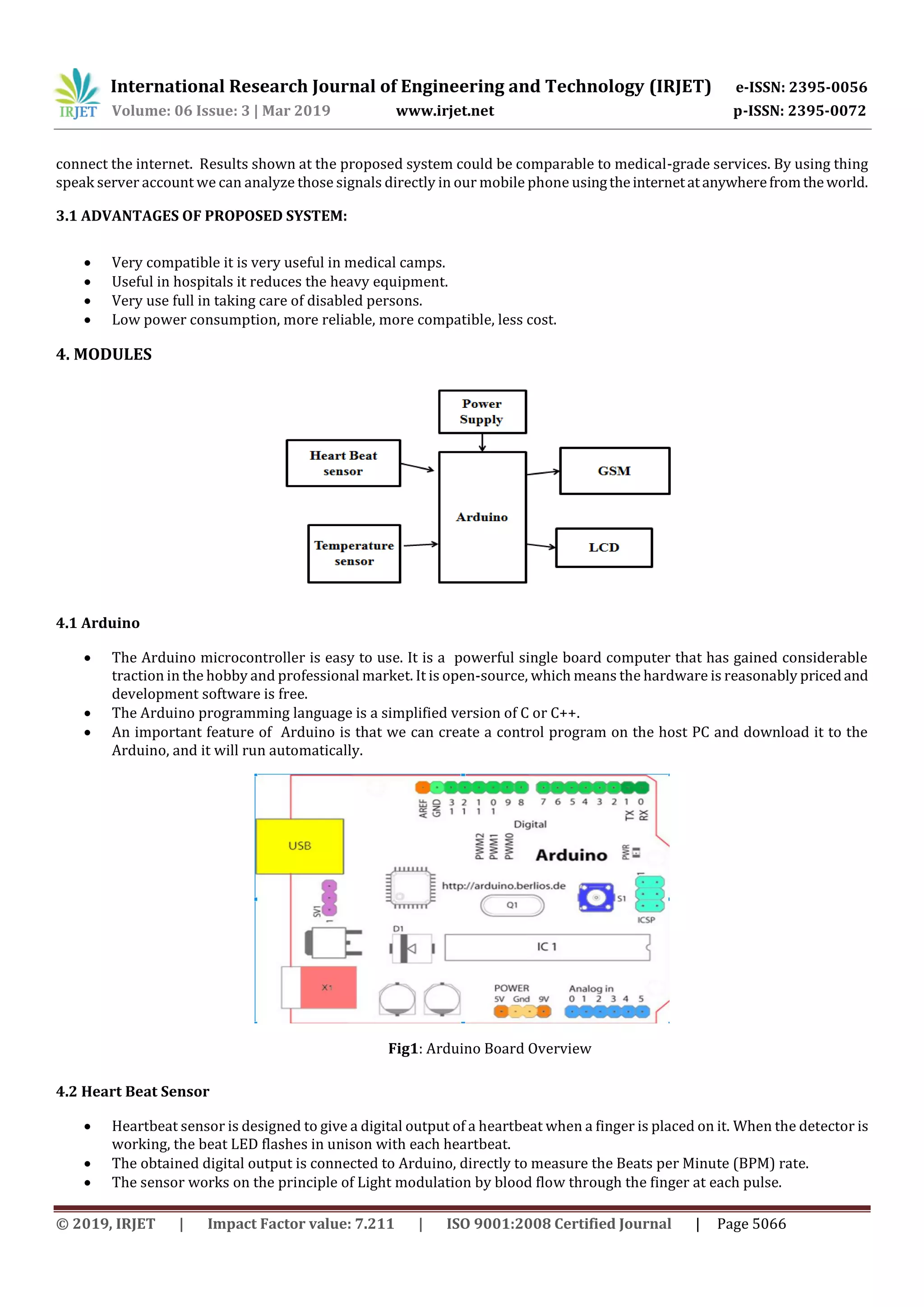
4. MODULES
4.1 Arduino
 The Arduino microcontroller is easy to use. It is a powerful single board computer that has gained considerable
traction in the hobby and professional market. It is open-source, which means the hardware is reasonably pricedand
development software is free.
 The Arduino programming language is a simplified version of C or C++.
 An important feature of Arduino is that we can create a control program on the host PC and download it to the
Arduino, and it will run automatically.
Fig1: Arduino Board Overview
4.2 Heart Beat Sensor
 Heartbeat sensor is designed to give a digital output of a heartbeat when a finger is placed on it. When the detector is
working, the beat LED flashes in unison with each heartbeat.
 The obtained digital output is connected to Arduino, directly to measure the Beats per Minute (BPM) rate.
 The sensor works on the principle of Light modulation by blood flow through the finger at each pulse.
International Research Journal of Engineering and Technology (IRJET) e-ISSN: 2395-0056
Volume: 06 Issue: 3 | Mar 2019 www.irjet.net p-ISSN: 2395-0072
© 2019, IRJET | Impact Factor value: 7.211 | ISO 9001:2008 Certified Journal | Page 5067
4.3 Temperature Sensor - LM35
 We can measure the temperature more accurately than using thermistors. The sensor circuitry is sealed and not
subjected to oxidation, etc.
 Possesses a low self-heating capability. The output voltage is converted into temperature by a simple conversion
factor.
 The operating temperature range is between -55°C to 150°C. It is a precision IC temperature sensor with output
proportional to the temperature.
4.4 Power Supply
 Power supply delivers an exact voltage to another device as per its needs. The power supplies available today in the
market are regulated, unregulated, variable, etc. The decision to pick the correct one depends on the device we try to
operate with the power supply.
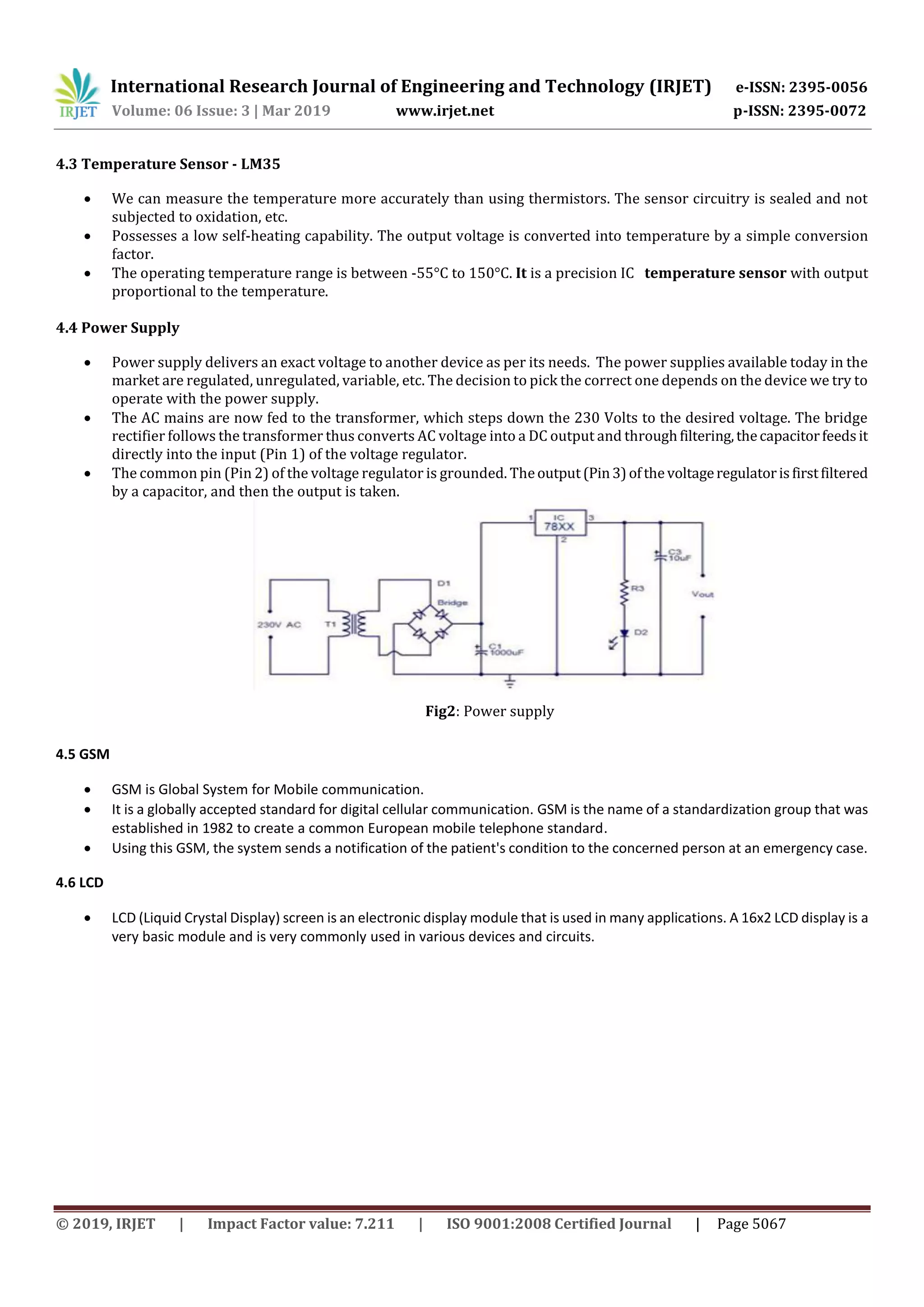
 The AC mains are now fed to the transformer, which steps down the 230 Volts to the desired voltage. The bridge
rectifier follows the transformer thus converts AC voltage into a DC output and throughfiltering,thecapacitorfeedsit
directly into the input (Pin 1) of the voltage regulator.
 The common pin (Pin 2) of the voltage regulator is grounded. Theoutput(Pin3)ofthevoltageregulatorisfirstfiltered
by a capacitor, and then the output is taken.
Fig2: Power supply
4.5 GSM
 GSM is Global System for Mobile communication.
 It is a globally accepted standard for digital cellular communication. GSM is the name of a standardization group that was
established in 1982 to create a common European mobile telephone standard.
 Using this GSM, the system sends a notification of the patient's condition to the concerned person at an emergency case.
4.6 LCD
 LCD (Liquid Crystal Display) screen is an electronic display module that is used in many applications. A 16x2 LCD display is a
very basic module and is very commonly used in various devices and circuits.
International Research Journal of Engineering and Technology (IRJET) e-ISSN: 2395-0056
Volume: 06 Issue: 3 | Mar 2019 www.irjet.net p-ISSN: 2395-0072
© 2019, IRJET | Impact Factor value: 7.211 | ISO 9001:2008 Certified Journal | Page 5068
5.RESULTS
Fig3: Uploading data through heart beat sensor
Fig4: Uploading data through temperature sensor
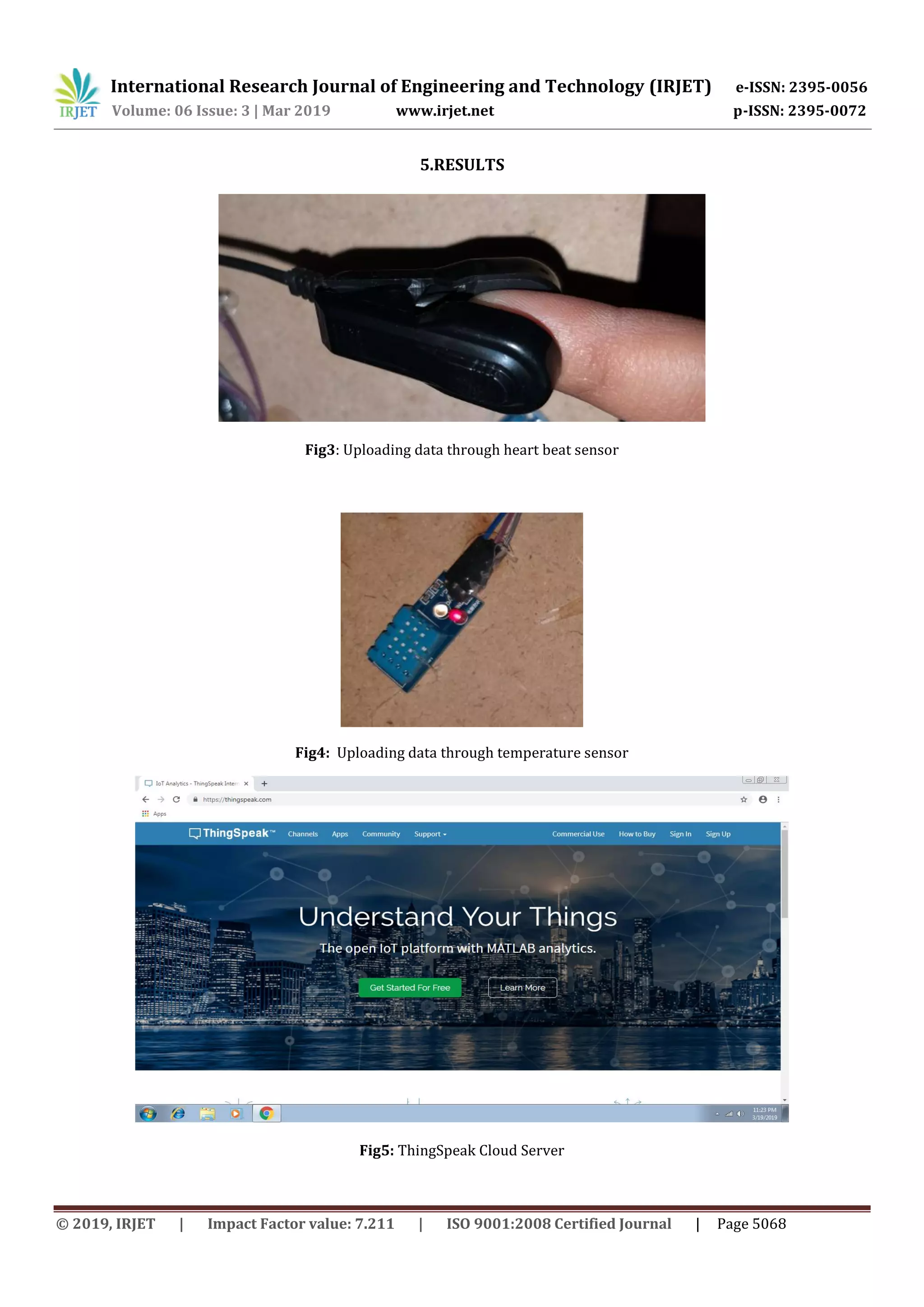
Fig5: ThingSpeak Cloud Server
International Research Journal of Engineering and Technology (IRJET) e-ISSN: 2395-0056
Volume: 06 Issue: 3 | Mar 2019 www.irjet.net p-ISSN: 2395-0072
© 2019, IRJET | Impact Factor value: 7.211 | ISO 9001:2008 Certified Journal | Page 5069
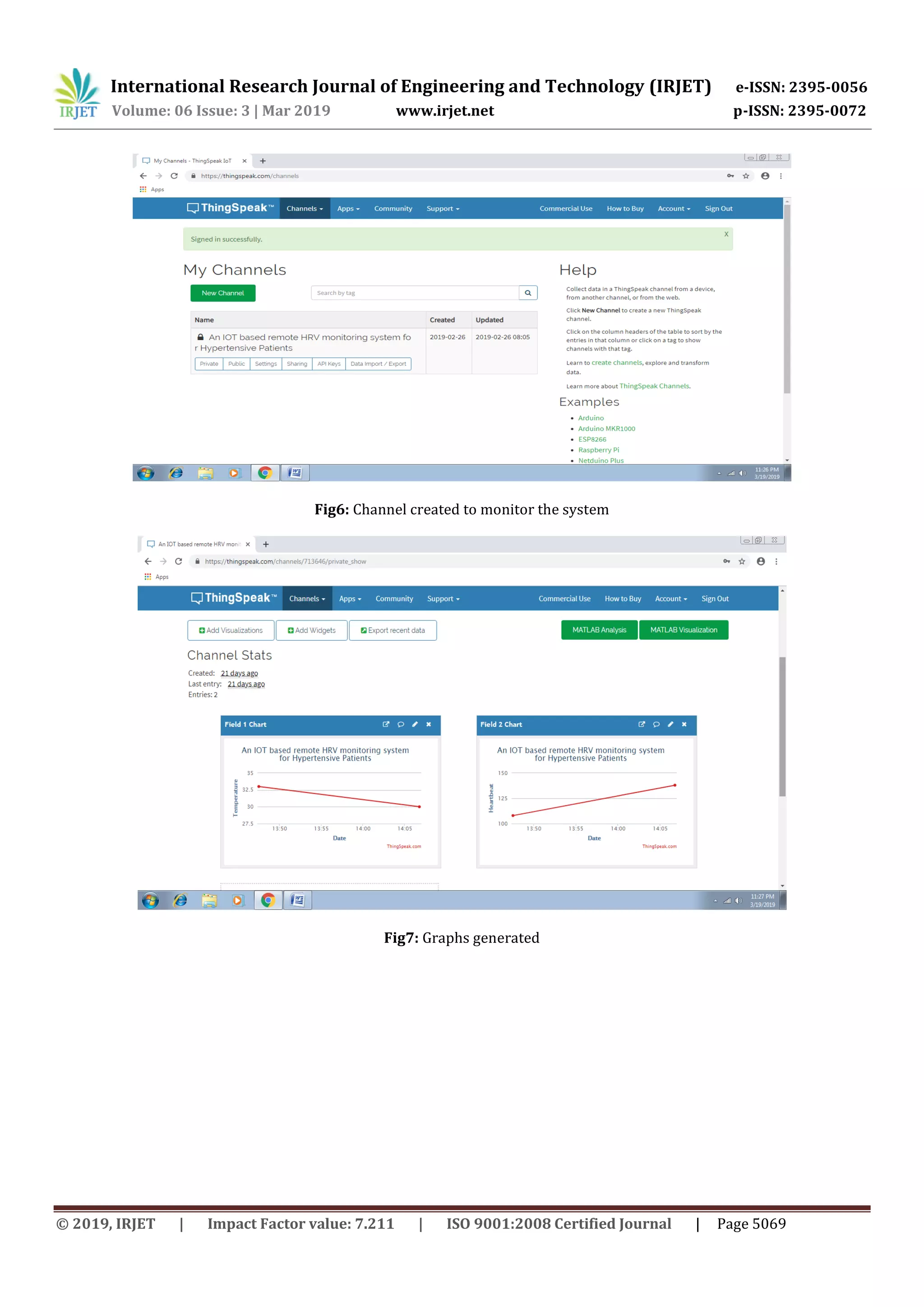
Fig6: Channel created to monitor the system
Fig7: Graphs generated
International Research Journal of Engineering and Technology (IRJET) e-ISSN: 2395-0056
Volume: 06 Issue: 3 | Mar 2019 www.irjet.net p-ISSN: 2395-0072
© 2019, IRJET | Impact Factor value: 7.211 | ISO 9001:2008 Certified Journal | Page 5070
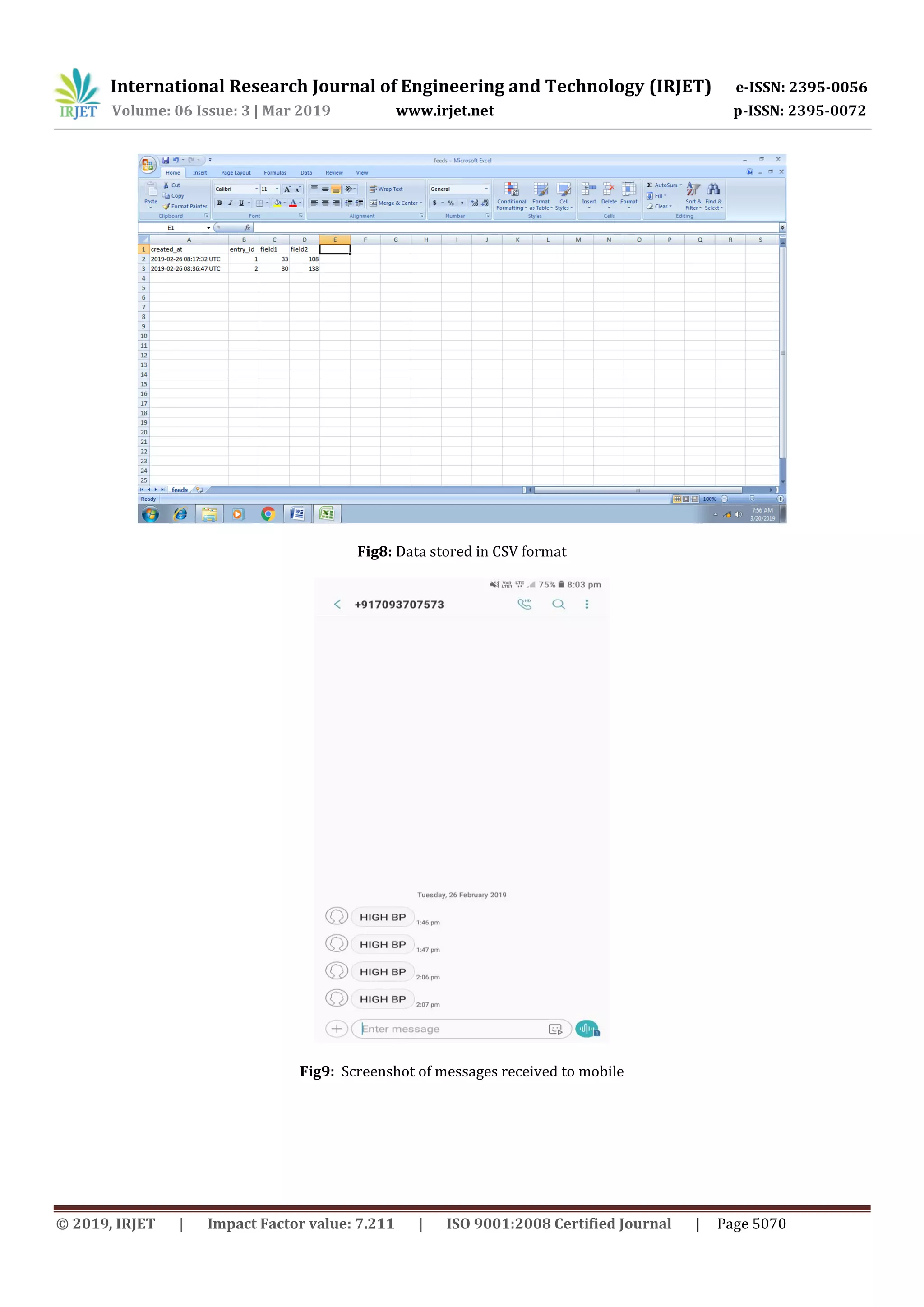
Fig8: Data stored in CSV format
Fig9: Screenshot of messages received to mobile
International Research Journal of Engineering and Technology (IRJET) e-ISSN: 2395-0056
Volume: 06 Issue: 3 | Mar 2019 www.irjet.net p-ISSN: 2395-0072
© 2019, IRJET | Impact Factor value: 7.211 | ISO 9001:2008 Certified Journal | Page 5071
5. CONCLUSIONS
We have completed the project research by implementing IOT based technology. We overruled the drawbacks caused by the
existing technology i.e., RF which is limited distance communication compare to IOT.
6. FUTURE ENHANCEMENT
In the future, An IoT based Remote HRV Monitoring System can be further enhanced to include following features:
 The system can be extended to monitor the patient’s temperature rather than room temperature.
 Group: Apart from sending an emergency message to a single person, we are planning to extend this system to
incorporate as a group.
REFERENCES
[1] Ya-lin Miao, Xiang-lin Miao, Zheng-Zhong Bian, Yong-Jie Zhang Xi'an Jiaotong University, Xi'an 710049, China "Design and
application of Embedded System based on ARM7 LPC2104 Processor in Telemedicine," Proceedings of the 2005 IEEE
[2] Ying-Wen Bai, Chien-Yung Cheng,Chou-LinLu,andYung-SongHuang,"Designand ImplementationofanEmbeddedRemote
ECG Measurement System," IMTC2005 -Instrumentation andMeasurementTechnologyConference Ottawa,Canada 17-19May
2005
[3] Nivedita Daimiwal, Asmita Wakankar, Dipali Ramdasi and Mrunal Chandratreya "Microcontroller Based ECG and Blood
Pressure Simulator," J. Instrum. Soc. India 37(4) 243-248
[4] Mohamed Fezari, Mounir Bousbia-Salah, and Mouldi Bedda "Microcontroller Based HeartRateMonitor,"TheInternational
Arab Journal of Information Technology, Vol. 5, No. 4, October 2008
[5] M. Chaitanya Suman, K. Prathyusha "Wireless ECG System Based on ARM LPC 2103 Processor," IJECT Vol. 3, Issue 1, Jan. -
March 2012, ISSN: 2230-7109 (Online) | ISSN: 2230-9543 (Print)
[6] M. B. I. Reaz "Tele-Health ECG Monitoring System: A Low-Cost Approach," International Islamic UniversityMalaysia,Kuala
Lumpur, Malaysia
International Research Journal of Engineering and Technology (IRJET) e-ISSN: 2395-0056
Volume: 06 Issue: 3 | Mar 2019 www.irjet.net p-ISSN: 2395-0072
© 2019, IRJET | Impact Factor value: 7.211 | ISO 9001:2008 Certified Journal | Page 5072
BIOGRAPHIES
M.Chandana: UG student pursuing her B.Tech in the dept of Computer Science and
Engineering, Mother Theresa InstituteofEngineeringandTechnology,Palamaner,Andhra
Pradesh, India.
S.P Siva Reddy: UG student pursuing his B.Tech in the dept of Computer Science and
Engineering, Mother Theresa InstituteofEngineeringandTechnology,Palamaner,Andhra
Pradesh, India.
N.Niranjan Reddy: UG student pursuing his B.Tech in the dept of Computer Science and
Engineering, Mother Theresa InstituteofEngineeringandTechnology,Palamaner,Andhra
Pradesh, India.
C.Dharma Teja: UG student pursuing his B.Tech in the dept of Computer Science and
Engineering, Mother Theresa InstituteofEngineeringandTechnology,Palamaner,Andhra
Pradesh, India.
M.Roshini: B.sc from PVKN degree college Chittoor, M.scMathematicsfrom SVUniversity,
M.Tech(CSE) from Madina Engineering college - Andhra Pradesh, pursuing Ph.D. from
VTU-Karnataka. Currently working as Associate. Professor in the dept of Computer
Science and Engineering, Mother Theresa Institute of Engineering and Technology,
Palamaner, Andhra Pradesh, India.

IRJET- An IoT based Remote HRV Monitoring System for Hypertensive Patients

  • 1.
    International Research Journalof Engineering and Technology (IRJET) e-ISSN: 2395-0056 Volume: 06 Issue: 3 | Mar 2019 www.irjet.net p-ISSN: 2395-0072 © 2019, IRJET | Impact Factor value: 7.211 | ISO 9001:2008 Certified Journal | Page 5065 An IoT based Remote HRV Monitoring System for Hypertensive Patients M.Chandana1, S.P Siva Reddy2, N.Niranjan Reddy3 , C.Dharma Teja4, M.Roshini5 1234 Student, Dept. Of Computer Science & Engineering, Mother Theresa Institute of Engineering and Technology, Palamaner, Andhra Pradesh, India. 5 Associate. Professor, Dept of Computer Science & Engineering, Mother Theresa Institute of Engineering and Technology, Palamaner, Andhra Pradesh, India. ---------------------------------------------------------------------***--------------------------------------------------------------------- Abstract - In many countries, the important public health issueisthatpatientswithchronic diseasesareincreasing rapidly. This accelerated many studies on a healthcare system that can whenever and wherever, extract and process patient data. Foreffective care, a patient with a chronic disease conducts self- management at the hospital environment and particularly at home environment. So it is necessary to provide integrated and personalized healthcare services. A service flow and a new model for personalized healthcare system architecture supporting an at-home and at-hospital environments are proposed to provide effective care for chronic disease patients. The system provides various chronic disease care services considering the different characteristics of at-hospital and at-home environments. The effectiveness of the system is shown by providing a prototype implementation, and a predicted cost model. An at-hospital environment and personalized self-managementofchronic diseasein an at-home environment that supports cost-effective disease care is proposed at the personalized healthcare system. Key Words: Chronic, Environment, Healthcare, Personalize. 1.INTRODUCTION Continuously monitoring and observing the health parameterslikeglucosecontent,temperature,heartbeat,etcisverydifficult today. It requires manpower to monitor. If In case the human being careless or engaged in different work or tiredness they can't monitor. So in this situation death is also possible. We are living in the 21st century in this century year science and technology evolves a vital role. In this project embedded technology has beenused.Thehealthparametersare beingmeasured by using different types of sensors. These values are given to the input of the ARDUINO controller. An ARDUINO controller compares the values from the sensors and takes the necessary action on that. 2.EXSISTING SYSTEM In many applications, wireless technology has propagated the use of sensor networks. In general purpose computing components, sensor networks join small sized sensors and actuators. Such networks comprise hundreds and sometimes thousands of self-functioning, low power, inexpensive wireless nodes to observe and influence the surroundings.Unlikemost of the existing methods with systems, there are many wireless technologiesareavailabletomonitorbuttherange ofdistance is limited. 2.1 DISADVANTAGES OF EXISTING SYSTEM:  It requires manpower to monitor  Continuously monitoring and observing the health parameters like temperature, heartbeat, etc is very difficult. 3.PROPOSED SYSTEM In this session, we are using IOT for monitoring. In IOT there is no limit to distance. We can monitor the patient heartbeat and temperature from anywhere through the internet. Our approach is to monitor real-time temperature and heart rate through the cloud. The collected temperature and heart rate can be stored and analyzed in real time through an IOT technology for prognosis and diagnosis. The proposed hardware system consists of a single chip microcontroller embedded with GPRS to
  • 2.
    International Research Journalof Engineering and Technology (IRJET) e-ISSN: 2395-0056 Volume: 06 Issue: 3 | Mar 2019 www.irjet.net p-ISSN: 2395-0072 © 2019, IRJET | Impact Factor value: 7.211 | ISO 9001:2008 Certified Journal | Page 5066 connect the internet. Results shown at the proposed system could be comparable to medical-grade services. By using thing speak server account we can analyze those signals directly in our mobile phone usingtheinternetatanywherefromtheworld. 3.1 ADVANTAGES OF PROPOSED SYSTEM:  Very compatible it is very useful in medical camps.  Useful in hospitals it reduces the heavy equipment.  Very use full in taking care of disabled persons.  Low power consumption, more reliable, more compatible, less cost. 4. MODULES 4.1 Arduino  The Arduino microcontroller is easy to use. It is a powerful single board computer that has gained considerable traction in the hobby and professional market. It is open-source, which means the hardware is reasonably pricedand development software is free.  The Arduino programming language is a simplified version of C or C++.  An important feature of Arduino is that we can create a control program on the host PC and download it to the Arduino, and it will run automatically. Fig1: Arduino Board Overview 4.2 Heart Beat Sensor  Heartbeat sensor is designed to give a digital output of a heartbeat when a finger is placed on it. When the detector is working, the beat LED flashes in unison with each heartbeat.  The obtained digital output is connected to Arduino, directly to measure the Beats per Minute (BPM) rate.  The sensor works on the principle of Light modulation by blood flow through the finger at each pulse.
  • 3.
    International Research Journalof Engineering and Technology (IRJET) e-ISSN: 2395-0056 Volume: 06 Issue: 3 | Mar 2019 www.irjet.net p-ISSN: 2395-0072 © 2019, IRJET | Impact Factor value: 7.211 | ISO 9001:2008 Certified Journal | Page 5067 4.3 Temperature Sensor - LM35  We can measure the temperature more accurately than using thermistors. The sensor circuitry is sealed and not subjected to oxidation, etc.  Possesses a low self-heating capability. The output voltage is converted into temperature by a simple conversion factor.  The operating temperature range is between -55°C to 150°C. It is a precision IC temperature sensor with output proportional to the temperature. 4.4 Power Supply  Power supply delivers an exact voltage to another device as per its needs. The power supplies available today in the market are regulated, unregulated, variable, etc. The decision to pick the correct one depends on the device we try to operate with the power supply.  The AC mains are now fed to the transformer, which steps down the 230 Volts to the desired voltage. The bridge rectifier follows the transformer thus converts AC voltage into a DC output and throughfiltering,thecapacitorfeedsit directly into the input (Pin 1) of the voltage regulator.  The common pin (Pin 2) of the voltage regulator is grounded. Theoutput(Pin3)ofthevoltageregulatorisfirstfiltered by a capacitor, and then the output is taken. Fig2: Power supply 4.5 GSM  GSM is Global System for Mobile communication.  It is a globally accepted standard for digital cellular communication. GSM is the name of a standardization group that was established in 1982 to create a common European mobile telephone standard.  Using this GSM, the system sends a notification of the patient's condition to the concerned person at an emergency case. 4.6 LCD  LCD (Liquid Crystal Display) screen is an electronic display module that is used in many applications. A 16x2 LCD display is a very basic module and is very commonly used in various devices and circuits.
  • 4.
    International Research Journalof Engineering and Technology (IRJET) e-ISSN: 2395-0056 Volume: 06 Issue: 3 | Mar 2019 www.irjet.net p-ISSN: 2395-0072 © 2019, IRJET | Impact Factor value: 7.211 | ISO 9001:2008 Certified Journal | Page 5068 5.RESULTS Fig3: Uploading data through heart beat sensor Fig4: Uploading data through temperature sensor Fig5: ThingSpeak Cloud Server
  • 5.
    International Research Journalof Engineering and Technology (IRJET) e-ISSN: 2395-0056 Volume: 06 Issue: 3 | Mar 2019 www.irjet.net p-ISSN: 2395-0072 © 2019, IRJET | Impact Factor value: 7.211 | ISO 9001:2008 Certified Journal | Page 5069 Fig6: Channel created to monitor the system Fig7: Graphs generated
  • 6.
    International Research Journalof Engineering and Technology (IRJET) e-ISSN: 2395-0056 Volume: 06 Issue: 3 | Mar 2019 www.irjet.net p-ISSN: 2395-0072 © 2019, IRJET | Impact Factor value: 7.211 | ISO 9001:2008 Certified Journal | Page 5070 Fig8: Data stored in CSV format Fig9: Screenshot of messages received to mobile
  • 7.
    International Research Journalof Engineering and Technology (IRJET) e-ISSN: 2395-0056 Volume: 06 Issue: 3 | Mar 2019 www.irjet.net p-ISSN: 2395-0072 © 2019, IRJET | Impact Factor value: 7.211 | ISO 9001:2008 Certified Journal | Page 5071 5. CONCLUSIONS We have completed the project research by implementing IOT based technology. We overruled the drawbacks caused by the existing technology i.e., RF which is limited distance communication compare to IOT. 6. FUTURE ENHANCEMENT In the future, An IoT based Remote HRV Monitoring System can be further enhanced to include following features:  The system can be extended to monitor the patient’s temperature rather than room temperature.  Group: Apart from sending an emergency message to a single person, we are planning to extend this system to incorporate as a group. REFERENCES [1] Ya-lin Miao, Xiang-lin Miao, Zheng-Zhong Bian, Yong-Jie Zhang Xi'an Jiaotong University, Xi'an 710049, China "Design and application of Embedded System based on ARM7 LPC2104 Processor in Telemedicine," Proceedings of the 2005 IEEE [2] Ying-Wen Bai, Chien-Yung Cheng,Chou-LinLu,andYung-SongHuang,"Designand ImplementationofanEmbeddedRemote ECG Measurement System," IMTC2005 -Instrumentation andMeasurementTechnologyConference Ottawa,Canada 17-19May 2005 [3] Nivedita Daimiwal, Asmita Wakankar, Dipali Ramdasi and Mrunal Chandratreya "Microcontroller Based ECG and Blood Pressure Simulator," J. Instrum. Soc. India 37(4) 243-248 [4] Mohamed Fezari, Mounir Bousbia-Salah, and Mouldi Bedda "Microcontroller Based HeartRateMonitor,"TheInternational Arab Journal of Information Technology, Vol. 5, No. 4, October 2008 [5] M. Chaitanya Suman, K. Prathyusha "Wireless ECG System Based on ARM LPC 2103 Processor," IJECT Vol. 3, Issue 1, Jan. - March 2012, ISSN: 2230-7109 (Online) | ISSN: 2230-9543 (Print) [6] M. B. I. Reaz "Tele-Health ECG Monitoring System: A Low-Cost Approach," International Islamic UniversityMalaysia,Kuala Lumpur, Malaysia
  • 8.
    International Research Journalof Engineering and Technology (IRJET) e-ISSN: 2395-0056 Volume: 06 Issue: 3 | Mar 2019 www.irjet.net p-ISSN: 2395-0072 © 2019, IRJET | Impact Factor value: 7.211 | ISO 9001:2008 Certified Journal | Page 5072 BIOGRAPHIES M.Chandana: UG student pursuing her B.Tech in the dept of Computer Science and Engineering, Mother Theresa InstituteofEngineeringandTechnology,Palamaner,Andhra Pradesh, India. S.P Siva Reddy: UG student pursuing his B.Tech in the dept of Computer Science and Engineering, Mother Theresa InstituteofEngineeringandTechnology,Palamaner,Andhra Pradesh, India. N.Niranjan Reddy: UG student pursuing his B.Tech in the dept of Computer Science and Engineering, Mother Theresa InstituteofEngineeringandTechnology,Palamaner,Andhra Pradesh, India. C.Dharma Teja: UG student pursuing his B.Tech in the dept of Computer Science and Engineering, Mother Theresa InstituteofEngineeringandTechnology,Palamaner,Andhra Pradesh, India. M.Roshini: B.sc from PVKN degree college Chittoor, M.scMathematicsfrom SVUniversity, M.Tech(CSE) from Madina Engineering college - Andhra Pradesh, pursuing Ph.D. from VTU-Karnataka. Currently working as Associate. Professor in the dept of Computer Science and Engineering, Mother Theresa Institute of Engineering and Technology, Palamaner, Andhra Pradesh, India.