International Research Journal of Engineering and Technology (IRJET) e-ISSN: 2395 -0056
Volume: 04 Issue: 03 | Mar -2017 www.irjet.net p-ISSN: 2395-0072
© 2017, IRJET | Impact Factor value: 5.181 | ISO 9001:2008 Certified Journal | Page 84
WIRELESS E-PASSPORT USING SMART CARD TECHNOLOGY
Sana Zeba Bakshi, Sadiya Mirza, Nadia Patel, Zahera Naseem, Mohammad Nasiruddin, M.Amin
Sultan
1,2,3,4 students, B.E. final year, Dept. Of Electronics and Telecommunication Engineering, Anjuman College of
Engineering & Technology, Nagpur, Maharashtra, India
5Prof. Mohammad Nasiruddin, H.O.D., Dept. Of Electronics and Telecommunication Engineering, Anjuman College
of Engineering & Technology, Nagpur Maharashtra, India
6Prof. M. Amin Sultan, Assistant professor, Dept. Of Electronics and Telecommunication Engineering, Anjuman
College of Engineering & Technology, Nagpur, Maharashtra, India
---------------------------------------------------------------------***---------------------------------------------------------------------
Abstract - The foremost aim of this project is to have
access to all the details of a passport holder by using
smart card technology. A smart card is given to
the authorized person who will own all the details
required for passport verification. This card will
contain the name, UID number, Date of Birth,
Nationality and allotherrequireddetails.AnICusedon
this card which will be responsible for storing
processing the information through modulation and
demodulation on the RF signal which will be
transmitted by the reader. The RFID reader will read
the data present in the RFID passport and sends the
data wirelessly by using RF transceiver. As soon as the
card is kept on the card reader, the details of the
person appear on the computer screen and verify
it using the data present inthe system andifitmatches
than the details of the passport holder is displayed. It
reduces the burden of documentation which thereby
reduces the time consumption. This makes the system
centralized by increasing the security.
Key Words: wireless e-passport, RFID reader,
authenticity of information,smartcard reader, security,
identification.
1. INTRODUCTION
Smart card technology is being used in this proposed
system. For this purpose, a smart card is provided to
the authorized person. An IC is used in this system
which will be responsible for storing the data and
processing it by usingmodulationanddemodulationof
RF signal which is being transmittedbythereader.The
card will contain all the details required for the
passport verification. This proposed system simplifies
the process by making use of a smart card which will
contain all the details present in the passport such as
name, date of birth, nationality, UIDnumber,etc.When
the person places the card into the card reader, the
data is read and then verified using the data present in
the system and then if the detail matches then it
displays the details of the passport holder.Thissystem
therebyreducesthetimeconsumptionandsinceituses
a smart card reduces the use of documents which
increases the securityofthesystemandavoidsforgery.
In this system, the RFID tag will contain the details
along with a unique identity number and the details of
the person are fed into the computer. The RFID reader
will read the data of the RFID passport and then
transmits the data wirelessly with the help of GSM
module.
The various components present in this project are as
listed below:
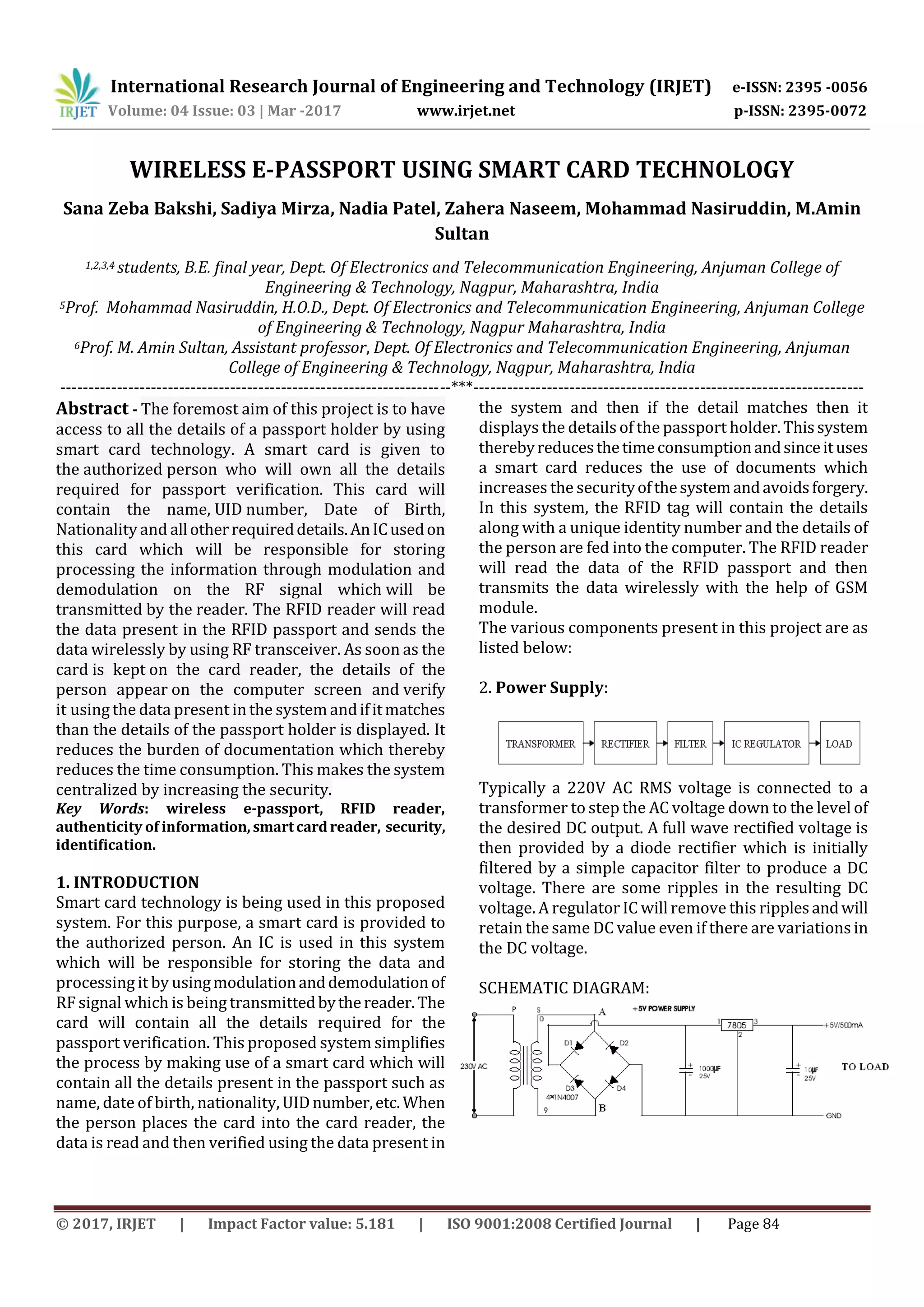
2. Power Supply:
Typically a 220V AC RMS voltage is connected to a
transformer to step the AC voltage down to the level of
the desired DC output. A full wave rectified voltage is
then provided by a diode rectifier which is initially
filtered by a simple capacitor filter to produce a DC
voltage. There are some ripples in the resulting DC
voltage. A regulator IC will remove this ripplesandwill
retain the same DC value even if there are variations in
the DC voltage.
SCHEMATIC DIAGRAM:
International Research Journal of Engineering and Technology (IRJET) e-ISSN: 2395 -0056
Volume: 04 Issue: 03 | Mar -2017 www.irjet.net p-ISSN: 2395-0072
© 2017, IRJET | Impact Factor value: 5.181 | ISO 9001:2008 Certified Journal | Page 85
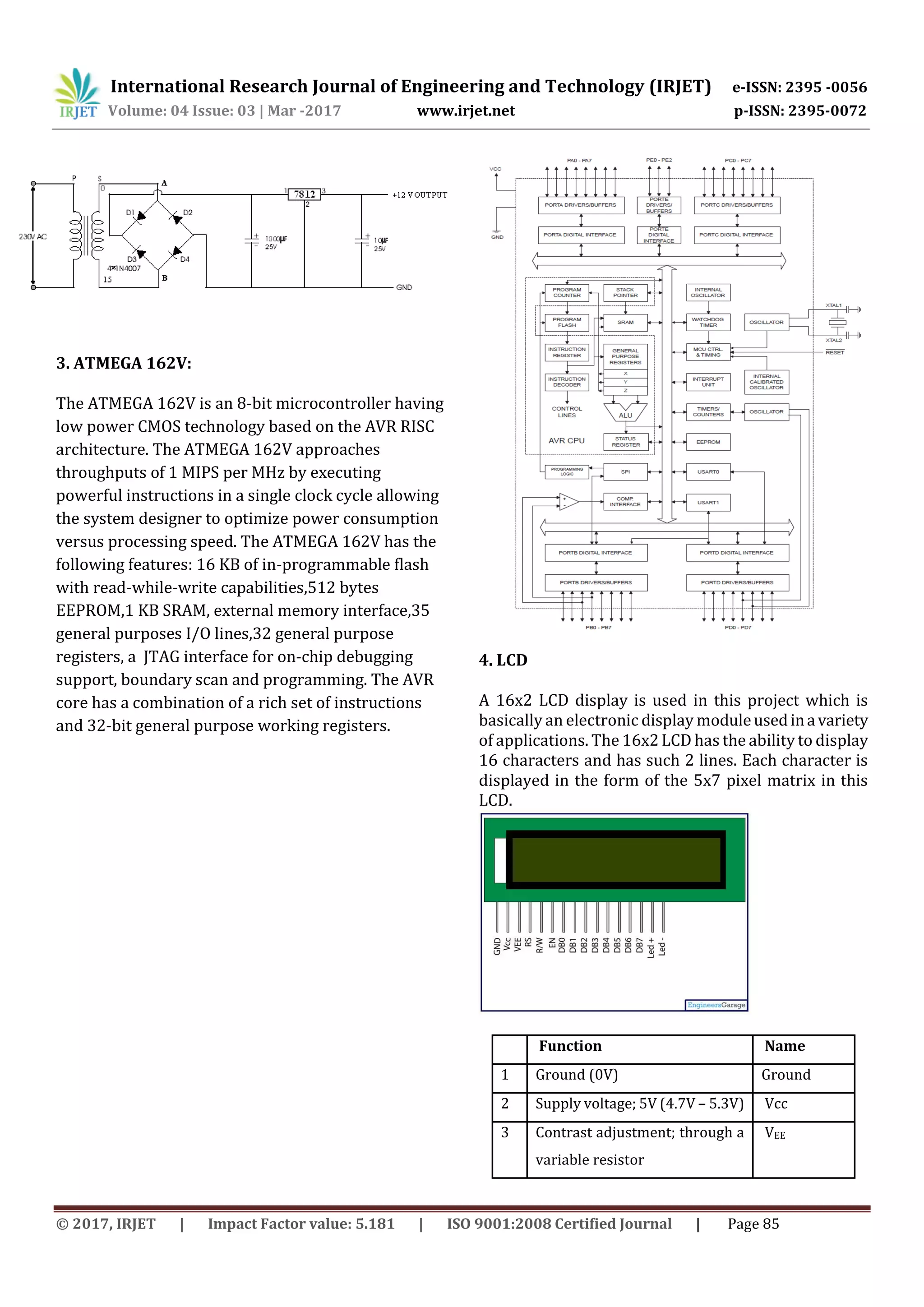
3. ATMEGA 162V:
The ATMEGA 162V is an 8-bit microcontroller having
low power CMOS technology based on the AVR RISC
architecture. The ATMEGA 162V approaches
throughputs of 1 MIPS per MHz by executing
powerful instructions in a single clock cycle allowing
the system designer to optimize power consumption
versus processing speed. The ATMEGA 162V has the
following features: 16 KB of in-programmable flash
with read-while-write capabilities,512 bytes
EEPROM,1 KB SRAM, external memory interface,35
general purposes I/O lines,32 general purpose
registers, a JTAG interface for on-chip debugging
support, boundary scan and programming. The AVR
core has a combination of a rich set of instructions
and 32-bit general purpose working registers.
4. LCD
A 16x2 LCD display is used in this project which is
basically an electronic display moduleusedinavariety
of applications. The 16x2 LCD has the ability to display
16 characters and has such 2 lines. Each character is
displayed in the form of the 5x7 pixel matrix in this
LCD.
Function Name
1 Ground (0V) Ground
2 Supply voltage; 5V (4.7V – 5.3V) Vcc
3 Contrast adjustment; through a
variable resistor
VEE
International Research Journal of Engineering and Technology (IRJET) e-ISSN: 2395 -0056
Volume: 04 Issue: 03 | Mar -2017 www.irjet.net p-ISSN: 2395-0072
© 2017, IRJET | Impact Factor value: 5.181 | ISO 9001:2008 Certified Journal | Page 86
4 Selects command register when
low; and data register when
high
Register
Select
5 Low to write to the register;
High to read from the register
Read/write
6 Sends data to data pins when a
high to low pulse is given
Enable
7
8-bit data pins
DB0
8 DB1
9 DB2
10 DB3
11 DB4
12 DB5
13 DB6
14 DB7
15 Backlight VCC (5V) Led+
16 Backlight Ground (0V) Led-
5. GSM Module:
This is a plug and plays GSM modem which is used to send
SMS, initiate and receive calls and to perform different GSM
operations by controlling it via simple AT commands given
by using microcontrollers and computers.SIM900 moduleis
widely used for all its operationswhichare usedalongwitha
standard RS232 interface which can be used to easily
interface the modem to microcontrollers and computers.
6. RFID reader and RFID tag:
A RFID reader is a device that gives the connection between
the tag data and the enterprise system software that
requires the information. It is commonly known as an
interrogator. The reader interacts with tags that are within
its field of operation, performing any number of tasks
including filtering (searching for tags that meet certain
criteria), simple continuous inventorying, writing (or
encoding) to selected tags, etc.
A RFID tag is made up of an integrated circuit (calledanICor
chip) attached to an antenna which hasbeenprinted, etched,
stamped or vapor-deposited onto a mount which is often a
paper substrate or Poly Ethylene Terephthalate (PET). The
combo of chip and antenna, known as an inlay, is then
converted or sandwiched between a printed label and its
adhesive backing or inserted into a more durable structure.
7. CONCLUSIONS:
Wireless e-passport system uses smart card technology
which gives a clear vision about the benefits of using
smart card technology as this system avoids forgery
and thus increases the security. This decreases the
burden of documentation and thereby reduces the time
consumption. The use of smart card technology makes
the system centralized and thus improves the security.
The security of the system can be further be enhanced
by adding biometric information such as palm scan,
fingerprints, iris scan, digital signature and other active
validation in the passport system. This project finally
look as shown below:
REFERENCES
[1] G. Matthew Ezovski, Steve E. Watkins, ―The
Electronic Passport and the Future of Government-
Issued RFID-Based Identification‖ 2007 IEEE
International Conference on RFID Gaylord Texan
Resort, Grapevine, TX, USA March 26-28, 2007
International Research Journal of Engineering and Technology (IRJET) e-ISSN: 2395 -0056
Volume: 04 Issue: 03 | Mar -2017 www.irjet.net p-ISSN: 2395-0072
© 2017, IRJET | Impact Factor value: 5.181 | ISO 9001:2008 Certified Journal | Page 87
[2] Piotr Porwik, "The Biometric Passport: The Technical
RequirementsandPossibilitiesofUsing",Biometricsand
Kansei Engineering, International Conference - ICBAKE
on 2009, pp. 65
[3] Marci Meingast, Jennifer King, and Deirdre K.
Mulligan,“Security and Privacy Risks ofEmbeddedRFID
in Everyday Things: the e-Passport and Beyond,"
Journal of Communications, vol.2,no.7,pp.36-48,2007.
[4] Dr. Albert B. Jeng, Elizabeth Hsu, And Chia Hung Lin
Sponsor: "Should and How CC be used to evaluate RFID
based Passports‖, National Communications
Commission, Available:
https://www.commoncriteriaportal.org/iccc/9iccc/pdf
/C2404.pdf

Wireless e-passport using smart card technology

  • 1.
    International Research Journalof Engineering and Technology (IRJET) e-ISSN: 2395 -0056 Volume: 04 Issue: 03 | Mar -2017 www.irjet.net p-ISSN: 2395-0072 © 2017, IRJET | Impact Factor value: 5.181 | ISO 9001:2008 Certified Journal | Page 84 WIRELESS E-PASSPORT USING SMART CARD TECHNOLOGY Sana Zeba Bakshi, Sadiya Mirza, Nadia Patel, Zahera Naseem, Mohammad Nasiruddin, M.Amin Sultan 1,2,3,4 students, B.E. final year, Dept. Of Electronics and Telecommunication Engineering, Anjuman College of Engineering & Technology, Nagpur, Maharashtra, India 5Prof. Mohammad Nasiruddin, H.O.D., Dept. Of Electronics and Telecommunication Engineering, Anjuman College of Engineering & Technology, Nagpur Maharashtra, India 6Prof. M. Amin Sultan, Assistant professor, Dept. Of Electronics and Telecommunication Engineering, Anjuman College of Engineering & Technology, Nagpur, Maharashtra, India ---------------------------------------------------------------------***--------------------------------------------------------------------- Abstract - The foremost aim of this project is to have access to all the details of a passport holder by using smart card technology. A smart card is given to the authorized person who will own all the details required for passport verification. This card will contain the name, UID number, Date of Birth, Nationality and allotherrequireddetails.AnICusedon this card which will be responsible for storing processing the information through modulation and demodulation on the RF signal which will be transmitted by the reader. The RFID reader will read the data present in the RFID passport and sends the data wirelessly by using RF transceiver. As soon as the card is kept on the card reader, the details of the person appear on the computer screen and verify it using the data present inthe system andifitmatches than the details of the passport holder is displayed. It reduces the burden of documentation which thereby reduces the time consumption. This makes the system centralized by increasing the security. Key Words: wireless e-passport, RFID reader, authenticity of information,smartcard reader, security, identification. 1. INTRODUCTION Smart card technology is being used in this proposed system. For this purpose, a smart card is provided to the authorized person. An IC is used in this system which will be responsible for storing the data and processing it by usingmodulationanddemodulationof RF signal which is being transmittedbythereader.The card will contain all the details required for the passport verification. This proposed system simplifies the process by making use of a smart card which will contain all the details present in the passport such as name, date of birth, nationality, UIDnumber,etc.When the person places the card into the card reader, the data is read and then verified using the data present in the system and then if the detail matches then it displays the details of the passport holder.Thissystem therebyreducesthetimeconsumptionandsinceituses a smart card reduces the use of documents which increases the securityofthesystemandavoidsforgery. In this system, the RFID tag will contain the details along with a unique identity number and the details of the person are fed into the computer. The RFID reader will read the data of the RFID passport and then transmits the data wirelessly with the help of GSM module. The various components present in this project are as listed below: 2. Power Supply: Typically a 220V AC RMS voltage is connected to a transformer to step the AC voltage down to the level of the desired DC output. A full wave rectified voltage is then provided by a diode rectifier which is initially filtered by a simple capacitor filter to produce a DC voltage. There are some ripples in the resulting DC voltage. A regulator IC will remove this ripplesandwill retain the same DC value even if there are variations in the DC voltage. SCHEMATIC DIAGRAM:
  • 2.
    International Research Journalof Engineering and Technology (IRJET) e-ISSN: 2395 -0056 Volume: 04 Issue: 03 | Mar -2017 www.irjet.net p-ISSN: 2395-0072 © 2017, IRJET | Impact Factor value: 5.181 | ISO 9001:2008 Certified Journal | Page 85 3. ATMEGA 162V: The ATMEGA 162V is an 8-bit microcontroller having low power CMOS technology based on the AVR RISC architecture. The ATMEGA 162V approaches throughputs of 1 MIPS per MHz by executing powerful instructions in a single clock cycle allowing the system designer to optimize power consumption versus processing speed. The ATMEGA 162V has the following features: 16 KB of in-programmable flash with read-while-write capabilities,512 bytes EEPROM,1 KB SRAM, external memory interface,35 general purposes I/O lines,32 general purpose registers, a JTAG interface for on-chip debugging support, boundary scan and programming. The AVR core has a combination of a rich set of instructions and 32-bit general purpose working registers. 4. LCD A 16x2 LCD display is used in this project which is basically an electronic display moduleusedinavariety of applications. The 16x2 LCD has the ability to display 16 characters and has such 2 lines. Each character is displayed in the form of the 5x7 pixel matrix in this LCD. Function Name 1 Ground (0V) Ground 2 Supply voltage; 5V (4.7V – 5.3V) Vcc 3 Contrast adjustment; through a variable resistor VEE
  • 3.
    International Research Journalof Engineering and Technology (IRJET) e-ISSN: 2395 -0056 Volume: 04 Issue: 03 | Mar -2017 www.irjet.net p-ISSN: 2395-0072 © 2017, IRJET | Impact Factor value: 5.181 | ISO 9001:2008 Certified Journal | Page 86 4 Selects command register when low; and data register when high Register Select 5 Low to write to the register; High to read from the register Read/write 6 Sends data to data pins when a high to low pulse is given Enable 7 8-bit data pins DB0 8 DB1 9 DB2 10 DB3 11 DB4 12 DB5 13 DB6 14 DB7 15 Backlight VCC (5V) Led+ 16 Backlight Ground (0V) Led- 5. GSM Module: This is a plug and plays GSM modem which is used to send SMS, initiate and receive calls and to perform different GSM operations by controlling it via simple AT commands given by using microcontrollers and computers.SIM900 moduleis widely used for all its operationswhichare usedalongwitha standard RS232 interface which can be used to easily interface the modem to microcontrollers and computers. 6. RFID reader and RFID tag: A RFID reader is a device that gives the connection between the tag data and the enterprise system software that requires the information. It is commonly known as an interrogator. The reader interacts with tags that are within its field of operation, performing any number of tasks including filtering (searching for tags that meet certain criteria), simple continuous inventorying, writing (or encoding) to selected tags, etc. A RFID tag is made up of an integrated circuit (calledanICor chip) attached to an antenna which hasbeenprinted, etched, stamped or vapor-deposited onto a mount which is often a paper substrate or Poly Ethylene Terephthalate (PET). The combo of chip and antenna, known as an inlay, is then converted or sandwiched between a printed label and its adhesive backing or inserted into a more durable structure. 7. CONCLUSIONS: Wireless e-passport system uses smart card technology which gives a clear vision about the benefits of using smart card technology as this system avoids forgery and thus increases the security. This decreases the burden of documentation and thereby reduces the time consumption. The use of smart card technology makes the system centralized and thus improves the security. The security of the system can be further be enhanced by adding biometric information such as palm scan, fingerprints, iris scan, digital signature and other active validation in the passport system. This project finally look as shown below: REFERENCES [1] G. Matthew Ezovski, Steve E. Watkins, ―The Electronic Passport and the Future of Government- Issued RFID-Based Identification‖ 2007 IEEE International Conference on RFID Gaylord Texan Resort, Grapevine, TX, USA March 26-28, 2007
  • 4.
    International Research Journalof Engineering and Technology (IRJET) e-ISSN: 2395 -0056 Volume: 04 Issue: 03 | Mar -2017 www.irjet.net p-ISSN: 2395-0072 © 2017, IRJET | Impact Factor value: 5.181 | ISO 9001:2008 Certified Journal | Page 87 [2] Piotr Porwik, "The Biometric Passport: The Technical RequirementsandPossibilitiesofUsing",Biometricsand Kansei Engineering, International Conference - ICBAKE on 2009, pp. 65 [3] Marci Meingast, Jennifer King, and Deirdre K. Mulligan,“Security and Privacy Risks ofEmbeddedRFID in Everyday Things: the e-Passport and Beyond," Journal of Communications, vol.2,no.7,pp.36-48,2007. [4] Dr. Albert B. Jeng, Elizabeth Hsu, And Chia Hung Lin Sponsor: "Should and How CC be used to evaluate RFID based Passports‖, National Communications Commission, Available: https://www.commoncriteriaportal.org/iccc/9iccc/pdf /C2404.pdf