International Research Journal of Engineering and Technology (IRJET) e-ISSN: 2395-0056
Volume: 07 Issue: 03 | Mar 2020 www.irjet.net p-ISSN: 2395-0072
© 2020, IRJET | Impact Factor value: 7.34 | ISO 9001:2008 Certified Journal | Page 3055
Automatic Attendance Provision using Image Processing
Mrs. G. Venkata Ramana1*, M. Sri Vyshnavi1, V. Bhargavi2, S. Narendra Reddy3, V. Sai Jahnavi4
1*Assistant Proffesor, Dept. of CSE, Dhanekula Institute of Engineering and Technology, AndhraPradesh, India.
1,2,3,4Bachelor of Technology, Computer Science and Enigineering, Dhanekula Institute of Engineeering and
Technology, Andhra Pradesh, India
---------------------------------------------------------------------***----------------------------------------------------------------------
Abstract - Automatic face recognition (AFR) technologies
have made many improvements in the changing world. Smart
Attendance using Real-Time Face Recognition is a real-world
solution which comes with day to day activities of handling
student attendance system. Face recognition-based
attendance system is a processofrecognizingthestudentsface
for taking attendance by using face biometrics based onhigh-
definition monitor video and other information technology. In
my face recognition project, a computer system will be able to
find and recognize human faces fast andprecisely inimages or
videos that are being captured through asurveillancecamera.
Numerous algorithms and techniques havebeendevelopedfor
improving the performanceof facerecognitionbuttheconcept
to be implemented here is Deep Learning. It helps in
conversion of the frames of the video into images so that the
face of the student can be easily recognized for their
attendance so that the attendance database can be easily
reflected automatically.
Key Words: Face Recognition, Attendance
1. INTRODUCTION
Traditionally, student’s attendance is taken manually by
using attendance sheet given by the attendant during
tutorials and leisure time, which is time consuming.
Moreover, it is very difficult to verify all studentsarepresent
or not. Using face recognition, it proposes a method to
automatically take the attendance of the students in a class.
The system stores the details of each student as well as their
facial features in the database and it compares the new
patterns with the previously stored patterns as per the
requirements.
Time and attendance system provide many benefits to the
institutions. Manual systems are also eliminated. It is an
efficient way to record and manage the attendance in the
class. There is also advantage of time saving and speed
making of the attendances. An automated system reduces
the risk of errors that are common in a manual system and
allows the workforce to be more productive instead of
wasting time on administrative tasks. We have researched
and reviewed dozens of attendance systems and came up
with the ones we think are best for a variety of tertiary
institution.
2. EXISTING PROBLEM
• The Existing System introduces face detection
method using the Voila and Jones algorithm and
recognition usingcorrelationtechnique.Thesystem
will record the attendance of the students in class
room environment. This system is fully automated.
User gets an authentication to upload the image
containing file and also to view the attendance.
• Drawbacks:
 Only 1-2 faces are recognized.
 Can’t be easily deployable.
3. PROPOSED SOLUTION
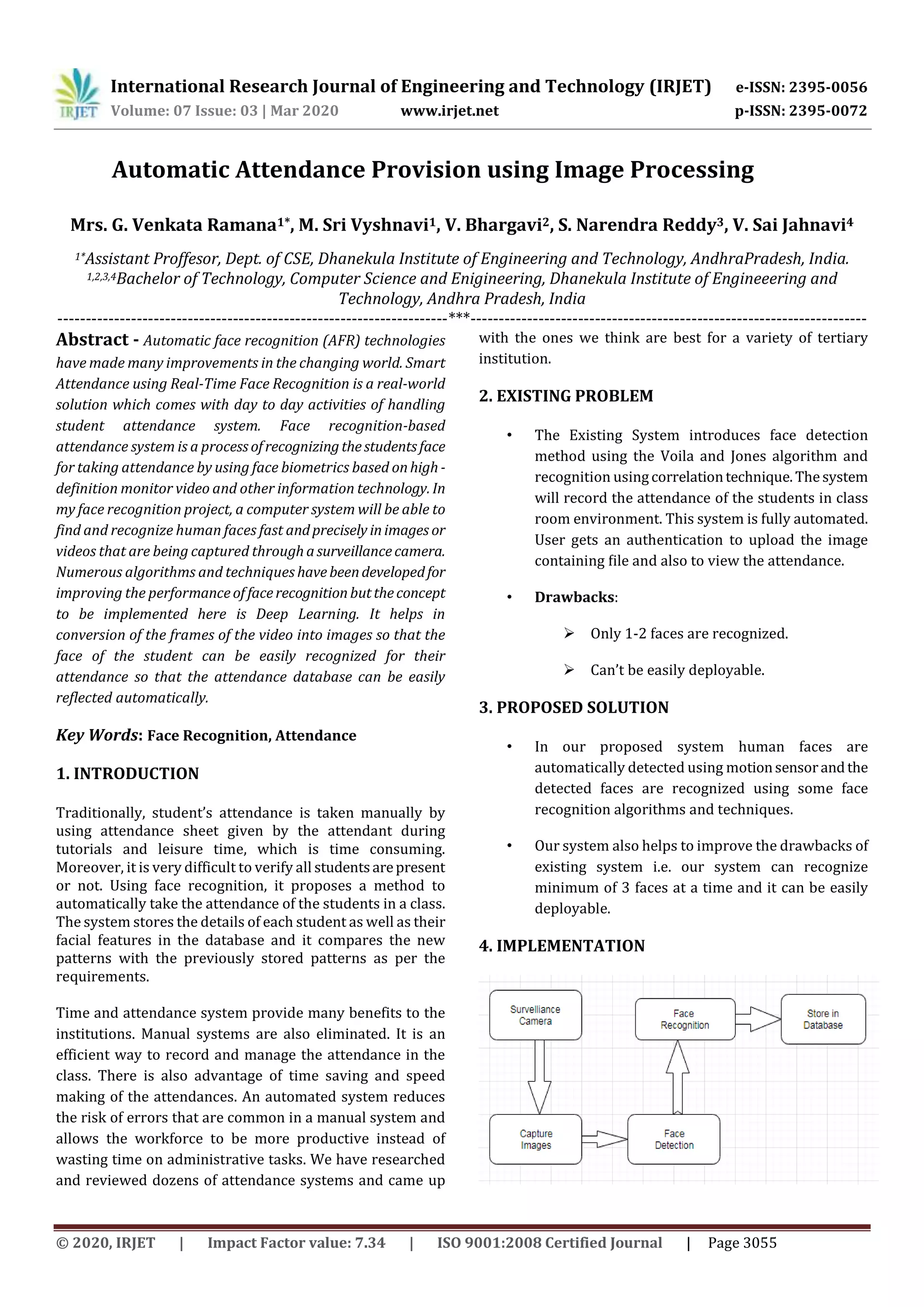
• In our proposed system human faces are
automatically detected using motionsensorandthe
detected faces are recognized using some face
recognition algorithms and techniques.
• Our system also helps to improve the drawbacks of
existing system i.e. our system can recognize
minimum of 3 faces at a time and it can be easily
deployable.
4. IMPLEMENTATION
International Research Journal of Engineering and Technology (IRJET) e-ISSN: 2395-0056
Volume: 07 Issue: 03 | Mar 2020 www.irjet.net p-ISSN: 2395-0072
© 2020, IRJET | Impact Factor value: 7.34 | ISO 9001:2008 Certified Journal | Page 3056
5. CONCLUSIONS
This project is done in order to eliminate the challenges and
limitations of the current manual attendance systems and e-
attendance system. This project is centered on how to
enhance attendance marking.
The essential benefit of automated student was highlighted.
We went further by investigating how face recognition can
solve the disturbing challenges manual attendance systems.
Based on the knowledge, it was safely concluded that
implementing the proposed systematthecollegelabwill not
only eliminate the challenges that are faced by the college
but will also provide a rich, sound and more flexible
environment that will have a positive effect on attendance
during tutorial session and exams.
ACKNOWLEDGEMENT
I would like to express my deep gratitude to Mrs. G. Venkata
Ramana, my project mentor, for her patient guidance,
enthusiastic encouragement for this project.
REFERENCES
1. S. Ullman. High-level vision: Object recognition and
visual recognition. MIT Press, 1996.
2. D. Marr. Vision. W. H. Freeman and Company, 1982.
3. S. Edelman. Representation and recognition in
vision.MIT Press, 1999.
4. J. Ponce, M. Hebert, C. Schmid, and A. Zisserman,
editors. Toward category-level object recognition.
Springer-Verlag,2006.
5. Pearson, K. (1901). "On Lines and Planes of Closest
Fit to Systems of Points in Space" (PDF).
Philosophical Magazine 2 (11): 559–572. doi:
10.1080/ 14786440109462720.
6. Hotelling, H. (1933). Analysis of a complex of
statistical variables into principal components.
Journal ofEducational Psychology,24,417–441,and
498–520.Hotelling, H. (1936).Relations between
two sets of variates. Biometrika, 27, 321–77.
7. Lowe, David G. "Distinctive Image Features from
Scale-Invariant Key points." International Journal of
Computer Vision. Volume 60, Number 2, pp. 91–
110.
8. D.G. Lowe, “Object recognition from local scale-
invariant features,” in computer Vision,1999. The
Preceedings of the Seventh IEEE International
Conference on, vol.2.LosAlamitos, CA,USA: IEEE,
August 1999,pp. 1150-1157 vol.2.[Online].
Available:http//dx.doi.org/10.1109/iccv.1999.7904
10.
9. C.Harris and M.Stephens, A combined corner and
edge detector. Manchester,UK,1998,vol.15,pp.147-
151. [Online]. Available:
http://www.cis.rit.edu/_cnspci/references/dip/har
ris1988.pdf.
10. D.Lowe, “Distinctive image features from scale-
invariant keypoints,” in International Journal of
Computer Vision, vol. 20, 2003,pp.91-110.[Online].
Available:
citseer.ist.psu.edu/lowe04distinctive.html.
11. J.Matas, O.Chum, M.Urban, and T.Padjdla, “Robust
wide baseline stereo from maximally stable
extremal regions,” in Proceedings of the British
Machine Vision Conference(BMVC), London,
GB,2002,pp. 384-393.
12. D. Nister and H. Stewenius. Scalable recognition
with avocabulary tree.In CVPR (2), pages 2161-
2168, 2006.
13. R. I. Hartley and A. Zisserman, Multiple View
Geometry in Computer Vision, 2nded.Cambridge
University Press, ISBN:0521540518,2004.
14. T. Lindeberg. Feature detection with automatic
scale selection.IJCV, 30(2):79-116, 1998.
15. K. Mikolajczyk and C. Schmid.A performance
evaluation of local descriptors. In CVPR, volume 2,
pages 257-263, June2003.
16. K. Mikolajczyk and C. Schmid.A performance
evaluation of local descriptors. PAMI, 27(10):1615-
1630, 2005.
17. H. Bay, T. Tuytelaars, and L. Van Gool. SURF:
Speeded up robust features. In ECCV, 2006.
18. Viola, P., Jones, M.: Rapid object detection using a
boosted cascade of simple features. In: CVPR (1).
(2001) 511 – 518.
19. C. Papageorgiou, M. Oren and T. Poggio. A General
Framework for Object Detection. International
Conference on Computer Vision, 1998.
20. T. Kadir and M. Brady. Scale, saliency and image
description. IJCV, 45(2):83-105, 2001.
21. F. Jurie and C. Schmid. Scale-invariant shape
features for recognition of object categories. In
CVPR, volume II, pages 90-96, 2004.
22. L. M. J. Florack, B. M. ter Haar Romeny, J. J.
Koenderink, and M. A. Viergever. General intensity
International Research Journal of Engineering and Technology (IRJET) e-ISSN: 2395-0056
Volume: 07 Issue: 03 | Mar 2020 www.irjet.net p-ISSN: 2395-0072
© 2020, IRJET | Impact Factor value: 7.34 | ISO 9001:2008 Certified Journal | Page 3057
transformations and differential invariants. JMIV,
4(2):171-187, 1994.
23. F. Mindru, T. Tuytelaars, L. Van Gool, and T. Moons.
Moment invariants for recognition under changing
viewpoint and illumination. CVIU, 94(1-3):3-27,
2004.
24. A. Baumberg. Reliable feature matching across
widely separated views. In CVPR, pages 774-781,
2000.
25. W. T. Freeman and E. H. Adelson. The design and
use of steerable filters. PAMI, 13(9):891-906, 1991.
26. G. Carneiro andA.D.Jepson. Multi-scalephase-based
local features. In CVPR (1), pages 736-743, 2003.

IRJET - Automatic Attendance Provision using Image Processing

  • 1.
    International Research Journalof Engineering and Technology (IRJET) e-ISSN: 2395-0056 Volume: 07 Issue: 03 | Mar 2020 www.irjet.net p-ISSN: 2395-0072 © 2020, IRJET | Impact Factor value: 7.34 | ISO 9001:2008 Certified Journal | Page 3055 Automatic Attendance Provision using Image Processing Mrs. G. Venkata Ramana1*, M. Sri Vyshnavi1, V. Bhargavi2, S. Narendra Reddy3, V. Sai Jahnavi4 1*Assistant Proffesor, Dept. of CSE, Dhanekula Institute of Engineering and Technology, AndhraPradesh, India. 1,2,3,4Bachelor of Technology, Computer Science and Enigineering, Dhanekula Institute of Engineeering and Technology, Andhra Pradesh, India ---------------------------------------------------------------------***---------------------------------------------------------------------- Abstract - Automatic face recognition (AFR) technologies have made many improvements in the changing world. Smart Attendance using Real-Time Face Recognition is a real-world solution which comes with day to day activities of handling student attendance system. Face recognition-based attendance system is a processofrecognizingthestudentsface for taking attendance by using face biometrics based onhigh- definition monitor video and other information technology. In my face recognition project, a computer system will be able to find and recognize human faces fast andprecisely inimages or videos that are being captured through asurveillancecamera. Numerous algorithms and techniques havebeendevelopedfor improving the performanceof facerecognitionbuttheconcept to be implemented here is Deep Learning. It helps in conversion of the frames of the video into images so that the face of the student can be easily recognized for their attendance so that the attendance database can be easily reflected automatically. Key Words: Face Recognition, Attendance 1. INTRODUCTION Traditionally, student’s attendance is taken manually by using attendance sheet given by the attendant during tutorials and leisure time, which is time consuming. Moreover, it is very difficult to verify all studentsarepresent or not. Using face recognition, it proposes a method to automatically take the attendance of the students in a class. The system stores the details of each student as well as their facial features in the database and it compares the new patterns with the previously stored patterns as per the requirements. Time and attendance system provide many benefits to the institutions. Manual systems are also eliminated. It is an efficient way to record and manage the attendance in the class. There is also advantage of time saving and speed making of the attendances. An automated system reduces the risk of errors that are common in a manual system and allows the workforce to be more productive instead of wasting time on administrative tasks. We have researched and reviewed dozens of attendance systems and came up with the ones we think are best for a variety of tertiary institution. 2. EXISTING PROBLEM • The Existing System introduces face detection method using the Voila and Jones algorithm and recognition usingcorrelationtechnique.Thesystem will record the attendance of the students in class room environment. This system is fully automated. User gets an authentication to upload the image containing file and also to view the attendance. • Drawbacks:  Only 1-2 faces are recognized.  Can’t be easily deployable. 3. PROPOSED SOLUTION • In our proposed system human faces are automatically detected using motionsensorandthe detected faces are recognized using some face recognition algorithms and techniques. • Our system also helps to improve the drawbacks of existing system i.e. our system can recognize minimum of 3 faces at a time and it can be easily deployable. 4. IMPLEMENTATION
  • 2.
    International Research Journalof Engineering and Technology (IRJET) e-ISSN: 2395-0056 Volume: 07 Issue: 03 | Mar 2020 www.irjet.net p-ISSN: 2395-0072 © 2020, IRJET | Impact Factor value: 7.34 | ISO 9001:2008 Certified Journal | Page 3056 5. CONCLUSIONS This project is done in order to eliminate the challenges and limitations of the current manual attendance systems and e- attendance system. This project is centered on how to enhance attendance marking. The essential benefit of automated student was highlighted. We went further by investigating how face recognition can solve the disturbing challenges manual attendance systems. Based on the knowledge, it was safely concluded that implementing the proposed systematthecollegelabwill not only eliminate the challenges that are faced by the college but will also provide a rich, sound and more flexible environment that will have a positive effect on attendance during tutorial session and exams. ACKNOWLEDGEMENT I would like to express my deep gratitude to Mrs. G. Venkata Ramana, my project mentor, for her patient guidance, enthusiastic encouragement for this project. REFERENCES 1. S. Ullman. High-level vision: Object recognition and visual recognition. MIT Press, 1996. 2. D. Marr. Vision. W. H. Freeman and Company, 1982. 3. S. Edelman. Representation and recognition in vision.MIT Press, 1999. 4. J. Ponce, M. Hebert, C. Schmid, and A. Zisserman, editors. Toward category-level object recognition. Springer-Verlag,2006. 5. Pearson, K. (1901). "On Lines and Planes of Closest Fit to Systems of Points in Space" (PDF). Philosophical Magazine 2 (11): 559–572. doi: 10.1080/ 14786440109462720. 6. Hotelling, H. (1933). Analysis of a complex of statistical variables into principal components. Journal ofEducational Psychology,24,417–441,and 498–520.Hotelling, H. (1936).Relations between two sets of variates. Biometrika, 27, 321–77. 7. Lowe, David G. "Distinctive Image Features from Scale-Invariant Key points." International Journal of Computer Vision. Volume 60, Number 2, pp. 91– 110. 8. D.G. Lowe, “Object recognition from local scale- invariant features,” in computer Vision,1999. The Preceedings of the Seventh IEEE International Conference on, vol.2.LosAlamitos, CA,USA: IEEE, August 1999,pp. 1150-1157 vol.2.[Online]. Available:http//dx.doi.org/10.1109/iccv.1999.7904 10. 9. C.Harris and M.Stephens, A combined corner and edge detector. Manchester,UK,1998,vol.15,pp.147- 151. [Online]. Available: http://www.cis.rit.edu/_cnspci/references/dip/har ris1988.pdf. 10. D.Lowe, “Distinctive image features from scale- invariant keypoints,” in International Journal of Computer Vision, vol. 20, 2003,pp.91-110.[Online]. Available: citseer.ist.psu.edu/lowe04distinctive.html. 11. J.Matas, O.Chum, M.Urban, and T.Padjdla, “Robust wide baseline stereo from maximally stable extremal regions,” in Proceedings of the British Machine Vision Conference(BMVC), London, GB,2002,pp. 384-393. 12. D. Nister and H. Stewenius. Scalable recognition with avocabulary tree.In CVPR (2), pages 2161- 2168, 2006. 13. R. I. Hartley and A. Zisserman, Multiple View Geometry in Computer Vision, 2nded.Cambridge University Press, ISBN:0521540518,2004. 14. T. Lindeberg. Feature detection with automatic scale selection.IJCV, 30(2):79-116, 1998. 15. K. Mikolajczyk and C. Schmid.A performance evaluation of local descriptors. In CVPR, volume 2, pages 257-263, June2003. 16. K. Mikolajczyk and C. Schmid.A performance evaluation of local descriptors. PAMI, 27(10):1615- 1630, 2005. 17. H. Bay, T. Tuytelaars, and L. Van Gool. SURF: Speeded up robust features. In ECCV, 2006. 18. Viola, P., Jones, M.: Rapid object detection using a boosted cascade of simple features. In: CVPR (1). (2001) 511 – 518. 19. C. Papageorgiou, M. Oren and T. Poggio. A General Framework for Object Detection. International Conference on Computer Vision, 1998. 20. T. Kadir and M. Brady. Scale, saliency and image description. IJCV, 45(2):83-105, 2001. 21. F. Jurie and C. Schmid. Scale-invariant shape features for recognition of object categories. In CVPR, volume II, pages 90-96, 2004. 22. L. M. J. Florack, B. M. ter Haar Romeny, J. J. Koenderink, and M. A. Viergever. General intensity
  • 3.
    International Research Journalof Engineering and Technology (IRJET) e-ISSN: 2395-0056 Volume: 07 Issue: 03 | Mar 2020 www.irjet.net p-ISSN: 2395-0072 © 2020, IRJET | Impact Factor value: 7.34 | ISO 9001:2008 Certified Journal | Page 3057 transformations and differential invariants. JMIV, 4(2):171-187, 1994. 23. F. Mindru, T. Tuytelaars, L. Van Gool, and T. Moons. Moment invariants for recognition under changing viewpoint and illumination. CVIU, 94(1-3):3-27, 2004. 24. A. Baumberg. Reliable feature matching across widely separated views. In CVPR, pages 774-781, 2000. 25. W. T. Freeman and E. H. Adelson. The design and use of steerable filters. PAMI, 13(9):891-906, 1991. 26. G. Carneiro andA.D.Jepson. Multi-scalephase-based local features. In CVPR (1), pages 736-743, 2003.