International Research Journal of Engineering and Technology (IRJET) e-ISSN: 2395-0056
Volume: 07 Issue: 03 | Mar 2020 www.irjet.net p-ISSN: 2395-0072
© 2020, IRJET | Impact Factor value: 7.34 | ISO 9001:2008 Certified Journal | Page 2654
Facial Recognition based Attendance System with LBPH
Akshay Deshpande1, Shubham Garje2, Monalisa Pramanick3
1,2,3,4Guru Nanak Dev Engineering College, Karnataka, India
---------------------------------------------------------------------***----------------------------------------------------------------------
Abstract – In this paper, we will propose a system that takes
the attendance of the students for the class. The proposed
takes the participation of the student using facial
identification technique. This participation is recorded by a
high quality camera which is installed as a part of classroom
and continuously capturing the images ofthestudents, detects
their faces , contrast Distinguished appearances and markthe
attendance. This paper first demonstrates therelatedworksin
the field of participation and faceacknowledgements. This will
also represent the structure of system and work flow. Finally
the experiments are implemented and it shows the
advancement of performance of the system.
Key Words: Python, Django, Machine Learning, LBPH,
Facial Recognition, Biometrics.
1. INTRODUCTION
Face recognition is an important application of Image
processing owing to its use in many fields. Identification of
individuals in an organization for the purpose of attendance
is one such application of face recognition. Maintenance and
monitoring of attendance records plays a vital role in the
analysis of performance of any organization. The purpose of
developing attendance management system is to
computerize the traditional way of taking attendance.
Automated Attendance Management System performs the
daily activities of attendance marking and analysis with
reduced human intervention. There are many other ways of
computerizing the attendance process usingother biometric
techniques as mentioned below:
1. Signature based System
2. Fingerprint based System
3. Iris Recognition
4. RFID based System
5. Face Recognition
Among all the above techniques the facial recognition
technique is unique, efficient, accurate and affordable
system. There are many different sub problems in the
system which is mentioned step-by-step below.
1. Capture a picture and detect all the faces from it.
2. Focus on a single face and understand it even it
turned into the different direction or bad lighting,
still it is a same person.
3. Note the unique characteristics of the face which
will help to distinguish it from all other images.The
Characteristics can be the nose, depth of eyes,
dimensions of face, color of skin etc.
The human brain is capable of recognizing the faces very
quickly. The computers can also be implemented to
recognize the uniqueness of the faces, so we need to
program or make the computer to learn that how to
differentiate the faces by their unique characters. The Facial
recognition can be divided into two categories asmentioned
below:
1. Verification
2. Identification
Verification is a method of matching of one on one i.e. match
or no match. The method can be used for locking and
unlocking systems, mobiles etc.
Identification is a method of identifying a person from a set
of people i.e. one on N people.
2. LITERATRE SURVEY
There are many ways to deal with differences between the
images and the variations in the environment of the images
and these approaches were implemented to detect the
objects. These systems may also be used in the systems that
detect the characteristics of the face. These methods use
gray-level information to extract the face and its
characteristics. The main reason of using the gray-scale
representation instead of using the colored image is that it
simplifies the algorithm, reduces the complexity,
implementation time and computational time. The colored
image may provide excessive and moreinformationwhichis
unnecessary and it will also increase the computational time
and results the low performance of the system. These
proposed systems assumed the shape of the objects or
illumination conditions. These assumptions were made for
the generic object recognitions so there for these are not
sufficient for face recognition systems.
The second approach is an Edge map of an image which is
useful object representation feature which is irrespective of
the environmental changes. This approach may be used for
facial recognition and also having similar accuracy as the
gray-scale approach. Edge map approach is having an
advantage of feature based approach, such as invariance to
illumination (i.e. darkness or brightness), low storage
structure. It amalgamates the facial information (i.e.
dimensions of face) with structural information bygrouping
International Research Journal of Engineering and Technology (IRJET) e-ISSN: 2395-0056
Volume: 07 Issue: 03 | Mar 2020 www.irjet.net p-ISSN: 2395-0072
© 2020, IRJET | Impact Factor value: 7.34 | ISO 9001:2008 Certified Journal | Page 2655
the face Edge map to line segments. After reducing the Edge
map, a polygonal line fitting process is applied to generate
the Edge map face.
There is another approach of handling the variations of
environmental conditions in an image is by creating several
models of several images. These images will be capturedofa
same person but in the different environmental conditions.
These conditions may be brightness, color, distance and etc.
These images captured may be used as several independent
models or may be used as a combinedmodel torecognize the
faces. Same kind of approach is used in this system where
30-40 images will be captured of a same student and these
images will be captured in all the environmental conditions.
3. PROBLEM DEFINATION
Recognizing faces in computer vision is a challenging
problem. The illumination problem, the pose problem, scale
variability, low quality image acquisition, partially occluded
faces are some examples of the issues to deal with. Thusface
recognition algorithms mustexhibitrobustnesstovariations
in the above parameters. The existing techniques do not
perform well in cases of different illumination, background
or rotation. Thus there is a need to address the above
mentioned disadvantages. The project aims to design and
implement a system which is less sensitivetoIllumination,is
rotation invariant, scale invariant and robust enough to be
implemented in practical applications.
4. PROBLEM SOLUTION
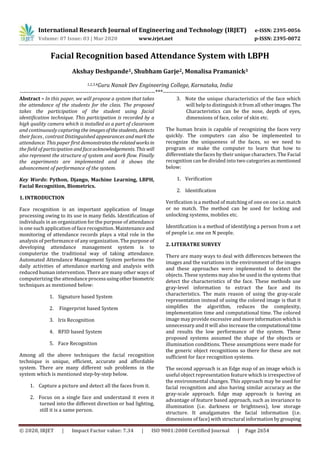
The method proposed in this paper is to mark the
attendance using facial recognition technology. As shown in
figure-1 the system records video feeds from camera and
detect the faces in image format. The detected faces will be
compared with student databaseandmark theattendancein
the Excel File. Using these Excel sheets we can generate a
graph which shows the overall attendance of whole
class/Individual student.
The project has two main phases
1. Development of Facial Recognition Technology
2. Development of Attendance System
Fig 1
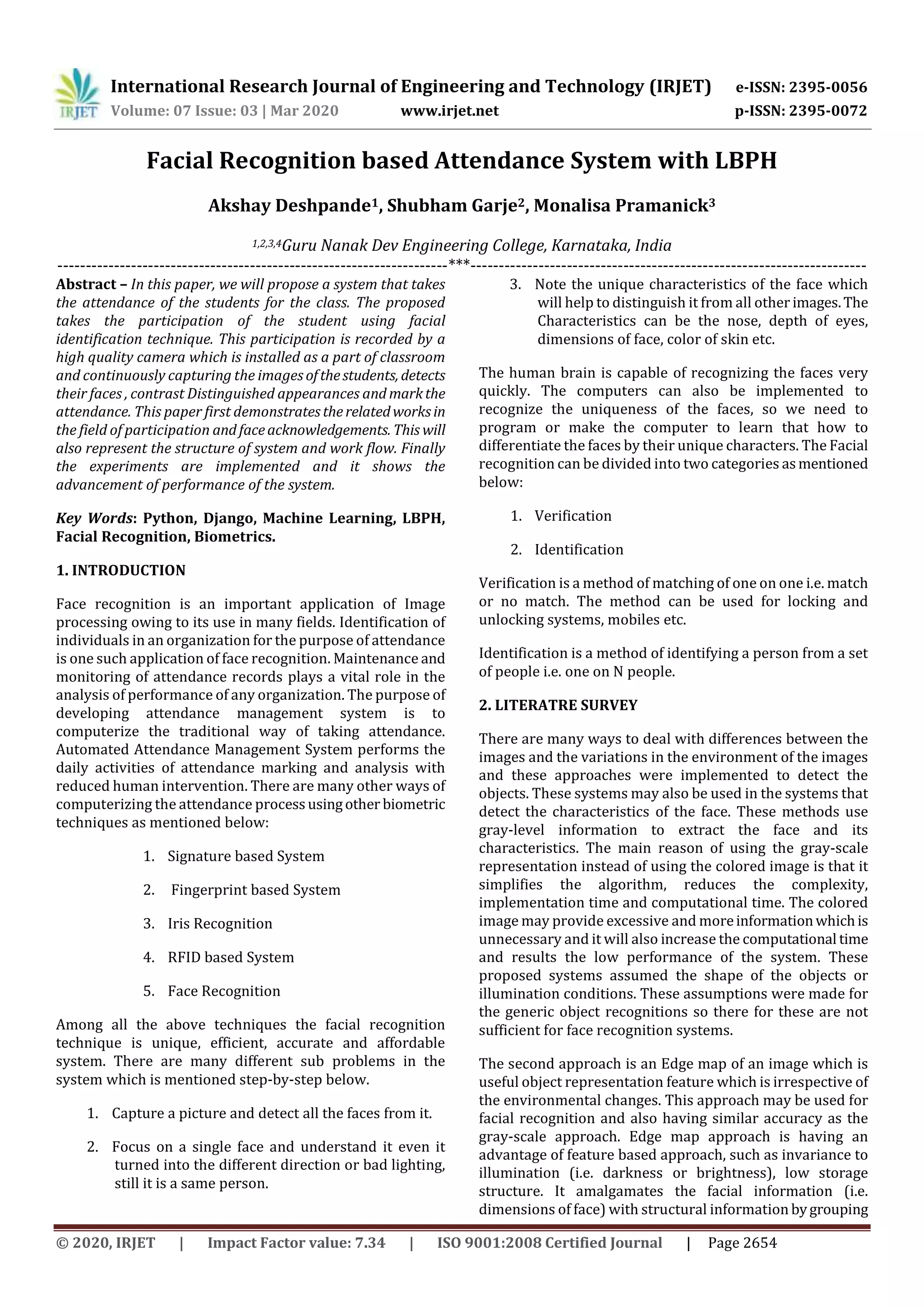
The Facial Recognition Technique can be achieved by using
following four image processing steps:
Fig 2
4.1 Collection of Physical/Behavioral Samples
It involves the collection of a sample using the video
equipment. This samples that was collected could be an
image/footage during the registration/enrollment of the
student.
4.2 Extraction of Data from Samples
Unique data is extracted from the sample and a template is
created. There are different types of face recognition
algorithms such Eigenfaces,Local BinaryPatternHistograms
(LBPH), Fisherfaces, Scale Invariant Feature Transform
(SIFT), Speed Up Robust Features (SUFR). In this project we
are using LBPH Algorithm because it is one of the easier face
recognition algorithm and everyone can understand it
without any difficulties.
4.2.1 Local Binary Pattern Histogram (LBPH)
It was first described in 1994(LBP)and has sincebeenfound
to be a powerful feature for texture classification. It has
further been determined that when LBP is combined with
histograms of oriented gradients (HOG) descriptor, it
improves the detection performance considerably on some
datasets. Using the LBP combined with histograms we can
represent the face images with a simpledatavector.AsLBPis
a visual descriptor it can also be used for face recognition
tasks, as can be seen in the following step-by-step
explanation.
1. Parameters: the LBPH uses 4 parameters:
Radius: It is the circular binary pattern that
represents the radius aroundcentralpixel.Thatmay
be 0 or 1.
International Research Journal of Engineering and Technology (IRJET) e-ISSN: 2395-0056
Volume: 07 Issue: 03 | Mar 2020 www.irjet.net p-ISSN: 2395-0072
© 2020, IRJET | Impact Factor value: 7.34 | ISO 9001:2008 Certified Journal | Page 2656
Neighbors: It is the total number of sample points
which is used to build the circular binary pattern. If
the number of sample points increases, the
computational cost also increases. So itisusuallyset
to 8.
Grid X: It is the total number cells in a horizontal
direction. If the number of cells increases the grid
will be better, the dimensionality of a resulting
vector will also increases. It is also usually set to 8.
Grid Y: It is the total number of cells in a vertical
direction. If the number of cells increases the grid
will be better, the dimensionality of a resulting
vector will also increases. It is also usually set to 8.
2. Training the Algorithm: To train the algorithm we need
to get all the facial images of all the students we want to
recognize. With that we also need a unique identification
number or a name for each image, so that we can use these
identification numbers to recognize a new image. All images
of the same student should have same identificationnumber.
3. Applying the Algorithm:Thereareseveralcomputational
steps of LBPH algorithm to createanintermediateimage.The
intermediate image will describe the original image in a
better format by highlighting several characteristics. To get
the characters of face the algorithm uses a concept called
sliding window, based on the parameters, radius and
neighbors.
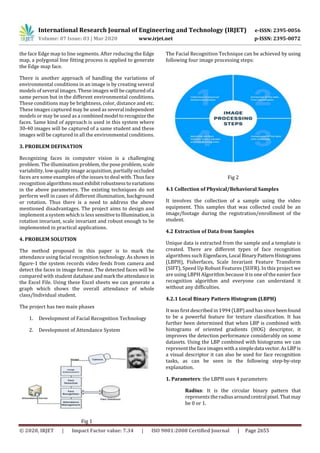
The below fig 3 shows this procedure
Fig 3
To understand the above image, let’s break the procedure
into a several steps.
a. Consider we have an image in grayscale.
b. We dividethe image into 3x3 pixels to get a part
of it.
c. It can also be represented as a 3x3 matrix each
pixel containing the intensity that lies between
0-255.
d. The central value will be considered as a
threshold value.
e. By considering this thresholdvalue we canseta
new binary value for each neighbor. If the
neighbor’s value is equal or more than the
threshold value the will set the binaryvalueto1
else it will be set to 0.
f. Now the new matrix will be a binary matrix
except the threshold value. Now we will
concentrate on each binary value by itsposition
in the matrix line by line. For example
considering the above image thebinarynumber
will be 10001101. It is not necessary to
approach line by line. Some authors may use
clockwise or anti-clockwise approach but atthe
end the result will be same.
g. Now we will convert this binary number into a
decimal number (i.e. 141 is the decimal value
for 10001101). Then we set this decimal value
to the central value that is actually a pixel of the
image.
h. At the end of this procedure we will have a new
image that will definebettercharacteristicsofit.
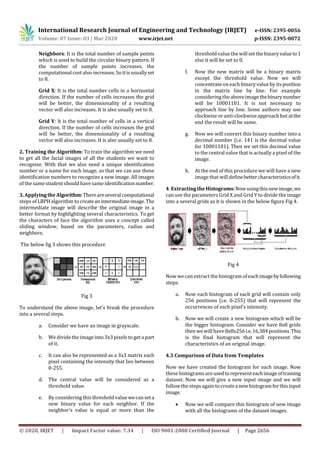
4. ExtractingtheHistograms:Nowusingthisnewimage,we
can use the parameters Grid X and Grid Y to divide the image
into a several grids as it is shown in the below figure Fig 4.
Fig 4
Now we can extract the histogram of eachimagebyfollowing
steps.
a. Now each histogram of each grid will contain only
256 positions (i.e. 0-255) that will represent the
occurrences of each pixel’s intensity.
b. Now we will create a new histogram which will be
the bigger histogram. Consider we have 8x8 grids
then we will have 8x8x256i.e.16,384positions.This
is the final histogram that will represent the
characteristics of an original image.
4.3 Comparison of Data from Templates
Now we have created the histogram for each image. Now
these histograms are usedtorepresenteachimageoftraining
dataset. Now we will give a new input image and we will
follow the steps again to createanewhistogramforthisinput
image.
 Now we will compare this histogram of new image
with all the histograms of the dataset images.
International Research Journal of Engineering and Technology (IRJET) e-ISSN: 2395-0056
Volume: 07 Issue: 03 | Mar 2020 www.irjet.net p-ISSN: 2395-0072
© 2020, IRJET | Impact Factor value: 7.34 | ISO 9001:2008 Certified Journal | Page 2657
 We have many different approaches to compare the
histograms (i.e. to compare the difference between
two histograms), For example Absolute value, Chi-
square value or etc.
4.4 Match the Face Features from samples with the
existing ones
Now it implicates making a final decisionthatwhetherornot
the template corresponds with the entry which is already in
the database.
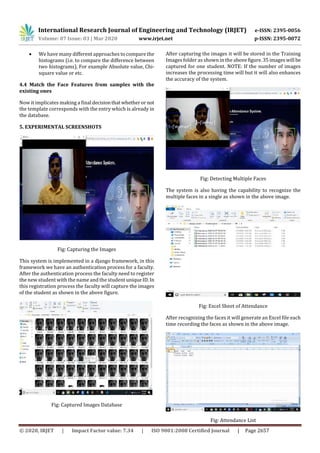
5. EXPERIMENTAL SCREENSHOTS
Fig: Capturing the Images
This system is implemented in a django framework, in this
framework we have an authentication process for a faculty.
After the authentication process the faculty need to register
the new student with the name and the student uniqueID.In
this registration process the faculty will capture the images
of the student as shown in the above figure.
Fig: Captured Images Database
After capturing the images it will be stored in the Training
Images folder as shown in the abovefigure.35imageswill be
captured for one student. NOTE: If the number of images
increases the processing time will but it will also enhances
the accuracy of the system.
Fig: Detecting Multiple Faces
The system is also having the capability to recognize the
multiple faces in a single as shown in the above image.
Fig: Excel Sheet of Attendance
After recognizing the faces it will generate an Excel file each
time recording the faces as shown in the above image.
Fig: Attendance List
International Research Journal of Engineering and Technology (IRJET) e-ISSN: 2395-0056
Volume: 07 Issue: 03 | Mar 2020 www.irjet.net p-ISSN: 2395-0072
© 2020, IRJET | Impact Factor value: 7.34 | ISO 9001:2008 Certified Journal | Page 2658
As additional information the system will also note the date
and time of attendance. This additional information is used
for future references.
Fig: Overall report of the attendance
And at the end we will generate the report of the class the in
a graphical representationasshownintheaboveimage.This
graph shown that how many students and present and how
many are absent for class. We can also generate the
individual student’s report.
6. CONCLUSION
The purpose of implementing this system is to reduce the
man power and to increase the class duration.Thissystemis
shows the better usage of the algorithm and exhibits the
robust towards recognition of the users with accuracy. The
result shows the capacity of the system to cope with the
change in posing and projection of faces and the distance.
From face recognition with machine learning , it has been
determined that during face detection, the problem of
change in environment is solved as the original image is
turned into a HOG representation that captures the major
features of the image regardless of image brightness. In the
face recognition method, local facial landmarks are
considered for further processing. After which faces are
encoded which generates128measurements ofthecaptured
face and the optimal face recognition is done by finding the
person’s name from the encoding. The result is then used to
generate an excel sheet. The facial recognition attendance
system will enforces the classes tobedigitalizedandcanalso
be implemented In IOT application also.
REFERENCES
[1] W. Zhao, R. Chellappa, P. J. Phillips, and A. Rosenfeld,
“Face recognition: A literature survey,” ACM Computing
Surveys, 2003, vol. 35, no. 4, pp. 399-458.
[2] Herbert Bay, AndreasEss,TinneTuytelaars,andLucVan
Gool. Surf: Speeded up robust features.ComputerVision
and Image Understanding (CVIU), 110(3):346–359.
[3] H.K.Ekenel and R.Stiefelhagen, Analysis of local
appearance based face recognition: Effects of feature
selection and feature normalization. InCVPR Biometrics
Workshop, New York, USA, 2006
[4] IJCSI International Journal of Computer Science Issues,
Vol. 9, Issue 4, No 1, July 2012 ISSN (Online):1694-0814
[5] IRJET International ResearchJournal ofEngineeringand
Technology, Vol. 5, Issue 6, June 2018 e-ISSN(Online):
2395-0056
[6] IJIRSET International Journal of Innovative Research In
Science, Engineering and Technology, Vol. 3, Issue
4,April 2014 ISSN:2319-8753.
[7] T. Kanade, Computer Recognition of Human Faces.
Basel and Stuttgart: Birkhauser Verlag 1997.
[8] Open source computer version library. (Online)
Available:http://www.scholarpedia.org/article/Local_Bi
nary_Patterns
[9] Open source computer vision library.[Online]
Available: https://opencv.org/
[10] Grundland M, Dodgson N (2007) Decolorize: Fast,
contrast enhancing, color to grayscale conversion.
Pattern Recognition 40: 2891-2896.

IRJET - Facial Recognition based Attendance System with LBPH

  • 1.
    International Research Journalof Engineering and Technology (IRJET) e-ISSN: 2395-0056 Volume: 07 Issue: 03 | Mar 2020 www.irjet.net p-ISSN: 2395-0072 © 2020, IRJET | Impact Factor value: 7.34 | ISO 9001:2008 Certified Journal | Page 2654 Facial Recognition based Attendance System with LBPH Akshay Deshpande1, Shubham Garje2, Monalisa Pramanick3 1,2,3,4Guru Nanak Dev Engineering College, Karnataka, India ---------------------------------------------------------------------***---------------------------------------------------------------------- Abstract – In this paper, we will propose a system that takes the attendance of the students for the class. The proposed takes the participation of the student using facial identification technique. This participation is recorded by a high quality camera which is installed as a part of classroom and continuously capturing the images ofthestudents, detects their faces , contrast Distinguished appearances and markthe attendance. This paper first demonstrates therelatedworksin the field of participation and faceacknowledgements. This will also represent the structure of system and work flow. Finally the experiments are implemented and it shows the advancement of performance of the system. Key Words: Python, Django, Machine Learning, LBPH, Facial Recognition, Biometrics. 1. INTRODUCTION Face recognition is an important application of Image processing owing to its use in many fields. Identification of individuals in an organization for the purpose of attendance is one such application of face recognition. Maintenance and monitoring of attendance records plays a vital role in the analysis of performance of any organization. The purpose of developing attendance management system is to computerize the traditional way of taking attendance. Automated Attendance Management System performs the daily activities of attendance marking and analysis with reduced human intervention. There are many other ways of computerizing the attendance process usingother biometric techniques as mentioned below: 1. Signature based System 2. Fingerprint based System 3. Iris Recognition 4. RFID based System 5. Face Recognition Among all the above techniques the facial recognition technique is unique, efficient, accurate and affordable system. There are many different sub problems in the system which is mentioned step-by-step below. 1. Capture a picture and detect all the faces from it. 2. Focus on a single face and understand it even it turned into the different direction or bad lighting, still it is a same person. 3. Note the unique characteristics of the face which will help to distinguish it from all other images.The Characteristics can be the nose, depth of eyes, dimensions of face, color of skin etc. The human brain is capable of recognizing the faces very quickly. The computers can also be implemented to recognize the uniqueness of the faces, so we need to program or make the computer to learn that how to differentiate the faces by their unique characters. The Facial recognition can be divided into two categories asmentioned below: 1. Verification 2. Identification Verification is a method of matching of one on one i.e. match or no match. The method can be used for locking and unlocking systems, mobiles etc. Identification is a method of identifying a person from a set of people i.e. one on N people. 2. LITERATRE SURVEY There are many ways to deal with differences between the images and the variations in the environment of the images and these approaches were implemented to detect the objects. These systems may also be used in the systems that detect the characteristics of the face. These methods use gray-level information to extract the face and its characteristics. The main reason of using the gray-scale representation instead of using the colored image is that it simplifies the algorithm, reduces the complexity, implementation time and computational time. The colored image may provide excessive and moreinformationwhichis unnecessary and it will also increase the computational time and results the low performance of the system. These proposed systems assumed the shape of the objects or illumination conditions. These assumptions were made for the generic object recognitions so there for these are not sufficient for face recognition systems. The second approach is an Edge map of an image which is useful object representation feature which is irrespective of the environmental changes. This approach may be used for facial recognition and also having similar accuracy as the gray-scale approach. Edge map approach is having an advantage of feature based approach, such as invariance to illumination (i.e. darkness or brightness), low storage structure. It amalgamates the facial information (i.e. dimensions of face) with structural information bygrouping
  • 2.
    International Research Journalof Engineering and Technology (IRJET) e-ISSN: 2395-0056 Volume: 07 Issue: 03 | Mar 2020 www.irjet.net p-ISSN: 2395-0072 © 2020, IRJET | Impact Factor value: 7.34 | ISO 9001:2008 Certified Journal | Page 2655 the face Edge map to line segments. After reducing the Edge map, a polygonal line fitting process is applied to generate the Edge map face. There is another approach of handling the variations of environmental conditions in an image is by creating several models of several images. These images will be capturedofa same person but in the different environmental conditions. These conditions may be brightness, color, distance and etc. These images captured may be used as several independent models or may be used as a combinedmodel torecognize the faces. Same kind of approach is used in this system where 30-40 images will be captured of a same student and these images will be captured in all the environmental conditions. 3. PROBLEM DEFINATION Recognizing faces in computer vision is a challenging problem. The illumination problem, the pose problem, scale variability, low quality image acquisition, partially occluded faces are some examples of the issues to deal with. Thusface recognition algorithms mustexhibitrobustnesstovariations in the above parameters. The existing techniques do not perform well in cases of different illumination, background or rotation. Thus there is a need to address the above mentioned disadvantages. The project aims to design and implement a system which is less sensitivetoIllumination,is rotation invariant, scale invariant and robust enough to be implemented in practical applications. 4. PROBLEM SOLUTION The method proposed in this paper is to mark the attendance using facial recognition technology. As shown in figure-1 the system records video feeds from camera and detect the faces in image format. The detected faces will be compared with student databaseandmark theattendancein the Excel File. Using these Excel sheets we can generate a graph which shows the overall attendance of whole class/Individual student. The project has two main phases 1. Development of Facial Recognition Technology 2. Development of Attendance System Fig 1 The Facial Recognition Technique can be achieved by using following four image processing steps: Fig 2 4.1 Collection of Physical/Behavioral Samples It involves the collection of a sample using the video equipment. This samples that was collected could be an image/footage during the registration/enrollment of the student. 4.2 Extraction of Data from Samples Unique data is extracted from the sample and a template is created. There are different types of face recognition algorithms such Eigenfaces,Local BinaryPatternHistograms (LBPH), Fisherfaces, Scale Invariant Feature Transform (SIFT), Speed Up Robust Features (SUFR). In this project we are using LBPH Algorithm because it is one of the easier face recognition algorithm and everyone can understand it without any difficulties. 4.2.1 Local Binary Pattern Histogram (LBPH) It was first described in 1994(LBP)and has sincebeenfound to be a powerful feature for texture classification. It has further been determined that when LBP is combined with histograms of oriented gradients (HOG) descriptor, it improves the detection performance considerably on some datasets. Using the LBP combined with histograms we can represent the face images with a simpledatavector.AsLBPis a visual descriptor it can also be used for face recognition tasks, as can be seen in the following step-by-step explanation. 1. Parameters: the LBPH uses 4 parameters: Radius: It is the circular binary pattern that represents the radius aroundcentralpixel.Thatmay be 0 or 1.
  • 3.
    International Research Journalof Engineering and Technology (IRJET) e-ISSN: 2395-0056 Volume: 07 Issue: 03 | Mar 2020 www.irjet.net p-ISSN: 2395-0072 © 2020, IRJET | Impact Factor value: 7.34 | ISO 9001:2008 Certified Journal | Page 2656 Neighbors: It is the total number of sample points which is used to build the circular binary pattern. If the number of sample points increases, the computational cost also increases. So itisusuallyset to 8. Grid X: It is the total number cells in a horizontal direction. If the number of cells increases the grid will be better, the dimensionality of a resulting vector will also increases. It is also usually set to 8. Grid Y: It is the total number of cells in a vertical direction. If the number of cells increases the grid will be better, the dimensionality of a resulting vector will also increases. It is also usually set to 8. 2. Training the Algorithm: To train the algorithm we need to get all the facial images of all the students we want to recognize. With that we also need a unique identification number or a name for each image, so that we can use these identification numbers to recognize a new image. All images of the same student should have same identificationnumber. 3. Applying the Algorithm:Thereareseveralcomputational steps of LBPH algorithm to createanintermediateimage.The intermediate image will describe the original image in a better format by highlighting several characteristics. To get the characters of face the algorithm uses a concept called sliding window, based on the parameters, radius and neighbors. The below fig 3 shows this procedure Fig 3 To understand the above image, let’s break the procedure into a several steps. a. Consider we have an image in grayscale. b. We dividethe image into 3x3 pixels to get a part of it. c. It can also be represented as a 3x3 matrix each pixel containing the intensity that lies between 0-255. d. The central value will be considered as a threshold value. e. By considering this thresholdvalue we canseta new binary value for each neighbor. If the neighbor’s value is equal or more than the threshold value the will set the binaryvalueto1 else it will be set to 0. f. Now the new matrix will be a binary matrix except the threshold value. Now we will concentrate on each binary value by itsposition in the matrix line by line. For example considering the above image thebinarynumber will be 10001101. It is not necessary to approach line by line. Some authors may use clockwise or anti-clockwise approach but atthe end the result will be same. g. Now we will convert this binary number into a decimal number (i.e. 141 is the decimal value for 10001101). Then we set this decimal value to the central value that is actually a pixel of the image. h. At the end of this procedure we will have a new image that will definebettercharacteristicsofit. 4. ExtractingtheHistograms:Nowusingthisnewimage,we can use the parameters Grid X and Grid Y to divide the image into a several grids as it is shown in the below figure Fig 4. Fig 4 Now we can extract the histogram of eachimagebyfollowing steps. a. Now each histogram of each grid will contain only 256 positions (i.e. 0-255) that will represent the occurrences of each pixel’s intensity. b. Now we will create a new histogram which will be the bigger histogram. Consider we have 8x8 grids then we will have 8x8x256i.e.16,384positions.This is the final histogram that will represent the characteristics of an original image. 4.3 Comparison of Data from Templates Now we have created the histogram for each image. Now these histograms are usedtorepresenteachimageoftraining dataset. Now we will give a new input image and we will follow the steps again to createanewhistogramforthisinput image.  Now we will compare this histogram of new image with all the histograms of the dataset images.
  • 4.
    International Research Journalof Engineering and Technology (IRJET) e-ISSN: 2395-0056 Volume: 07 Issue: 03 | Mar 2020 www.irjet.net p-ISSN: 2395-0072 © 2020, IRJET | Impact Factor value: 7.34 | ISO 9001:2008 Certified Journal | Page 2657  We have many different approaches to compare the histograms (i.e. to compare the difference between two histograms), For example Absolute value, Chi- square value or etc. 4.4 Match the Face Features from samples with the existing ones Now it implicates making a final decisionthatwhetherornot the template corresponds with the entry which is already in the database. 5. EXPERIMENTAL SCREENSHOTS Fig: Capturing the Images This system is implemented in a django framework, in this framework we have an authentication process for a faculty. After the authentication process the faculty need to register the new student with the name and the student uniqueID.In this registration process the faculty will capture the images of the student as shown in the above figure. Fig: Captured Images Database After capturing the images it will be stored in the Training Images folder as shown in the abovefigure.35imageswill be captured for one student. NOTE: If the number of images increases the processing time will but it will also enhances the accuracy of the system. Fig: Detecting Multiple Faces The system is also having the capability to recognize the multiple faces in a single as shown in the above image. Fig: Excel Sheet of Attendance After recognizing the faces it will generate an Excel file each time recording the faces as shown in the above image. Fig: Attendance List
  • 5.
    International Research Journalof Engineering and Technology (IRJET) e-ISSN: 2395-0056 Volume: 07 Issue: 03 | Mar 2020 www.irjet.net p-ISSN: 2395-0072 © 2020, IRJET | Impact Factor value: 7.34 | ISO 9001:2008 Certified Journal | Page 2658 As additional information the system will also note the date and time of attendance. This additional information is used for future references. Fig: Overall report of the attendance And at the end we will generate the report of the class the in a graphical representationasshownintheaboveimage.This graph shown that how many students and present and how many are absent for class. We can also generate the individual student’s report. 6. CONCLUSION The purpose of implementing this system is to reduce the man power and to increase the class duration.Thissystemis shows the better usage of the algorithm and exhibits the robust towards recognition of the users with accuracy. The result shows the capacity of the system to cope with the change in posing and projection of faces and the distance. From face recognition with machine learning , it has been determined that during face detection, the problem of change in environment is solved as the original image is turned into a HOG representation that captures the major features of the image regardless of image brightness. In the face recognition method, local facial landmarks are considered for further processing. After which faces are encoded which generates128measurements ofthecaptured face and the optimal face recognition is done by finding the person’s name from the encoding. The result is then used to generate an excel sheet. The facial recognition attendance system will enforces the classes tobedigitalizedandcanalso be implemented In IOT application also. REFERENCES [1] W. Zhao, R. Chellappa, P. J. Phillips, and A. Rosenfeld, “Face recognition: A literature survey,” ACM Computing Surveys, 2003, vol. 35, no. 4, pp. 399-458. [2] Herbert Bay, AndreasEss,TinneTuytelaars,andLucVan Gool. Surf: Speeded up robust features.ComputerVision and Image Understanding (CVIU), 110(3):346–359. [3] H.K.Ekenel and R.Stiefelhagen, Analysis of local appearance based face recognition: Effects of feature selection and feature normalization. InCVPR Biometrics Workshop, New York, USA, 2006 [4] IJCSI International Journal of Computer Science Issues, Vol. 9, Issue 4, No 1, July 2012 ISSN (Online):1694-0814 [5] IRJET International ResearchJournal ofEngineeringand Technology, Vol. 5, Issue 6, June 2018 e-ISSN(Online): 2395-0056 [6] IJIRSET International Journal of Innovative Research In Science, Engineering and Technology, Vol. 3, Issue 4,April 2014 ISSN:2319-8753. [7] T. Kanade, Computer Recognition of Human Faces. Basel and Stuttgart: Birkhauser Verlag 1997. [8] Open source computer version library. (Online) Available:http://www.scholarpedia.org/article/Local_Bi nary_Patterns [9] Open source computer vision library.[Online] Available: https://opencv.org/ [10] Grundland M, Dodgson N (2007) Decolorize: Fast, contrast enhancing, color to grayscale conversion. Pattern Recognition 40: 2891-2896.