International Research Journal of Engineering and Technology (IRJET) e-ISSN: 2395 -0056
Volume: 04 Issue: 03 | Mar -2017 www.irjet.net p-ISSN: 2395-0072
© 2017, IRJET | Impact Factor value: 5.181 | ISO 9001:2008 Certified Journal | Page 2404
ROBUST TRACKING VIA FEATURE MAPPING METHOD AND SUPPORT
VECTOR MACHINE
A.Akalya1, M.Fiona clen maurus2, V.Vinothini3, S.Selva Agnes4
123Student,Dept Of ECE ,Panimalar Institute Of Technology,Tamilnadu,India.
4Assistant professor,Dept Of ECE,Panimalar Institute Of Technology,Tamilnadu,India.
---------------------------------------------------------------------------------------------------------------------------------------------------------
Abstract: Visual tracking is a challenging process due to variations caused by various factors such as object deformation,
occlusion, scale and illumination changes. In our proposed system, we tend to overcome these drawbacks by using expectation
maximization algorithm and support vector machine. By using this algorithm, we can improve the accuracy while tracking of
object or a person from a video. This tracking model is better in terms of efficiency and robustness. This tracker maintains a
speed of approximately 45frames/sec.
KEYWORDS: Expectation maximization, Support Vector machine, Positivetemplates,occlusion detection,
Tracking,Accuracy.
1.INTRODUCTION:
Visual Object tracking is a fundamental problem in image processing. It has various applications like motion analysis, video
surveillance, human computer interaction and robot perception. Although there are many researches going on for the
development of this process, it is still challenging due to some factors like appearance, pose change, occlusion etc. Hence it is
necessary to develop better feature representation to achieve more effective tracking models. The intuition behind SFA is
linked to the assumption that the information contained in a signal changes not suddenly, but slowly. Note, a signal generally
contains high variation (caused by noise), nonetheless, it is the seldom varying features that mark the separation between
informative changes. SFA extracts these features, as it selects the important attributes which change least over time.
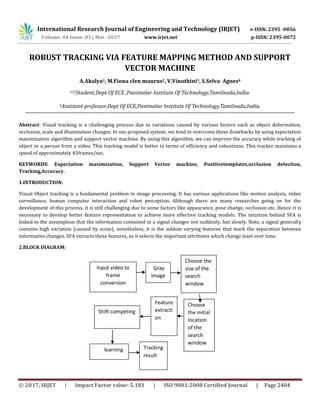
2.BLOCK DIAGRAM:
Input video to
frame
conversion
Choose the
size of the
search
window
Gray
image
Choose
the initial
location
of the
search
window
Feature
extracti
on
Shift competing
learning Tracking
result
International Research Journal of Engineering and Technology (IRJET) e-ISSN: 2395 -0056
Volume: 04 Issue: 03 | Mar -2017 www.irjet.net p-ISSN: 2395-0072
© 2017, IRJET | Impact Factor value: 5.181 | ISO 9001:2008 Certified Journal | Page 2405
3.MODULES:
o Select the target image from initial frame
o Feature Extraction
o Tracking
3.1SELECT THE TARGET IMAGE FROM INITIAL FRAME:
An input sequence of color images, we summarize the generation of dynamic image tracking. We begin by cropping the region
of a target in the initial frame .This window size is fixed. Compute the mean of the data within the window.
3.2FEATURE EXTRACTION:
In the marked object is given to the algorithm features are calculated using Expectation maximization algorithm.
3.3TRACKING
In each frame features are calculated this will be given to the machine learning the object is recognized and this will be tracked
in every frame using support vector machine classifiers.
4.SOFTWARE USED
MATLAB 8.3.0.532 (R2014a)
The MATLAB is a Matrix laboratory which is used to solve many technical computing problems .It is used to access
matrix software. It is used for simulation ,modeling and prototyping.
5.OCCULISION DETECTION AND MODEL UPDATE:
At the time of tracking ,the target with no or slight occlusion is represented by positive templates. If there is a severe occlusion
in the object it is represented not only by positive templates but also by negative templates. The occlusion are detected based
on the criterion whether negative templates are used to represent the target. If more negative templates are used to
reconstruct the target, it means the target is severly occuled. If more negative templates are used to reconstruct the target
which is used for error detection rate. If an occlusion is detected the negative template is updated every 5 frames at that time
no positive template is updated. If the reconstruction error in the positive sample is smaller than the threshold that is 0.5 ,the
current tracking result is a good candidate to represent the target. After that the tracking result is added to the positive
template set. After that the best tracking results is added continuously, then the size of positive template is larger.
Positive template negative template
Fig. 1.Illustration of an occluded target is represented by positive templates and negative templates
International Research Journal of Engineering and Technology (IRJET) e-ISSN: 2395 -0056
Volume: 04 Issue: 03 | Mar -2017 www.irjet.net p-ISSN: 2395-0072
© 2017, IRJET | Impact Factor value: 5.181 | ISO 9001:2008 Certified Journal | Page 2406
6.QUALITATIV EVALUTION:
6.1 Heavy occlusion:
When the target is undergo occlusion, our Proposed system perfectly find an object in terms of rotation and position.
But the previous method IVT L1APG and MTT are fail to locate an atd track the target in frames.Our proposed method is more
accuracy than the previous methods.
6.2 Shape deformation and Rotation variation:
The target is easily confused if it is moving and change in appearance. But our proposed system could easily identify the
object even there is change in appearance of the target. Only our proposed system can track an object upto an extent in the
condition of complicated background and low light.
6.3 Abrupt motion and camera shake:
It is difficult to predict an animal and human when they both undergo an abrupt motion and camera shake. Most of the
trackers are failed to track the target due to severe drifting in the sequence of an animal or human being.
7.MOTIVATION:
In video surveillance tracking a person or object from a video it took trillions of hours. Human labor is expensive. In
our work, we use computer aided surveillance which is automatic.
8.PRECISION AND SUCCESS PLOT:
International Research Journal of Engineering and Technology (IRJET) e-ISSN: 2395 -0056
Volume: 04 Issue: 03 | Mar -2017 www.irjet.net p-ISSN: 2395-0072
© 2017, IRJET | Impact Factor value: 5.181 | ISO 9001:2008 Certified Journal | Page 2407
9. FUTURE WORK:
We will develop learning tools to model the temporal relationship between cortical responses ,which may further improve
tracking accuracy. Tracking humans across multiple cameras from different view points.
10.CONCLUSION:
By using this method we can improve accuracy while tracking of an object or a person from video. In previous method due to
occlusion and deformation in a video we cannot track an object or a person with more accuracy. By using Expectation
maximization algorithm and support vector machine we get more accuracy.
REFERENCES
[1] K. Cannons, “A review of visual tracking,” Dept. Comput. Sci. Eng., York Univ., Toronto, ON, Canada, Tech. Rep. CSE-2008-07,
2008.
[2] D. Comaniciu, V. Ramesh, and P. Meer, “Kernel-based object tracking,” IEEE Trans. Pattern Anal. Mach. Intell., vol. 25, no. 5,
pp. 564–577, May 2003.
[3] J. F. Henriques, R. Caseiro, P. Martins, and J. Batista, “High-speed tracking with kernelized correlation filters,” IEEE Trans.
Pattern Anal. Mach. Intell., vol. 37, no. 3, pp. 583–596, Mar. 2015.
[4] L. Sevilla-Lara and E. Learned-Miller, “Distribution fields for tracking,” in Proc. Comput. Vis. Pattern Recognit., Jun. 2012,
pp. 1910–1917.
[5] T. B. Dinh, N. Vo, and G. Medioni, “Context tracker: Exploring supporters and distracters in unconstrained environments,” in
Proc. Comput. Vis. Pattern Recognit., Jun. 2011, pp. 1177–1184.
[6] H. Zhou, Y. Yuan, and C. Shi, “Object tracking using SIFT features and mean shift,” Comput. Vis. image Understand., vol. 113,
no. 3, pp. 345–352, Mar. 2009.
[7] K. Zhang, L. Zhang, and M.-H. Yang, “Real-time compressive tracking,” in Computer Vision—ECCV. Berlin, Germany:
Springer, 2012, pp. 864–877.
International Research Journal of Engineering and Technology (IRJET) e-ISSN: 2395 -0056
Volume: 04 Issue: 03 | Mar -2017 www.irjet.net p-ISSN: 2395-0072
© 2017, IRJET | Impact Factor value: 5.181 | ISO 9001:2008 Certified Journal | Page 2408
[8] R. Raina, A. Battle, H. Lee, B. Packer, and A. Y. Ng, “Self-taught learning: Transfer learning from unlabeled data,” in Proc.
24th Int. Conf. Mach. Learn., 2007, pp. 759–766.
[9] D. A. Ross, J. Lim, R.-S. Lin, and M.-H. Yang, “Incremental learning for robust visual tracking,” Int. J. Comput. Vis., vol. 77, nos.
1–3, pp. 125–141, 2008.
[10] R.-S. Lin, M.-H. Yang, and S. E. Levinson, “Object tracking using incremental Fisher discriminant analysis,” in Proc. 17th Int.
Conf. Pattern Recognit. (ICPR), vol. 2. Aug. 2004, pp. 757–760.
[11] G. Wang et al., “Visual tracking via sparse and local linear coding,” IEEE Trans. Image Process., vol. 24, no. 11, pp. 3796–
3809, Nov. 2015.
[12] W. Zhong, H. Lu, and M.-H. Yang, “Robust object tracking via sparsitybased collaborative model,” in Proc. Comput. Vis.
Pattern Recognit., Jun. 2012, pp. 1838–1845.
[13] Z. Hong, X. Mei, D. Prokhorov, and D. Tao, “Tracking via robust multitask multi-view joint sparse representation,” in Proc.
IEEE Int. Conf. Comput. Vis. (ICCV), Dec. 2013, pp. 649–656.

Robust Tracking Via Feature Mapping Method and Support Vector Machine

  • 1.
    International Research Journalof Engineering and Technology (IRJET) e-ISSN: 2395 -0056 Volume: 04 Issue: 03 | Mar -2017 www.irjet.net p-ISSN: 2395-0072 © 2017, IRJET | Impact Factor value: 5.181 | ISO 9001:2008 Certified Journal | Page 2404 ROBUST TRACKING VIA FEATURE MAPPING METHOD AND SUPPORT VECTOR MACHINE A.Akalya1, M.Fiona clen maurus2, V.Vinothini3, S.Selva Agnes4 123Student,Dept Of ECE ,Panimalar Institute Of Technology,Tamilnadu,India. 4Assistant professor,Dept Of ECE,Panimalar Institute Of Technology,Tamilnadu,India. --------------------------------------------------------------------------------------------------------------------------------------------------------- Abstract: Visual tracking is a challenging process due to variations caused by various factors such as object deformation, occlusion, scale and illumination changes. In our proposed system, we tend to overcome these drawbacks by using expectation maximization algorithm and support vector machine. By using this algorithm, we can improve the accuracy while tracking of object or a person from a video. This tracking model is better in terms of efficiency and robustness. This tracker maintains a speed of approximately 45frames/sec. KEYWORDS: Expectation maximization, Support Vector machine, Positivetemplates,occlusion detection, Tracking,Accuracy. 1.INTRODUCTION: Visual Object tracking is a fundamental problem in image processing. It has various applications like motion analysis, video surveillance, human computer interaction and robot perception. Although there are many researches going on for the development of this process, it is still challenging due to some factors like appearance, pose change, occlusion etc. Hence it is necessary to develop better feature representation to achieve more effective tracking models. The intuition behind SFA is linked to the assumption that the information contained in a signal changes not suddenly, but slowly. Note, a signal generally contains high variation (caused by noise), nonetheless, it is the seldom varying features that mark the separation between informative changes. SFA extracts these features, as it selects the important attributes which change least over time. 2.BLOCK DIAGRAM: Input video to frame conversion Choose the size of the search window Gray image Choose the initial location of the search window Feature extracti on Shift competing learning Tracking result
  • 2.
    International Research Journalof Engineering and Technology (IRJET) e-ISSN: 2395 -0056 Volume: 04 Issue: 03 | Mar -2017 www.irjet.net p-ISSN: 2395-0072 © 2017, IRJET | Impact Factor value: 5.181 | ISO 9001:2008 Certified Journal | Page 2405 3.MODULES: o Select the target image from initial frame o Feature Extraction o Tracking 3.1SELECT THE TARGET IMAGE FROM INITIAL FRAME: An input sequence of color images, we summarize the generation of dynamic image tracking. We begin by cropping the region of a target in the initial frame .This window size is fixed. Compute the mean of the data within the window. 3.2FEATURE EXTRACTION: In the marked object is given to the algorithm features are calculated using Expectation maximization algorithm. 3.3TRACKING In each frame features are calculated this will be given to the machine learning the object is recognized and this will be tracked in every frame using support vector machine classifiers. 4.SOFTWARE USED MATLAB 8.3.0.532 (R2014a) The MATLAB is a Matrix laboratory which is used to solve many technical computing problems .It is used to access matrix software. It is used for simulation ,modeling and prototyping. 5.OCCULISION DETECTION AND MODEL UPDATE: At the time of tracking ,the target with no or slight occlusion is represented by positive templates. If there is a severe occlusion in the object it is represented not only by positive templates but also by negative templates. The occlusion are detected based on the criterion whether negative templates are used to represent the target. If more negative templates are used to reconstruct the target, it means the target is severly occuled. If more negative templates are used to reconstruct the target which is used for error detection rate. If an occlusion is detected the negative template is updated every 5 frames at that time no positive template is updated. If the reconstruction error in the positive sample is smaller than the threshold that is 0.5 ,the current tracking result is a good candidate to represent the target. After that the tracking result is added to the positive template set. After that the best tracking results is added continuously, then the size of positive template is larger. Positive template negative template Fig. 1.Illustration of an occluded target is represented by positive templates and negative templates
  • 3.
    International Research Journalof Engineering and Technology (IRJET) e-ISSN: 2395 -0056 Volume: 04 Issue: 03 | Mar -2017 www.irjet.net p-ISSN: 2395-0072 © 2017, IRJET | Impact Factor value: 5.181 | ISO 9001:2008 Certified Journal | Page 2406 6.QUALITATIV EVALUTION: 6.1 Heavy occlusion: When the target is undergo occlusion, our Proposed system perfectly find an object in terms of rotation and position. But the previous method IVT L1APG and MTT are fail to locate an atd track the target in frames.Our proposed method is more accuracy than the previous methods. 6.2 Shape deformation and Rotation variation: The target is easily confused if it is moving and change in appearance. But our proposed system could easily identify the object even there is change in appearance of the target. Only our proposed system can track an object upto an extent in the condition of complicated background and low light. 6.3 Abrupt motion and camera shake: It is difficult to predict an animal and human when they both undergo an abrupt motion and camera shake. Most of the trackers are failed to track the target due to severe drifting in the sequence of an animal or human being. 7.MOTIVATION: In video surveillance tracking a person or object from a video it took trillions of hours. Human labor is expensive. In our work, we use computer aided surveillance which is automatic. 8.PRECISION AND SUCCESS PLOT:
  • 4.
    International Research Journalof Engineering and Technology (IRJET) e-ISSN: 2395 -0056 Volume: 04 Issue: 03 | Mar -2017 www.irjet.net p-ISSN: 2395-0072 © 2017, IRJET | Impact Factor value: 5.181 | ISO 9001:2008 Certified Journal | Page 2407 9. FUTURE WORK: We will develop learning tools to model the temporal relationship between cortical responses ,which may further improve tracking accuracy. Tracking humans across multiple cameras from different view points. 10.CONCLUSION: By using this method we can improve accuracy while tracking of an object or a person from video. In previous method due to occlusion and deformation in a video we cannot track an object or a person with more accuracy. By using Expectation maximization algorithm and support vector machine we get more accuracy. REFERENCES [1] K. Cannons, “A review of visual tracking,” Dept. Comput. Sci. Eng., York Univ., Toronto, ON, Canada, Tech. Rep. CSE-2008-07, 2008. [2] D. Comaniciu, V. Ramesh, and P. Meer, “Kernel-based object tracking,” IEEE Trans. Pattern Anal. Mach. Intell., vol. 25, no. 5, pp. 564–577, May 2003. [3] J. F. Henriques, R. Caseiro, P. Martins, and J. Batista, “High-speed tracking with kernelized correlation filters,” IEEE Trans. Pattern Anal. Mach. Intell., vol. 37, no. 3, pp. 583–596, Mar. 2015. [4] L. Sevilla-Lara and E. Learned-Miller, “Distribution fields for tracking,” in Proc. Comput. Vis. Pattern Recognit., Jun. 2012, pp. 1910–1917. [5] T. B. Dinh, N. Vo, and G. Medioni, “Context tracker: Exploring supporters and distracters in unconstrained environments,” in Proc. Comput. Vis. Pattern Recognit., Jun. 2011, pp. 1177–1184. [6] H. Zhou, Y. Yuan, and C. Shi, “Object tracking using SIFT features and mean shift,” Comput. Vis. image Understand., vol. 113, no. 3, pp. 345–352, Mar. 2009. [7] K. Zhang, L. Zhang, and M.-H. Yang, “Real-time compressive tracking,” in Computer Vision—ECCV. Berlin, Germany: Springer, 2012, pp. 864–877.
  • 5.
    International Research Journalof Engineering and Technology (IRJET) e-ISSN: 2395 -0056 Volume: 04 Issue: 03 | Mar -2017 www.irjet.net p-ISSN: 2395-0072 © 2017, IRJET | Impact Factor value: 5.181 | ISO 9001:2008 Certified Journal | Page 2408 [8] R. Raina, A. Battle, H. Lee, B. Packer, and A. Y. Ng, “Self-taught learning: Transfer learning from unlabeled data,” in Proc. 24th Int. Conf. Mach. Learn., 2007, pp. 759–766. [9] D. A. Ross, J. Lim, R.-S. Lin, and M.-H. Yang, “Incremental learning for robust visual tracking,” Int. J. Comput. Vis., vol. 77, nos. 1–3, pp. 125–141, 2008. [10] R.-S. Lin, M.-H. Yang, and S. E. Levinson, “Object tracking using incremental Fisher discriminant analysis,” in Proc. 17th Int. Conf. Pattern Recognit. (ICPR), vol. 2. Aug. 2004, pp. 757–760. [11] G. Wang et al., “Visual tracking via sparse and local linear coding,” IEEE Trans. Image Process., vol. 24, no. 11, pp. 3796– 3809, Nov. 2015. [12] W. Zhong, H. Lu, and M.-H. Yang, “Robust object tracking via sparsitybased collaborative model,” in Proc. Comput. Vis. Pattern Recognit., Jun. 2012, pp. 1838–1845. [13] Z. Hong, X. Mei, D. Prokhorov, and D. Tao, “Tracking via robust multitask multi-view joint sparse representation,” in Proc. IEEE Int. Conf. Comput. Vis. (ICCV), Dec. 2013, pp. 649–656.