WELCOME
INTERNET PROTOCOL  VIRTUAL PRIVATE NETWORKS   (IP VPN) PRESENTED BY:  IQxplorer
IP Virtual Private Networks (IP VPNs) play an important role in today's enterprises by providing the ability to deploy a cost-effective networking solution  . IP VPNs offer flexible architectural options that harness the strength and reach of IP networks and provide simplified, secure,robust and scalable connectivity.   INTRODUCTION
  An IP-VPN uses a single public network to provide end-to-end remote connectivity. It is an alternative to a Wide Area Network (WAN), extending a company's internal IP network by securely using a public network, such as the Internet. · Secure data transmission to remote workers, suppliers, and partners ·30-50% lower cost A highly-scalable WAN infrastructure
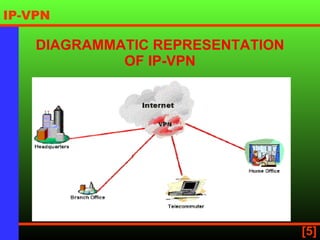
DIAGRAMMATIC REPRESENTATION OF IP-VPN
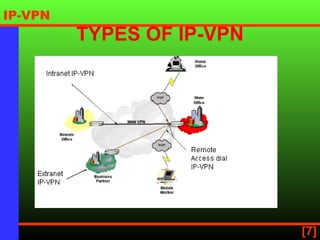
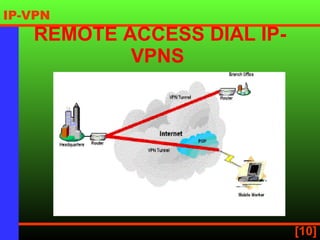
TYPES OF IP-VPNS 1.   Intranet IP-VPN 2.   Extranet IP-VPN 3.  Remote Access Dial IP-VPN
TYPES OF IP-VPN
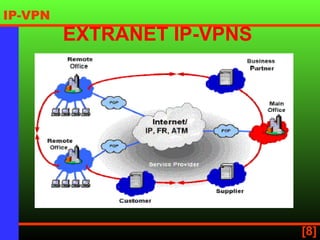
EXTRANET IP-VPNS
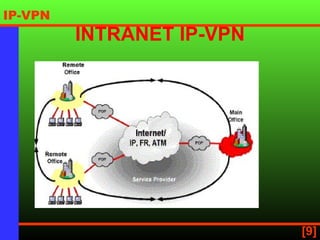
INTRANET IP-VPN
REMOTE ACCESS DIAL IP-VPNS
ADVANTAGES OF IP-VPNS   HIGH SECURITY   LOADENORMOUS RELIABILITY  ENORMOUS RELIABILITY  OUTSOURCING BENEFITS  FAST,STRAIGHTFORWARD IMPLEMENTATION FLEXIBLE IMPLEMENTATION   EFFECTIVE BUSINESS COMMUNICATIONS
APPLICATIONS OF AN IP-VPN   MULTI-SITE ORGANIZATIONS   ORGANIZATIONS WITH REMOTE USERS   ORGANIZATIONS REQUIRING SECURE EDI WITH EXTERNAL PARTNERS, SUPPLIERS, AND CUSTOMERS
CRITERIAS TO CHOSE IP-VPN SERVICE PROVIDER   SECURITY   RELIABILITY HIGHLY RELIABLE CLUSTERED HARDWARE   AVAILABILITY SCALABILITY CLEARLY DEFINED SLAS   FLEXIBILITY
IP-VPN BUSINESS SOLUTION    Based  on Enterprise requirements 1.  IP-VPN Security Solution 2.  IP-VPN Remote Access Solution 3.  IP-VPN Site-to-Site (Intranet and Extranet) Solution
CONCLUSION  IP-VPN uses the Internet's IP network to connect to remote VPNs and creates routes using normal IP routing  ,it is cost effective and secure. IP-based VPNs are less stressful on the backbone because the customers are the ones that provision their VPN and maintain it and there is no bandwidth reservation on the routes.
THANK YOU

IP-VPN

  • 1.
  • 2.
    INTERNET PROTOCOL VIRTUAL PRIVATE NETWORKS (IP VPN) PRESENTED BY: IQxplorer
  • 3.
    IP Virtual PrivateNetworks (IP VPNs) play an important role in today's enterprises by providing the ability to deploy a cost-effective networking solution . IP VPNs offer flexible architectural options that harness the strength and reach of IP networks and provide simplified, secure,robust and scalable connectivity. INTRODUCTION
  • 4.
    AnIP-VPN uses a single public network to provide end-to-end remote connectivity. It is an alternative to a Wide Area Network (WAN), extending a company's internal IP network by securely using a public network, such as the Internet. · Secure data transmission to remote workers, suppliers, and partners ·30-50% lower cost A highly-scalable WAN infrastructure
  • 5.
  • 6.
    TYPES OF IP-VPNS1.   Intranet IP-VPN 2.   Extranet IP-VPN 3. Remote Access Dial IP-VPN
  • 7.
  • 8.
  • 9.
  • 10.
  • 11.
    ADVANTAGES OF IP-VPNS HIGH SECURITY LOADENORMOUS RELIABILITY ENORMOUS RELIABILITY OUTSOURCING BENEFITS FAST,STRAIGHTFORWARD IMPLEMENTATION FLEXIBLE IMPLEMENTATION EFFECTIVE BUSINESS COMMUNICATIONS
  • 12.
    APPLICATIONS OF ANIP-VPN MULTI-SITE ORGANIZATIONS ORGANIZATIONS WITH REMOTE USERS ORGANIZATIONS REQUIRING SECURE EDI WITH EXTERNAL PARTNERS, SUPPLIERS, AND CUSTOMERS
  • 13.
    CRITERIAS TO CHOSEIP-VPN SERVICE PROVIDER SECURITY RELIABILITY HIGHLY RELIABLE CLUSTERED HARDWARE AVAILABILITY SCALABILITY CLEARLY DEFINED SLAS FLEXIBILITY
  • 14.
    IP-VPN BUSINESS SOLUTION   Based on Enterprise requirements 1. IP-VPN Security Solution 2.  IP-VPN Remote Access Solution 3. IP-VPN Site-to-Site (Intranet and Extranet) Solution
  • 15.
    CONCLUSION IP-VPNuses the Internet's IP network to connect to remote VPNs and creates routes using normal IP routing ,it is cost effective and secure. IP-based VPNs are less stressful on the backbone because the customers are the ones that provision their VPN and maintain it and there is no bandwidth reservation on the routes.
  • 16.