
WI-VI
Technology
A close look on “Wireless Vision”…
Presented By :
Anandhu A S
What is Wi-Vi ?
 Wi-Vi is one of the most modern
technology which modifies the Wi-Fi
technology to make the concept of
wireless vision possible.
 The main logic or idea is the tracking and
manipulation of reflected Wi-Fi signals.
 It can hence be called as an adaption of
From The Development…
 The history of Wi-Fi lies in the campus of
MIT
 Developed by professor Dina Katabi and
her graduate student Fadel Adib.
 Developed in science and AI laboratory of
MIT by the faculty and student of electrical
engineering and computer science
department
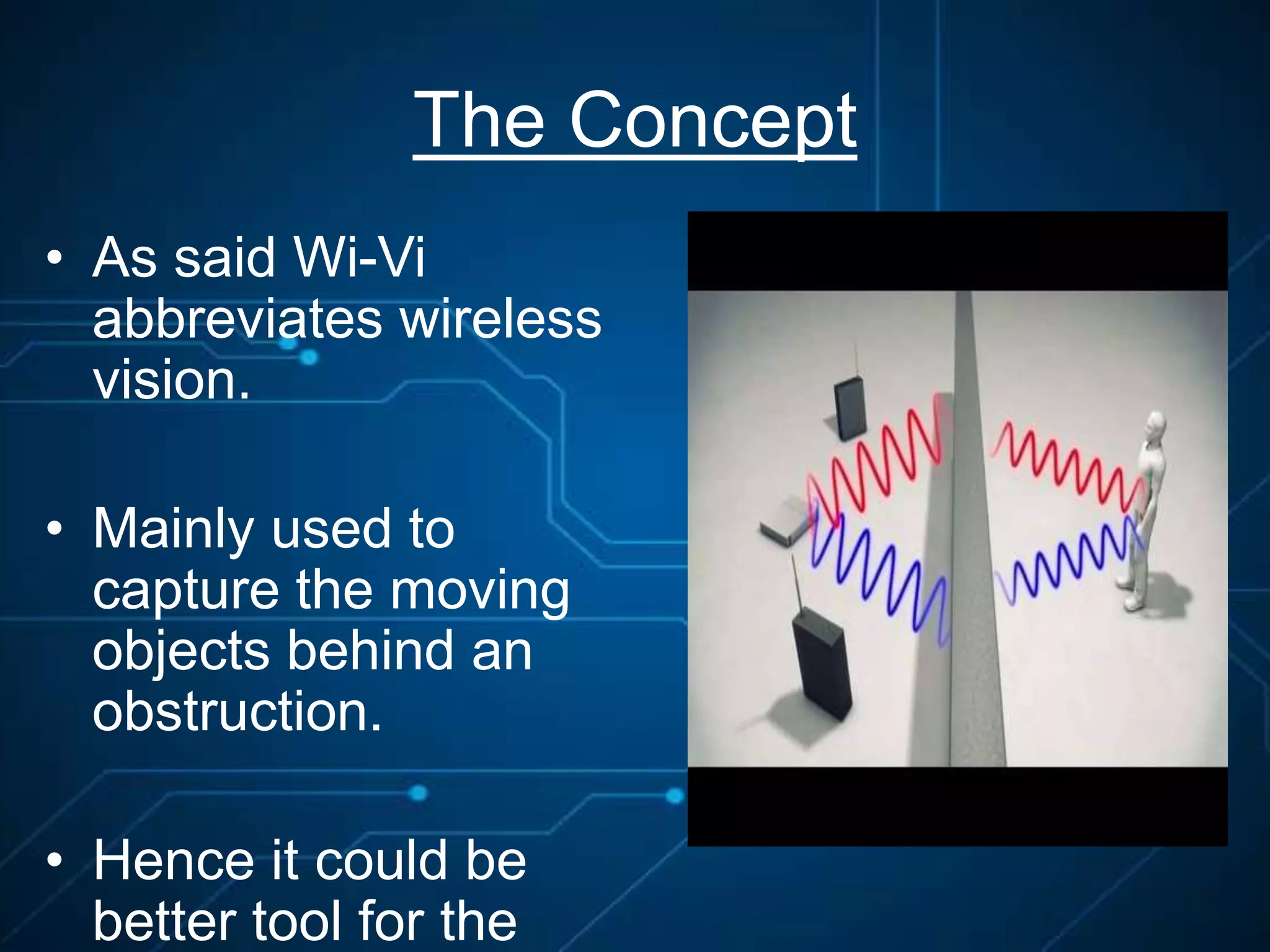
The Concept
• As said Wi-Vi
abbreviates wireless
vision.
• Mainly used to
capture the moving
objects behind an
obstruction.
• Hence it could be
better tool for the
Wi-Vi Device
KEY IDEA
Introduction
• Wi-vi uses Wi-Fi technology to image
behind the obstacles.
• Totally wireless devices are the main
advantage of the technology.
• Uses only single receiver to map up the
image.
Old v/s New
• An array of special antennas are required
in earlier technology to map over
obstacles.
• Each of them capture the signals for
mapping.
• Hence it becomes more expensive
• Wi-Vi uses simpler device receiver than
Principle
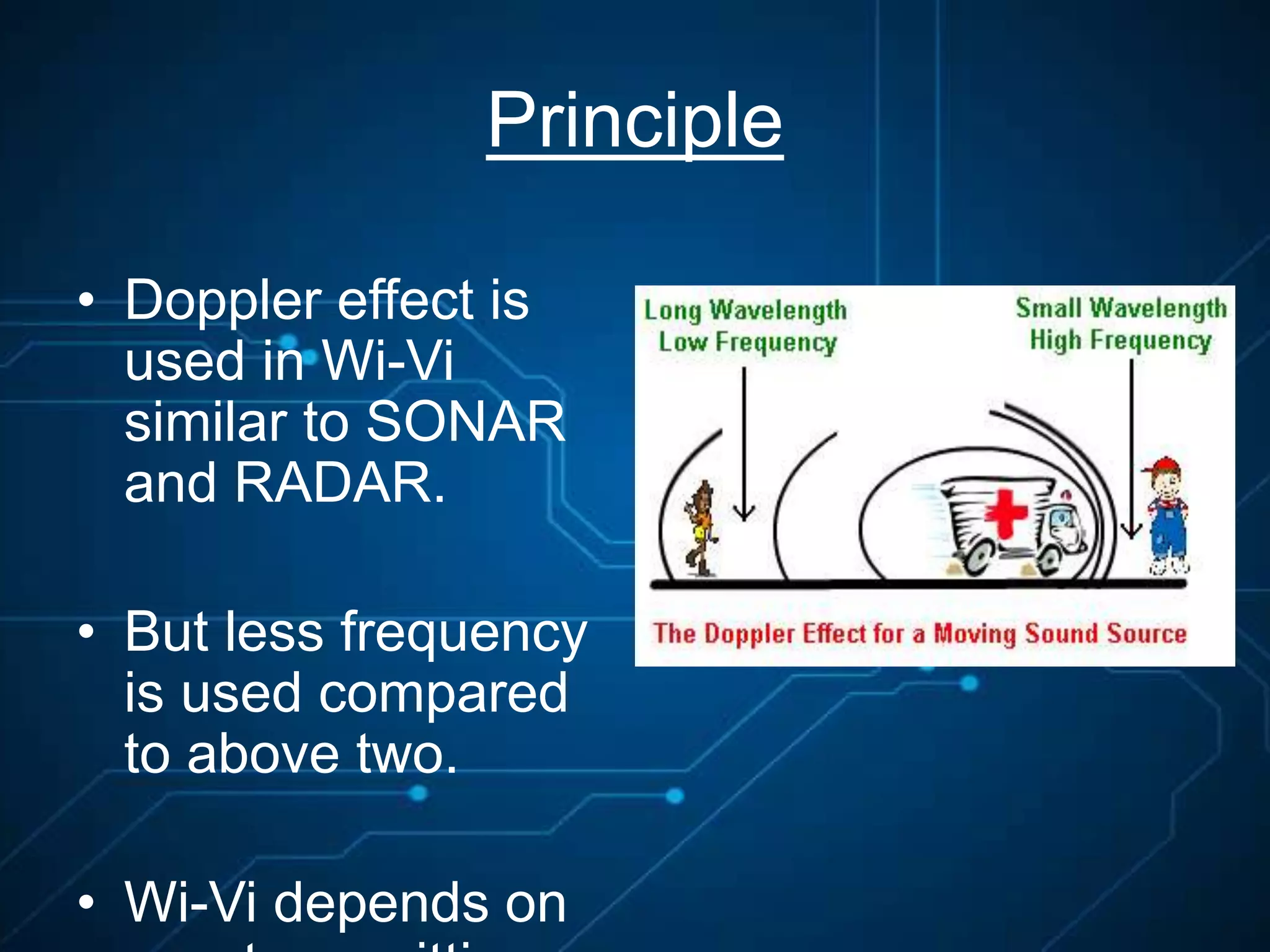
• Doppler effect is
used in Wi-Vi
similar to SONAR
and RADAR.
• But less frequency
is used compared
to above two.
• Wi-Vi depends on
Working
• Two antennas transmit identical signals
where the second antenna signal is the
inverse if the first.
• This causes interference for imaging.
• Wi-Vi relies on a simple 2.4 GHz Wi-Fi
hardware radio.
• Simply this can be decoded on handheld
Diagrammatic Representation
• During the motion of the target, the
distance of it changes with respect to
receiver.
• It changes the time that reflected signal
takes to get back to receiver.
• Only those reflections that changes
between the two signals such as those
from the moving object arrive back at the
receiver.
For example, here all the signals form
other obstacles are cancelled out and the
only target is moving human.
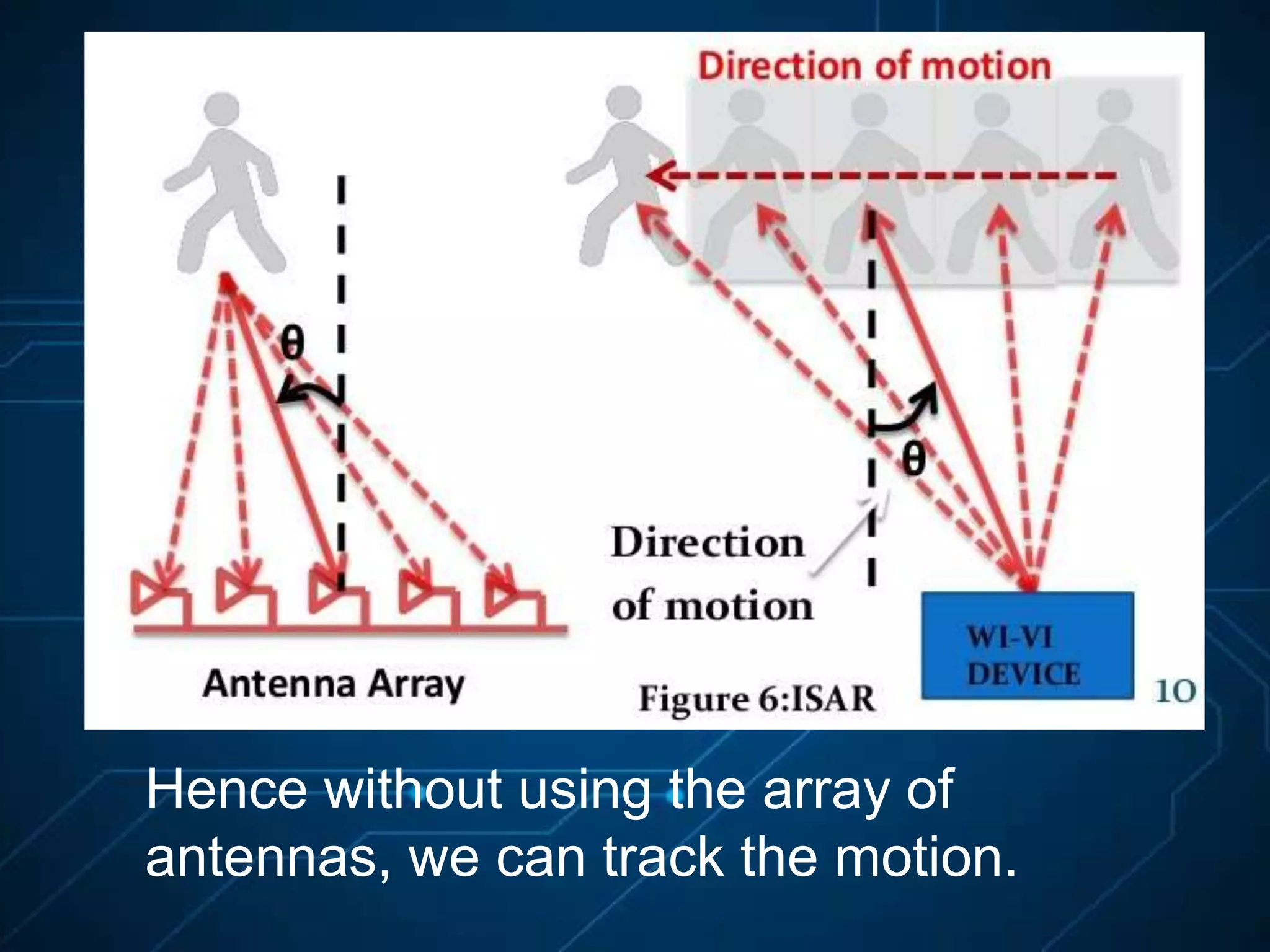
Tracking Reflections
 Refection from human behaves like it is the
source.
 Antennas are used to trace a radio frequency
source.
 We can find the direction of the signal
movement by steering the beam of antennas.
 Finally using this method, when the person
moves, the change in direction can be
Comparison with Antenna array
A graphical view
Hence without using the array of
antennas, we can track the motion.
Extend Of Resolution
• It delivers a basic perspective of the
moving object.
• Simple gestures can be traced using Wi-
Fi.
• The imaging clarity grades lower to that of
a camera quality due to RF signals used
rather than direct light .
Challenges In The Path…
• Due to the obstructions and intermediate
object it is essential to generate more
sharper output rays.
• The major challenges faced are :
flash effect
tracking of human movement
Flash effect
 In this technology, the most challenging
part is the reflections for the wall itself
rather than reflections form the object.
 Due to reflection off the wall, minute
variations coming through the object are
prevented from being tracked.
 This behavior is known as flash effect.
 To cancel both wall reflections and direct
signal from transmitting and receiving
antenna, Wi-Vi uses interference nulling.
 This increase the sensitivity of the
reflections.
 Multi Input Multi Output (MIMO)
antennas are used to nullify the flash
effect.
Nullification
 Wi-Vi, however, avoids using an antenna
array for two reasons:
 In order to achieve a good resolution,
one needs a large antenna array with
many antenna elements. This would
result in a bulky and expensive device.
 Since Wi-Vi eliminates the flash effect
using MIMO nulling, adding multiple
receive antennas would require nulling
the signal at each of them. This would
require adding more transmit antenna,
 To eliminate the flash effect we have to
remove reflected signal received from
stationary objects both in front off and
behind the wall and direct signals from
transmitting antenna to receiving antenna.
 Wi-Vi’s uses nulling algorithm which
provides a 42dB mean reduction in signal
power which is enough to remove the flash
effect.
 Nulling can be performed in the presence
of objects moving behind the wall and front
Nulling involves steps:
– Initial nulling
• Initial output signals are nullified.
– Power nulling
• MIMO radars and antennas boost the power of
signal to increase the sharpness.
– Iterative nulling
• Nulling is done continuously on final signals
Track human movements
 Reflections include every objects behind
the wall.
 But it is possible to clear out the human
reflected rays and to trace their
movement.
 So one of the important challenges faced
are those to track the human movements
only.
 Antenna array can eliminate by movement
of target by using ISAR (Inverse Synthetic
Aperture Radar)
 There is only one receiver antenna in
ISAR ,so at any point in time we capture a
single measurement.
 Since the target is moving consecutive
measurements in time eliminate an
inverse antenna array that is as if the
moving human is imaging the Wi Vi
device.
 By processing such consecutive
measurements using standard antenna
array beam steering. Wi-vi can identify the
spatial direction of the human.
Gesture Based Communication
• For wireless communication with a system,
usually humans need to carry any wireless
device.
• Wi-Vi allow freehand communication using
gestures for humans without wireless
devices.
• Wi-Vi designates pair of gestures as 0 bit
and 1 bit.
Advantages
 Operates in same bandwidth as Wi-Fi.
 Wall imaging can be done without
accessing any device on the other side of
wall.
 Signal wavelength of 12.5 cm are only
used.
• Its low power low cost and low bandwidth
makes it accessible for the average users.
• It operates in Industrial Scientific and
Medical radio band. (ISM band).
• It motivates a new form of user interfaces
which rely solely on using the reflections of
a transmitted RF signal to identify human
gestures .
• By leveraging finer nulling techniques and
employing better hardware, the system
can evolve to seeing humans through
denser building.
Limitations
 Low resolution display is only possible.
 Detection of human is only possible for
walls below 8 inch thickness.
 Humans need to move by about 50cm to
achieve a narrow beam.
 Short range of communication is only
Way To Go…
• Can be built in to special hand held devices.
• High quality imaging can possibly be done.
• Sight mapping through denser building beyond 8
inch thicker walls may be possible.
• Possibly used as next generation RADAR.
• The efficient device for military purpose may get
Applications
 Can be implemented
on smart phone a and
hand held devices.
 Used in monitoring
purposes.
 Virtual gaming is
possible.
Conclusion
• Wi-Vi or wireless vision technology is the
simplest evolution for communicating.
• Rather than RADARS and old measures, it
can be afforded simply and cheaply.
• Its operation in ISM band makes it easily
accessible to public without any specially
built transmitting devices.
• Hence in most ways, it makes a
sense that Wi-Vi technology is one
further step in the fields of electronics
and has the most scope of
improvements and applications an far
considered…
Reference
www.seminarsonly.com
www.gizmag.com
www.techhive.com
www.electronicstoday.com
THANK YOU...

Wi-Vi Technology

  • 1.
    WI-VI Technology A close lookon “Wireless Vision”… Presented By : Anandhu A S
  • 2.
    What is Wi-Vi?  Wi-Vi is one of the most modern technology which modifies the Wi-Fi technology to make the concept of wireless vision possible.  The main logic or idea is the tracking and manipulation of reflected Wi-Fi signals.  It can hence be called as an adaption of
  • 3.
    From The Development… The history of Wi-Fi lies in the campus of MIT  Developed by professor Dina Katabi and her graduate student Fadel Adib.  Developed in science and AI laboratory of MIT by the faculty and student of electrical engineering and computer science department
  • 4.
    The Concept • Assaid Wi-Vi abbreviates wireless vision. • Mainly used to capture the moving objects behind an obstruction. • Hence it could be better tool for the
  • 5.
  • 6.
    Introduction • Wi-vi usesWi-Fi technology to image behind the obstacles. • Totally wireless devices are the main advantage of the technology. • Uses only single receiver to map up the image.
  • 7.
    Old v/s New •An array of special antennas are required in earlier technology to map over obstacles. • Each of them capture the signals for mapping. • Hence it becomes more expensive • Wi-Vi uses simpler device receiver than
  • 8.
    Principle • Doppler effectis used in Wi-Vi similar to SONAR and RADAR. • But less frequency is used compared to above two. • Wi-Vi depends on
  • 9.
    Working • Two antennastransmit identical signals where the second antenna signal is the inverse if the first. • This causes interference for imaging. • Wi-Vi relies on a simple 2.4 GHz Wi-Fi hardware radio. • Simply this can be decoded on handheld
  • 10.
  • 11.
    • During themotion of the target, the distance of it changes with respect to receiver. • It changes the time that reflected signal takes to get back to receiver. • Only those reflections that changes between the two signals such as those from the moving object arrive back at the receiver.
  • 12.
    For example, hereall the signals form other obstacles are cancelled out and the only target is moving human.
  • 13.
    Tracking Reflections  Refectionfrom human behaves like it is the source.  Antennas are used to trace a radio frequency source.  We can find the direction of the signal movement by steering the beam of antennas.  Finally using this method, when the person moves, the change in direction can be
  • 14.
    Comparison with Antennaarray A graphical view
  • 15.
    Hence without usingthe array of antennas, we can track the motion.
  • 16.
    Extend Of Resolution •It delivers a basic perspective of the moving object. • Simple gestures can be traced using Wi- Fi. • The imaging clarity grades lower to that of a camera quality due to RF signals used rather than direct light .
  • 17.
    Challenges In ThePath… • Due to the obstructions and intermediate object it is essential to generate more sharper output rays. • The major challenges faced are : flash effect tracking of human movement
  • 18.
    Flash effect  Inthis technology, the most challenging part is the reflections for the wall itself rather than reflections form the object.  Due to reflection off the wall, minute variations coming through the object are prevented from being tracked.  This behavior is known as flash effect.
  • 19.
     To cancelboth wall reflections and direct signal from transmitting and receiving antenna, Wi-Vi uses interference nulling.  This increase the sensitivity of the reflections.  Multi Input Multi Output (MIMO) antennas are used to nullify the flash effect.
  • 20.
    Nullification  Wi-Vi, however,avoids using an antenna array for two reasons:  In order to achieve a good resolution, one needs a large antenna array with many antenna elements. This would result in a bulky and expensive device.  Since Wi-Vi eliminates the flash effect using MIMO nulling, adding multiple receive antennas would require nulling the signal at each of them. This would require adding more transmit antenna,
  • 21.
     To eliminatethe flash effect we have to remove reflected signal received from stationary objects both in front off and behind the wall and direct signals from transmitting antenna to receiving antenna.  Wi-Vi’s uses nulling algorithm which provides a 42dB mean reduction in signal power which is enough to remove the flash effect.  Nulling can be performed in the presence of objects moving behind the wall and front
  • 22.
    Nulling involves steps: –Initial nulling • Initial output signals are nullified. – Power nulling • MIMO radars and antennas boost the power of signal to increase the sharpness. – Iterative nulling • Nulling is done continuously on final signals
  • 23.
    Track human movements Reflections include every objects behind the wall.  But it is possible to clear out the human reflected rays and to trace their movement.  So one of the important challenges faced are those to track the human movements only.
  • 24.
     Antenna arraycan eliminate by movement of target by using ISAR (Inverse Synthetic Aperture Radar)  There is only one receiver antenna in ISAR ,so at any point in time we capture a single measurement.
  • 25.
     Since thetarget is moving consecutive measurements in time eliminate an inverse antenna array that is as if the moving human is imaging the Wi Vi device.  By processing such consecutive measurements using standard antenna array beam steering. Wi-vi can identify the spatial direction of the human.
  • 26.
    Gesture Based Communication •For wireless communication with a system, usually humans need to carry any wireless device. • Wi-Vi allow freehand communication using gestures for humans without wireless devices. • Wi-Vi designates pair of gestures as 0 bit and 1 bit.
  • 27.
    Advantages  Operates insame bandwidth as Wi-Fi.  Wall imaging can be done without accessing any device on the other side of wall.  Signal wavelength of 12.5 cm are only used.
  • 28.
    • Its lowpower low cost and low bandwidth makes it accessible for the average users. • It operates in Industrial Scientific and Medical radio band. (ISM band). • It motivates a new form of user interfaces which rely solely on using the reflections of a transmitted RF signal to identify human gestures . • By leveraging finer nulling techniques and employing better hardware, the system can evolve to seeing humans through denser building.
  • 29.
    Limitations  Low resolutiondisplay is only possible.  Detection of human is only possible for walls below 8 inch thickness.  Humans need to move by about 50cm to achieve a narrow beam.  Short range of communication is only
  • 30.
    Way To Go… •Can be built in to special hand held devices. • High quality imaging can possibly be done. • Sight mapping through denser building beyond 8 inch thicker walls may be possible. • Possibly used as next generation RADAR. • The efficient device for military purpose may get
  • 31.
    Applications  Can beimplemented on smart phone a and hand held devices.  Used in monitoring purposes.  Virtual gaming is possible.
  • 32.
    Conclusion • Wi-Vi orwireless vision technology is the simplest evolution for communicating. • Rather than RADARS and old measures, it can be afforded simply and cheaply. • Its operation in ISM band makes it easily accessible to public without any specially built transmitting devices.
  • 33.
    • Hence inmost ways, it makes a sense that Wi-Vi technology is one further step in the fields of electronics and has the most scope of improvements and applications an far considered…
  • 34.
  • 35.