How the Apple iPhone has dramatically changed the way we view the mobile web
Contact Info Mike Qaissaunee Co-PI, National Center for Information and Communications Technologies [email_address] Website –  ictcenter.org
Blogs/Podcast and other Read our blogs at: Mike Qaissaunee -  q-ontech.blogspot.com Gordon F. Snyder -  ictcenter.blogspot.com Listen to our podcast @  gsnyder.libsyn.com/  or subscribe in  iTunes Join us on  twitte r –  mqaissaunee  and  gsnyder   Join us in  Facebook Watch  our  YouT ube Channel
What is the iPhone? Apple’s Smartphone More than a Phone?  Built in Accelerometer GPS or Position Triangulation  Multi Touch Interface Sensors Keyboard Safari Mail Calendar Wide Screen Display
iPhone Overview Smart Phone + iPod (Widescreen)  Wireless Internet Communication Device Wifi 802.11 b/g PDA  Computer (OS X) Camera  App Store
iPhone Development Development done with the help of iPhone SDK ( requires an Intel MAC ) Uses Objective-C XCODE + Other tools Can submit your application to App Store $99  membership Review your application + code Revenue model You set your price (free, 99cents, $9.99m etc) 70% developer (you) and 30% Apple
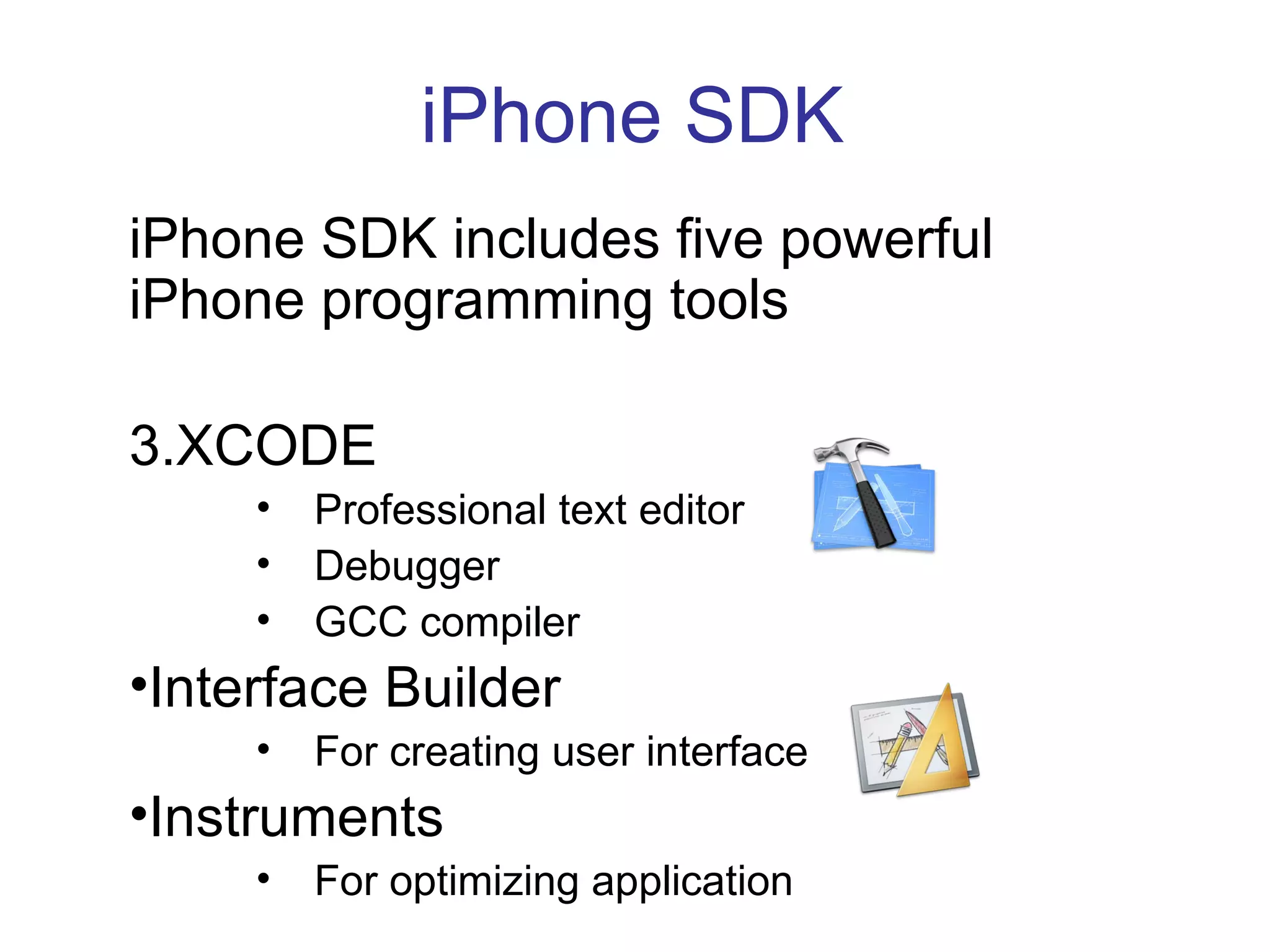
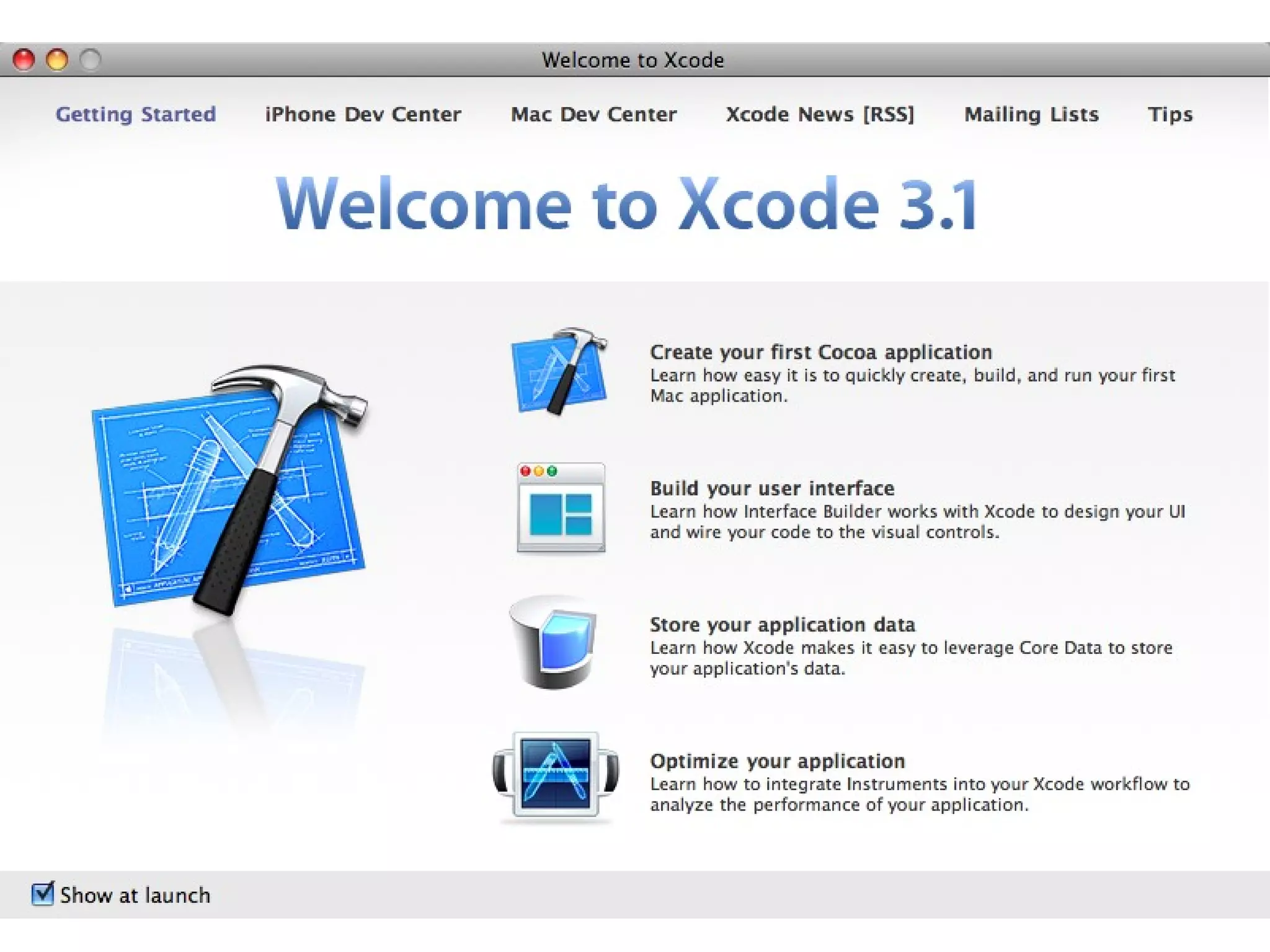
iPhone SDK iPhone SDK includes five powerful iPhone programming tools XCODE Professional text editor Debugger GCC compiler Interface Builder For creating user interface Instruments For optimizing application
iPhone SDK Dash Code For creating web applications for Safari iPhone Simulator
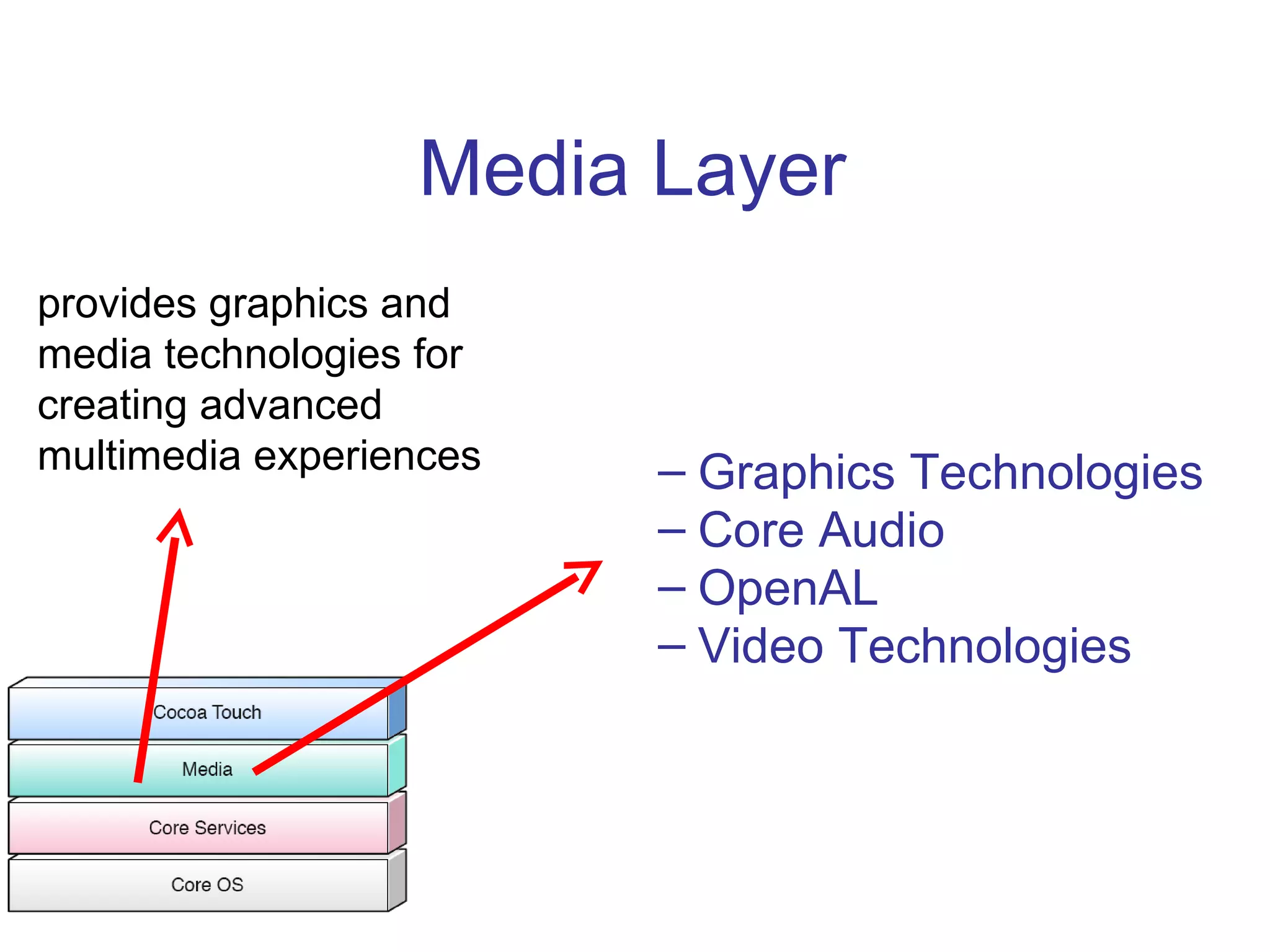
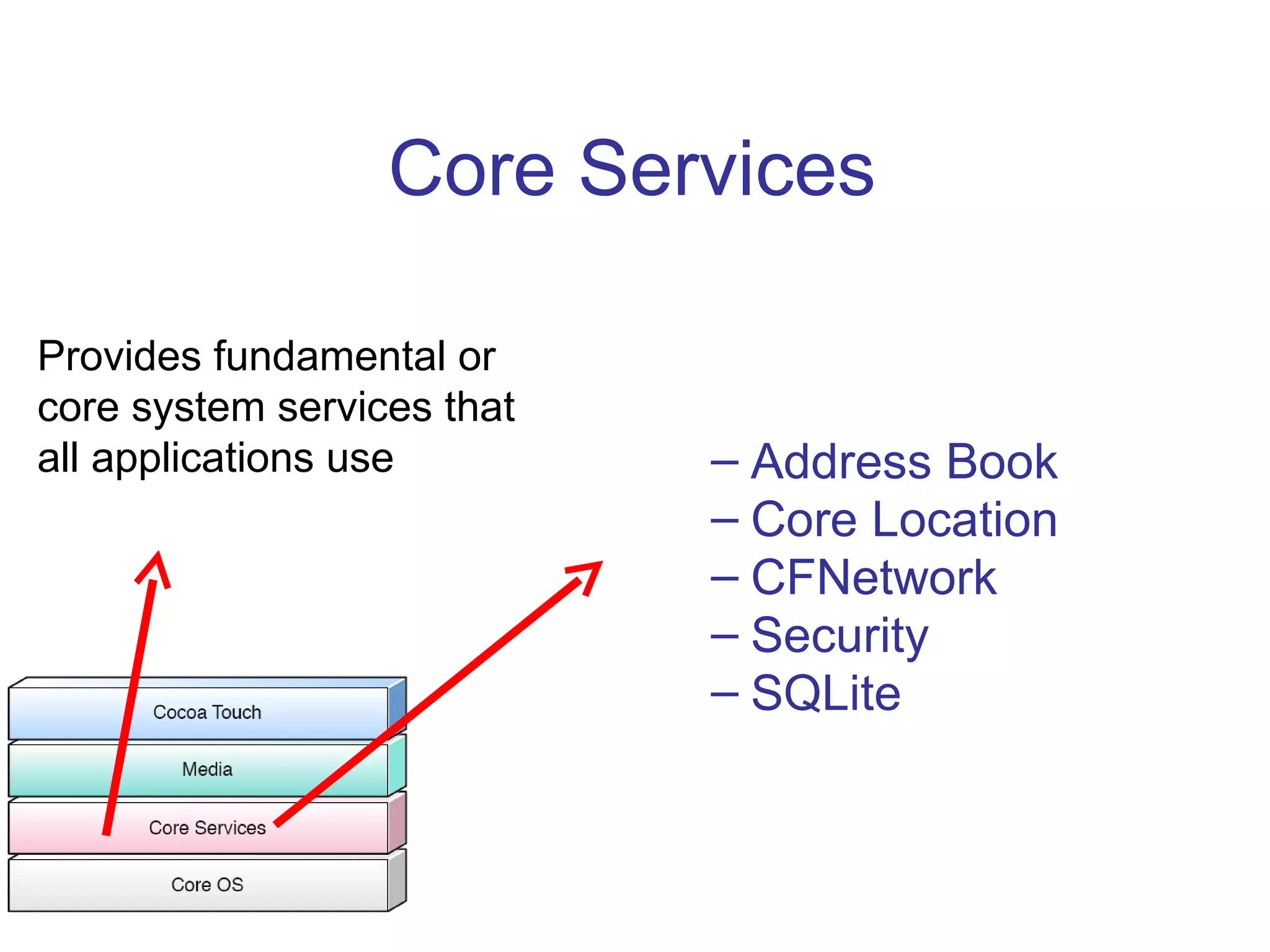
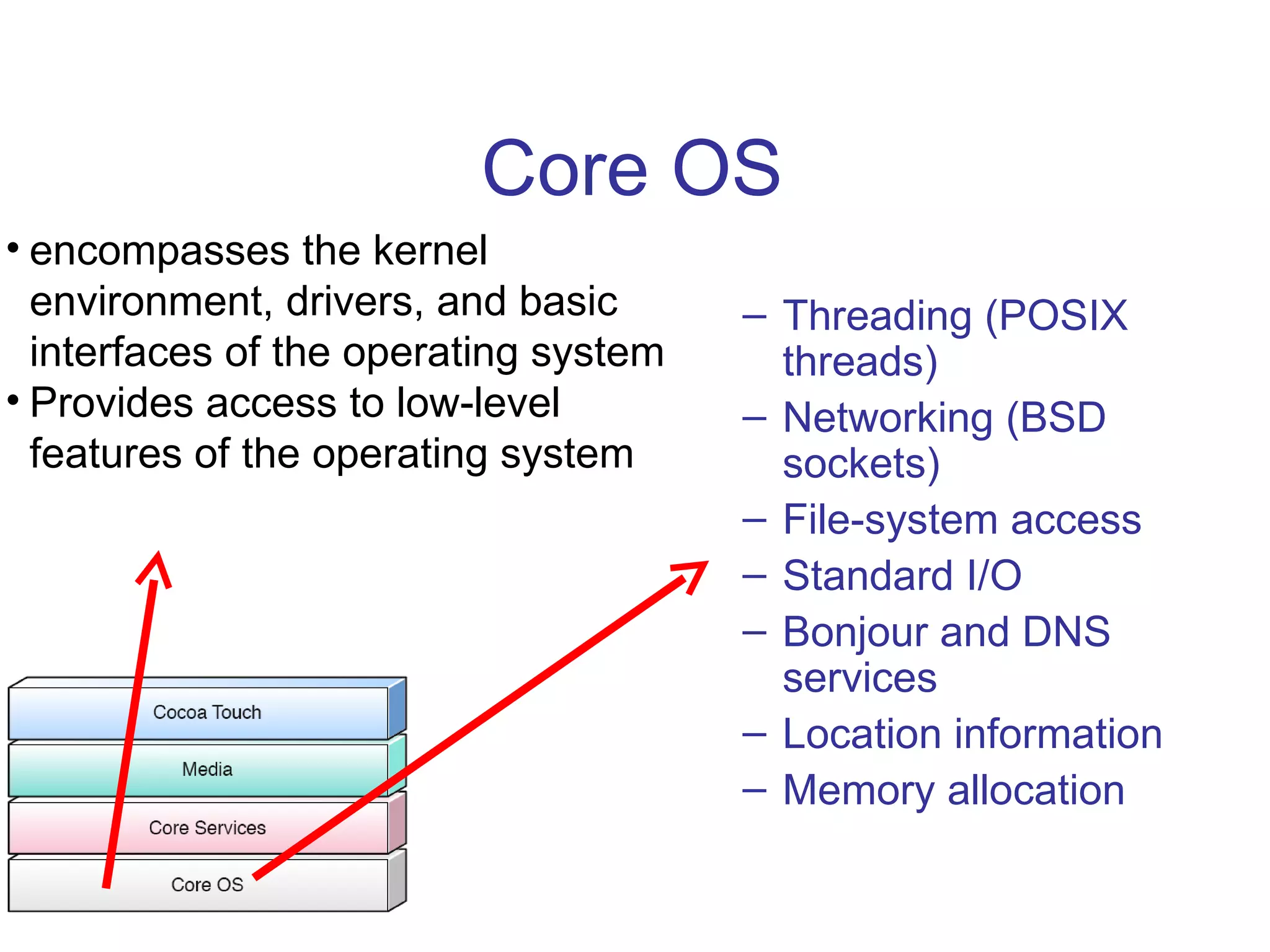
iPhone OS can be viewed as set of layers
Cocoa Touch Layer Application management Graphics and windowing support Event-handling support User interface management Objects representing the standard system views and controls Support for text and web content Accelerometer data The built-in camera The photo library Device-specific information the basic tools to implement graphical, event-driven applications
Media Layer Graphics Technologies Core Audio OpenAL Video Technologies provides graphics and media technologies for creating advanced multimedia experiences
Core Services Address Book Core Location CFNetwork Security SQLite Provides fundamental or core system services that all applications use
Core OS Threading (POSIX threads) Networking (BSD sockets) File-system access Standard I/O Bonjour and DNS services Location information Memory allocation encompasses the kernel environment, drivers, and basic interfaces of the operating system Provides access to low-level features of the operating system
iPhone Hardware and Software Features Available to Applications Accelerometer iPhone and iPod touch have 3 accelerometers to measure/detect movement along each of the primary ( x, y, and z ) axes in three-dimensional space The system uses the accelerometers to monitor a device’s current orientation and to notify applications when that orientation changes Applications can access accelerometer data directly
iPhone Hardware and Software Features Available to Applications Core Location Core Location monitors signals from cell towers and Wi-Fi hotspots to triangulate the user’s current position Accuracy of location information and threshold for reporting location changes can be specified  Use sparingly – drains battery
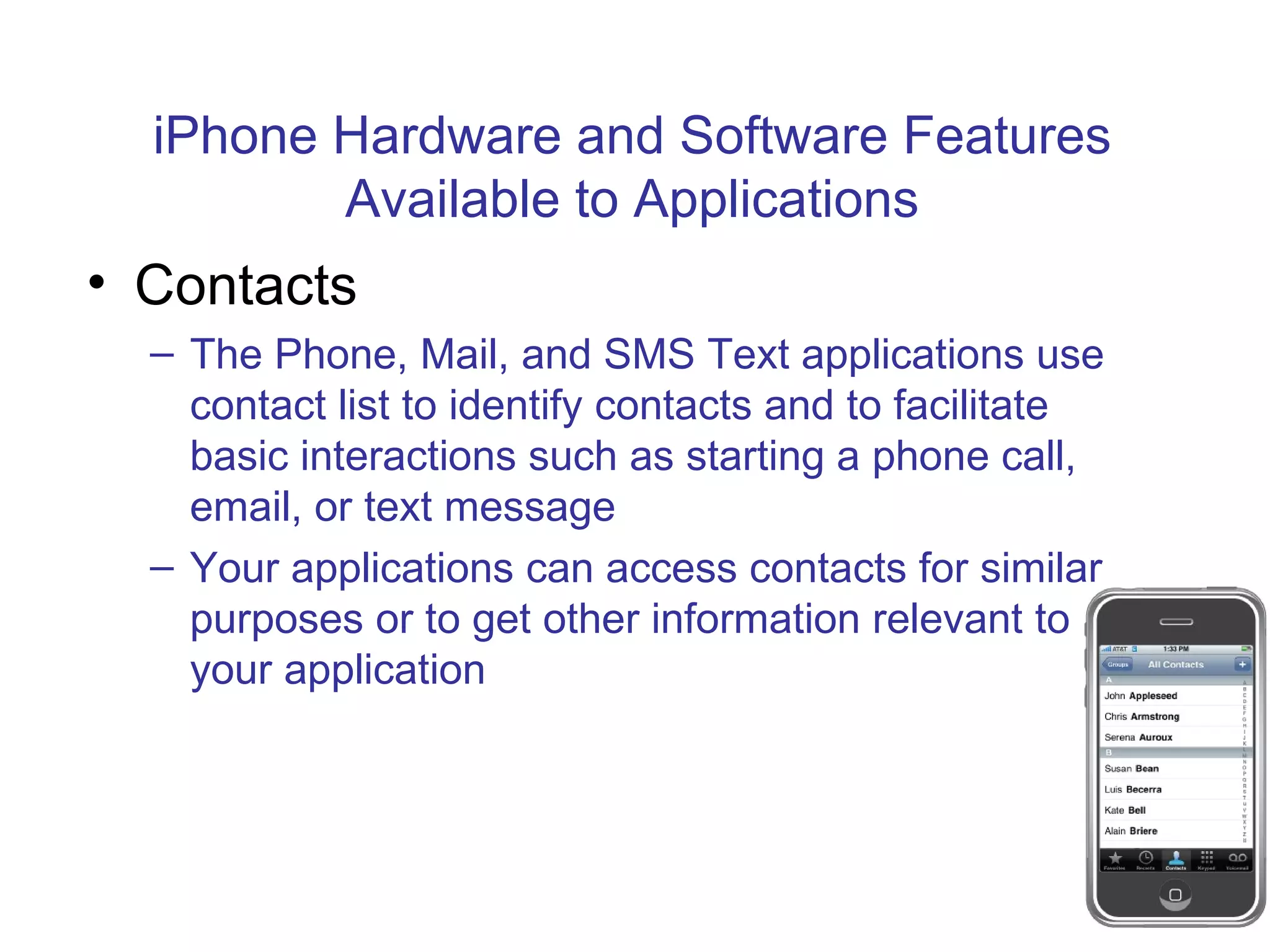
iPhone Hardware and Software Features Available to Applications Contacts The Phone, Mail, and SMS Text applications use contact list to identify contacts and to facilitate basic interactions such as starting a phone call, email, or text message Your applications can access contacts for similar purposes or to get other information relevant to your application
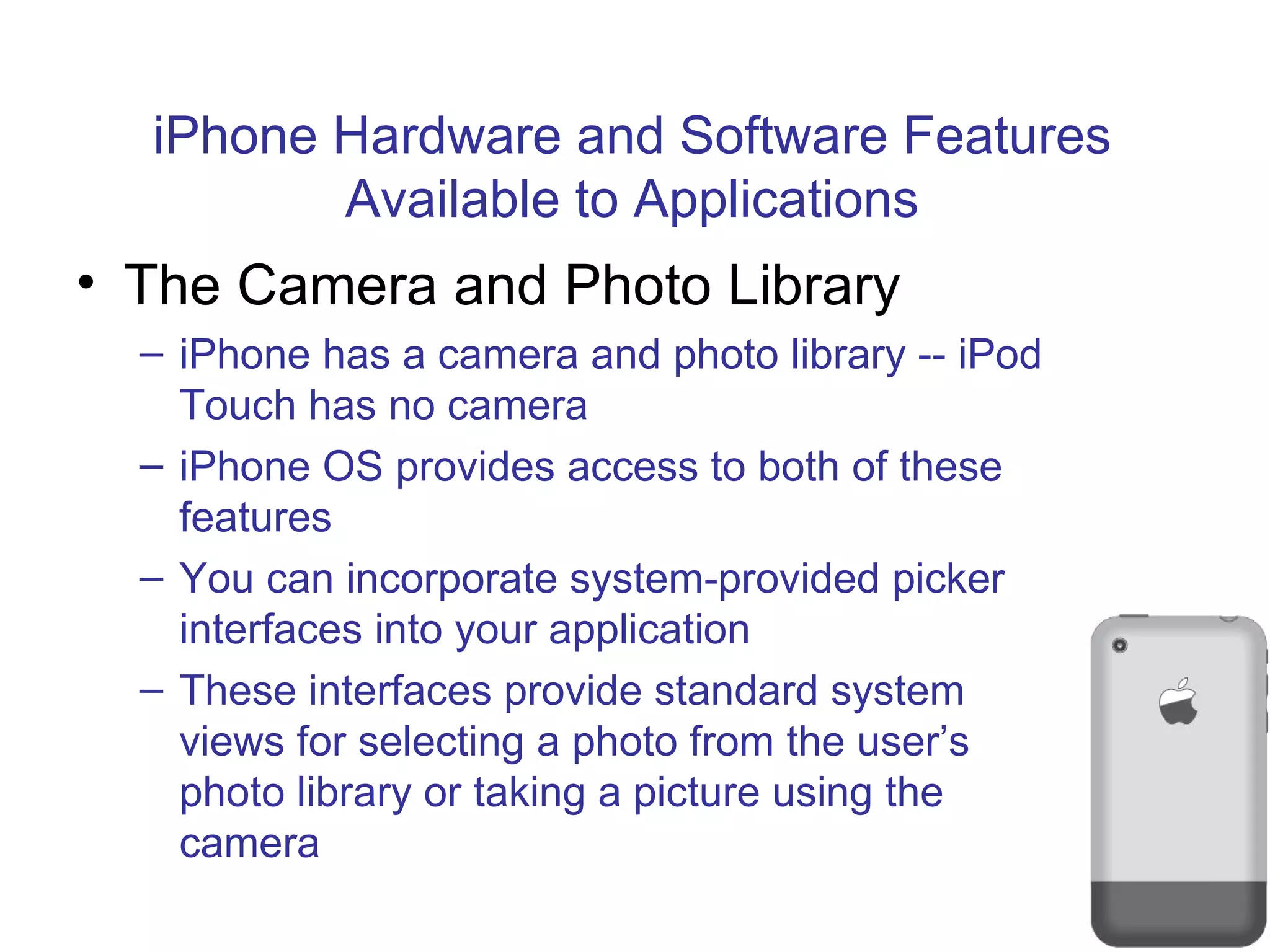
iPhone Hardware and Software Features Available to Applications The Camera and Photo Library iPhone has a camera and photo library -- iPod Touch has no camera iPhone OS provides access to both of these features You can incorporate system-provided picker interfaces into your application These interfaces provide standard system views for selecting a photo from the user’s photo library or taking a picture using the camera
App Distribution Three methods of distribution: App Store Wi-Fi/EDGE/HSDPA on iPhone Desktop syncing via iTunes Enterprise Proprietary in-house apps Requires 500+ employees Ad-hoc Provide users with app via email/website Requires users to register their device ID with the developer 100 device limit per app 75
Downloading Apps 76 App Store distribution method determined by size: Apps < 10 MB can be downloaded over the cellular network Apps > 10 MB require WiFi connectivity or side loading via iTunes
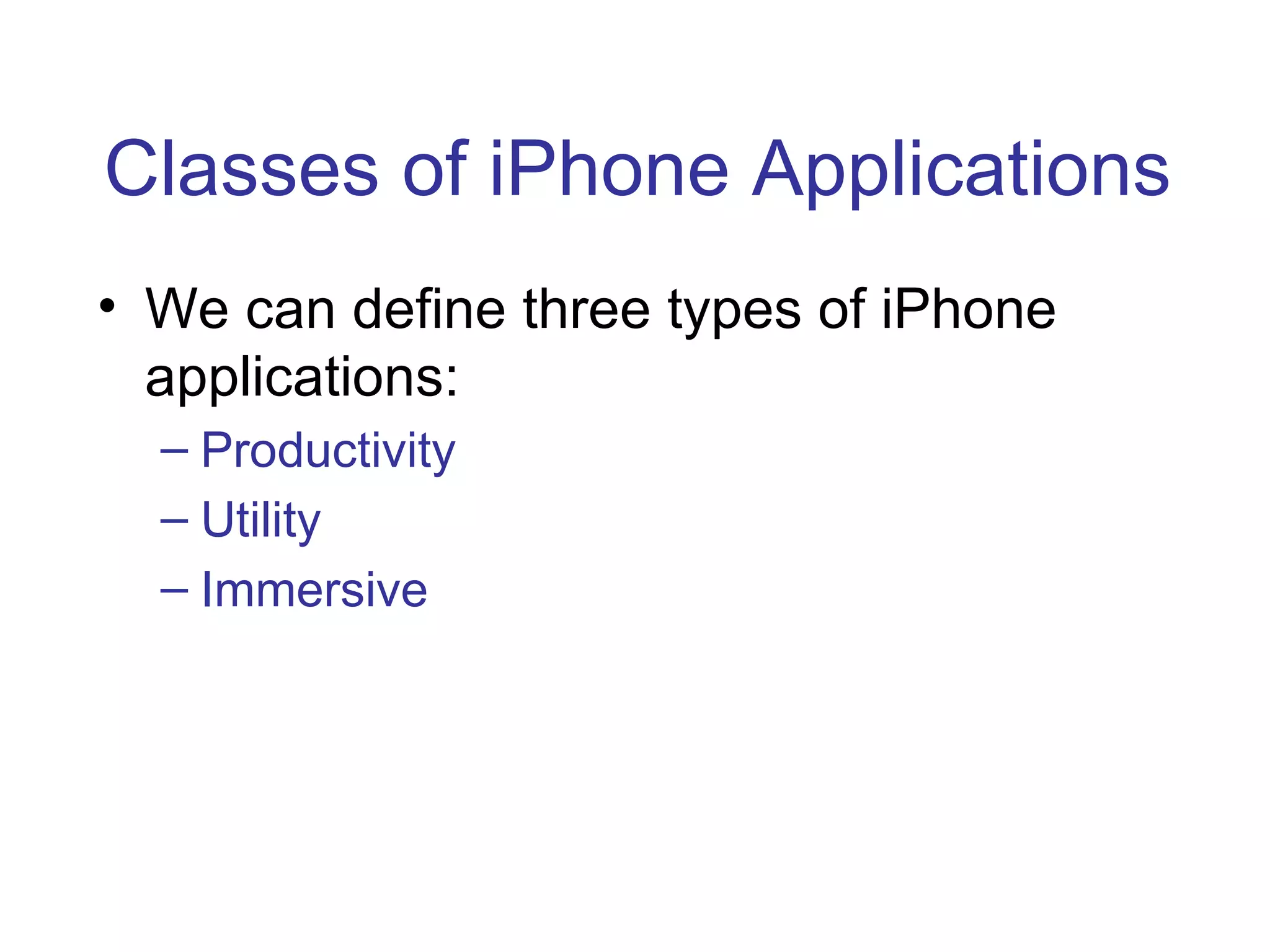
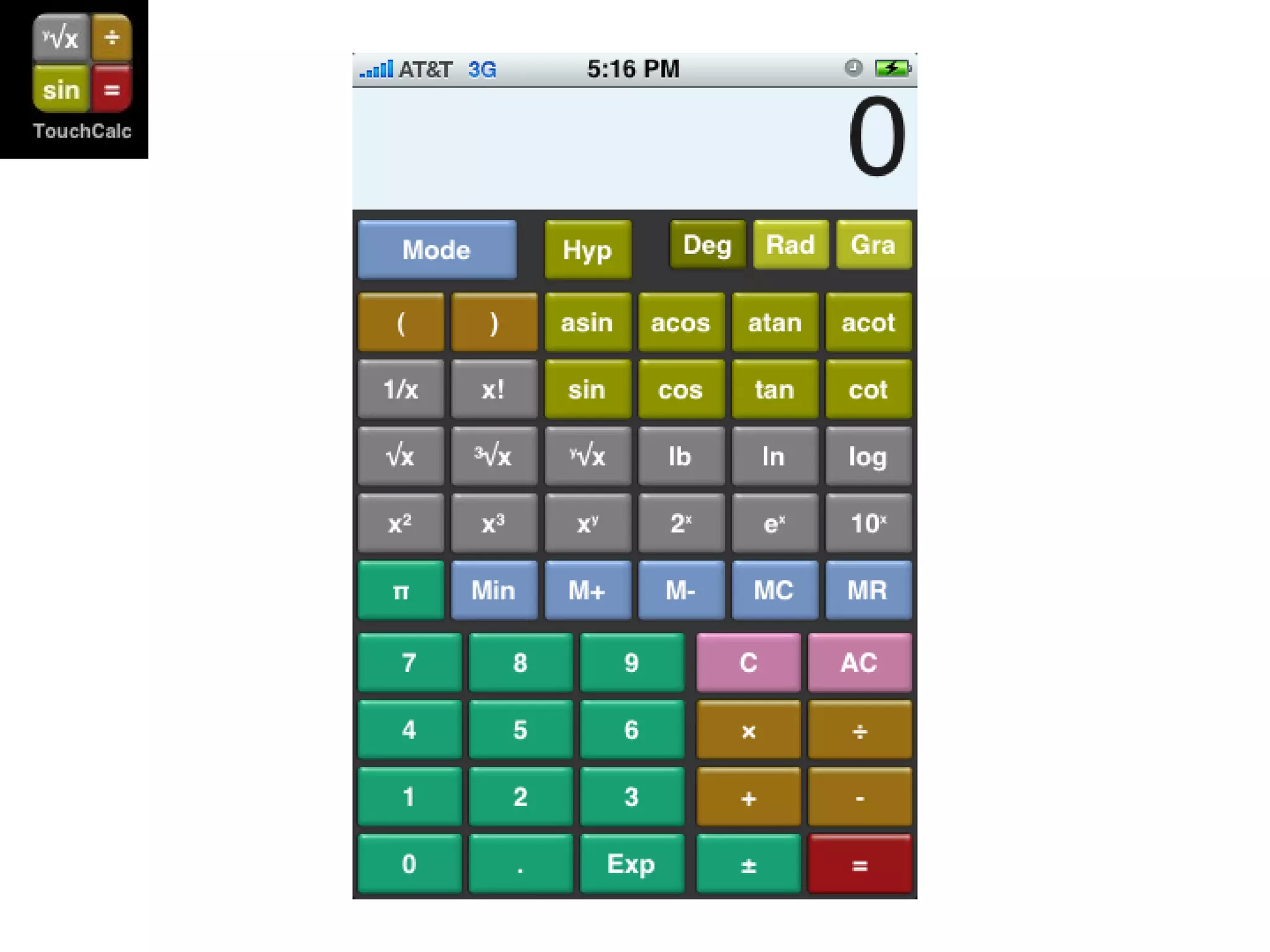
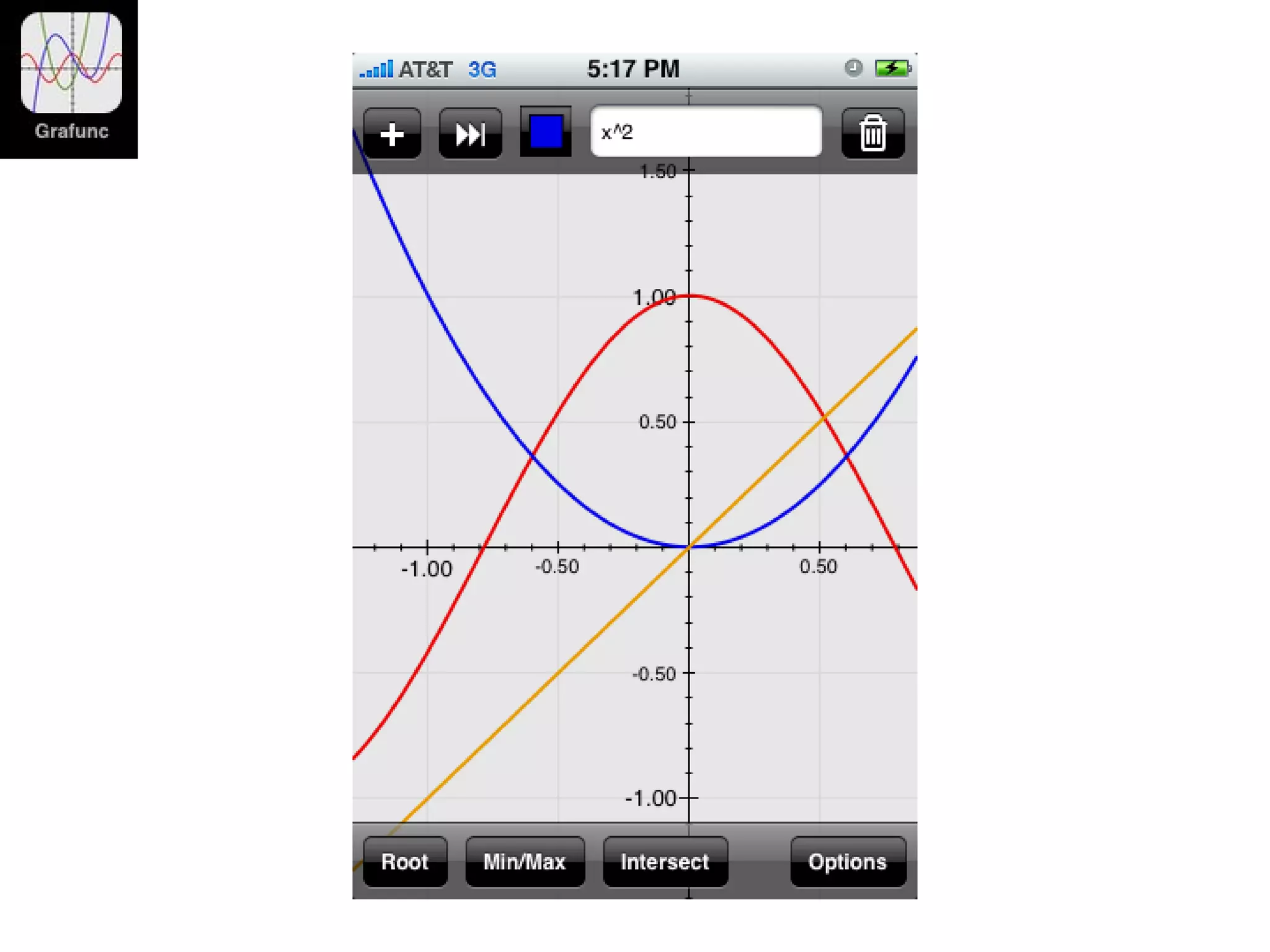
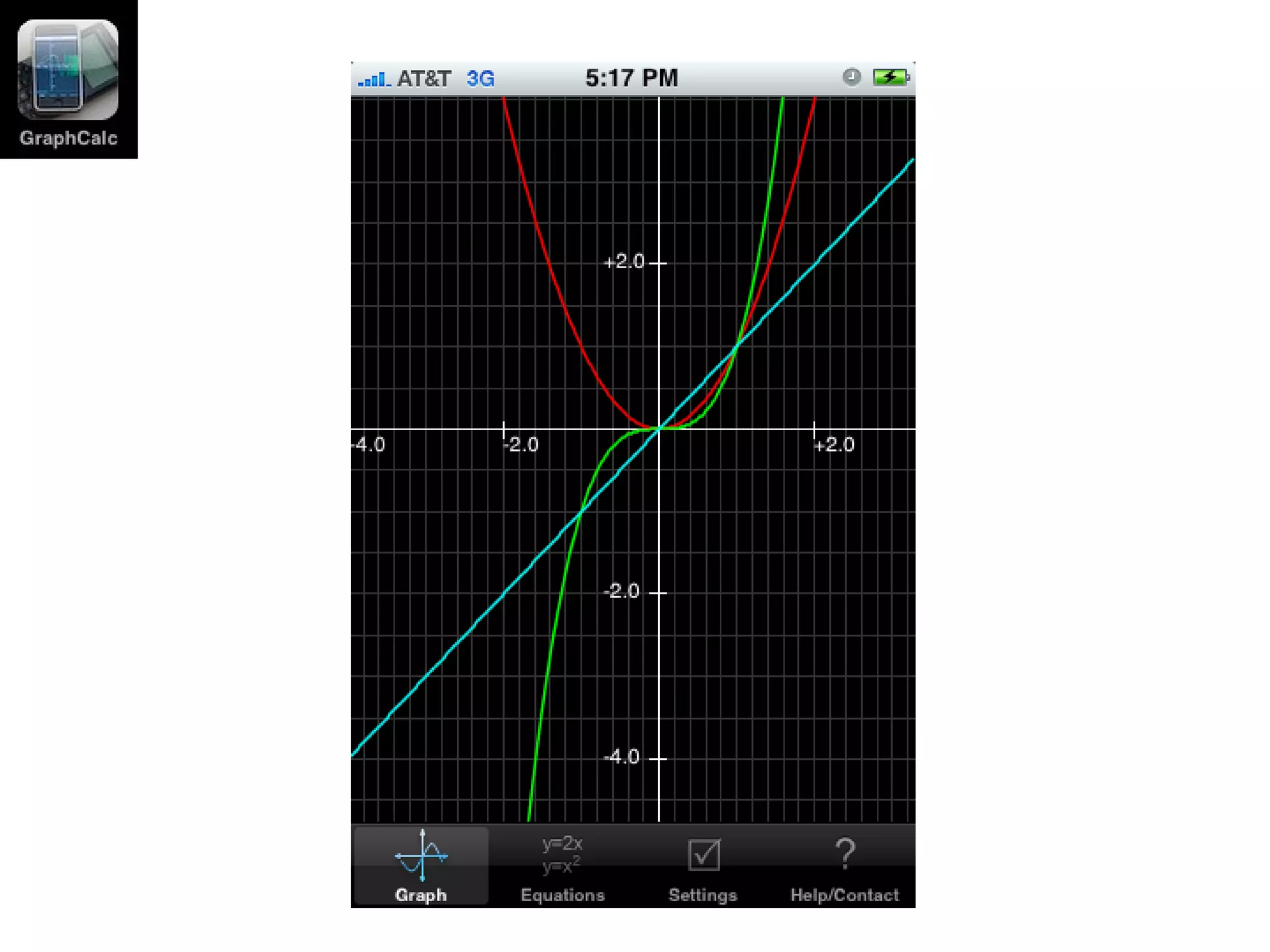
Classes of iPhone Applications We can define three types of iPhone applications: Productivity Utility Immersive


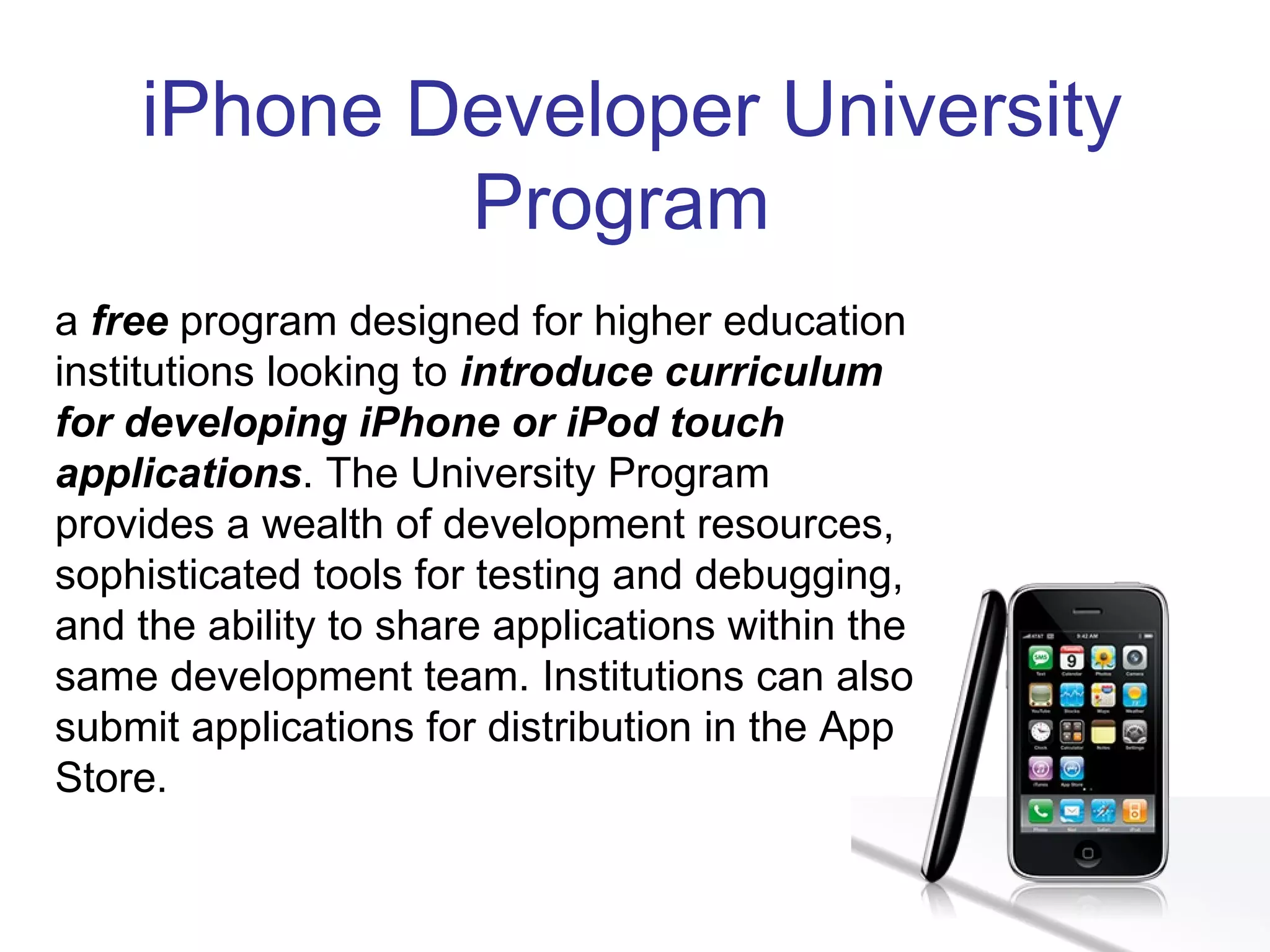
iPhone Developer University Program  a  free  program designed for higher education institutions looking to  introduce curriculum for developing iPhone or iPod touch applications . The University Program provides a wealth of development resources, sophisticated tools for testing and debugging, and the ability to share applications within the same development team. Institutions can also submit applications for distribution in the App Store.
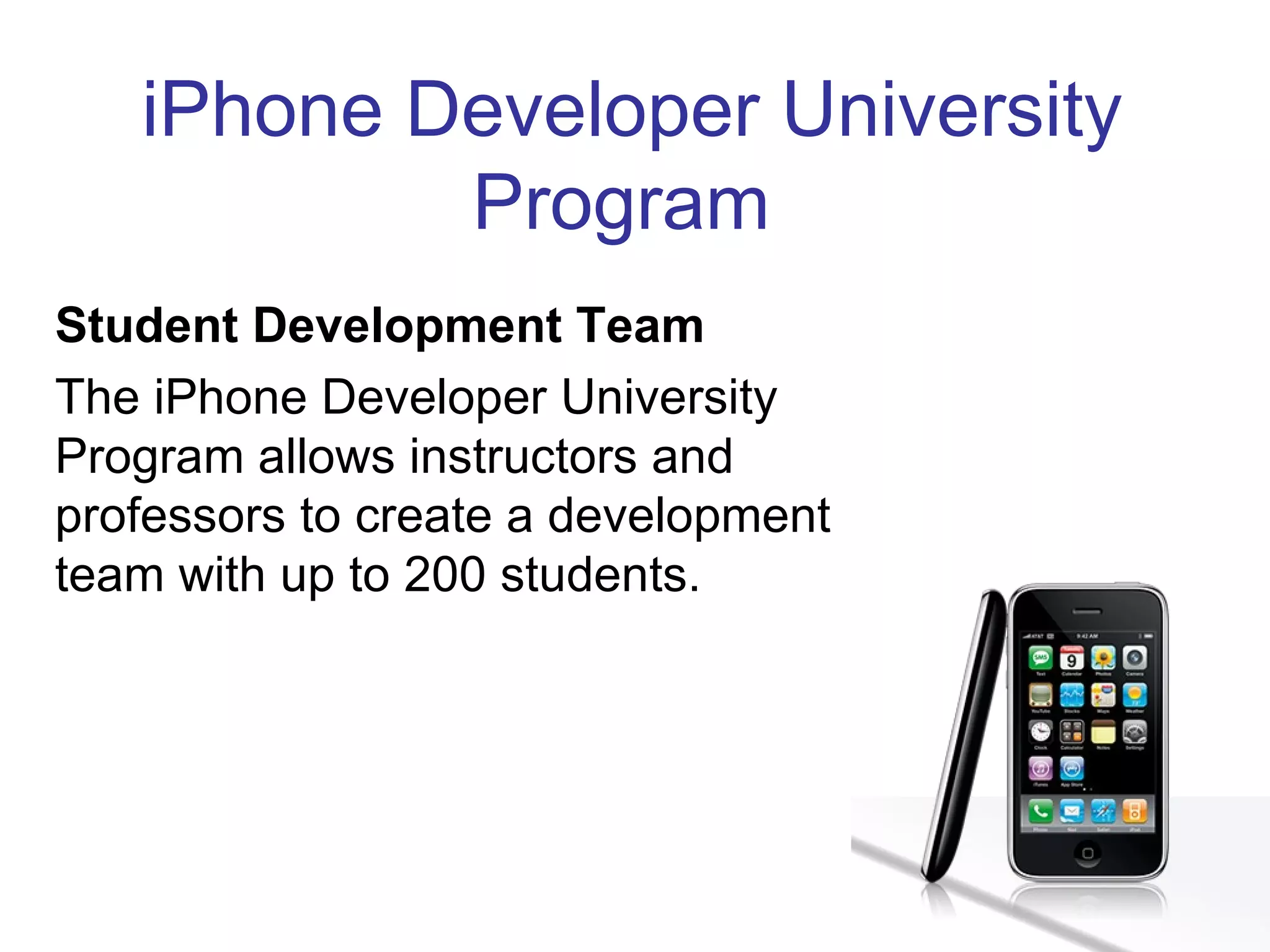
iPhone Developer University Program  Student Development Team The iPhone Developer University Program allows instructors and professors to create a development team with up to 200 students.
iPhone Developer University Program  The iPhone Developer University Program includes: iPhone SDK iPhone Dev Center Resources
iPhone Developer University Program  Testing on iPhone and iPod touch
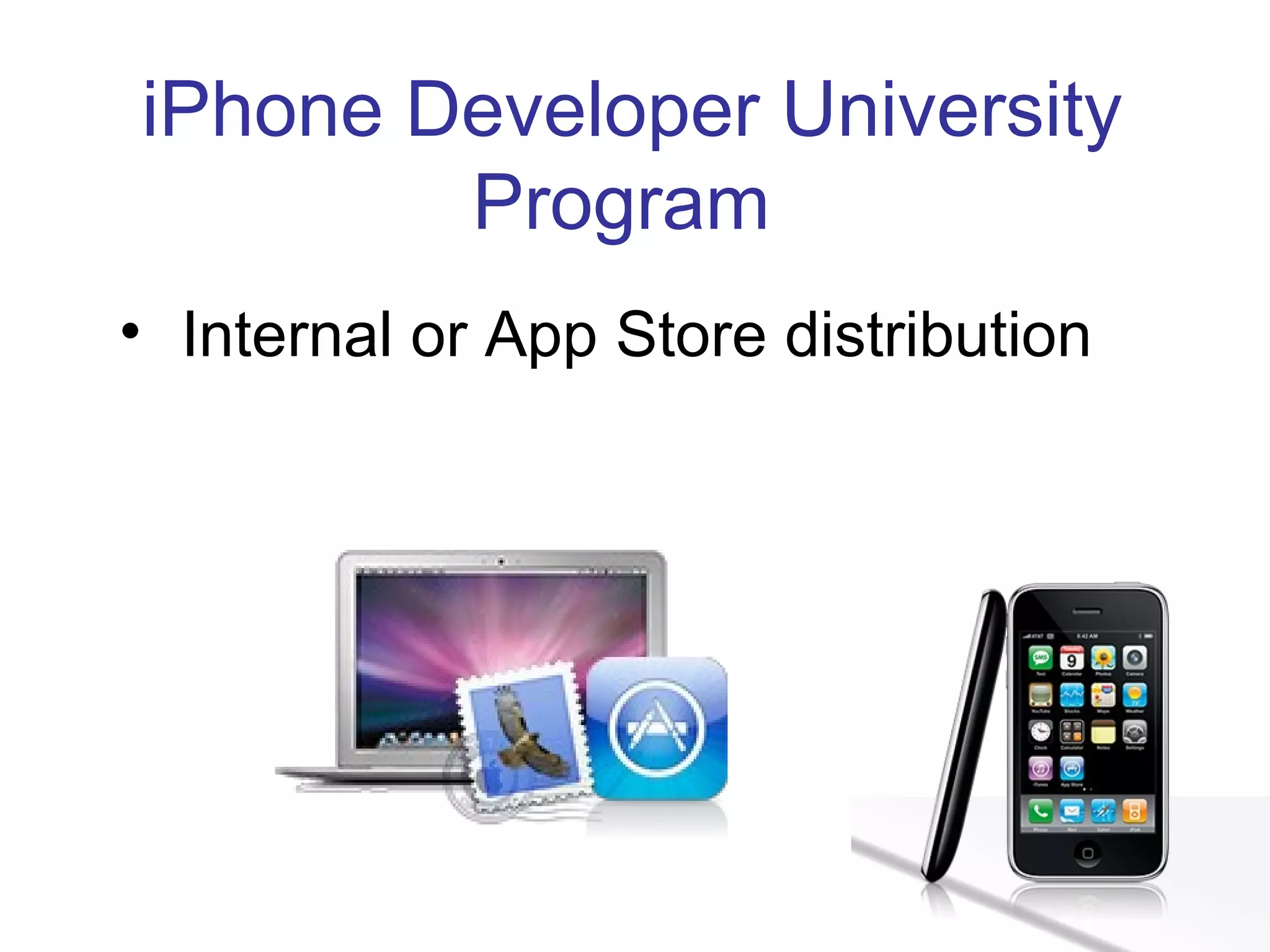
iPhone Developer University Program  Internal or App Store distribution


iPhone/SDK Recommendations Optimize Web Site for Mobile Devices Computer Science    iPhone University Developer Program Create iPhone App for Marketing Create iPhone App for Registration/Student Services Integrate iPhone into Classroom Activities Also Investigate Google’s Android App Store and RIM’s Blackberry App Store
iPhone SDK Demo
Invitation and  Call for Presentations      National and Mid-Pacific ICT Centers   Winter 2009  ICT Educator Conference San Francisco January 8-9, 2009 Presentation Tracks On: ICT Industry Educational Programs ICT Educator Successes MPICT Center Efforts Register at  www.ictcenter.org
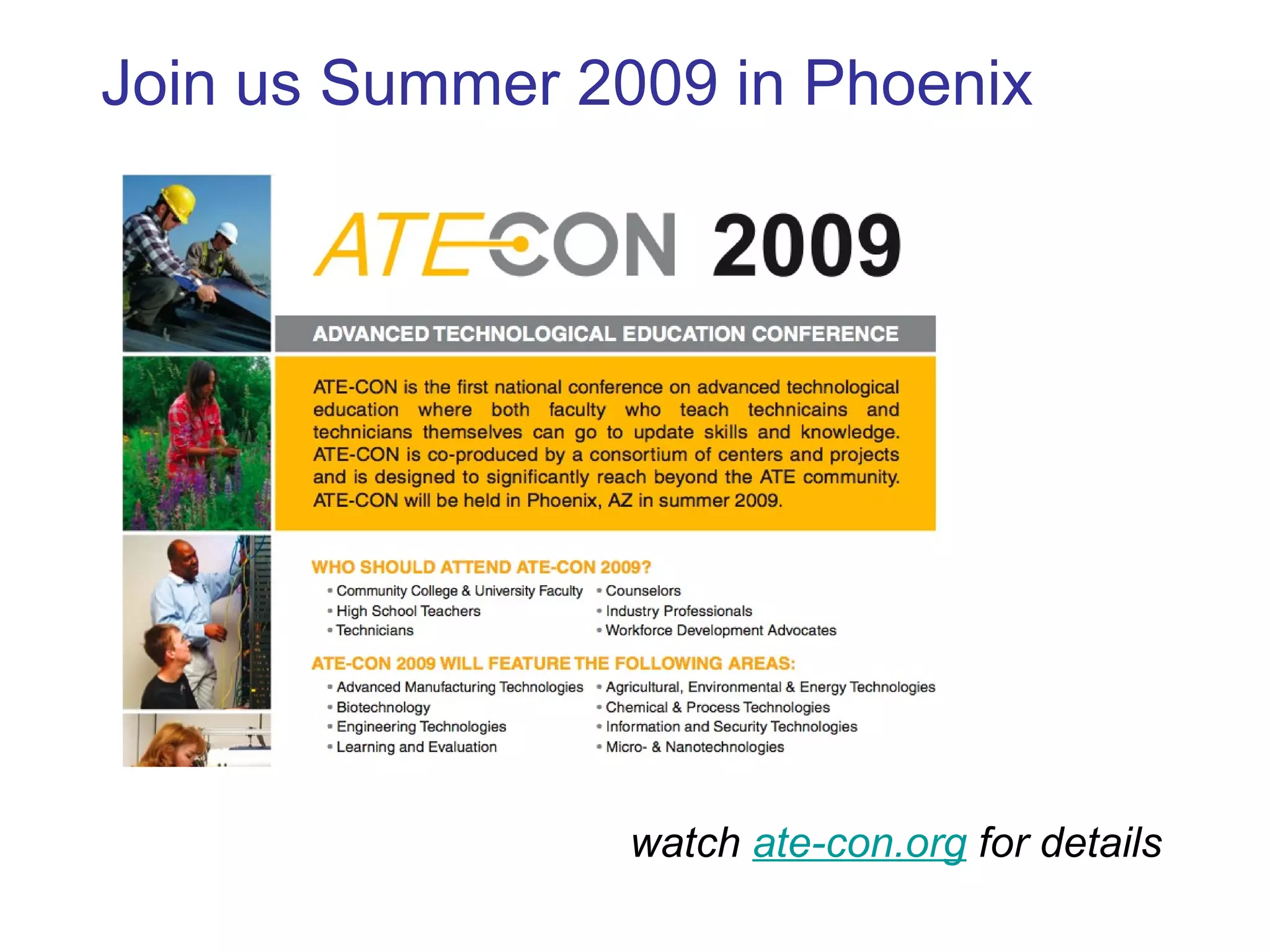
Join us Summer 2009 in Phoenix watch  ate-con.org  for details
Blogs/Podcast and other Read our blogs at: Mike Qaissaunee -  q-ontech.blogspot.com Gordon F. Snyder -  ictcenter.blogspot.com Listen to our podcast @  gsnyder.libsyn.com/  or subscribe in  iTunes Join us on  twitte r –  mqaissaunee  and  gsnyder   Join us in  Facebook Watch  our  YouT ube Channel
Contact Info Mike Qaissaunee Co-PI, National Center for Information and Communications Technologies [email_address] Gordon F. Snyder Executive Director, National Center for Information and Communications Technologies [email_address] Website –   ictcenter.org

iPhone Sdk Winter Conference

  • 1.
    How the AppleiPhone has dramatically changed the way we view the mobile web
  • 2.
    Contact Info MikeQaissaunee Co-PI, National Center for Information and Communications Technologies [email_address] Website – ictcenter.org
  • 3.
    Blogs/Podcast and otherRead our blogs at: Mike Qaissaunee - q-ontech.blogspot.com Gordon F. Snyder - ictcenter.blogspot.com Listen to our podcast @ gsnyder.libsyn.com/ or subscribe in iTunes Join us on twitte r – mqaissaunee and gsnyder Join us in Facebook Watch our YouT ube Channel
  • 4.
    What is theiPhone? Apple’s Smartphone More than a Phone? Built in Accelerometer GPS or Position Triangulation Multi Touch Interface Sensors Keyboard Safari Mail Calendar Wide Screen Display
  • 5.
    iPhone Overview SmartPhone + iPod (Widescreen) Wireless Internet Communication Device Wifi 802.11 b/g PDA Computer (OS X) Camera App Store
  • 6.
    iPhone Development Developmentdone with the help of iPhone SDK ( requires an Intel MAC ) Uses Objective-C XCODE + Other tools Can submit your application to App Store $99 membership Review your application + code Revenue model You set your price (free, 99cents, $9.99m etc) 70% developer (you) and 30% Apple
  • 7.
    iPhone SDK iPhoneSDK includes five powerful iPhone programming tools XCODE Professional text editor Debugger GCC compiler Interface Builder For creating user interface Instruments For optimizing application
  • 8.
    iPhone SDK DashCode For creating web applications for Safari iPhone Simulator
  • 9.
    iPhone OS canbe viewed as set of layers
  • 10.
    Cocoa Touch LayerApplication management Graphics and windowing support Event-handling support User interface management Objects representing the standard system views and controls Support for text and web content Accelerometer data The built-in camera The photo library Device-specific information the basic tools to implement graphical, event-driven applications
  • 11.
    Media Layer GraphicsTechnologies Core Audio OpenAL Video Technologies provides graphics and media technologies for creating advanced multimedia experiences
  • 12.
    Core Services AddressBook Core Location CFNetwork Security SQLite Provides fundamental or core system services that all applications use
  • 13.
    Core OS Threading(POSIX threads) Networking (BSD sockets) File-system access Standard I/O Bonjour and DNS services Location information Memory allocation encompasses the kernel environment, drivers, and basic interfaces of the operating system Provides access to low-level features of the operating system
  • 14.
    iPhone Hardware andSoftware Features Available to Applications Accelerometer iPhone and iPod touch have 3 accelerometers to measure/detect movement along each of the primary ( x, y, and z ) axes in three-dimensional space The system uses the accelerometers to monitor a device’s current orientation and to notify applications when that orientation changes Applications can access accelerometer data directly
  • 15.
    iPhone Hardware andSoftware Features Available to Applications Core Location Core Location monitors signals from cell towers and Wi-Fi hotspots to triangulate the user’s current position Accuracy of location information and threshold for reporting location changes can be specified Use sparingly – drains battery
  • 16.
    iPhone Hardware andSoftware Features Available to Applications Contacts The Phone, Mail, and SMS Text applications use contact list to identify contacts and to facilitate basic interactions such as starting a phone call, email, or text message Your applications can access contacts for similar purposes or to get other information relevant to your application
  • 17.
    iPhone Hardware andSoftware Features Available to Applications The Camera and Photo Library iPhone has a camera and photo library -- iPod Touch has no camera iPhone OS provides access to both of these features You can incorporate system-provided picker interfaces into your application These interfaces provide standard system views for selecting a photo from the user’s photo library or taking a picture using the camera
  • 18.
    App Distribution Threemethods of distribution: App Store Wi-Fi/EDGE/HSDPA on iPhone Desktop syncing via iTunes Enterprise Proprietary in-house apps Requires 500+ employees Ad-hoc Provide users with app via email/website Requires users to register their device ID with the developer 100 device limit per app 75
  • 19.
    Downloading Apps 76App Store distribution method determined by size: Apps < 10 MB can be downloaded over the cellular network Apps > 10 MB require WiFi connectivity or side loading via iTunes
  • 20.
    Classes of iPhoneApplications We can define three types of iPhone applications: Productivity Utility Immersive
  • 21.
  • 22.
  • 23.
  • 24.
  • 25.
  • 26.
  • 27.
  • 28.
  • 29.
  • 30.
  • 31.
  • 32.
  • 33.
  • 34.
  • 35.
  • 36.
  • 37.
  • 38.
  • 39.
  • 40.
  • 41.
  • 42.
  • 43.
  • 44.
  • 45.
  • 46.
  • 47.
  • 48.
  • 49.
  • 50.
  • 51.
  • 52.
  • 53.
  • 54.
  • 55.
  • 56.
  • 57.
  • 58.
    iPhone Developer UniversityProgram a free program designed for higher education institutions looking to introduce curriculum for developing iPhone or iPod touch applications . The University Program provides a wealth of development resources, sophisticated tools for testing and debugging, and the ability to share applications within the same development team. Institutions can also submit applications for distribution in the App Store.
  • 59.
    iPhone Developer UniversityProgram Student Development Team The iPhone Developer University Program allows instructors and professors to create a development team with up to 200 students.
  • 60.
    iPhone Developer UniversityProgram The iPhone Developer University Program includes: iPhone SDK iPhone Dev Center Resources
  • 61.
    iPhone Developer UniversityProgram Testing on iPhone and iPod touch
  • 62.
    iPhone Developer UniversityProgram Internal or App Store distribution
  • 63.
  • 64.
  • 65.
  • 66.
  • 67.
  • 68.
    iPhone/SDK Recommendations OptimizeWeb Site for Mobile Devices Computer Science  iPhone University Developer Program Create iPhone App for Marketing Create iPhone App for Registration/Student Services Integrate iPhone into Classroom Activities Also Investigate Google’s Android App Store and RIM’s Blackberry App Store
  • 69.
  • 70.
    Invitation and Call for Presentations     National and Mid-Pacific ICT Centers   Winter 2009 ICT Educator Conference San Francisco January 8-9, 2009 Presentation Tracks On: ICT Industry Educational Programs ICT Educator Successes MPICT Center Efforts Register at www.ictcenter.org
  • 71.
    Join us Summer2009 in Phoenix watch ate-con.org for details
  • 72.
    Blogs/Podcast and otherRead our blogs at: Mike Qaissaunee - q-ontech.blogspot.com Gordon F. Snyder - ictcenter.blogspot.com Listen to our podcast @ gsnyder.libsyn.com/ or subscribe in iTunes Join us on twitte r – mqaissaunee and gsnyder Join us in Facebook Watch our YouT ube Channel
  • 73.
    Contact Info MikeQaissaunee Co-PI, National Center for Information and Communications Technologies [email_address] Gordon F. Snyder Executive Director, National Center for Information and Communications Technologies [email_address] Website – ictcenter.org