Bharati Vidyapeeth Deemed University
    College Of Engineering, Pune

             A
      Seminar report on
            Web 2.0
               By
          SRIJAN BOSE
           B-Tech Computer-II
              Semester- VII
               Roll No: 48


          Under the Guidance of:
   Prof. Sachin Wakurdekar
 DEPARTMENT OF COMPUTER ENGINEERING
 B.V.D.U. COLLEGE OF ENGINEERING, PUNE
                2011-2012
The world wide web
The world wide web( abbreviated as WWW or W3
commonly known as the Web) a system of
hyperlinked documents accessed via the Internet. It
was introduced to allow collaborators in remote
sites to share their ideas and knowledge.

                       WWW invented by Tim
                       Berners- Lee

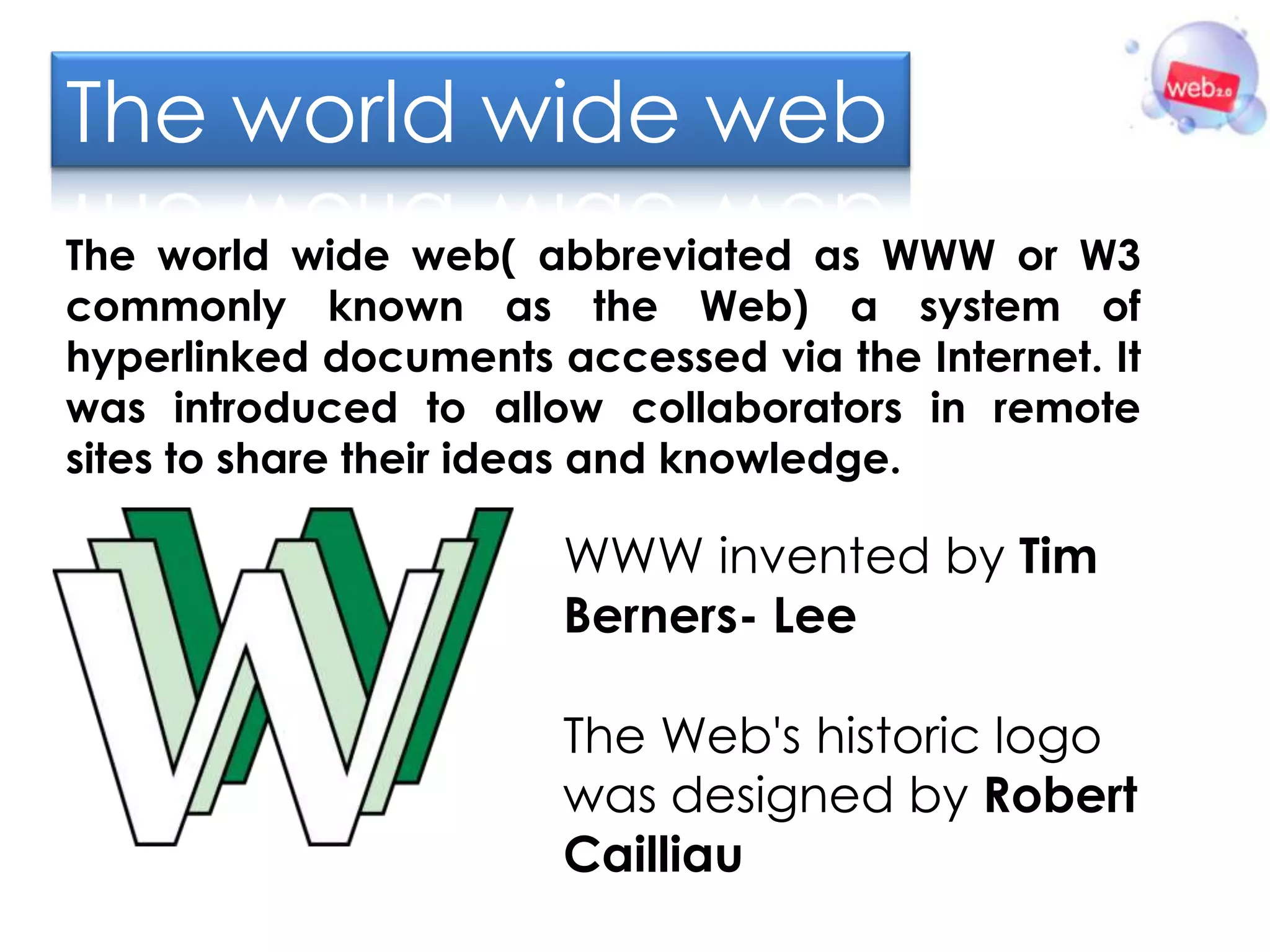
                       The Web's historic logo
                       was designed by Robert
                       Cailliau
New technologies are transforming the way
people use the world wide web
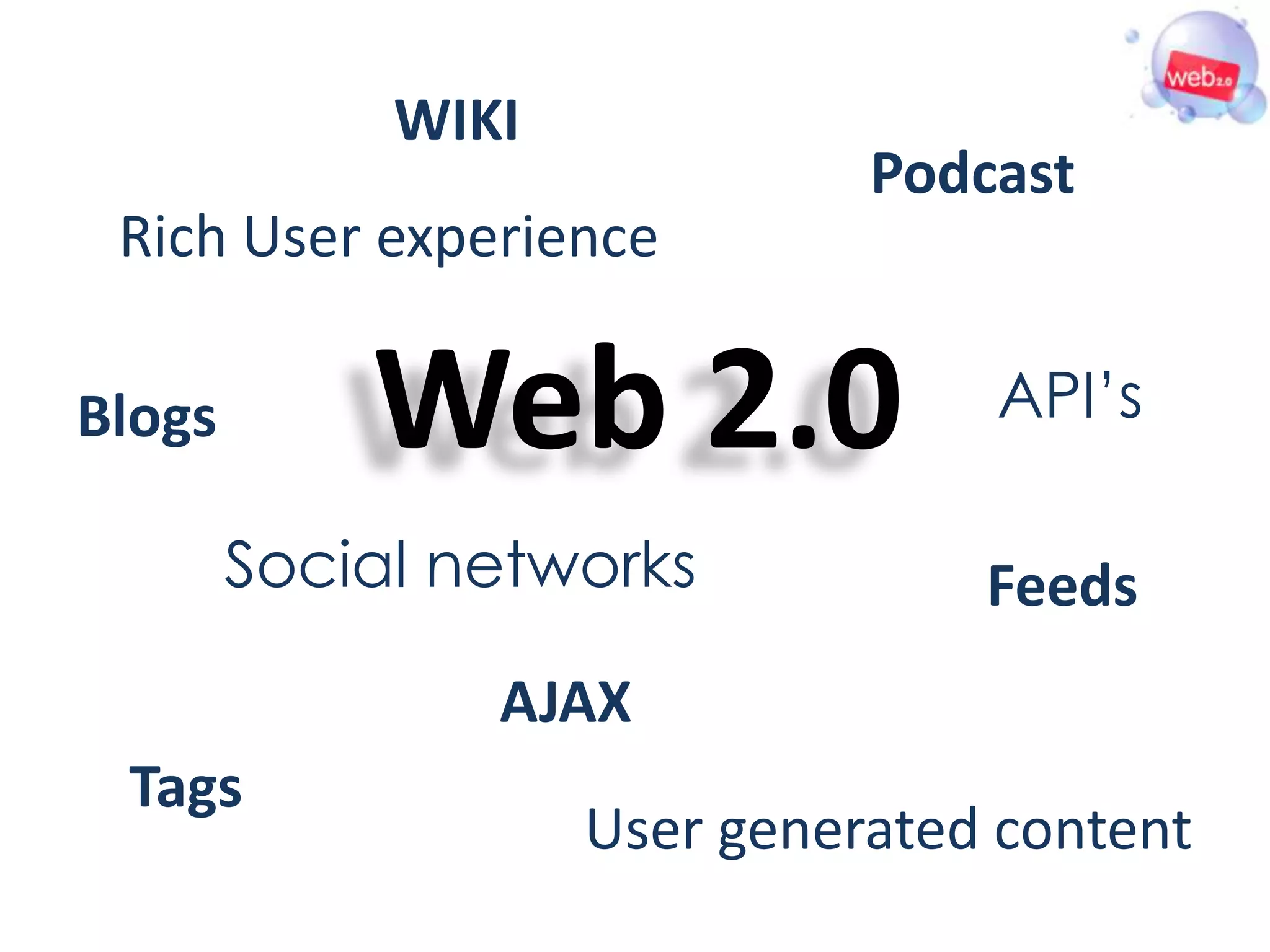
WIKI
                              Podcast
 Rich User experience

Blogs       Web 2.0               API’s

        Social networks           Feeds
                AJAX
 Tags
                    User generated content
Origin of Web 2.0
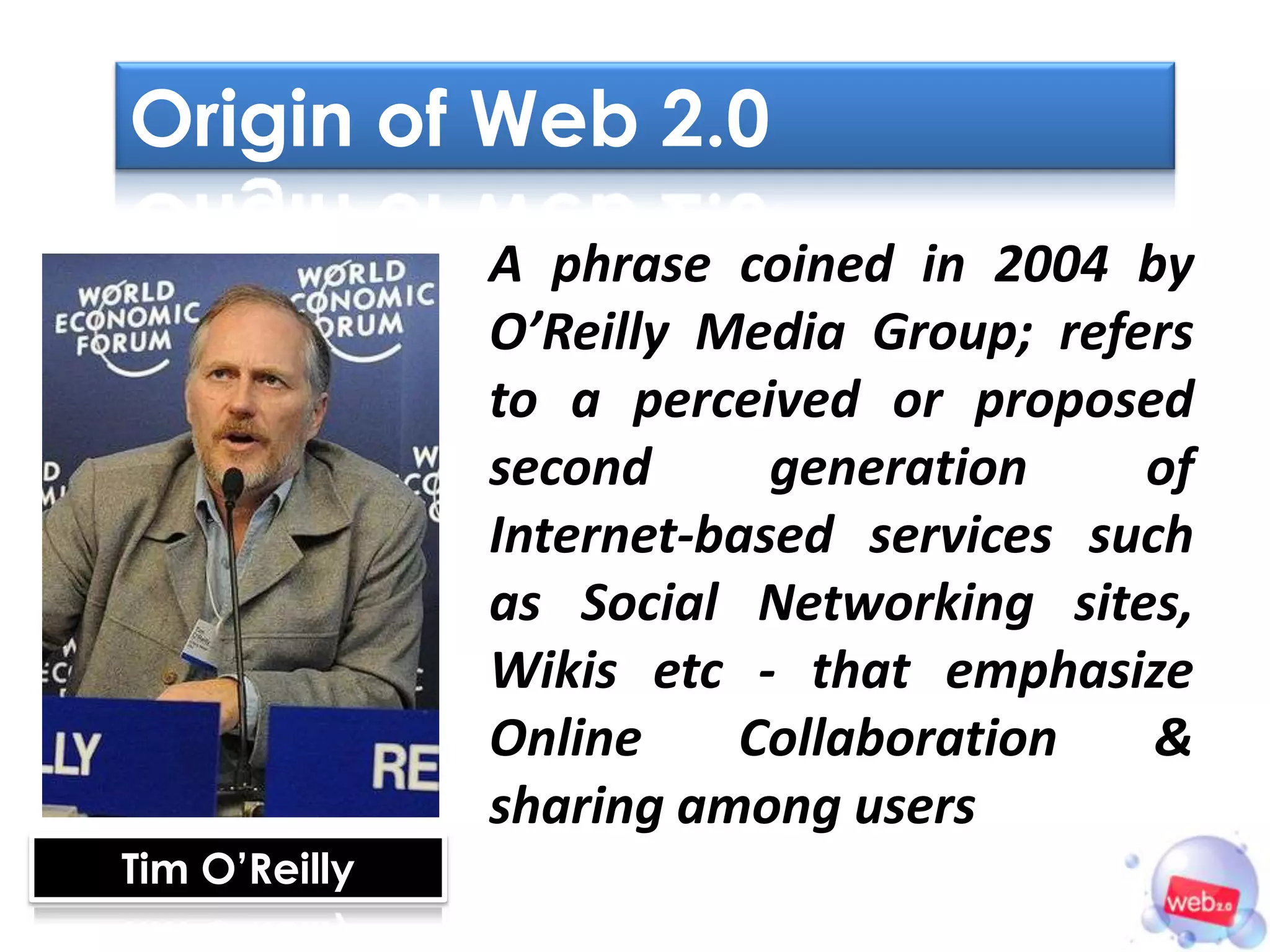
               A phrase coined in 2004 by
               O’Reilly Media Group; refers
               to a perceived or proposed
               second      generation    of
               Internet-based services such
               as Social Networking sites,
               Wikis etc - that emphasize
               Online    Collaboration    &
               sharing among users
Tim O’Reilly
Web 2.0 called Read/Write Web

Web Browser based Application
Social Networking-
Connecting, Sharing, Collaborating

Participatory media.    Creating
content :
Uploading photos, Music, Videos,
Tagging, commenting, Blogging
Netscape compared with Google"
•Their flagship product was the web browser, a
desktop application, and their strategy was to use
their dominance in the browser market to establish
a market for high-priced server products. Control
over standards for displaying content and
applications in the browser would, in theory, give
Netscape the kind of market power enjoyed by
Microsoft in the PC market.

•Netscape promoted a "WebTop" to replace the
desktop, and planned to populate that WebTop
with information updates and applets pushed to
the WebTop by information providers who would
purchase Netscape servers.
•In short, Netscape focused on creating software,
updating it on occasion, and distributing it to the end
users. O'Reilly contrasted this with Google, a
company which did not at the time focus on
producing software, such as a browser, but instead
focused on providing a service based on data such as
the links Web page between sites.

•Google exploits this user-generated content to offer
Web search based on reputation through its "Page
Rank" algorithm.
A similar difference can be seen between the
   Encyclopedia Britannica Online and Wikipedia
•The Britannica relies upon experts to create
articles and releases them periodically in
publications

•Wikipedia relies on trust in anonymous users to
constantly and quickly build content. Wikipedia is
not based on expertise but rather an adaptation of
the open source and it produces and updates articles
constantly.
Web 2.0 is the common term that is used
to differentiate today’s internet.


                               Creation of
                              Web 2.0
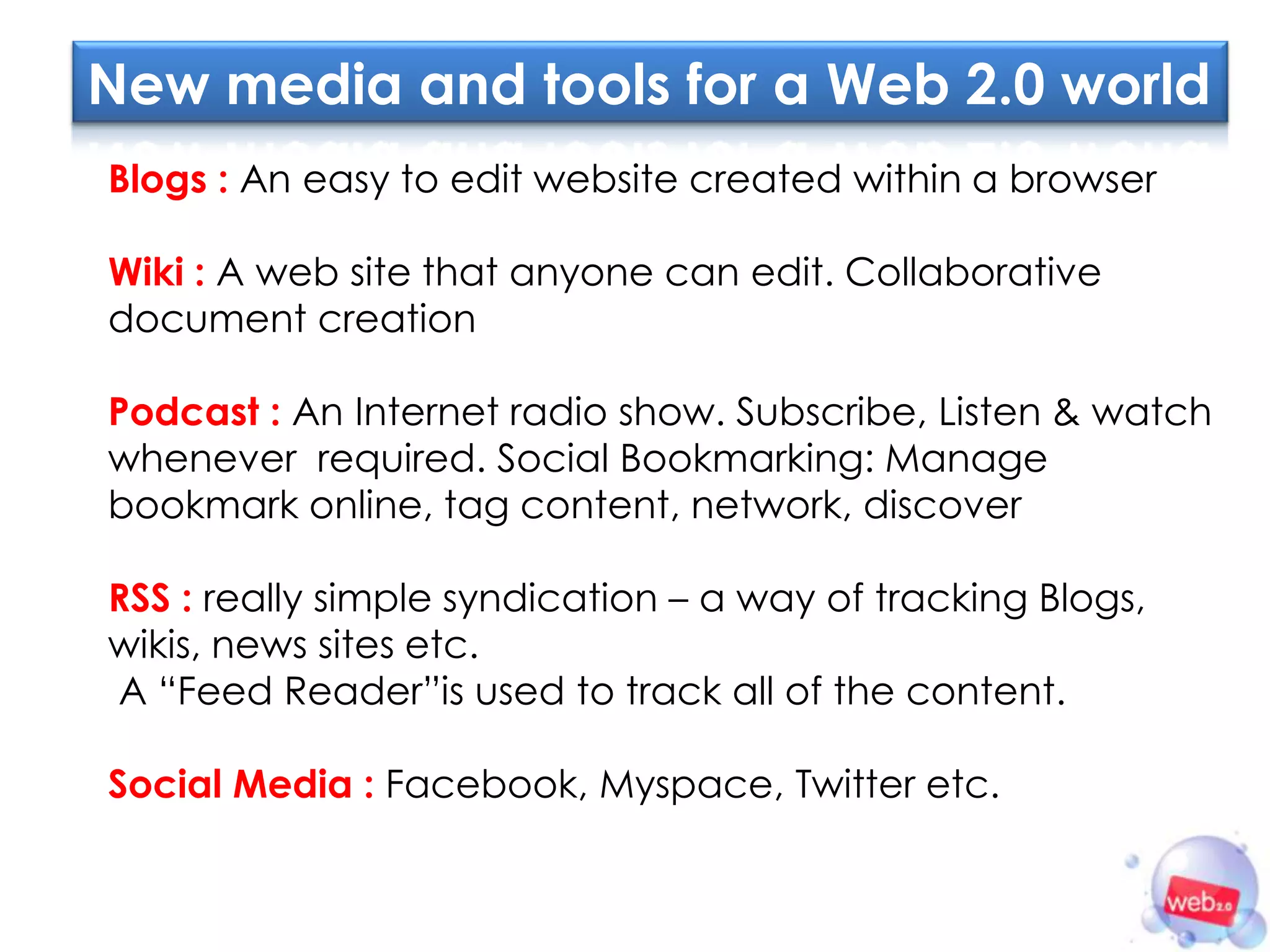
New media and tools for a Web 2.0 world
Blogs : An easy to edit website created within a browser

Wiki : A web site that anyone can edit. Collaborative
document creation

Podcast : An Internet radio show. Subscribe, Listen & watch
whenever required. Social Bookmarking: Manage
bookmark online, tag content, network, discover

RSS : really simple syndication – a way of tracking Blogs,
wikis, news sites etc.
A “Feed Reader”is used to track all of the content.

Social Media : Facebook, Myspace, Twitter etc.
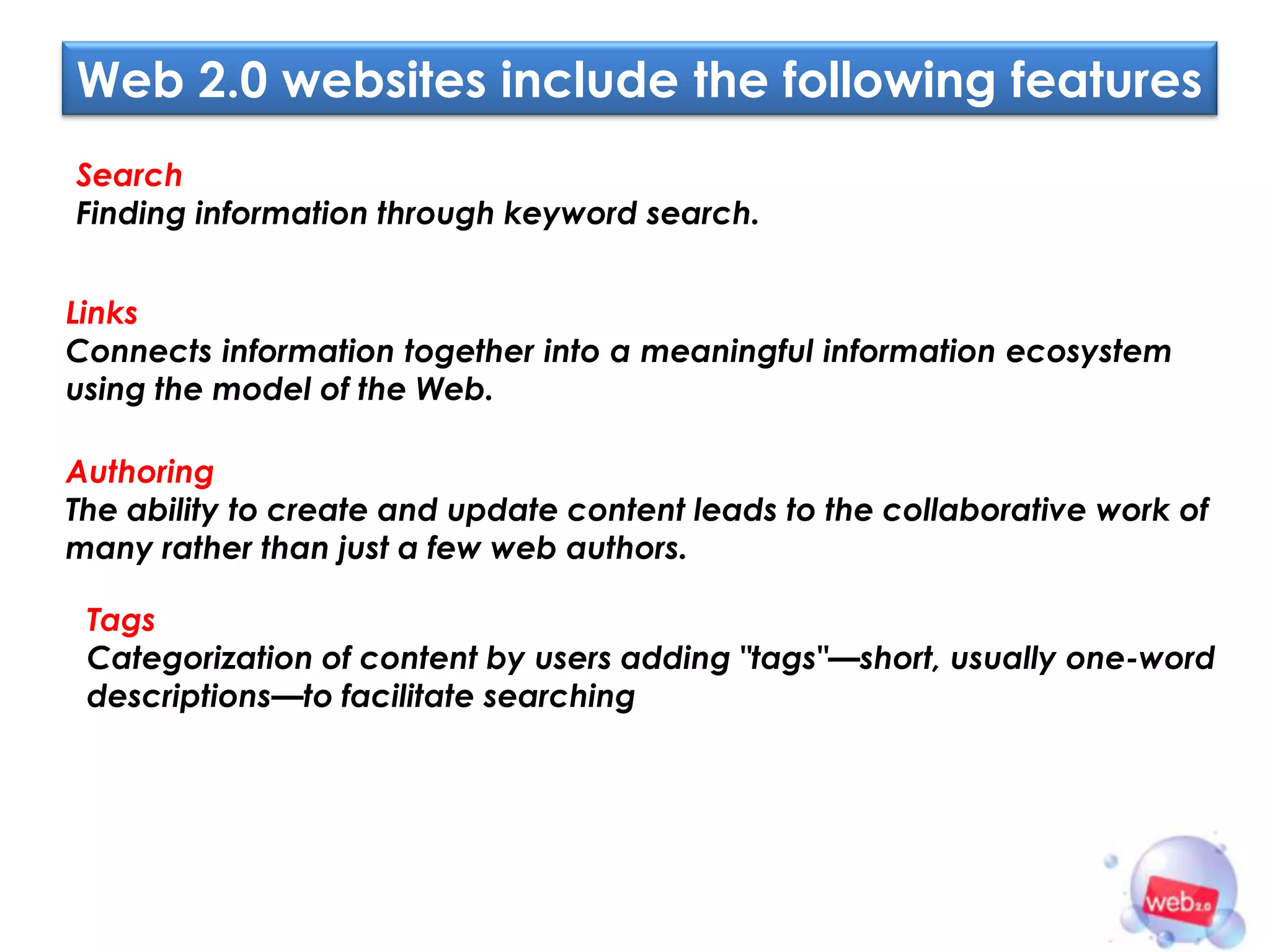
Web 2.0 websites include the following features
Search
Finding information through keyword search.


Links
Connects information together into a meaningful information ecosystem
using the model of the Web.

Authoring
The ability to create and update content leads to the collaborative work of
many rather than just a few web authors.

 Tags
 Categorization of content by users adding "tags"—short, usually one-word
 descriptions—to facilitate searching
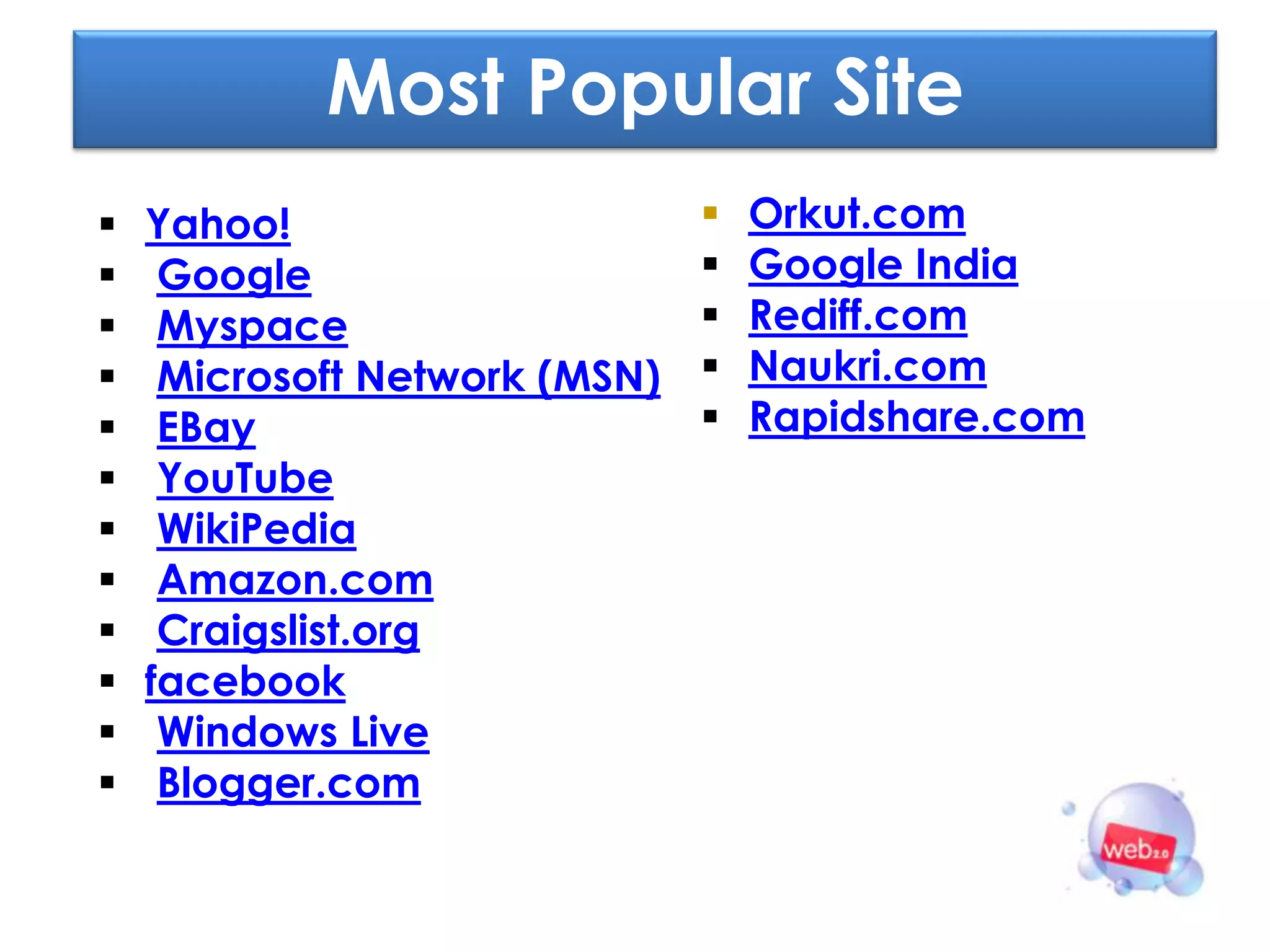
Most Popular Site
   Yahoo!                        Orkut.com
    Google                       Google India
    Myspace                      Rediff.com
    Microsoft Network (MSN)      Naukri.com
    EBay                         Rapidshare.com
    YouTube
    WikiPedia
    Amazon.com
    Craigslist.org
   facebook
    Windows Live
    Blogger.com
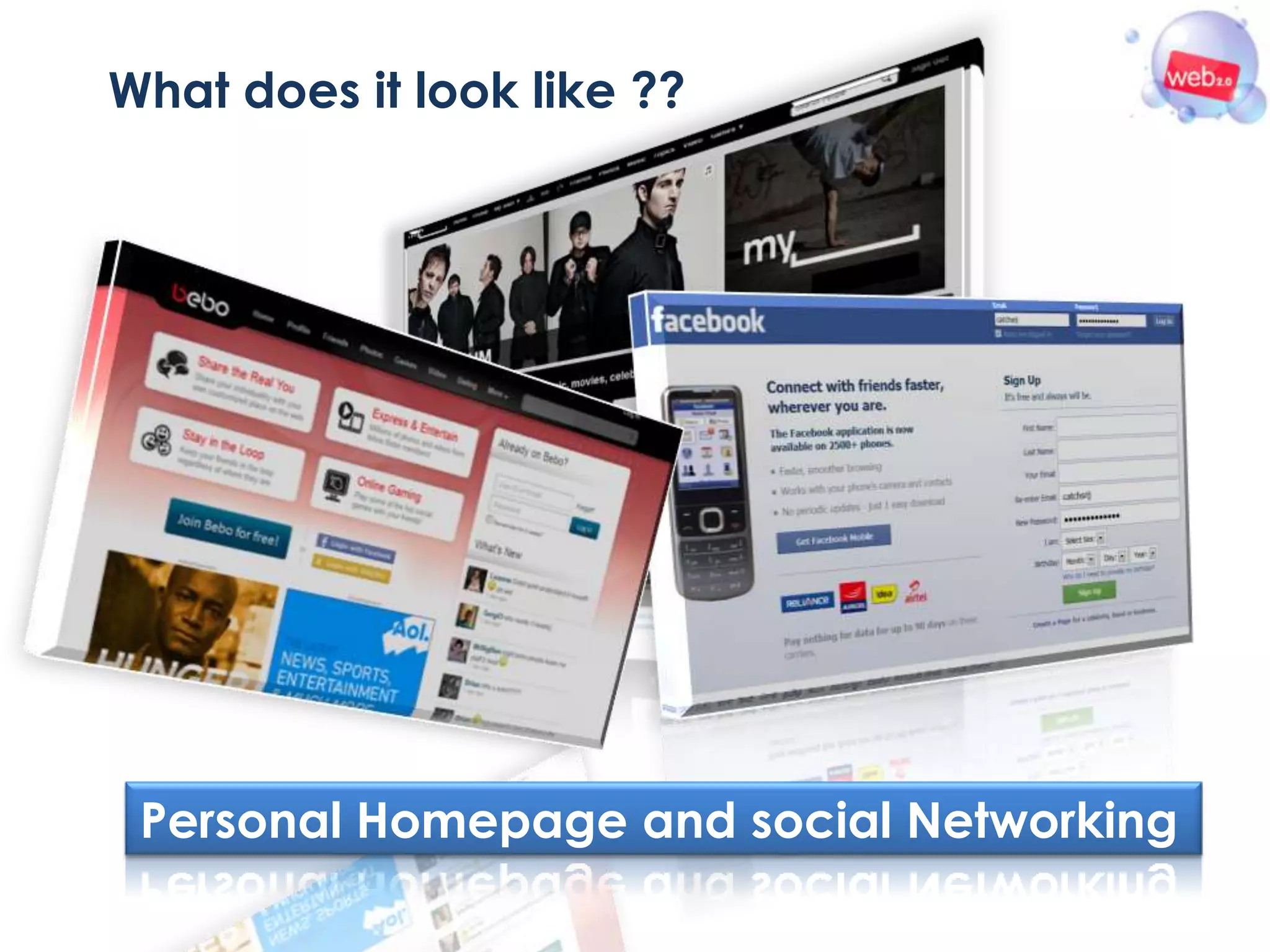
What does it look like ??


 Personal Homepage and social Networking
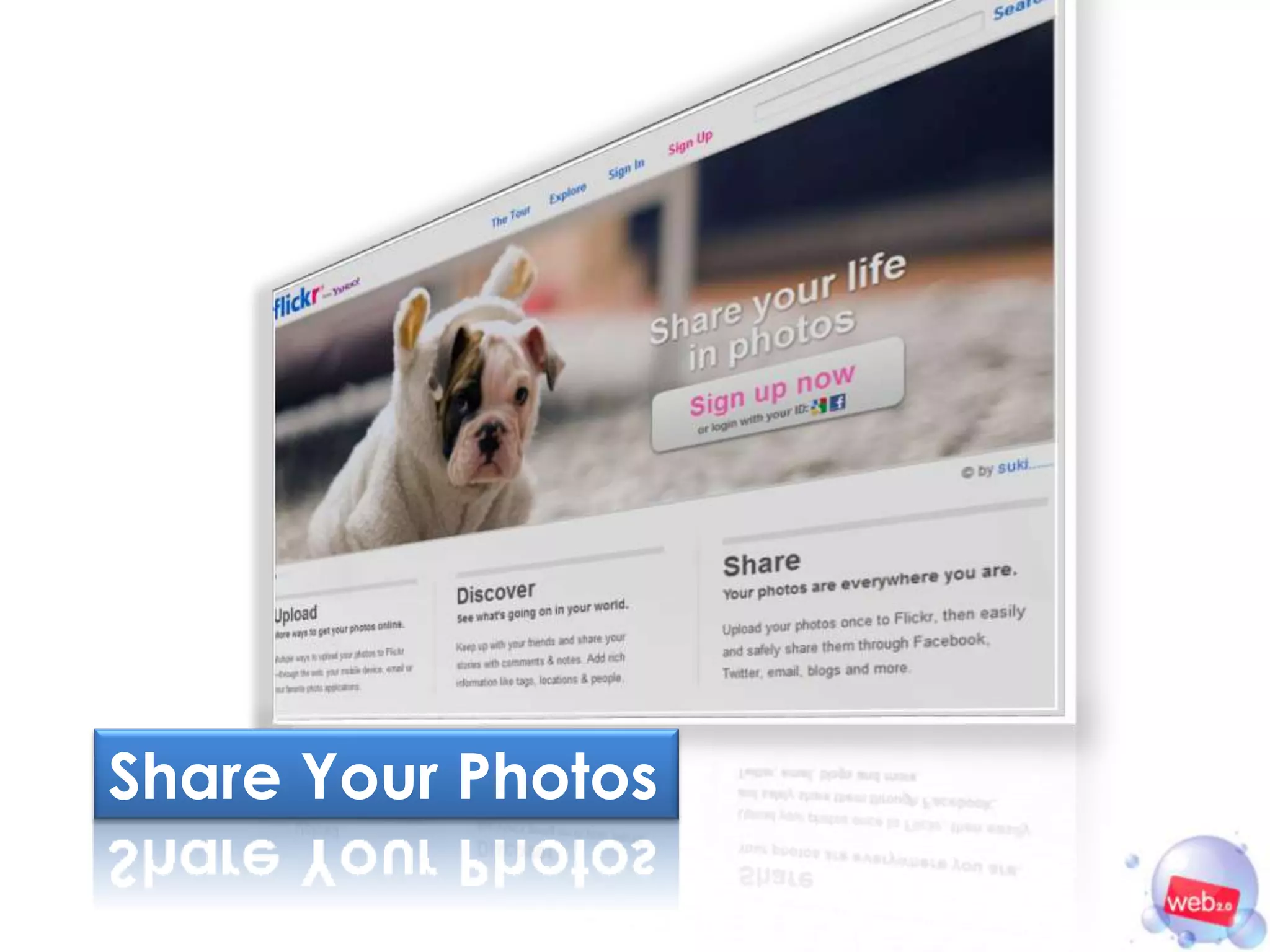
Share Your Photos
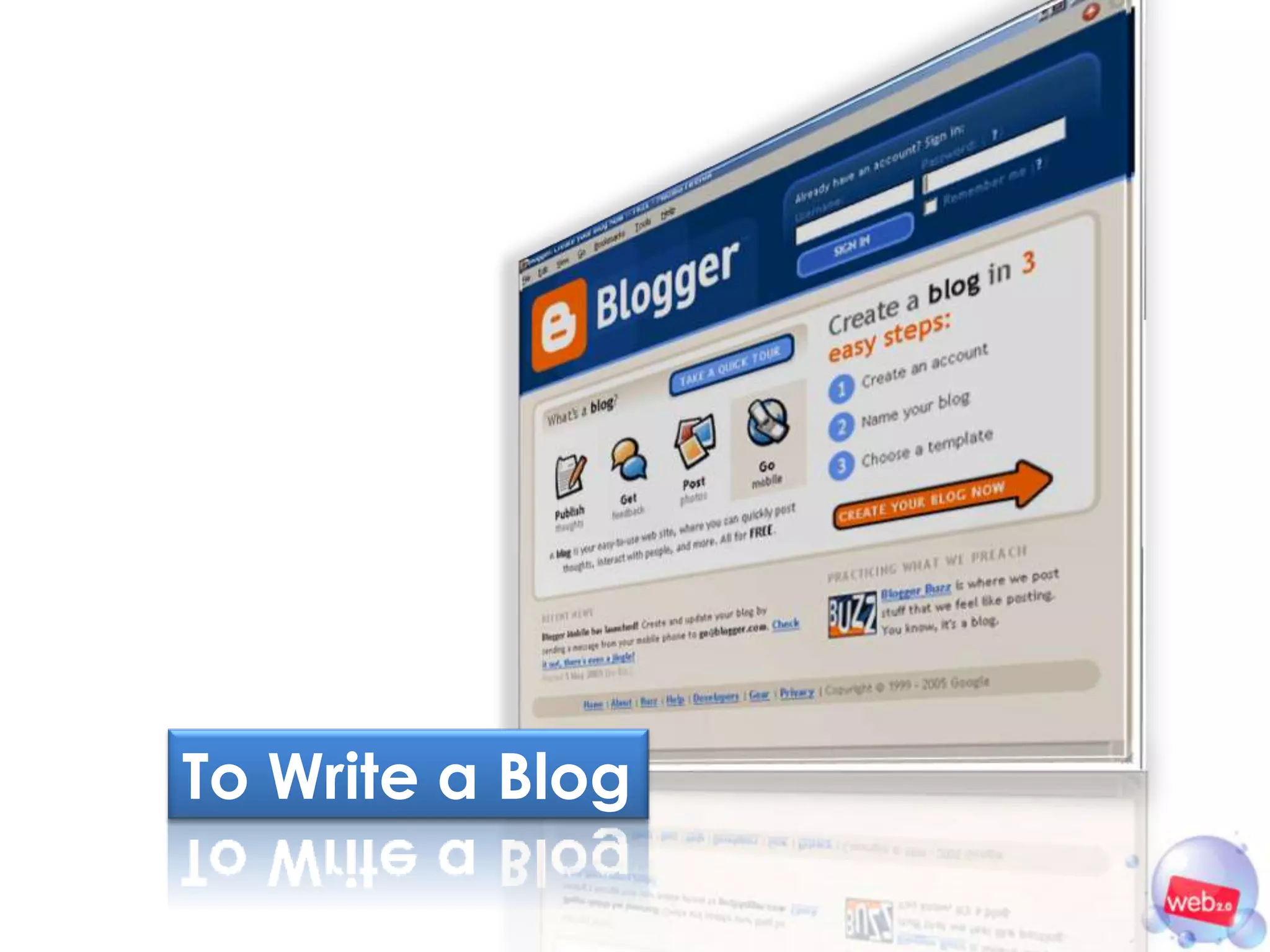
To Write a Blog
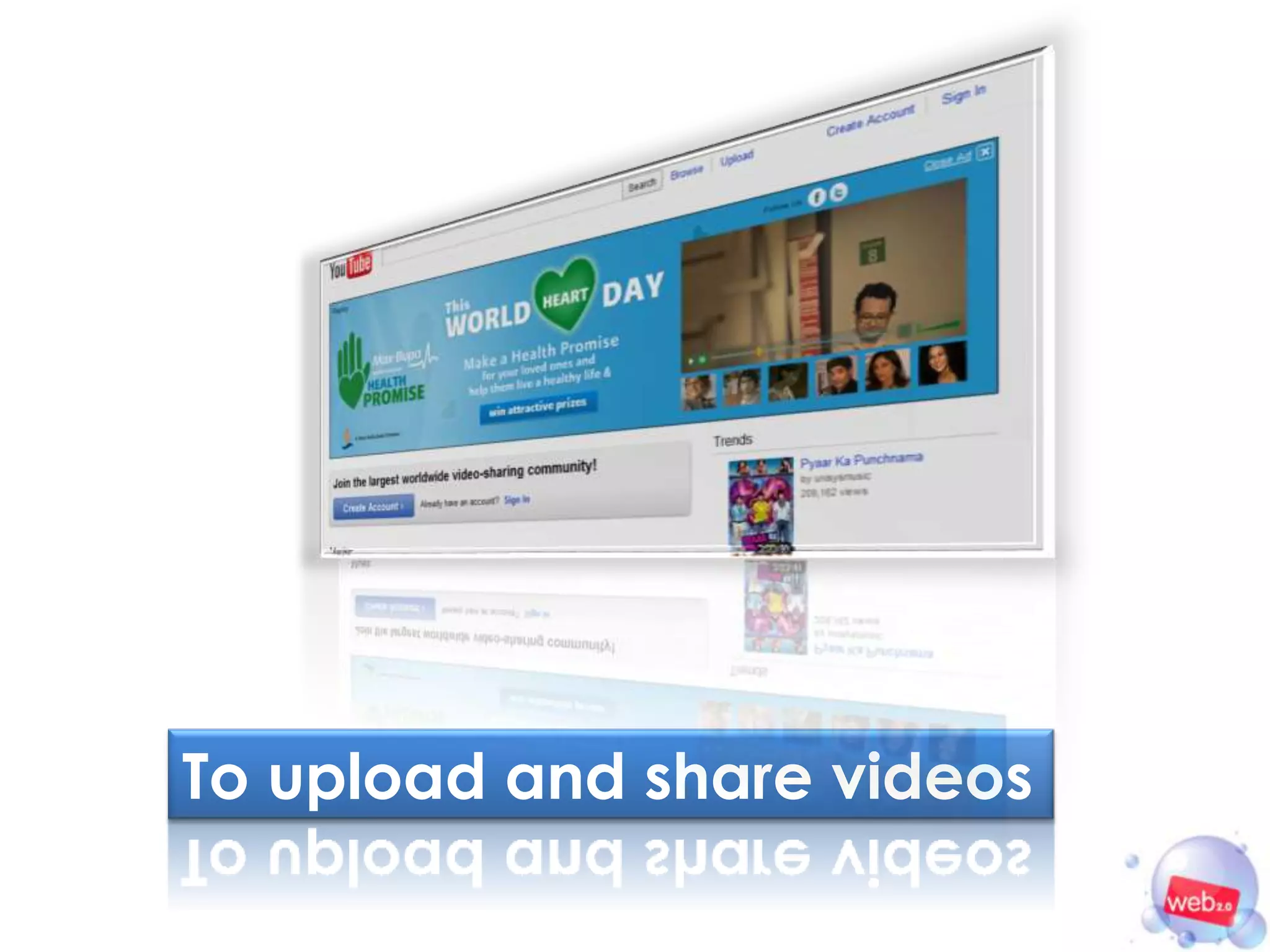
To upload and share videos
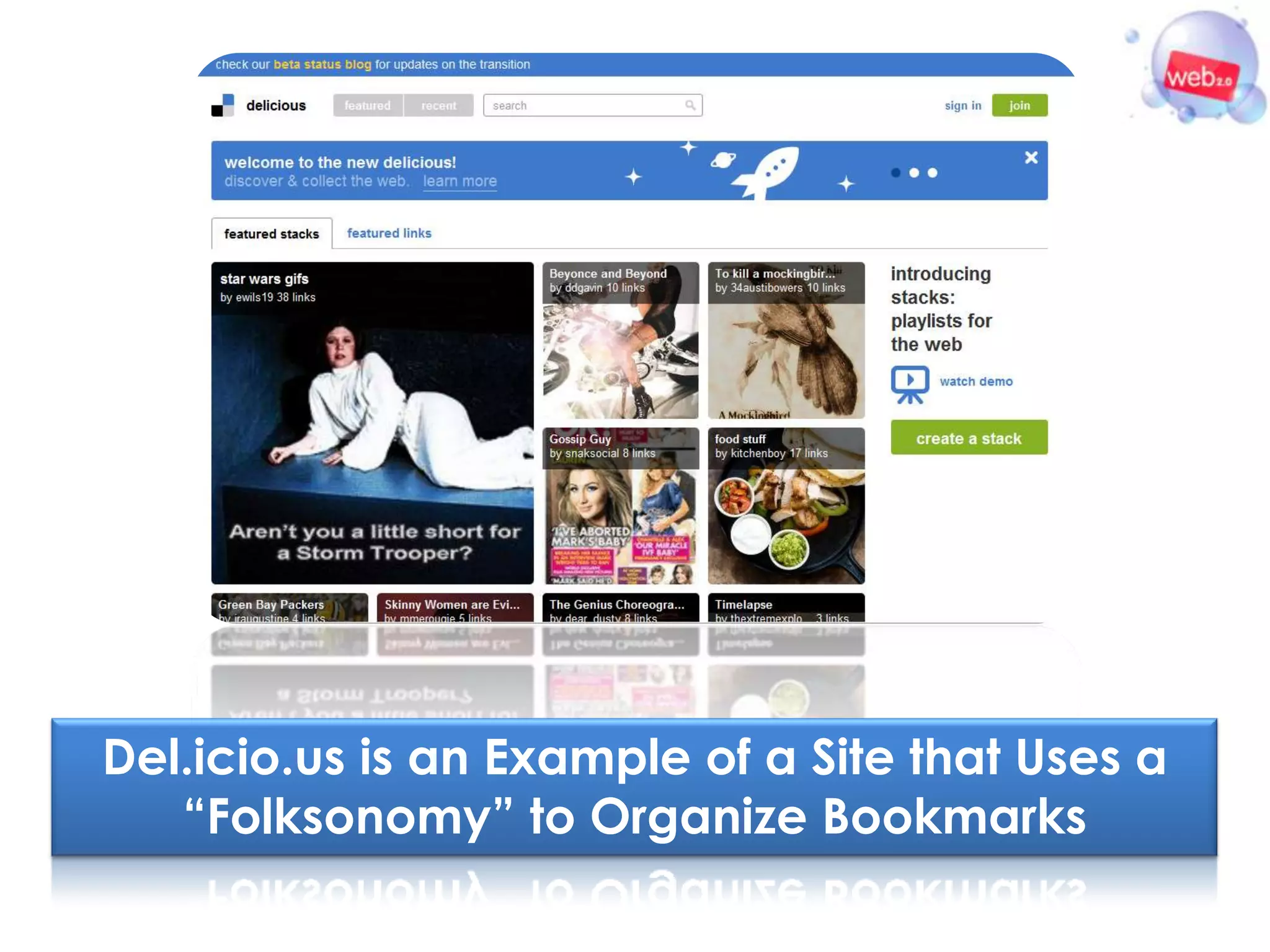
Del.icio.us is an Example of a Site that Uses a
   “Folksonomy” to Organize Bookmarks
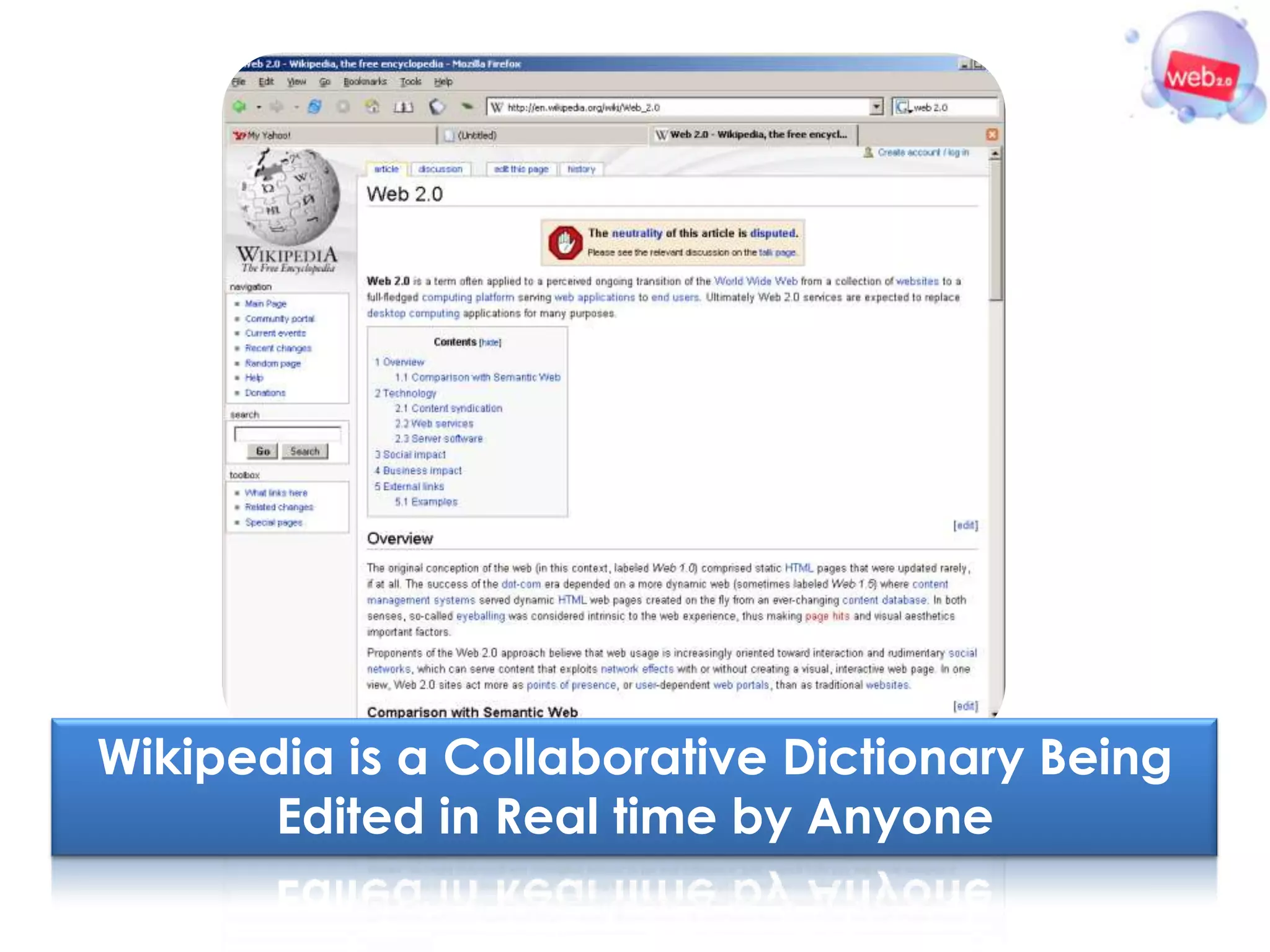
Wikipedia is a Collaborative Dictionary Being
       Edited in Real time by Anyone
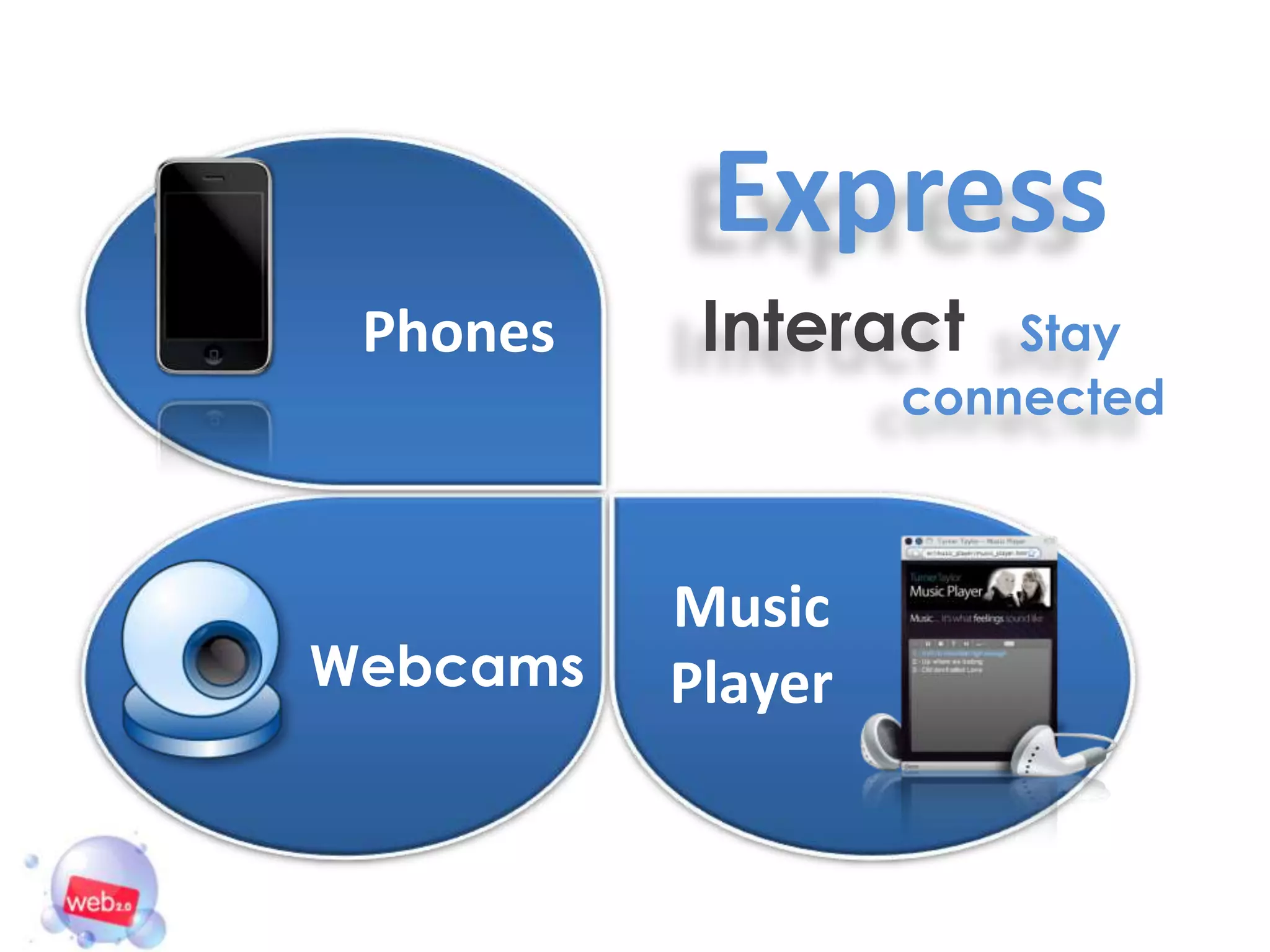
Express
 Phones    Interact    Stay
                   connected


          Music
Webcams   Player
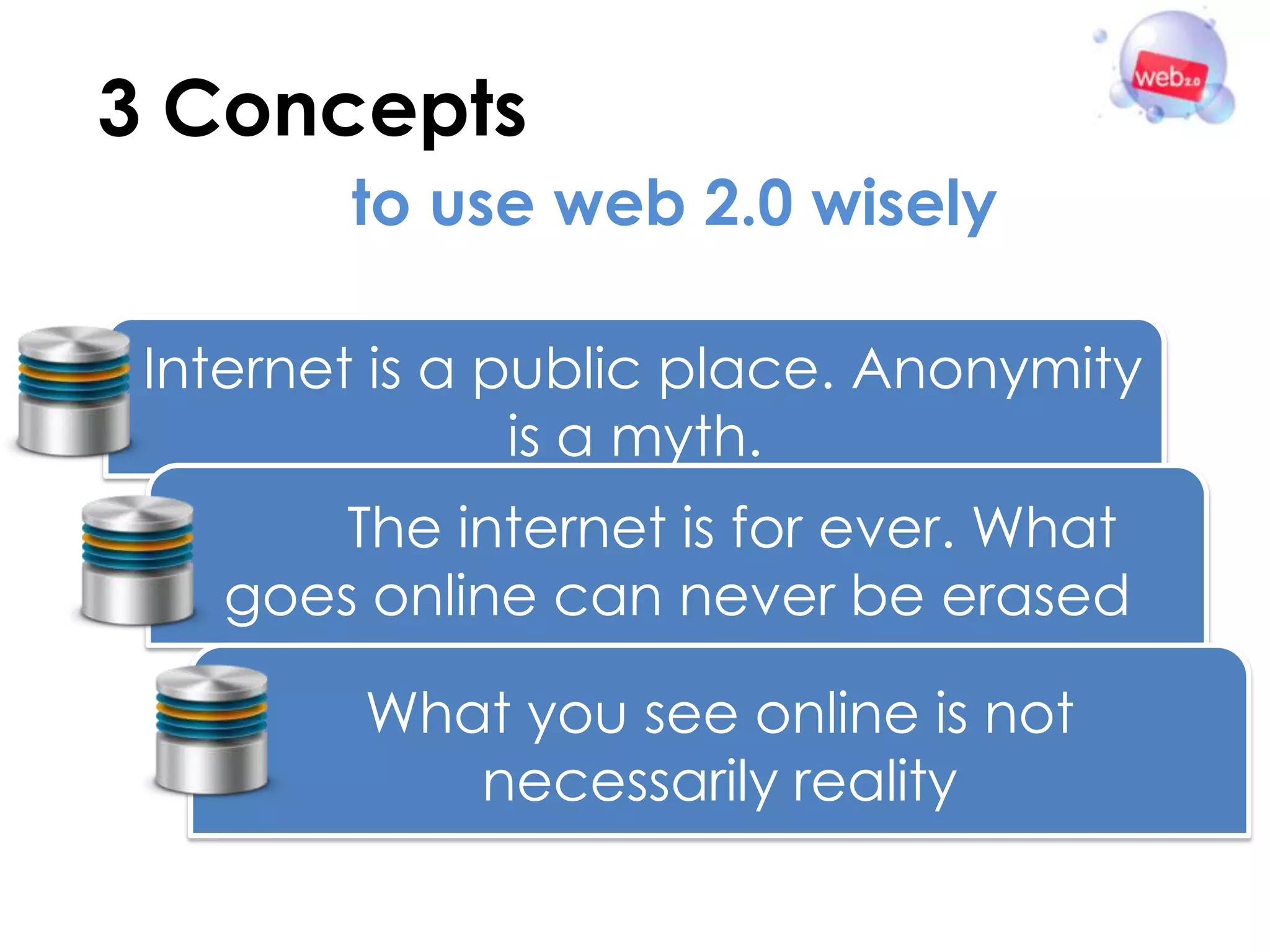
3 Concepts
        to use web 2.0 wisely

 Internet is a public place. Anonymity
                is a myth.
       The internet is for ever. What
   goes online can never be erased

         What you see online is not
            necessarily reality
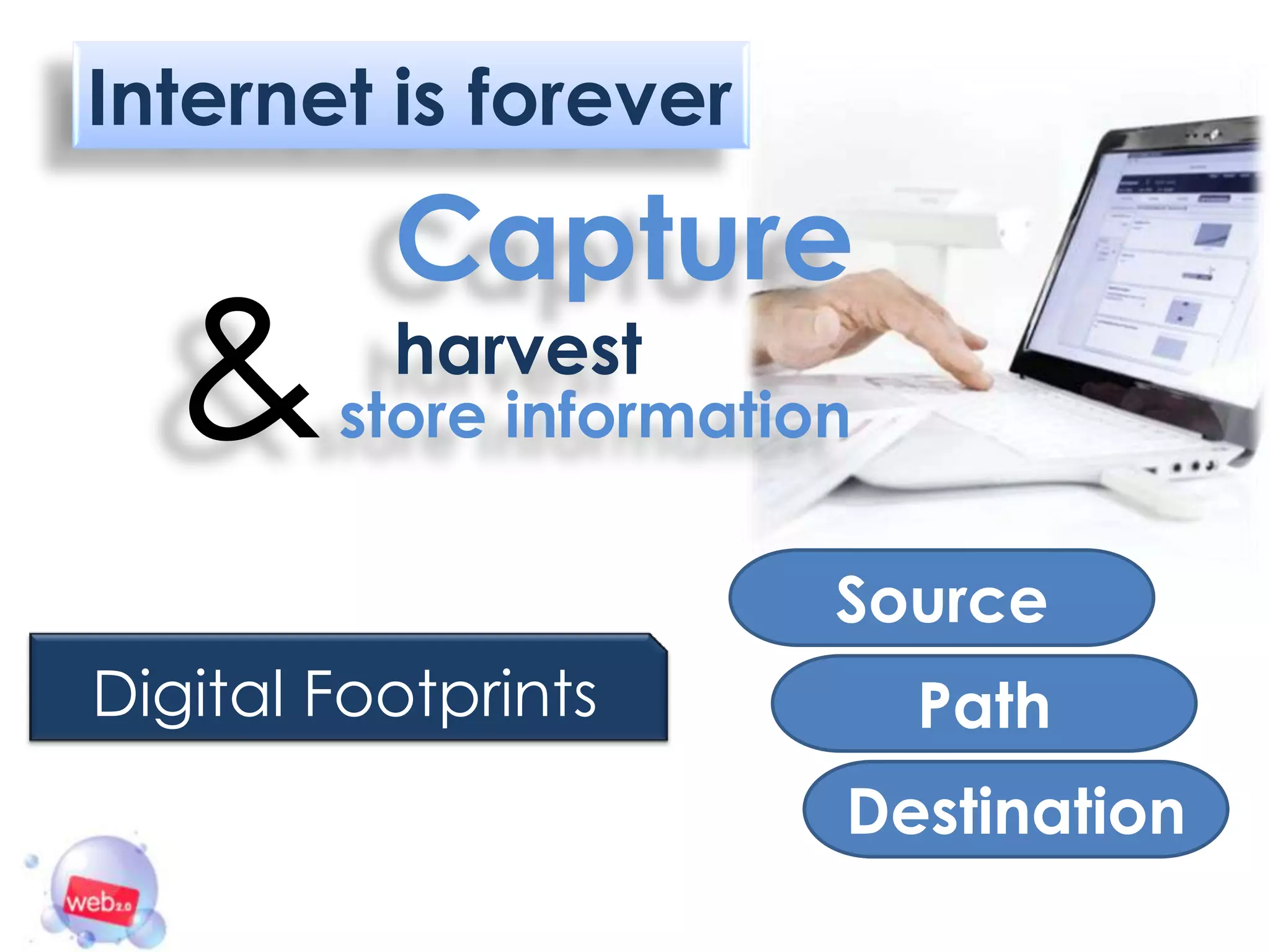
Internet is forever
          Capture
  &       harvest
        store information

                        Source
Digital Footprints          Path
                        Destination
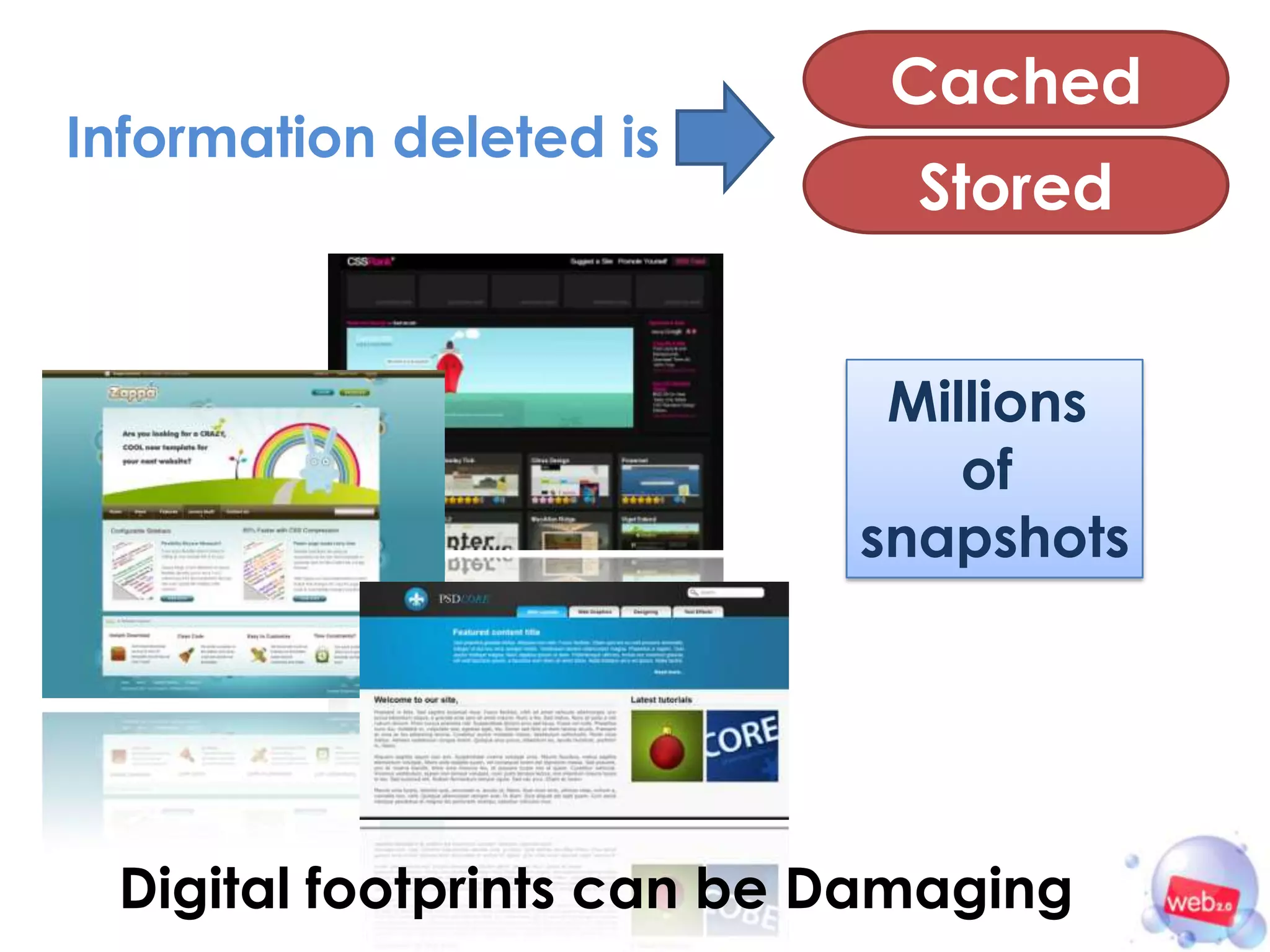
Cached
Information deleted is
                             Stored


                            Millions
                               of
                           snapshots


 Digital footprints can be Damaging
Internet is a public place
     Anonymity is a myth

   Posted         Or

 Can be identified by
 * Internet service provider
 * Foreign governments
 * Marketers
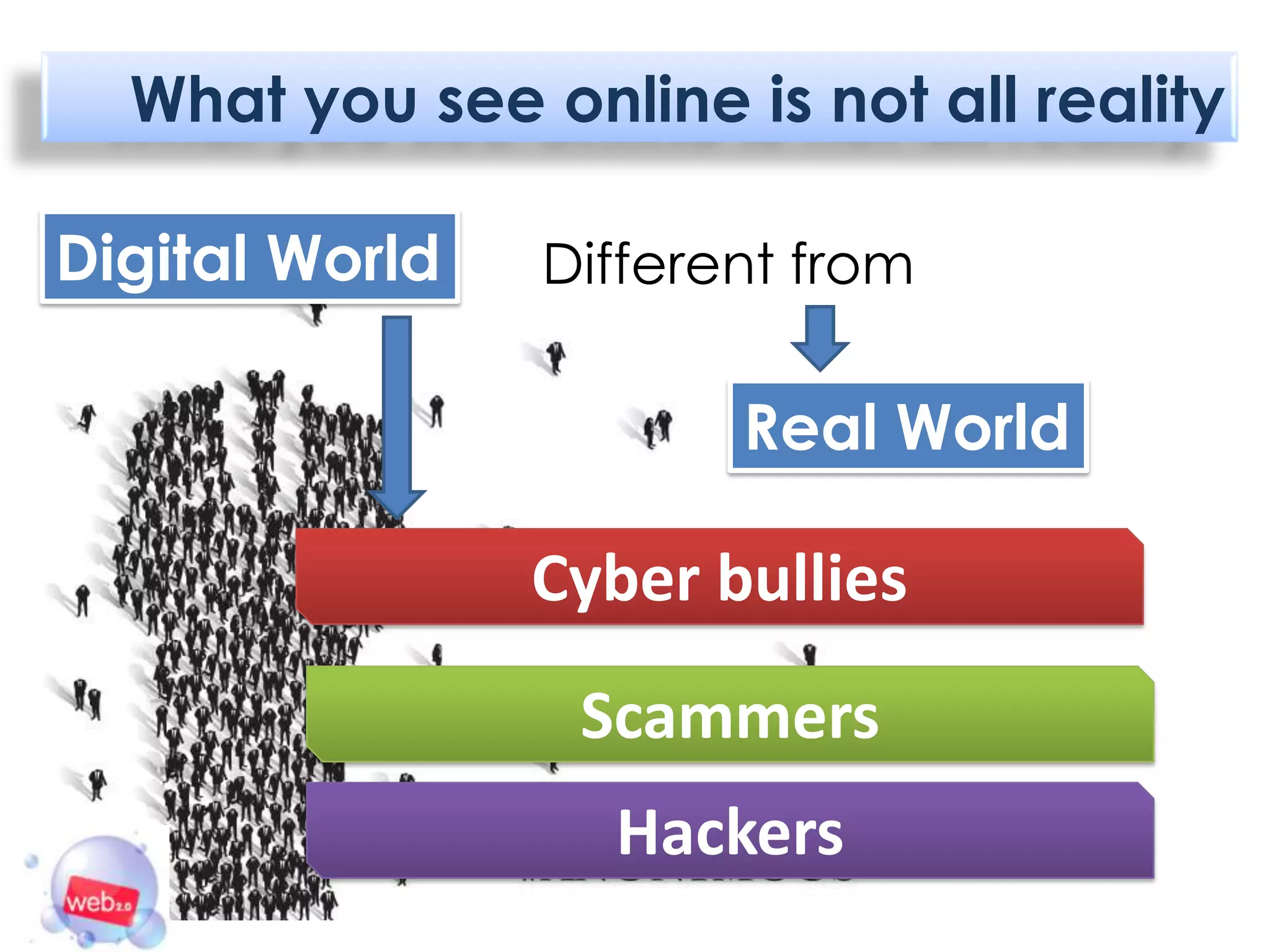
What you see online is not all reality

Digital World   Different from

                       Real World

                Cyber bullies
                 Scammers
                  Hackers
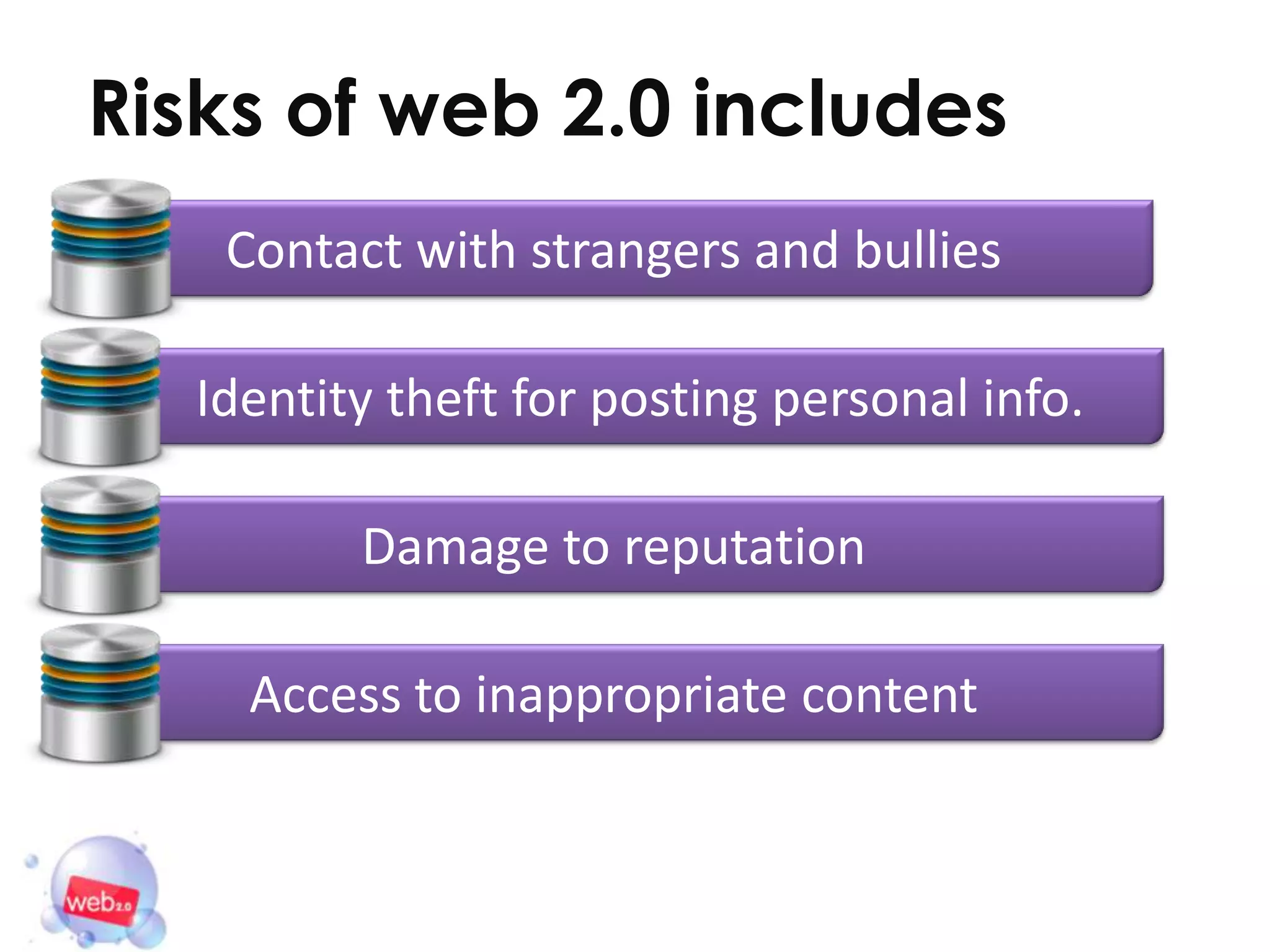
Risks of web 2.0 includes
   Contact with strangers and bullies

  Identity theft for posting personal info.

         Damage to reputation

    Access to inappropriate content
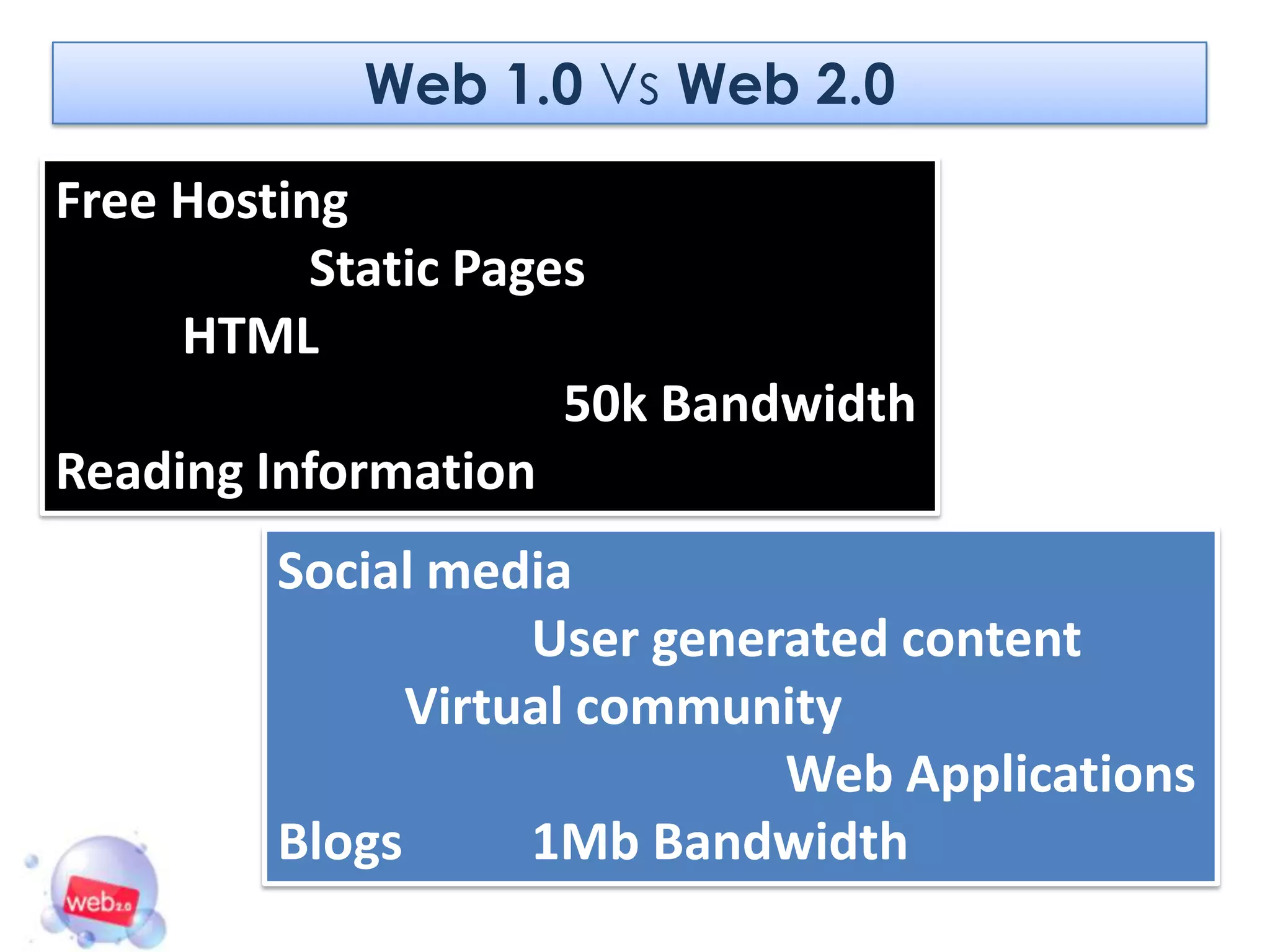
Web 1.0 Vs Web 2.0

Free Hosting
           Static Pages
     HTML
                      50k Bandwidth
Reading Information
         Social media
                    User generated content
               Virtual community
                              Web Applications
         Blogs      1Mb Bandwidth
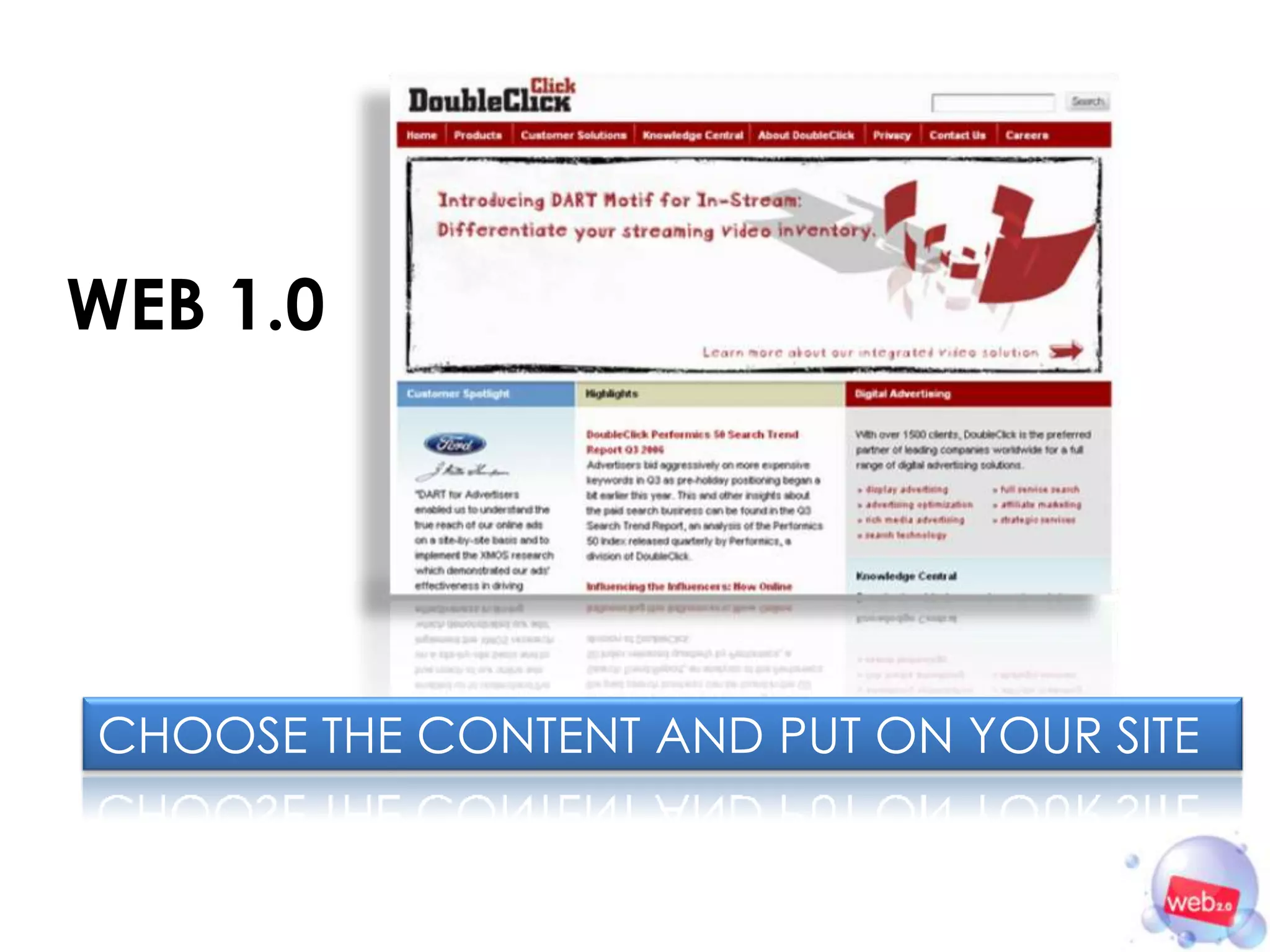
WEB 1.0


CHOOSE THE CONTENT AND PUT ON YOUR SITE
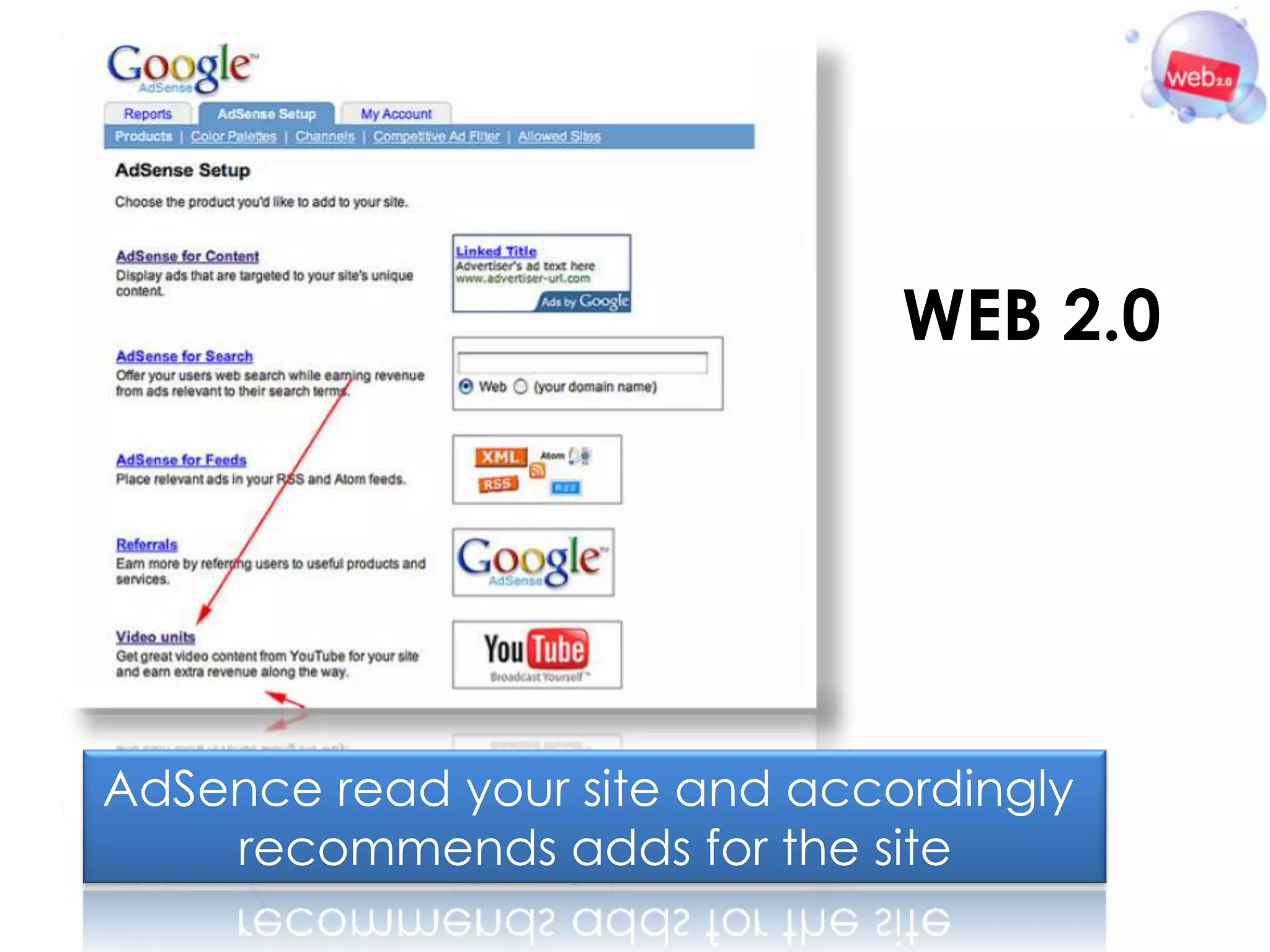
WEB 2.0


AdSence read your site and accordingly
    recommends adds for the site
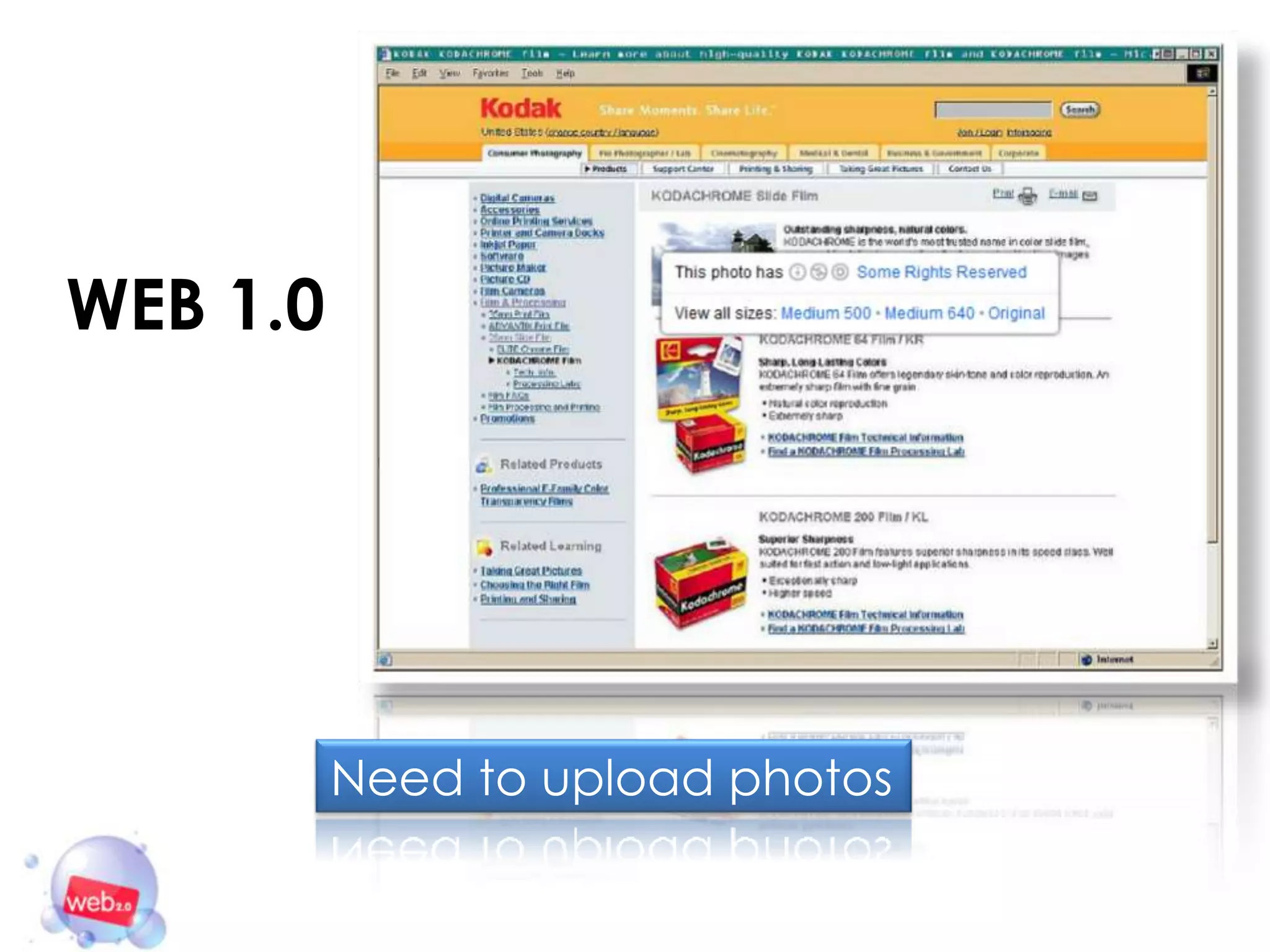
WEB 1.0


          Need to upload photos
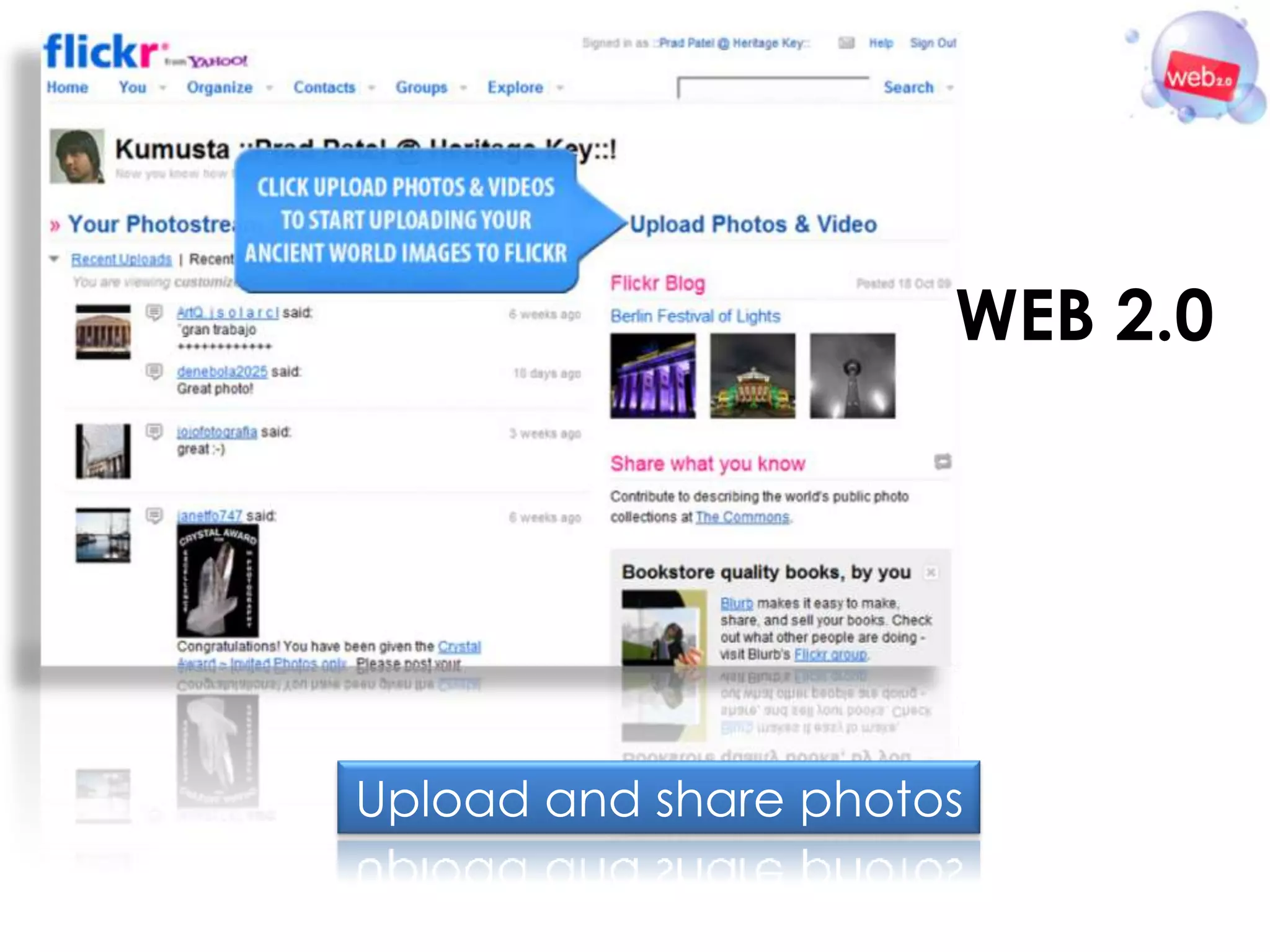
WEB 2.0


Upload and share photos
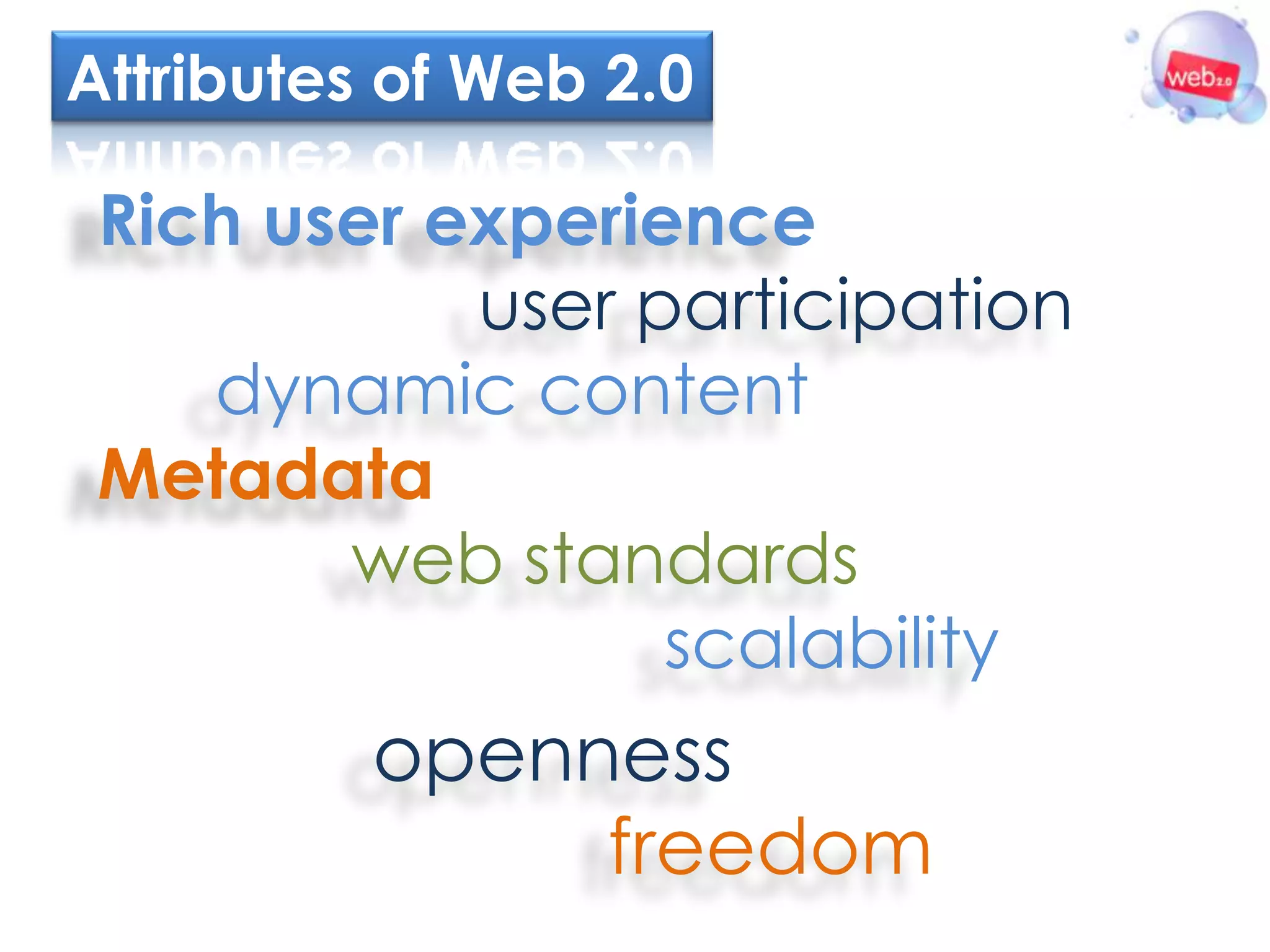
Attributes of Web 2.0

 Rich user experience
            user participation
    dynamic content
 Metadata
        web standards
                  scalability
          openness
               freedom
Why Web 2.0 is called Network as a Platform ?

Web 2.0 websites allow users to do
more than just retrieve information.

It provide user with :

 More User Interface
 Software
 Storage facility
Technologies

    For web 2.0 development

  Adobe Flash           AJAX

     Adobe flex framework
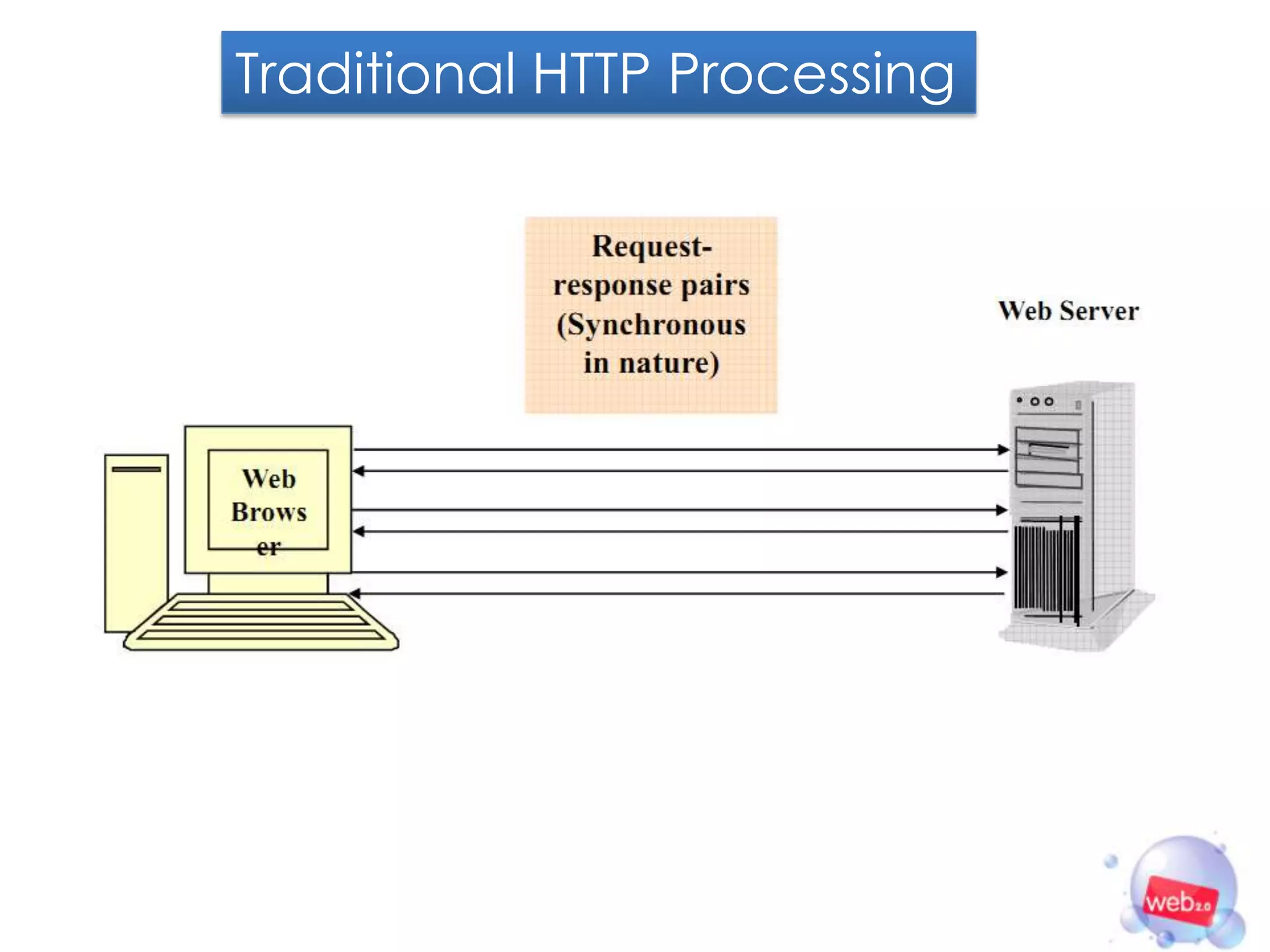
Traditional HTTP Processing
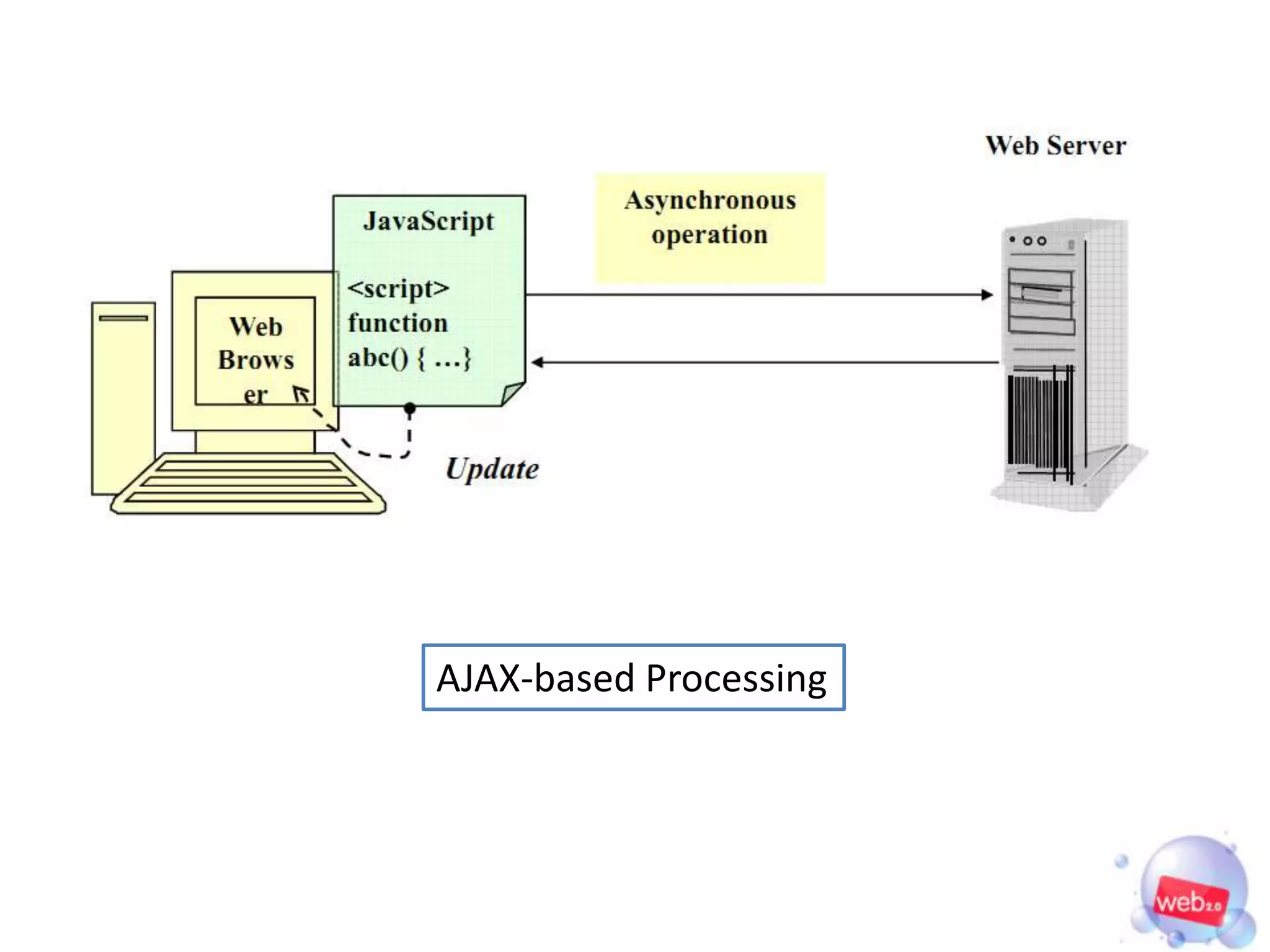
AJAX-based Processing

•Asynchronous JavaScript and XML

• Allows for asynchronous communication
between a browser (client) and server

•Does not mandate that the end user must
wait for processing a request

•Can be used as an alternative to HTML forms
in certain situations
AJAX-based Processing
Adobe Flex

Adobe Flex is a software development
kit (SDK) released by Adobe Systems for the
development and deployment of cross-
platform rich Internet applications based on
the Adobe Flash platform. Flex applications
can be written using Adobe Flash Builder or
by using the freely available Flex compiler
from Adobe.
Concepts

Web 2.0 can be described in 3 parts

 Rich Internet Application (RIA)
 Service Oriented Architecture(SOA)
 Social Web
Web 2.0 applications are giving programmers access to their
information data stores and basic functions through simple
programming interfaces (API’s) based on service oriented
architecture principles. A program’s content and functions can be
exposed to other programs running on the web by “wrapping” them
with these API’s.


 There are really two common API standards

 1.   SOAP (simple object access protocol)

 2.   REST (representational state transfer).
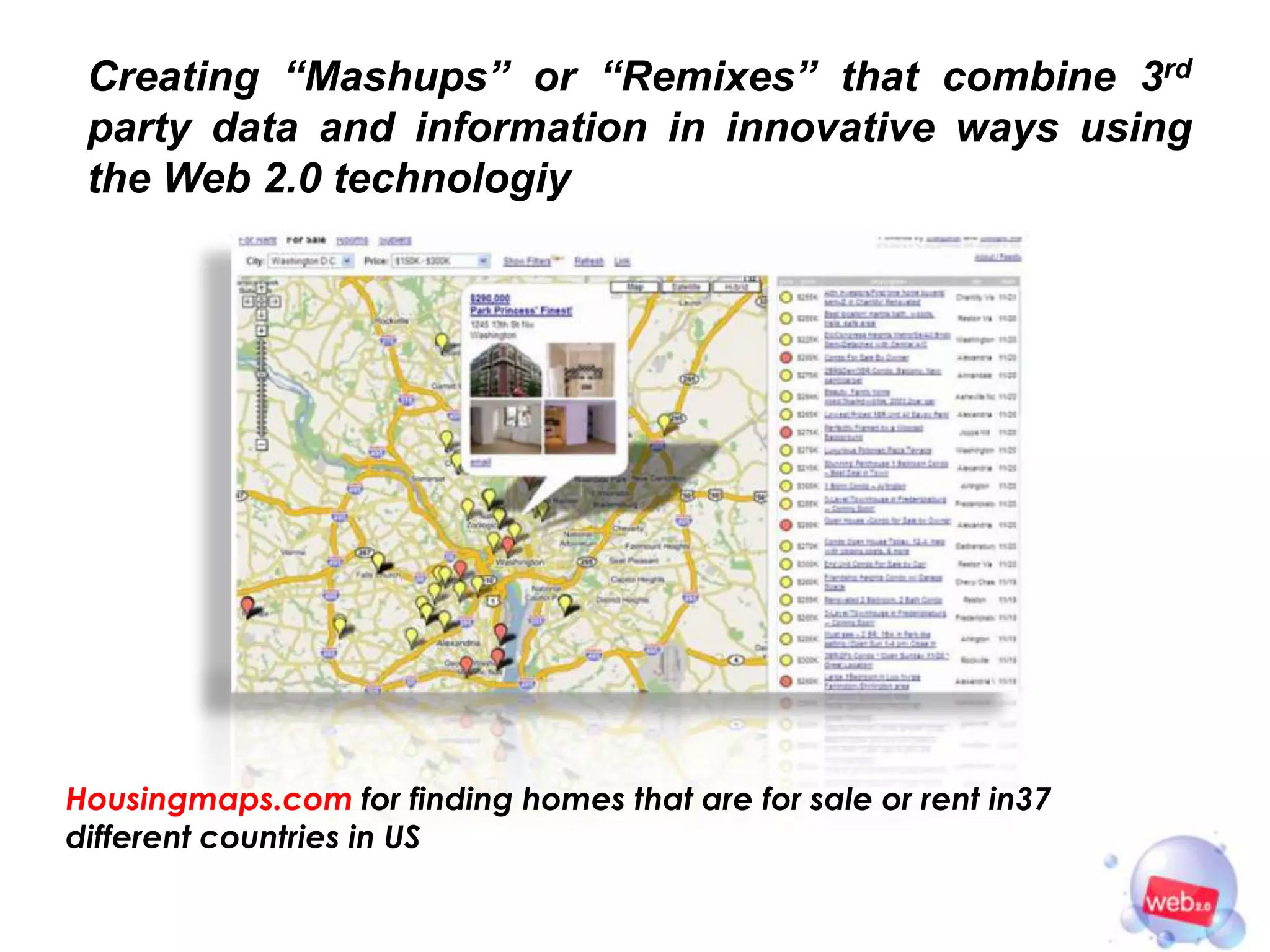
Creating “Mashups” or “Remixes” that combine 3rd
 party data and information in innovative ways using
 the Web 2.0 technologiy


Housingmaps.com for finding homes that are for sale or rent in37
different countries in US
Marketing

A growing number of marketers are
using Web 2.0 tools to collaborate with
consumers on product Development,
service enhancement and promotion.

Company employees have created
wikis – that allows Users to add, delete,
and edit content.
Web 2.0 is about write Ones and read Many

As more and more number of users uses it ,
it keeps on getting better and better.

                   Tim O’Reilly on web 2.0
                   from O’Reilly Media
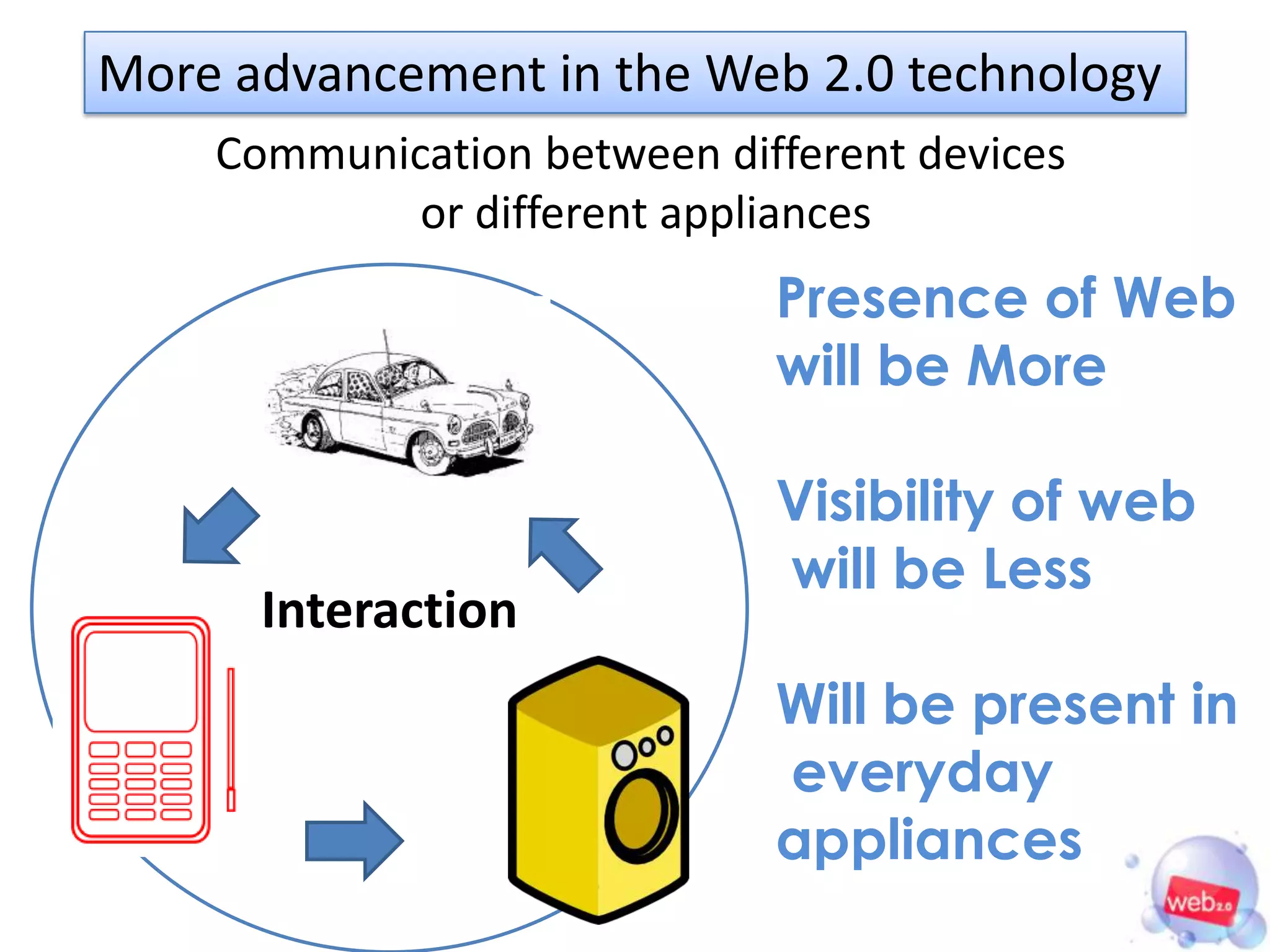
More advancement in the Web 2.0 technology
    Communication between different devices
            or different appliances
                             Presence of Web
                             will be More

                             Visibility of web
                             will be Less
      Interaction
                             Will be present in
                             everyday
                             appliances
Criticism
Tim Berners-Lee the inventor of www in
an interview described the term “Web
2.0” as a “piece of jargon”.

 Does not represents a newer version of
“www” but continues to use web 1.0
concepts and technologies.

 AJAX did not replace HTTP protocol
Peek into the future – Web 3.0

• Being defined as the "Semantic Web"
• Personalization is the new buzzword
• A.I. + Profiling + Search + Rich
     metadata = high degree of
     Personalization
Thank You

Web 2.0

  • 1.
    Bharati Vidyapeeth DeemedUniversity College Of Engineering, Pune A Seminar report on Web 2.0 By SRIJAN BOSE B-Tech Computer-II Semester- VII Roll No: 48 Under the Guidance of: Prof. Sachin Wakurdekar DEPARTMENT OF COMPUTER ENGINEERING B.V.D.U. COLLEGE OF ENGINEERING, PUNE 2011-2012
  • 3.
    The world wideweb The world wide web( abbreviated as WWW or W3 commonly known as the Web) a system of hyperlinked documents accessed via the Internet. It was introduced to allow collaborators in remote sites to share their ideas and knowledge. WWW invented by Tim Berners- Lee The Web's historic logo was designed by Robert Cailliau
  • 4.
    New technologies aretransforming the way people use the world wide web
  • 5.
    WIKI Podcast Rich User experience Blogs Web 2.0 API’s Social networks Feeds AJAX Tags User generated content
  • 6.
    Origin of Web2.0 A phrase coined in 2004 by O’Reilly Media Group; refers to a perceived or proposed second generation of Internet-based services such as Social Networking sites, Wikis etc - that emphasize Online Collaboration & sharing among users Tim O’Reilly
  • 7.
    Web 2.0 calledRead/Write Web Web Browser based Application Social Networking- Connecting, Sharing, Collaborating Participatory media. Creating content : Uploading photos, Music, Videos, Tagging, commenting, Blogging
  • 8.
    Netscape compared withGoogle" •Their flagship product was the web browser, a desktop application, and their strategy was to use their dominance in the browser market to establish a market for high-priced server products. Control over standards for displaying content and applications in the browser would, in theory, give Netscape the kind of market power enjoyed by Microsoft in the PC market. •Netscape promoted a "WebTop" to replace the desktop, and planned to populate that WebTop with information updates and applets pushed to the WebTop by information providers who would purchase Netscape servers.
  • 9.
    •In short, Netscapefocused on creating software, updating it on occasion, and distributing it to the end users. O'Reilly contrasted this with Google, a company which did not at the time focus on producing software, such as a browser, but instead focused on providing a service based on data such as the links Web page between sites. •Google exploits this user-generated content to offer Web search based on reputation through its "Page Rank" algorithm.
  • 10.
    A similar differencecan be seen between the Encyclopedia Britannica Online and Wikipedia •The Britannica relies upon experts to create articles and releases them periodically in publications •Wikipedia relies on trust in anonymous users to constantly and quickly build content. Wikipedia is not based on expertise but rather an adaptation of the open source and it produces and updates articles constantly.
  • 11.
    Web 2.0 isthe common term that is used to differentiate today’s internet. Creation of Web 2.0
  • 12.
    New media andtools for a Web 2.0 world Blogs : An easy to edit website created within a browser Wiki : A web site that anyone can edit. Collaborative document creation Podcast : An Internet radio show. Subscribe, Listen & watch whenever required. Social Bookmarking: Manage bookmark online, tag content, network, discover RSS : really simple syndication – a way of tracking Blogs, wikis, news sites etc. A “Feed Reader”is used to track all of the content. Social Media : Facebook, Myspace, Twitter etc.
  • 13.
    Web 2.0 websitesinclude the following features Search Finding information through keyword search. Links Connects information together into a meaningful information ecosystem using the model of the Web. Authoring The ability to create and update content leads to the collaborative work of many rather than just a few web authors. Tags Categorization of content by users adding "tags"—short, usually one-word descriptions—to facilitate searching
  • 14.
    Most Popular Site  Yahoo!  Orkut.com  Google  Google India  Myspace  Rediff.com  Microsoft Network (MSN)  Naukri.com  EBay  Rapidshare.com  YouTube  WikiPedia  Amazon.com  Craigslist.org  facebook  Windows Live  Blogger.com
  • 15.
    What does itlook like ?? Personal Homepage and social Networking
  • 16.
  • 17.
  • 18.
    To upload andshare videos
  • 19.
    Del.icio.us is anExample of a Site that Uses a “Folksonomy” to Organize Bookmarks
  • 20.
    Wikipedia is aCollaborative Dictionary Being Edited in Real time by Anyone
  • 21.
    Express Phones Interact Stay connected Music Webcams Player
  • 22.
    3 Concepts to use web 2.0 wisely Internet is a public place. Anonymity is a myth. The internet is for ever. What goes online can never be erased What you see online is not necessarily reality
  • 23.
    Internet is forever Capture & harvest store information Source Digital Footprints Path Destination
  • 24.
    Cached Information deleted is Stored Millions of snapshots Digital footprints can be Damaging
  • 25.
    Internet is apublic place Anonymity is a myth Posted Or Can be identified by * Internet service provider * Foreign governments * Marketers
  • 26.
    What you seeonline is not all reality Digital World Different from Real World Cyber bullies Scammers Hackers
  • 27.
    Risks of web2.0 includes Contact with strangers and bullies Identity theft for posting personal info. Damage to reputation Access to inappropriate content
  • 28.
    Web 1.0 VsWeb 2.0 Free Hosting Static Pages HTML 50k Bandwidth Reading Information Social media User generated content Virtual community Web Applications Blogs 1Mb Bandwidth
  • 29.
    WEB 1.0 CHOOSE THECONTENT AND PUT ON YOUR SITE
  • 30.
    WEB 2.0 AdSence readyour site and accordingly recommends adds for the site
  • 31.
    WEB 1.0 Need to upload photos
  • 32.
    WEB 2.0 Upload andshare photos
  • 33.
    Attributes of Web2.0 Rich user experience user participation dynamic content Metadata web standards scalability openness freedom
  • 34.
    Why Web 2.0is called Network as a Platform ? Web 2.0 websites allow users to do more than just retrieve information. It provide user with :  More User Interface  Software  Storage facility
  • 35.
    Technologies For web 2.0 development Adobe Flash AJAX Adobe flex framework
  • 36.
  • 37.
    AJAX-based Processing •Asynchronous JavaScriptand XML • Allows for asynchronous communication between a browser (client) and server •Does not mandate that the end user must wait for processing a request •Can be used as an alternative to HTML forms in certain situations
  • 38.
  • 39.
    Adobe Flex Adobe Flexis a software development kit (SDK) released by Adobe Systems for the development and deployment of cross- platform rich Internet applications based on the Adobe Flash platform. Flex applications can be written using Adobe Flash Builder or by using the freely available Flex compiler from Adobe.
  • 40.
    Concepts Web 2.0 canbe described in 3 parts  Rich Internet Application (RIA)  Service Oriented Architecture(SOA)  Social Web
  • 41.
    Web 2.0 applicationsare giving programmers access to their information data stores and basic functions through simple programming interfaces (API’s) based on service oriented architecture principles. A program’s content and functions can be exposed to other programs running on the web by “wrapping” them with these API’s. There are really two common API standards 1. SOAP (simple object access protocol) 2. REST (representational state transfer).
  • 42.
    Creating “Mashups” or“Remixes” that combine 3rd party data and information in innovative ways using the Web 2.0 technologiy Housingmaps.com for finding homes that are for sale or rent in37 different countries in US
  • 43.
    Marketing A growing numberof marketers are using Web 2.0 tools to collaborate with consumers on product Development, service enhancement and promotion. Company employees have created wikis – that allows Users to add, delete, and edit content.
  • 44.
    Web 2.0 isabout write Ones and read Many As more and more number of users uses it , it keeps on getting better and better. Tim O’Reilly on web 2.0 from O’Reilly Media
  • 45.
    More advancement inthe Web 2.0 technology Communication between different devices or different appliances Presence of Web will be More Visibility of web will be Less Interaction Will be present in everyday appliances
  • 46.
    Criticism Tim Berners-Lee theinventor of www in an interview described the term “Web 2.0” as a “piece of jargon”.  Does not represents a newer version of “www” but continues to use web 1.0 concepts and technologies.  AJAX did not replace HTTP protocol
  • 47.
    Peek into thefuture – Web 3.0 • Being defined as the "Semantic Web" • Personalization is the new buzzword • A.I. + Profiling + Search + Rich metadata = high degree of Personalization
  • 48.