
















Internet Search Strategy
Advantages The ability to  learn   faster   than  your competitor may be the  only  sustainable  competitive  advantage. Peter Senge, The Fifth Discipline
Outline Background Browsers Search Engine Directory Blog Web 2.0 Internet Politics
Background
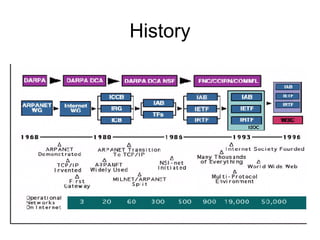
History
Definition of Net The  Internet  is the publicly accessible worldwide system of interconnected  computer networks  that transmit data by  packet switching  using a standardized  Internet Protocol  (IP).  It is made up of thousands of smaller commercial, academic, domestic and  government networks. It carries various information and services, such as  electronic mail ,  online chat , and the interlinked  web pages  and other documents of the  World Wide Web .
How big is the web? 56 billion static web pages  are publicly-available on the World Wide Web.  Another estimated 6 billion static pages are available within private intranet sites 200+ billion database-driven pages  are available as dynamic database reports ("invisible web" pages) Google.com indexes 9.75 billion web pages.
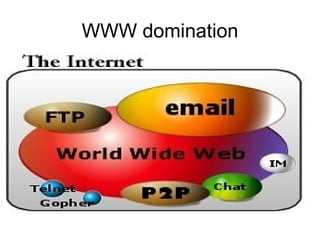
WWW domination
Deep Web The invisible web, , a vast repository of information that search engines don't have access to, such as databases  Private networks,  called intranets, that are not actually hooked up to the Web  Forms , like ColdFusion or CGI  Password-protected sites , like a university library  Sites that  intentionally,  for various reasons, keep their information from being indexed by search engine spiders
Today 200 Billion Only 50 Billion is static web Geogle only indexed 10% Daily Web Space increase 100,000  websites
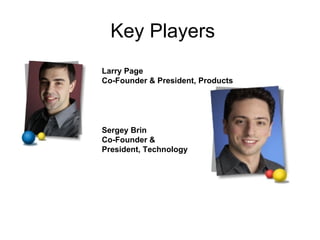
Key Players Larry Page Co-Founder & President, Products   Sergey Brin Co-Founder & President, Technology
 
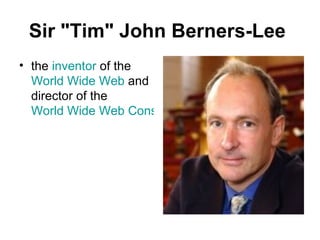
Sir  "Tim" John Berners-Lee   the  inventor  of the  World Wide Web  and director of the  World Wide Web Consortium
Search Strategy
Search Strategy Choose appropriate key words b.  Select right tools  c.  Evaluate Information
 
Sharing Interesting sites? Your frustration? Questions ?
Your needs? 1. What information you want to  have right now? A.________________________ B. _______________________ C. _______________________
Tools Search engine Meta Search Specialized search engine Directory Specialized Directory – academy, alexa Blog RSS Torrent
Tools for Multimedia Sound - Podcast TV – Online TV Photo  – flickr Invisible Web
Browser
Definition A  web browser  is a  software application , technically a type of  HTTP   client , that enables a user to display and interact with  HTML  documents hosted by  web servers  or held in a  file system .
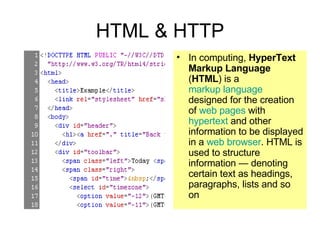
HTML & HTTP In computing,  HyperText Markup Language  ( HTML ) is a  markup language  designed for the creation of  web pages  with  hypertext  and other information to be displayed in a  web browser . HTML is used to structure information — denoting certain text as headings, paragraphs, lists and so on
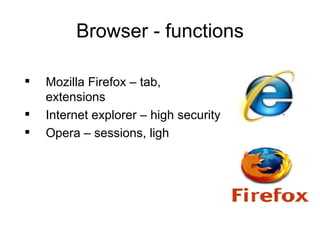
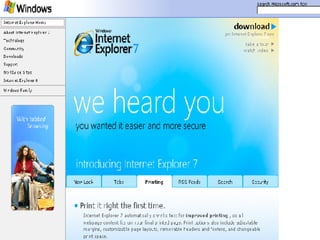
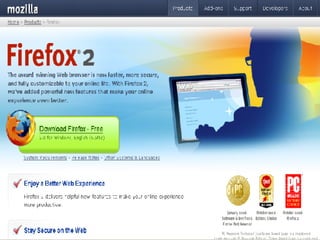
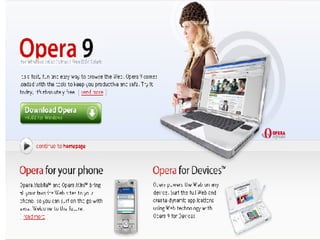
Browser - functions Mozilla Firefox – tab,  extensions Internet explorer – high security Opera – sessions, ligh


Browsers Internet Explorer (decoder) Bookmark/Favorite Home Page (Google, Yahoo) Back Forward Refresh (7 seconds) History Text size Encoding
Search Engine
Definition Definition:   A search engine is a searchable database of Internet files collected by a computer program  (called a wanderer, crawler, robot, worm, spider).
search  engine   Spider:  Program that traverses the Web from link to link, identifying and reading pages  Index:  Database containing a copy of each Web page gathered by the spider  Search and retrieval mechanism:  Technology that enables users to query the index and that returns results in a schematic order
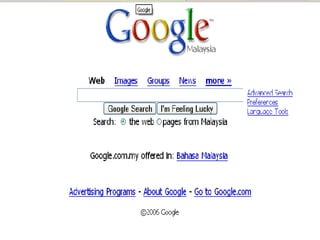
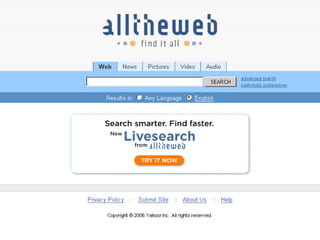
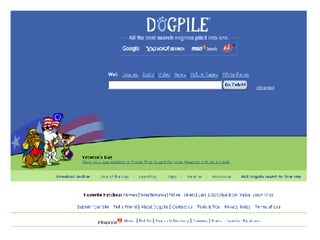
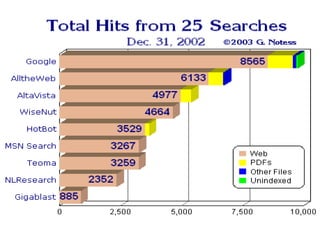
Single Google.com   Vivisimo.com Meta All the Web   Dogpile Internet search engines can be the most useful--or useless--tools on the Internet Search Engines


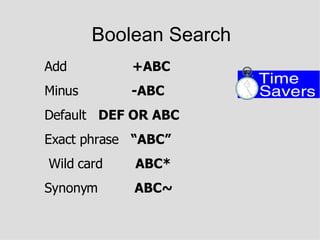
Boolean Search Add  +ABC Minus  -ABC Default  DEF OR ABC   Exact phrase  “ABC” Wild card  ABC* Synonym  ABC~
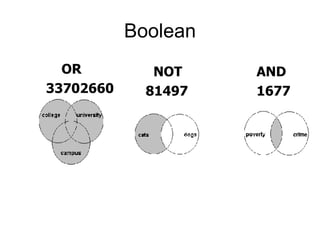
Boolean                                                        OR 33702660 NOT 81497 AND 1677
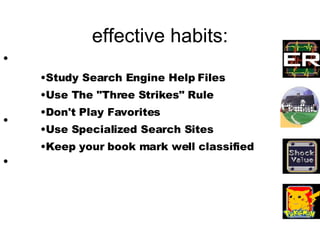
effective habits: Study Search Engine Help Files Use The "Three Strikes" Rule Don't Play Favorites Use Specialized Search Sites Keep your book mark well classified
TEST Use google to find the three items you have listed down
Directory
pick by human hierarchy small portion of cyberspace low noise Characters
 
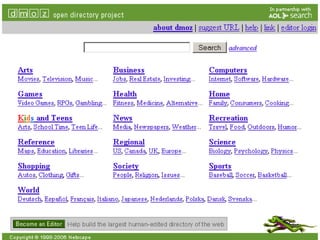
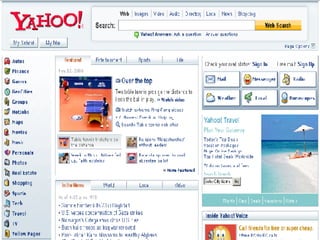
General Directory  Yahoo  - largest collection of topical collections Google Web Directory  –  using the  Google  link ranking technology; Google search results are also included with directory results  Open Directory  – volunteers to pick the web pages
 
 
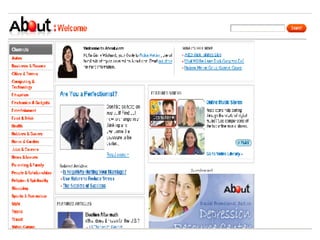
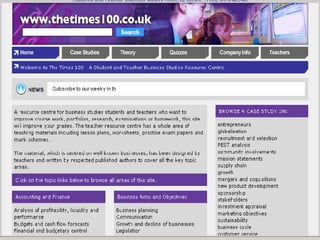
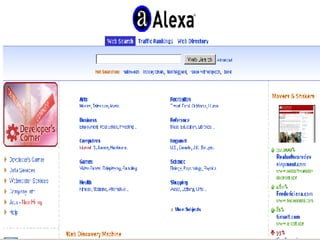
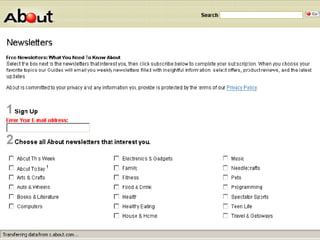
Specialized Dir  About  - large collection of topical collections gathered subject specialists  Alexa  – List down the highly ranked websites 100times  – free education sites for business studies


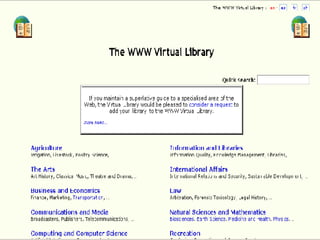
INFOMINE  - large collection of scholarly Internet resources collectively maintained by several libraries, including those from the University of California  The Internet Public Library  - large, selective collection from the University of Michigan  The WWW Virtual Library  - highly respected guides to many disciplines sponsored by the W3 Consortium
 
TEST Find directories that related to your profession
 
Blog


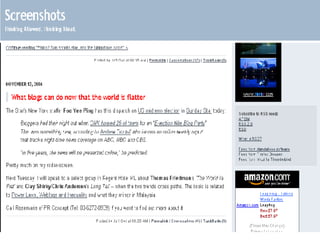
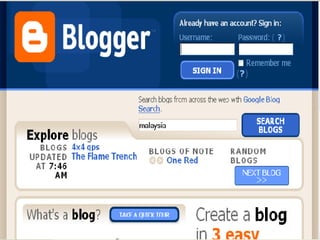
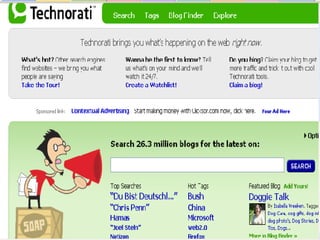
Blog http://www.tehnorati.com http://www.bloglines.com http://www.blogger.com http://blog.iht.com http://www.jeffooi.com
Mailing List/Groups Info Exchange
 
 
Multimedia
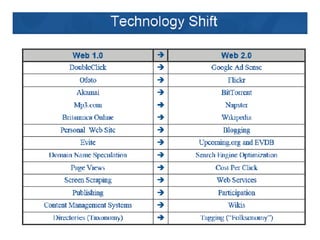
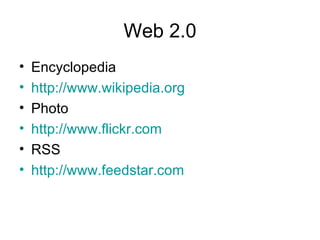
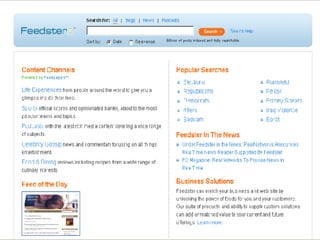
Web 2.0 Encyclopedia http://www.wikipedia.org Photo http://www.flickr.com RSS http://www.feedstar.com
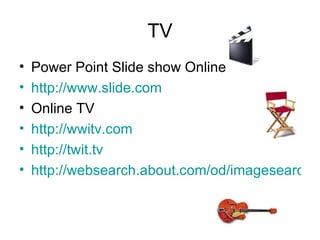
TV Power Point Slide show Online http://www.slide.com Online TV http://wwitv.com http://twit.tv http://websearch.about.com/od/imagesearch/a/freeonlineTV.htm
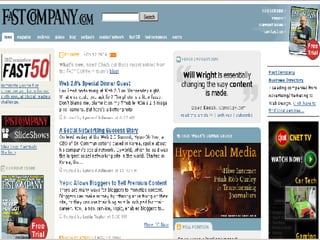
Magazine & Newsletter
 
 
Podcast Sound
 
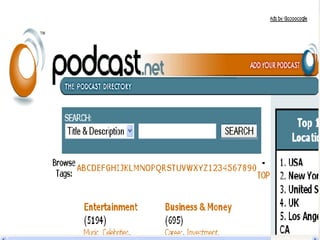
Podcast Podcasting  is a term coined in 2004 when the use of  RSS   syndication  technologies became popular for distributing audio content for listening on mobile devices and personal computer
RSS News Aggregator
 
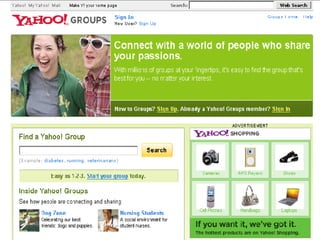
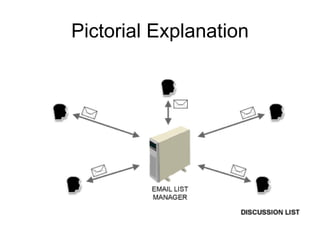
Mailing List Connect
 
Pictorial Explanation
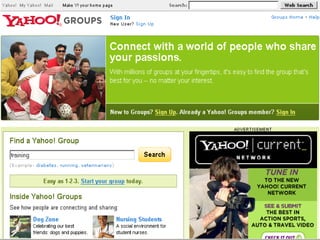
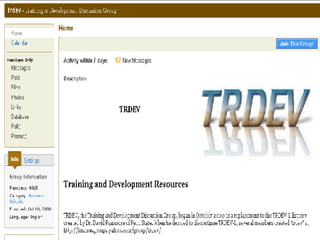
Web Based Mailing List Google Groups Yahoo Groups MSN Groups LIST :   SIPI, Dale Carnegie , TRDEV
Benefits Ask questions Sense of belonging International exposure Contribution Networking
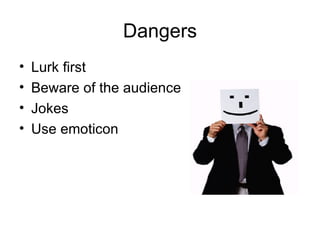
Dangers Lurk first Beware of the audience Jokes Use emoticon
Information Evaluation
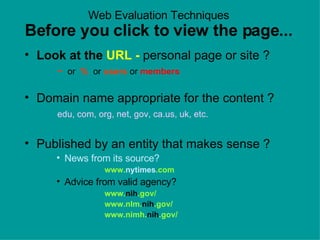
Web Evaluation Techniques Before you click to view the page... Look at the  URL -  personal page or site ?    ~   or  %   or   users  or  members Domain name appropriate for the content ?   edu, com, org, net, gov, ca.us, uk, etc. Published by an entity that makes sense ?  News from its source?   www. nytimes .com Advice from valid agency?  www. nih .gov/ www.nlm. nih .gov/ www.nimh. nih .gov/
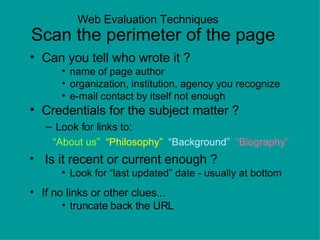
Web Evaluation Techniques    Scan the perimeter of the page Can you tell who wrote it ? name of page author organization, institution, agency you recognize e-mail contact by itself not enough Credentials for the subject matter ? Look for links to: “ About us”   “Philosophy”   “Background”  “Biography” Is it recent or current enough ? Look for “last updated” date - usually at bottom If no links or other clues... truncate back the URL http://hs.houstonisd.org/hspva/academic/Science/Thinkquest/gail/text/ethics.html
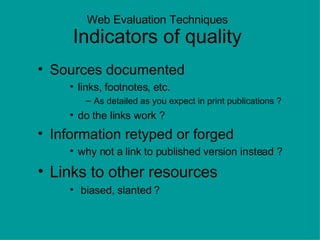
Web Evaluation Techniques Indicators of quality Sources documented links, footnotes, etc. As detailed as you expect in print publications ? do the links work ? Information retyped or forged why not a link to published version instead ? Links to other resources biased, slanted ?
Web Evaluation Techniques What Do Others Say ? Search the URL in alexa.com Who links to the site? Who owns the domain?  Type or paste the URL into the basic search box Traffic for top 100,000 sites See what links are in Google’s  Similar pages Look up the page author in Google
Web Evaluation Techniques STEP BACK  &  ASK:  Does it all add up ? Why was the page put on the Web ?  inform with facts and data?  explain, persuade?  sell, entice?   share, disclose? as a parody or satire?  Is it appropriate for your purpose?
Try evaluating some sites... Search a controversial topic in  Google : "nuclear armageddon" prions danger “ stem cells” abortion Scan the first two pages of results Visit one or two sites  try to evaluate their quality and reliability
Internet Politics
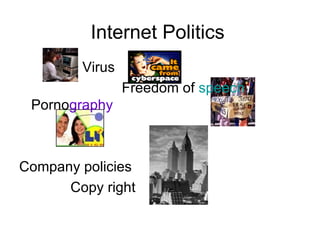
Internet Politics Virus Freedom of  speech   Porno graphy Company policies Copy right
Internet Politics Virus data loss due to viruses is still less than 10%  2 hours to clear up, a major infection will probably  take 5 days   What is the consequences?
Internet Politics Virus One of the first major attacks in the United States occurred in 1988 with a virus created by a Cornell University graduate student. It jammed more than  6,000  computers across the country, shutting down some networks on what was then a much smaller national computer network.
Internet Politics Antivirus Rules For The Users 1 .   Never accept disks , programs or data files without checking them first 2.   Never use software , demo's or other software with doubtful origins 3 .  Always  scan any program  or document download onto your machine before you open or read it, this includes attachments received via e-mail 4.   If you lend a disk to anyone,  check it  when you get it back. BEFORE you use it again 5.  Keep your Antivirus software  up to date
Internet Politics Freedom of speech Abide to non-disclosure agreement. In discussion group, lurk before you participant.  Do not use four letter words Use emoticon for international communication
Internet Politics Pornography It’s a big NO NO Why it is not allowed? If allowed, what would be the negative consequences?  If accidental, leave straight immediately
Internet Politics Company policies Internet Users Policy (IUP) Previous experience
Internet Politics Copy right Three types of software: public domain, freeware and shareware Give credit to authors electronics, verbal or written forms Check virus Consult IT or HR if not clear

Internet Research

  • 1.
  • 2.
    Advantages The abilityto learn faster than your competitor may be the only sustainable competitive advantage. Peter Senge, The Fifth Discipline
  • 3.
    Outline Background BrowsersSearch Engine Directory Blog Web 2.0 Internet Politics
  • 4.
  • 5.
  • 6.
    Definition of NetThe Internet is the publicly accessible worldwide system of interconnected computer networks that transmit data by packet switching using a standardized Internet Protocol (IP). It is made up of thousands of smaller commercial, academic, domestic and government networks. It carries various information and services, such as electronic mail , online chat , and the interlinked web pages and other documents of the World Wide Web .
  • 7.
    How big isthe web? 56 billion static web pages are publicly-available on the World Wide Web. Another estimated 6 billion static pages are available within private intranet sites 200+ billion database-driven pages are available as dynamic database reports ("invisible web" pages) Google.com indexes 9.75 billion web pages.
  • 8.
  • 9.
    Deep Web Theinvisible web, , a vast repository of information that search engines don't have access to, such as databases Private networks, called intranets, that are not actually hooked up to the Web Forms , like ColdFusion or CGI Password-protected sites , like a university library Sites that intentionally, for various reasons, keep their information from being indexed by search engine spiders
  • 10.
    Today 200 BillionOnly 50 Billion is static web Geogle only indexed 10% Daily Web Space increase 100,000 websites
  • 11.
    Key Players LarryPage Co-Founder & President, Products Sergey Brin Co-Founder & President, Technology
  • 12.
  • 13.
    Sir "Tim"John Berners-Lee the inventor of the World Wide Web and director of the World Wide Web Consortium
  • 14.
  • 15.
    Search Strategy Chooseappropriate key words b. Select right tools c. Evaluate Information
  • 16.
  • 17.
    Sharing Interesting sites?Your frustration? Questions ?
  • 18.
    Your needs? 1.What information you want to have right now? A.________________________ B. _______________________ C. _______________________
  • 19.
    Tools Search engineMeta Search Specialized search engine Directory Specialized Directory – academy, alexa Blog RSS Torrent
  • 20.
    Tools for MultimediaSound - Podcast TV – Online TV Photo – flickr Invisible Web
  • 21.
  • 22.
    Definition A web browser is a software application , technically a type of HTTP client , that enables a user to display and interact with HTML documents hosted by web servers or held in a file system .
  • 23.
    HTML & HTTPIn computing, HyperText Markup Language ( HTML ) is a markup language designed for the creation of web pages with hypertext and other information to be displayed in a web browser . HTML is used to structure information — denoting certain text as headings, paragraphs, lists and so on
  • 24.
    Browser - functionsMozilla Firefox – tab, extensions Internet explorer – high security Opera – sessions, ligh
  • 25.
  • 26.
  • 27.
  • 28.
    Browsers Internet Explorer(decoder) Bookmark/Favorite Home Page (Google, Yahoo) Back Forward Refresh (7 seconds) History Text size Encoding
  • 29.
  • 30.
    Definition Definition: A search engine is a searchable database of Internet files collected by a computer program (called a wanderer, crawler, robot, worm, spider).
  • 31.
    search engine Spider: Program that traverses the Web from link to link, identifying and reading pages Index: Database containing a copy of each Web page gathered by the spider Search and retrieval mechanism: Technology that enables users to query the index and that returns results in a schematic order
  • 32.
    Single Google.com Vivisimo.com Meta All the Web Dogpile Internet search engines can be the most useful--or useless--tools on the Internet Search Engines
  • 33.
  • 34.
  • 35.
  • 36.
  • 37.
  • 38.
  • 39.
  • 40.
    Boolean Search Add +ABC Minus -ABC Default DEF OR ABC Exact phrase “ABC” Wild card ABC* Synonym ABC~
  • 41.
  • 42.
    effective habits: StudySearch Engine Help Files Use The "Three Strikes" Rule Don't Play Favorites Use Specialized Search Sites Keep your book mark well classified
  • 43.
    TEST Use googleto find the three items you have listed down
  • 44.
  • 45.
    pick by humanhierarchy small portion of cyberspace low noise Characters
  • 46.
  • 47.
    General Directory Yahoo - largest collection of topical collections Google Web Directory – using the Google link ranking technology; Google search results are also included with directory results Open Directory – volunteers to pick the web pages
  • 48.
  • 49.
  • 50.
    Specialized Dir About - large collection of topical collections gathered subject specialists Alexa – List down the highly ranked websites 100times – free education sites for business studies
  • 51.
  • 52.
  • 53.
  • 54.
    INFOMINE -large collection of scholarly Internet resources collectively maintained by several libraries, including those from the University of California The Internet Public Library - large, selective collection from the University of Michigan The WWW Virtual Library - highly respected guides to many disciplines sponsored by the W3 Consortium
  • 55.
  • 56.
    TEST Find directoriesthat related to your profession
  • 57.
  • 58.
  • 59.
  • 60.
  • 61.
  • 62.
  • 63.
    Blog http://www.tehnorati.com http://www.bloglines.comhttp://www.blogger.com http://blog.iht.com http://www.jeffooi.com
  • 64.
  • 65.
  • 66.
  • 67.
  • 68.
    Web 2.0 Encyclopediahttp://www.wikipedia.org Photo http://www.flickr.com RSS http://www.feedstar.com
  • 69.
    TV Power PointSlide show Online http://www.slide.com Online TV http://wwitv.com http://twit.tv http://websearch.about.com/od/imagesearch/a/freeonlineTV.htm
  • 70.
  • 71.
  • 72.
  • 73.
  • 74.
  • 75.
    Podcast Podcasting is a term coined in 2004 when the use of RSS syndication technologies became popular for distributing audio content for listening on mobile devices and personal computer
  • 76.
  • 77.
  • 78.
  • 79.
  • 80.
  • 81.
    Web Based MailingList Google Groups Yahoo Groups MSN Groups LIST : SIPI, Dale Carnegie , TRDEV
  • 82.
    Benefits Ask questionsSense of belonging International exposure Contribution Networking
  • 83.
    Dangers Lurk firstBeware of the audience Jokes Use emoticon
  • 84.
  • 85.
    Web Evaluation TechniquesBefore you click to view the page... Look at the URL - personal page or site ? ~ or % or users or members Domain name appropriate for the content ? edu, com, org, net, gov, ca.us, uk, etc. Published by an entity that makes sense ? News from its source? www. nytimes .com Advice from valid agency? www. nih .gov/ www.nlm. nih .gov/ www.nimh. nih .gov/
  • 86.
    Web Evaluation Techniques Scan the perimeter of the page Can you tell who wrote it ? name of page author organization, institution, agency you recognize e-mail contact by itself not enough Credentials for the subject matter ? Look for links to: “ About us” “Philosophy” “Background” “Biography” Is it recent or current enough ? Look for “last updated” date - usually at bottom If no links or other clues... truncate back the URL http://hs.houstonisd.org/hspva/academic/Science/Thinkquest/gail/text/ethics.html
  • 87.
    Web Evaluation TechniquesIndicators of quality Sources documented links, footnotes, etc. As detailed as you expect in print publications ? do the links work ? Information retyped or forged why not a link to published version instead ? Links to other resources biased, slanted ?
  • 88.
    Web Evaluation TechniquesWhat Do Others Say ? Search the URL in alexa.com Who links to the site? Who owns the domain? Type or paste the URL into the basic search box Traffic for top 100,000 sites See what links are in Google’s Similar pages Look up the page author in Google
  • 89.
    Web Evaluation TechniquesSTEP BACK & ASK: Does it all add up ? Why was the page put on the Web ? inform with facts and data? explain, persuade? sell, entice? share, disclose? as a parody or satire? Is it appropriate for your purpose?
  • 90.
    Try evaluating somesites... Search a controversial topic in Google : "nuclear armageddon" prions danger “ stem cells” abortion Scan the first two pages of results Visit one or two sites try to evaluate their quality and reliability
  • 91.
  • 92.
    Internet Politics VirusFreedom of speech Porno graphy Company policies Copy right
  • 93.
    Internet Politics Virusdata loss due to viruses is still less than 10% 2 hours to clear up, a major infection will probably take 5 days What is the consequences?
  • 94.
    Internet Politics VirusOne of the first major attacks in the United States occurred in 1988 with a virus created by a Cornell University graduate student. It jammed more than 6,000 computers across the country, shutting down some networks on what was then a much smaller national computer network.
  • 95.
    Internet Politics AntivirusRules For The Users 1 . Never accept disks , programs or data files without checking them first 2. Never use software , demo's or other software with doubtful origins 3 . Always scan any program or document download onto your machine before you open or read it, this includes attachments received via e-mail 4. If you lend a disk to anyone, check it when you get it back. BEFORE you use it again 5. Keep your Antivirus software up to date
  • 96.
    Internet Politics Freedomof speech Abide to non-disclosure agreement. In discussion group, lurk before you participant. Do not use four letter words Use emoticon for international communication
  • 97.
    Internet Politics PornographyIt’s a big NO NO Why it is not allowed? If allowed, what would be the negative consequences? If accidental, leave straight immediately
  • 98.
    Internet Politics Companypolicies Internet Users Policy (IUP) Previous experience
  • 99.
    Internet Politics Copyright Three types of software: public domain, freeware and shareware Give credit to authors electronics, verbal or written forms Check virus Consult IT or HR if not clear