The Internet and the Mobile Web
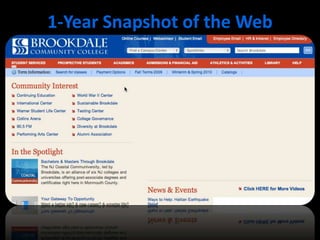
1-Year Snapshot of the Web
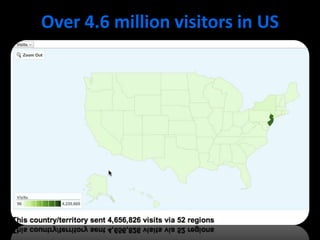
Over 4.6 million visitors in US
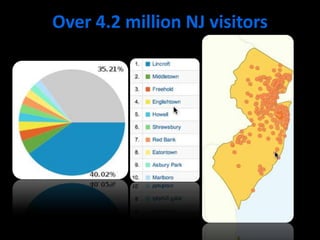
Over 4.2 million NJ visitors
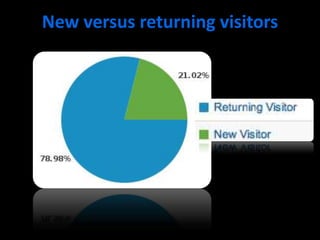
New versus returning visitors
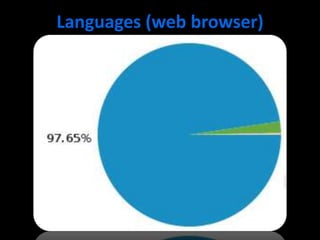
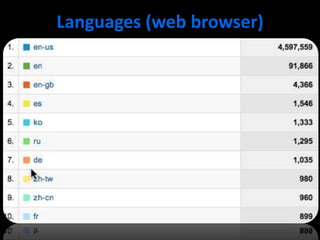
Languages (web browser)
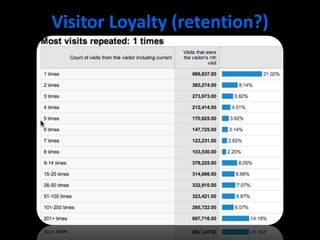
Visitor Loyalty (retention?)
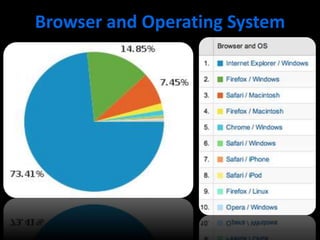
Browser and Operating System
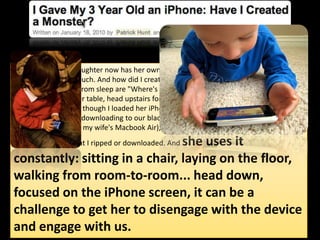
My three year old daughter now has her own iPhone, though without service so it is effectively an iPod touch. And how did I create a monster, you might ask? Easy. Her first words upon waking from sleep are "Where's my iPhone?" Her reaction to her parents call to come to the dinner table, head upstairs for a bath or get ready for bed is to clutch her iPhone and cry. Even though I loaded her iPhone with some of her favorite apps from her mom's phone (by re-downloading to our black Macbook, as I couldn't get iTunes Home Sharing to work with my wife's Macbook Air), she only really uses it to watch a small handful of videos that I ripped or downloaded. And she uses it constantly: sitting in a chair, laying on the floor, walking from room-to-room... head down, focused on the iPhone screen, it can be a challenge to get her to disengage with the device and engage with us.
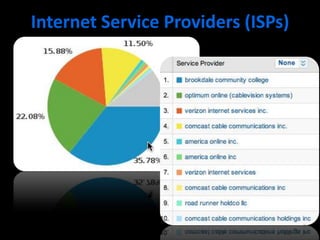
Internet Service Providers (ISPs)
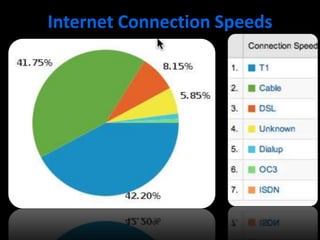
Internet Connection Speeds
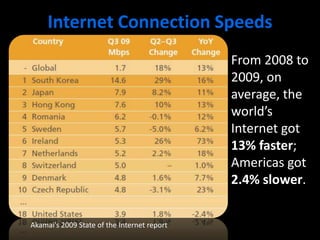
Internet Connection SpeedsFrom 2008 to 2009, on average, the world’s Internet got 13% faster; Americas got 2.4% slower.Akamai’s 2009 State of the Internet report
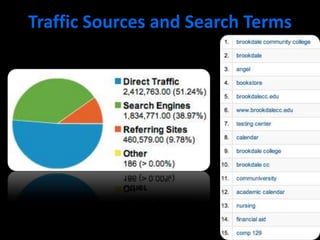
Traffic Sources and Search Terms
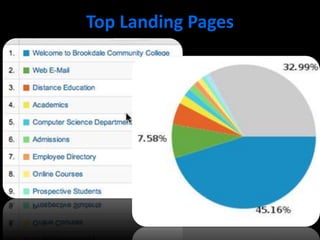
Top Landing Pages
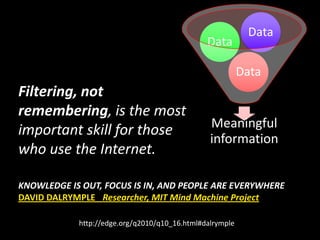
Filtering, not remembering, is the most important skill for those who use the Internet. KNOWLEDGE IS OUT, FOCUS IS IN, AND PEOPLE ARE EVERYWHERE	DAVID DALRYMPLE 
Researcher, MIT Mind Machine Projecthttp://edge.org/q2010/q10_16.html#dalrymple
three primary, broad consequences of the Internet:information is no longer stored and retrieved by people, but is managed externally, by the Internet, it is increasingly challenging and important for people to maintain their focus in a world where distractions are available anywhere, and the Internet enables us to talk to and hear from people around the world effortlessly.	http://edge.org/q2010/q10_16.html#dalrymple
Gaming
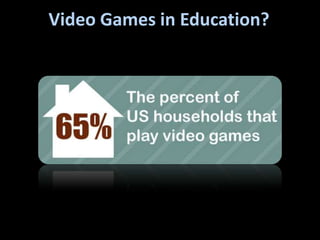
Video Games in Education?
2010 Horizon Report
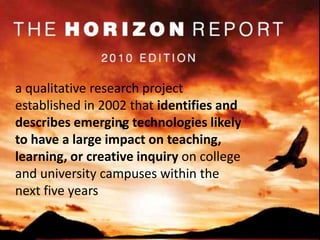
a qualitative research project established in 2002 that identifies and describes emerging technologies likely to have a large impact on teaching, learning, or creative inquiry on college and university campuses within the next five years
six emerging technologies or practices are described that are likely to enter mainstream use on campuses within three adoption horizons spread over the next one to five years
Key TrendsThe abundance of resources and relationships made easily accessible via the Internet is increasingly challenging us to revisit our roles as educators in sense-making, coaching, and credentialing.
Key TrendsPeople expect to be able to work, learn, and study whenever and wherever they want to.
Key TrendsThe technologies we use are increasingly cloud-based, and our notions of IT support are decentralized.
Key TrendsThe work of students is increasingly seen as collaborative by nature, and there is more cross-campus collaboration between departments.
Critical ChallengesThe role of the academy — and the way we prepare students for their future lives — is changing.
Critical ChallengesNew scholarly forms of authoring, publishing, and researching continue to emerge but appropriate metrics for evaluating them increasingly and far too often lag behind
Critical ChallengesDigital media literacy continues its rise in importance as a key skill in every discipline and profession.
Critical ChallengesInstitutions increasingly focus more narrowly on key goals, as a result of shrinking budgets in the present economic climate.
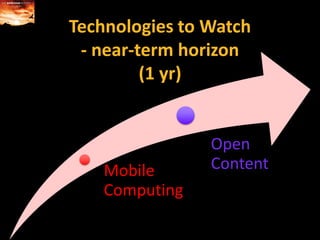
Technologies to Watch- near-term horizon(1 yr)
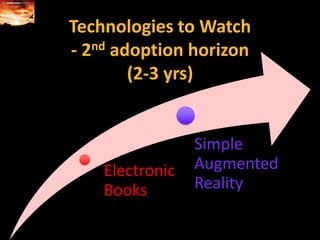
Technologies to Watch- 2nd adoption horizon(2-3 yrs)
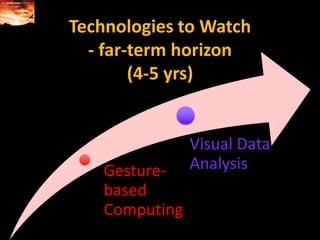
Technologies to Watch- far-term horizon(4-5 yrs)
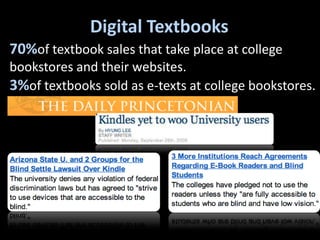
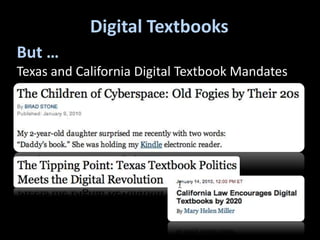
Digital Textbooks70%of textbook sales that take place at college bookstores and their websites.   3%of textbooks sold as e-texts at college bookstores.
Digital TextbooksBut …Texas and California Digital Textbook Mandates

ESMP Update

Editor's Notes

  • #3 Let’s consider a one year snapshot of the college website
  • #4 Using Google analytics – we see over 4.6 million visitors from the US
  • #5 4.2 million from all over NJ – with the top 10 cities listed. We have 400,000 visitors from outside NJ – do they take classes? Are we capturing that potential audience?
  • #6 The slide shows new versus returning visitors to the website. What are we doing to make sure these 21% new visitors come back – i.e. become return visitors?
  • #7 The dominant language of visitors to the website is English …
  • #8 … but we have visitors whose language is Spanish, Russian, German, Chinese, French, etc. Are we doing anything to capture these demographics?
  • #9 Think of visitor loyalty as a measure of retention. How often do visitors come back? 14% come back over 201 times, but what about those that visit only one time, two times, or three times. Can we get them to visit again?
  • #10 Most of our labs have Windows and IE installed, so this isn’t surprising, but Firefox/Windows is significant, and Safari/Mac + Firefox/Mac are 3rd and 4th. Also look at 7 and 8 (iPhone and iPod) – mobile devices are 7th and 8th!
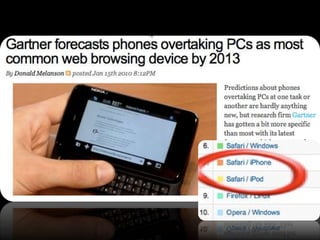
  • #11 Consider that result in the context of this predication from Gartner. Is the website optimized for mobile devices? Are student services available for mobile devices?
  • #12 Consider that result in the context of this predication from Gartner. Is the website optimized for mobile devices? Are student services available for mobile devices?
  • #14 The technology already exists to present your classroom content from a mobile device!
  • #15 Lots of variety in ISPs
  • #16 High speed Internet fairly wide-spread, but still a sliver of slow dialup
  • #17 Slow internet is a national problem
  • #18 How are visitors getting to the website? Mostly direct traffic – computers at the college, which open to the BCC website, but significant numbers from search. Consider the top search terms – angel, bookstore, testing center, calendar, communiversity, etc
  • #19 Landing page – where do visitors end up? Webmail, distance ed, comp sci, admin, directory, online courses, etc
  • #20 MIT researcher David Dalrymple observes that the shift to greater dependence/use of the Internet requires a shift from “remembering” as a skill to “filtering”
  • #21 Dalrymple identifies three consequences of the InternetA shift from information that is stored and retrieved to information that is managed externally on and by the InternetMore distractions and therefore greater difficulty maintaining focusAbility to communicate globally
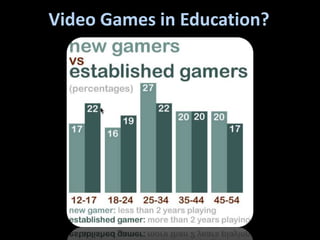
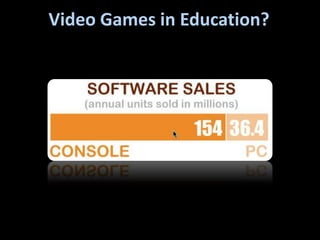
  • #23 Some real eye-opening data about gaming makes me think about gaming in education - especially console gaming. Consider for example the following data:- 65% of US households play video games
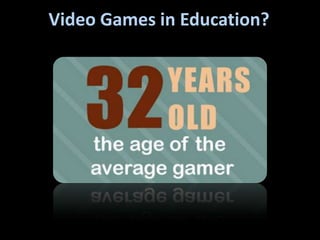
  • #24 - the average gamer is 32 years old
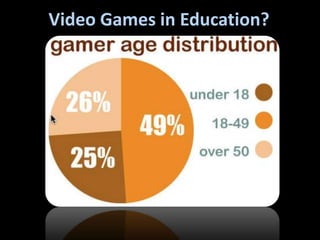
  • #25 the age distribution:25% under 1849% between 18-4926% over 5
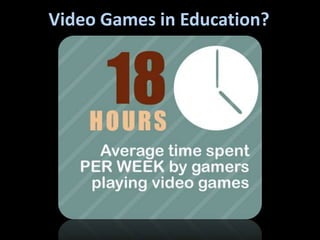
  • #26 gamers spend an average of 18 hours per week playing video games
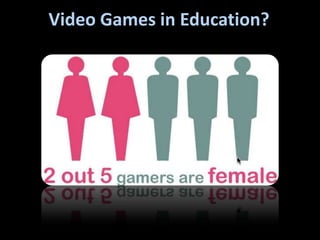
  • #27 2 out of 5 gamers are female
  • #28 New gamers are popping up in every age categroy