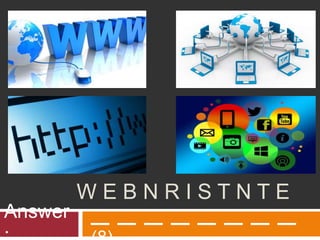
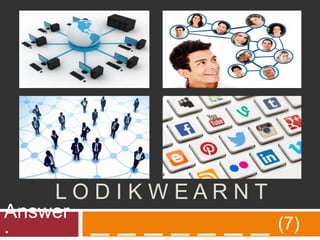
W E B N R I S T N T E
_ _ _ _ _ _ _ _Answer
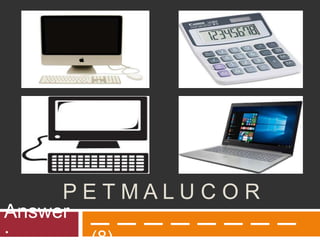
P E T M A L U C O R
_ _ _ _ _ _ _ _Answer
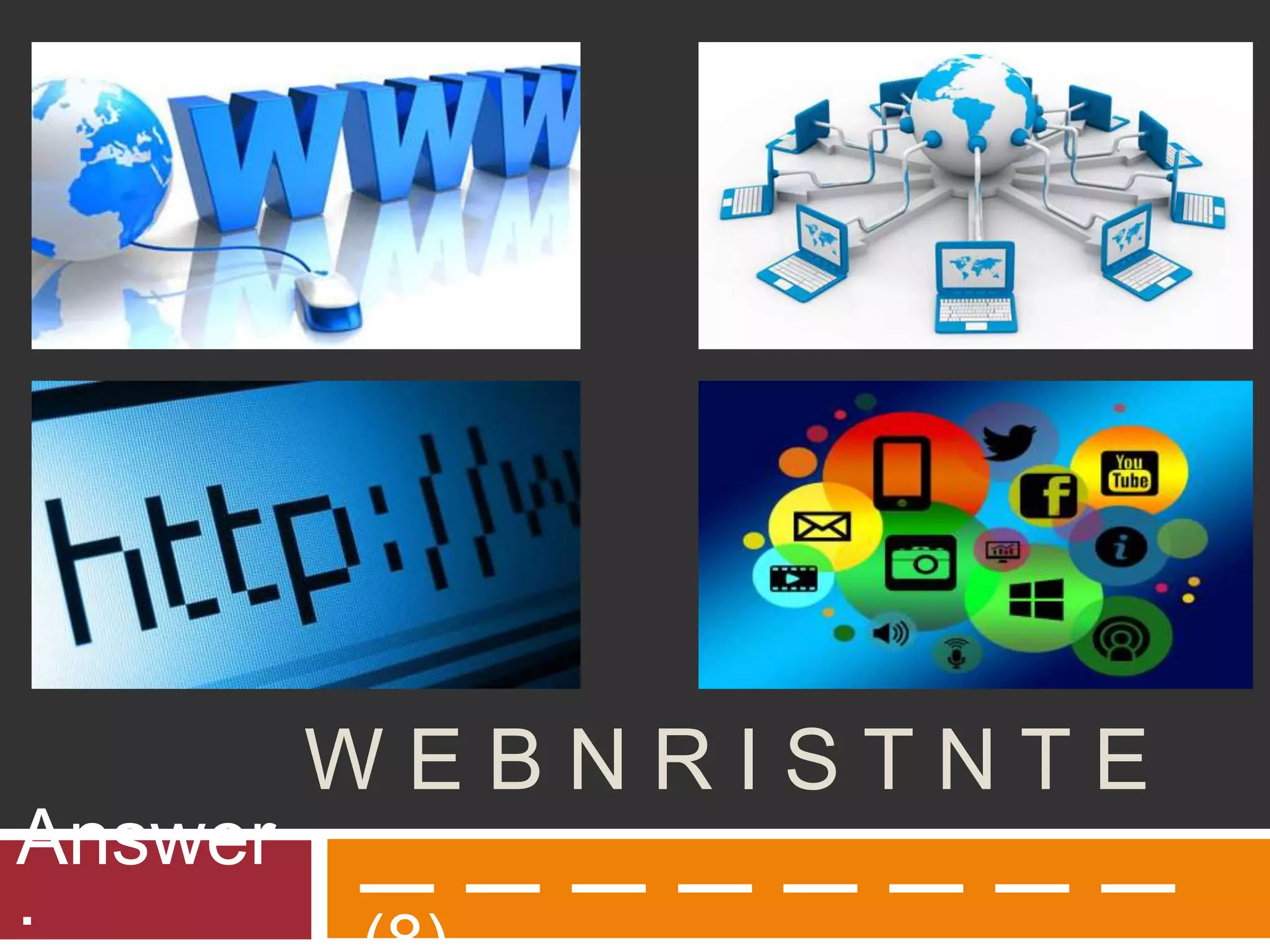
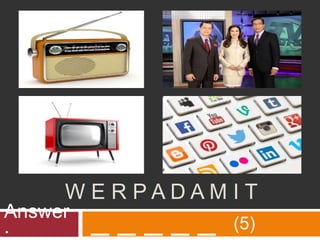
W E R P A D A M I T
_ _ _ _ _ (5)
Answer
L O D I K W E A R N T
_ _ _ _ _ _ _ (7)
Answer
LESSON 1 :
INFORMATION
AND
COMMUNICATIO
N TECHNOLOGY
Prepared
by:
MARK JHON C. OXILLO
WHAT IS
ICT ?LET’S DEFINE IT ONE BY
ONE.
Information
 facts provided or
learned about something
or someone
(Source: google.com)
Communication
 the imparting or
exchanging of
information or news
(Source: google.com)
Technology
 machinery and
equipment developed
from the application of
scientific knowledge
(Source: google.com)
SO
WHAT IS
ICT ?
ICT (Information and
Communication
Technology)
 deals with the use of
different communication
technologies such as mobile
phones, telephone, Internet,
etc. to locate, save, send and
edit information
How does ICT affected
the Philippines in different
aspects of living (e.g.,
economic, social, etc.)?
ICT IN THE
PHILIPPINE
S
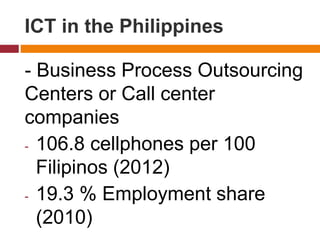
- Business Process Outsourcing
Centers or Call center
companies
- 106.8 cellphones per 100
Filipinos (2012)
- 19.3 % Employment share
(2010)
ICT in the Philippines
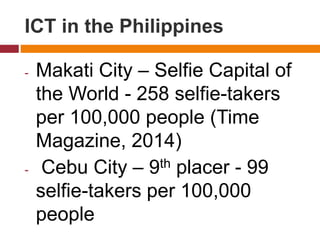
- Makati City – Selfie Capital of
the World - 258 selfie-takers
per 100,000 people (Time
Magazine, 2014)
- Cebu City – 9th placer - 99
selfie-takers per 100,000
people
ICT in the Philippines
- As of January 2014, there
were 37.6 million Internet
users, of which 34 million were
on Facebook. Thus, one in
every three Filipinos were on
Facebook.
ICT in the Philippines
- 43.5% of Filipinos accessed the
Internet (2016)
- Internet penetration amongst
consumers aged 15 to 19 was
close to two-thirds (65%) and
nearly half of those in their 20‟s
were online (48%)
ICT in the Philippines
 52% of Filipinos had a
computer with high speed
Internet connection at home
 74% of 15–19 years identified
Internet cafés as their main
point of Internet access
ICT in the Philippines
 Most followed Filipino Celebrity
on Twitter is Vice Ganda (9.85
million) followed by Anne Curtis
(9.80 million) and Angel Locsin
(9.7 million)
ICT in the Philippines
 Most followed Filipino Facebook
Page is Marian Rivera (18.35
million) followed by ABS-CBN
(16 million) and Angel Locsin
(15.5 million)
ICT in the Philippines
 Most followed Filipino Celebrity
on Instagram is Anne Curtis (6.6
million) followed by Liza
Soberano (4.9 million), Kathryn
Bernardo (4.7 million), Vice
Ganda (4.4 million), Pia
Wurtzbach (3.9 million)
ICT in the Philippines
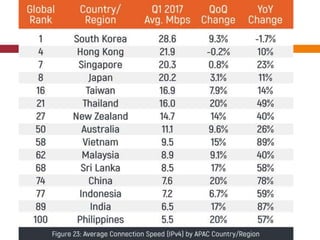
 Ranked 74th out of 77
countries in terms of 4G speed
 Download speed of just 8.24
Mbps (CNN Phils, Nov. 2017)
ICT in the Philippines
STATE OF
ICT
The World Wide Web (WWW)
 is an information space where
documents and other web
resources are identified by
Uniform Resource Locators
(URLs), interlinked by
hypertext links, and can be
accessed via the Internet
Web 1.0 (early 90s)
 when the World Wide Web was
created by Tim Berners-Lee,
most web pages were static.
Static (stationary page) in the
sense that the page is “as is”
and cannot be manipulated by
the user. The content is also the
Web 2.0 : Dynamic Web Pages
(1999)
 is the evolution of Web 1.0 by
adding dynamic web pages - the
user is able to see a website
differently than others. Examples of
Web 2.0 include social networking
sites, blogs, wikis, video sharing
sites, hosted services, and web
applications
Web 2.0 : Dynamic Web Pages
(1999)
 Web 2.0 allows users to interact with the
page: instead of just reading a page, the
user may be able to comment or create a
user account. Web 2.0 also allows users
to use web browsers instead of just using
their operating system. Browsers can now
be used for their user interface, application
software (or web applications), and even
for file storage.
Most websites
that we visit today
are Web 2.0.
FEATURES OF WEB 2.0 :
1. Folksonomy - It allows users to
categorize and classify/arrange
information using freely chosen
keywords (e.g., tagging). Popular
social networking sites such as
Twitter, Instagram, Facebook, etc.
use tags that start with the pound
sign (#). This is also referred to as
FEATURES OF WEB 2.0 :
2. Rich User Experience. Content is
dynamic and is responsive to user’s
input. An example would be a
website that shows local content. In
the case of social networking sites,
when logged on, your account is
used to modify what you see in their
website.
FEATURES OF WEB 2.0 :
3. Long Tail. Services are offered
on demand rather than on a one-
time purchase. In certain cases,
time-based pricing is better than
file-size-based pricing or vice
versa.
FEATURES OF WEB 2.0 :
Long Tail is synonymous to
subscribing to a data plan that
charges you for the amount of
time you spent in the Internet, or
a data plan that charges you for
the amount of bandwidth you
used.
FEATURES OF WEB 2.0 :
4. User Participation. The owner
of the website is not the only one
who is able to put content. Others
are able to place a content of
their own by means of comment,
reviews, and evaluation.
FEATURES OF WEB 2.0 :
5. Software as a Service. Users
will subscribe to a software only
when needed rather than
purchasing them. This is a
cheaper option if you do not
always need to use a software.
FEATURES OF WEB 2.0 :
6. Mass Participation. It is a
diverse information sharing
through universal web access.
Since most users can use the
Internet, Web 2.0’s content is
based on people from various
cultures.
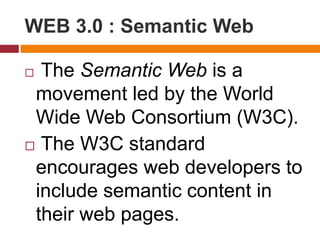
WEB 3.0 : Semantic Web
 The Semantic Web is a
movement led by the World
Wide Web Consortium (W3C).
 The W3C standard
encourages web developers to
include semantic content in
their web pages.
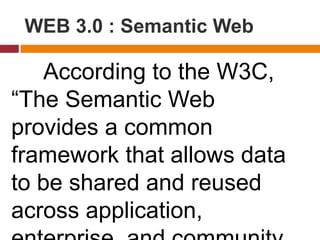
According to the W3C,
“The Semantic Web
provides a common
framework that allows data
to be shared and reused
across application,
WEB 3.0 : Semantic Web
The aim of Web 3.0 is to
have machines (or servers)
understand the user’s
preferences to be able to
deliver web content
specifically targeting the
WEB 3.0 : Semantic Web
Problems of Web
3.0
1. Compatibility
HTML files and current
web browsers could not
support Web 3.0.
Problems of Web
3.0
2. Security
The user’s security is
also in question since the
machine is saving his or her
preferences.
Problems of Web
3.0
3. Vastness
The World Wide Web
already contains billions of
web pages.
Problems of Web
3.0
4. Vagueness
Certain words are
imprecise. The words “old”
and “small” would depend
on the user.
Problems of Web
3.0
5. Logic
Since machines use logic,
there are certain limitations for
a computer to be able to
predict what the user is
referring to at a given time.
1. Convergence
Technological
convergence is the
synergy of technological
advancements to work
on a similar goal or task.
2. Social Media
Social media is a website,
application, or online channels
that enable web users to
create, co-create, discuss,
modify, and exchange user-
generated content.
a. Social Networks. These are sites that
allow you to connect with other people
with the same interests or background.
b. Bookmarking Sites. These are sites
that allow you to store and manage links
to various websites and resources.
c. Social News. These are sites that
allow users to post their own news items
or links to other news sources.
d. Media Sharing. These are sites
that allow you to upload and share
media content like images, music,
and video.
e. Microblogging. These are sites
that focus on short updates from the
user.
f. Blogs and Forums. These
3. Assistive Media - is a
nonprofit service designed to
help people who have visual
and reading impairments. A
database of audio recordings is
used to read to the user.
4. Mobile Technologies
The popularity of smartphones
and tablets has taken a major
rise over the years. This is
largely because of the devices’
capability to do tasks that were
originally found in personal
a. iOS
b. Android
c. Blackberry OS
d. Windows Phone OS
e. Symbian
f. WebOS
g. Windows Mobile
iOS – iPhone Operating
System
iOS – iPhone Operating
System
- is a mobile operating system
created and developed by Apple
Inc. exclusively for its hardware. It
is the operating system that
presently powers many of the
company's mobile devices,
including the iPhone, iPad, and
iPod Touch (Latest Version: iOS
Android OS
Android OS
- is a mobile operating system
developed by Google and
designed primarily for
touchscreen mobile devices
such as smartphones and
tablets
(Latest Version: Android
Blackberry OS
Blackberry OS
- is a proprietary mobile
operating system developed
by BlackBerry Limited for its
BlackBerry line of smartphone
handheld devices
(Latest Version: 10.3)
Windows Phone OS
Windows Phone OS
- was a family of mobile
operating systems developed
by Microsoft for smartphones as
the replacement successor to
Windows Mobile and Zune.
Windows Phone features a new
user interface derived from
Symbian
Symbian
- was a mobile operating
system and computing
platform designed for
smartphones. Symbian was
originally developed as a
closed-source OS for PDAs in
1998 by Symbian Ltd. It is the
WebOS
WebOS
- as Open WebOS or LG WebOS,
is a multitasking operating
system for smart devices such
as Smart TVs and it has been
used as a mobile operating
system
Windows Mobile
Windows Mobile
- is a family of mobile operating
systems developed by
Microsoft for smartphones and
Pocket PCs
SYSTEMS,
FUNCTIONS
AND
PLATFORMS
ONLINE SYSTEMS
 is a system that is
connected to the Internet.
An offline system would
be a system that is
disconnected from the
Internet.
ONLINE FUNCTIONS
 include email notifications
from the server, the
updating of web blacklists
(lists of undesirable
websites), updating of the
list of file-sharing programs,
and remote access to Child
ONLINE PLATFORMS
 an online
marketplace that
places one party in
touch with another,
such as buyers and
sellers.
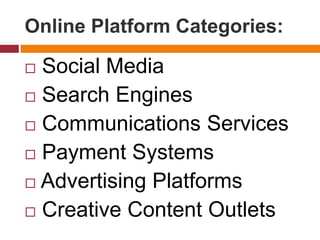
Online Platform Categories:
 Social Media
 Search Engines
 Communications Services
 Payment Systems
 Advertising Platforms
 Creative Content Outlets
EN D

Information and Communication Technology (ICT) - Empowerment Technologies

  • 1.
    W E BN R I S T N T E _ _ _ _ _ _ _ _Answer
  • 2.
    P E TM A L U C O R _ _ _ _ _ _ _ _Answer
  • 3.
    W E RP A D A M I T _ _ _ _ _ (5) Answer
  • 4.
    L O DI K W E A R N T _ _ _ _ _ _ _ (7) Answer
  • 5.
    LESSON 1 : INFORMATION AND COMMUNICATIO NTECHNOLOGY Prepared by: MARK JHON C. OXILLO
  • 6.
    WHAT IS ICT ?LET’SDEFINE IT ONE BY ONE.
  • 7.
    Information  facts providedor learned about something or someone (Source: google.com)
  • 8.
    Communication  the impartingor exchanging of information or news (Source: google.com)
  • 9.
    Technology  machinery and equipmentdeveloped from the application of scientific knowledge (Source: google.com)
  • 10.
  • 11.
    ICT (Information and Communication Technology) deals with the use of different communication technologies such as mobile phones, telephone, Internet, etc. to locate, save, send and edit information
  • 12.
    How does ICTaffected the Philippines in different aspects of living (e.g., economic, social, etc.)?
  • 13.
  • 14.
    - Business ProcessOutsourcing Centers or Call center companies - 106.8 cellphones per 100 Filipinos (2012) - 19.3 % Employment share (2010) ICT in the Philippines
  • 15.
    - Makati City– Selfie Capital of the World - 258 selfie-takers per 100,000 people (Time Magazine, 2014) - Cebu City – 9th placer - 99 selfie-takers per 100,000 people ICT in the Philippines
  • 16.
    - As ofJanuary 2014, there were 37.6 million Internet users, of which 34 million were on Facebook. Thus, one in every three Filipinos were on Facebook. ICT in the Philippines
  • 17.
    - 43.5% ofFilipinos accessed the Internet (2016) - Internet penetration amongst consumers aged 15 to 19 was close to two-thirds (65%) and nearly half of those in their 20‟s were online (48%) ICT in the Philippines
  • 18.
     52% ofFilipinos had a computer with high speed Internet connection at home  74% of 15–19 years identified Internet cafés as their main point of Internet access ICT in the Philippines
  • 19.
     Most followedFilipino Celebrity on Twitter is Vice Ganda (9.85 million) followed by Anne Curtis (9.80 million) and Angel Locsin (9.7 million) ICT in the Philippines
  • 20.
     Most followedFilipino Facebook Page is Marian Rivera (18.35 million) followed by ABS-CBN (16 million) and Angel Locsin (15.5 million) ICT in the Philippines
  • 21.
     Most followedFilipino Celebrity on Instagram is Anne Curtis (6.6 million) followed by Liza Soberano (4.9 million), Kathryn Bernardo (4.7 million), Vice Ganda (4.4 million), Pia Wurtzbach (3.9 million) ICT in the Philippines
  • 23.
     Ranked 74thout of 77 countries in terms of 4G speed  Download speed of just 8.24 Mbps (CNN Phils, Nov. 2017) ICT in the Philippines
  • 24.
  • 25.
    The World WideWeb (WWW)  is an information space where documents and other web resources are identified by Uniform Resource Locators (URLs), interlinked by hypertext links, and can be accessed via the Internet
  • 26.
    Web 1.0 (early90s)  when the World Wide Web was created by Tim Berners-Lee, most web pages were static. Static (stationary page) in the sense that the page is “as is” and cannot be manipulated by the user. The content is also the
  • 27.
    Web 2.0 :Dynamic Web Pages (1999)  is the evolution of Web 1.0 by adding dynamic web pages - the user is able to see a website differently than others. Examples of Web 2.0 include social networking sites, blogs, wikis, video sharing sites, hosted services, and web applications
  • 28.
    Web 2.0 :Dynamic Web Pages (1999)  Web 2.0 allows users to interact with the page: instead of just reading a page, the user may be able to comment or create a user account. Web 2.0 also allows users to use web browsers instead of just using their operating system. Browsers can now be used for their user interface, application software (or web applications), and even for file storage.
  • 29.
    Most websites that wevisit today are Web 2.0.
  • 30.
    FEATURES OF WEB2.0 : 1. Folksonomy - It allows users to categorize and classify/arrange information using freely chosen keywords (e.g., tagging). Popular social networking sites such as Twitter, Instagram, Facebook, etc. use tags that start with the pound sign (#). This is also referred to as
  • 31.
    FEATURES OF WEB2.0 : 2. Rich User Experience. Content is dynamic and is responsive to user’s input. An example would be a website that shows local content. In the case of social networking sites, when logged on, your account is used to modify what you see in their website.
  • 32.
    FEATURES OF WEB2.0 : 3. Long Tail. Services are offered on demand rather than on a one- time purchase. In certain cases, time-based pricing is better than file-size-based pricing or vice versa.
  • 33.
    FEATURES OF WEB2.0 : Long Tail is synonymous to subscribing to a data plan that charges you for the amount of time you spent in the Internet, or a data plan that charges you for the amount of bandwidth you used.
  • 34.
    FEATURES OF WEB2.0 : 4. User Participation. The owner of the website is not the only one who is able to put content. Others are able to place a content of their own by means of comment, reviews, and evaluation.
  • 35.
    FEATURES OF WEB2.0 : 5. Software as a Service. Users will subscribe to a software only when needed rather than purchasing them. This is a cheaper option if you do not always need to use a software.
  • 36.
    FEATURES OF WEB2.0 : 6. Mass Participation. It is a diverse information sharing through universal web access. Since most users can use the Internet, Web 2.0’s content is based on people from various cultures.
  • 37.
    WEB 3.0 :Semantic Web  The Semantic Web is a movement led by the World Wide Web Consortium (W3C).  The W3C standard encourages web developers to include semantic content in their web pages.
  • 38.
    According to theW3C, “The Semantic Web provides a common framework that allows data to be shared and reused across application, WEB 3.0 : Semantic Web
  • 39.
    The aim ofWeb 3.0 is to have machines (or servers) understand the user’s preferences to be able to deliver web content specifically targeting the WEB 3.0 : Semantic Web
  • 40.
    Problems of Web 3.0 1.Compatibility HTML files and current web browsers could not support Web 3.0.
  • 41.
    Problems of Web 3.0 2.Security The user’s security is also in question since the machine is saving his or her preferences.
  • 42.
    Problems of Web 3.0 3.Vastness The World Wide Web already contains billions of web pages.
  • 43.
    Problems of Web 3.0 4.Vagueness Certain words are imprecise. The words “old” and “small” would depend on the user.
  • 44.
    Problems of Web 3.0 5.Logic Since machines use logic, there are certain limitations for a computer to be able to predict what the user is referring to at a given time.
  • 45.
    1. Convergence Technological convergence isthe synergy of technological advancements to work on a similar goal or task.
  • 46.
    2. Social Media Socialmedia is a website, application, or online channels that enable web users to create, co-create, discuss, modify, and exchange user- generated content.
  • 47.
    a. Social Networks.These are sites that allow you to connect with other people with the same interests or background. b. Bookmarking Sites. These are sites that allow you to store and manage links to various websites and resources. c. Social News. These are sites that allow users to post their own news items or links to other news sources.
  • 48.
    d. Media Sharing.These are sites that allow you to upload and share media content like images, music, and video. e. Microblogging. These are sites that focus on short updates from the user. f. Blogs and Forums. These
  • 49.
    3. Assistive Media- is a nonprofit service designed to help people who have visual and reading impairments. A database of audio recordings is used to read to the user.
  • 50.
    4. Mobile Technologies Thepopularity of smartphones and tablets has taken a major rise over the years. This is largely because of the devices’ capability to do tasks that were originally found in personal
  • 51.
    a. iOS b. Android c.Blackberry OS d. Windows Phone OS e. Symbian f. WebOS g. Windows Mobile
  • 52.
    iOS – iPhoneOperating System
  • 53.
    iOS – iPhoneOperating System - is a mobile operating system created and developed by Apple Inc. exclusively for its hardware. It is the operating system that presently powers many of the company's mobile devices, including the iPhone, iPad, and iPod Touch (Latest Version: iOS
  • 54.
  • 55.
    Android OS - isa mobile operating system developed by Google and designed primarily for touchscreen mobile devices such as smartphones and tablets (Latest Version: Android
  • 56.
  • 57.
    Blackberry OS - isa proprietary mobile operating system developed by BlackBerry Limited for its BlackBerry line of smartphone handheld devices (Latest Version: 10.3)
  • 58.
  • 59.
    Windows Phone OS -was a family of mobile operating systems developed by Microsoft for smartphones as the replacement successor to Windows Mobile and Zune. Windows Phone features a new user interface derived from
  • 60.
  • 61.
    Symbian - was amobile operating system and computing platform designed for smartphones. Symbian was originally developed as a closed-source OS for PDAs in 1998 by Symbian Ltd. It is the
  • 62.
  • 63.
    WebOS - as OpenWebOS or LG WebOS, is a multitasking operating system for smart devices such as Smart TVs and it has been used as a mobile operating system
  • 64.
  • 65.
    Windows Mobile - isa family of mobile operating systems developed by Microsoft for smartphones and Pocket PCs
  • 66.
  • 67.
    ONLINE SYSTEMS  isa system that is connected to the Internet. An offline system would be a system that is disconnected from the Internet.
  • 68.
    ONLINE FUNCTIONS  includeemail notifications from the server, the updating of web blacklists (lists of undesirable websites), updating of the list of file-sharing programs, and remote access to Child
  • 69.
    ONLINE PLATFORMS  anonline marketplace that places one party in touch with another, such as buyers and sellers.
  • 70.
    Online Platform Categories: Social Media  Search Engines  Communications Services  Payment Systems  Advertising Platforms  Creative Content Outlets
  • 71.