VISVESVARAYA TECHNOLOGICAL UNIVERSITY BELGAUM


                              Technical Seminar
                                    On
                                “Apple iOS”
                                    By
                                CHETHAN H A
                                4GH08CS010

                             Under the guidance of
                              Mr.Annaiah.,B.E.,M.Tech
                               Asst.professor
Seminar co-ordinator                                         Head of the Department
Mr.Chethan K.C.,B.E,M.Tech                              Dr. K.C Ravishankar B.E., M.Tech., Ph.d
                                                            Professor & Head,Dept.of
   Asst.professor
                                                               CS&E, GEC,Hassan
Apple iOS


            February 16 2012
Mobile Operating System

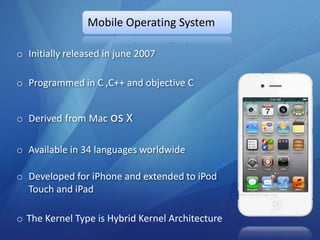
o Initially released in june 2007

o Programmed in C ,C++ and objective C


o Derived from Mac os X

o Available in 34 languages worldwide

o Developed for iPhone and extended to iPod
  Touch and iPad

o The Kernel Type is Hybrid Kernel Architecture
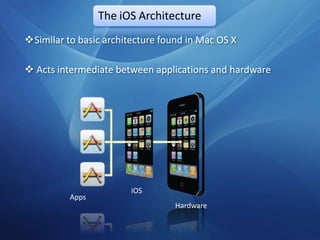
The iOS Architecture
Similar to basic architecture found in Mac OS X

 Acts intermediate between applications and hardware


                        iOS
          Apps
                                  Hardware
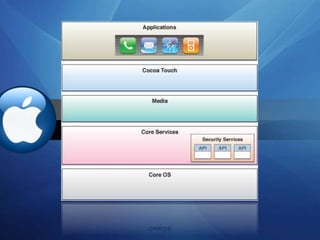
The Layers in iOS Architecture Technology

 Consists of four Abstraction layers
     • Core OS Layer

     • Core service Layer

     • The Media Layer


     • The Cocoa Touch Layer


Uses Darwin foundation and therefore a unix like OS

 The user interface of iOS is based on the concept
  of direct manipulation, using multi-touch gestures.
The core of iOS

Contains the low-level features such as
  Accelerate Framework (Accelerate.framework)
     This framework contains interfaces for performing DSP,
     linear algebra, and image-processing calculations
 Core Bluetooth (CoreBluetooth.framework)
     This framework allows developers to interact specifically
     with Bluetooth Low-Energy ("LE") accessories
 External Accessory Framework (ExternalAccessory.framework)
     This framework provides support for communicating with
     hardware accessories attached to an iOS based device
Core services Layer

Contains the High-level features that all applications use such as

    iCloud Storage
     lets your application write data to a central location and access
   those items from all user’s computers and iOS devices
    Core services framework

    Includes Accounts.framework, AddressBook.framework and
   CoreData.framework for user accounts ,contacts and for
   managing model-view-controller application


             iCloud
Media Layer

The Media layer contains the graphics, audio, and video technologies
    Graphics Technologies

       Includes Core Graphics , Core Animation and OpenGL technologies
       which handles 2D vector and animating views and 2D and 3D figures
    Audio Technologies

       Supports rich audio experince and audio formats like AAC, Apple
       Lossless(ALAC),A-Law and Linear PCM


    Video technologies

       The iOS support the playback of movie files with the .mov, .mp4, .m4v,
       and .3gp filename extensions
Compression standards in Video Technologies


●   H.264 video, up to 1.5 Mbps, 640x480 pixels, 30 frames
    per second

• H.264 video, up to 768 Kbps, 320x240 pixels, 30 frames
  per second

• MPEG-4 video, up to 2.5 Mbps, 640x480 pixels, 30 frames
  per second


Media layer also consists of different frameworks like
CoreAudio.framework, CoreImage.framework and
CoreText.framework
Cocoa Touch Layer


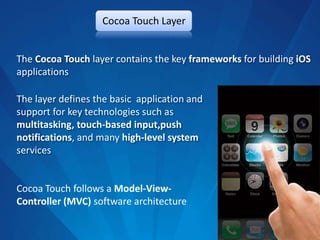
The Cocoa Touch layer contains the key frameworks for building iOS
applications

The layer defines the basic application and
support for key technologies such as
multitasking, touch-based input,push
notifications, and many high-level system
services


Cocoa Touch follows a Model-View-
Controller (MVC) software architecture
The iOS Development

The iOS SDK (Software Development kit)

 Includes interfaces,tools and resources

 Includes special packages called Frameworks

 A framework is a directory that contains a dynamic shared library and the
  resources (such as header files, images, helper applications, and so on)

Key Components of SDK

      Xcode Tools
         Xcode         Instruments

      iOS simulator

      iOS Developer Library
Xcode Tools

• Xcode is a suite of tools used for developing softwares
  for Mac OS X and iOS

• An Integrated Development Environment (IDE) that
  manages to edit,compile,run and Debug source code


• Xcode suite supports C, C++, Objective C, Objective
  C++, Java, AppleScript, Python and Ruby source
  code with a variety of programming models


• Instruments are the runtime performance analysis and debugging Tools

• iOS Simulator is a Mac OS X application that simulates the iOS technology
  stack, allowing you to test iOS applications on Macintosh computer
Xcode Version series


  1.x series

      2.X series


        3.x series

          4.x series

The latest stable release is Xcode version 4.2.1, which is available
on the Mac App Store
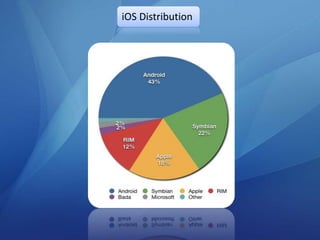
iOS Distribution
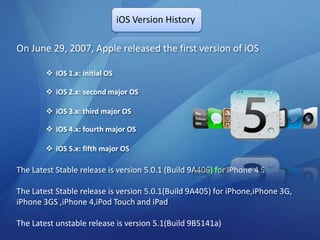
iOS Version History

On June 29, 2007, Apple released the first version of iOS

         iOS 1.x: initial OS

         iOS 2.x: second major OS

         iOS 3.x: third major OS

         iOS 4.x: fourth major OS

         iOS 5.x: fifth major OS

The Latest Stable release is version 5.0.1 (Build 9A406) for iPhone 4 S

The Latest Stable release is version 5.0.1(Build 9A405) for iPhone,iPhone 3G,
iPhone 3GS ,iPhone 4,iPod Touch and iPad

The Latest unstable release is version 5.1(Build 9B5141a)
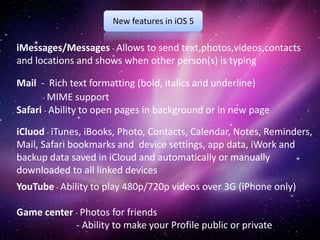
New features in iOS 5

iMessages/Messages - Allows to send text,photos,videos,contacts
and locations and shows when other person(s) is typing

Mail - Rich text formatting (bold, italics and underline)
      - MIME support
Safari - Ability to open pages in background or in new page

iCluod - iTunes, iBooks, Photo, Contacts, Calendar, Notes, Reminders,
Mail, Safari bookmarks and device settings, app data, iWork and
backup data saved in iCloud and automatically or manually
downloaded to all linked devices
YouTube - Ability to play 480p/720p videos over 3G (iPhone only)

Game center - Photos for friends
            - Ability to make your Profile public or private
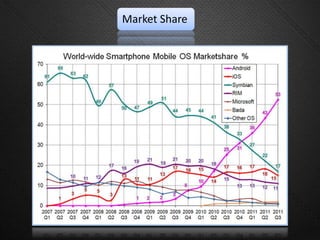
Market Share
Conclusion


The objective of the seminar was to study and enhance
 our knowledge about Apple iOS , mobile operating
 system. We have learnt about the new features of the
 iOS 5 operating system.

 So we have learnt about the layers of iOS technology viz.
  core OS, core services, media and cocoa touch.

 The fact that all the information regarding iOS cannot
  be bound in this Presentation, I have tried to cover
  almost all points that made study of iOS worthy.
Any Q?
ThanQ You

Apple iOS

  • 1.
    VISVESVARAYA TECHNOLOGICAL UNIVERSITYBELGAUM Technical Seminar On “Apple iOS” By CHETHAN H A 4GH08CS010 Under the guidance of Mr.Annaiah.,B.E.,M.Tech Asst.professor Seminar co-ordinator Head of the Department Mr.Chethan K.C.,B.E,M.Tech Dr. K.C Ravishankar B.E., M.Tech., Ph.d Professor & Head,Dept.of Asst.professor CS&E, GEC,Hassan
  • 2.
    Apple iOS February 16 2012
  • 3.
    Mobile Operating System oInitially released in june 2007 o Programmed in C ,C++ and objective C o Derived from Mac os X o Available in 34 languages worldwide o Developed for iPhone and extended to iPod Touch and iPad o The Kernel Type is Hybrid Kernel Architecture
  • 4.
    The iOS Architecture Similarto basic architecture found in Mac OS X  Acts intermediate between applications and hardware iOS Apps Hardware
  • 5.
    The Layers iniOS Architecture Technology  Consists of four Abstraction layers • Core OS Layer • Core service Layer • The Media Layer • The Cocoa Touch Layer Uses Darwin foundation and therefore a unix like OS  The user interface of iOS is based on the concept of direct manipulation, using multi-touch gestures.
  • 7.
    The core ofiOS Contains the low-level features such as Accelerate Framework (Accelerate.framework) This framework contains interfaces for performing DSP, linear algebra, and image-processing calculations Core Bluetooth (CoreBluetooth.framework) This framework allows developers to interact specifically with Bluetooth Low-Energy ("LE") accessories External Accessory Framework (ExternalAccessory.framework) This framework provides support for communicating with hardware accessories attached to an iOS based device
  • 8.
    Core services Layer Containsthe High-level features that all applications use such as iCloud Storage lets your application write data to a central location and access those items from all user’s computers and iOS devices Core services framework Includes Accounts.framework, AddressBook.framework and CoreData.framework for user accounts ,contacts and for managing model-view-controller application iCloud
  • 9.
    Media Layer The Medialayer contains the graphics, audio, and video technologies Graphics Technologies Includes Core Graphics , Core Animation and OpenGL technologies which handles 2D vector and animating views and 2D and 3D figures Audio Technologies Supports rich audio experince and audio formats like AAC, Apple Lossless(ALAC),A-Law and Linear PCM Video technologies The iOS support the playback of movie files with the .mov, .mp4, .m4v, and .3gp filename extensions
  • 10.
    Compression standards inVideo Technologies ● H.264 video, up to 1.5 Mbps, 640x480 pixels, 30 frames per second • H.264 video, up to 768 Kbps, 320x240 pixels, 30 frames per second • MPEG-4 video, up to 2.5 Mbps, 640x480 pixels, 30 frames per second Media layer also consists of different frameworks like CoreAudio.framework, CoreImage.framework and CoreText.framework
  • 11.
    Cocoa Touch Layer TheCocoa Touch layer contains the key frameworks for building iOS applications The layer defines the basic application and support for key technologies such as multitasking, touch-based input,push notifications, and many high-level system services Cocoa Touch follows a Model-View- Controller (MVC) software architecture
  • 12.
    The iOS Development TheiOS SDK (Software Development kit)  Includes interfaces,tools and resources  Includes special packages called Frameworks  A framework is a directory that contains a dynamic shared library and the resources (such as header files, images, helper applications, and so on) Key Components of SDK  Xcode Tools  Xcode  Instruments  iOS simulator  iOS Developer Library
  • 13.
    Xcode Tools • Xcodeis a suite of tools used for developing softwares for Mac OS X and iOS • An Integrated Development Environment (IDE) that manages to edit,compile,run and Debug source code • Xcode suite supports C, C++, Objective C, Objective C++, Java, AppleScript, Python and Ruby source code with a variety of programming models • Instruments are the runtime performance analysis and debugging Tools • iOS Simulator is a Mac OS X application that simulates the iOS technology stack, allowing you to test iOS applications on Macintosh computer
  • 14.
    Xcode Version series  1.x series  2.X series  3.x series  4.x series The latest stable release is Xcode version 4.2.1, which is available on the Mac App Store
  • 15.
  • 16.
    iOS Version History OnJune 29, 2007, Apple released the first version of iOS  iOS 1.x: initial OS  iOS 2.x: second major OS  iOS 3.x: third major OS  iOS 4.x: fourth major OS  iOS 5.x: fifth major OS The Latest Stable release is version 5.0.1 (Build 9A406) for iPhone 4 S The Latest Stable release is version 5.0.1(Build 9A405) for iPhone,iPhone 3G, iPhone 3GS ,iPhone 4,iPod Touch and iPad The Latest unstable release is version 5.1(Build 9B5141a)
  • 17.
    New features iniOS 5 iMessages/Messages - Allows to send text,photos,videos,contacts and locations and shows when other person(s) is typing Mail - Rich text formatting (bold, italics and underline) - MIME support Safari - Ability to open pages in background or in new page iCluod - iTunes, iBooks, Photo, Contacts, Calendar, Notes, Reminders, Mail, Safari bookmarks and device settings, app data, iWork and backup data saved in iCloud and automatically or manually downloaded to all linked devices YouTube - Ability to play 480p/720p videos over 3G (iPhone only) Game center - Photos for friends - Ability to make your Profile public or private
  • 19.
  • 20.
    Conclusion The objective ofthe seminar was to study and enhance our knowledge about Apple iOS , mobile operating system. We have learnt about the new features of the iOS 5 operating system.  So we have learnt about the layers of iOS technology viz. core OS, core services, media and cocoa touch.  The fact that all the information regarding iOS cannot be bound in this Presentation, I have tried to cover almost all points that made study of iOS worthy.
  • 21.
  • 22.