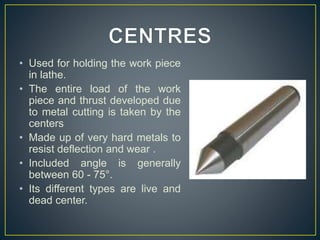
• Used for holding the work piece
in lathe.
• The entire load of the work
piece and thrust developed due
to metal cutting is taken by the
centers
• Made up of very hard metals to
resist deflection and wear .
• Included angle is generally
between 60 - 75°.
• Its different types are live and
dead center.
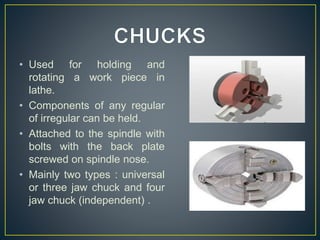
• Used for holding and
rotating a work piece in
lathe.
• Components of any regular
of irregular can be held.
• Attached to the spindle with
bolts with the back plate
screwed on spindle nose.
• Mainly two types : universal
or three jaw chuck and four
jaw chuck (independent) .
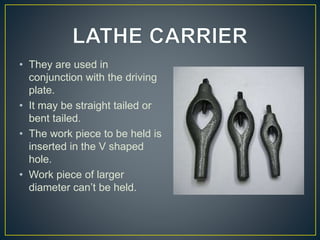
• They are used in
conjunction with the driving
plate.
• It may be straight tailed or
bent tailed.
• The work piece to be held is
inserted in the V shaped
hole.
• Work piece of larger
diameter can’t be held.
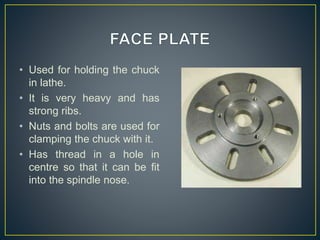
• Used for holding the chuck
in lathe.
• It is very heavy and has
strong ribs.
• Nuts and bolts are used for
clamping the chuck with it.
• Has thread in a hole in
centre so that it can be fit
into the spindle nose.
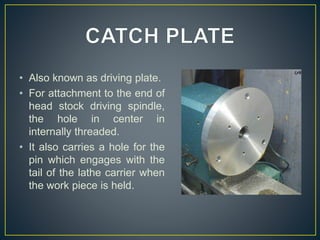
• Also known as driving plate.
• For attachment to the end of
head stock driving spindle,
the hole in center in
internally threaded.
• It also carries a hole for the
pin which engages with the
tail of the lathe carrier when
the work piece is held.
• It is a L shaped plate with two
faces machined at right angles
on has slots for clamping on
face plate.
• When work piece is such that
it is not possible to clamp it to
the chuck then angle plate is
used.
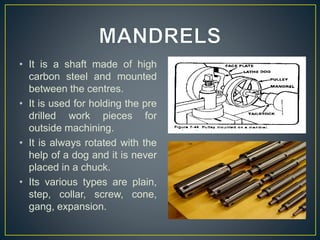
• It is a shaft made of high
carbon steel and mounted
between the centres.
• It is used for holding the pre
drilled work pieces for
outside machining.
• It is always rotated with the
help of a dog and it is never
placed in a chuck.
• Its various types are plain,
step, collar, screw, cone,
gang, expansion.
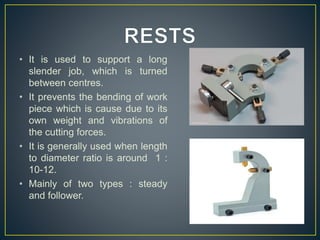
• It is used to support a long
slender job, which is turned
between centres.
• It prevents the bending of work
piece which is cause due to its
own weight and vibrations of
the cutting forces.
• It is generally used when length
to diameter ratio is around 1 :
10-12.
• Mainly of two types : steady
and follower.
Lathe accessories
Lathe accessories
Lathe accessories

Lathe accessories

  • 2.
    • Used forholding the work piece in lathe. • The entire load of the work piece and thrust developed due to metal cutting is taken by the centers • Made up of very hard metals to resist deflection and wear . • Included angle is generally between 60 - 75°. • Its different types are live and dead center.
  • 3.
    • Used forholding and rotating a work piece in lathe. • Components of any regular of irregular can be held. • Attached to the spindle with bolts with the back plate screwed on spindle nose. • Mainly two types : universal or three jaw chuck and four jaw chuck (independent) .
  • 4.
    • They areused in conjunction with the driving plate. • It may be straight tailed or bent tailed. • The work piece to be held is inserted in the V shaped hole. • Work piece of larger diameter can’t be held.
  • 5.
    • Used forholding the chuck in lathe. • It is very heavy and has strong ribs. • Nuts and bolts are used for clamping the chuck with it. • Has thread in a hole in centre so that it can be fit into the spindle nose.
  • 6.
    • Also knownas driving plate. • For attachment to the end of head stock driving spindle, the hole in center in internally threaded. • It also carries a hole for the pin which engages with the tail of the lathe carrier when the work piece is held.
  • 7.
    • It isa L shaped plate with two faces machined at right angles on has slots for clamping on face plate. • When work piece is such that it is not possible to clamp it to the chuck then angle plate is used.
  • 8.
    • It isa shaft made of high carbon steel and mounted between the centres. • It is used for holding the pre drilled work pieces for outside machining. • It is always rotated with the help of a dog and it is never placed in a chuck. • Its various types are plain, step, collar, screw, cone, gang, expansion.
  • 9.
    • It isused to support a long slender job, which is turned between centres. • It prevents the bending of work piece which is cause due to its own weight and vibrations of the cutting forces. • It is generally used when length to diameter ratio is around 1 : 10-12. • Mainly of two types : steady and follower.