Branch:- PRODUCTION (PE2)
Guided by :- Prof. ARSHPREET KAUR
Broaching is a machining operation in which a
tool having a series of cutting teeth called
broach is either pulled or pushed by the
broaching machine past the surface of a
workpiece. when the operation is performed on
internal surfaces is called internal broaching and
in case of external surface external broaching.
BROACHING:-
Principle of broaching:-
Broaching is a machining process for removal of a layer of
material of desired width and depth usually in one stroke by a
slender rod or bar type cutter having a series of cutting edges
with gradually increased protrusion as indicated in Fig a. In
shaping, attaining full depth requires a number of strokes to
remove the material in thin layers step -by-step by gradually ing
the single point tool (Fig.b). Whereas, broaching enables remove
the whole material in one stroke only by the gradually rising
teeth of the cutter called broach. The amount of tooth rise
between the successive teeth of the broach is equivalent to the
in feed given in shaping.
Broaching operation:-
1. Selection of broach and broaching machine.
2. Mounting and clamping the broach in the
broaching machine.
3. Fixing workpiece in the machine.
4. Planning tool - work motions.
5. Selection of the levels of the process
parameters and their setting.
6. Conducting machining by the broach.
Specification of broaching machine:-
1.Power of the motor and its speed
2.Length of bed
3.Length of slide stroke
4.Rated pulling force
5.Cutting stroke speed
6.Number of speeds
7.Return stroke speed
8.Maximum size of cut
9.Weight of machine
10.Size and floor area
TOOL MATERIAL
» High speed steel is mostly used.
» H.S.S. broaches is used in mass production and
heavy duty work.
» It gives a better surface finish.
» It have long life.
BROACH TERM
BROACHING TOOL
Nomenclature of broach:-
Pull End: It is provided in pull broach to attach
pulling mechanism.
Front pilot: It guides broach in hole and also
works as rough no-go gauge.
Rear pilot: It determines size of finished hole.
Follower diameter: It is held in automatic
machine in order bring in original position.
Shank length: It is length to pass from work
piece and attach puller before roughing teeth
engage with work piece.
USE OF FIXTURES:-
» To located the work in correct position.
» To support and hold the work rigidly during
the operation.
» To guide the broach during the operation.
» To move the the work to correct position
before the start of operation and remove it
after the operation.
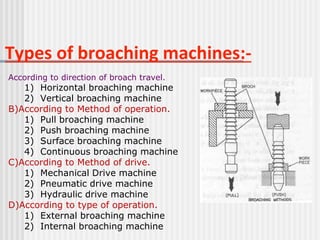
According to direction of broach travel.
1) Horizontal broaching machine
2) Vertical broaching machine
B)According to Method of operation.
1) Pull broaching machine
2) Push broaching machine
3) Surface broaching machine
4) Continuous broaching machine
C)According to Method of drive.
1) Mechanical Drive machine
2) Pneumatic drive machine
3) Hydraulic drive machine
D)According to type of operation.
1) External broaching machine
2) Internal broaching machine
Types of broaching machines:-
1) Horizontal broaching machine:-
• Usually pull type.
• Used for internal and external
broaching.
• Bed is approximately double size
than broach stroke
• Ram is hydraulically operated.
• Used to make keyways, splines,
slots etc.
• Usually pull type.
• Used for internal and external
broaching.
• Bed is approximately double size
than broach stroke
• Ram is hydraulically operated.
• Used to make keyways, splines,
slots etc.
1) Horizontal broaching machine:-
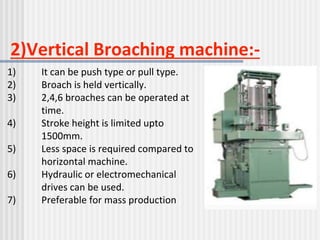
2)Vertical Broaching machine:-
1) It can be push type or pull type.
2) Broach is held vertically.
3) 2,4,6 broaches can be operated at
time.
4) Stroke height is limited upto
1500mm.
5) Less space is required compared to
horizontal machine.
6) Hydraulic or electromechanical
drives can be used.
7) Preferable for mass production
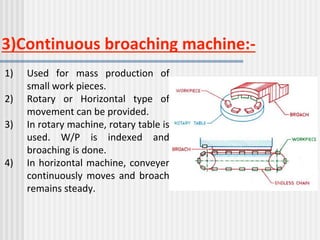
1) Used for mass production of
small work pieces.
2) Rotary or Horizontal type of
movement can be provided.
3) In rotary machine, rotary table is
used. W/P is indexed and
broaching is done.
4) In horizontal machine, conveyer
continuously moves and broach
remains steady.
3)Continuous broaching machine:-
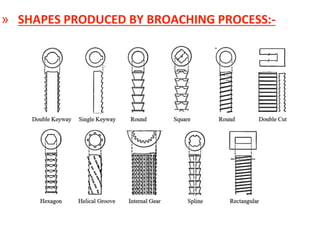
» SHAPES PRODUCED BY BROACHING PROCESS:-
METHODS OF BROACHING:-
There are five methods of broaching :- 1.
Internal broaching. 2. external
broaching. 3. pull broaching.
4. push broaching. 5.
continuous broaching.
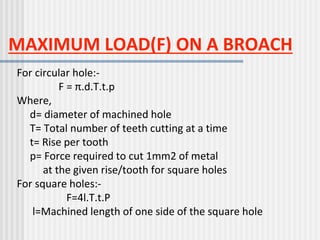
For circular hole:-
F = π.d.T.t.p
Where,
d= diameter of machined hole
T= Total number of teeth cutting at a time
t= Rise per tooth
p= Force required to cut 1mm2 of metal
at the given rise/tooth for square holes
For square holes:-
F=4l.T.t.P
l=Machined length of one side of the square hole
MAXIMUM LOAD(F) ON A BROACH
Advantages of broaching:-
1)High production rate.
2)Job is prepared in one stroke
3)High tool life
4)Internal and external machining can be done
5)0.8micron finishing can be obtained
6)Interchangeability of components can be done
due to tolerances obtained in range.
7)Roughing and finishing can be done in single
stroke
Disadvantages of broaching:-
1)Costly tool
2)Not suitable for small batch.
3)Less amount of material is removed
4)Proper fixtures are required.
5)Strains are produced in w/p
6)Surfaces should be parallel to broach travel
axis.
Broaching applications:-
Broaching is widely used in bearing bodies,
cylinder blocks, connecting rods, cylinder heads,
rotors, crankcases, gears, turbine blades, sleeves,
aircraft engine parts, etc.
Broaching machine

Broaching machine

  • 2.
    Branch:- PRODUCTION (PE2) Guidedby :- Prof. ARSHPREET KAUR
  • 3.
    Broaching is amachining operation in which a tool having a series of cutting teeth called broach is either pulled or pushed by the broaching machine past the surface of a workpiece. when the operation is performed on internal surfaces is called internal broaching and in case of external surface external broaching. BROACHING:-
  • 4.
    Principle of broaching:- Broachingis a machining process for removal of a layer of material of desired width and depth usually in one stroke by a slender rod or bar type cutter having a series of cutting edges with gradually increased protrusion as indicated in Fig a. In shaping, attaining full depth requires a number of strokes to remove the material in thin layers step -by-step by gradually ing the single point tool (Fig.b). Whereas, broaching enables remove the whole material in one stroke only by the gradually rising teeth of the cutter called broach. The amount of tooth rise between the successive teeth of the broach is equivalent to the in feed given in shaping.
  • 5.
    Broaching operation:- 1. Selectionof broach and broaching machine. 2. Mounting and clamping the broach in the broaching machine. 3. Fixing workpiece in the machine. 4. Planning tool - work motions. 5. Selection of the levels of the process parameters and their setting. 6. Conducting machining by the broach.
  • 6.
    Specification of broachingmachine:- 1.Power of the motor and its speed 2.Length of bed 3.Length of slide stroke 4.Rated pulling force 5.Cutting stroke speed 6.Number of speeds 7.Return stroke speed 8.Maximum size of cut 9.Weight of machine 10.Size and floor area
  • 8.
    TOOL MATERIAL » Highspeed steel is mostly used. » H.S.S. broaches is used in mass production and heavy duty work. » It gives a better surface finish. » It have long life.
  • 9.
  • 10.
  • 11.
    Nomenclature of broach:- PullEnd: It is provided in pull broach to attach pulling mechanism. Front pilot: It guides broach in hole and also works as rough no-go gauge. Rear pilot: It determines size of finished hole. Follower diameter: It is held in automatic machine in order bring in original position. Shank length: It is length to pass from work piece and attach puller before roughing teeth engage with work piece.
  • 12.
    USE OF FIXTURES:- »To located the work in correct position. » To support and hold the work rigidly during the operation. » To guide the broach during the operation. » To move the the work to correct position before the start of operation and remove it after the operation.
  • 13.
    According to directionof broach travel. 1) Horizontal broaching machine 2) Vertical broaching machine B)According to Method of operation. 1) Pull broaching machine 2) Push broaching machine 3) Surface broaching machine 4) Continuous broaching machine C)According to Method of drive. 1) Mechanical Drive machine 2) Pneumatic drive machine 3) Hydraulic drive machine D)According to type of operation. 1) External broaching machine 2) Internal broaching machine Types of broaching machines:-
  • 14.
    1) Horizontal broachingmachine:- • Usually pull type. • Used for internal and external broaching. • Bed is approximately double size than broach stroke • Ram is hydraulically operated. • Used to make keyways, splines, slots etc.
  • 15.
    • Usually pulltype. • Used for internal and external broaching. • Bed is approximately double size than broach stroke • Ram is hydraulically operated. • Used to make keyways, splines, slots etc. 1) Horizontal broaching machine:-
  • 16.
    2)Vertical Broaching machine:- 1)It can be push type or pull type. 2) Broach is held vertically. 3) 2,4,6 broaches can be operated at time. 4) Stroke height is limited upto 1500mm. 5) Less space is required compared to horizontal machine. 6) Hydraulic or electromechanical drives can be used. 7) Preferable for mass production
  • 17.
    1) Used formass production of small work pieces. 2) Rotary or Horizontal type of movement can be provided. 3) In rotary machine, rotary table is used. W/P is indexed and broaching is done. 4) In horizontal machine, conveyer continuously moves and broach remains steady. 3)Continuous broaching machine:-
  • 18.
    » SHAPES PRODUCEDBY BROACHING PROCESS:-
  • 19.
    METHODS OF BROACHING:- Thereare five methods of broaching :- 1. Internal broaching. 2. external broaching. 3. pull broaching. 4. push broaching. 5. continuous broaching.
  • 20.
    For circular hole:- F= π.d.T.t.p Where, d= diameter of machined hole T= Total number of teeth cutting at a time t= Rise per tooth p= Force required to cut 1mm2 of metal at the given rise/tooth for square holes For square holes:- F=4l.T.t.P l=Machined length of one side of the square hole MAXIMUM LOAD(F) ON A BROACH
  • 21.
    Advantages of broaching:- 1)Highproduction rate. 2)Job is prepared in one stroke 3)High tool life 4)Internal and external machining can be done 5)0.8micron finishing can be obtained 6)Interchangeability of components can be done due to tolerances obtained in range. 7)Roughing and finishing can be done in single stroke
  • 22.
    Disadvantages of broaching:- 1)Costlytool 2)Not suitable for small batch. 3)Less amount of material is removed 4)Proper fixtures are required. 5)Strains are produced in w/p 6)Surfaces should be parallel to broach travel axis.
  • 23.
    Broaching applications:- Broaching iswidely used in bearing bodies, cylinder blocks, connecting rods, cylinder heads, rotors, crankcases, gears, turbine blades, sleeves, aircraft engine parts, etc.