Specifications of Lapping,
Honing and Broaching Machine
Specifications of Lapping Machine
                By
         Athar Kothawala
            (11BME082)
WHAT IS LAPPING ?
• Lapping is a machining operation, in which two
  surfaces are rubbed together with an abrasive
  between them, by hand movement or by way of a
  machine.
• This can take two forms. The first type of lapping
  (traditionally called grinding), typically involves rubbing
  a brittle material such as glass against a surface such as
  iron or glass itself (also known as the "lap" or grinding
  tool) with an abrasive such as aluminum oxide,
  jeweller's rouge, optician's rouge, emery, silicon
  carbide, diamond, etc., in between them. This
  produces microscopic conchoidal fractures as the
  abrasive rolls about between the two surfaces and
  removes material from both.
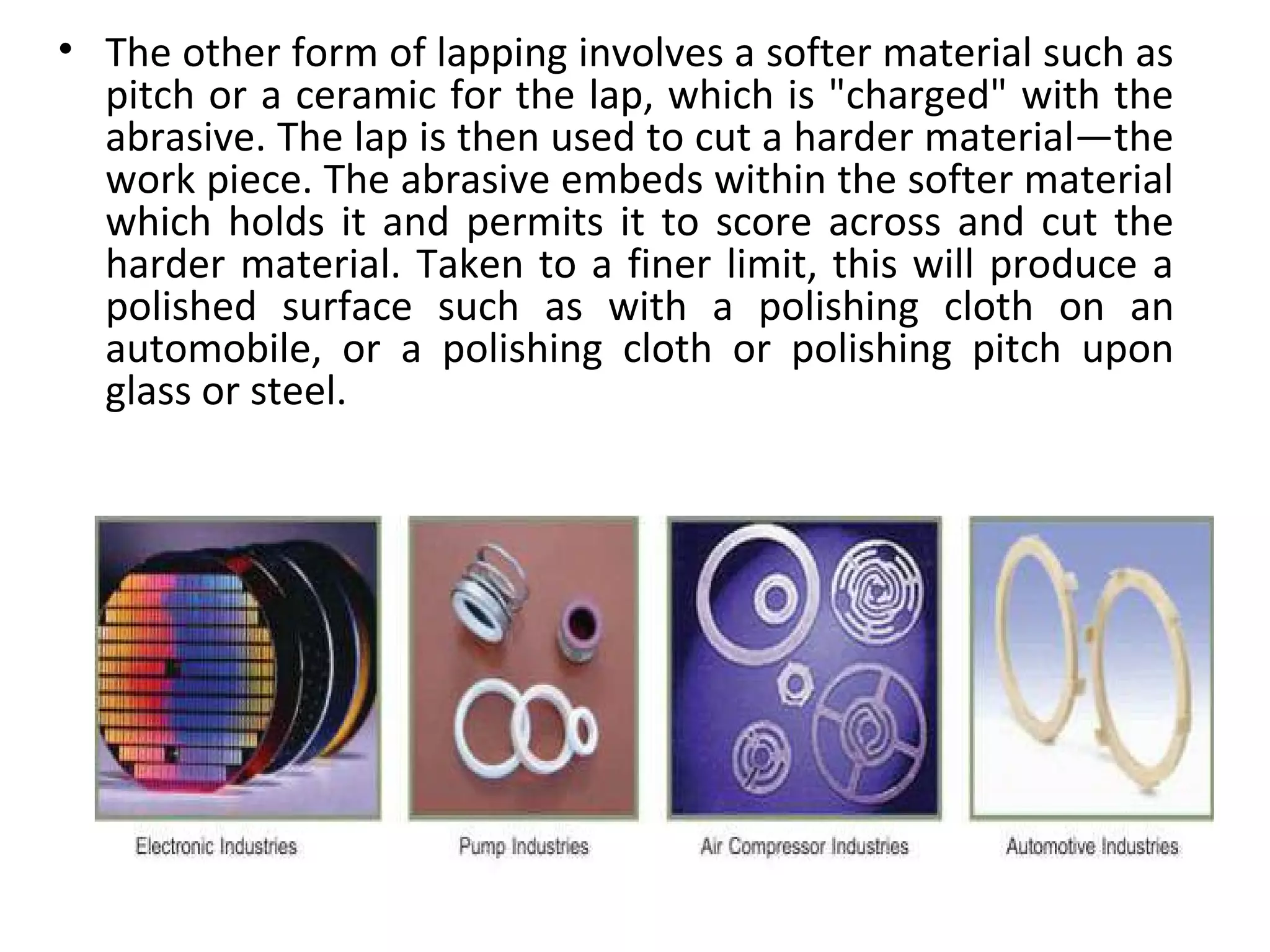
• The other form of lapping involves a softer material such as
  pitch or a ceramic for the lap, which is "charged" with the
  abrasive. The lap is then used to cut a harder material—the
  work piece. The abrasive embeds within the softer material
  which holds it and permits it to score across and cut the
  harder material. Taken to a finer limit, this will produce a
  polished surface such as with a polishing cloth on an
  automobile, or a polishing cloth or polishing pitch upon
  glass or steel.
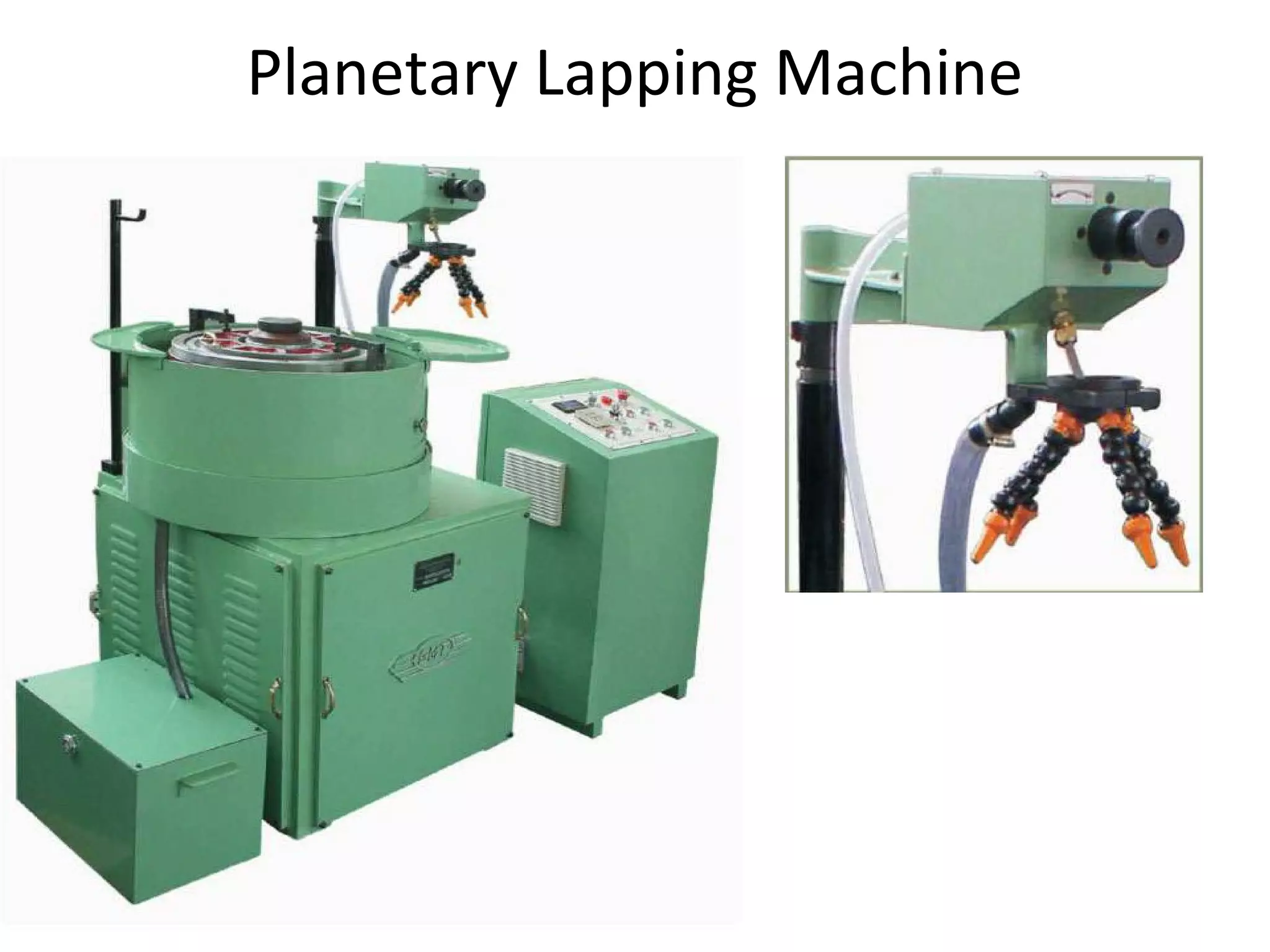
Planetary Lapping Machine
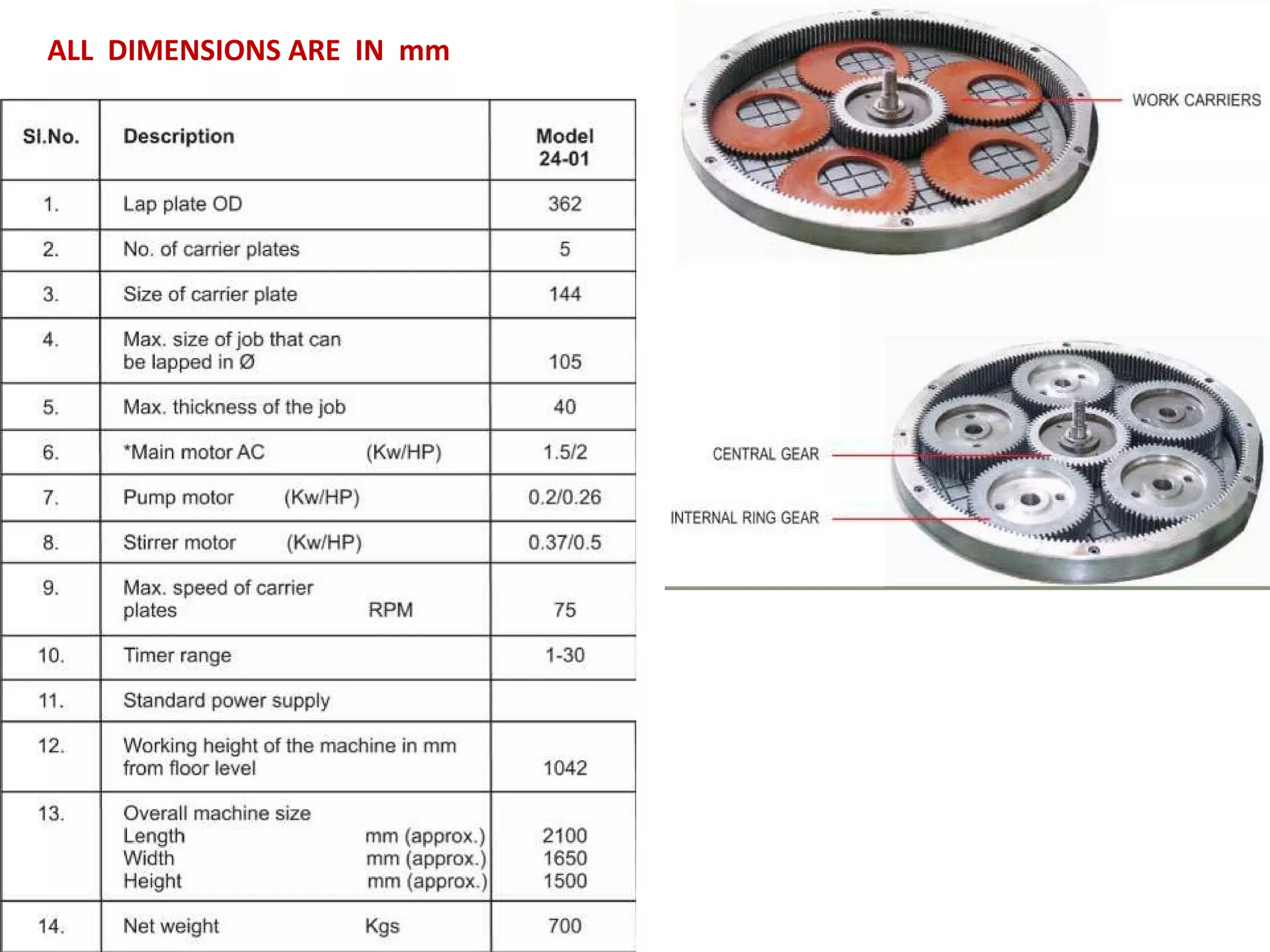
ALL DIMENSIONS ARE IN mm
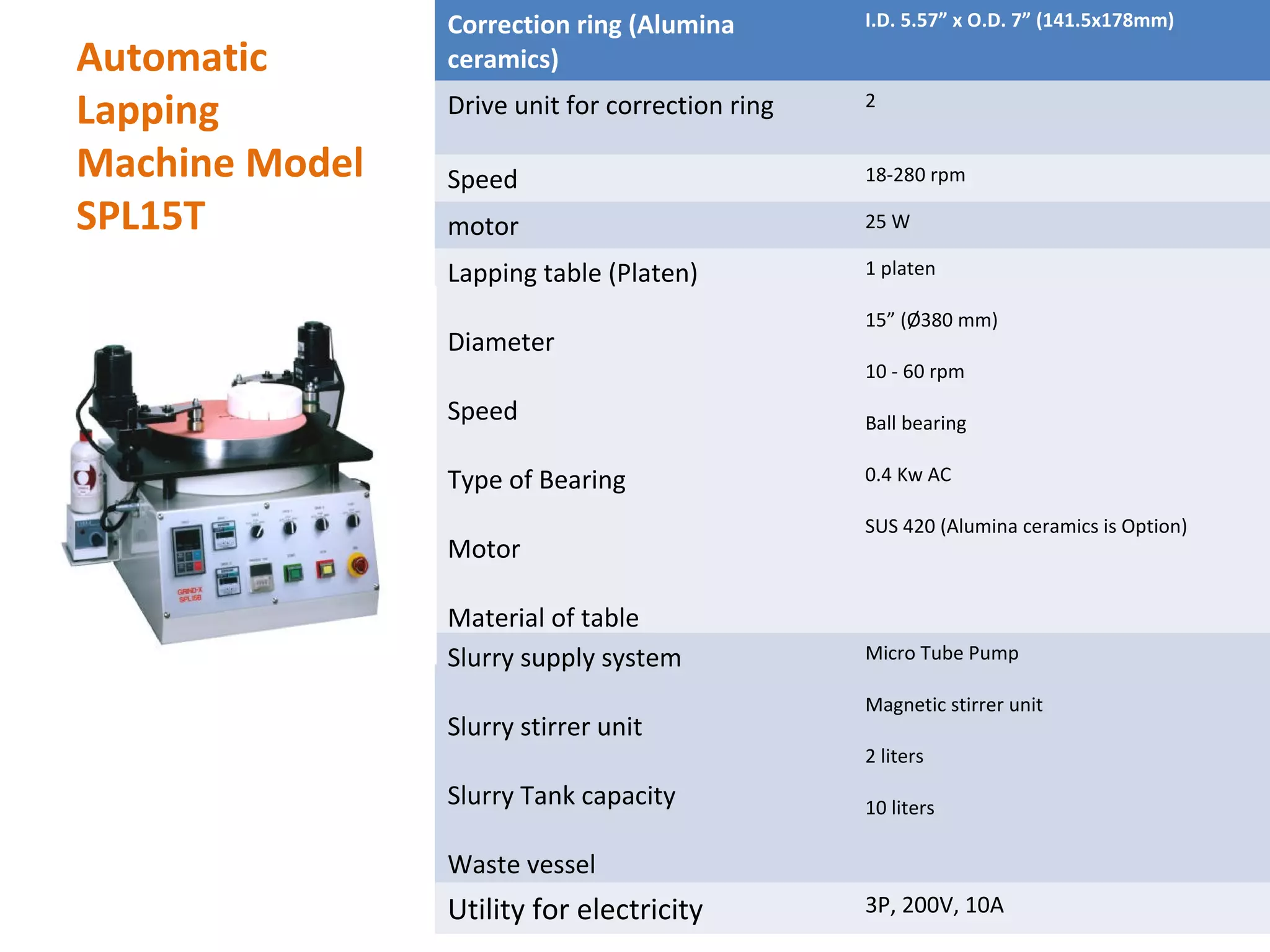
Correction ring (Alumina         I.D. 5.57” x O.D. 7” (141.5x178mm)

Automatic       ceramics)
Lapping         Drive unit for correction ring   2


Machine Model   Speed                            18-280 rpm

SPL15T          motor                            25 W

                Lapping table (Platen)           1 platen

                                                 15” (Ø380 mm)
                Diameter
                                                 10 - 60 rpm
                Speed                            Ball bearing

                Type of Bearing                  0.4 Kw AC

                                                 SUS 420 (Alumina ceramics is Option)
                Motor

                Material of table
                Slurry supply system             Micro Tube Pump

                                                 Magnetic stirrer unit
                Slurry stirrer unit
                                                 2 liters
                Slurry Tank capacity             10 liters

                Waste vessel
                Utility for electricity          3P, 200V, 10A
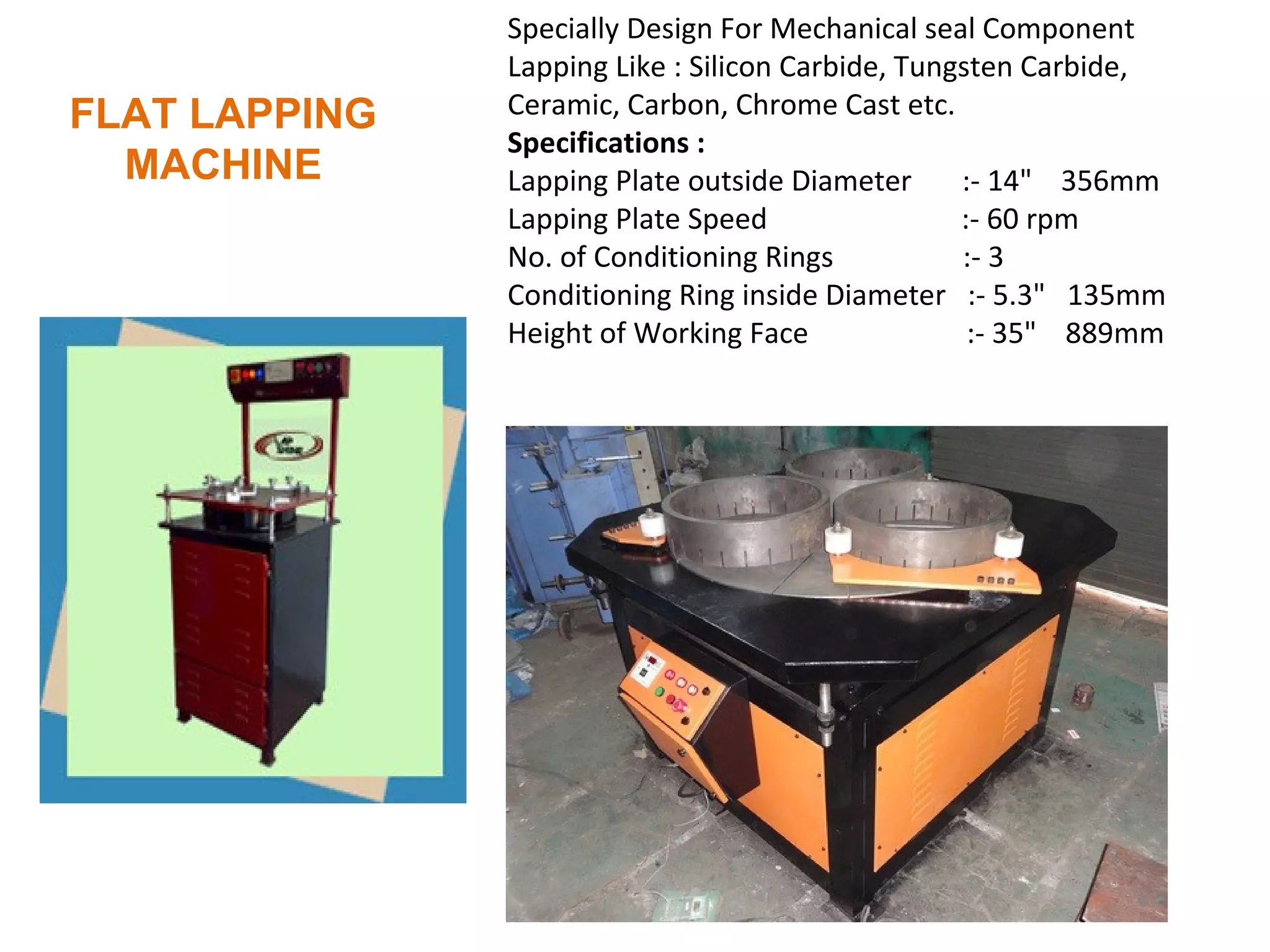
Specially Design For Mechanical seal Component
               Lapping Like : Silicon Carbide, Tungsten Carbide,
FLAT LAPPING   Ceramic, Carbon, Chrome Cast etc.
               Specifications :
  MACHINE      Lapping Plate outside Diameter      :- 14" 356mm
               Lapping Plate Speed                 :- 60 rpm
               No. of Conditioning Rings           :- 3
               Conditioning Ring inside Diameter :- 5.3" 135mm
               Height of Working Face               :- 35" 889mm
Double Side Lapping Machine

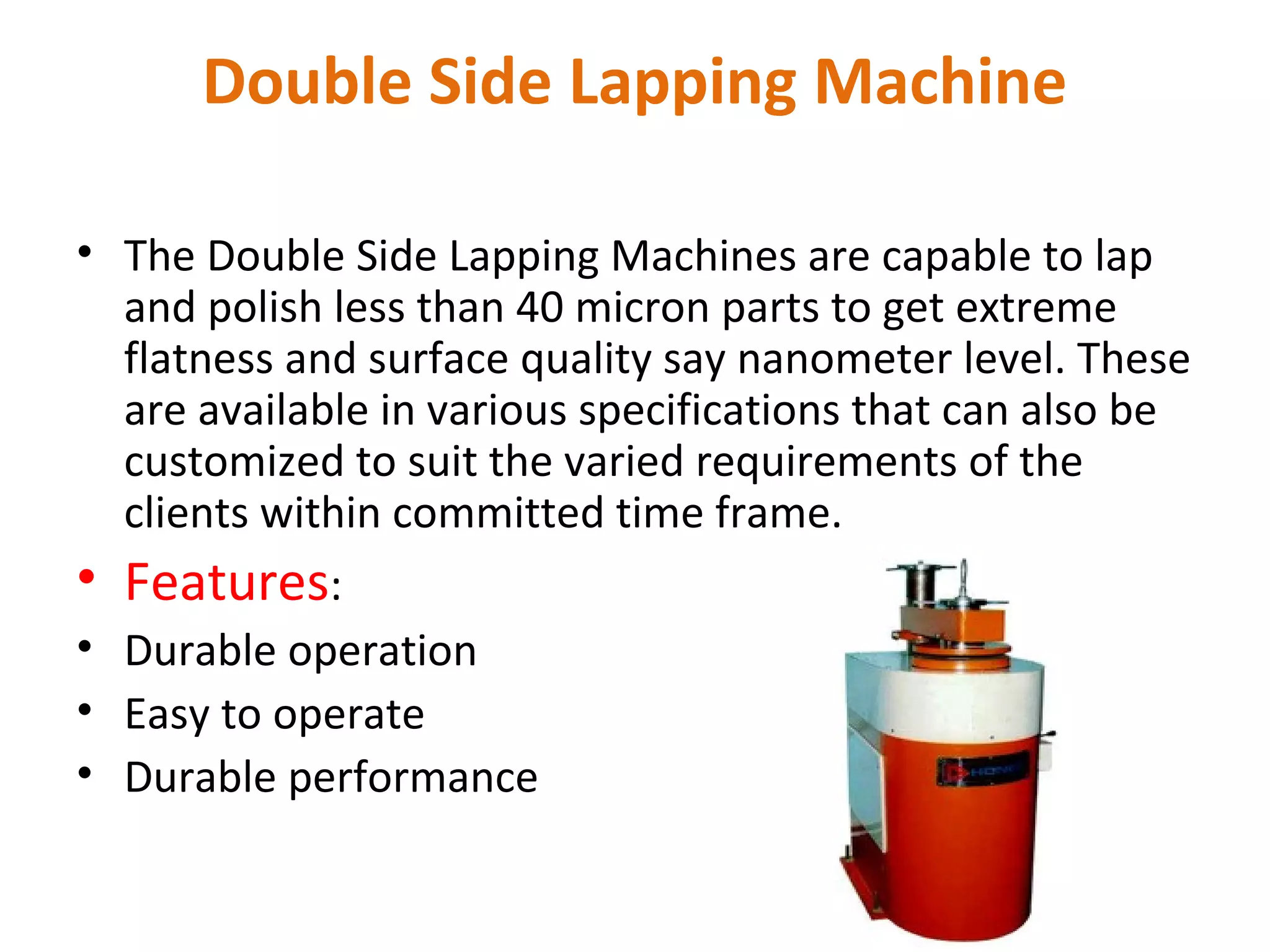
• The Double Side Lapping Machines are capable to lap
  and polish less than 40 micron parts to get extreme
  flatness and surface quality say nanometer level. These
  are available in various specifications that can also be
  customized to suit the varied requirements of the
  clients within committed time frame.
• Features:
• Durable operation
• Easy to operate
• Durable performance
Valve Body Lapping Machine

• D-HONER DHL machine can mechanize the operation as
  well as overcome all the draw-back that are associated
  with Manual lapping.
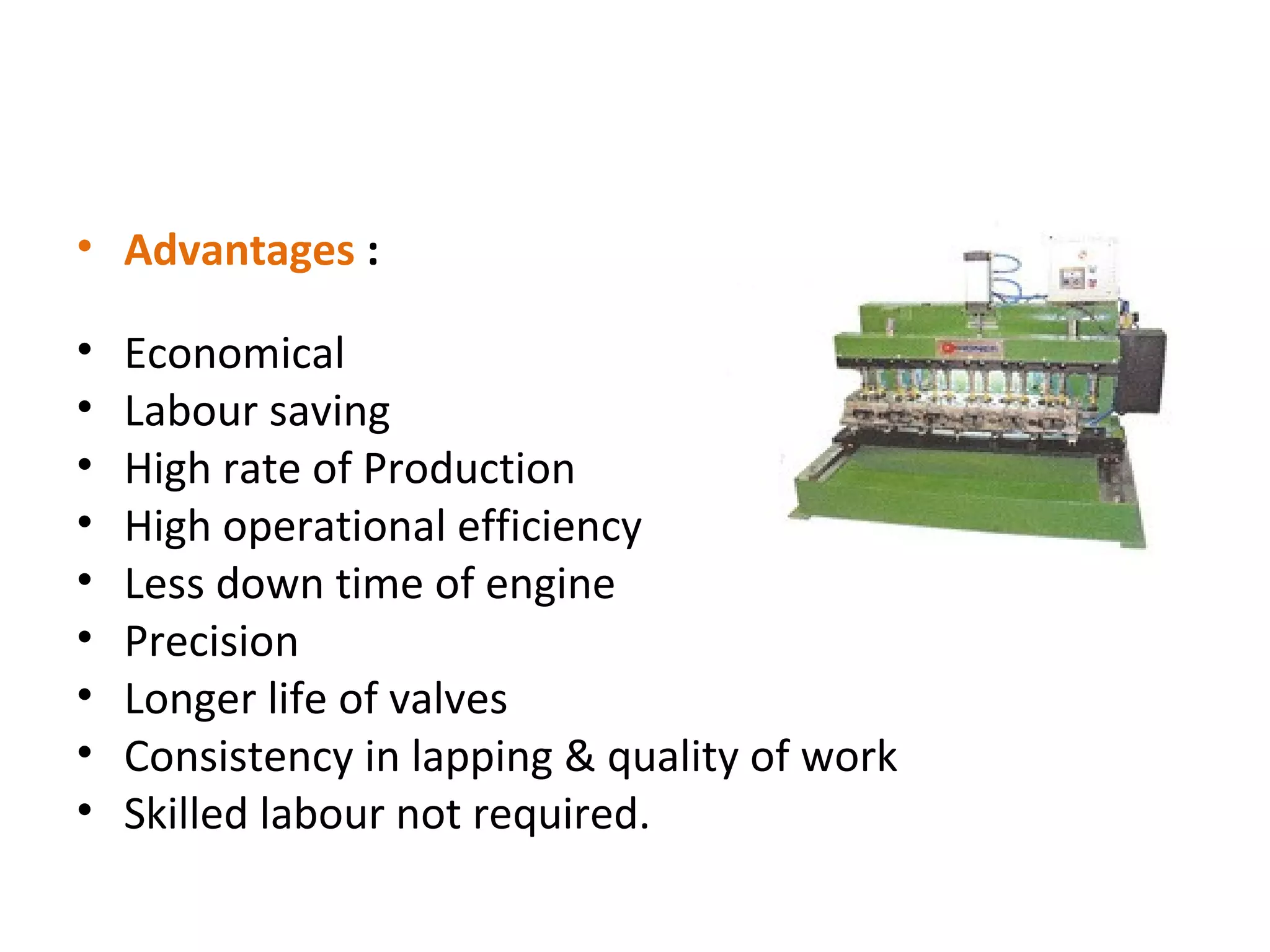
• Due to simultaneous lapping of 4 or 6 valves at optimum
  lapping speed, production is high as 5 to 6 times can be
  achieved with remarkable degree of consistency. The
  operational simplicity of the machine enable use of
  unskilled labour. All these factors result in considerable
  reduction in operational cost.
• Specially designed heavy-duty compact geared motor of
  ample capacity with an output speed that is optimum for
  valve lapping operation. The mechanism of the machines is
  the machine is fairly simple and hence requires practically
  no maintenance.
• Advantages :

•   Economical
•   Labour saving
•   High rate of Production
•   High operational efficiency
•   Less down time of engine
•   Precision
•   Longer life of valves
•   Consistency in lapping & quality of work
•   Skilled labour not required.
Bench Type Lapping Machine
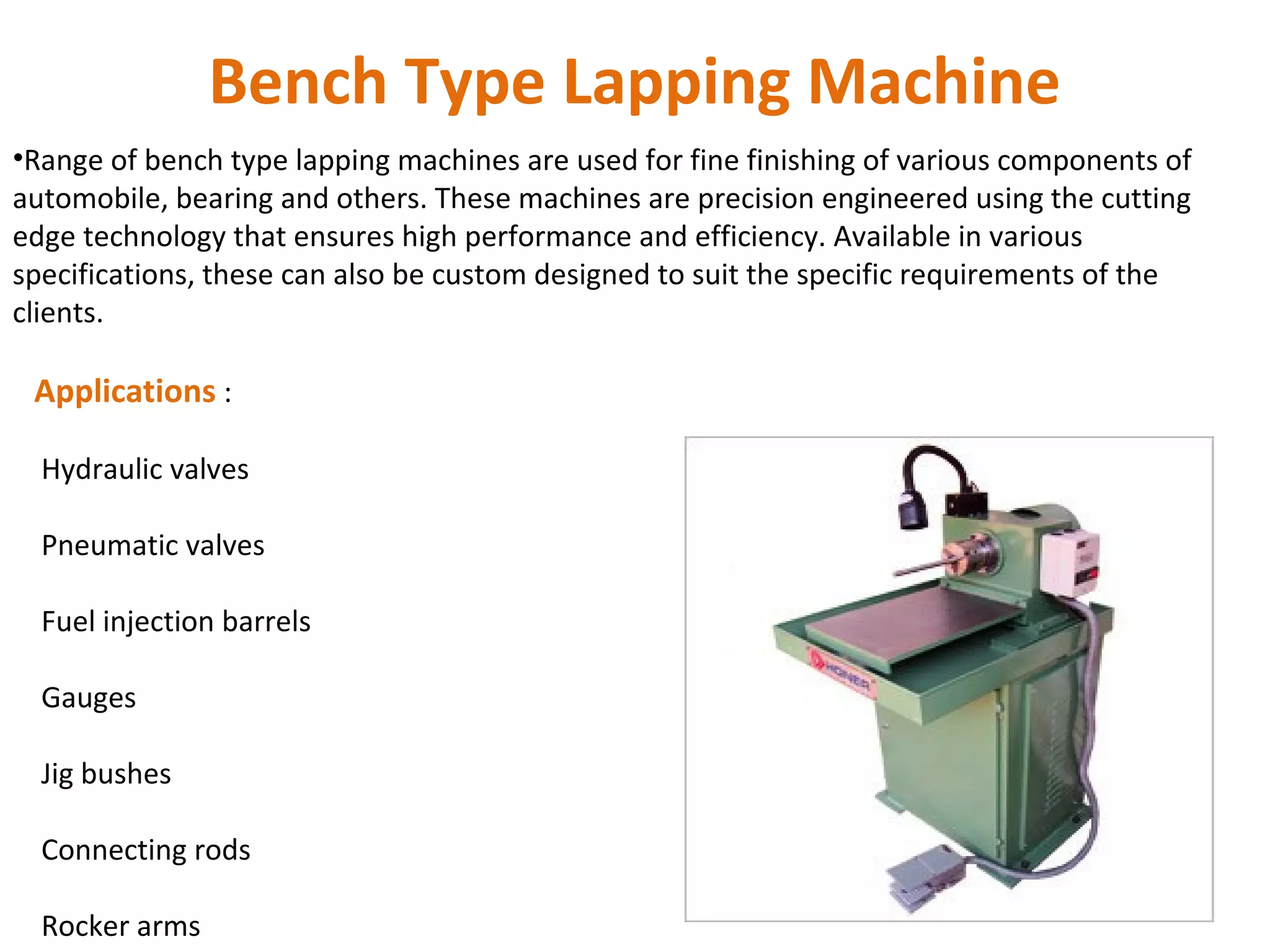
•Range of bench type lapping machines are used for fine finishing of various components of
automobile, bearing and others. These machines are precision engineered using the cutting
edge technology that ensures high performance and efficiency. Available in various
specifications, these can also be custom designed to suit the specific requirements of the
clients.

 Applications :

  Hydraulic valves

  Pneumatic valves

  Fuel injection barrels

  Gauges

  Jig bushes

  Connecting rods

  Rocker arms
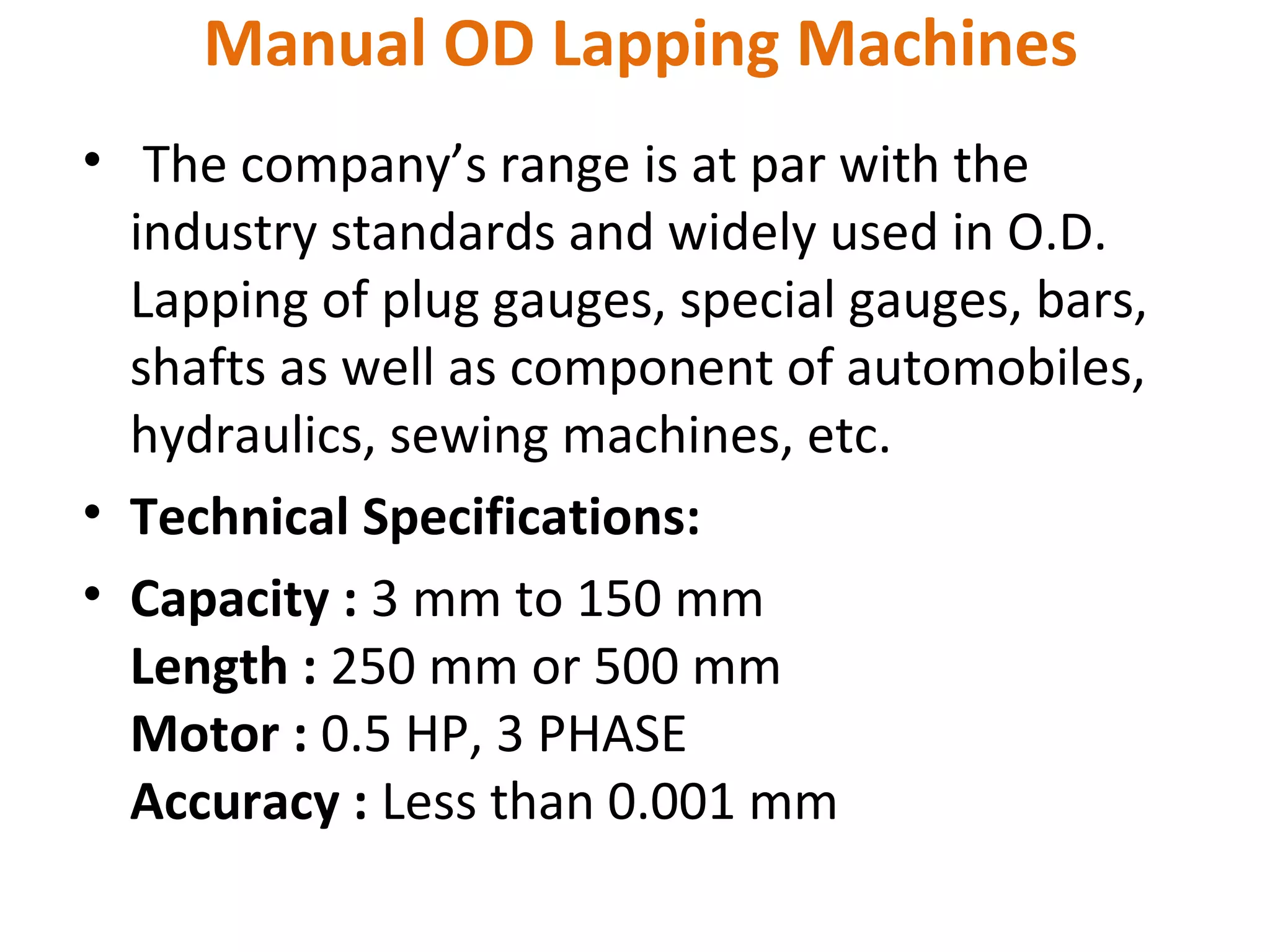
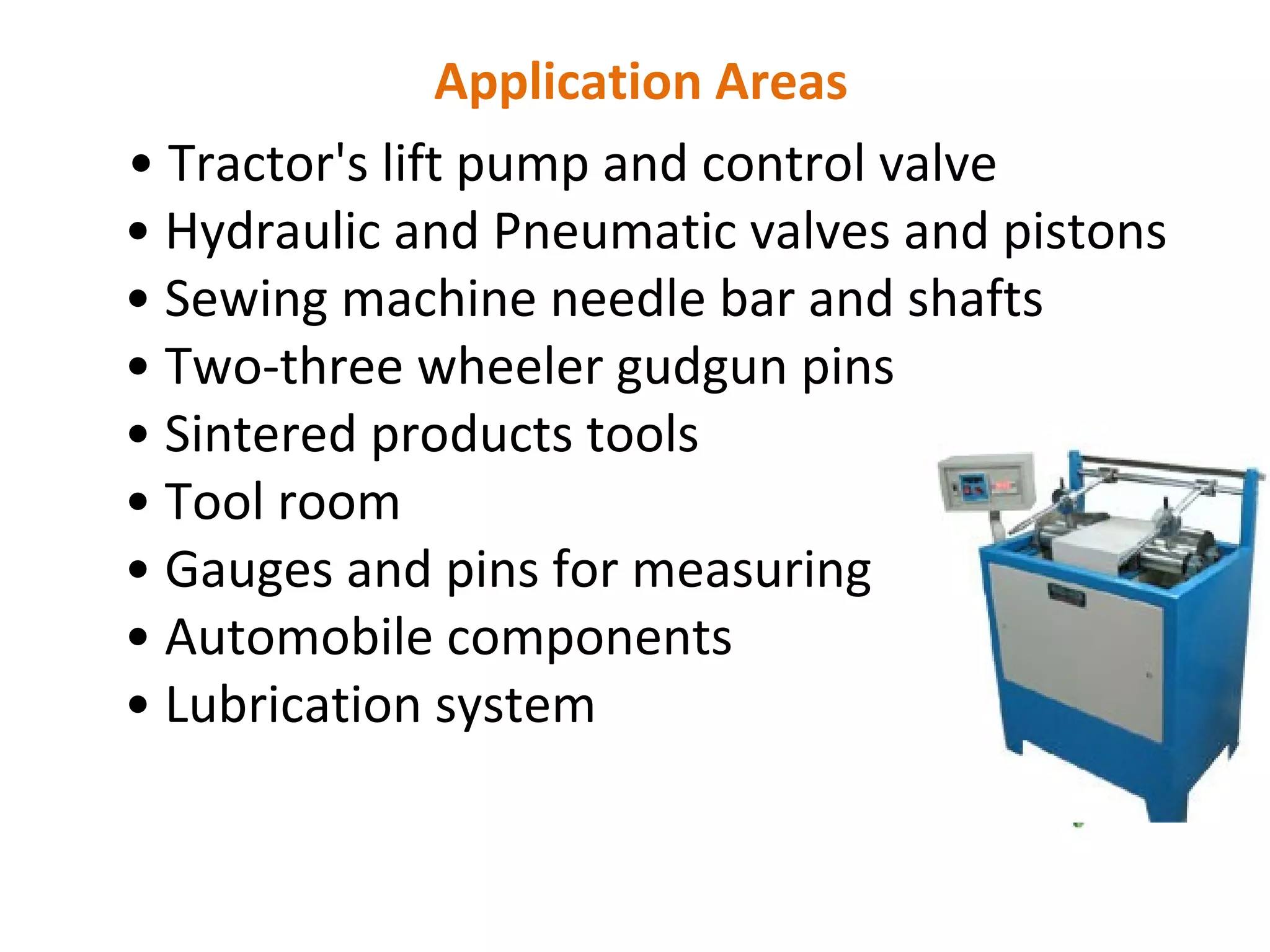
Manual OD Lapping Machines
• The company’s range is at par with the
  industry standards and widely used in O.D.
  Lapping of plug gauges, special gauges, bars,
  shafts as well as component of automobiles,
  hydraulics, sewing machines, etc.
• Technical Specifications:
• Capacity : 3 mm to 150 mm
  Length : 250 mm or 500 mm
  Motor : 0.5 HP, 3 PHASE
  Accuracy : Less than 0.001 mm
Application Areas
• Tractor's lift pump and control valve
• Hydraulic and Pneumatic valves and pistons
• Sewing machine needle bar and shafts
• Two-three wheeler gudgun pins
• Sintered products tools
• Tool room
• Gauges and pins for measuring
• Automobile components
• Lubrication system
Specification of Broaching Machine
                 By
         Karan C. Prajapati
            (11BME083)
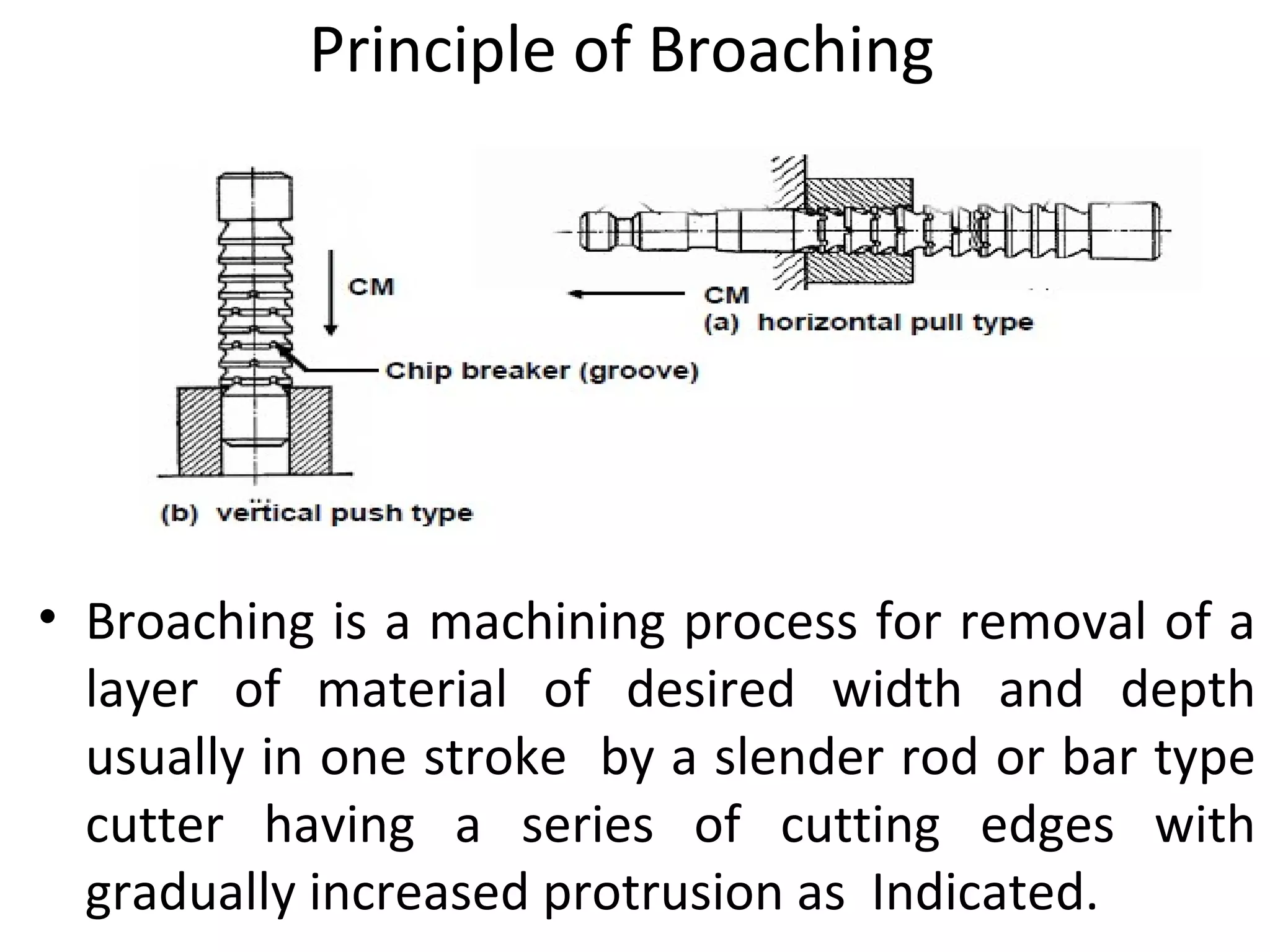
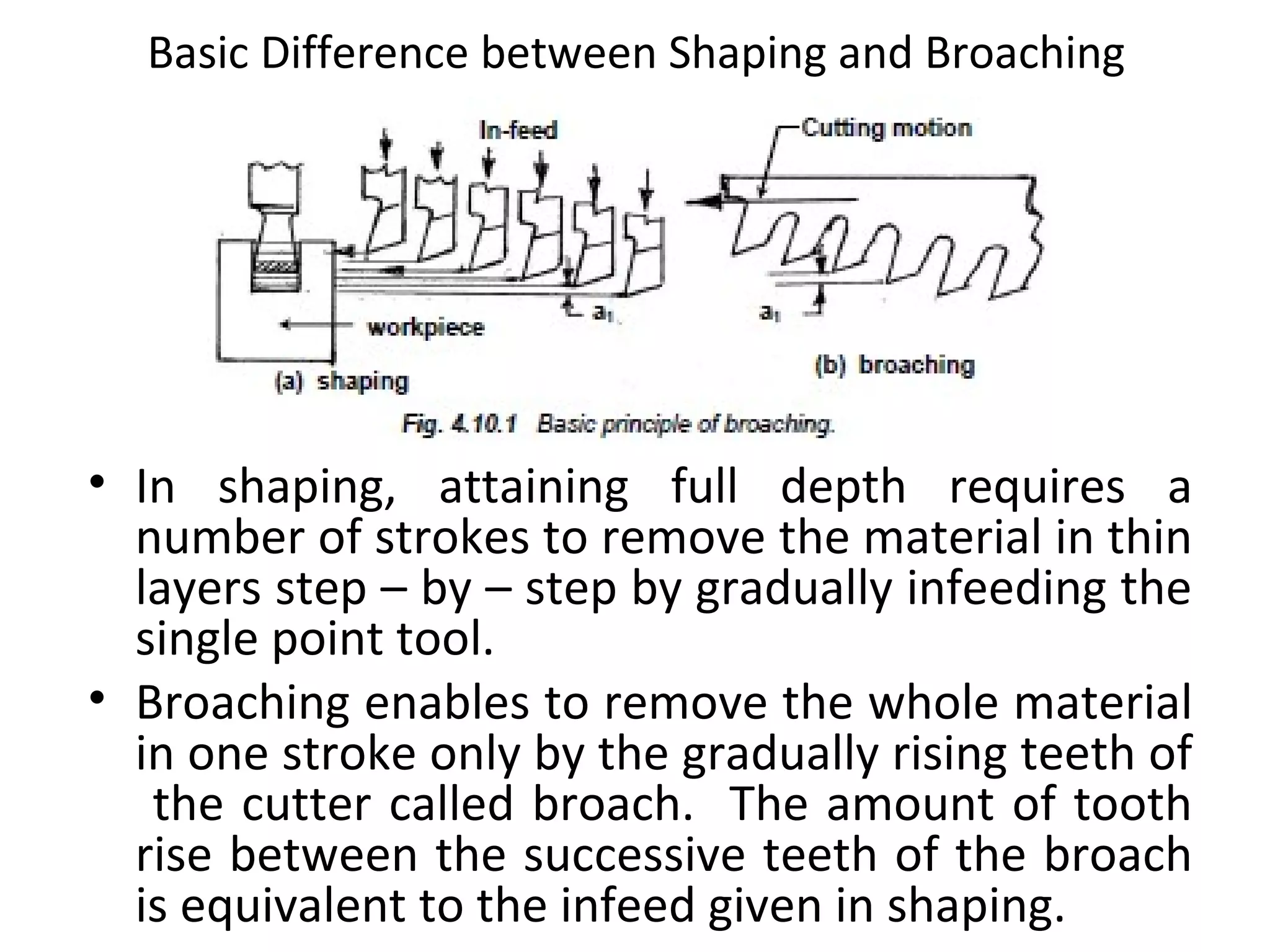
Principle of Broaching


• Broaching is a machining process for removal of a
  layer of material of desired width and depth
  usually in one stroke by a slender rod or bar type
  cutter having a series of cutting edges with
  gradually increased protrusion as Indicated.
Basic Difference between Shaping and Broaching


• In shaping, attaining full depth requires a
  number of strokes to remove the material in thin
  layers step – by – step by gradually infeeding the
  single point tool.
• Broaching enables to remove the whole material
  in one stroke only by the gradually rising teeth of
   the cutter called broach. The amount of tooth
  rise between the successive teeth of the broach
  is equivalent to the infeed given in shaping.
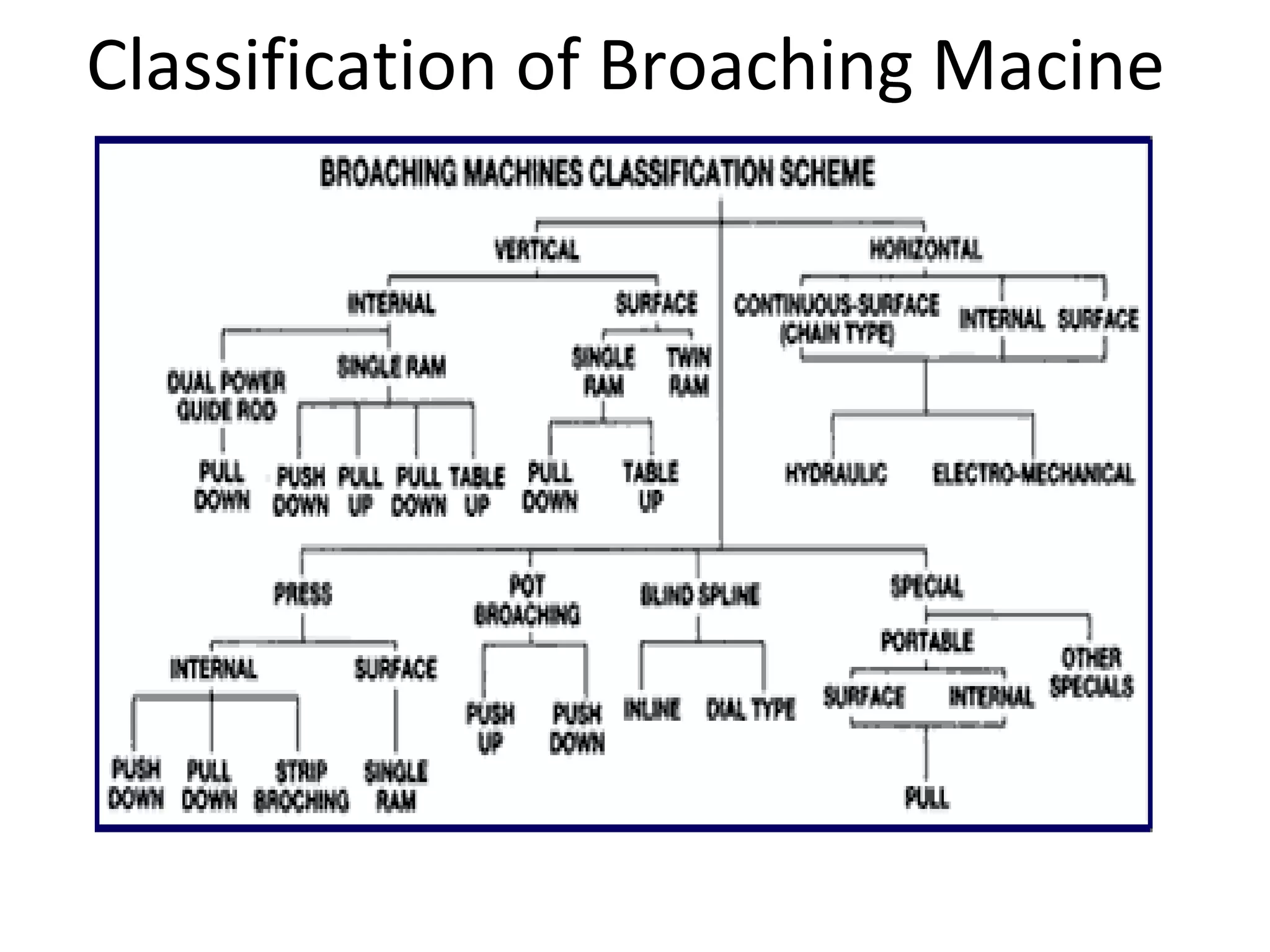
Classification of Broaching Macine
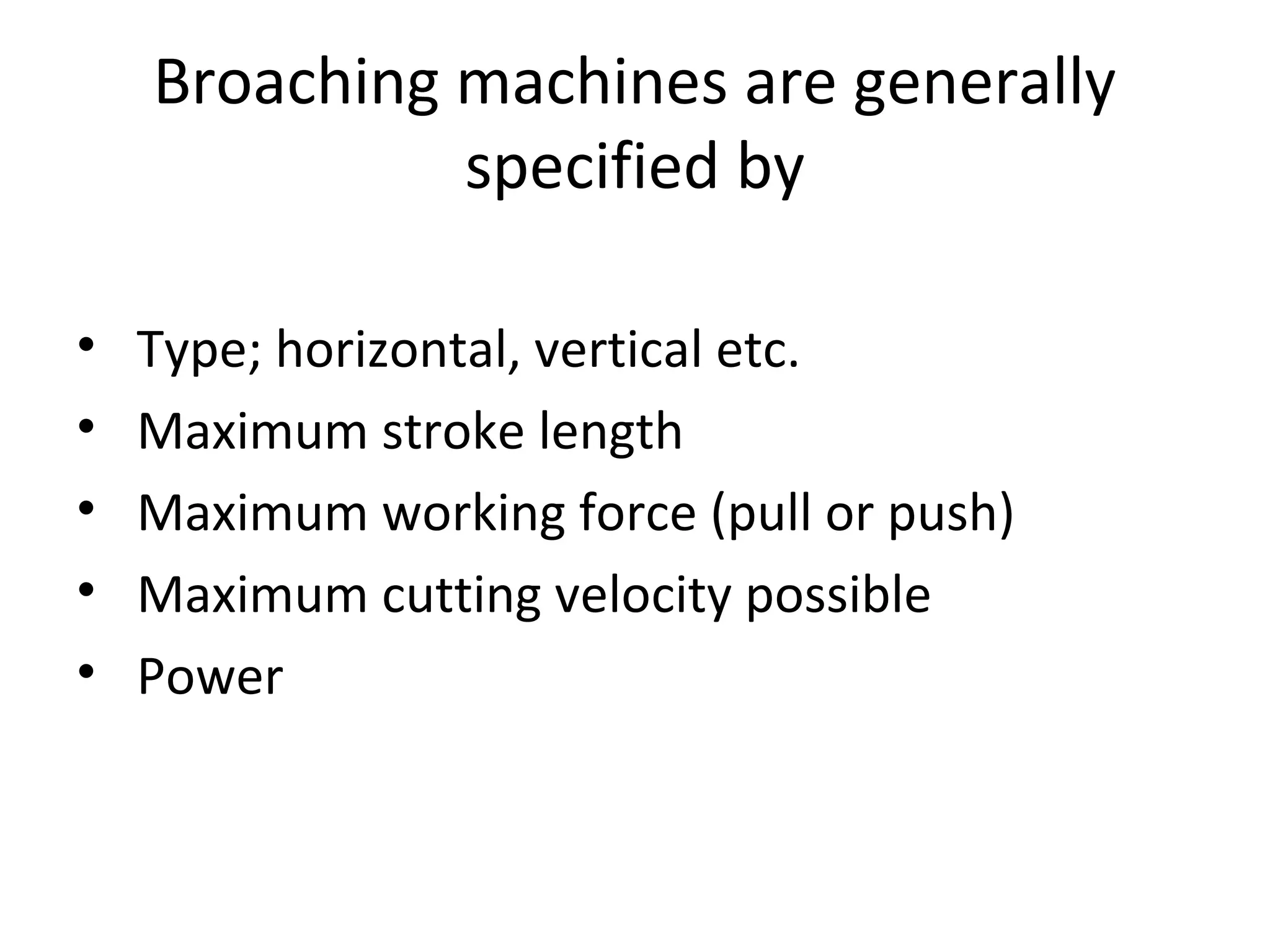
Broaching machines are generally
              specified by

•   Type; horizontal, vertical etc.
•   Maximum stroke length
•   Maximum working force (pull or push)
•   Maximum cutting velocity possible
•   Power
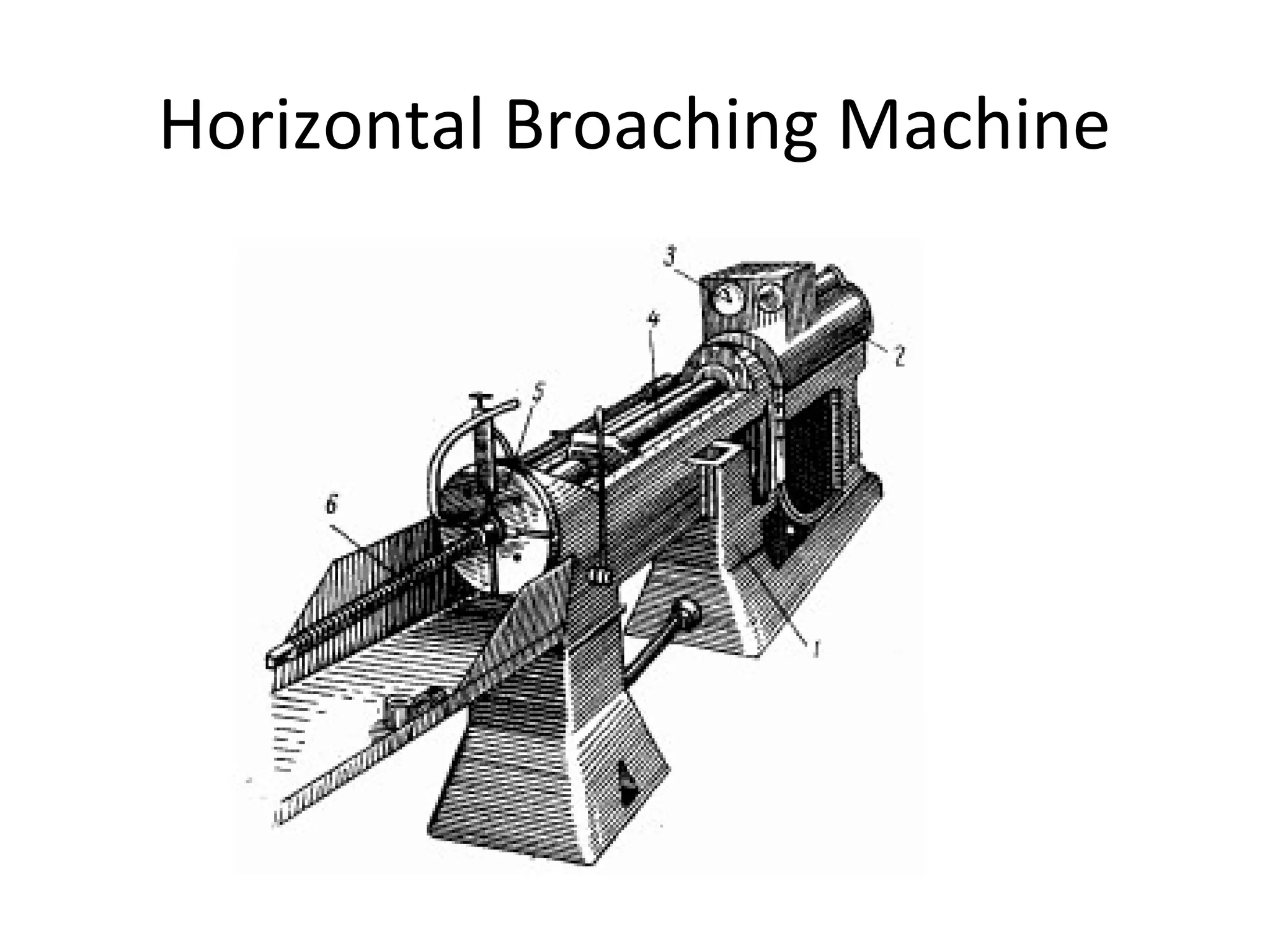
Horizontal Broaching Machine
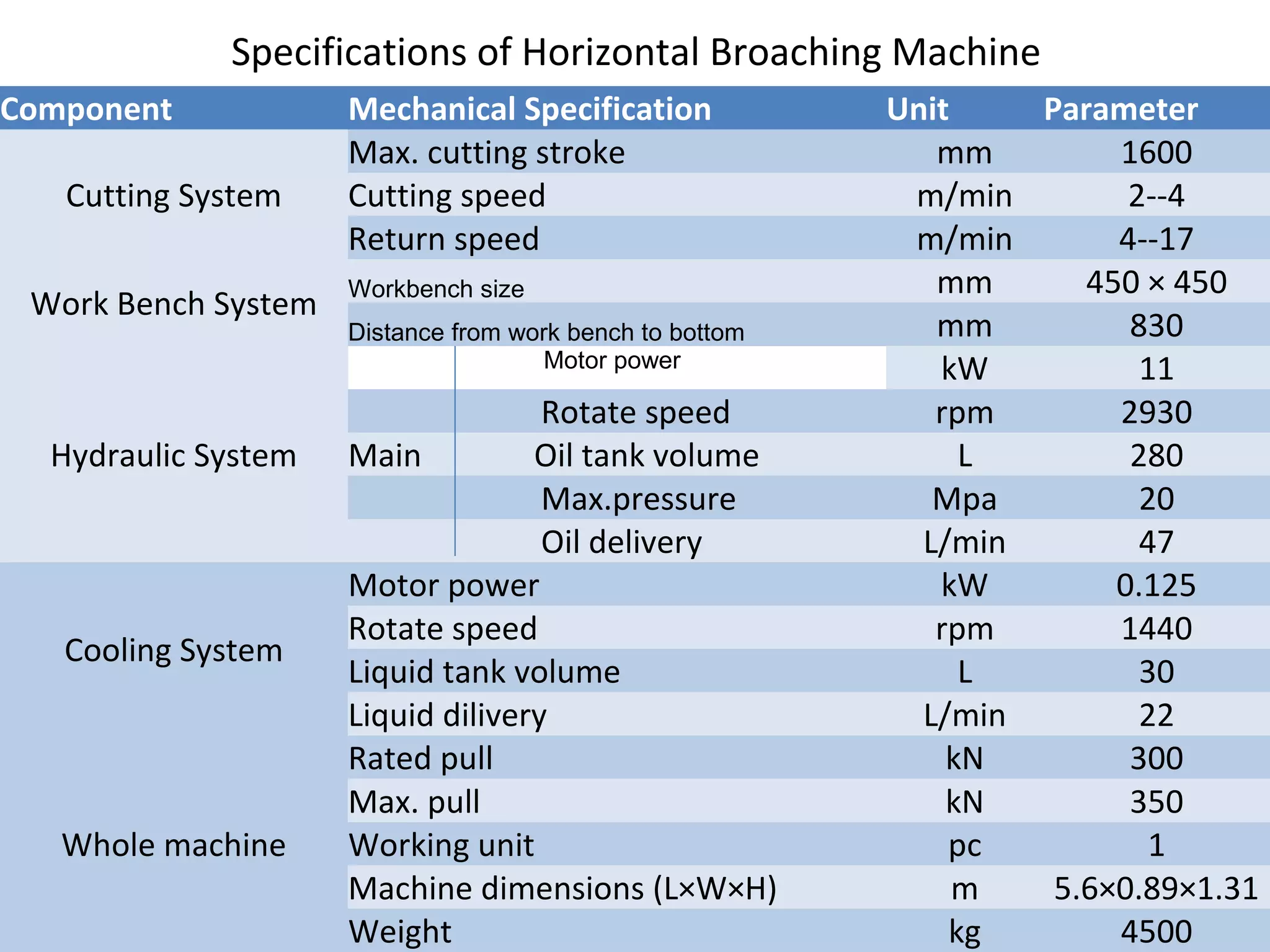
Specifications of Horizontal Broaching Machine
Component            Mechanical Specification             Unit    Parameter
                     Max. cutting stroke                     mm        1600
   Cutting System    Cutting speed                         m/min        2--4
                     Return speed                          m/min       4--17
                     Workbench size                          mm      450 × 450
 Work Bench System
                     Distance from work bench to bottom      mm         830
                                      Motor power            kW          11
                                    Rotate speed             rpm       2930
  Hydraulic System   Main          Oil tank volume             L        280
                                    Max.pressure             Mpa         20
                                    Oil delivery            L/min        47
                     Motor power                             kW        0.125
                     Rotate speed                            rpm       1440
   Cooling System
                     Liquid tank volume                        L         30
                     Liquid dilivery                        L/min        22
                     Rated pull                               kN        300
                     Max. pull                                kN        350
   Whole machine     Working unit                             pc          1
                     Machine dimensions (L×W×H)                m   5.6×0.89×1.31
                     Weight                                   kg       4500
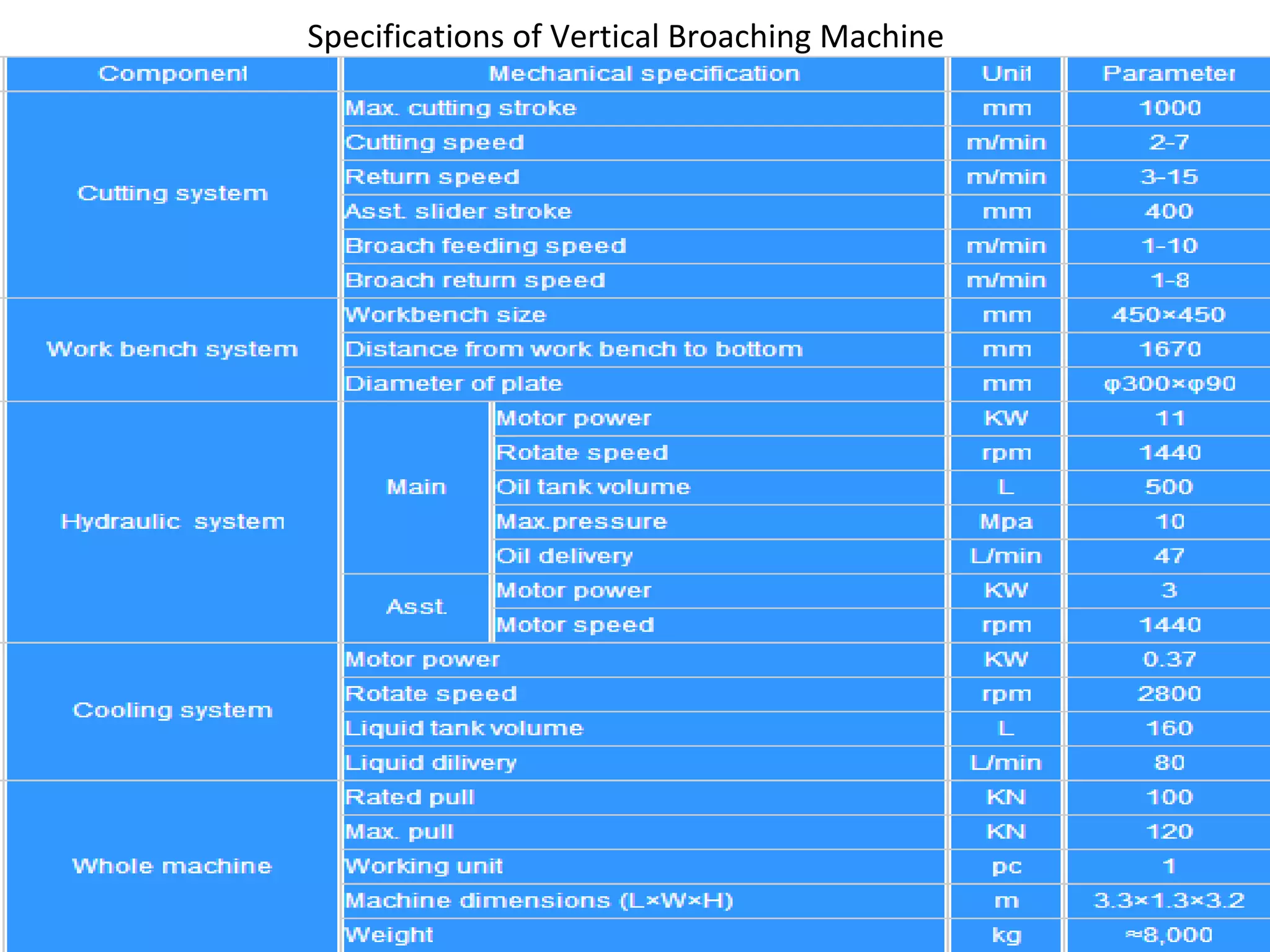
Specifications of Vertical Broaching Machine
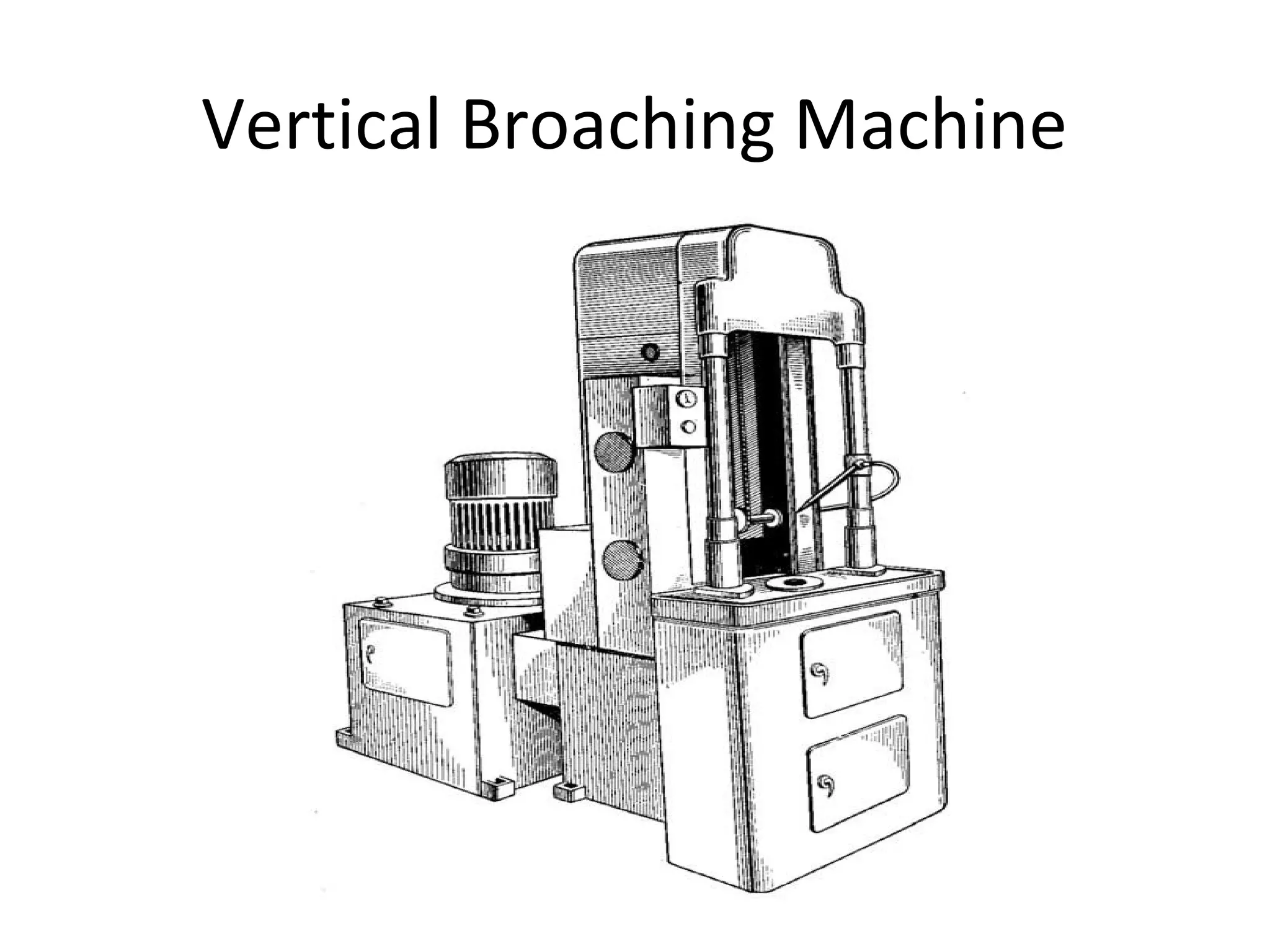
Vertical Broaching Machine
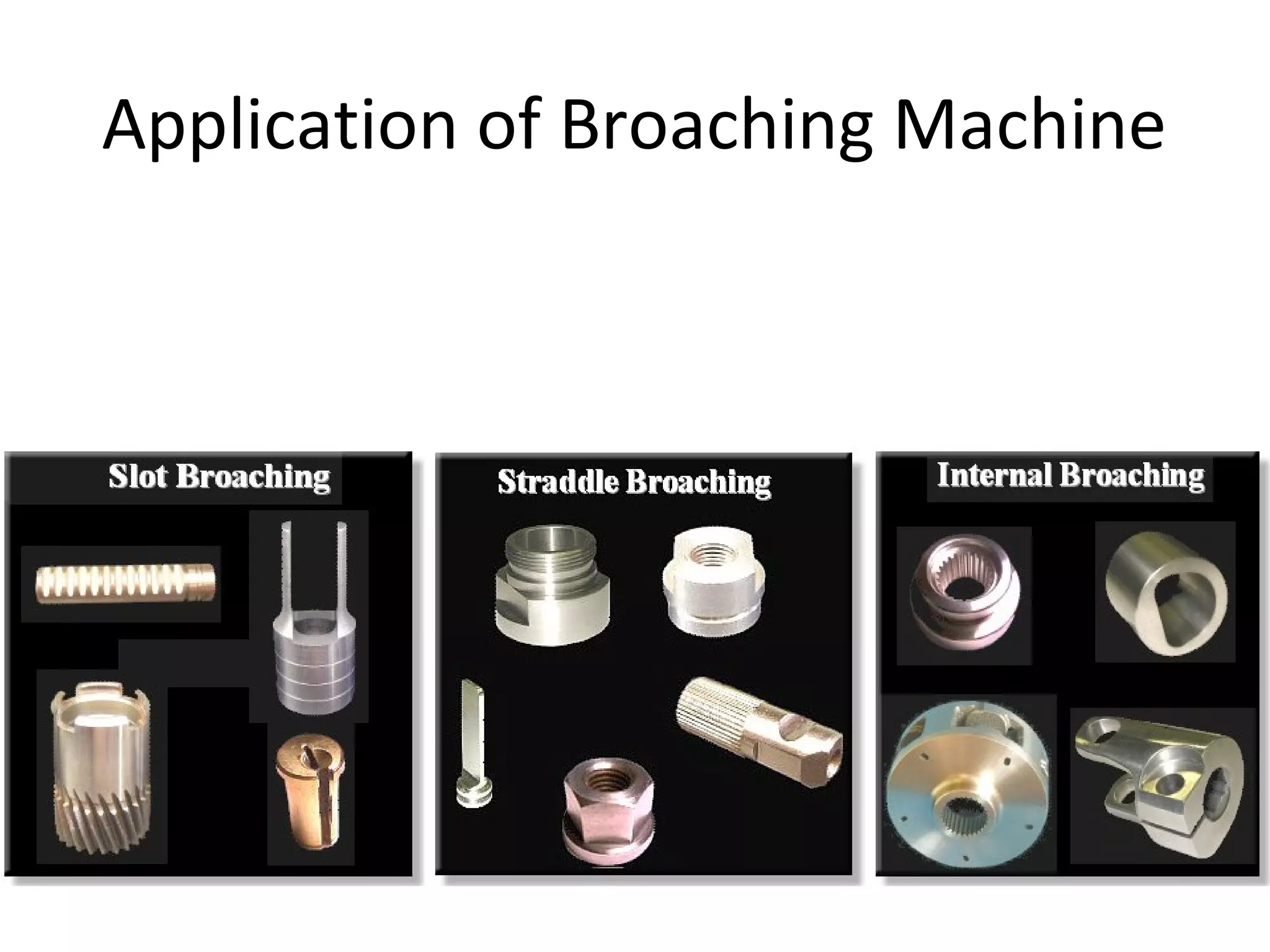
Application of Broaching Machine
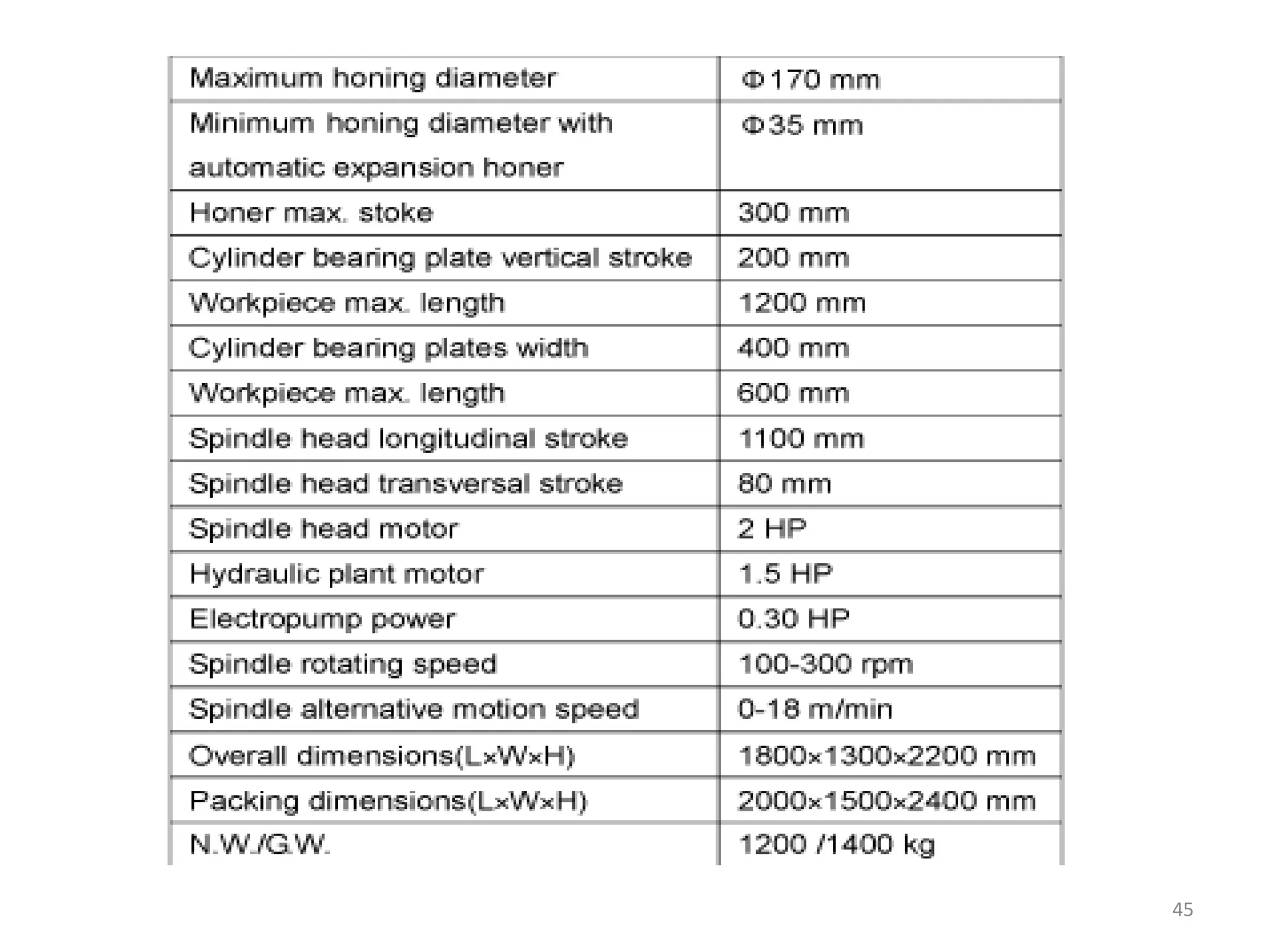
Specifications of Honing Machine
                By
      Yudhishthir Ramnani
           (11BME084)
         Samiraj Anupam
           (11BME085)
HONING
• Honing is a low velocity abrading process in which
  stock is removed from metallic or non metallic
  surfaces by bonded abrasive sticks.
• Honing improves the accuracy and finish of
  automobile cylinder bores, hydraulic cylinders, and
  similar parts. The honing machine consists of four
  fine-grain abrasive stones attached to an expandable
  tool that is then slowly revolved and oscillated inside
  the cylinder until the desired finish and diameter are
  obtained.
                                                       27
USE
• Produce high finish
• To correct
     • Out of orderness
     • Taper
     • Axial distortion
• Employed very frequently for finishing of
  – Bores
  – Gear teeth
  – Roller bearings

                                              28
EFFECTIVENESS


• It is effective on almost all ferrous or non
  ferrous material in a hardened or soft
  condition.


                                                 29
MATERIALS HONED
• Materials honed range from
  – Plastics
  – Silver
  – Aluminium
  – Brass
  – Cast iron
  – Hard steel
  – Cemented carbide

                               30
HONING STONES


• Honing stones are made from common abrasive
  and bonding materials, often impregnated with
  sulphur, resin, or wax to improve cutting action
  and tool life.


                                                 31
• Abrasive particles must withstand the cutting
  pressure for metal removal.

• Bond must be strong enough to hold the grit.

• Not so hard as to rub the bore and retard
  cutting.

                                                 32
GRIT SIZE

• Size ranges from 36-600

• Most widely used size : 120-320

• Selection depends on
  – Material removal rate
  – Required finish

                                    33
ABRASIVE

• Selection of abrasive depends on
  – Composition
  – Hardness of metal being honed.
  – Finish required
  – Cost.


                                     34
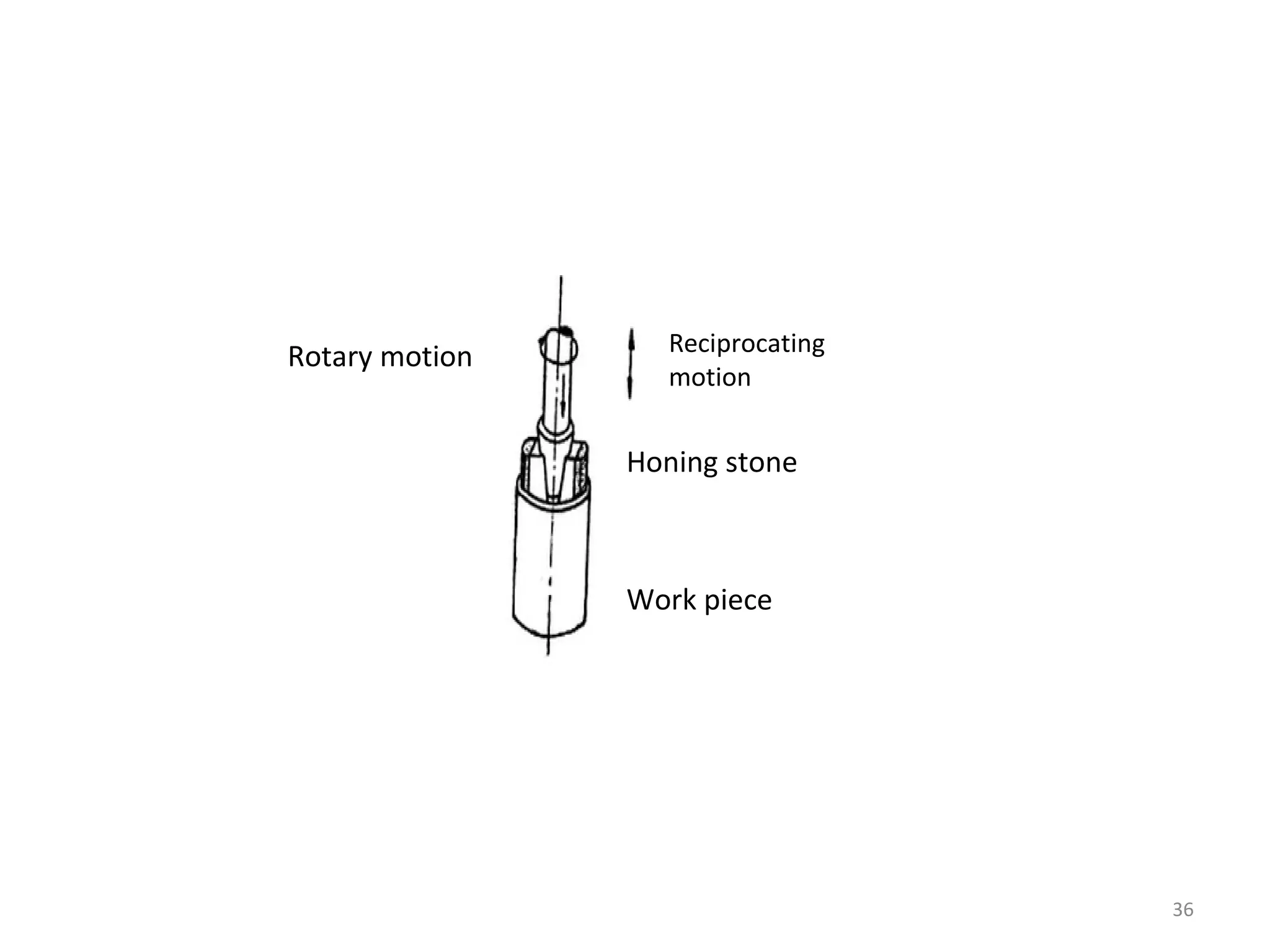
PROCESS

• Simultaneous rotating and reciprocating
  motion is given to the stick.

• The surface produced will have a
  characteristic cross-hatch lay pattern.


                                            35
Reciprocating
Rotary motion
                  motion


                Honing stone


                Work piece


                                  36
37
MACHINES

• Honing operation can be performed on
   - drill press
    - lathe

– Simultaneous rotary and reciprocating motion.

• Work pieces are to be held on fixtures that can float.

• Production honing is done on honing machine.

                                                           38
METHODS OF HONING
• MANUAL STROKING
  – Preferred for large quantities when tolerances are
    extremely close.
  – Main advantage

     • Work pieces need not be fixtured.

     • This reduces tooling investment .

     • Permits immediate changeover from one job to another.

                                                               39
• Other advantages

  – End to end reversal of work pieces.

  – Change of stroke length for required accuracy.

  – Necessary corrections can be made as stroking
    proceeds.

  – Employed as final touch.

                                                     40
• POWER STROKING

  – More economical for mass production of small
    parts.

  – Fixturing is required for work piece that exceeds
    size or weight.


                                                        41
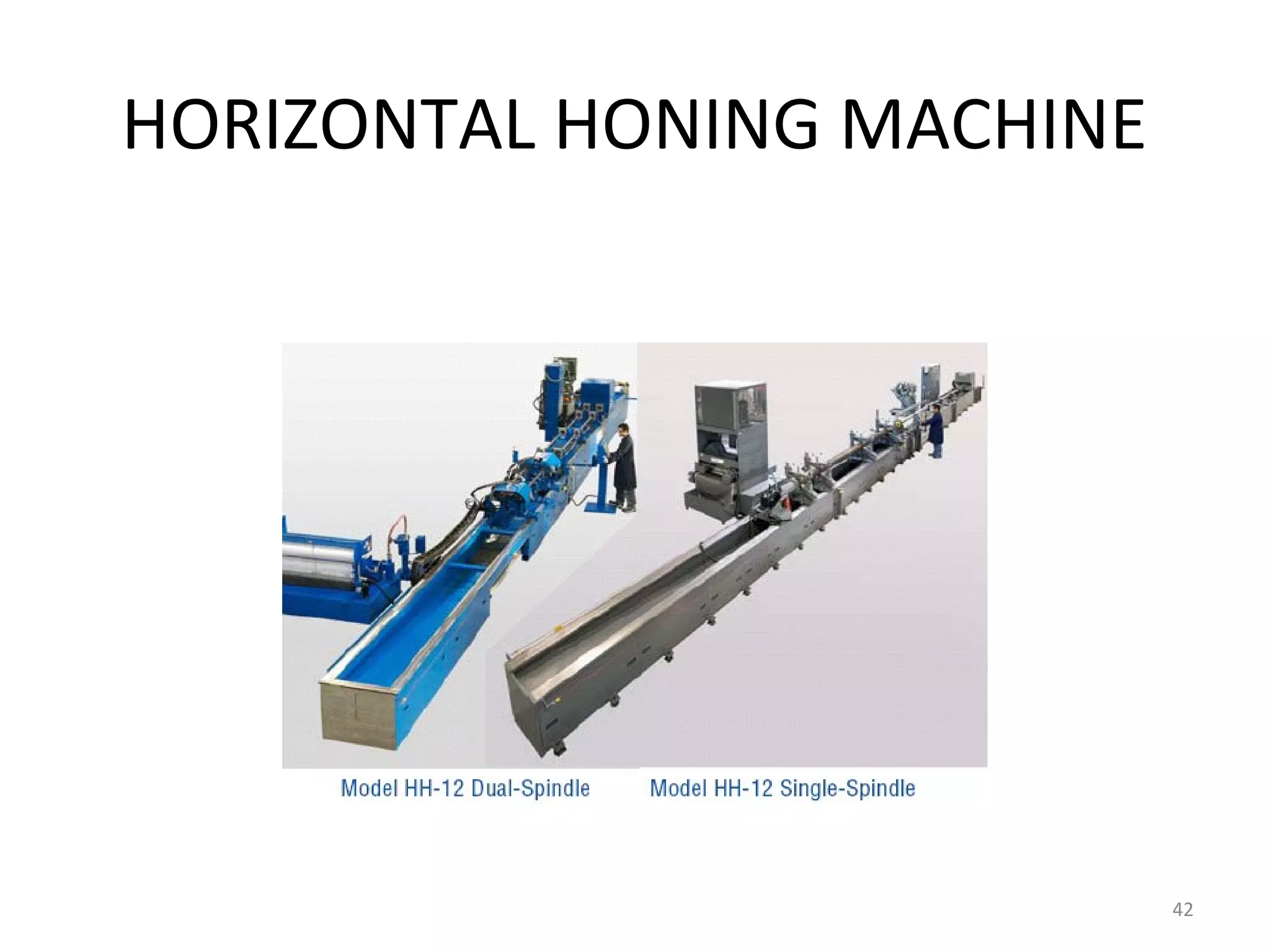
HORIZONTAL HONING MACHINE


                            42
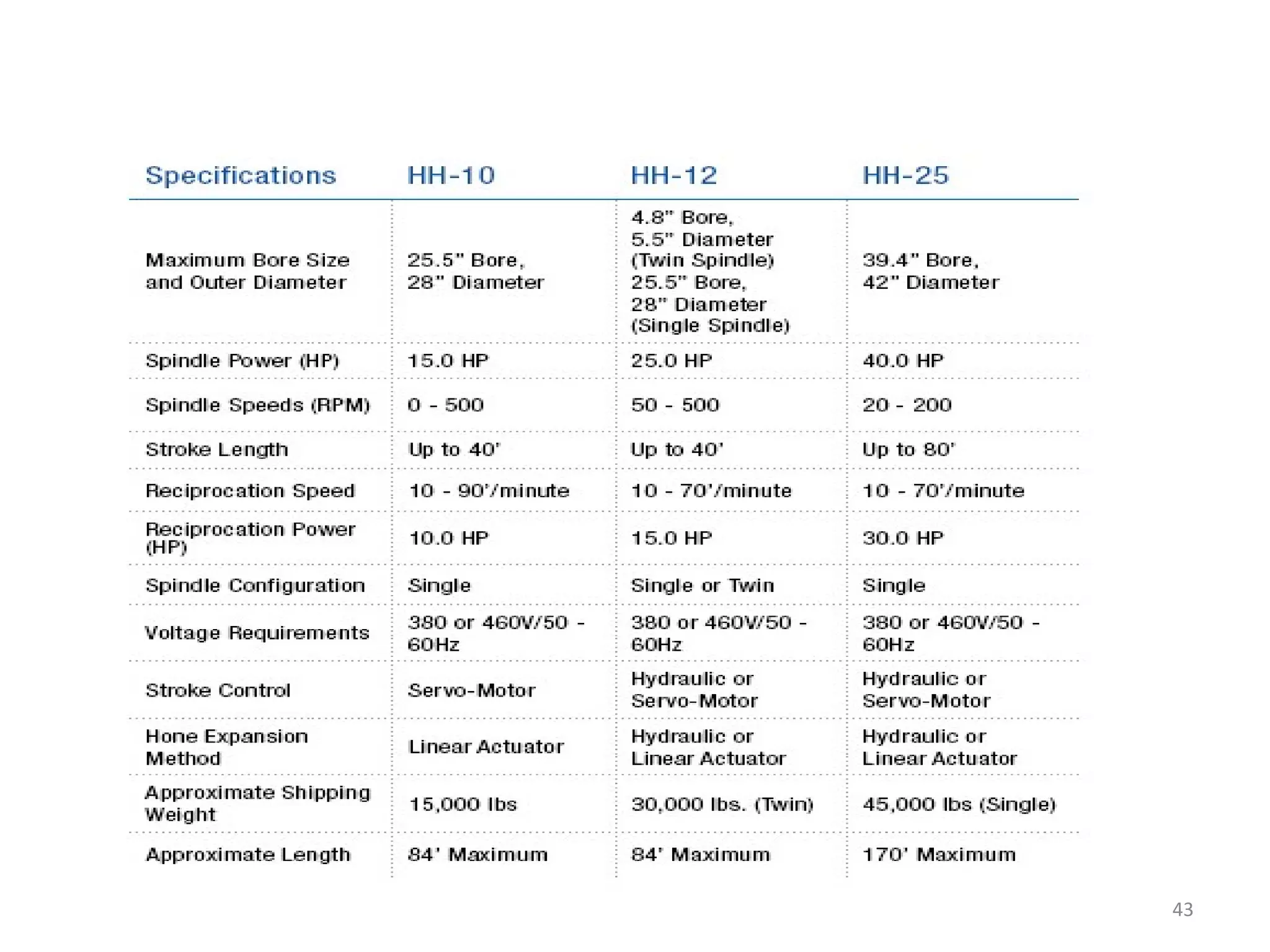
43
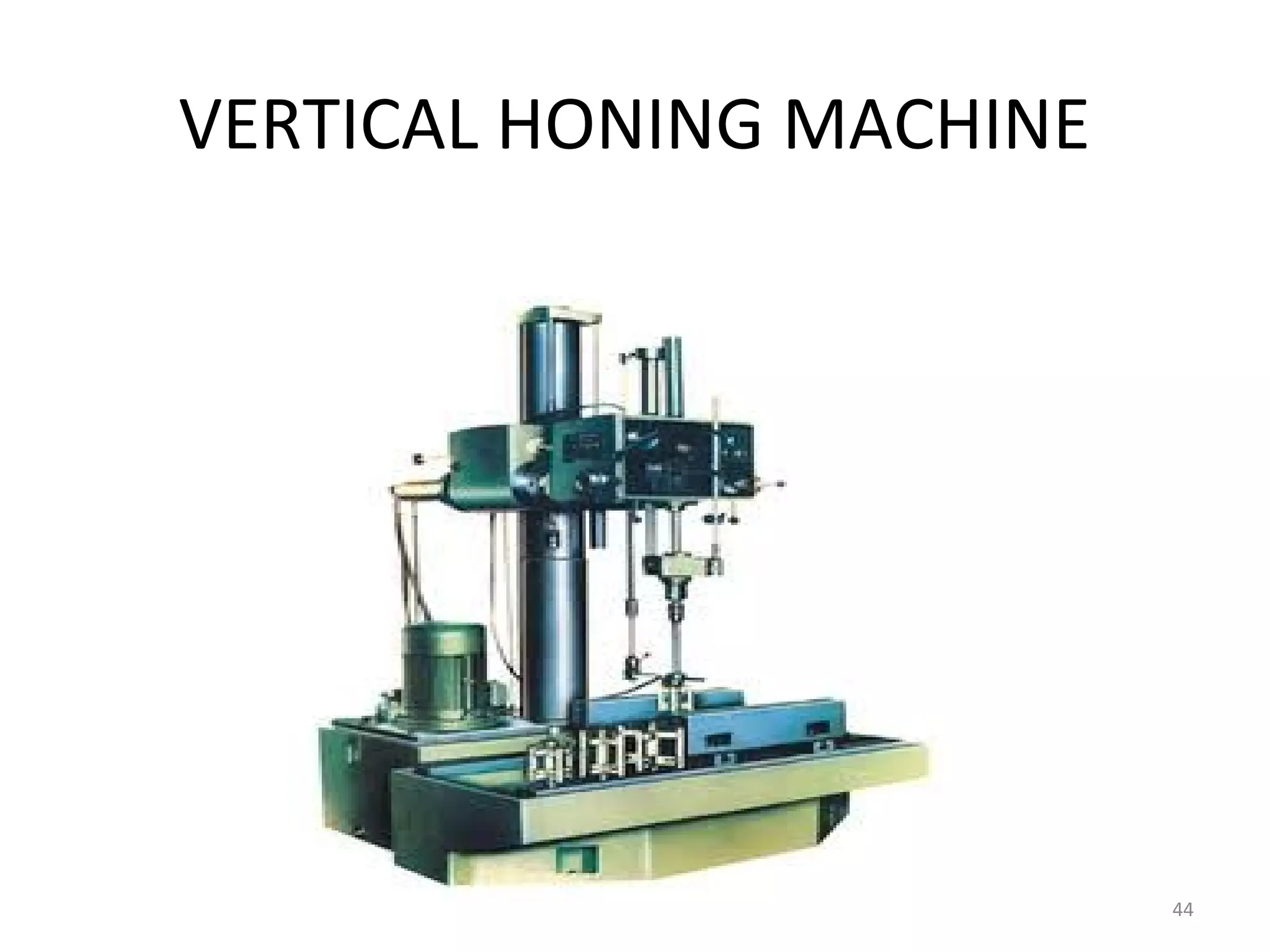
VERTICAL HONING MACHINE


                          44
45
HONING CONDITIONS
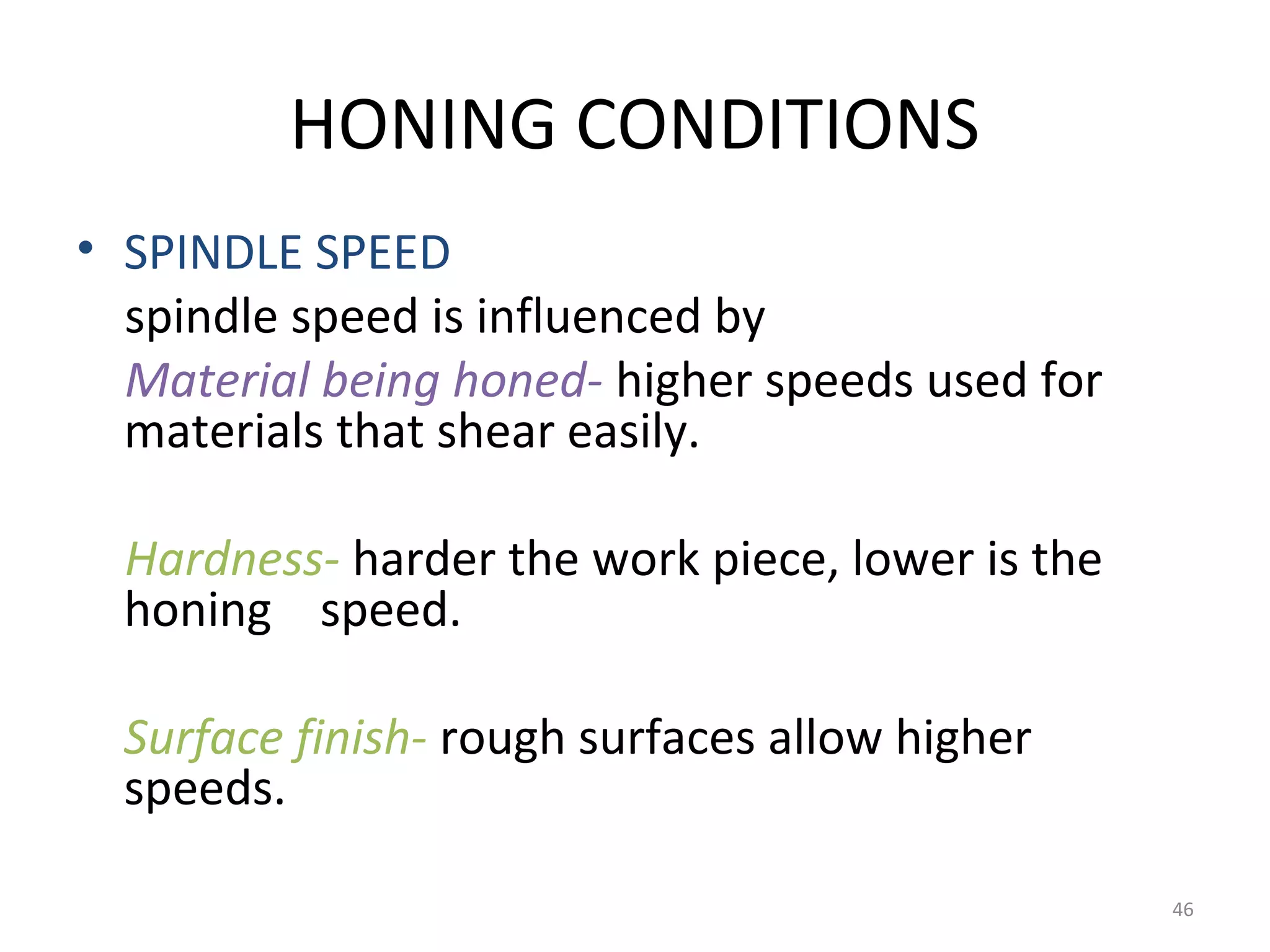
• SPINDLE SPEED
  spindle speed is influenced by
  Material being honed- higher speeds used for
  materials that shear easily.

  Hardness- harder the work piece, lower is the
  honing speed.

  Surface finish- rough surfaces allow higher
  speeds.

                                                  46
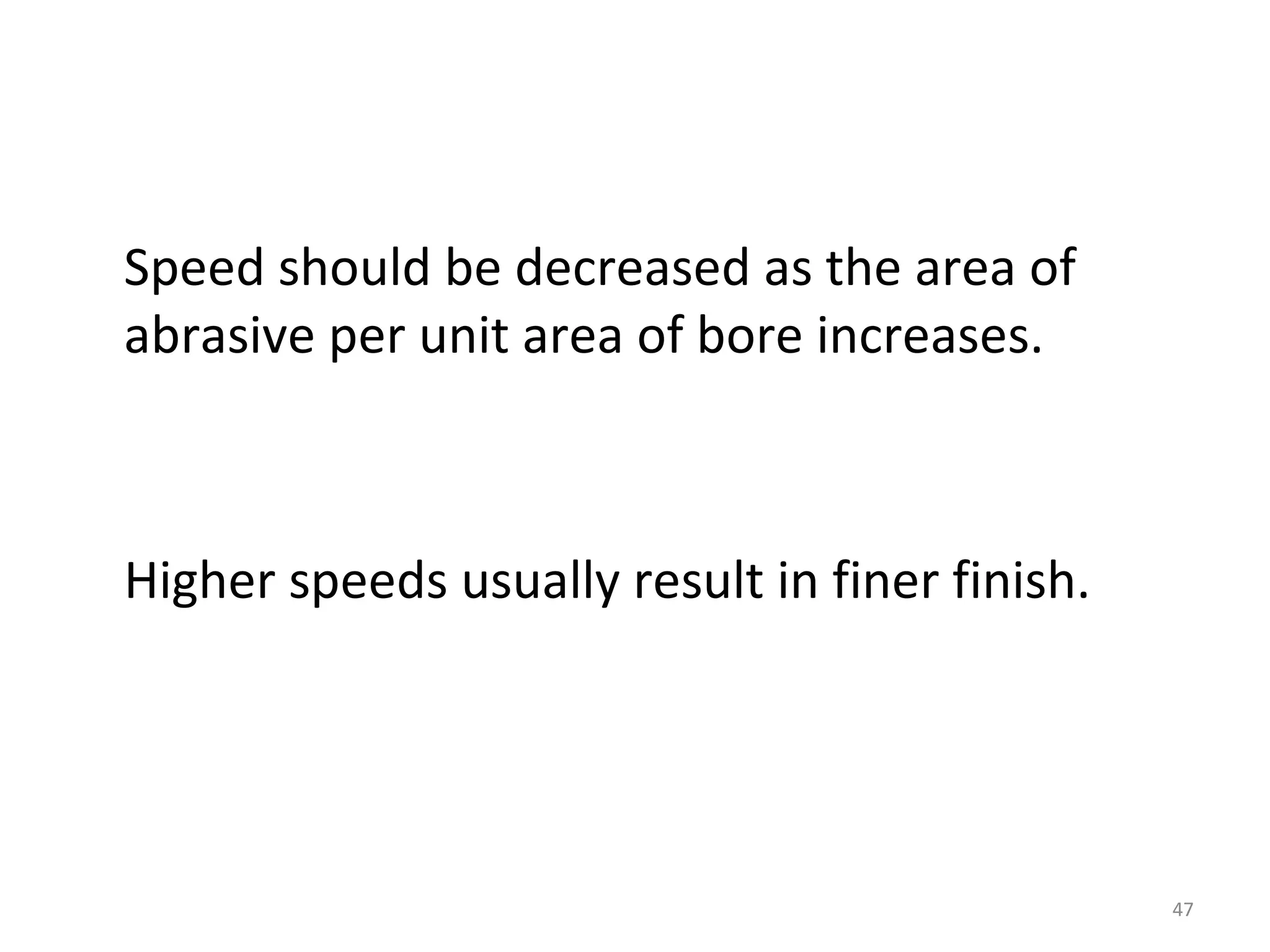
Speed should be decreased as the area of
abrasive per unit area of bore increases.


Higher speeds usually result in finer finish.


                                                47
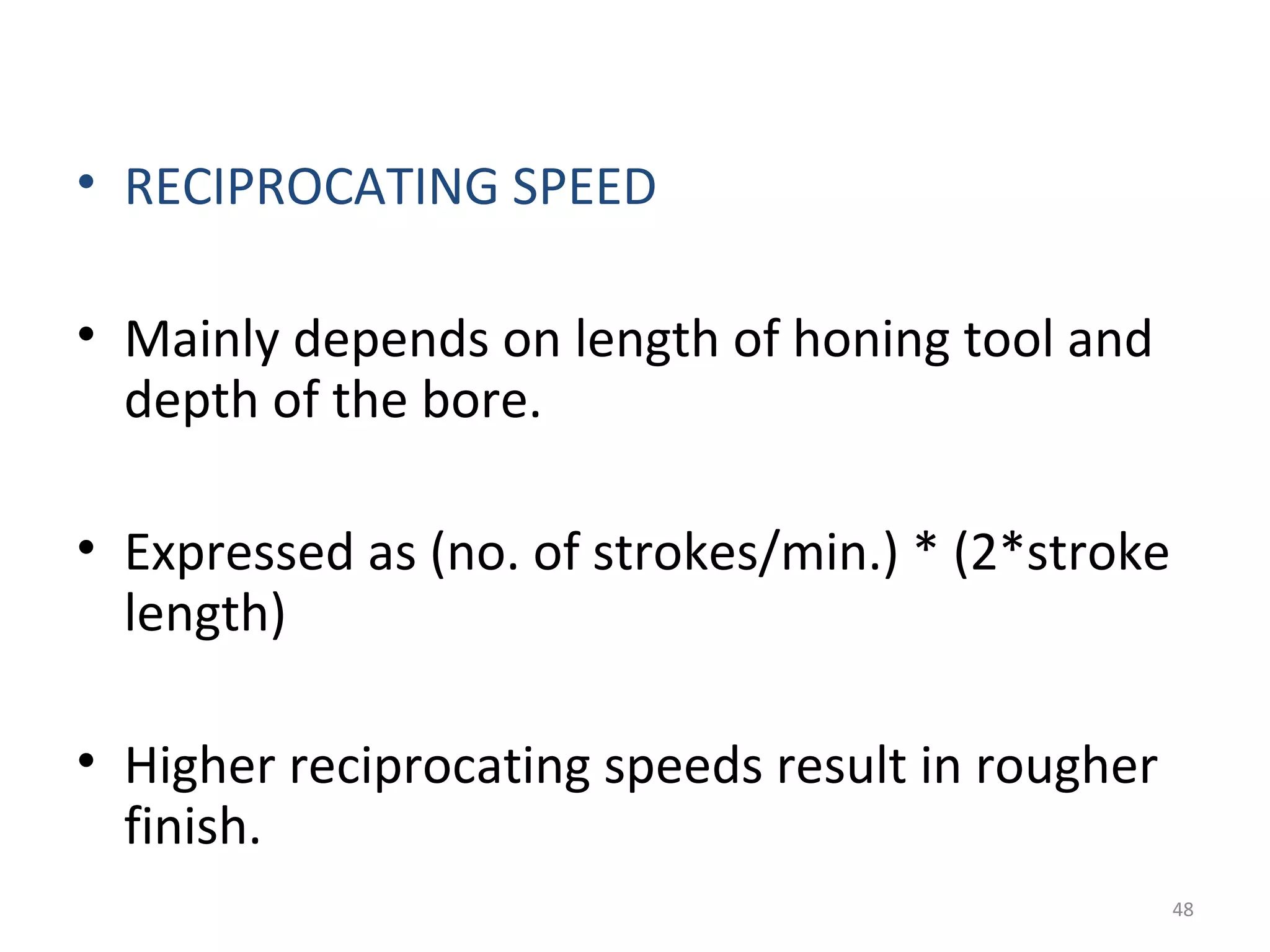
• RECIPROCATING SPEED

• Mainly depends on length of honing tool and
  depth of the bore.

• Expressed as (no. of strokes/min.) * (2*stroke
  length)

• Higher reciprocating speeds result in rougher
  finish.
                                                   48
…Thank You…

Specifications of lapping, honing and broaching machine

  • 1.
    Specifications of Lapping, Honingand Broaching Machine
  • 2.
    Specifications of LappingMachine By Athar Kothawala (11BME082)
  • 3.
    WHAT IS LAPPING? • Lapping is a machining operation, in which two surfaces are rubbed together with an abrasive between them, by hand movement or by way of a machine. • This can take two forms. The first type of lapping (traditionally called grinding), typically involves rubbing a brittle material such as glass against a surface such as iron or glass itself (also known as the "lap" or grinding tool) with an abrasive such as aluminum oxide, jeweller's rouge, optician's rouge, emery, silicon carbide, diamond, etc., in between them. This produces microscopic conchoidal fractures as the abrasive rolls about between the two surfaces and removes material from both.
  • 4.
    • The otherform of lapping involves a softer material such as pitch or a ceramic for the lap, which is "charged" with the abrasive. The lap is then used to cut a harder material—the work piece. The abrasive embeds within the softer material which holds it and permits it to score across and cut the harder material. Taken to a finer limit, this will produce a polished surface such as with a polishing cloth on an automobile, or a polishing cloth or polishing pitch upon glass or steel.
  • 5.
  • 6.
  • 7.
    Correction ring (Alumina I.D. 5.57” x O.D. 7” (141.5x178mm) Automatic ceramics) Lapping Drive unit for correction ring 2 Machine Model Speed 18-280 rpm SPL15T motor 25 W Lapping table (Platen) 1 platen 15” (Ø380 mm) Diameter 10 - 60 rpm Speed Ball bearing Type of Bearing 0.4 Kw AC SUS 420 (Alumina ceramics is Option) Motor Material of table Slurry supply system Micro Tube Pump Magnetic stirrer unit Slurry stirrer unit 2 liters Slurry Tank capacity 10 liters Waste vessel Utility for electricity 3P, 200V, 10A
  • 8.
    Specially Design ForMechanical seal Component Lapping Like : Silicon Carbide, Tungsten Carbide, FLAT LAPPING Ceramic, Carbon, Chrome Cast etc. Specifications : MACHINE Lapping Plate outside Diameter :- 14" 356mm Lapping Plate Speed :- 60 rpm No. of Conditioning Rings :- 3 Conditioning Ring inside Diameter :- 5.3" 135mm Height of Working Face :- 35" 889mm
  • 9.
    Double Side LappingMachine • The Double Side Lapping Machines are capable to lap and polish less than 40 micron parts to get extreme flatness and surface quality say nanometer level. These are available in various specifications that can also be customized to suit the varied requirements of the clients within committed time frame. • Features: • Durable operation • Easy to operate • Durable performance
  • 10.
    Valve Body LappingMachine • D-HONER DHL machine can mechanize the operation as well as overcome all the draw-back that are associated with Manual lapping. • Due to simultaneous lapping of 4 or 6 valves at optimum lapping speed, production is high as 5 to 6 times can be achieved with remarkable degree of consistency. The operational simplicity of the machine enable use of unskilled labour. All these factors result in considerable reduction in operational cost. • Specially designed heavy-duty compact geared motor of ample capacity with an output speed that is optimum for valve lapping operation. The mechanism of the machines is the machine is fairly simple and hence requires practically no maintenance.
  • 11.
    • Advantages : • Economical • Labour saving • High rate of Production • High operational efficiency • Less down time of engine • Precision • Longer life of valves • Consistency in lapping & quality of work • Skilled labour not required.
  • 12.
    Bench Type LappingMachine •Range of bench type lapping machines are used for fine finishing of various components of automobile, bearing and others. These machines are precision engineered using the cutting edge technology that ensures high performance and efficiency. Available in various specifications, these can also be custom designed to suit the specific requirements of the clients. Applications : Hydraulic valves Pneumatic valves Fuel injection barrels Gauges Jig bushes Connecting rods Rocker arms
  • 13.
    Manual OD LappingMachines • The company’s range is at par with the industry standards and widely used in O.D. Lapping of plug gauges, special gauges, bars, shafts as well as component of automobiles, hydraulics, sewing machines, etc. • Technical Specifications: • Capacity : 3 mm to 150 mm Length : 250 mm or 500 mm Motor : 0.5 HP, 3 PHASE Accuracy : Less than 0.001 mm
  • 14.
    Application Areas • Tractor'slift pump and control valve • Hydraulic and Pneumatic valves and pistons • Sewing machine needle bar and shafts • Two-three wheeler gudgun pins • Sintered products tools • Tool room • Gauges and pins for measuring • Automobile components • Lubrication system
  • 15.
    Specification of BroachingMachine By Karan C. Prajapati (11BME083)
  • 16.
    Principle of Broaching •Broaching is a machining process for removal of a layer of material of desired width and depth usually in one stroke by a slender rod or bar type cutter having a series of cutting edges with gradually increased protrusion as Indicated.
  • 17.
    Basic Difference betweenShaping and Broaching • In shaping, attaining full depth requires a number of strokes to remove the material in thin layers step – by – step by gradually infeeding the single point tool. • Broaching enables to remove the whole material in one stroke only by the gradually rising teeth of the cutter called broach. The amount of tooth rise between the successive teeth of the broach is equivalent to the infeed given in shaping.
  • 18.
  • 19.
    Broaching machines aregenerally specified by • Type; horizontal, vertical etc. • Maximum stroke length • Maximum working force (pull or push) • Maximum cutting velocity possible • Power
  • 20.
  • 21.
    Specifications of HorizontalBroaching Machine Component Mechanical Specification Unit Parameter Max. cutting stroke mm 1600 Cutting System Cutting speed m/min 2--4 Return speed m/min 4--17 Workbench size mm 450 × 450 Work Bench System Distance from work bench to bottom mm 830 Motor power kW 11 Rotate speed rpm 2930 Hydraulic System Main Oil tank volume L 280 Max.pressure Mpa 20 Oil delivery L/min 47 Motor power kW 0.125 Rotate speed rpm 1440 Cooling System Liquid tank volume L 30 Liquid dilivery L/min 22 Rated pull kN 300 Max. pull kN 350 Whole machine Working unit pc 1 Machine dimensions (L×W×H) m 5.6×0.89×1.31 Weight kg 4500
  • 22.
    Specifications of VerticalBroaching Machine
  • 23.
  • 24.
  • 26.
    Specifications of HoningMachine By Yudhishthir Ramnani (11BME084) Samiraj Anupam (11BME085)
  • 27.
    HONING • Honing isa low velocity abrading process in which stock is removed from metallic or non metallic surfaces by bonded abrasive sticks. • Honing improves the accuracy and finish of automobile cylinder bores, hydraulic cylinders, and similar parts. The honing machine consists of four fine-grain abrasive stones attached to an expandable tool that is then slowly revolved and oscillated inside the cylinder until the desired finish and diameter are obtained. 27
  • 28.
    USE • Produce highfinish • To correct • Out of orderness • Taper • Axial distortion • Employed very frequently for finishing of – Bores – Gear teeth – Roller bearings 28
  • 29.
    EFFECTIVENESS • It iseffective on almost all ferrous or non ferrous material in a hardened or soft condition. 29
  • 30.
    MATERIALS HONED • Materialshoned range from – Plastics – Silver – Aluminium – Brass – Cast iron – Hard steel – Cemented carbide 30
  • 31.
    HONING STONES • Honingstones are made from common abrasive and bonding materials, often impregnated with sulphur, resin, or wax to improve cutting action and tool life. 31
  • 32.
    • Abrasive particlesmust withstand the cutting pressure for metal removal. • Bond must be strong enough to hold the grit. • Not so hard as to rub the bore and retard cutting. 32
  • 33.
    GRIT SIZE • Sizeranges from 36-600 • Most widely used size : 120-320 • Selection depends on – Material removal rate – Required finish 33
  • 34.
    ABRASIVE • Selection ofabrasive depends on – Composition – Hardness of metal being honed. – Finish required – Cost. 34
  • 35.
    PROCESS • Simultaneous rotatingand reciprocating motion is given to the stick. • The surface produced will have a characteristic cross-hatch lay pattern. 35
  • 36.
    Reciprocating Rotary motion motion Honing stone Work piece 36
  • 37.
  • 38.
    MACHINES • Honing operationcan be performed on - drill press - lathe – Simultaneous rotary and reciprocating motion. • Work pieces are to be held on fixtures that can float. • Production honing is done on honing machine. 38
  • 39.
    METHODS OF HONING •MANUAL STROKING – Preferred for large quantities when tolerances are extremely close. – Main advantage • Work pieces need not be fixtured. • This reduces tooling investment . • Permits immediate changeover from one job to another. 39
  • 40.
    • Other advantages – End to end reversal of work pieces. – Change of stroke length for required accuracy. – Necessary corrections can be made as stroking proceeds. – Employed as final touch. 40
  • 41.
    • POWER STROKING – More economical for mass production of small parts. – Fixturing is required for work piece that exceeds size or weight. 41
  • 42.
  • 43.
  • 44.
  • 45.
  • 46.
    HONING CONDITIONS • SPINDLESPEED spindle speed is influenced by Material being honed- higher speeds used for materials that shear easily. Hardness- harder the work piece, lower is the honing speed. Surface finish- rough surfaces allow higher speeds. 46
  • 47.
    Speed should bedecreased as the area of abrasive per unit area of bore increases. Higher speeds usually result in finer finish. 47
  • 48.
    • RECIPROCATING SPEED •Mainly depends on length of honing tool and depth of the bore. • Expressed as (no. of strokes/min.) * (2*stroke length) • Higher reciprocating speeds result in rougher finish. 48
  • 49.