Climate Change
Introduction
Did you know that
 Global temperatures rose about 1.8°F (1°C)
from 1901 to 2020.
 Sea level rise has accelerated from 1.7
mm/year throughout most of the twentieth
century to 3.2 mm/year since 1993.
 Glaciers are shrinking: average thickness of
30 well-studied glaciers has decreased more
than 60 feet since 1980.
 The area covered by sea ice in the Arctic at
the end of summer has shrunk by about 40%
since 1979.
 The amount of carbon dioxide in the
atmosphere has risen by 25% since 1958,and
by about 40% since the Industrial Revolution
Climate change is a major global challenge
today, and the world is becoming more
vulnerable to this change. Climate change refers
to the changes in Earth’s climate condition. It
describes the changes in the atmosphere which
have taken place over a period, ranging from
decades to millions of years. A recent report
from the United Nations predicted that average
global temperature could increase by 6˚ Celsius
at the end of the century. Climate change refers
to more than an increase in temperature. It also
includes sea level rise, changes in weather
patterns like drought and flooding, and much
more. Things that we depend upon and value —
water, energy, transportation, wildlife,
agriculture, ecosystems, and human health —
are experiencing the effects of a changing
climate. Climate change has an adverse effect on
the environment and ecosystem.
Causes
Generating power
Generating electricity and heat by burning fossil fuels causes a large chunk of global
emissions. Most electricity is still generated by burning coal, oil, or gas, which produces
carbon dioxide and nitrous oxide – powerful greenhouse gases that blanket the Earth and
trap the sun’s heat.
Manufacturing goods
Manufacturing and industry produce emissions, mostly from burning fossil fuels to produce
energy for making things like cement, iron, steel, electronics, plastics, clothes, and other
goods. Mining and other industrial processes also release gases, as does the construction
industry.
Cutting down forests
Cutting down forests to create farms or pastures, or for other reasons, causes emissions,
since trees, when they are cut, release the carbon they have been storing. Each year
approximately 12 million hectares of forest are destroyed.
Using transportation
Most cars, trucks, ships, and planes run on fossil fuels. That makes transportation a major
contributor of greenhouse gases, especially carbon-dioxide emissions.
Powering buildings
Globally, residential and commercial buildings consume over half of all electricity. As they
continue to draw on coal, oil, and natural gas for heating and cooling, they emit significant
quantities of greenhouse gas emissions
Consuming too much “The wealthiest bear The Greatest responsibility” Your home and use
of power, how you move around, what you eat and how much you throw away all contribute to
greenhouse gas emissions. So, does the consumption of goods such as clothing, electronics, and
plastics.
Effect of Global Warming on Climate change
Scientists agree that the earth’s rising temperatures are fueling longer and hotter heat
waves, more frequent droughts, heavier rainfall, and more powerful hurricanes. A real-
time extreme event attribution study by the World Weather Attribution project shows the heat wave
was rendered 30 times more likely and more intense due to climate change In 2015, for example,
scientists concluded that a lengthy drought in California—the state’s worst water
shortage in 1,200 years—had been intensified by 15 to 20 percent by global warming.
They also said the odds of similar droughts happening in the future had roughly doubled
over the past century. The 2022 heat wave in India and Pakistan is an extreme weather
event which has resulted in the hottest March in India since 1901. The hot season arrived unusually
early in the year and extended into April, affecting a large part of India's northwest and Pakistan.
Several cities across India had high temperatures over 42.8 °C (109.0 °F), with Wardha rising to
45 °C (113 °F).[4]
The heatwave has also been felt in neighboring Pakistan, where the city
of Nawabshah recorded a high temperature of 49.5 °C (121.1 °F)[5]
and Jacobabad and Sibi reaching
47 °C (117 °F).
Effect of Pollution
Climate change and air pollution have been a matter of serious concern all
over the world in the last few decades. The present review has been carried out
in this concern over the Indian cities with significant impacts of both the
climate change and air pollution on human health. The expanding urban areas
with extreme climate events (high rainfall, extreme temperature, floods, and
droughts) are posing human health risks. The intensified heat waves as a
result of climate change have led to the elevation in temperature levels causing
thermal discomfort and several health issues to urban residents.
Other Effects on world
More severe storms
Destructive storms have become more intense and more frequent in many regions. As
temperatures rise, more moisture evaporates, which exacerbates extreme rainfall and
flooding, causing more destructive storms.
Increased dro ught
Climate change is changing water availability, making it scarcer in more regions.
Loss of species
Climate change poses risks to the survival of species on land and in the ocean. These risks
increase as temperatures climb. Exacerbated by climate change, the world is losing species at a
rate 1,000 times greater than at any other time in recorded human history. One million species are at
risk of becoming extinct within the next few decades. Forest fires, extreme weather, and invasive
pests and diseases are among many threats related to climate change.
Not enough food
Changes in the climate and increases in extreme weather events are among the reasons
behind a global rise in hunger and poor nutrition. Fisheries, crops, and livestock may be
destroyed or become less productive.
More health risks
Climate change is the single biggest health threat facing humanity. Climate impacts are
already harming health, through air pollution, disease, extreme weather events, forced
displacement, pressures on mental health, and increased hunger and poor nutrition in
places where people cannot grow or find sufficient food. Every year, environmental factors
take the lives of around 13 million people.
POV: United Nations
At the 21st Conference of the Parties in Paris in 2015, Parties to the UNFCCC reached a landmark
agreement to combat climate change and to accelerate and intensify the actions and investments
needed for a sustainable low carbon future. The Paris Agreement’s central aim is to strengthen the
global response to the threat of climate change by keeping the global temperature rise this century well
below 2 degrees Celsius above pre-industrial levels and to pursue efforts to limit the temperature
increase even further to 1.5 degrees Celsius.On Earth Day, 22 April 2016, 175 world leaders signed
the Paris Agreement at United Nations Headquarters in New York. This was by far the largest number
of countries ever to sign an international agreement on a single day. There are now 194 countries that
have ratified the Paris Agreement.
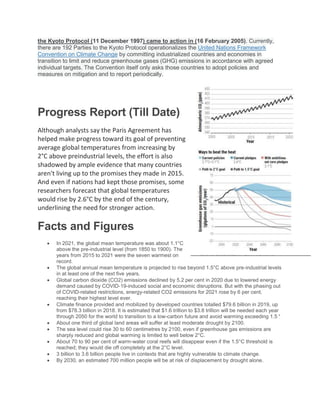
the Kyoto Protocol (11 December 1997) came to action in (16 February 2005). Currently,
there are 192 Parties to the Kyoto Protocol operationalizes the United Nations Framework
Convention on Climate Change by committing industrialized countries and economies in
transition to limit and reduce greenhouse gases (GHG) emissions in accordance with agreed
individual targets. The Convention itself only asks those countries to adopt policies and
measures on mitigation and to report periodically.
Progress Report (Till Date)
Although analysts say the Paris Agreement has
helped make progress toward its goal of preventing
average global temperatures from increasing by
2°C above preindustrial levels, the effort is also
shadowed by ample evidence that many countries
aren't living up to the promises they made in 2015.
And even if nations had kept those promises, some
researchers forecast that global temperatures
would rise by 2.6°C by the end of the century,
underlining the need for stronger action.
Facts and Figures
 In 2021, the global mean temperature was about 1.1°C
above the pre-industrial level (from 1850 to 1900). The
years from 2015 to 2021 were the seven warmest on
record.
 The global annual mean temperature is projected to rise beyond 1.5°C above pre-industrial levels
in at least one of the next five years.
 Global carbon dioxide (CO2) emissions declined by 5.2 per cent in 2020 due to lowered energy
demand caused by COVID-19-induced social and economic disruptions. But with the phasing out
of COVID-related restrictions, energy-related CO2 emissions for 2021 rose by 6 per cent,
reaching their highest level ever.
 Climate finance provided and mobilized by developed countries totalled $79.6 billion in 2019, up
from $78.3 billion in 2018. It is estimated that $1.6 trillion to $3.8 trillion will be needed each year
through 2050 for the world to transition to a low-carbon future and avoid warming exceeding 1.5 °
 About one third of global land areas will suffer at least moderate drought by 2100.
 The sea level could rise 30 to 60 centimetres by 2100, even if greenhouse gas emissions are
sharply reduced and global warming is limited to well below 2°C.
 About 70 to 90 per cent of warm-water coral reefs will disappear even if the 1.5°C threshold is
reached; they would die off completely at the 2°C level.
 3 billion to 3.6 billion people live in contexts that are highly vulnerable to climate change.
 By 2030, an estimated 700 million people will be at risk of displacement by drought alone.
Sustainable Development
Goal 13 programs
13.1 Strengthen resilience and adaptive capacity to climate-related hazards and natural
disasters in all countries
13.2 Integrate climate change measures into national policies, strategies and planning
13.3 Improve education, awareness-raising and human and institutional capacity on
climate change mitigation, adaptation, impact reduction and early warning
13.A Implement the commitment undertaken by developed-country parties to the United
Nations Framework Convention on Climate Change to a goal of mobilizing jointly $100
billion annually by 2020 from all sources to address the needs of developing countries in
the context of meaningful mitigation actions and transparency on implementation and
fully operationalize the Green Climate Fund through its capitalization as soon as
possible
13.B Promote mechanisms for raising capacity for effective climate change-related
planning and management in least developed countries and small island developing
States, including focusing on women, youth and local and marginalized communities
Bibliography
 www.unitednations.org.com
 www.unfccc.org.com
 www.wikipedia.com
 https://sustainabledevelopment.un.org
 https://www.undp.org.com
The Hindu
New York Times
 National Geography
 Departments of Pollution Control of India

Climate Change.docx school project

  • 1.
    Climate Change Introduction Did youknow that  Global temperatures rose about 1.8°F (1°C) from 1901 to 2020.  Sea level rise has accelerated from 1.7 mm/year throughout most of the twentieth century to 3.2 mm/year since 1993.  Glaciers are shrinking: average thickness of 30 well-studied glaciers has decreased more than 60 feet since 1980.  The area covered by sea ice in the Arctic at the end of summer has shrunk by about 40% since 1979.  The amount of carbon dioxide in the atmosphere has risen by 25% since 1958,and by about 40% since the Industrial Revolution
  • 2.
    Climate change isa major global challenge today, and the world is becoming more vulnerable to this change. Climate change refers to the changes in Earth’s climate condition. It describes the changes in the atmosphere which have taken place over a period, ranging from decades to millions of years. A recent report from the United Nations predicted that average global temperature could increase by 6˚ Celsius at the end of the century. Climate change refers to more than an increase in temperature. It also includes sea level rise, changes in weather patterns like drought and flooding, and much more. Things that we depend upon and value — water, energy, transportation, wildlife, agriculture, ecosystems, and human health — are experiencing the effects of a changing
  • 3.
    climate. Climate changehas an adverse effect on the environment and ecosystem. Causes Generating power Generating electricity and heat by burning fossil fuels causes a large chunk of global emissions. Most electricity is still generated by burning coal, oil, or gas, which produces carbon dioxide and nitrous oxide – powerful greenhouse gases that blanket the Earth and trap the sun’s heat. Manufacturing goods Manufacturing and industry produce emissions, mostly from burning fossil fuels to produce energy for making things like cement, iron, steel, electronics, plastics, clothes, and other goods. Mining and other industrial processes also release gases, as does the construction industry. Cutting down forests Cutting down forests to create farms or pastures, or for other reasons, causes emissions, since trees, when they are cut, release the carbon they have been storing. Each year approximately 12 million hectares of forest are destroyed. Using transportation Most cars, trucks, ships, and planes run on fossil fuels. That makes transportation a major contributor of greenhouse gases, especially carbon-dioxide emissions. Powering buildings Globally, residential and commercial buildings consume over half of all electricity. As they continue to draw on coal, oil, and natural gas for heating and cooling, they emit significant quantities of greenhouse gas emissions Consuming too much “The wealthiest bear The Greatest responsibility” Your home and use of power, how you move around, what you eat and how much you throw away all contribute to greenhouse gas emissions. So, does the consumption of goods such as clothing, electronics, and plastics.
  • 4.
    Effect of GlobalWarming on Climate change Scientists agree that the earth’s rising temperatures are fueling longer and hotter heat waves, more frequent droughts, heavier rainfall, and more powerful hurricanes. A real- time extreme event attribution study by the World Weather Attribution project shows the heat wave was rendered 30 times more likely and more intense due to climate change In 2015, for example, scientists concluded that a lengthy drought in California—the state’s worst water shortage in 1,200 years—had been intensified by 15 to 20 percent by global warming. They also said the odds of similar droughts happening in the future had roughly doubled over the past century. The 2022 heat wave in India and Pakistan is an extreme weather event which has resulted in the hottest March in India since 1901. The hot season arrived unusually early in the year and extended into April, affecting a large part of India's northwest and Pakistan. Several cities across India had high temperatures over 42.8 °C (109.0 °F), with Wardha rising to 45 °C (113 °F).[4] The heatwave has also been felt in neighboring Pakistan, where the city of Nawabshah recorded a high temperature of 49.5 °C (121.1 °F)[5] and Jacobabad and Sibi reaching 47 °C (117 °F). Effect of Pollution Climate change and air pollution have been a matter of serious concern all over the world in the last few decades. The present review has been carried out in this concern over the Indian cities with significant impacts of both the climate change and air pollution on human health. The expanding urban areas with extreme climate events (high rainfall, extreme temperature, floods, and droughts) are posing human health risks. The intensified heat waves as a result of climate change have led to the elevation in temperature levels causing thermal discomfort and several health issues to urban residents.
  • 5.
    Other Effects onworld More severe storms Destructive storms have become more intense and more frequent in many regions. As temperatures rise, more moisture evaporates, which exacerbates extreme rainfall and flooding, causing more destructive storms. Increased dro ught Climate change is changing water availability, making it scarcer in more regions. Loss of species Climate change poses risks to the survival of species on land and in the ocean. These risks increase as temperatures climb. Exacerbated by climate change, the world is losing species at a rate 1,000 times greater than at any other time in recorded human history. One million species are at risk of becoming extinct within the next few decades. Forest fires, extreme weather, and invasive pests and diseases are among many threats related to climate change. Not enough food Changes in the climate and increases in extreme weather events are among the reasons behind a global rise in hunger and poor nutrition. Fisheries, crops, and livestock may be destroyed or become less productive. More health risks Climate change is the single biggest health threat facing humanity. Climate impacts are already harming health, through air pollution, disease, extreme weather events, forced displacement, pressures on mental health, and increased hunger and poor nutrition in places where people cannot grow or find sufficient food. Every year, environmental factors take the lives of around 13 million people. POV: United Nations At the 21st Conference of the Parties in Paris in 2015, Parties to the UNFCCC reached a landmark agreement to combat climate change and to accelerate and intensify the actions and investments needed for a sustainable low carbon future. The Paris Agreement’s central aim is to strengthen the global response to the threat of climate change by keeping the global temperature rise this century well below 2 degrees Celsius above pre-industrial levels and to pursue efforts to limit the temperature increase even further to 1.5 degrees Celsius.On Earth Day, 22 April 2016, 175 world leaders signed the Paris Agreement at United Nations Headquarters in New York. This was by far the largest number of countries ever to sign an international agreement on a single day. There are now 194 countries that have ratified the Paris Agreement.
  • 6.
    the Kyoto Protocol(11 December 1997) came to action in (16 February 2005). Currently, there are 192 Parties to the Kyoto Protocol operationalizes the United Nations Framework Convention on Climate Change by committing industrialized countries and economies in transition to limit and reduce greenhouse gases (GHG) emissions in accordance with agreed individual targets. The Convention itself only asks those countries to adopt policies and measures on mitigation and to report periodically. Progress Report (Till Date) Although analysts say the Paris Agreement has helped make progress toward its goal of preventing average global temperatures from increasing by 2°C above preindustrial levels, the effort is also shadowed by ample evidence that many countries aren't living up to the promises they made in 2015. And even if nations had kept those promises, some researchers forecast that global temperatures would rise by 2.6°C by the end of the century, underlining the need for stronger action. Facts and Figures  In 2021, the global mean temperature was about 1.1°C above the pre-industrial level (from 1850 to 1900). The years from 2015 to 2021 were the seven warmest on record.  The global annual mean temperature is projected to rise beyond 1.5°C above pre-industrial levels in at least one of the next five years.  Global carbon dioxide (CO2) emissions declined by 5.2 per cent in 2020 due to lowered energy demand caused by COVID-19-induced social and economic disruptions. But with the phasing out of COVID-related restrictions, energy-related CO2 emissions for 2021 rose by 6 per cent, reaching their highest level ever.  Climate finance provided and mobilized by developed countries totalled $79.6 billion in 2019, up from $78.3 billion in 2018. It is estimated that $1.6 trillion to $3.8 trillion will be needed each year through 2050 for the world to transition to a low-carbon future and avoid warming exceeding 1.5 °  About one third of global land areas will suffer at least moderate drought by 2100.  The sea level could rise 30 to 60 centimetres by 2100, even if greenhouse gas emissions are sharply reduced and global warming is limited to well below 2°C.  About 70 to 90 per cent of warm-water coral reefs will disappear even if the 1.5°C threshold is reached; they would die off completely at the 2°C level.  3 billion to 3.6 billion people live in contexts that are highly vulnerable to climate change.  By 2030, an estimated 700 million people will be at risk of displacement by drought alone.
  • 7.
    Sustainable Development Goal 13programs 13.1 Strengthen resilience and adaptive capacity to climate-related hazards and natural disasters in all countries 13.2 Integrate climate change measures into national policies, strategies and planning 13.3 Improve education, awareness-raising and human and institutional capacity on climate change mitigation, adaptation, impact reduction and early warning 13.A Implement the commitment undertaken by developed-country parties to the United Nations Framework Convention on Climate Change to a goal of mobilizing jointly $100 billion annually by 2020 from all sources to address the needs of developing countries in the context of meaningful mitigation actions and transparency on implementation and fully operationalize the Green Climate Fund through its capitalization as soon as possible 13.B Promote mechanisms for raising capacity for effective climate change-related planning and management in least developed countries and small island developing States, including focusing on women, youth and local and marginalized communities Bibliography  www.unitednations.org.com  www.unfccc.org.com  www.wikipedia.com  https://sustainabledevelopment.un.org  https://www.undp.org.com
  • 8.
    The Hindu New YorkTimes  National Geography  Departments of Pollution Control of India