Understanding Climate change II
Welcome to the Anthropocene
• Interactions with the climate system
• Modelling & Scenarios
• Introduction to Socio-Ecological
concepts – societal metabolism,
transformations, socio-ecological
systems
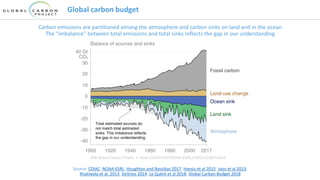
Global carbon budget
Carbon emissions are partitioned among the atmosphere and carbon sinks on land and in the ocean
The “imbalance” between total emissions and total sinks reflects the gap in our understanding
Source: CDIAC; NOAA-ESRL; Houghton and Nassikas 2017; Hansis et al 2015; Joos et al 2013;
Khatiwala et al. 2013; DeVries 2014; Le Quéré et al 2018; Global Carbon Budget 2018
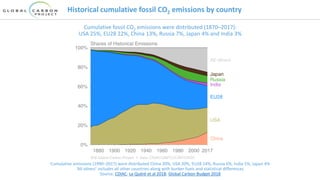
Historical cumulative fossil CO2 emissions by country
Cumulative fossil CO2 emissions were distributed (1870–2017):
USA 25%, EU28 22%, China 13%, Russia 7%, Japan 4% and India 3%
Cumulative emissions (1990–2017) were distributed China 20%, USA 20%, EU28 14%, Russia 6%, India 5%, Japan 4%
‘All others’ includes all other countries along with bunker fuels and statistical differences
Source: CDIAC; Le Quéré et al 2018; Global Carbon Budget 2018
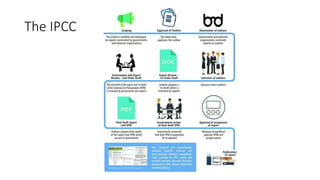
The IPCC
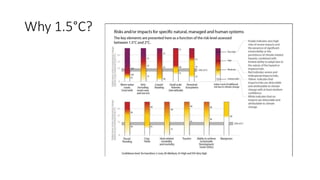
Why 1.5°C?
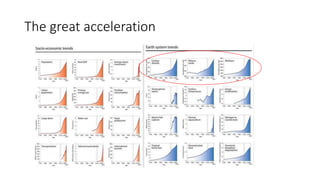
The great acceleration
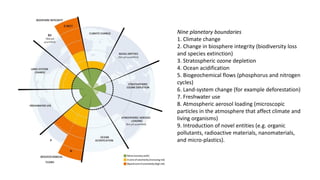
Nine planetary boundaries
1. Climate change
2. Change in biosphere integrity (biodiversity loss
and species extinction)
3. Stratospheric ozone depletion
4. Ocean acidification
5. Biogeochemical flows (phosphorus and nitrogen
cycles)
6. Land-system change (for example deforestation)
7. Freshwater use
8. Atmospheric aerosol loading (microscopic
particles in the atmosphere that affect climate and
living organisms)
9. Introduction of novel entities (e.g. organic
pollutants, radioactive materials, nanomaterials,
and micro-plastics).
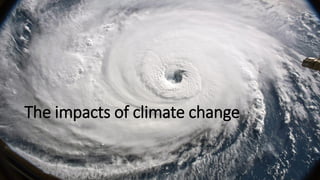
The impacts of climate change
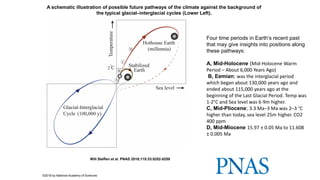
A schematic illustration of possible future pathways of the climate against the background of
the typical glacial–interglacial cycles (Lower Left).
Will Steffen et al. PNAS 2018;115:33:8252-8259
©2018 by National Academy of Sciences
Four time periods in Earth’s recent past
that may give insights into positions along
these pathways:
A, Mid-Holocene (Mid-Holocene Warm
Period – About 6,000 Years Ago)
B, Eemian; was the interglacial period
which began about 130,000 years ago and
ended about 115,000 years ago at the
beginning of the Last Glacial Period. Temp was
1-2°C and Sea level was 6-9m higher.
C, Mid-Pliocene; 3.3 Ma–3 Ma was 2–3 °C
higher than today, sea level 25m higher. CO2
400 ppm
D, Mid-Miocene 15.97 ± 0.05 Ma to 11.608
± 0.005 Ma
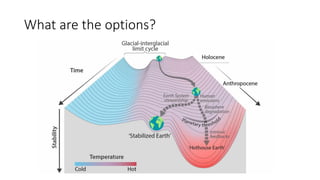
What are the options?
The direct consequences of man-​made
climate change include:
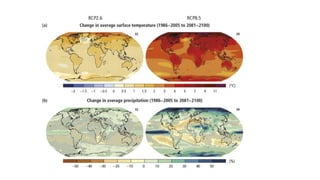
• rising maximum temperatures
• rising minimum temperatures
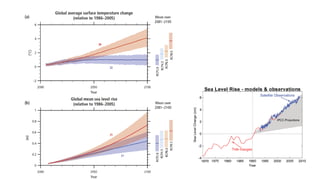
• rising sea levels
• higher ocean temperatures
• an increase in heavy precipitation (heavy rain and hail)
• shrinking glaciers
• thawing permafrost
The indirect consequences of climate change, which
directly affect us humans and our environment, include:
• an increase in hunger and water crises, especially in developing countries
• health risks through rising air temperatures and heatwaves
• economic implications of dealing with secondary damage related to
climate change
• increasing spread of pests and pathogens
• loss of biodiversity due to limited adaptability and adaptability speed of
flora and fauna
• ocean acidification due to increased HCO3 concentrations in the water as
a consequence of increased CO₂ concentrations
• the need for adaptation in all areas (e.g. agriculture, forestry, energy,
infrastructure, tourism, etc.)
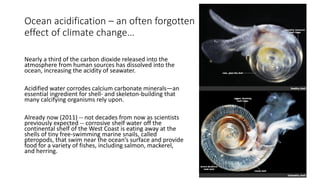
Ocean acidification – an often forgotten
effect of climate change…
Nearly a third of the carbon dioxide released into the
atmosphere from human sources has dissolved into the
ocean, increasing the acidity of seawater.
Acidified water corrodes calcium carbonate minerals—an
essential ingredient for shell- and skeleton-building that
many calcifying organisms rely upon.
Already now (2011) -- not decades from now as scientists
previously expected -- corrosive shelf water off the
continental shelf of the West Coast is eating away at the
shells of tiny free-swimming marine snails, called
pteropods, that swim near the ocean’s surface and provide
food for a variety of fishes, including salmon, mackerel,
and herring.
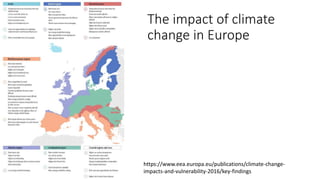
The impact of climate
change in Europe
https://www.eea.europa.eu/publications/climate-change-
impacts-and-vulnerability-2016/key-findings
Consequences for Europe
• Southern and central Europe are seeing more frequent heat waves,
forest fires and droughts.
• The Mediterranean area is becoming drier, making it even more
vulnerable to drought and wildfires.
• Northern Europe is getting significantly wetter, and winter floods
could become common.
• Urban areas, where 4 out of 5 Europeans now live, are exposed to
heat waves, flooding or rising sea levels, but are often ill-equipped for
adapting to climate change.
Risks for human health
• There has been an increase in the number of heat-related deaths in
some regions and a decrease in cold-related deaths in others.
• We are already seeing changes in the distribution of some water-
borne illnesses and disease vectors.
Climate Change Scenarios
Representative Concentration Pathway (RCP)
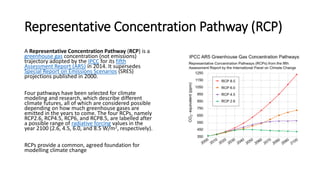
A Representative Concentration Pathway (RCP) is a
greenhouse gas concentration (not emissions)
trajectory adopted by the IPCC for its fifth
Assessment Report (AR5) in 2014. It supersedes
Special Report on Emissions Scenarios (SRES)
projections published in 2000.
Four pathways have been selected for climate
modeling and research, which describe different
climate futures, all of which are considered possible
depending on how much greenhouse gases are
emitted in the years to come. The four RCPs, namely
RCP2.6, RCP4.5, RCP6, and RCP8.5, are labelled after
a possible range of radiative forcing values in the
year 2100 (2.6, 4.5, 6.0, and 8.5 W/m2, respectively).
RCPs provide a common, agreed foundation for
modelling climate change
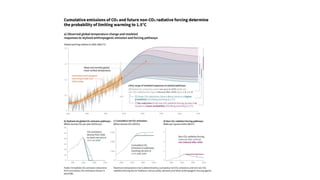
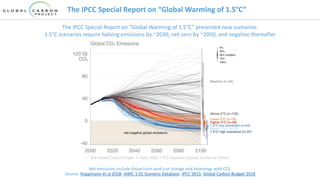
The IPCC Special Report on “Global Warming of 1.5°C”
Net emissions include those from land-use change and bioenergy with CCS.
Source: Huppmann et al 2018; IAMC 1.5C Scenario Database; IPCC SR15; Global Carbon Budget 2018
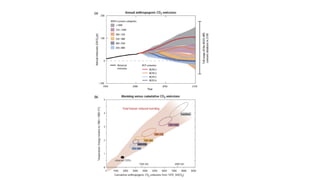
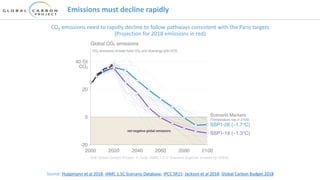
The IPCC Special Report on “Global Warming of 1.5°C” presented new scenarios:
1.5°C scenarios require halving emissions by ~2030, net-zero by ~2050, and negative thereafter
Shared Socioeconomic Pathways (SSPs)
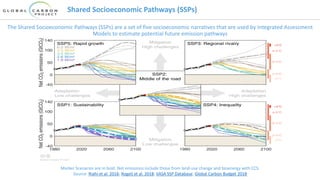
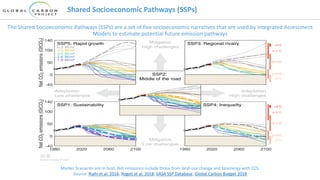
The Shared Socioeconomic Pathways (SSPs) are a set of five socioeconomic narratives that are used by Integrated Assessment
Models to estimate potential future emission pathways
Marker Scenarios are in bold. Net emissions include those from land-use change and bioenergy with CCS.
Source: Riahi et al. 2016; Rogelj et al. 2018; IIASA SSP Database; Global Carbon Budget 2018
Shared Socioeconomic Pathways
• Over the past few years, an international team of climate scientists,
economists and energy systems modellers have built a range of new
“pathways” that examine how global society, demographics and
economics might change over the next century. They are collectively k
• The new SSPs offer five pathways that the world could take.
Compared to previous scenarios, these offer a broader view of a
“business as usual” world without future climate policy, with global
warming in 2100 ranging from a low of 3.1C to a high of 5.1C above
pre-industrial levels. nown as the “Shared Socioeconomic Pathways”
(SSPs).
Emissions must decline rapidly
CO2 emissions need to rapidly decline to follow pathways consistent with the Paris targets
(Projection for 2018 emissions in red)
Source: Huppmann et al 2018; IAMC 1.5C Scenario Database; IPCC SR15; Jackson et al 2018; Global Carbon Budget 2018
Models & Scenarios
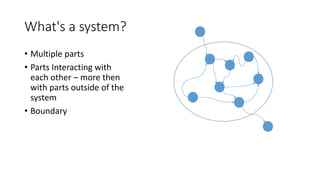
What's a system?
• Multiple parts
• Parts Interacting with
each other – more then
with parts outside of the
system
• Boundary
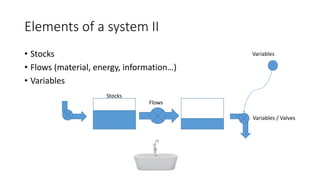
Elements of a system II
• Stocks
• Flows (material, energy, information…)
• Variables
Stocks
Flows
Variables / Valves
Variables
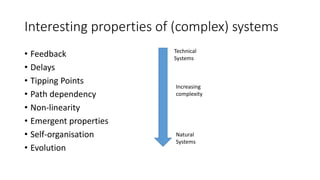
Interesting properties of (complex) systems
• Feedback
• Delays
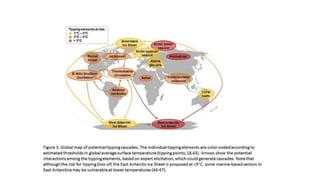
• Tipping Points
• Path dependency
• Non-linearity
• Emergent properties
• Self-organisation
• Evolution
Increasing
complexity
Technical
Systems
Natural
Systems
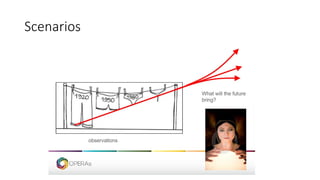
Scenarios
Scenario Exercise
Grab one of the questions and take three minutes to think about an
answer.
Scenario Exercise
• How will your live look like in 20 Years?
• How will the world look like in 20 Years and how will you live in it?
• How do you want to live in 20 years?
• How would you like the world to look like in 20 years and what has to
happen to get there?
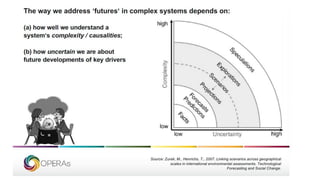
The problem with studying the future:
• We cant observe it
• We know that it will be different (probably)
• We can not use traditional scientific methods
• We need a set of tools to tackle the unknowns and the uncertainties
of the future
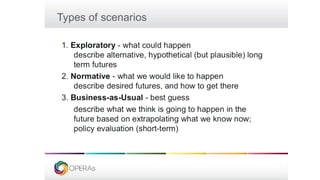
What are scenarios?
• A tool to address uncertainty
• Presented through stories or narratives
• Describing drivers of change – social, economic, policy, technology,
governance,…
• They may be both qualitative (narratives) and quantitative (models)
• They are no predictions
SSP1: Sustainability – Taking the Green Road
(Low challenges to mitigation and adaptation)
The world shifts gradually, but pervasively, toward a more sustainable
path, emphasizing more inclusive development that respects
perceived environmental boundaries.
Management of the global commons slowly improves, educational and
health investments accelerate the demographic transition, and the
emphasis on economic growth shifts toward a broader emphasis on
human well-being.
Driven by an increasing commitment to achieving development goals,
inequality is reduced both across and within countries. Consumption is
oriented toward low material growth and lower resource and energy
intensity.
SSP2: Middle of the Road (Medium challenges
to mitigation and adaptation)
The world follows a path in which social, economic, and technological trends
do not shift markedly from historical patterns.
Development and income growth proceeds unevenly, with some countries
making relatively good progress while others fall short of expectations.
Global and national institutions work toward but make slow progress in
achieving sustainable development goals. Environmental systems experience
degradation, although there are some improvements and overall the
intensity of resource and energy use declines.
Global population growth is moderate and levels off in the second half of the
century. Income inequality persists or improves only slowly and challenges to
reducing vulnerability to societal and environmental changes remain.
SSP3: Regional Rivalry – A Rocky Road (High
challenges to mitigation and adaptation)
A resurgent nationalism, concerns about competitiveness and security, and regional
conflicts push countries to increasingly focus on domestic or, at most, regional
issues.
Policies shift over time to become increasingly oriented toward national and
regional security issues. Countries focus on achieving energy and food security
goals within their own regions at the expense of broader-based development.
Investments in education and technological development decline. Economic
development is slow, consumption is material-intensive, and inequalities persist
or worsen over time.
Population growth is low in industrialized and high in developing countries. A low
international priority for addressing environmental concerns leads to strong
environmental degradation in some regions.
SSP4: Inequality – A Road Divided (Low challenges
to mitigation, high challenges to adaptation)
Highly unequal investments in human capital, combined with increasing disparities
in economic opportunity and political power, lead to increasing inequalities and
stratification both across and within countries.
Over time, a gap widens between an internationally-connected society that
contributes to knowledge- and capital-intensive sectors of the global economy, and
a fragmented collection of lower-income, poorly educated societies that work in a
labor intensive, low-tech economy.
Social cohesion degrades and conflict and unrest become increasingly common.
Technology development is high in the high-tech economy and sectors. The
globally connected energy sector diversifies, with investments in both carbon-
intensive fuels like coal and unconventional oil, but also low-carbon energy sources.
Environmental policies focus on local issues around middle and high income areas.
SSP5: Fossil-fueled Development – Taking the
Highway (High challenges to mitigation, low
challenges to adaptation)
This world places increasing faith in competitive markets, innovation and
participatory societies to produce rapid technological progress and development of
human capital as the path to sustainable development.
Global markets are increasingly integrated. There are also strong investments in
health, education, and institutions to enhance human and social capital.
At the same time, the push for economic and social development is coupled with
the exploitation of abundant fossil fuel resources and the adoption of resource
and energy intensive lifestyles around the world.
All these factors lead to rapid growth of the global economy, while global
population peaks and declines in the 21st century. Local environmental problems
like air pollution are successfully managed. There is faith in the ability to effectively
manage social and ecological systems, including by geo-engineering if necessary.
Integrated assessment models
Researchers employed six different integrated assessment models
(IAMs) to translate the socioeconomic conditions of the SSPs into
estimates of future energy use characteristics and greenhouse gas
emissions.
IAMs add aspects of society to an energy systems model, simulating
how population, economic growth and energy use affect – and interact
with – the physical climate.
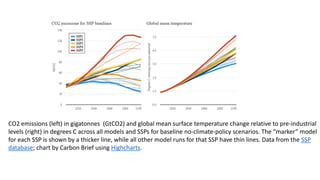
CO2 emissions (left) in gigatonnes (GtCO2) and global mean surface temperature change relative to pre-industrial
levels (right) in degrees C across all models and SSPs for baseline no-climate-policy scenarios. The “marker” model
for each SSP is shown by a thicker line, while all other model runs for that SSP have thin lines. Data from the SSP
database; chart by Carbon Brief using Highcharts.
Shared Socioeconomic Pathways (SSPs)
The Shared Socioeconomic Pathways (SSPs) are a set of five socioeconomic narratives that are used by Integrated Assessment
Models to estimate potential future emission pathways
Marker Scenarios are in bold. Net emissions include those from land-use change and bioenergy with CCS.
Source: Riahi et al. 2016; Rogelj et al. 2018; IIASA SSP Database; Global Carbon Budget 2018
Modelling Exercise (about 45 min)
1.) what are the most important factors influencing climate change?
-> make a List (5min)
2.) Groups of 3: Identify the 20 most important elements on your three
lists. How do those elements influence each other? Use arrows and +
(positive influence) or – (negative influence) to draw a causal map.
(15min)
3.) Unite with another group – take a flipchart and come up with a
common causal model about factors influencing climate change.
(15min)
4.) Present your model and the reasoning behind it. (3 min each)
Understanding Society and Nature
interactions

Global climate change unit 2

  • 1.
    Understanding Climate changeII Welcome to the Anthropocene • Interactions with the climate system • Modelling & Scenarios • Introduction to Socio-Ecological concepts – societal metabolism, transformations, socio-ecological systems
  • 3.
    Global carbon budget Carbonemissions are partitioned among the atmosphere and carbon sinks on land and in the ocean The “imbalance” between total emissions and total sinks reflects the gap in our understanding Source: CDIAC; NOAA-ESRL; Houghton and Nassikas 2017; Hansis et al 2015; Joos et al 2013; Khatiwala et al. 2013; DeVries 2014; Le Quéré et al 2018; Global Carbon Budget 2018
  • 4.
    Historical cumulative fossilCO2 emissions by country Cumulative fossil CO2 emissions were distributed (1870–2017): USA 25%, EU28 22%, China 13%, Russia 7%, Japan 4% and India 3% Cumulative emissions (1990–2017) were distributed China 20%, USA 20%, EU28 14%, Russia 6%, India 5%, Japan 4% ‘All others’ includes all other countries along with bunker fuels and statistical differences Source: CDIAC; Le Quéré et al 2018; Global Carbon Budget 2018
  • 5.
  • 7.
  • 8.
  • 9.
    Nine planetary boundaries 1.Climate change 2. Change in biosphere integrity (biodiversity loss and species extinction) 3. Stratospheric ozone depletion 4. Ocean acidification 5. Biogeochemical flows (phosphorus and nitrogen cycles) 6. Land-system change (for example deforestation) 7. Freshwater use 8. Atmospheric aerosol loading (microscopic particles in the atmosphere that affect climate and living organisms) 9. Introduction of novel entities (e.g. organic pollutants, radioactive materials, nanomaterials, and micro-plastics).
  • 10.
    The impacts ofclimate change
  • 11.
    A schematic illustrationof possible future pathways of the climate against the background of the typical glacial–interglacial cycles (Lower Left). Will Steffen et al. PNAS 2018;115:33:8252-8259 ©2018 by National Academy of Sciences Four time periods in Earth’s recent past that may give insights into positions along these pathways: A, Mid-Holocene (Mid-Holocene Warm Period – About 6,000 Years Ago) B, Eemian; was the interglacial period which began about 130,000 years ago and ended about 115,000 years ago at the beginning of the Last Glacial Period. Temp was 1-2°C and Sea level was 6-9m higher. C, Mid-Pliocene; 3.3 Ma–3 Ma was 2–3 °C higher than today, sea level 25m higher. CO2 400 ppm D, Mid-Miocene 15.97 ± 0.05 Ma to 11.608 ± 0.005 Ma
  • 12.
    What are theoptions?
  • 13.
    The direct consequencesof man-​made climate change include: • rising maximum temperatures • rising minimum temperatures • rising sea levels • higher ocean temperatures • an increase in heavy precipitation (heavy rain and hail) • shrinking glaciers • thawing permafrost
  • 14.
    The indirect consequencesof climate change, which directly affect us humans and our environment, include: • an increase in hunger and water crises, especially in developing countries • health risks through rising air temperatures and heatwaves • economic implications of dealing with secondary damage related to climate change • increasing spread of pests and pathogens • loss of biodiversity due to limited adaptability and adaptability speed of flora and fauna • ocean acidification due to increased HCO3 concentrations in the water as a consequence of increased CO₂ concentrations • the need for adaptation in all areas (e.g. agriculture, forestry, energy, infrastructure, tourism, etc.)
  • 15.
    Ocean acidification –an often forgotten effect of climate change… Nearly a third of the carbon dioxide released into the atmosphere from human sources has dissolved into the ocean, increasing the acidity of seawater. Acidified water corrodes calcium carbonate minerals—an essential ingredient for shell- and skeleton-building that many calcifying organisms rely upon. Already now (2011) -- not decades from now as scientists previously expected -- corrosive shelf water off the continental shelf of the West Coast is eating away at the shells of tiny free-swimming marine snails, called pteropods, that swim near the ocean’s surface and provide food for a variety of fishes, including salmon, mackerel, and herring.
  • 16.
    The impact ofclimate change in Europe https://www.eea.europa.eu/publications/climate-change- impacts-and-vulnerability-2016/key-findings
  • 17.
    Consequences for Europe •Southern and central Europe are seeing more frequent heat waves, forest fires and droughts. • The Mediterranean area is becoming drier, making it even more vulnerable to drought and wildfires. • Northern Europe is getting significantly wetter, and winter floods could become common. • Urban areas, where 4 out of 5 Europeans now live, are exposed to heat waves, flooding or rising sea levels, but are often ill-equipped for adapting to climate change.
  • 18.
    Risks for humanhealth • There has been an increase in the number of heat-related deaths in some regions and a decrease in cold-related deaths in others. • We are already seeing changes in the distribution of some water- borne illnesses and disease vectors.
  • 19.
  • 22.
    Representative Concentration Pathway(RCP) A Representative Concentration Pathway (RCP) is a greenhouse gas concentration (not emissions) trajectory adopted by the IPCC for its fifth Assessment Report (AR5) in 2014. It supersedes Special Report on Emissions Scenarios (SRES) projections published in 2000. Four pathways have been selected for climate modeling and research, which describe different climate futures, all of which are considered possible depending on how much greenhouse gases are emitted in the years to come. The four RCPs, namely RCP2.6, RCP4.5, RCP6, and RCP8.5, are labelled after a possible range of radiative forcing values in the year 2100 (2.6, 4.5, 6.0, and 8.5 W/m2, respectively). RCPs provide a common, agreed foundation for modelling climate change
  • 27.
    The IPCC SpecialReport on “Global Warming of 1.5°C” Net emissions include those from land-use change and bioenergy with CCS. Source: Huppmann et al 2018; IAMC 1.5C Scenario Database; IPCC SR15; Global Carbon Budget 2018 The IPCC Special Report on “Global Warming of 1.5°C” presented new scenarios: 1.5°C scenarios require halving emissions by ~2030, net-zero by ~2050, and negative thereafter
  • 28.
    Shared Socioeconomic Pathways(SSPs) The Shared Socioeconomic Pathways (SSPs) are a set of five socioeconomic narratives that are used by Integrated Assessment Models to estimate potential future emission pathways Marker Scenarios are in bold. Net emissions include those from land-use change and bioenergy with CCS. Source: Riahi et al. 2016; Rogelj et al. 2018; IIASA SSP Database; Global Carbon Budget 2018
  • 29.
    Shared Socioeconomic Pathways •Over the past few years, an international team of climate scientists, economists and energy systems modellers have built a range of new “pathways” that examine how global society, demographics and economics might change over the next century. They are collectively k • The new SSPs offer five pathways that the world could take. Compared to previous scenarios, these offer a broader view of a “business as usual” world without future climate policy, with global warming in 2100 ranging from a low of 3.1C to a high of 5.1C above pre-industrial levels. nown as the “Shared Socioeconomic Pathways” (SSPs).
  • 30.
    Emissions must declinerapidly CO2 emissions need to rapidly decline to follow pathways consistent with the Paris targets (Projection for 2018 emissions in red) Source: Huppmann et al 2018; IAMC 1.5C Scenario Database; IPCC SR15; Jackson et al 2018; Global Carbon Budget 2018
  • 31.
  • 32.
    What's a system? •Multiple parts • Parts Interacting with each other – more then with parts outside of the system • Boundary
  • 33.
    Elements of asystem II • Stocks • Flows (material, energy, information…) • Variables Stocks Flows Variables / Valves Variables
  • 34.
    Interesting properties of(complex) systems • Feedback • Delays • Tipping Points • Path dependency • Non-linearity • Emergent properties • Self-organisation • Evolution Increasing complexity Technical Systems Natural Systems
  • 35.
  • 36.
    Scenario Exercise Grab oneof the questions and take three minutes to think about an answer.
  • 37.
    Scenario Exercise • Howwill your live look like in 20 Years? • How will the world look like in 20 Years and how will you live in it? • How do you want to live in 20 years? • How would you like the world to look like in 20 years and what has to happen to get there?
  • 38.
    The problem withstudying the future: • We cant observe it • We know that it will be different (probably) • We can not use traditional scientific methods • We need a set of tools to tackle the unknowns and the uncertainties of the future
  • 40.
    What are scenarios? •A tool to address uncertainty • Presented through stories or narratives • Describing drivers of change – social, economic, policy, technology, governance,… • They may be both qualitative (narratives) and quantitative (models) • They are no predictions
  • 43.
    SSP1: Sustainability –Taking the Green Road (Low challenges to mitigation and adaptation) The world shifts gradually, but pervasively, toward a more sustainable path, emphasizing more inclusive development that respects perceived environmental boundaries. Management of the global commons slowly improves, educational and health investments accelerate the demographic transition, and the emphasis on economic growth shifts toward a broader emphasis on human well-being. Driven by an increasing commitment to achieving development goals, inequality is reduced both across and within countries. Consumption is oriented toward low material growth and lower resource and energy intensity.
  • 44.
    SSP2: Middle ofthe Road (Medium challenges to mitigation and adaptation) The world follows a path in which social, economic, and technological trends do not shift markedly from historical patterns. Development and income growth proceeds unevenly, with some countries making relatively good progress while others fall short of expectations. Global and national institutions work toward but make slow progress in achieving sustainable development goals. Environmental systems experience degradation, although there are some improvements and overall the intensity of resource and energy use declines. Global population growth is moderate and levels off in the second half of the century. Income inequality persists or improves only slowly and challenges to reducing vulnerability to societal and environmental changes remain.
  • 45.
    SSP3: Regional Rivalry– A Rocky Road (High challenges to mitigation and adaptation) A resurgent nationalism, concerns about competitiveness and security, and regional conflicts push countries to increasingly focus on domestic or, at most, regional issues. Policies shift over time to become increasingly oriented toward national and regional security issues. Countries focus on achieving energy and food security goals within their own regions at the expense of broader-based development. Investments in education and technological development decline. Economic development is slow, consumption is material-intensive, and inequalities persist or worsen over time. Population growth is low in industrialized and high in developing countries. A low international priority for addressing environmental concerns leads to strong environmental degradation in some regions.
  • 46.
    SSP4: Inequality –A Road Divided (Low challenges to mitigation, high challenges to adaptation) Highly unequal investments in human capital, combined with increasing disparities in economic opportunity and political power, lead to increasing inequalities and stratification both across and within countries. Over time, a gap widens between an internationally-connected society that contributes to knowledge- and capital-intensive sectors of the global economy, and a fragmented collection of lower-income, poorly educated societies that work in a labor intensive, low-tech economy. Social cohesion degrades and conflict and unrest become increasingly common. Technology development is high in the high-tech economy and sectors. The globally connected energy sector diversifies, with investments in both carbon- intensive fuels like coal and unconventional oil, but also low-carbon energy sources. Environmental policies focus on local issues around middle and high income areas.
  • 47.
    SSP5: Fossil-fueled Development– Taking the Highway (High challenges to mitigation, low challenges to adaptation) This world places increasing faith in competitive markets, innovation and participatory societies to produce rapid technological progress and development of human capital as the path to sustainable development. Global markets are increasingly integrated. There are also strong investments in health, education, and institutions to enhance human and social capital. At the same time, the push for economic and social development is coupled with the exploitation of abundant fossil fuel resources and the adoption of resource and energy intensive lifestyles around the world. All these factors lead to rapid growth of the global economy, while global population peaks and declines in the 21st century. Local environmental problems like air pollution are successfully managed. There is faith in the ability to effectively manage social and ecological systems, including by geo-engineering if necessary.
  • 48.
    Integrated assessment models Researchersemployed six different integrated assessment models (IAMs) to translate the socioeconomic conditions of the SSPs into estimates of future energy use characteristics and greenhouse gas emissions. IAMs add aspects of society to an energy systems model, simulating how population, economic growth and energy use affect – and interact with – the physical climate.
  • 50.
    CO2 emissions (left)in gigatonnes (GtCO2) and global mean surface temperature change relative to pre-industrial levels (right) in degrees C across all models and SSPs for baseline no-climate-policy scenarios. The “marker” model for each SSP is shown by a thicker line, while all other model runs for that SSP have thin lines. Data from the SSP database; chart by Carbon Brief using Highcharts.
  • 51.
    Shared Socioeconomic Pathways(SSPs) The Shared Socioeconomic Pathways (SSPs) are a set of five socioeconomic narratives that are used by Integrated Assessment Models to estimate potential future emission pathways Marker Scenarios are in bold. Net emissions include those from land-use change and bioenergy with CCS. Source: Riahi et al. 2016; Rogelj et al. 2018; IIASA SSP Database; Global Carbon Budget 2018
  • 52.
    Modelling Exercise (about45 min) 1.) what are the most important factors influencing climate change? -> make a List (5min) 2.) Groups of 3: Identify the 20 most important elements on your three lists. How do those elements influence each other? Use arrows and + (positive influence) or – (negative influence) to draw a causal map. (15min) 3.) Unite with another group – take a flipchart and come up with a common causal model about factors influencing climate change. (15min) 4.) Present your model and the reasoning behind it. (3 min each)
  • 53.
    Understanding Society andNature interactions