Organized by UNEP DTIE sponsored by InWent
Training Programme for Capacity Building in Cleaner Production Centers
Sustainable Consumption & Production: Making the Connection
Integrating
Sustainable Consumption & Production
 What is Sustainable Consumption & Production.
 Need for a practical approach.
UNEP Division of
Objectives
 improve participants understanding of how
sustainable consumption and production are
interrelated.
 demonstrate the tools and strategies that
are available to address this.
 support participants in identifying
opportunities for leveraging sustainable
consumption and production in their
activities.
UNEP Division of
Outline
 Sustainable Consumption
 Cleaner Production
 Integrating Consumption and
Production
 Stakeholder engagement and
future directions
UNEP Division of
What is Sustainable
Consumption?
“…the use of services and products which
respond to basic needs and bring a better
quality of life while minimizing the use of
natural resources and toxic materials as well
as the emissions of waste and pollutants over
the life cycle of the service or product so as to
not jeopardize the needs of future
generations.”
UN CSD, 1995
UNEP Division of
Sustainable Consumption is ...
 more than “consuming green”
 meeting basic needs
 about changing patterns,
not “doing without”
 responsible consumption
consuming differently, efficiently !!
UNEP Division of
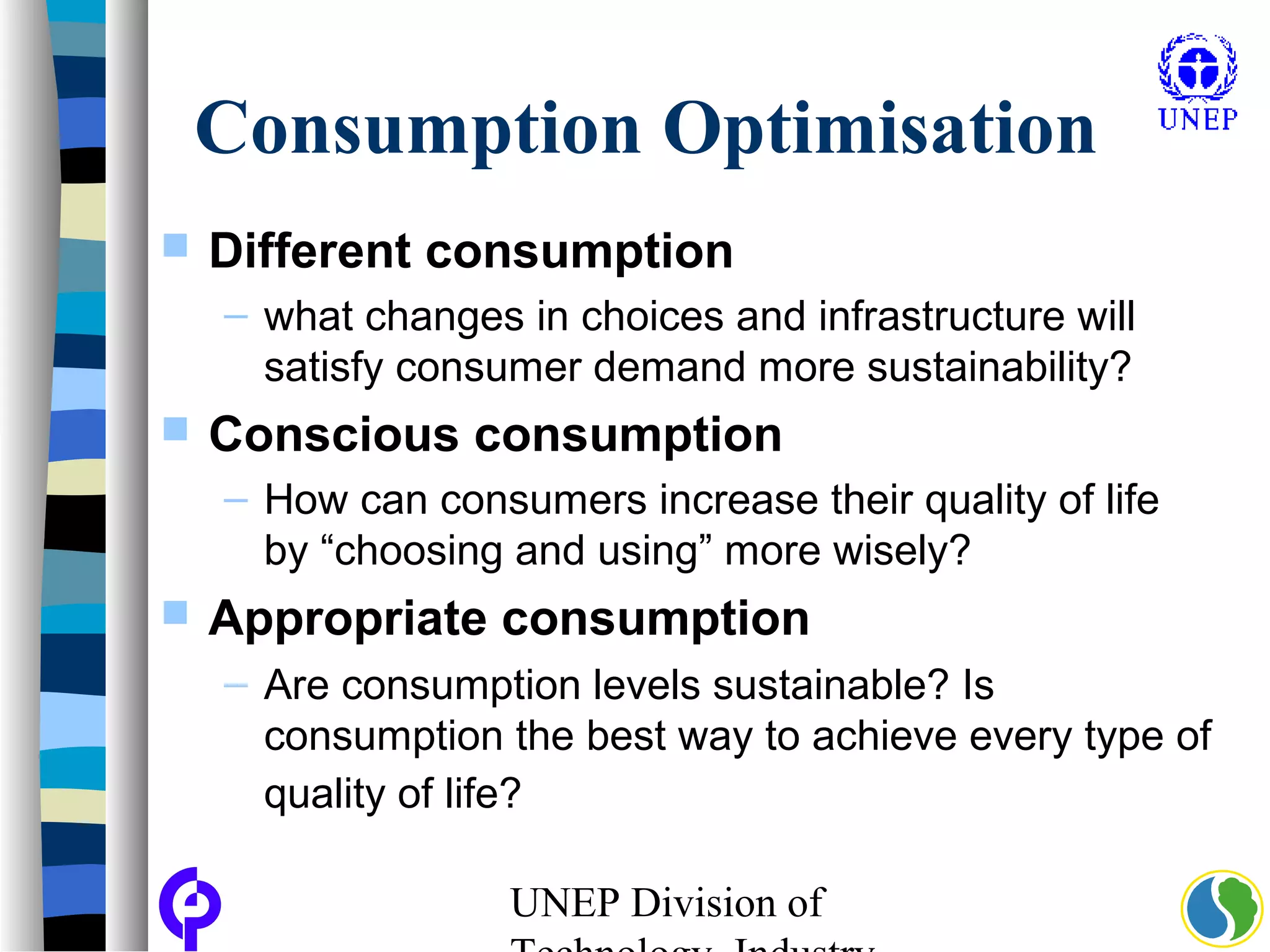
Consumption Optimisation
 Different consumption
– what changes in choices and infrastructure will
satisfy consumer demand more sustainability?
 Conscious consumption
– How can consumers increase their quality of life
by “choosing and using” more wisely?
 Appropriate consumption
– Are consumption levels sustainable? Is
consumption the best way to achieve every type of
quality of life?
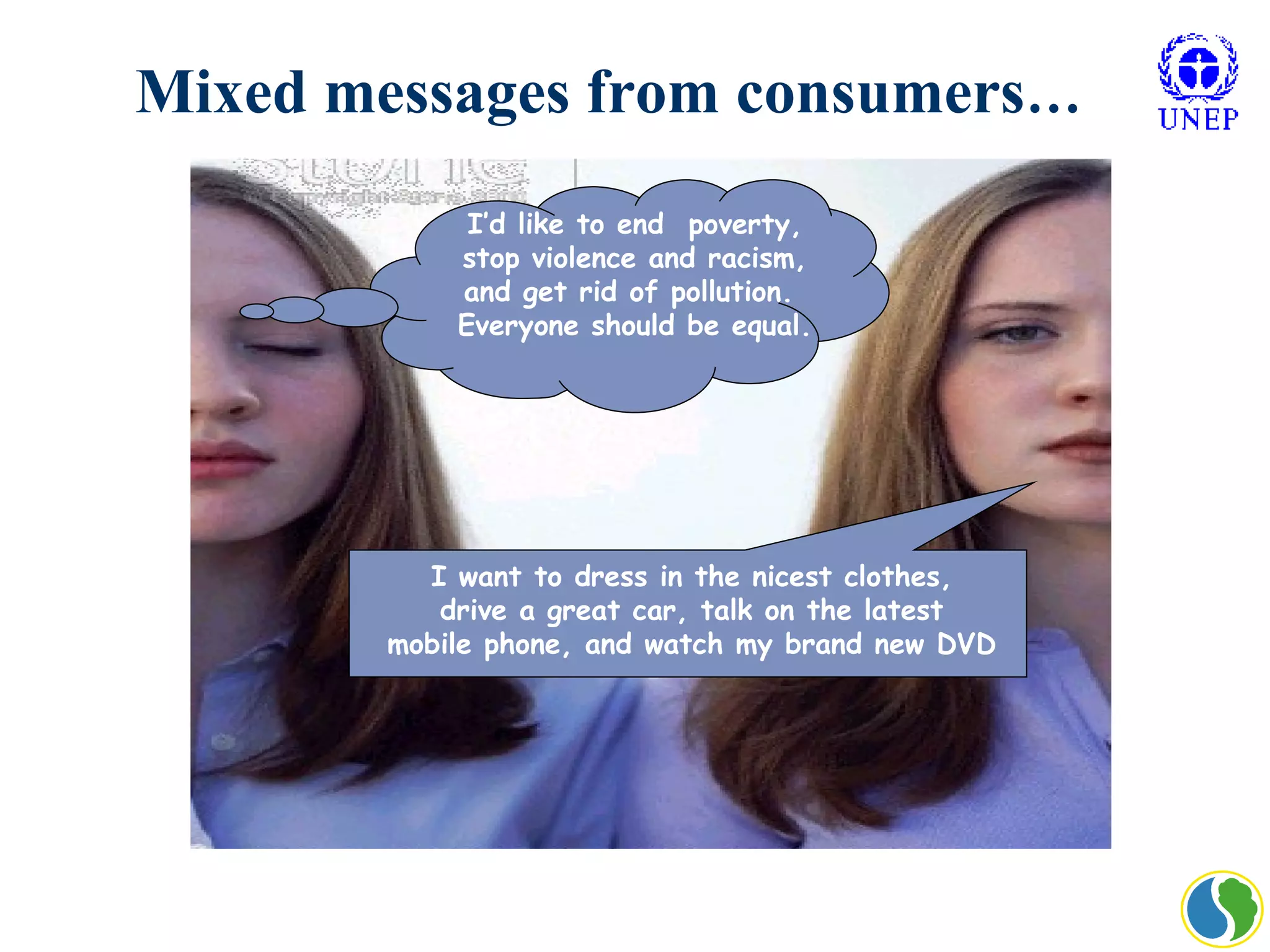
Mixed messages from consumers…
I’d like to end poverty,
stop violence and racism,
and get rid of pollution.
Everyone should be equal.
I want to dress in the nicest clothes,
drive a great car, talk on the latest
mobile phone, and watch my brand new DVD
UNEP Division of
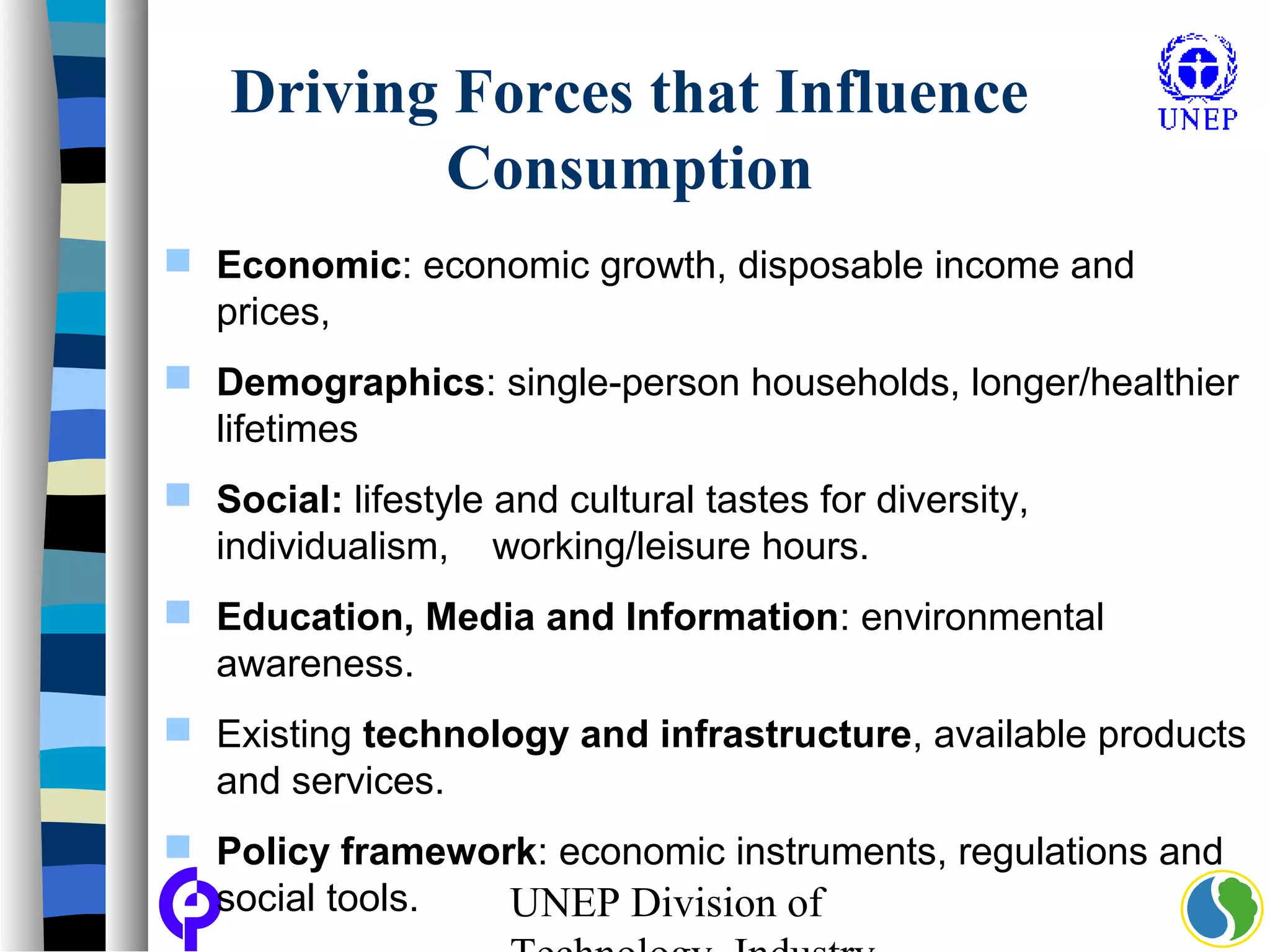
Driving Forces that Influence
Consumption
 Economic: economic growth, disposable income and
prices,
 Demographics: single-person households, longer/healthier
lifetimes
 Social: lifestyle and cultural tastes for diversity,
individualism, working/leisure hours.
 Education, Media and Information: environmental
awareness.
 Existing technology and infrastructure, available products
and services.
 Policy framework: economic instruments, regulations and
social tools.
UNEP Division of
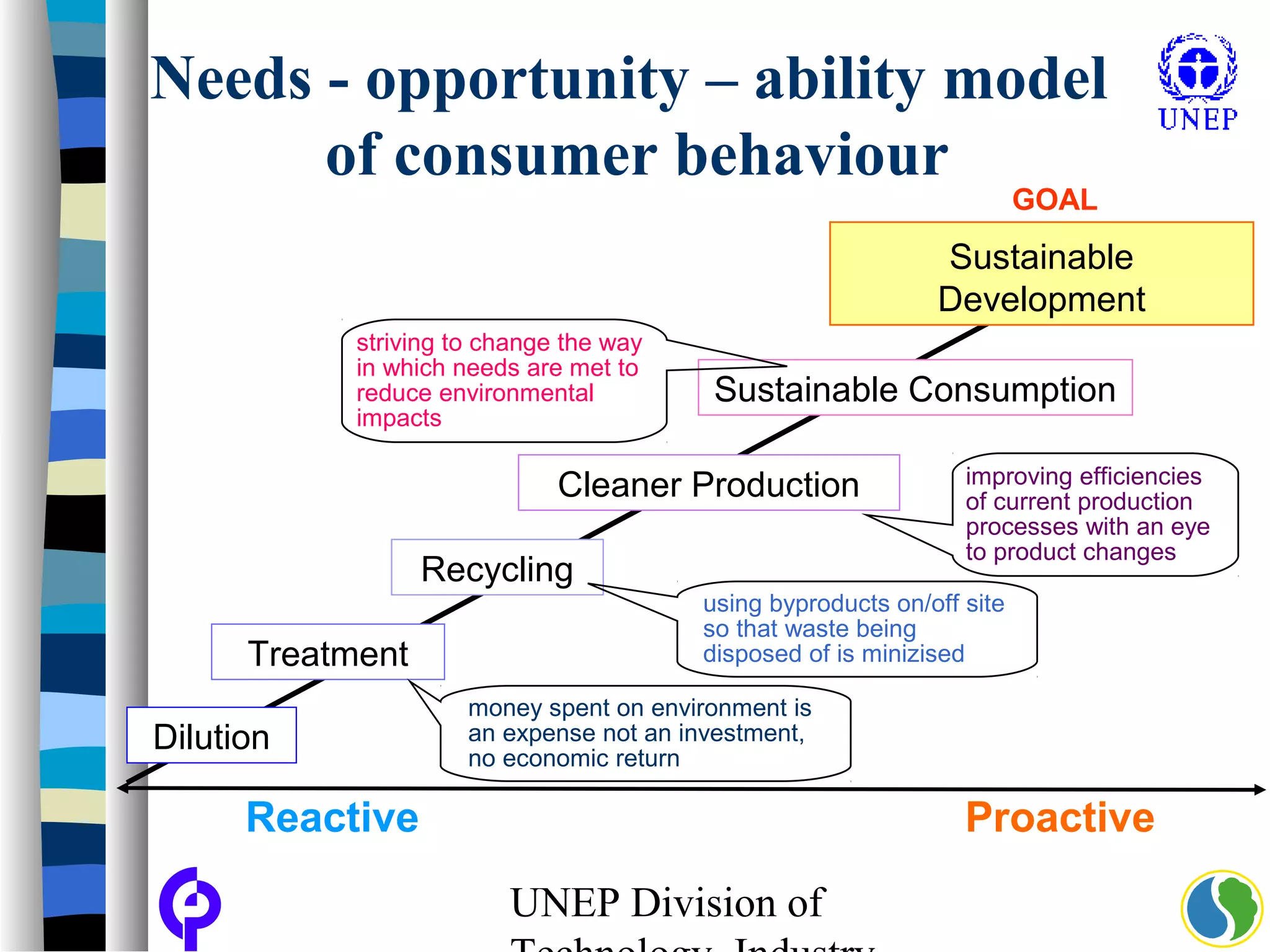
ProactiveReactive
Cleaner Production
Recycling
Treatment
Dilution
Sustainable
Development
Sustainable Consumption
improving efficiencies
of current production
processes with an eye
to product changes
money spent on environment is
an expense not an investment,
no economic return
using byproducts on/off site
so that waste being
disposed of is minizised
striving to change the way
in which needs are met to
reduce environmental
impacts
GOAL
Needs - opportunity – ability model
of consumer behaviour
UNEP Division of
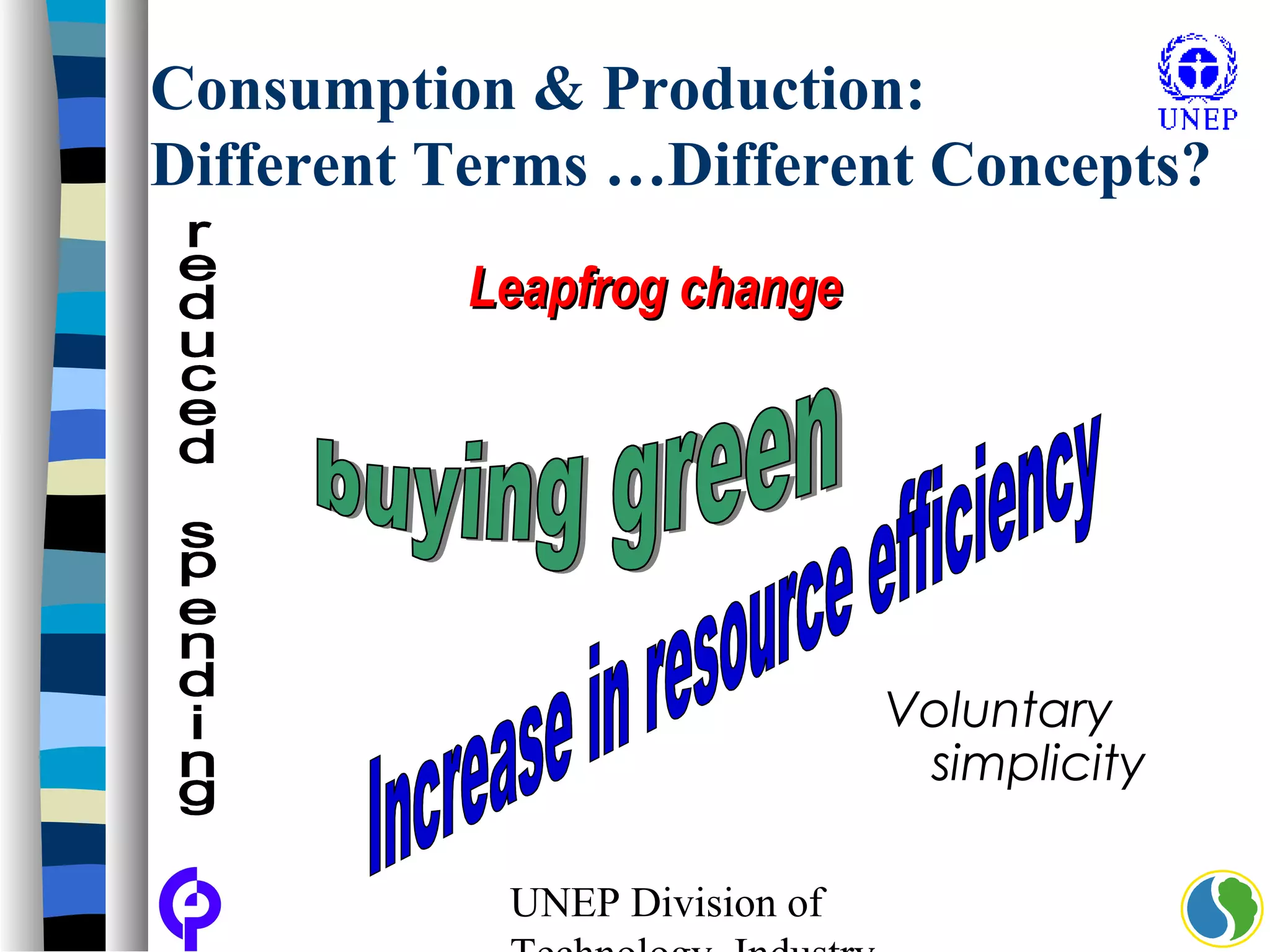
Consumption & Production:
Different Terms …Different Concepts?
Voluntary
simplicity
Leapfrog changeLeapfrog change
UNEP Division of
What is Cleaner Production?
“ Cleaner Production is the continuous
application of an integrated environmental
strategy
to processes, products, and services
to increase overall efficiency,
and reduce risks to humans and the
environment.
Cleaner production can be applied
to the processes used in any industry,
to products themselves and
to various services provided in society”
http://www.uneptie.org/pc/cp/understanding_cp/home.htm
UNEP Division of
What Cleaner Production means for…
 Production processes: conserving raw materials,
water and energy; eliminating toxic and dangerous
raw materials; reducing the quantity and toxicity of all
emissions and wasters at source during the
production process.
 Products: reducing the environmental, health and
safety impacts of products through their entire life
cycle, from raw materials extraction, throughout
manufacturing and use to the “ultimate” disposal of
the product.
 Services: incorporating environmental concerns into
designing and delivering services.
UNEP Division of
Cleaner Production in action
For companies, cleaner production is
implemented via:
 factory and site Cleaner Production audits
 improved maintenance and operational
practices
 equipment modification
 increased recycling
 change to cleaner technologies
 better product design
UNEP Division of
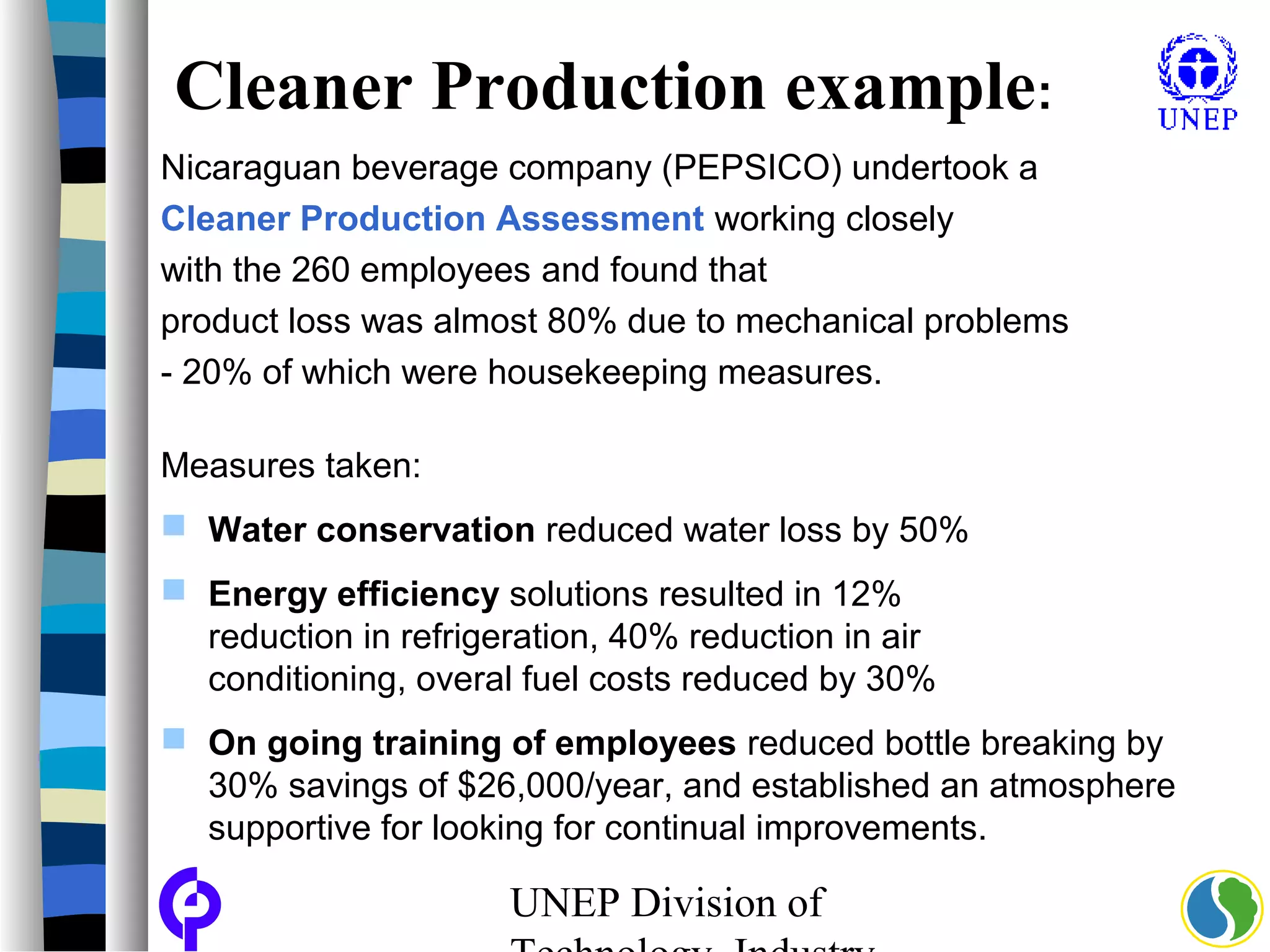
Cleaner Production example:
Nicaraguan beverage company (PEPSICO) undertook a
Cleaner Production Assessment working closely
with the 260 employees and found that
product loss was almost 80% due to mechanical problems
- 20% of which were housekeeping measures.
Measures taken:
 Water conservation reduced water loss by 50%
 Energy efficiency solutions resulted in 12%
reduction in refrigeration, 40% reduction in air
conditioning, overal fuel costs reduced by 30%
 On going training of employees reduced bottle breaking by
30% savings of $26,000/year, and established an atmosphere
supportive for looking for continual improvements.
UNEP Division of
Sustainable Production
There is no
Sustainable Consumption without
and vice versa
UNEP Division of
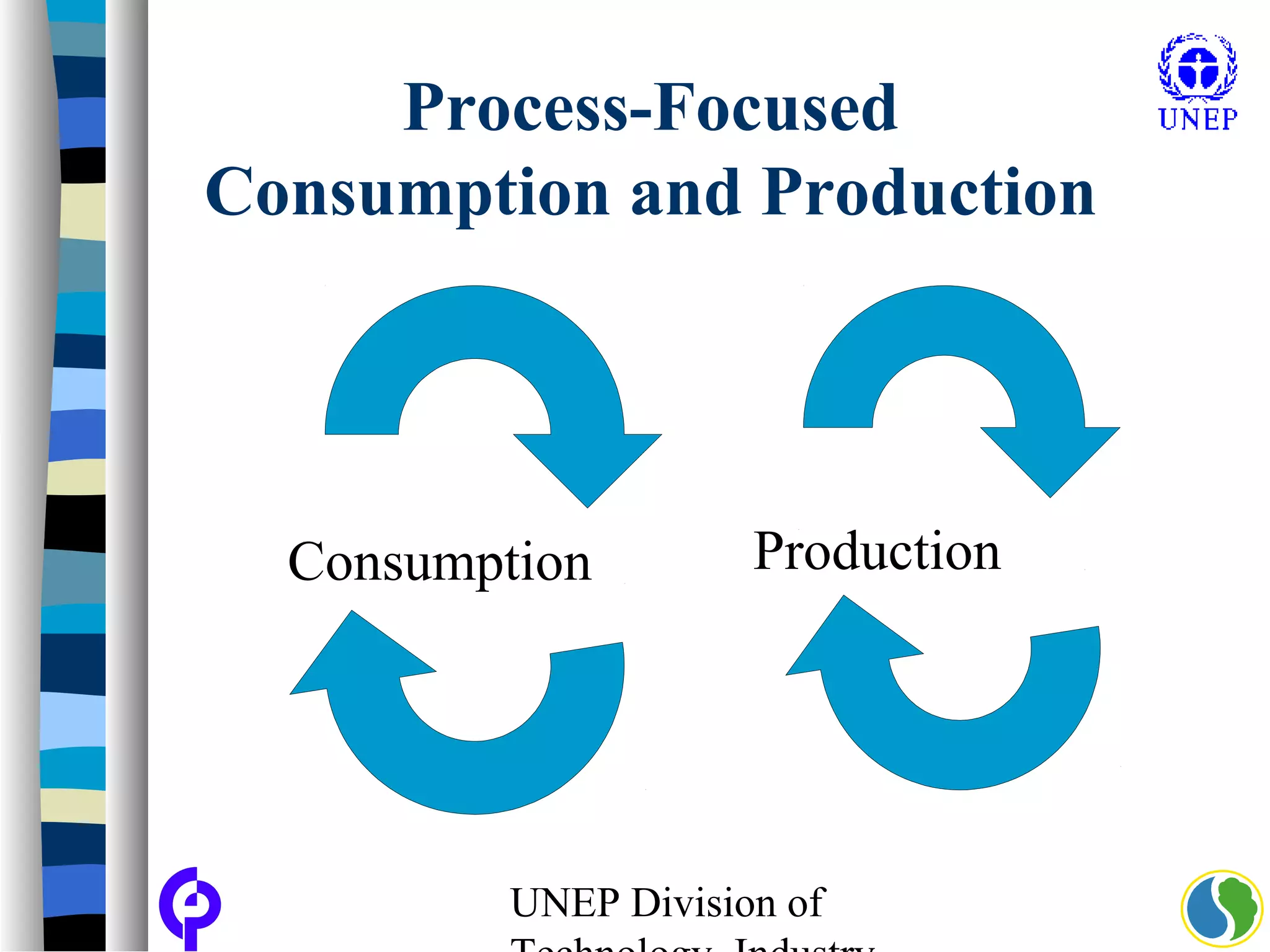
Consumption
Process-Focused
Consumption and Production
Production
UNEP Division of
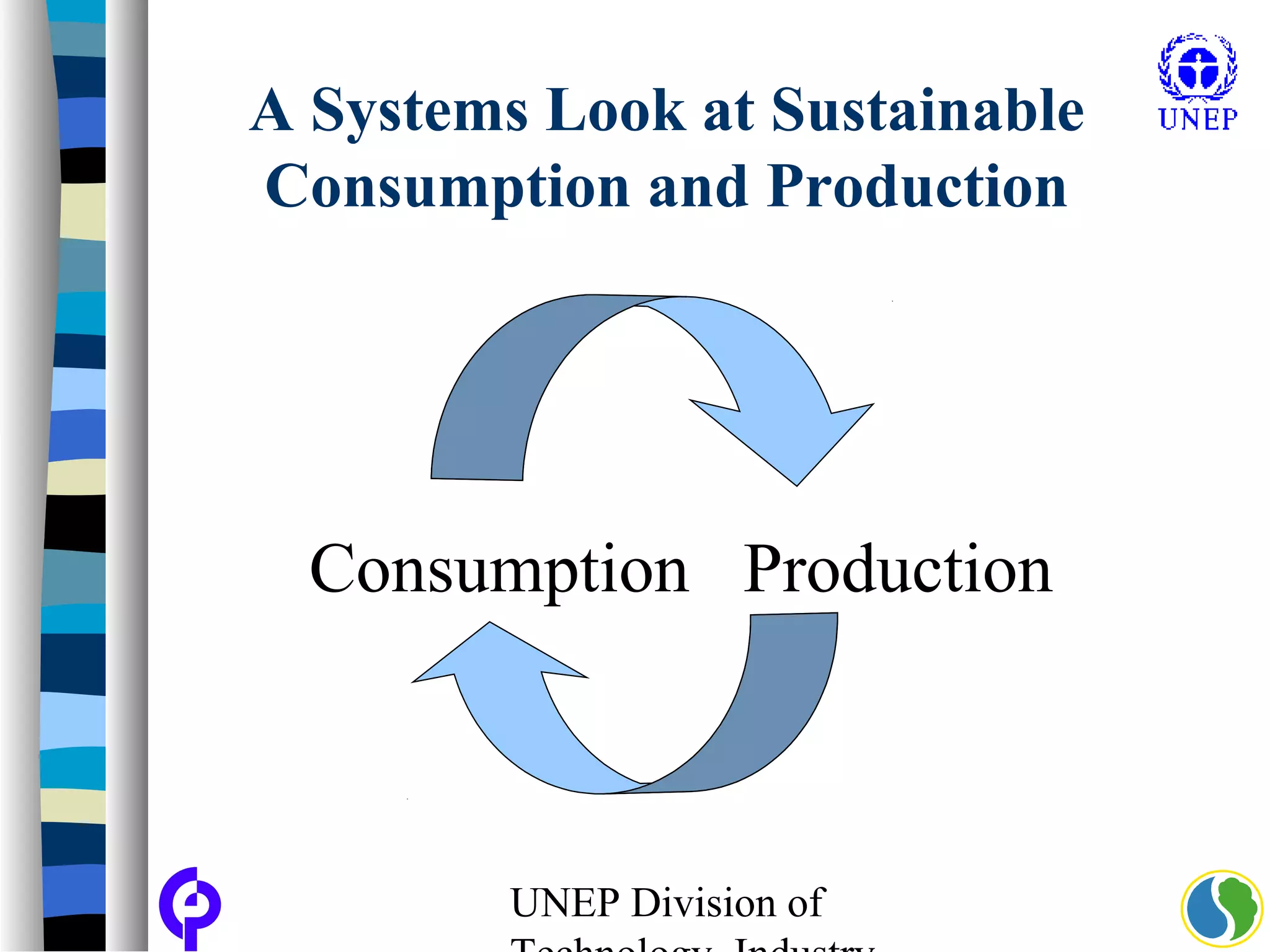
A Systems Look at Sustainable
Consumption and Production
Consumption Production
UNEP Division of
Consumption and production:
integrated issue
“Consumers are increasingly interested in the
world that lies behind the products. They want
to know how and where and by whom the
products have been produced.”
“This increasing awareness is a sign of hope.
Business and governments must build on
that.”
Klaus Toepfer, UNEP Executive Director
UNEP Division of
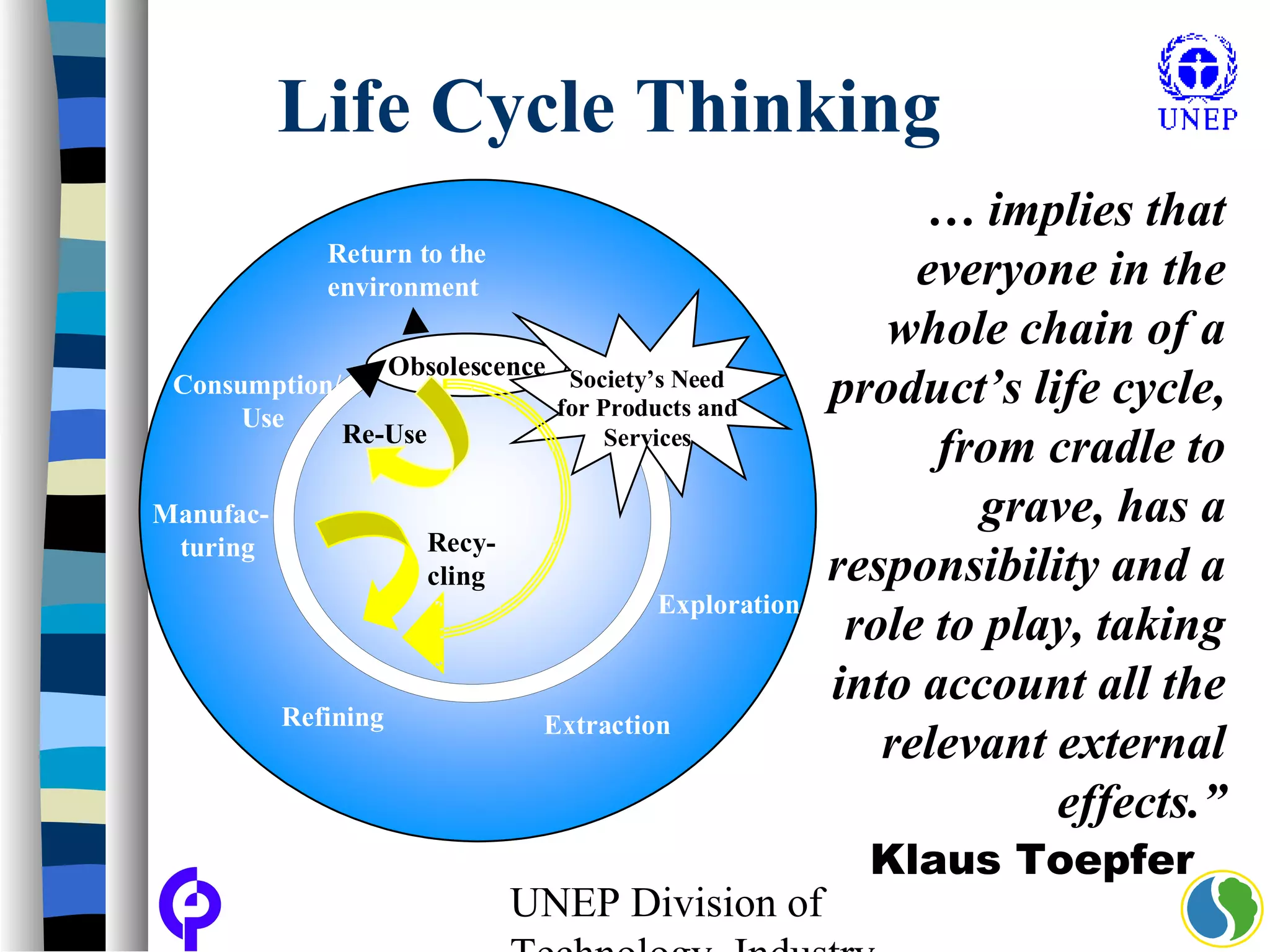
Life Cycle Thinking
Recy-
cling
Refining
Manufac-
turing
Exploration
Consumption/
Use
Extraction
Return to the
environment
Re-Use
Society’s Need
for Products and
Services
Obsolescence
Klaus Toepfer
… implies that
everyone in the
whole chain of a
product’s life cycle,
from cradle to
grave, has a
responsibility and a
role to play, taking
into account all the
relevant external
effects.”
UNEP Division of
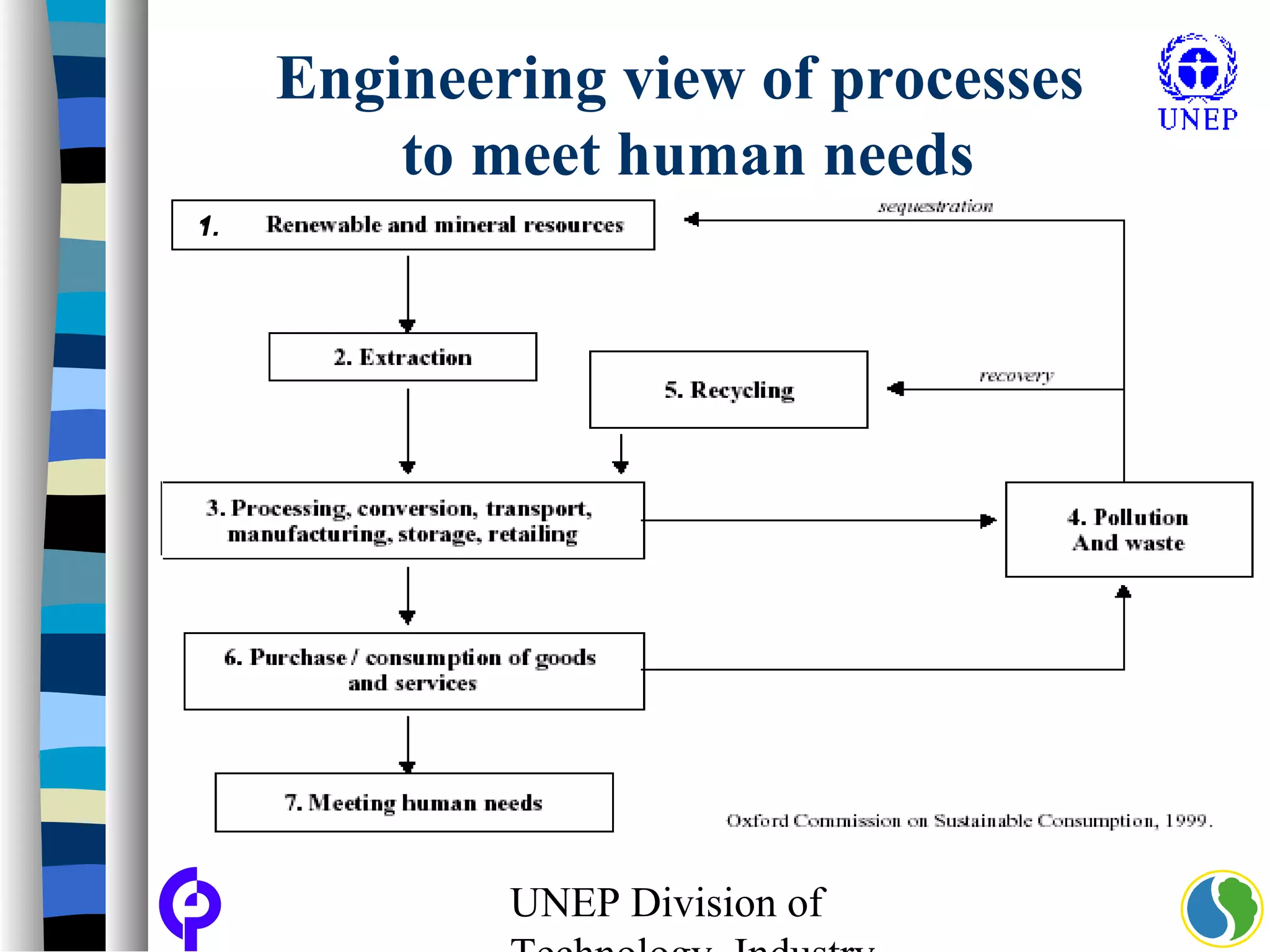
Engineering view of processes
to meet human needs
1.
UNEP Division of
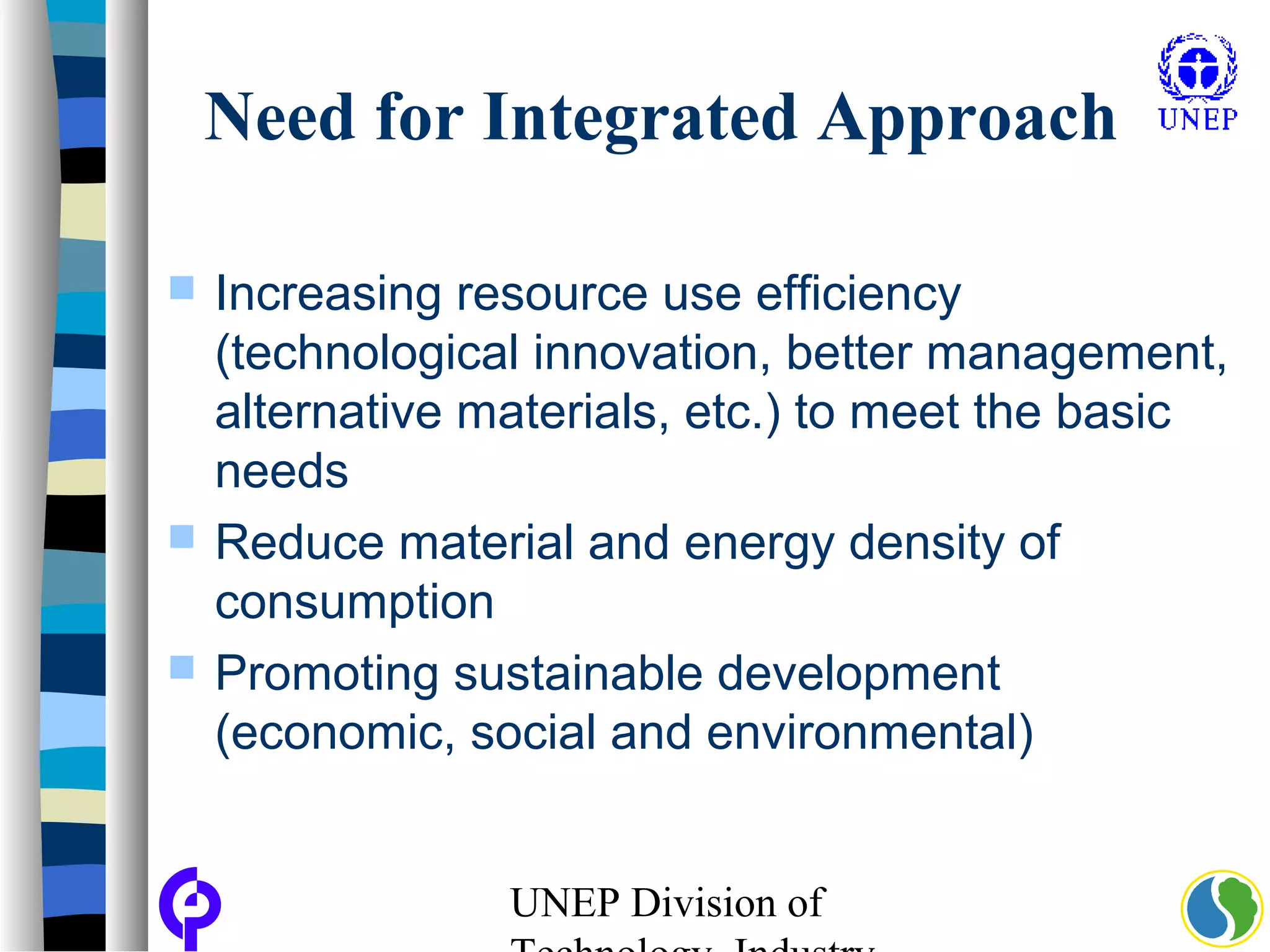
Need for Integrated Approach
 Increasing resource use efficiency
(technological innovation, better management,
alternative materials, etc.) to meet the basic
needs
 Reduce material and energy density of
consumption
 Promoting sustainable development
(economic, social and environmental)
UNEP Division of
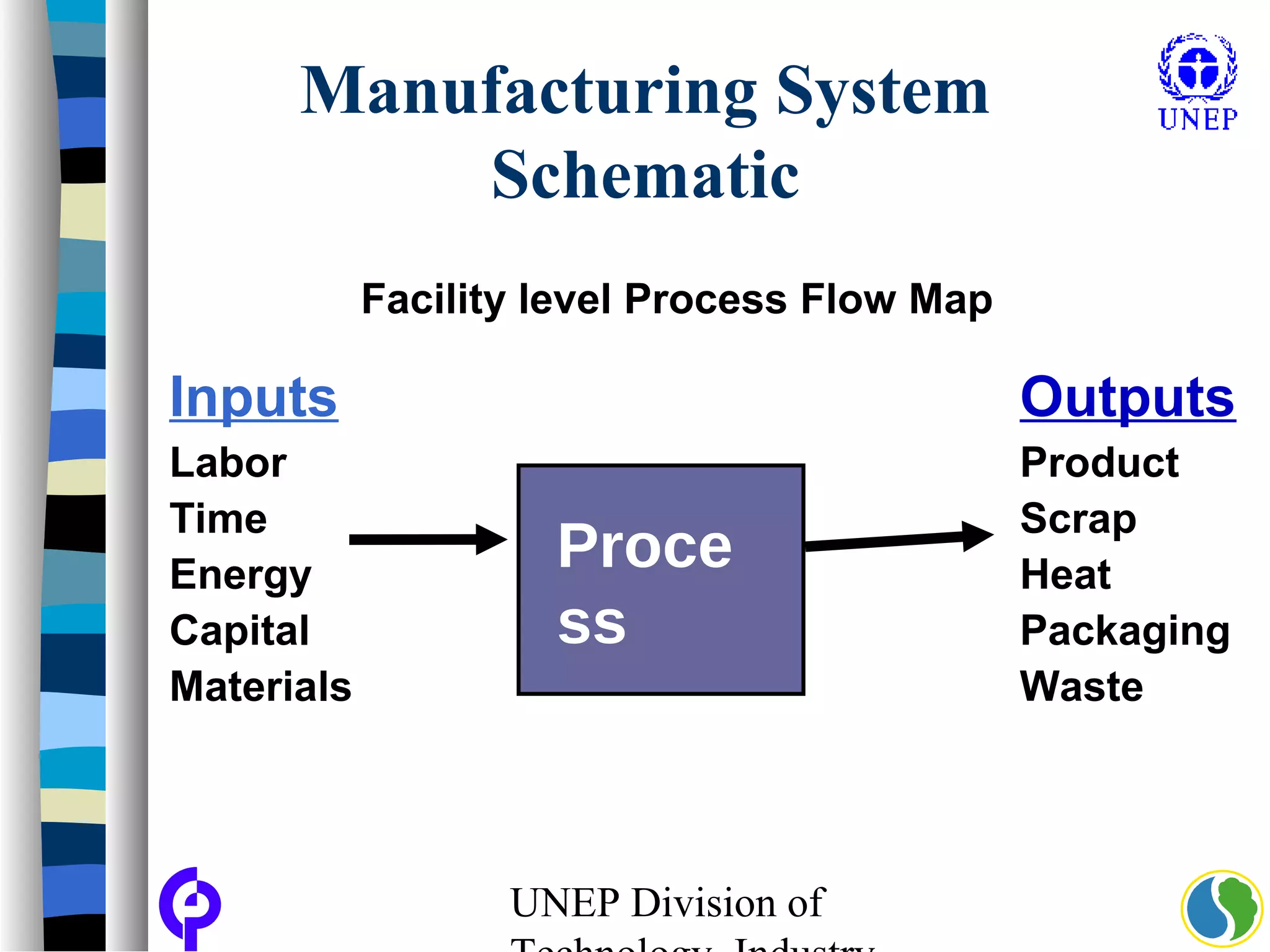
Manufacturing System
Schematic
Inputs
Labor
Time
Energy
Capital
Materials
Proce
ss
Outputs
Product
Scrap
Heat
Packaging
Waste
Facility level Process Flow Map
UNEP Division of
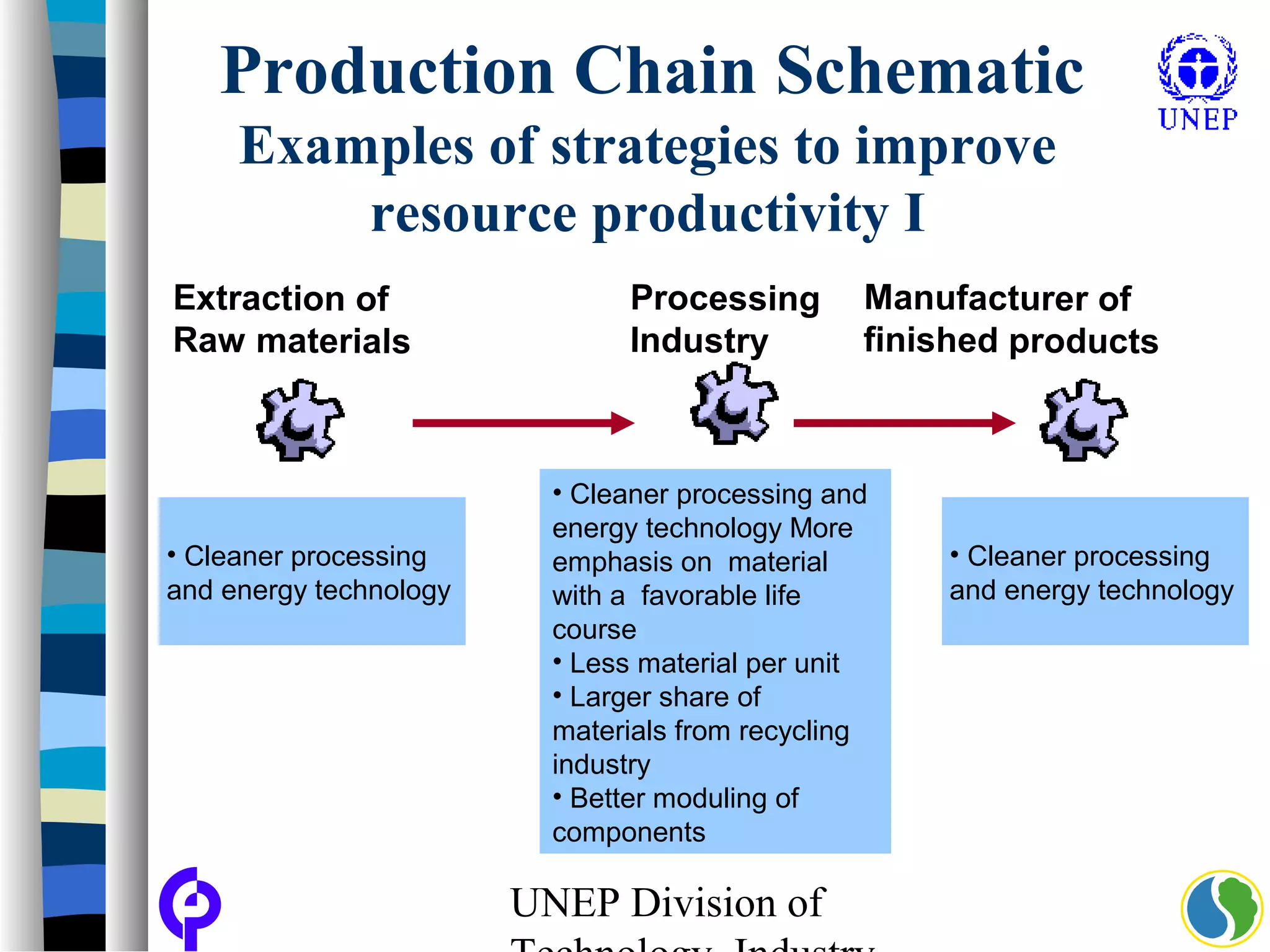
Production Chain Schematic
Examples of strategies to improve
resource productivity I
Extraction of
Raw materials
Processing
Industry
• Cleaner processing
and energy technology
Manufacturer of
finished products
• Cleaner processing and
energy technology More
emphasis on material
with a favorable life
course
• Less material per unit
• Larger share of
materials from recycling
industry
• Better moduling of
components
• Cleaner processing
and energy technology
UNEP Division of
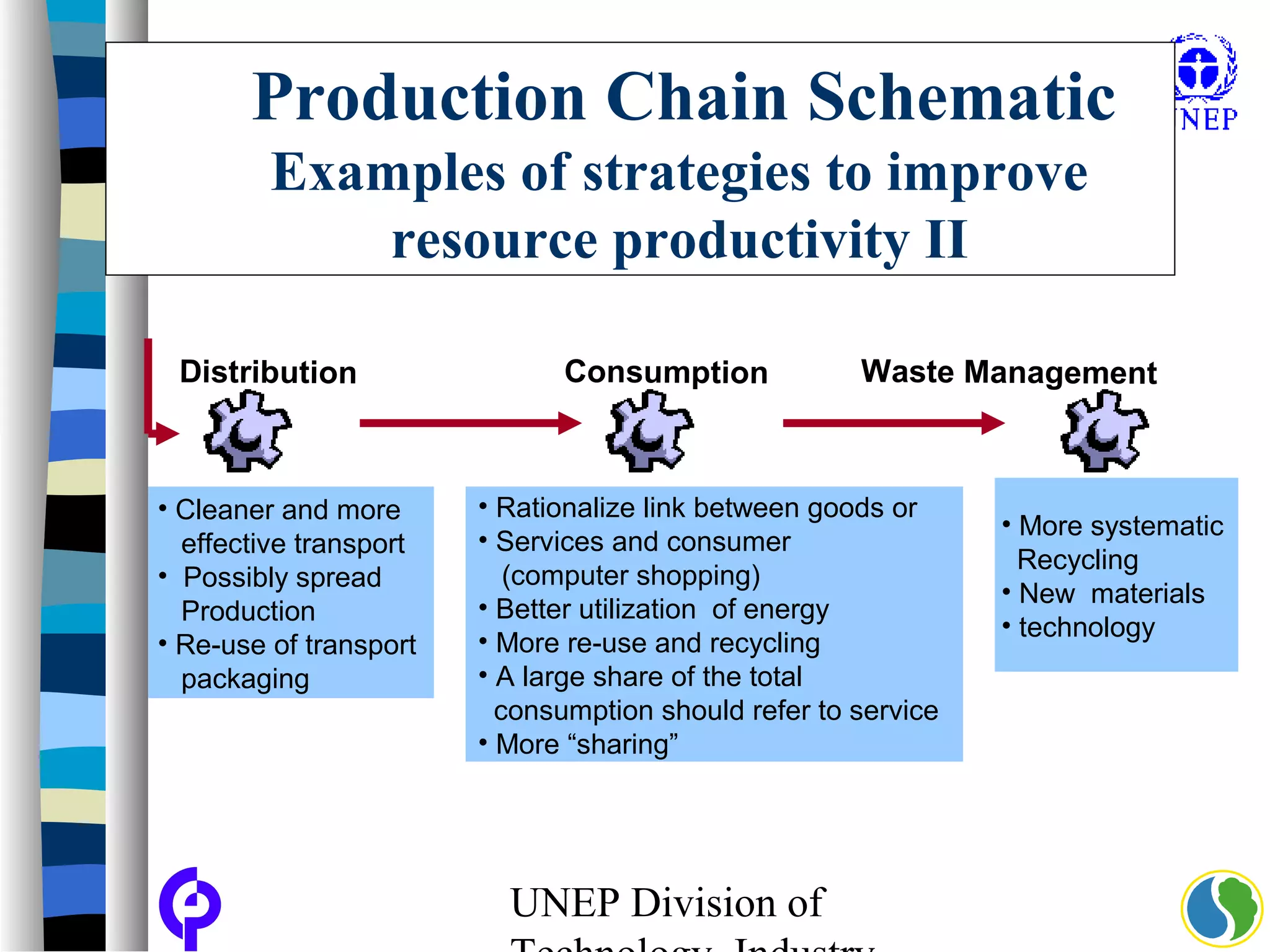
• Cleaner and more
effective transport
• Possibly spread
Production
• Re-use of transport
packaging
• Rationalize link between goods or
• Services and consumer
(computer shopping)
• Better utilization of energy
• More re-use and recycling
• A large share of the total
consumption should refer to service
• More “sharing”
• More systematic
Recycling
• New materials
• technology
Distribution Consumption Waste Management
Production Chain Schematic
Examples of strategies to improve
resource productivity II
UNEP Division of
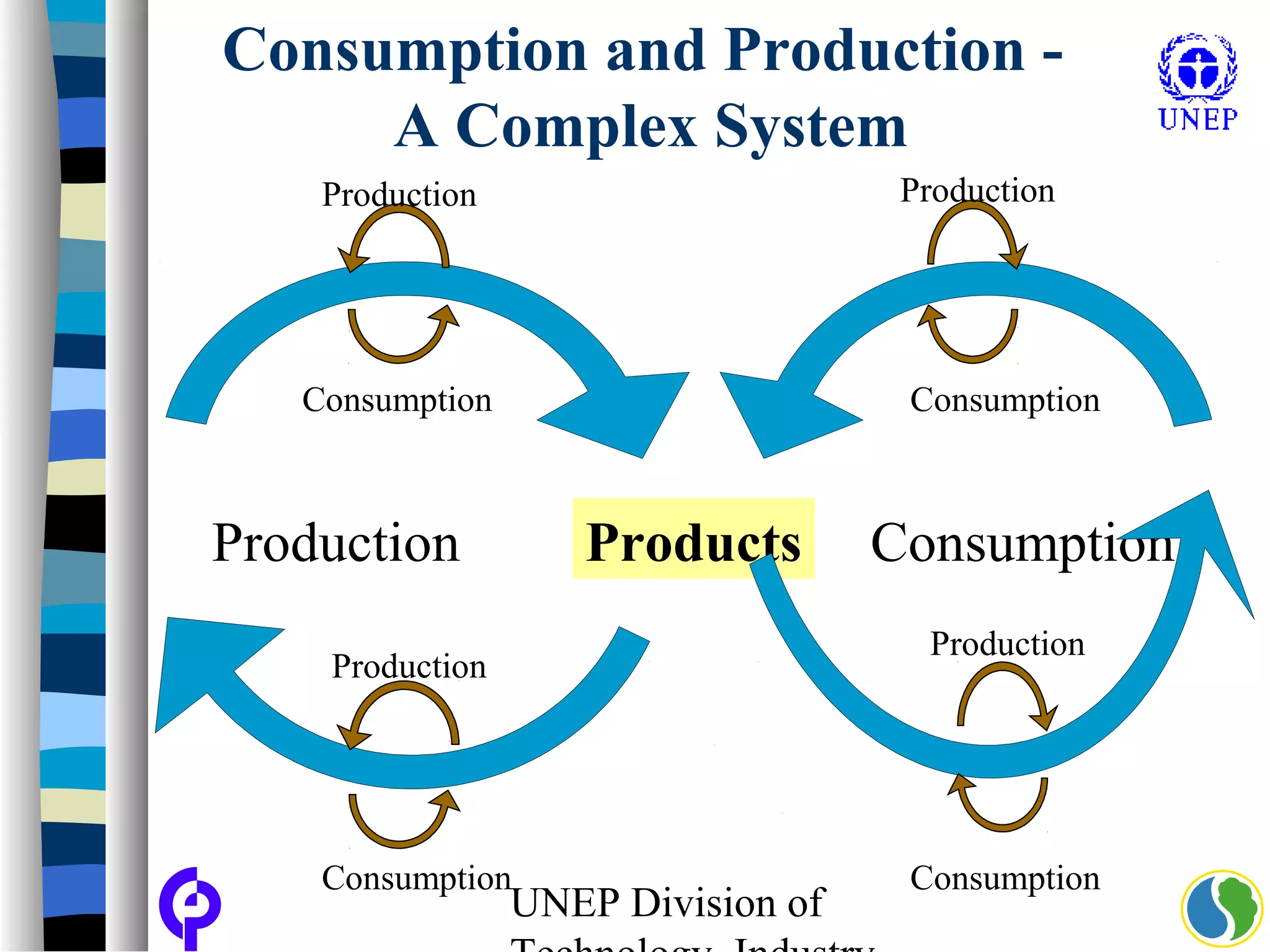
Production ConsumptionProducts
Production
ProductionProduction
Production
Consumption
Consumption Consumption
Consumption
Consumption and Production -
A Complex System
UNEP Division of
New approach for development
Example of mobility
Needs: to be able to reach places easily, timely and
comfortably
Environmental impacts (life-cycle): land use for road,
material use in making automobiles, roads and
related facilities, energy consumption and pollution
emission, automobile wastes, etc.
New approaches: urban planing (location of residents,
commercial and leisure services), public transport,
cleaner fuels, design for efficiency and recycling,
telecommunication (working from home, tele-
conferencing, on-line shopping), diversity of leisure
activities
Actors: government, financial institutes, automobile
manufacturers, public transport services, leisure
service companies, IT industry, etc.
UNEP Division of
Sustainable Consumption and
Production: a role for ALL
Sustainable consumption and production
is a common responsibility of
 Governments,
 Industry,
 Consumers and
 Mass media.
UNEP Division of
Future directions...
Encompasses entire consumption and production
system with a life cycle perspective
 Includes stages upstream and downstream of
targeted area
 Focuses on minimising impacts of entire
system
 Includes interventions that influence
consumption patterns (e.g, PSS, product
information and product design)
 Involves wide range of stakeholders
 Covers both policy as well as techno-
managerial aspects

Integrating Sustainable Consumption & Production

  • 1.
    Organized by UNEPDTIE sponsored by InWent Training Programme for Capacity Building in Cleaner Production Centers Sustainable Consumption & Production: Making the Connection Integrating Sustainable Consumption & Production  What is Sustainable Consumption & Production.  Need for a practical approach.
  • 2.
    UNEP Division of Objectives improve participants understanding of how sustainable consumption and production are interrelated.  demonstrate the tools and strategies that are available to address this.  support participants in identifying opportunities for leveraging sustainable consumption and production in their activities.
  • 3.
    UNEP Division of Outline Sustainable Consumption  Cleaner Production  Integrating Consumption and Production  Stakeholder engagement and future directions
  • 4.
    UNEP Division of Whatis Sustainable Consumption? “…the use of services and products which respond to basic needs and bring a better quality of life while minimizing the use of natural resources and toxic materials as well as the emissions of waste and pollutants over the life cycle of the service or product so as to not jeopardize the needs of future generations.” UN CSD, 1995
  • 5.
    UNEP Division of SustainableConsumption is ...  more than “consuming green”  meeting basic needs  about changing patterns, not “doing without”  responsible consumption consuming differently, efficiently !!
  • 6.
    UNEP Division of ConsumptionOptimisation  Different consumption – what changes in choices and infrastructure will satisfy consumer demand more sustainability?  Conscious consumption – How can consumers increase their quality of life by “choosing and using” more wisely?  Appropriate consumption – Are consumption levels sustainable? Is consumption the best way to achieve every type of quality of life?
  • 7.
    Mixed messages fromconsumers… I’d like to end poverty, stop violence and racism, and get rid of pollution. Everyone should be equal. I want to dress in the nicest clothes, drive a great car, talk on the latest mobile phone, and watch my brand new DVD
  • 8.
    UNEP Division of DrivingForces that Influence Consumption  Economic: economic growth, disposable income and prices,  Demographics: single-person households, longer/healthier lifetimes  Social: lifestyle and cultural tastes for diversity, individualism, working/leisure hours.  Education, Media and Information: environmental awareness.  Existing technology and infrastructure, available products and services.  Policy framework: economic instruments, regulations and social tools.
  • 9.
    UNEP Division of ProactiveReactive CleanerProduction Recycling Treatment Dilution Sustainable Development Sustainable Consumption improving efficiencies of current production processes with an eye to product changes money spent on environment is an expense not an investment, no economic return using byproducts on/off site so that waste being disposed of is minizised striving to change the way in which needs are met to reduce environmental impacts GOAL Needs - opportunity – ability model of consumer behaviour
  • 10.
    UNEP Division of Consumption& Production: Different Terms …Different Concepts? Voluntary simplicity Leapfrog changeLeapfrog change
  • 11.
    UNEP Division of Whatis Cleaner Production? “ Cleaner Production is the continuous application of an integrated environmental strategy to processes, products, and services to increase overall efficiency, and reduce risks to humans and the environment. Cleaner production can be applied to the processes used in any industry, to products themselves and to various services provided in society” http://www.uneptie.org/pc/cp/understanding_cp/home.htm
  • 12.
    UNEP Division of WhatCleaner Production means for…  Production processes: conserving raw materials, water and energy; eliminating toxic and dangerous raw materials; reducing the quantity and toxicity of all emissions and wasters at source during the production process.  Products: reducing the environmental, health and safety impacts of products through their entire life cycle, from raw materials extraction, throughout manufacturing and use to the “ultimate” disposal of the product.  Services: incorporating environmental concerns into designing and delivering services.
  • 13.
    UNEP Division of CleanerProduction in action For companies, cleaner production is implemented via:  factory and site Cleaner Production audits  improved maintenance and operational practices  equipment modification  increased recycling  change to cleaner technologies  better product design
  • 14.
    UNEP Division of CleanerProduction example: Nicaraguan beverage company (PEPSICO) undertook a Cleaner Production Assessment working closely with the 260 employees and found that product loss was almost 80% due to mechanical problems - 20% of which were housekeeping measures. Measures taken:  Water conservation reduced water loss by 50%  Energy efficiency solutions resulted in 12% reduction in refrigeration, 40% reduction in air conditioning, overal fuel costs reduced by 30%  On going training of employees reduced bottle breaking by 30% savings of $26,000/year, and established an atmosphere supportive for looking for continual improvements.
  • 15.
    UNEP Division of SustainableProduction There is no Sustainable Consumption without and vice versa
  • 16.
  • 17.
    UNEP Division of ASystems Look at Sustainable Consumption and Production Consumption Production
  • 18.
    UNEP Division of Consumptionand production: integrated issue “Consumers are increasingly interested in the world that lies behind the products. They want to know how and where and by whom the products have been produced.” “This increasing awareness is a sign of hope. Business and governments must build on that.” Klaus Toepfer, UNEP Executive Director
  • 19.
    UNEP Division of LifeCycle Thinking Recy- cling Refining Manufac- turing Exploration Consumption/ Use Extraction Return to the environment Re-Use Society’s Need for Products and Services Obsolescence Klaus Toepfer … implies that everyone in the whole chain of a product’s life cycle, from cradle to grave, has a responsibility and a role to play, taking into account all the relevant external effects.”
  • 20.
    UNEP Division of Engineeringview of processes to meet human needs 1.
  • 21.
    UNEP Division of Needfor Integrated Approach  Increasing resource use efficiency (technological innovation, better management, alternative materials, etc.) to meet the basic needs  Reduce material and energy density of consumption  Promoting sustainable development (economic, social and environmental)
  • 22.
    UNEP Division of ManufacturingSystem Schematic Inputs Labor Time Energy Capital Materials Proce ss Outputs Product Scrap Heat Packaging Waste Facility level Process Flow Map
  • 23.
    UNEP Division of ProductionChain Schematic Examples of strategies to improve resource productivity I Extraction of Raw materials Processing Industry • Cleaner processing and energy technology Manufacturer of finished products • Cleaner processing and energy technology More emphasis on material with a favorable life course • Less material per unit • Larger share of materials from recycling industry • Better moduling of components • Cleaner processing and energy technology
  • 24.
    UNEP Division of •Cleaner and more effective transport • Possibly spread Production • Re-use of transport packaging • Rationalize link between goods or • Services and consumer (computer shopping) • Better utilization of energy • More re-use and recycling • A large share of the total consumption should refer to service • More “sharing” • More systematic Recycling • New materials • technology Distribution Consumption Waste Management Production Chain Schematic Examples of strategies to improve resource productivity II
  • 25.
    UNEP Division of ProductionConsumptionProducts Production ProductionProduction Production Consumption Consumption Consumption Consumption Consumption and Production - A Complex System
  • 26.
    UNEP Division of Newapproach for development Example of mobility Needs: to be able to reach places easily, timely and comfortably Environmental impacts (life-cycle): land use for road, material use in making automobiles, roads and related facilities, energy consumption and pollution emission, automobile wastes, etc. New approaches: urban planing (location of residents, commercial and leisure services), public transport, cleaner fuels, design for efficiency and recycling, telecommunication (working from home, tele- conferencing, on-line shopping), diversity of leisure activities Actors: government, financial institutes, automobile manufacturers, public transport services, leisure service companies, IT industry, etc.
  • 27.
    UNEP Division of SustainableConsumption and Production: a role for ALL Sustainable consumption and production is a common responsibility of  Governments,  Industry,  Consumers and  Mass media.
  • 28.
    UNEP Division of Futuredirections... Encompasses entire consumption and production system with a life cycle perspective  Includes stages upstream and downstream of targeted area  Focuses on minimising impacts of entire system  Includes interventions that influence consumption patterns (e.g, PSS, product information and product design)  Involves wide range of stakeholders  Covers both policy as well as techno- managerial aspects

Editor's Notes

  • #14 Cleaner Production has many parallel concepts: Eco-efficiency (used in the european Union and by the World Business Council for Sustaianble Development) Pollution prevention (used in North America) Green productivity (used by the Asian Productivity Organisation) Waste minisation
  • #15 Cleaner Production has many parallel concepts: Eco-efficiency (used in the european Union and by the World Business Council for Sustaianble Development) Pollution prevention (used in North America) Green productivity (used by the Asian Productivity Organisation) Waste minisation
  • #23 These are typical facility level inputs and outputs. Which of these were addressed in Buzz 101?