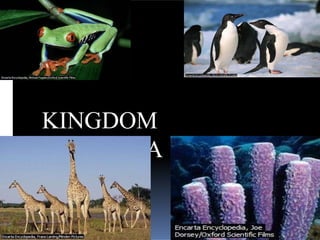
KINGDOM
ANIMALIA
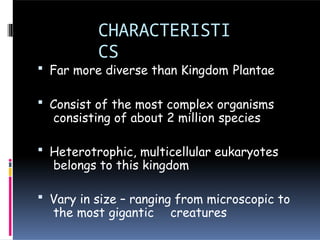
CHARACTERISTI
CS
 Far more diverse than Kingdom Plantae
 Consist of the most complex organisms
consisting of about 2 million species
 Heterotrophic, multicellular eukaryotes
belongs to this kingdom
 Vary in size – ranging from microscopic to
the most gigantic creatures
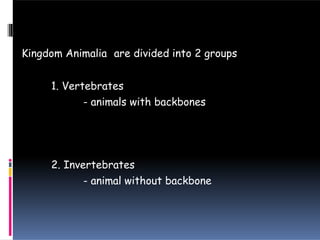
Kingdom Animalia are divided into 2 groups
1. Vertebrates
- animals with backbones
2. Invertebrates
- animal without backbone
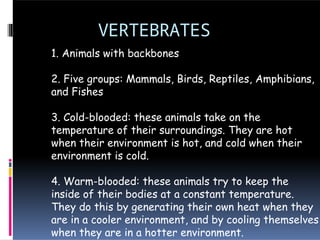
VERTEBRATES
1. Animals with backbones
2. Five groups: Mammals, Birds, Reptiles, Amphibians,
and Fishes
3. Cold-blooded: these animals take on the
temperature of their surroundings. They are hot
when their environment is hot, and cold when their
environment is cold.
4. Warm-blooded: these animals try to keep the
inside of their bodies at a constant temperature.
They do this by generating their own heat when they
are in a cooler environment, and by cooling themselves
when they are in a hotter environment.
VERTEBRATE
S
1. MAMMALS
-Covered with hair or fur
-They produce live young
-Most mammals are nourished by their mother’s milk
-They breathe through lungs
-Most live on land, some live in water
-They are warm-blooded
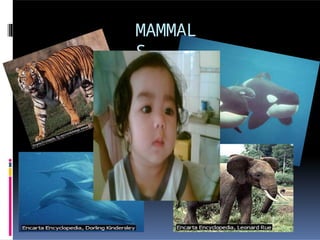
Ex. Cats, dogs, goat, whales, and dolphins
MAMMAL
S
VERTEBRATE
S
2. BIRDS
-they have beaks or bill which they used to get
food
-they wings and light, hollow bones for flight
-They are warm-blooded animals
-They are covered with feathers
-They produce young by laying eggs
-They breathe through lungs
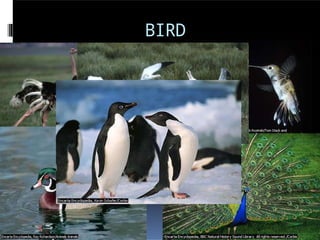
Ex. Flamingo, pigeon, turkey, parrot, robin, duck
BIRD
S
VERTEBRATE
S
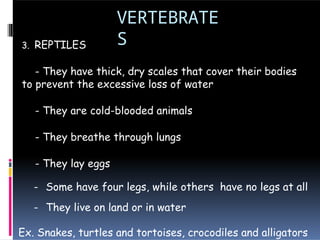
3. REPTILES
- They have thick, dry scales that cover their bodies
to prevent the excessive loss of water
- They are cold-blooded animals
- They breathe through lungs
- They lay eggs
- Some have four legs, while others have no legs at all
- They live on land or in water
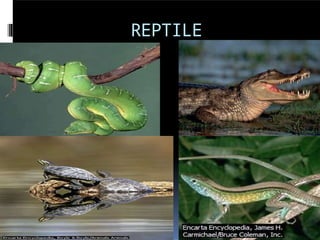
Ex. Snakes, turtles and tortoises, crocodiles and alligators
REPTILE
S
VERTEBRATE
S
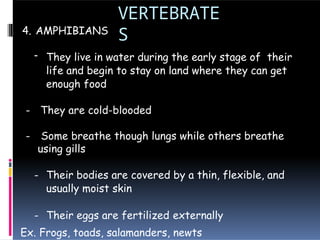
4. AMPHIBIANS
- They live in water during the early stage of their
life and begin to stay on land where they can get
enough food
- They are cold-blooded
- Some breathe though lungs while others breathe
using gills
- Their bodies are covered by a thin, flexible, and
usually moist skin
- Their eggs are fertilized externally
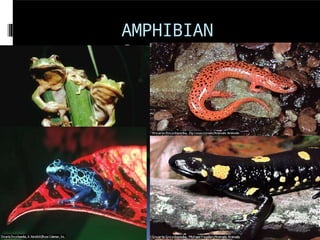
Ex. Frogs, toads, salamanders, newts
AMPHIBIAN
S
VERTEBRATE
S
5. FISHES
- They are cold-blooded
- Their bodies are covered with scales
- They breathe through the gills
- They live in water
- Most fish reproduce by laying eggs
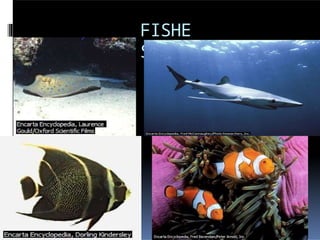
Ex. Shark, stingray, grouper, snapper
FISHE
S
INVERTEBRATES
1. Animals without backbones
2. More than three out of every four
animals on Earth is an invertebrate
INVERTEBRAT
ES
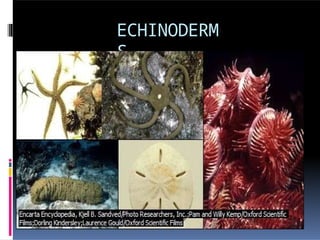
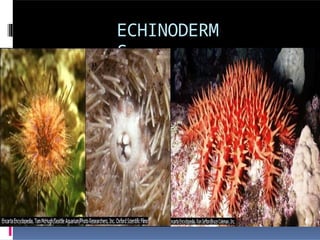
1. PHYLUM ECHINODERMATA – Ex. Starfish, brittle star,
sea urchin
- Marine organisms (live in salt water)
- This group of animals got their name from their tough,
spiny skin
- From the Greek terms echinos (meaning hedgehog) and
derma (meaning skin)
- Body has a pattern of five stars (Radial Symmetry – they
can be split into more than 5 parts)
- They have tube feet and system of canals in the body
that serves as a channel for sucking in the sea water to
obtain nutrients and for vomiting sea water
ECHINODERM
S
ECHINODERM
S
INVERTEBRAT
ES
2. PHYLUM ARTHOPODA
- They are known for their jointed limbs, hard exoskeleton
(outside of the body), and segmented body
- Divided into four groups: Crustaceans, Insects, Arachnids,
and Myriapods
- They have a pair of 3 or more jointed legs
- From the Greek term arthron ( meaning joint) and podus
(meaning foot)
- They have an exoskeleton or hard outer body covering made
up of chitin
- The largest phylum in kingdom Animalia
PHYLUM ARTHOPODA: Crustaceans
- They have 2 pairs of antennae (feelers)
- They have 5 pairs of legs (10 legs)
- They are aquatic or live in damp places
Ex. Shrimp, barnacles, crabs, lobster, wood lice, water flea
- Have 3 pairs of legs (6 legs)
- One pair of antennae
- Body divided into 3 parts: head, thorax,
abdomen
- Have 1 or 2 pairs of wings
PHYLUM ARTHOPODA: Insects
Ex. Grasshoppers, ants, fleas, locusts, beetles, bee, butterfly
- Have 4 pairs of legs (8 legs)
- No antennae
- Live on land (terrestrial)
- Mouth parts have pincers (gripping)
- Carnivorous
PHYLUM ARTHOPODA: Arachnids
Ex. Spiders, scorpions, tick, mites
- Have 1 pair of antennae
- Body is long and clearly segmented
- These animals are terrestrial (live on land)
- There are 2 groups: Centipedes and Millipedes
- Centipedes: Body is flattened, one pair of legs
per segment, carnivorous (eat meat), and have
poison glands for killing prey
- Millipedes: Body is rounded, two pairs of legs
per segment, eat dead plant material
PHYLUM ARTHOPODA: Myriapods
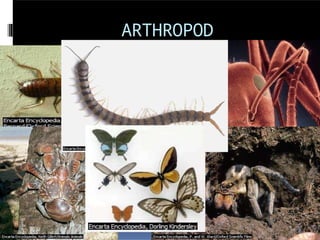
ARTHROPOD
S
INVERTEBRAT
ES
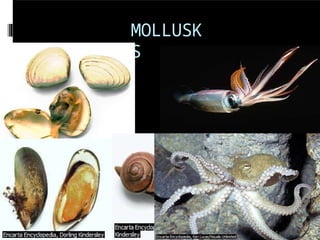
3. PHYLUM MOLLUSKA
- They have a soft body
- From Latin term mollis, which means soft
- Most have protective hard shells as the outer covering
- Most mollusks have a muscular foot
- There are three groups of mollusks: Cephalopods,
Gastropods, and Bivalves
- Have no visible shell
- Have tentacles
- Protect themselves by squirting a cloud of
purple-black ink and then jetting away from
predators
PHYLUM MOLLUSKA: Cephalopods
Ex. Squid, octopus, slug, cuttlefish
- Have a single, coiled shell
PHYLUM MOLLUSKA: Gastropods
Ex. Conch, snail, whelk
- Are named for their two-part
shells
PHYLUM MOLLUSKA: Bivalves
Ex. Clam, oyster, scallops
MOLLUSK
S
INVERTEBRAT
ES
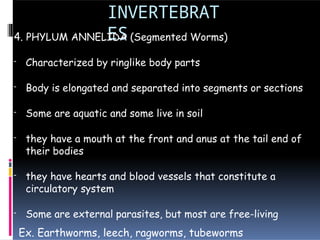
4. PHYLUM ANNELIDA (Segmented Worms)
- Characterized by ringlike body parts
- Body is elongated and separated into segments or sections
- Some are aquatic and some live in soil
- they have a mouth at the front and anus at the tail end of
their bodies
- they have hearts and blood vessels that constitute a
circulatory system
- Some are external parasites, but most are free-living
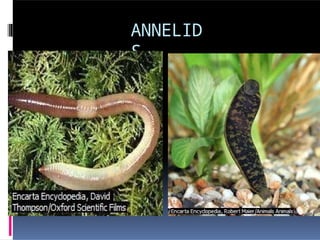
Ex. Earthworms, leech, ragworms, tubeworms
ANNELID
S
INVERTEBRAT
ES
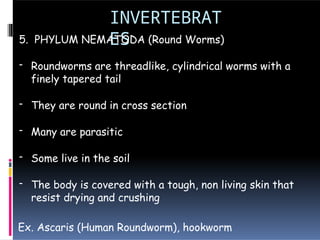
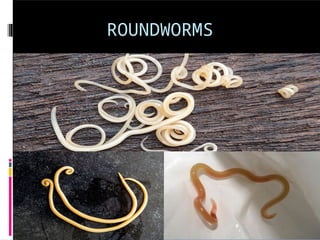
5. PHYLUM NEMATODA (Round Worms)
- Roundworms are threadlike, cylindrical worms with a
finely tapered tail
- They are round in cross section
- Many are parasitic
- Some live in the soil
- The body is covered with a tough, non living skin that
resist drying and crushing
Ex. Ascaris (Human Roundworm), hookworm
ROUNDWORMS
INVERTEBRAT
ES
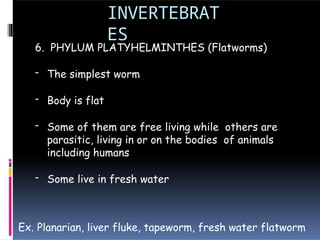
6. PHYLUM PLATYHELMINTHES (Flatworms)
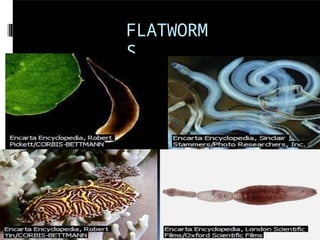
- The simplest worm
- Body is flat
- Some of them are free living while others are
parasitic, living in or on the bodies of animals
including humans
- Some live in fresh water
Ex. Planarian, liver fluke, tapeworm, fresh water flatworm
FLATWORM
S
INVERTEBRAT
ES
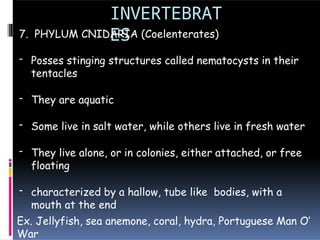
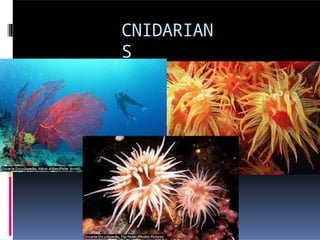
7. PHYLUM CNIDARIA (Coelenterates)
- Posses stinging structures called nematocysts in their
tentacles
- They are aquatic
- Some live in salt water, while others live in fresh water
- They live alone, or in colonies, either attached, or free
floating
- characterized by a hallow, tube like bodies, with a
mouth at the end
Ex. Jellyfish, sea anemone, coral, hydra, Portuguese Man O’
War
CNIDARIAN
S
INVERTEBRAT
ES
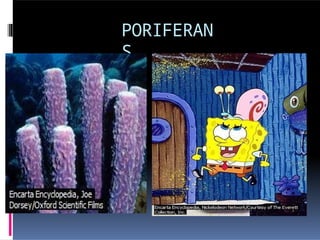
8. PHYLUM PORIFERA (Sponges)
- Body composed of cells loosely grouped together
- Pore-bearing organisms and may live singly or in colonies
- As adults they live attached to something
- Reproduce sexually or asexually
- Live in aquatic environment, most are marine
- All are filter feeders (they eat by allowing water to
flow through their bodies and trapping small organisms
in the water using their specialized cells)
PORIFERAN
S

kingdom Animalia PowerPoint Presentation

  • 1.
  • 2.
    CHARACTERISTI CS  Far morediverse than Kingdom Plantae  Consist of the most complex organisms consisting of about 2 million species  Heterotrophic, multicellular eukaryotes belongs to this kingdom  Vary in size – ranging from microscopic to the most gigantic creatures
  • 3.
    Kingdom Animalia aredivided into 2 groups 1. Vertebrates - animals with backbones 2. Invertebrates - animal without backbone
  • 4.
    VERTEBRATES 1. Animals withbackbones 2. Five groups: Mammals, Birds, Reptiles, Amphibians, and Fishes 3. Cold-blooded: these animals take on the temperature of their surroundings. They are hot when their environment is hot, and cold when their environment is cold. 4. Warm-blooded: these animals try to keep the inside of their bodies at a constant temperature. They do this by generating their own heat when they are in a cooler environment, and by cooling themselves when they are in a hotter environment.
  • 5.
    VERTEBRATE S 1. MAMMALS -Covered withhair or fur -They produce live young -Most mammals are nourished by their mother’s milk -They breathe through lungs -Most live on land, some live in water -They are warm-blooded Ex. Cats, dogs, goat, whales, and dolphins
  • 6.
  • 7.
    VERTEBRATE S 2. BIRDS -they havebeaks or bill which they used to get food -they wings and light, hollow bones for flight -They are warm-blooded animals -They are covered with feathers -They produce young by laying eggs -They breathe through lungs Ex. Flamingo, pigeon, turkey, parrot, robin, duck
  • 8.
  • 9.
    VERTEBRATE S 3. REPTILES - Theyhave thick, dry scales that cover their bodies to prevent the excessive loss of water - They are cold-blooded animals - They breathe through lungs - They lay eggs - Some have four legs, while others have no legs at all - They live on land or in water Ex. Snakes, turtles and tortoises, crocodiles and alligators
  • 10.
  • 11.
    VERTEBRATE S 4. AMPHIBIANS - Theylive in water during the early stage of their life and begin to stay on land where they can get enough food - They are cold-blooded - Some breathe though lungs while others breathe using gills - Their bodies are covered by a thin, flexible, and usually moist skin - Their eggs are fertilized externally Ex. Frogs, toads, salamanders, newts
  • 12.
  • 13.
    VERTEBRATE S 5. FISHES - Theyare cold-blooded - Their bodies are covered with scales - They breathe through the gills - They live in water - Most fish reproduce by laying eggs Ex. Shark, stingray, grouper, snapper
  • 14.
  • 15.
    INVERTEBRATES 1. Animals withoutbackbones 2. More than three out of every four animals on Earth is an invertebrate
  • 16.
    INVERTEBRAT ES 1. PHYLUM ECHINODERMATA– Ex. Starfish, brittle star, sea urchin - Marine organisms (live in salt water) - This group of animals got their name from their tough, spiny skin - From the Greek terms echinos (meaning hedgehog) and derma (meaning skin) - Body has a pattern of five stars (Radial Symmetry – they can be split into more than 5 parts) - They have tube feet and system of canals in the body that serves as a channel for sucking in the sea water to obtain nutrients and for vomiting sea water
  • 17.
  • 18.
  • 19.
    INVERTEBRAT ES 2. PHYLUM ARTHOPODA -They are known for their jointed limbs, hard exoskeleton (outside of the body), and segmented body - Divided into four groups: Crustaceans, Insects, Arachnids, and Myriapods - They have a pair of 3 or more jointed legs - From the Greek term arthron ( meaning joint) and podus (meaning foot) - They have an exoskeleton or hard outer body covering made up of chitin - The largest phylum in kingdom Animalia
  • 20.
    PHYLUM ARTHOPODA: Crustaceans -They have 2 pairs of antennae (feelers) - They have 5 pairs of legs (10 legs) - They are aquatic or live in damp places Ex. Shrimp, barnacles, crabs, lobster, wood lice, water flea
  • 21.
    - Have 3pairs of legs (6 legs) - One pair of antennae - Body divided into 3 parts: head, thorax, abdomen - Have 1 or 2 pairs of wings PHYLUM ARTHOPODA: Insects Ex. Grasshoppers, ants, fleas, locusts, beetles, bee, butterfly
  • 22.
    - Have 4pairs of legs (8 legs) - No antennae - Live on land (terrestrial) - Mouth parts have pincers (gripping) - Carnivorous PHYLUM ARTHOPODA: Arachnids Ex. Spiders, scorpions, tick, mites
  • 23.
    - Have 1pair of antennae - Body is long and clearly segmented - These animals are terrestrial (live on land) - There are 2 groups: Centipedes and Millipedes - Centipedes: Body is flattened, one pair of legs per segment, carnivorous (eat meat), and have poison glands for killing prey - Millipedes: Body is rounded, two pairs of legs per segment, eat dead plant material PHYLUM ARTHOPODA: Myriapods
  • 24.
  • 25.
    INVERTEBRAT ES 3. PHYLUM MOLLUSKA -They have a soft body - From Latin term mollis, which means soft - Most have protective hard shells as the outer covering - Most mollusks have a muscular foot - There are three groups of mollusks: Cephalopods, Gastropods, and Bivalves
  • 26.
    - Have novisible shell - Have tentacles - Protect themselves by squirting a cloud of purple-black ink and then jetting away from predators PHYLUM MOLLUSKA: Cephalopods Ex. Squid, octopus, slug, cuttlefish
  • 27.
    - Have asingle, coiled shell PHYLUM MOLLUSKA: Gastropods Ex. Conch, snail, whelk
  • 28.
    - Are namedfor their two-part shells PHYLUM MOLLUSKA: Bivalves Ex. Clam, oyster, scallops
  • 29.
  • 30.
    INVERTEBRAT ES 4. PHYLUM ANNELIDA(Segmented Worms) - Characterized by ringlike body parts - Body is elongated and separated into segments or sections - Some are aquatic and some live in soil - they have a mouth at the front and anus at the tail end of their bodies - they have hearts and blood vessels that constitute a circulatory system - Some are external parasites, but most are free-living Ex. Earthworms, leech, ragworms, tubeworms
  • 31.
  • 32.
    INVERTEBRAT ES 5. PHYLUM NEMATODA(Round Worms) - Roundworms are threadlike, cylindrical worms with a finely tapered tail - They are round in cross section - Many are parasitic - Some live in the soil - The body is covered with a tough, non living skin that resist drying and crushing Ex. Ascaris (Human Roundworm), hookworm
  • 33.
  • 34.
    INVERTEBRAT ES 6. PHYLUM PLATYHELMINTHES(Flatworms) - The simplest worm - Body is flat - Some of them are free living while others are parasitic, living in or on the bodies of animals including humans - Some live in fresh water Ex. Planarian, liver fluke, tapeworm, fresh water flatworm
  • 35.
  • 36.
    INVERTEBRAT ES 7. PHYLUM CNIDARIA(Coelenterates) - Posses stinging structures called nematocysts in their tentacles - They are aquatic - Some live in salt water, while others live in fresh water - They live alone, or in colonies, either attached, or free floating - characterized by a hallow, tube like bodies, with a mouth at the end Ex. Jellyfish, sea anemone, coral, hydra, Portuguese Man O’ War
  • 37.
  • 38.
    INVERTEBRAT ES 8. PHYLUM PORIFERA(Sponges) - Body composed of cells loosely grouped together - Pore-bearing organisms and may live singly or in colonies - As adults they live attached to something - Reproduce sexually or asexually - Live in aquatic environment, most are marine - All are filter feeders (they eat by allowing water to flow through their bodies and trapping small organisms in the water using their specialized cells)
  • 39.