INVERTEBRATES
GROUP OF ANIMALS THAT DO
NOT HAVE BACKBONES.
There are eight large groups or subgroups of
invertebrates:
-Porifera
-Coelenterates
-Platyhelminthes
-Nematoda
-Annelida
-Mollusca
-Echinoderms
-Arthropods
1. Porifera
The Poriferans are marine animals full of pores
or holes. These holes serve as passage for water
which carries nutrients and gases.
Sponges or pore-bearing animals belong to this
group.
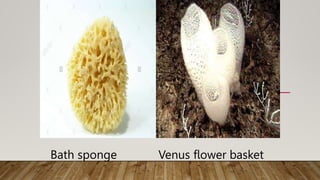
Bath sponge
Bath sponge
Venus flower basket
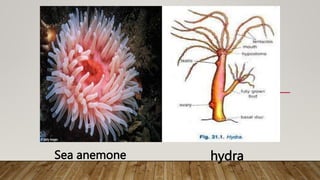
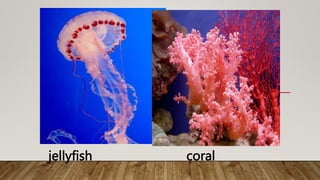
2. Coelenterata (Coelenterates)
The Coelenterate or Coelenterates are hollow-
bodied or soft-bodied animals. Their bodies are
made up of two layers of cells which form a
hollow tube. Examples of animals in this group
are the fresh water hydras, hydroids, jellyfish,
sea fans, sea anemones, and corals.
Sea anemone hydra
jellyfish coral
3. Platyhelminthes
Platyhelminthes have bodies that look like
ribbons. They have no space inside so they
have no digestive system. Flatworms
belong to this
group.
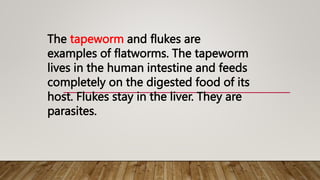
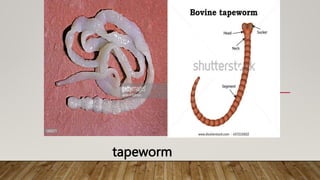
The tapeworm and flukes are
examples of flatworms. The tapeworm
lives in the human intestine and feeds
completely on the digested food of its
host. Flukes stay in the liver. They are
parasites.
tapeworm
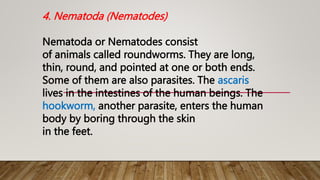
4. Nematoda (Nematodes)
Nematoda or Nematodes consist
of animals called roundworms. They are long,
thin, round, and pointed at one or both ends.
Some of them are also parasites. The ascaris
lives in the intestines of the human beings. The
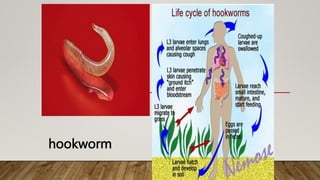
hookworm, another parasite, enters the human
body by boring through the skin
in the feet.
hookworm
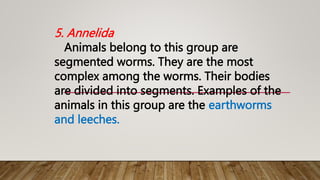
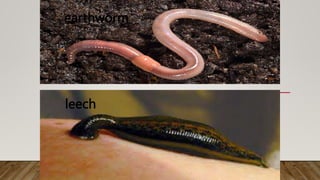
5. Annelida
Animals belong to this group are
segmented worms. They are the most
complex among the worms. Their bodies
are divided into segments. Examples of the
animals in this group are the earthworms
and leeches.
earthworm
leech
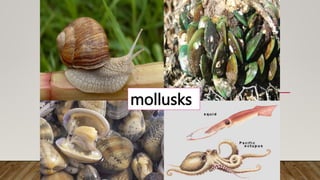
6. Mollusca (Mollusks)
Mollusca or Mollusks are soft bodied or
shelled animals. Snails, slugs, clams,
mussels, oysters, squids and octopuses
are mollusks. Most animals like the clams,
oysters and snails have
shells that protect their soft bodies.
mollusks
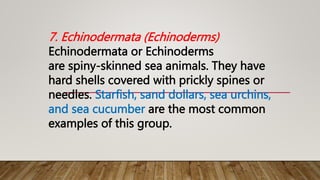
7. Echinodermata (Echinoderms)
Echinodermata or Echinoderms
are spiny-skinned sea animals. They have
hard shells covered with prickly spines or
needles. Starfish, sand dollars, sea urchins,
and sea cucumber are the most common
examples of this group.
starfish sea urchin
8. Arthropoda (Arthropods)
Arthropoda or Arthropods are joint-
legged animals. They make up the largest
group in the animal kingdom. Their legs
are jointed. Their bodies and legs are made
up of sections. They have an outside shell
called the exoskeleton.
There are four groups of animals
(Arthropods)
in this group. These are:
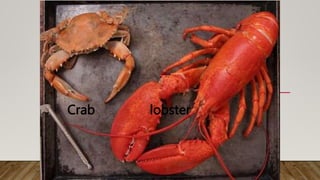
a. Crustaceans have a hard outer body
covering divided into sections. Crabs,
lobsters and shrimps belong to this
group.
Crab lobster
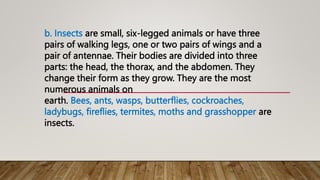
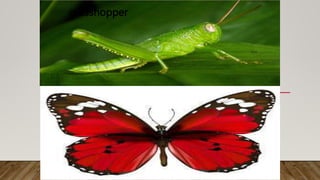
b. Insects are small, six-legged animals or have three
pairs of walking legs, one or two pairs of wings and a
pair of antennae. Their bodies are divided into three
parts: the head, the thorax, and the abdomen. They
change their form as they grow. They are the most
numerous animals on
earth. Bees, ants, wasps, butterflies, cockroaches,
ladybugs, fireflies, termites, moths and grasshopper are
insects.
grasshopper
butterfly
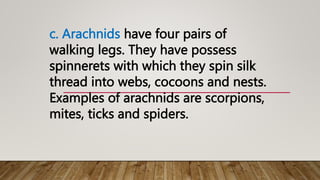
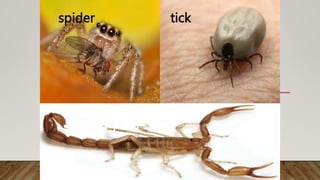
c. Arachnids have four pairs of
walking legs. They have possess
spinnerets with which they spin silk
thread into webs, cocoons and nests.
Examples of arachnids are scorpions,
mites, ticks and spiders.
tick
spider
scorpion
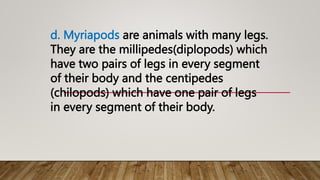
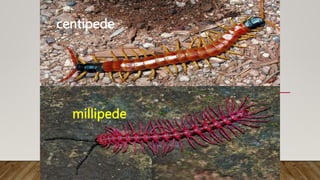
d. Myriapods are animals with many legs.
They are the millipedes(diplopods) which
have two pairs of legs in every segment
of their body and the centipedes
(chilopods) which have one pair of legs
in every segment of their body.
centipede
millipede
Identify the characteristics of the different
invertebrates by completing
the Chart using the following descriptions.
Classification - arthropods, mollusks, echinoderms,
coelenterates
Movement - fly, crawl, swim
Description - with exoskeleton, spiny skin, soft and
segmented body, enclosed in a shell, hollow-body
stinging cells or tentacles
ANIMALS CLASSIFICATION MOVEMENT DESCRIPTION
Snails
Earthworms
Lobsters
Starfish
Jellyfish
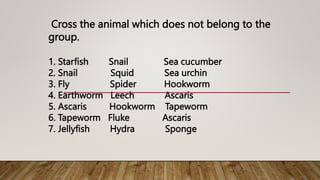
Cross the animal which does not belong to the
group.
1. Starfish Snail Sea cucumber
2. Snail Squid Sea urchin
3. Fly Spider Hookworm
4. Earthworm Leech Ascaris
5. Ascaris Hookworm Tapeworm
6. Tapeworm Fluke Ascaris
7. Jellyfish Hydra Sponge
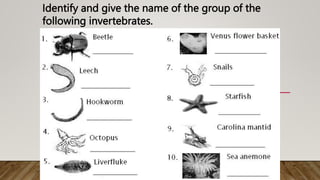
Identify and give the name of the group of the
following invertebrates.
REF.
LM IN SC...2ND QUARTER

Grade 6_Science_Q2_W6_Invertebrates.pptx

  • 1.
    INVERTEBRATES GROUP OF ANIMALSTHAT DO NOT HAVE BACKBONES.
  • 2.
    There are eightlarge groups or subgroups of invertebrates: -Porifera -Coelenterates -Platyhelminthes -Nematoda -Annelida -Mollusca -Echinoderms -Arthropods
  • 3.
    1. Porifera The Poriferansare marine animals full of pores or holes. These holes serve as passage for water which carries nutrients and gases. Sponges or pore-bearing animals belong to this group.
  • 4.
  • 5.
    2. Coelenterata (Coelenterates) TheCoelenterate or Coelenterates are hollow- bodied or soft-bodied animals. Their bodies are made up of two layers of cells which form a hollow tube. Examples of animals in this group are the fresh water hydras, hydroids, jellyfish, sea fans, sea anemones, and corals.
  • 6.
  • 7.
  • 8.
    3. Platyhelminthes Platyhelminthes havebodies that look like ribbons. They have no space inside so they have no digestive system. Flatworms belong to this group.
  • 9.
    The tapeworm andflukes are examples of flatworms. The tapeworm lives in the human intestine and feeds completely on the digested food of its host. Flukes stay in the liver. They are parasites.
  • 10.
  • 11.
    4. Nematoda (Nematodes) Nematodaor Nematodes consist of animals called roundworms. They are long, thin, round, and pointed at one or both ends. Some of them are also parasites. The ascaris lives in the intestines of the human beings. The hookworm, another parasite, enters the human body by boring through the skin in the feet.
  • 12.
  • 13.
    5. Annelida Animals belongto this group are segmented worms. They are the most complex among the worms. Their bodies are divided into segments. Examples of the animals in this group are the earthworms and leeches.
  • 14.
  • 15.
    6. Mollusca (Mollusks) Molluscaor Mollusks are soft bodied or shelled animals. Snails, slugs, clams, mussels, oysters, squids and octopuses are mollusks. Most animals like the clams, oysters and snails have shells that protect their soft bodies.
  • 16.
  • 17.
    7. Echinodermata (Echinoderms) Echinodermataor Echinoderms are spiny-skinned sea animals. They have hard shells covered with prickly spines or needles. Starfish, sand dollars, sea urchins, and sea cucumber are the most common examples of this group.
  • 18.
  • 19.
    8. Arthropoda (Arthropods) Arthropodaor Arthropods are joint- legged animals. They make up the largest group in the animal kingdom. Their legs are jointed. Their bodies and legs are made up of sections. They have an outside shell called the exoskeleton.
  • 20.
    There are fourgroups of animals (Arthropods) in this group. These are: a. Crustaceans have a hard outer body covering divided into sections. Crabs, lobsters and shrimps belong to this group.
  • 21.
  • 22.
    b. Insects aresmall, six-legged animals or have three pairs of walking legs, one or two pairs of wings and a pair of antennae. Their bodies are divided into three parts: the head, the thorax, and the abdomen. They change their form as they grow. They are the most numerous animals on earth. Bees, ants, wasps, butterflies, cockroaches, ladybugs, fireflies, termites, moths and grasshopper are insects.
  • 23.
  • 24.
    c. Arachnids havefour pairs of walking legs. They have possess spinnerets with which they spin silk thread into webs, cocoons and nests. Examples of arachnids are scorpions, mites, ticks and spiders.
  • 25.
  • 26.
    d. Myriapods areanimals with many legs. They are the millipedes(diplopods) which have two pairs of legs in every segment of their body and the centipedes (chilopods) which have one pair of legs in every segment of their body.
  • 27.
  • 28.
    Identify the characteristicsof the different invertebrates by completing the Chart using the following descriptions. Classification - arthropods, mollusks, echinoderms, coelenterates Movement - fly, crawl, swim Description - with exoskeleton, spiny skin, soft and segmented body, enclosed in a shell, hollow-body stinging cells or tentacles
  • 29.
    ANIMALS CLASSIFICATION MOVEMENTDESCRIPTION Snails Earthworms Lobsters Starfish Jellyfish
  • 30.
    Cross the animalwhich does not belong to the group. 1. Starfish Snail Sea cucumber 2. Snail Squid Sea urchin 3. Fly Spider Hookworm 4. Earthworm Leech Ascaris 5. Ascaris Hookworm Tapeworm 6. Tapeworm Fluke Ascaris 7. Jellyfish Hydra Sponge
  • 31.
    Identify and givethe name of the group of the following invertebrates.
  • 32.