Inventory
Management and
Techniques
What is Inventory Management and Control
Inventory management is the overseeing and controlling of
the ordering, storage and use of components that a
company will use in the production of the items it will sell
as well as the overseeing and controlling of quantities of
finished products for sale. A business's inventory is one
of its major assets and represents an investment that is
tied up until the item is sold or used in the production of
an item that is sold. It also costs money to store, track
and insure inventory. Inventories that are mismanaged can
create significant financial problems for a business,
whether the mismanagement results in an inventory glut or
an inventory shortage.
Techniques
1. Determination of Stock Levels
To avoid over-stocking and under stocking of materials, the management has to
decide about the maximum level, minimum level, re-order level, danger level and
average level of materials to be kept in the store
Explanation:
(a) Re-ordering level: It is a point at which order for supply of material should be
made. This level is fixed somewhere between the maximum level and the minimum
level in such a way that the quantity of materials represented by the difference
between the re-ordering level and the minimum level will be sufficient to meet
the demands of production till such time as the materials are replenished.
Reorder level depends mainly on the maximum rate of consumption and order lead
time.
Reordering level is calculated with the following formula:
Re-order level =Maximum Rate of consumption x maximum lead time
(b) Maximum Level:
Maximum level is the level above which stock should never
reach. It is also known as ‘maximum limit’ or ‘maximum
stock’. The function of maximum level is essential to avoid
unnecessary blocking up of capital in inventories, losses on
account of deterioration and obsolescence of materials,
extra overheads and temptation to thefts etc.
This level can be determined with the following formula.
Maximum Stock level = Reordering level + Reordering
quantity —(Minimum Consumption x Minimum re-ordering
period)
(c) Minimum Level:
It represents the lowest quantity of a particular
material below which stock should not be allowed
to fall. This level must be maintained at every time
so that production is not held up due to shortage
of any material.
It is that level of inventories of which a fresh
order must be placed to replenish the stock. This
level is usually determined through the following
formula:
Minimum Level = Re-ordering level — (Normal rate
of consumption x Normal delivery period)
(d) Average Stock Level:
Average stock level is determined by averaging the
minimum and maximum level of stock.
The formula for determination of the level is as follows:
Average level =1/2 (Minimum stock level + Maximum stock
level)
This may also be expressed by minimum level + 1/2 of Re-
ordering Quantity
(e) Danger Level:
Danger level is that level below which the stock should
under no circumstances be allowed to fall. Danger level is
slightly below the minimum level and therefore the
purchases manager should make special efforts to
acquire required materials and stores.
This level can be calculated with the help of following
formula:
Danger Level =Average rate of consumption x Emergency
supply time.
2. Determination of Safety Stocks
Safety stock is the stock held by a company in excess
of its requirement for the lead time. Companies hold
safety stock to guard against stock-out.
Safety stock is calculated using the following formula:
Safety Stock = (Maximum Daily Usage − Average Daily
Usage) × Lead Time
Lead time is the time which supplier takes in ordering
the items
3. Ordering Systems of Inventory
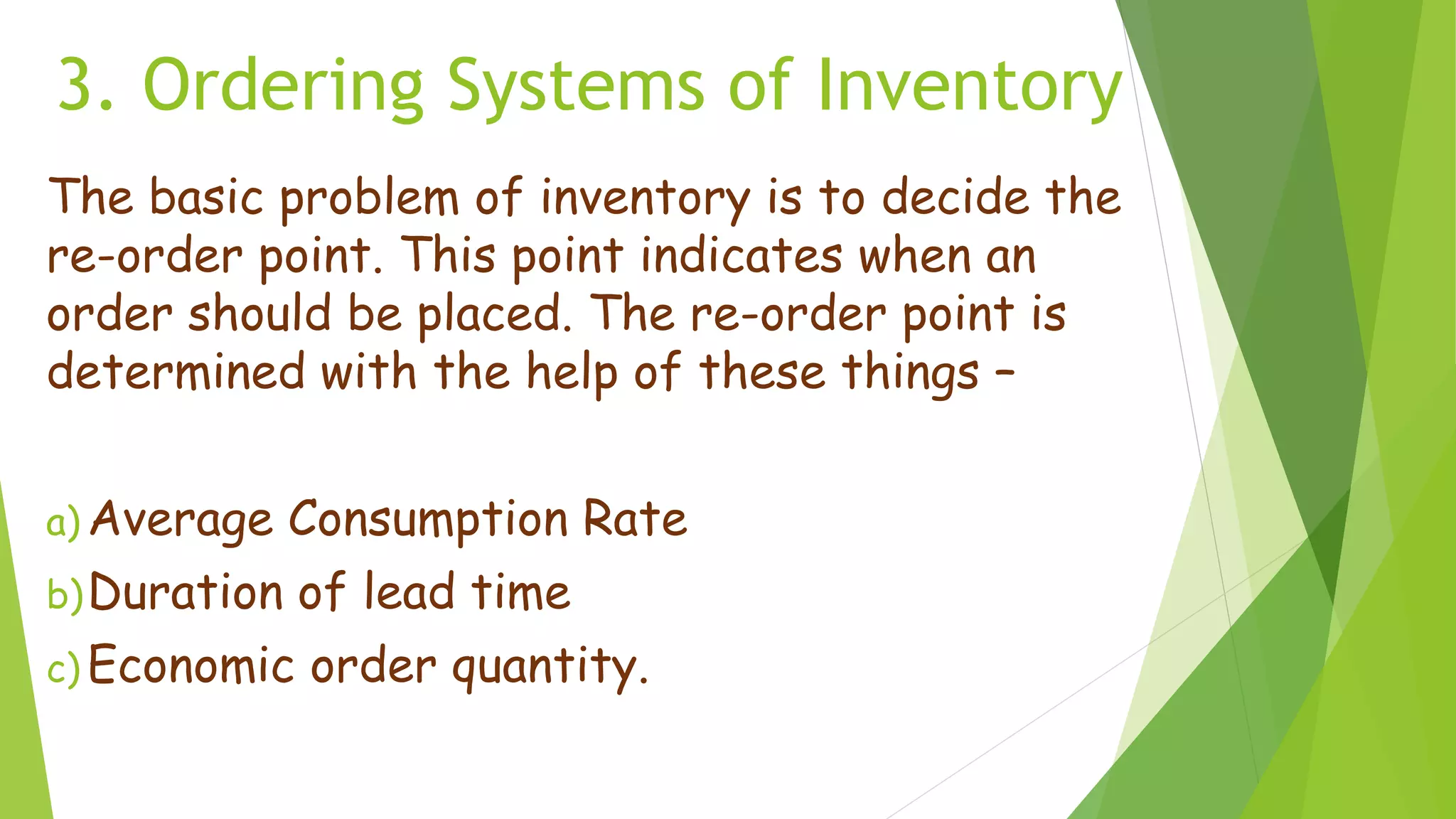
The basic problem of inventory is to decide the
re-order point. This point indicates when an
order should be placed. The re-order point is
determined with the help of these things –
a) Average Consumption Rate
b)Duration of lead time
c) Economic order quantity.
4. Economic Order Quantity (EOQ)
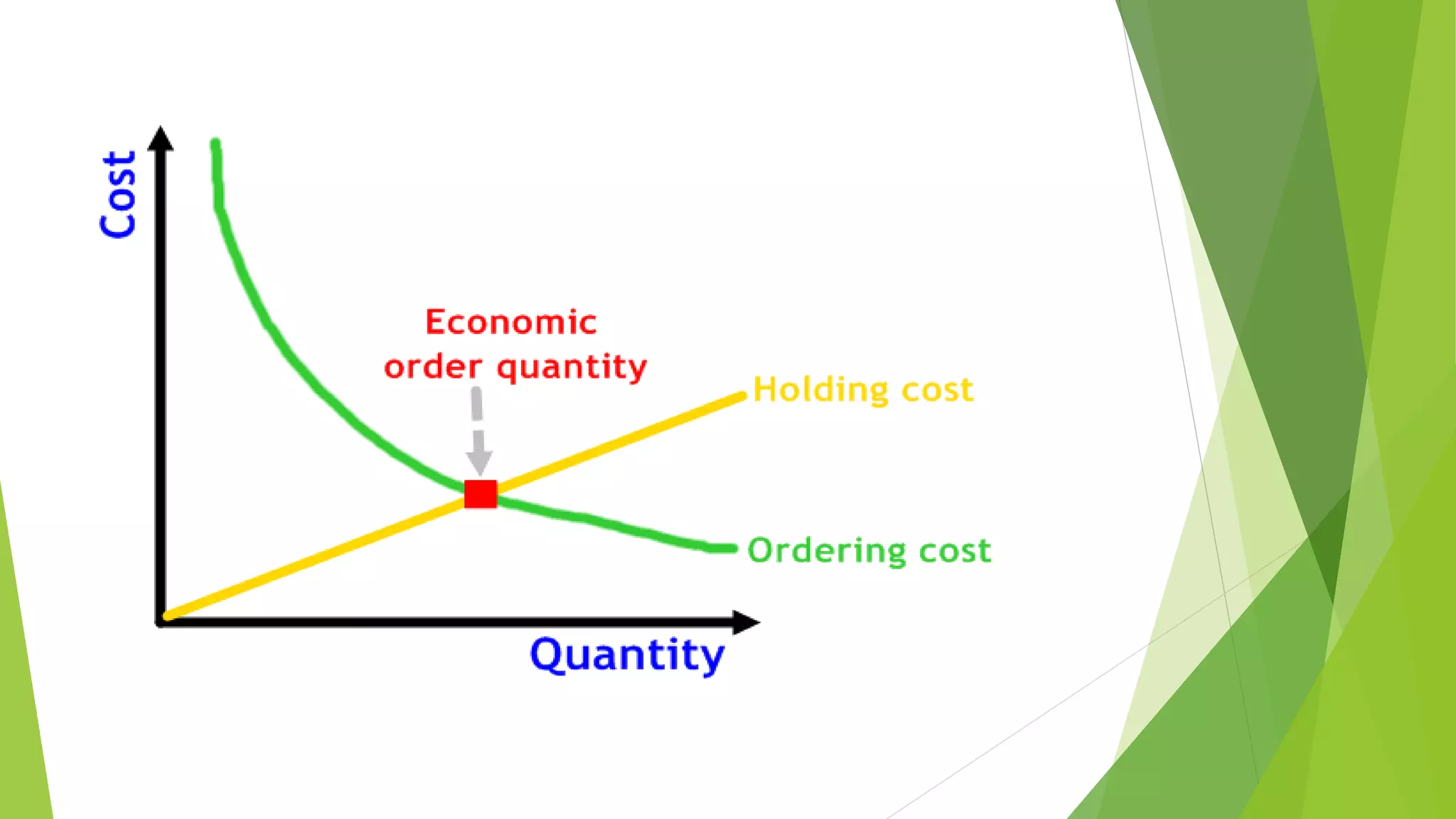
One of the most important problems faced by the
purchasing department is how much to order at a time.
Purchasing in large quantities involve lesser purchasing
cost. But cost of carrying them tends to be higher.
Likewise if purchases are made in smaller quantities,
holding costs are lower while purchasing costs tend to
be higher.
Hence, the most economic buying quantity or the
optimum quantity should be determined by the purchase
department by considering the factors such as cost of
ordering, holding or carrying.
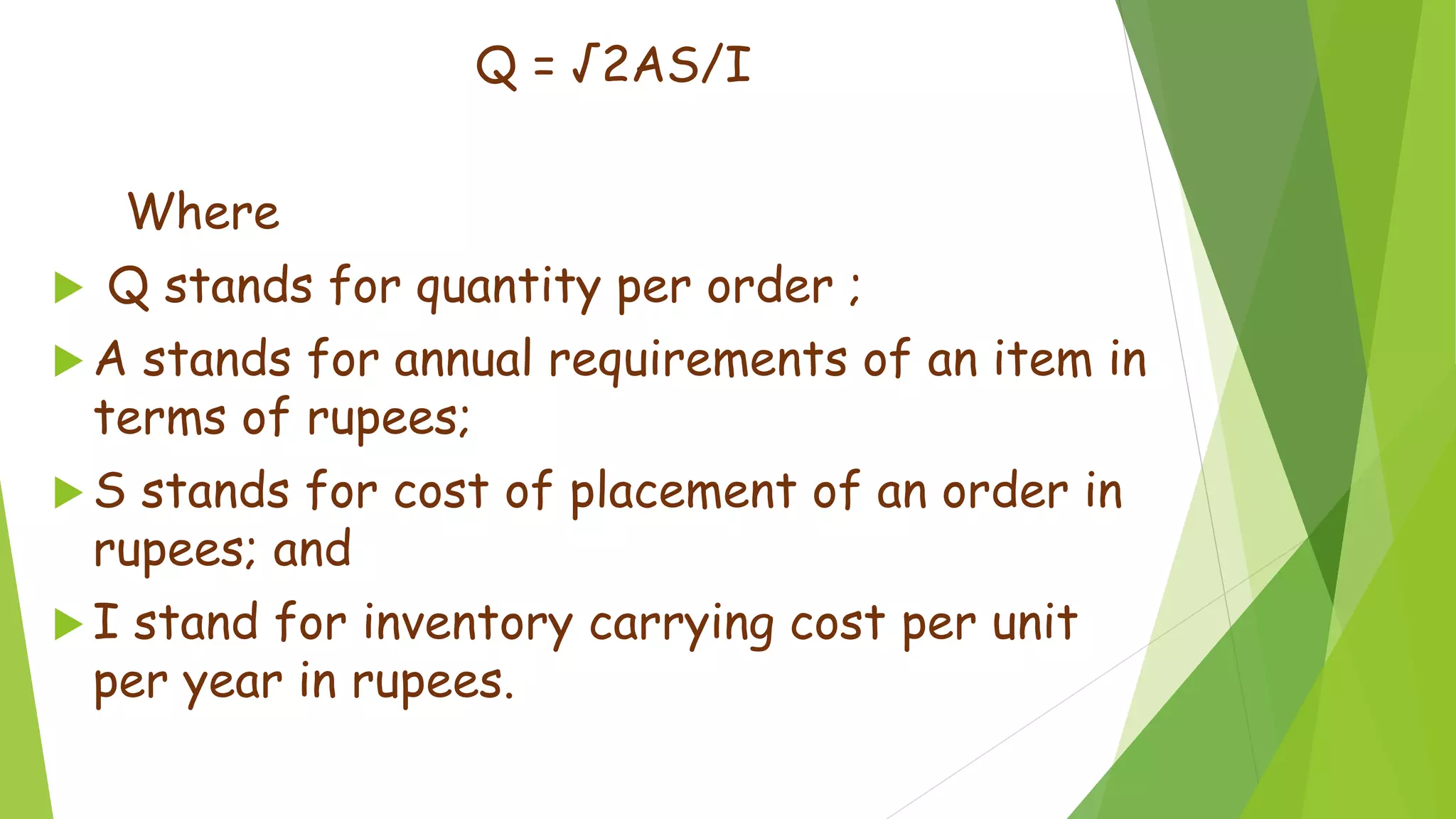
Q = √2AS/I
Where
 Q stands for quantity per order ;
 A stands for annual requirements of an item in
terms of rupees;
 S stands for cost of placement of an order in
rupees; and
 I stand for inventory carrying cost per unit
per year in rupees.
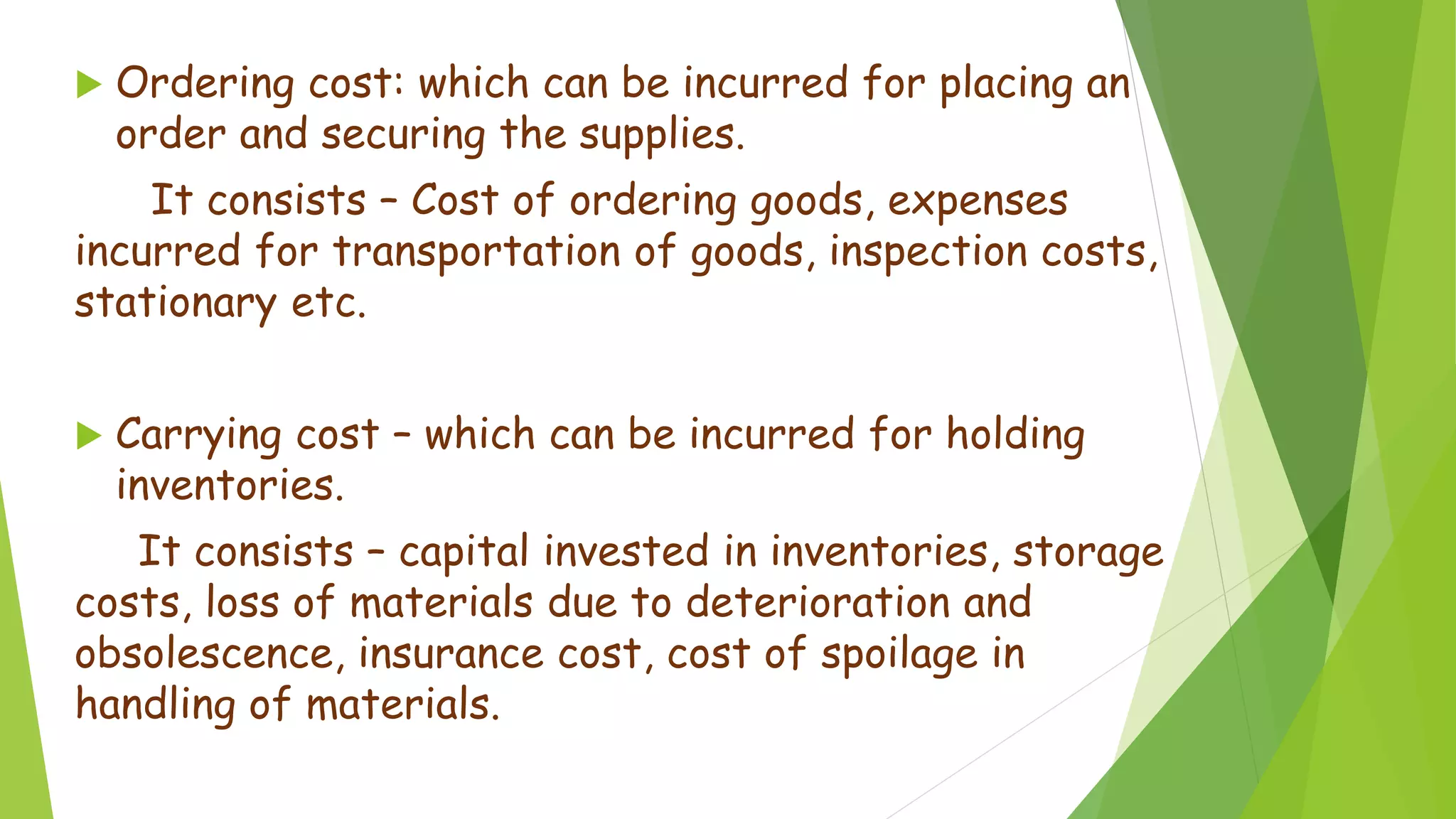
 Ordering cost: which can be incurred for placing an
order and securing the supplies.
It consists – Cost of ordering goods, expenses
incurred for transportation of goods, inspection costs,
stationary etc.
 Carrying cost – which can be incurred for holding
inventories.
It consists – capital invested in inventories, storage
costs, loss of materials due to deterioration and
obsolescence, insurance cost, cost of spoilage in
handling of materials.
Inventory management and control

Inventory management and control

  • 1.
  • 2.
    What is InventoryManagement and Control Inventory management is the overseeing and controlling of the ordering, storage and use of components that a company will use in the production of the items it will sell as well as the overseeing and controlling of quantities of finished products for sale. A business's inventory is one of its major assets and represents an investment that is tied up until the item is sold or used in the production of an item that is sold. It also costs money to store, track and insure inventory. Inventories that are mismanaged can create significant financial problems for a business, whether the mismanagement results in an inventory glut or an inventory shortage.
  • 3.
  • 4.
    1. Determination ofStock Levels To avoid over-stocking and under stocking of materials, the management has to decide about the maximum level, minimum level, re-order level, danger level and average level of materials to be kept in the store Explanation: (a) Re-ordering level: It is a point at which order for supply of material should be made. This level is fixed somewhere between the maximum level and the minimum level in such a way that the quantity of materials represented by the difference between the re-ordering level and the minimum level will be sufficient to meet the demands of production till such time as the materials are replenished. Reorder level depends mainly on the maximum rate of consumption and order lead time. Reordering level is calculated with the following formula: Re-order level =Maximum Rate of consumption x maximum lead time
  • 5.
    (b) Maximum Level: Maximumlevel is the level above which stock should never reach. It is also known as ‘maximum limit’ or ‘maximum stock’. The function of maximum level is essential to avoid unnecessary blocking up of capital in inventories, losses on account of deterioration and obsolescence of materials, extra overheads and temptation to thefts etc. This level can be determined with the following formula. Maximum Stock level = Reordering level + Reordering quantity —(Minimum Consumption x Minimum re-ordering period)
  • 6.
    (c) Minimum Level: Itrepresents the lowest quantity of a particular material below which stock should not be allowed to fall. This level must be maintained at every time so that production is not held up due to shortage of any material. It is that level of inventories of which a fresh order must be placed to replenish the stock. This level is usually determined through the following formula: Minimum Level = Re-ordering level — (Normal rate of consumption x Normal delivery period)
  • 7.
    (d) Average StockLevel: Average stock level is determined by averaging the minimum and maximum level of stock. The formula for determination of the level is as follows: Average level =1/2 (Minimum stock level + Maximum stock level) This may also be expressed by minimum level + 1/2 of Re- ordering Quantity
  • 8.
    (e) Danger Level: Dangerlevel is that level below which the stock should under no circumstances be allowed to fall. Danger level is slightly below the minimum level and therefore the purchases manager should make special efforts to acquire required materials and stores. This level can be calculated with the help of following formula: Danger Level =Average rate of consumption x Emergency supply time.
  • 10.
    2. Determination ofSafety Stocks Safety stock is the stock held by a company in excess of its requirement for the lead time. Companies hold safety stock to guard against stock-out. Safety stock is calculated using the following formula: Safety Stock = (Maximum Daily Usage − Average Daily Usage) × Lead Time Lead time is the time which supplier takes in ordering the items
  • 11.
    3. Ordering Systemsof Inventory The basic problem of inventory is to decide the re-order point. This point indicates when an order should be placed. The re-order point is determined with the help of these things – a) Average Consumption Rate b)Duration of lead time c) Economic order quantity.
  • 12.
    4. Economic OrderQuantity (EOQ) One of the most important problems faced by the purchasing department is how much to order at a time. Purchasing in large quantities involve lesser purchasing cost. But cost of carrying them tends to be higher. Likewise if purchases are made in smaller quantities, holding costs are lower while purchasing costs tend to be higher. Hence, the most economic buying quantity or the optimum quantity should be determined by the purchase department by considering the factors such as cost of ordering, holding or carrying.
  • 13.
    Q = √2AS/I Where Q stands for quantity per order ;  A stands for annual requirements of an item in terms of rupees;  S stands for cost of placement of an order in rupees; and  I stand for inventory carrying cost per unit per year in rupees.
  • 14.
     Ordering cost:which can be incurred for placing an order and securing the supplies. It consists – Cost of ordering goods, expenses incurred for transportation of goods, inspection costs, stationary etc.  Carrying cost – which can be incurred for holding inventories. It consists – capital invested in inventories, storage costs, loss of materials due to deterioration and obsolescence, insurance cost, cost of spoilage in handling of materials.