INVENTORY PLANNING &
CONTROL
Inventory-A physical resource that a firm holds in stock
with the intent of selling it or transforming it into a more
valuable state
Inventory Systems-A set of policies and controls that
monitors levels of inventory and determines what levels
should be maintained and how large orders should be
placed
INVENTORY PLANNING FOR
INDEPENDENT DEMAND ITEMS
In a manufacturing organization, finished goods and spare parts
typically belong to the category of independent demand items.
Planning for a dependent demand item is done to meet
manufacturing requirements but incase of independent demand
item,it is done to meet customer requirements.
CONTINUOUS DEMAND
Independent demand items are always in continuous demand
Consider the sale of consumer appliances of manufactures such as
Videocon and LG. The demand for 32”LCD color television panel in a
particular city will be continuous. When there is a continuous demand
for an item, constant availability of items and periodic replacement of
stock are important elements of the planning process.
UNCERTAINITY OF DEMAND
There is an element of considerable uncertainty of demand in the
case of independent demand items. On the other hand, in the case of
dependent demand items, the demand is always derived and hence
known with certainty.
TYPES OF INVENTORY
4/23/2016 6
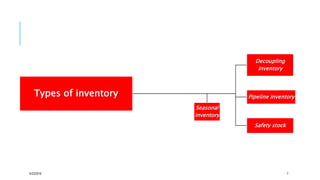
Types of inventory
Decoupling
inventory
Pipeline inventory
Safety stock
Seasonal
inventory
4/23/2016 7
SEASONAL INVENTORY
Organisations carry out to meet the fluctuations in demand arising
out of seasonality.
During the festivals the demand for consumer durable may be high
due to increase in disposable income from consumers
To meet such this inventory is prepared
Example
During lunch hours hotels and fast food chains to handle increase
and decrease demand inventory helps them for short term capacity.
4/23/2016 8
DECOUPLING INVENTORY
Manufacturing normally involves many steps and many workstations, raw
materials pass through many process to meet the finished goods so the
planning so such process is important and it becomes complex as well
To solve this decoupling inventory can be used
4/23/2016 9
Decoupling
inventory
Stage
1
Stage
2
Stage
3
CYCLIC INVENTORY
Its customary for organisations to order inventory in repeated cycles and
consume them over time.
Example
Hospital uses disposable syringes of 10k, if average consumption is 500
then it takes 20 days delicate the order, and another day for 10k and so on
it will continue.
4/23/2016 10
time
q
u
a
n
t
i
t
y
The average cyclic inventory=
Q+0 = q
2 2
PIPE LINE INVENTORY
Organisations carry in long run due to no zero lead time for order.
Due to distance between the supplier and the host so the time
between the order placement and the order delivery is known as
pipeline inventory
Example
Suppose it takes 3 days for supply of disposable sriynges, then
hospital must place order at end of 7th day to replenish the order of
10000 that means the order will be placed when inventory reaches
1500(3days at the rate 500 per day)
4/23/2016 11
SAFETY STOCK
Safety Stock:
If the actual usage increases or the delivery of the inventory is
delayed, firm can face a problem of stock-out. So firm may maintain
the safety stock.
In this case Reorder point is calculated as
Reorder point=Lead*Average usage + safety stock.
4/23/2016 12
CARYING COSTSl.no Items of expenditure{annual} Amount
1 Stationary 75000
2 Insurance premium 375000
3 Establishment expenses and
overheads
275000
4 Salary of stores personnel 1,100,000
Total expenditure 1,750,000
Average value of the
inventory in stores
5.00%
A Cost of warehousing 5.00%
B Cost of capital 15.00%
C Obsolescence(estimated
historically)
2.00%
D Damages,spoliers,etc 1.00%
CARYING COST?4/23/2016 13
COST OF ORDERING
SL.NO ITEMS OF EXPENDITURE AMOUNT
1 Stationary 80,000
2 Telephone 40,000
3 Other communication
expenses
60,000
4 Salary of purchase
department personnel
1,100,000
5 Inwards goods inspection
section expenses
350,000
6 Other expenses and
overheads
200,000
TOTAL EXPENDITURE 1,830,000
no of purchase orders
generated
600.004/23/2016 14
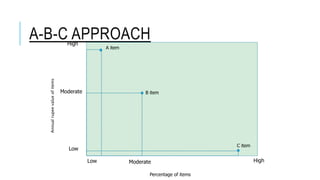
WHAT IS ABC ANALYSIS?
ABC analysis is an inventory categorization method which
consists in dividing items into three categories (A, B, C):
 A being the most valuable items,
 C being the least valuable ones.
This method aims to draw managers’ attention on the critical
few (A-items) not on the trivial many (C-items).
ABC analysis also called as :
 HML (High Moderate Low) Analysis
 Pareto Analysis
 Selective Stock Control
STEPS
Find out the unit cost and and the usage of each material over a given
period.
Multiply the unit cost by the estimated annual usage to obtain the net
value
(Annual demand) x (item cost per unit)
Find % of each material/item in total inventory .
All items are then ranked according to their % rupee value as either A,
B, or C as per rule.
A-B-C APPROACH
A item
B item
C item
High
Moderate
Low
Low HighModerate
Annualrupeevalueofitems
Percentage of items
PROBLEM 1
From the following information classify the inventory items into A,B
and C categories-Item Quantity Price per
unit
Items Quantity Price per
unit
A 200 201 G 400 25
B 600 83 H 280 400
C 250 250 I 400 55
D 470 50 J 300 40
E 250 64 K 250 30
F 300 85 L 1000 15
Material Quantity Price per
unit
Inventory
Value
(Qty*rate)
% in value Category
A 200 201 100200 21.97% A
B 600 83 49800 10.92% A
C 250 250 62500 13.71% A
D 470 50 23500 5.15% B
E 250 64 16000 3.51% C
F 300 85 25500 5.59% B
G 400 25 10000 2.19% C
H 280 400 112000 24.56% A
I 400 55 22000 4.82% B
J 300 40 12000 2.63% C
K 250 30 7500 1.64% C
L 1000 15 15000 3.29% C
TOTAL 456000 100%
SOLUTION:
PROBLEM 2
Item Annual demand Unit cost (Rs.)
1 250 330
2 100 70
3 190 500
4 150 100
5 390 700
6 100 915
7 20 210
8 100 4000
9 800 10
10 900 2
11 50 200
12 40 300
Items Annual
demand
(qty)
Price per
unit
(rate)
Inventory
Value
(qty * rate)
% in value Classificatio
n
1 250 330 82500 8.25% B
2 100 70 7000 0.7% C
3 190 500 95000 9.5% B
4 150 100 15000 1.5% C
5 390 700 273000 27.3% A
6 100 915 91500 9.15% B
7 20 210 4200 0.42% C
8 100 4000 400000 40% A
9 800 10 8000 0.8% C
10 900 2 1800 0.18% C
11 50 200 10000 1% C
12 40 300 12000 1.2% C
TOTAL 1000000 100%
Solution:
PROBLEM 3
Classify Inventory Items into ABC Category:Items Unit Cost Annual Demand
1 5 48000
2 11 2000
3 15 300
4 8 800
5 7 4800
6 16 1200
7 20 18000
8 4 300
9 9 5000
10 12 500
Items Unit Cost Annual
Demand
Inventory
Value
(qty*rate)
% in
Value
Classificatio
n
1 5 48000 240,000 32.5% A
2 11 2000 22,000 3% B
3 15 300 4,500 0.6% C
4 8 800 6,400 0.9% C
5 7 4800 33,600 4.6% B
6 16 1200 19,200 2.6% B
7 20 18000 360,000 48.8% A
8 4 300 1,200 0.2% C
9 9 5000 45,000 6.1% B
10 12 500 6,000 0.8% C
TOTAL 737,900 100%
Solution :
ECONOMIC ORDER QUANTITY
It is the order size that minimizes the total annual cost.
The Question to how much to order is determind by Economic order
quantity.
It identifies the optimal order quantity by minimizing the sum of
certain annual costs that vary with order size.
Three order size models are:
1.The basic economic order quantity model
2.The economic production quantity model
3.The quantity discount model
4/23/2016 24
ASSUMPTIONS OF EOQ MODEL
Only one product is involved
Annual demand requirements known
Demand is even throughout the year
Lead time does not vary
Each order is received in a single delivery
There are no quantity discounts
12-26
Order Quantity
(Q)
The Total-Cost Curve is U-Shaped
Ordering Costs
QO
AnnualCost
(optimal order quantity)
TC
Q
H
D
Q
S 
2
THE BASIC ECONOMIC ORDER QUANTITY
MODEL
Annual Carrying cost=(Q/2)H
Q =order quantity per unit
H=Holding (carrying)cost per unit.
Annual Ordering cost=(D/Q)S
D=Annual demand
S=Ordering cost
D = Annual demand (units)
C = Cost per unit ($)
Q = Order quantity (units)
S = Cost per order ($)
I = Holding cost (%)
H = Holding cost ($) = I x C
Number of Orders = D / Q
Ordering costs = S x (D / Q)
Average inventory
units = Q / 2
$ = (Q / 2) x C
Cost to carry
average inventory = (Q / 2) x I x C
= (Q /2) x H
Total cost = (Q/2) x I x C + S x
(D/Q)
inv carry cost order
cost
Take the 1st derivative:
d(TC)/d(Q) = (I x C) / 2 - (D x
S) / Q²
To optimize: set d(TC)/d(Q) = 0
DS/ Q² = IC / 2
Q²/DS = 2 / IC
Q²= (DS x 2 )/ IC
Q = sqrt (2DS / IC)
Deriving the
EOQ
4/23/2016 29
Total Cost=(Q/2)H+(D/Q)S
Economic Order Quantity(Q0)= √(2DS/H)
Length of the order cycle=Q/D;
Number of orders=(D/Q)
Example 1:. Piddling Manufacturing assembles security monitors .It purchases
3600 black and white cathode ray tubes a year at $65 each.Ordering costs are $31,
and annual carrying costs are 20% of the purchase price.Compute the optimal
quantity and the total annual cost of ordering and carrying the inventory?
 Here D=3600 cathode ray tubes per year
 S=$31
 H= 0.20*65=$13
A)Qo=√(2DS/H)
√(2(3600)(31)/13=131 cathode ray tubes
B)TC=carrying cost+ ordering cost
(Qo/2)H+(D/Qo)S
=(131/2)13+(3600/131)31
=$1704
Example:2
A local distributor for a national tire company expects to sell approximately
9,600 steel-belted radial tires of a certain size and tread design next year
.Annual carrying cost is $16 per tier,and ordering cost is $75.The
distributor operates 288 days a year.
A)What is EOQ?
B)How many times per year does the store order?
C)What is length of an order cycle?
D)What is total annual cost if the EOQ quantity is ordered?
D=9600 tires per year
H= $16 per unit per year
S= $75
A)Q0= √(2DS/H)=√(2(9600)75)/16=300
B)Number of orders pre year: (D/Q)
=9600/300=32
c)Length of order cycle=(Q/D)=300tires/9600 tires/yr
1/32 of a year
1/32*288=9 days
D)TC=CC+OC
=(Q/2)H+(D/Q)S
=(300/2)16+(9600/300)75
=2400+2400
= $ 4800
ECONOMIC PRODUCTION
QUANTITY (EPQ)
Production done in batches or lots
Capacity to produce a part exceeds the part’s usage or demand rate
Assumptions of EPQ are similar to EOQ except orders are received
incrementally during production
Economic run size:
P=Production or delivary rate
u=Usage Rate
S=Setup cost
Q
DS
H
p
p u
0
2


ECONOMIC PRODUCTION
QUANTITY ASSUMPTIONS
Only one item is involved
Annual demand is known
Usage rate is constant
Usage occurs continually
Production rate is constant
Lead time does not vary
No quantity discounts
4/23/2016 36
Cycle time is time between orders or between the beginnings of the run)
Cycle time= (Qo/u)
Run time is a function of run(lot size) and the production rate:
Run time=(Qo/p)
Max inventory levels (Imax)=(Qo/p)(p-u)
Avg inventory level(Iavg)=Imax/2
Example:
A toy manufacturer uses 48000 rubber wheels per year for its popular dump
truck series.The firm makes its own wheels,which it can produce at a rate of
800 per day .The toy trucks are assembled uniformly over the entire
year.Carrying cost is $1 per wheel a year.Setup cost for a production run of
wheels is $45.The firm operates 240 days per year.Determine the
A)optimal run size
B)Minimum total annual cost for carrying and setup
C)Cycle time for carrying and setup
D)run time
D=48000 wheels per year
S=$45
H=$1 per wheel per year
P=800 wheels per day
U=48000 per 240 days
A)
√(2*48000*45)/1* √(800/(800-200)
=2400 wheels
Q
DS
H
p
p u
0
2


B)TC min=CC+Setup cost=(Imax/2)H+(D/Qo)S
Imax=(Qo/p)(p-u)=1,800 wheels
TC min=1800/2*1+48000/2400*45=$1800
C)Cycle time=(Qo/u)
2400 wheels/200 wheels per day=12 days
D)Run time=(Qo/p)=2400wheels/800 wheels per day=3 days
Example2:
A firm in Sialkot produces 250,000 each world class footballs for both dome
stic and international markets . It can make footballs at a rate
of 2000 per day. The footballs are manufactured uniformly
over the whole year. Carrying cost is Rs. 100 per football and Setup cost for
a production run is Rs.2500. The manufacturing unit operates for 250 days
per year
Determine the
1. Optimal Run Size.
2. Minimum total annual cost for carrying and setup cost.
3. Cycle time for the Optimal Run Size.
4. Run time by using the formula
A)Optimal Run Size.(Qo)=
= √ (2 X 250,000 X 2500/100 )* √(2 000 /2000-1000 ))
= 2500( sq.root2X2)=5000 footballs.
B) Minimum total annual cost for carrying and setup cost.
= Carrying Cost + Set up Cost
=( I max/2)H+ ( D/Q0)S
Where I max= (Q0/p )(p-u)=5000/2000(1000)
=2500 footballs
Now TC= 2500/2 X 100 + (250,000/5000 )(2500)
=1250 X 100 + 125,000
=125,000+ 125,000
= Rs. 250,000.
C)
Cycle time for the Optimal Run Size.
Q0/U=5000/1000= 5 days
D)
Run time
Q0/p=5000/2000= 2.5 days
4/23/2016 44

Inventory management

  • 1.
  • 2.
    Inventory-A physical resourcethat a firm holds in stock with the intent of selling it or transforming it into a more valuable state Inventory Systems-A set of policies and controls that monitors levels of inventory and determines what levels should be maintained and how large orders should be placed
  • 3.
    INVENTORY PLANNING FOR INDEPENDENTDEMAND ITEMS In a manufacturing organization, finished goods and spare parts typically belong to the category of independent demand items. Planning for a dependent demand item is done to meet manufacturing requirements but incase of independent demand item,it is done to meet customer requirements.
  • 4.
    CONTINUOUS DEMAND Independent demanditems are always in continuous demand Consider the sale of consumer appliances of manufactures such as Videocon and LG. The demand for 32”LCD color television panel in a particular city will be continuous. When there is a continuous demand for an item, constant availability of items and periodic replacement of stock are important elements of the planning process.
  • 5.
    UNCERTAINITY OF DEMAND Thereis an element of considerable uncertainty of demand in the case of independent demand items. On the other hand, in the case of dependent demand items, the demand is always derived and hence known with certainty.
  • 6.
  • 7.
    Types of inventory Decoupling inventory Pipelineinventory Safety stock Seasonal inventory 4/23/2016 7
  • 8.
    SEASONAL INVENTORY Organisations carryout to meet the fluctuations in demand arising out of seasonality. During the festivals the demand for consumer durable may be high due to increase in disposable income from consumers To meet such this inventory is prepared Example During lunch hours hotels and fast food chains to handle increase and decrease demand inventory helps them for short term capacity. 4/23/2016 8
  • 9.
    DECOUPLING INVENTORY Manufacturing normallyinvolves many steps and many workstations, raw materials pass through many process to meet the finished goods so the planning so such process is important and it becomes complex as well To solve this decoupling inventory can be used 4/23/2016 9 Decoupling inventory Stage 1 Stage 2 Stage 3
  • 10.
    CYCLIC INVENTORY Its customaryfor organisations to order inventory in repeated cycles and consume them over time. Example Hospital uses disposable syringes of 10k, if average consumption is 500 then it takes 20 days delicate the order, and another day for 10k and so on it will continue. 4/23/2016 10 time q u a n t i t y The average cyclic inventory= Q+0 = q 2 2
  • 11.
    PIPE LINE INVENTORY Organisationscarry in long run due to no zero lead time for order. Due to distance between the supplier and the host so the time between the order placement and the order delivery is known as pipeline inventory Example Suppose it takes 3 days for supply of disposable sriynges, then hospital must place order at end of 7th day to replenish the order of 10000 that means the order will be placed when inventory reaches 1500(3days at the rate 500 per day) 4/23/2016 11
  • 12.
    SAFETY STOCK Safety Stock: Ifthe actual usage increases or the delivery of the inventory is delayed, firm can face a problem of stock-out. So firm may maintain the safety stock. In this case Reorder point is calculated as Reorder point=Lead*Average usage + safety stock. 4/23/2016 12
  • 13.
    CARYING COSTSl.no Itemsof expenditure{annual} Amount 1 Stationary 75000 2 Insurance premium 375000 3 Establishment expenses and overheads 275000 4 Salary of stores personnel 1,100,000 Total expenditure 1,750,000 Average value of the inventory in stores 5.00% A Cost of warehousing 5.00% B Cost of capital 15.00% C Obsolescence(estimated historically) 2.00% D Damages,spoliers,etc 1.00% CARYING COST?4/23/2016 13
  • 14.
    COST OF ORDERING SL.NOITEMS OF EXPENDITURE AMOUNT 1 Stationary 80,000 2 Telephone 40,000 3 Other communication expenses 60,000 4 Salary of purchase department personnel 1,100,000 5 Inwards goods inspection section expenses 350,000 6 Other expenses and overheads 200,000 TOTAL EXPENDITURE 1,830,000 no of purchase orders generated 600.004/23/2016 14
  • 15.
    WHAT IS ABCANALYSIS? ABC analysis is an inventory categorization method which consists in dividing items into three categories (A, B, C):  A being the most valuable items,  C being the least valuable ones. This method aims to draw managers’ attention on the critical few (A-items) not on the trivial many (C-items). ABC analysis also called as :  HML (High Moderate Low) Analysis  Pareto Analysis  Selective Stock Control
  • 16.
    STEPS Find out theunit cost and and the usage of each material over a given period. Multiply the unit cost by the estimated annual usage to obtain the net value (Annual demand) x (item cost per unit) Find % of each material/item in total inventory . All items are then ranked according to their % rupee value as either A, B, or C as per rule.
  • 17.
    A-B-C APPROACH A item Bitem C item High Moderate Low Low HighModerate Annualrupeevalueofitems Percentage of items
  • 18.
    PROBLEM 1 From thefollowing information classify the inventory items into A,B and C categories-Item Quantity Price per unit Items Quantity Price per unit A 200 201 G 400 25 B 600 83 H 280 400 C 250 250 I 400 55 D 470 50 J 300 40 E 250 64 K 250 30 F 300 85 L 1000 15
  • 19.
    Material Quantity Priceper unit Inventory Value (Qty*rate) % in value Category A 200 201 100200 21.97% A B 600 83 49800 10.92% A C 250 250 62500 13.71% A D 470 50 23500 5.15% B E 250 64 16000 3.51% C F 300 85 25500 5.59% B G 400 25 10000 2.19% C H 280 400 112000 24.56% A I 400 55 22000 4.82% B J 300 40 12000 2.63% C K 250 30 7500 1.64% C L 1000 15 15000 3.29% C TOTAL 456000 100% SOLUTION:
  • 20.
    PROBLEM 2 Item Annualdemand Unit cost (Rs.) 1 250 330 2 100 70 3 190 500 4 150 100 5 390 700 6 100 915 7 20 210 8 100 4000 9 800 10 10 900 2 11 50 200 12 40 300
  • 21.
    Items Annual demand (qty) Price per unit (rate) Inventory Value (qty* rate) % in value Classificatio n 1 250 330 82500 8.25% B 2 100 70 7000 0.7% C 3 190 500 95000 9.5% B 4 150 100 15000 1.5% C 5 390 700 273000 27.3% A 6 100 915 91500 9.15% B 7 20 210 4200 0.42% C 8 100 4000 400000 40% A 9 800 10 8000 0.8% C 10 900 2 1800 0.18% C 11 50 200 10000 1% C 12 40 300 12000 1.2% C TOTAL 1000000 100% Solution:
  • 22.
    PROBLEM 3 Classify InventoryItems into ABC Category:Items Unit Cost Annual Demand 1 5 48000 2 11 2000 3 15 300 4 8 800 5 7 4800 6 16 1200 7 20 18000 8 4 300 9 9 5000 10 12 500
  • 23.
    Items Unit CostAnnual Demand Inventory Value (qty*rate) % in Value Classificatio n 1 5 48000 240,000 32.5% A 2 11 2000 22,000 3% B 3 15 300 4,500 0.6% C 4 8 800 6,400 0.9% C 5 7 4800 33,600 4.6% B 6 16 1200 19,200 2.6% B 7 20 18000 360,000 48.8% A 8 4 300 1,200 0.2% C 9 9 5000 45,000 6.1% B 10 12 500 6,000 0.8% C TOTAL 737,900 100% Solution :
  • 24.
    ECONOMIC ORDER QUANTITY Itis the order size that minimizes the total annual cost. The Question to how much to order is determind by Economic order quantity. It identifies the optimal order quantity by minimizing the sum of certain annual costs that vary with order size. Three order size models are: 1.The basic economic order quantity model 2.The economic production quantity model 3.The quantity discount model 4/23/2016 24
  • 25.
    ASSUMPTIONS OF EOQMODEL Only one product is involved Annual demand requirements known Demand is even throughout the year Lead time does not vary Each order is received in a single delivery There are no quantity discounts
  • 26.
    12-26 Order Quantity (Q) The Total-CostCurve is U-Shaped Ordering Costs QO AnnualCost (optimal order quantity) TC Q H D Q S  2
  • 27.
    THE BASIC ECONOMICORDER QUANTITY MODEL Annual Carrying cost=(Q/2)H Q =order quantity per unit H=Holding (carrying)cost per unit. Annual Ordering cost=(D/Q)S D=Annual demand S=Ordering cost
  • 28.
    D = Annualdemand (units) C = Cost per unit ($) Q = Order quantity (units) S = Cost per order ($) I = Holding cost (%) H = Holding cost ($) = I x C Number of Orders = D / Q Ordering costs = S x (D / Q) Average inventory units = Q / 2 $ = (Q / 2) x C Cost to carry average inventory = (Q / 2) x I x C = (Q /2) x H Total cost = (Q/2) x I x C + S x (D/Q) inv carry cost order cost Take the 1st derivative: d(TC)/d(Q) = (I x C) / 2 - (D x S) / Q² To optimize: set d(TC)/d(Q) = 0 DS/ Q² = IC / 2 Q²/DS = 2 / IC Q²= (DS x 2 )/ IC Q = sqrt (2DS / IC) Deriving the EOQ
  • 29.
  • 30.
    Total Cost=(Q/2)H+(D/Q)S Economic OrderQuantity(Q0)= √(2DS/H) Length of the order cycle=Q/D; Number of orders=(D/Q) Example 1:. Piddling Manufacturing assembles security monitors .It purchases 3600 black and white cathode ray tubes a year at $65 each.Ordering costs are $31, and annual carrying costs are 20% of the purchase price.Compute the optimal quantity and the total annual cost of ordering and carrying the inventory?
  • 31.
     Here D=3600cathode ray tubes per year  S=$31  H= 0.20*65=$13 A)Qo=√(2DS/H) √(2(3600)(31)/13=131 cathode ray tubes B)TC=carrying cost+ ordering cost (Qo/2)H+(D/Qo)S =(131/2)13+(3600/131)31 =$1704
  • 32.
    Example:2 A local distributorfor a national tire company expects to sell approximately 9,600 steel-belted radial tires of a certain size and tread design next year .Annual carrying cost is $16 per tier,and ordering cost is $75.The distributor operates 288 days a year. A)What is EOQ? B)How many times per year does the store order? C)What is length of an order cycle? D)What is total annual cost if the EOQ quantity is ordered?
  • 33.
    D=9600 tires peryear H= $16 per unit per year S= $75 A)Q0= √(2DS/H)=√(2(9600)75)/16=300 B)Number of orders pre year: (D/Q) =9600/300=32 c)Length of order cycle=(Q/D)=300tires/9600 tires/yr 1/32 of a year 1/32*288=9 days D)TC=CC+OC =(Q/2)H+(D/Q)S =(300/2)16+(9600/300)75 =2400+2400 = $ 4800
  • 34.
    ECONOMIC PRODUCTION QUANTITY (EPQ) Productiondone in batches or lots Capacity to produce a part exceeds the part’s usage or demand rate Assumptions of EPQ are similar to EOQ except orders are received incrementally during production Economic run size: P=Production or delivary rate u=Usage Rate S=Setup cost Q DS H p p u 0 2  
  • 35.
    ECONOMIC PRODUCTION QUANTITY ASSUMPTIONS Onlyone item is involved Annual demand is known Usage rate is constant Usage occurs continually Production rate is constant Lead time does not vary No quantity discounts
  • 36.
  • 37.
    Cycle time istime between orders or between the beginnings of the run) Cycle time= (Qo/u) Run time is a function of run(lot size) and the production rate: Run time=(Qo/p) Max inventory levels (Imax)=(Qo/p)(p-u) Avg inventory level(Iavg)=Imax/2
  • 38.
    Example: A toy manufactureruses 48000 rubber wheels per year for its popular dump truck series.The firm makes its own wheels,which it can produce at a rate of 800 per day .The toy trucks are assembled uniformly over the entire year.Carrying cost is $1 per wheel a year.Setup cost for a production run of wheels is $45.The firm operates 240 days per year.Determine the A)optimal run size B)Minimum total annual cost for carrying and setup C)Cycle time for carrying and setup D)run time
  • 39.
    D=48000 wheels peryear S=$45 H=$1 per wheel per year P=800 wheels per day U=48000 per 240 days A) √(2*48000*45)/1* √(800/(800-200) =2400 wheels Q DS H p p u 0 2  
  • 40.
    B)TC min=CC+Setup cost=(Imax/2)H+(D/Qo)S Imax=(Qo/p)(p-u)=1,800wheels TC min=1800/2*1+48000/2400*45=$1800 C)Cycle time=(Qo/u) 2400 wheels/200 wheels per day=12 days D)Run time=(Qo/p)=2400wheels/800 wheels per day=3 days
  • 41.
    Example2: A firm inSialkot produces 250,000 each world class footballs for both dome stic and international markets . It can make footballs at a rate of 2000 per day. The footballs are manufactured uniformly over the whole year. Carrying cost is Rs. 100 per football and Setup cost for a production run is Rs.2500. The manufacturing unit operates for 250 days per year Determine the 1. Optimal Run Size. 2. Minimum total annual cost for carrying and setup cost. 3. Cycle time for the Optimal Run Size. 4. Run time by using the formula
  • 42.
    A)Optimal Run Size.(Qo)= =√ (2 X 250,000 X 2500/100 )* √(2 000 /2000-1000 )) = 2500( sq.root2X2)=5000 footballs. B) Minimum total annual cost for carrying and setup cost. = Carrying Cost + Set up Cost =( I max/2)H+ ( D/Q0)S Where I max= (Q0/p )(p-u)=5000/2000(1000) =2500 footballs Now TC= 2500/2 X 100 + (250,000/5000 )(2500) =1250 X 100 + 125,000 =125,000+ 125,000 = Rs. 250,000.
  • 43.
    C) Cycle time forthe Optimal Run Size. Q0/U=5000/1000= 5 days D) Run time Q0/p=5000/2000= 2.5 days
  • 44.