INVENTORY MANAGEMENT
Prepared by Mahmoud Eltaweel
1
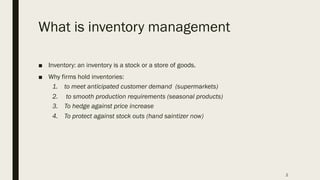
What is inventory management
■ Inventory: an inventory is a stock or a store of goods.
■ Why firms hold inventories:
1. to meet anticipated customer demand (supermarkets)
2. to smooth production requirements (seasonal products)
3. To hedge against price increase
4. To protect against stock outs (hand saintizer now)
2
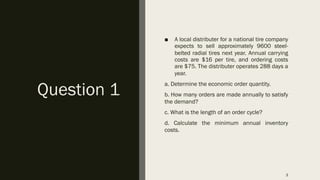
Question 1
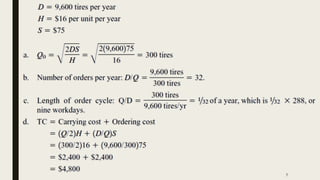
■ A local distributer for a national tire company
expects to sell approximately 9600 steel-
belted radial tires next year. Annual carrying
costs are $16 per tire, and ordering costs
are $75. The distributer operates 288 days a
year.
a. Determine the economic order quantity.
b. How many orders are made annually to satisfy
the demand?
c. What is the length of an order cycle?
d. Calculate the minimum annual inventory
costs.
3
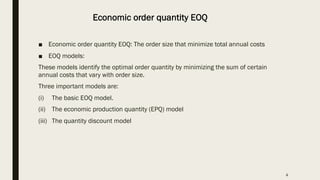
■ Economic order quantity EOQ: The order size that minimize total annual costs
■ EOQ models:
These models identify the optimal order quantity by minimizing the sum of certain
annual costs that vary with order size.
Three important models are:
(i) The basic EOQ model.
(ii) The economic production quantity (EPQ) model
(iii) The quantity discount model
Economic order quantity EOQ
4
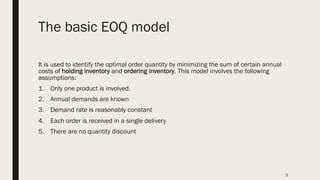
The basic EOQ model
It is used to identify the optimal order quantity by minimizing the sum of certain annual
costs of holding inventory and ordering inventory. This model involves the following
assumptions:
1. Only one product is involved.
2. Annual demands are known
3. Demand rate is reasonably constant
4. Each order is received in a single delivery
5. There are no quantity discount
5
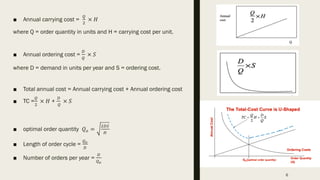
■ Annual carrying cost =
!
"
× 𝐻
where Q = order quantity in units and H = carrying cost per unit.
■ Annual ordering cost =
#
!
× 𝑆
where D = demand in units per year and S = ordering cost.
■ Total annual cost = Annual carrying cost + Annual ordering cost
■ TC =
!
"
× 𝐻 +
#
!
× 𝑆
■ optimal order quantity 𝑄$ =
"#%
&
■ Length of order cycle =
!!
#
■ Number of orders per year =
#
!!
6
7
Question 2
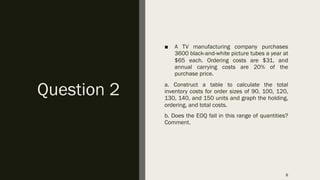
■ A TV manufacturing company purchases
3600 black-and-white picture tubes a year at
$65 each. Ordering costs are $31, and
annual carrying costs are 20% of the
purchase price.
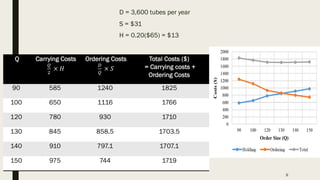
a. Construct a table to calculate the total
inventory costs for order sizes of 90, 100, 120,
130, 140, and 150 units and graph the holding,
ordering, and total costs.
b. Does the EOQ fall in this range of quantities?
Comment.
8
D = 3,600 tubes per year
S = $31
H = 0.20($65) = $13
Q Carrying Costs
!
"
× 𝐻
Ordering Costs
#
!
× 𝑆
Total Costs ($)
= Carrying costs +
Ordering Costs
90 585 1240 1825
100 650 1116 1766
120 780 930 1710
130 845 858.5 1703.5
140 910 797.1 1707.1
150 975 744 1719
9
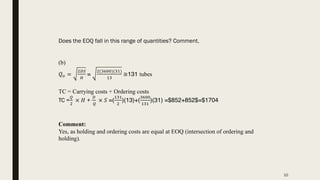
Does the EOQ fall in this range of quantities? Comment.
(b)
𝑄$ =
"#%
&
=
"(()**)((,)
,(
≅131 tubes
TC = Carrying costs + Ordering costs
TC =
!
"
× 𝐻 +
#
!
× 𝑆 =(
,(,
"
)(13)+(
()**
,(,
)(31) =$852+852$=$1704
Comment:
Yes, as holding and ordering costs are equal at EOQ (intersection of ordering and
holding).
10
Question 3
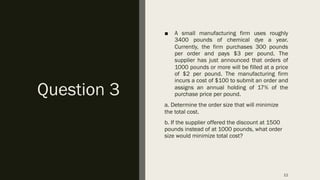
■ A small manufacturing firm uses roughly
3400 pounds of chemical dye a year.
Currently, the firm purchases 300 pounds
per order and pays $3 per pound. The
supplier has just announced that orders of
1000 pounds or more will be filled at a price
of $2 per pound. The manufacturing firm
incurs a cost of $100 to submit an order and
assigns an annual holding of 17% of the
purchase price per pound.
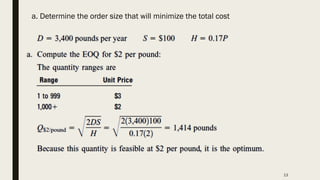
a. Determine the order size that will minimize
the total cost.
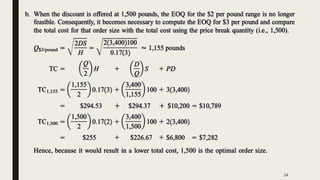
b. If the supplier offered the discount at 1500
pounds instead of at 1000 pounds, what order
size would minimize total cost?
11
Quantity discount Model:
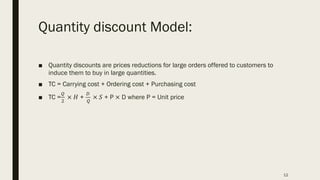
■ Quantity discounts are prices reductions for large orders offered to customers to
induce them to buy in large quantities.
■ TC = Carrying cost + Ordering cost + Purchasing cost
■ TC =
!
"
× 𝐻 +
#
!
× 𝑆 + P × D where P = Unit price
12
13
a. Determine the order size that will minimize the total cost
14
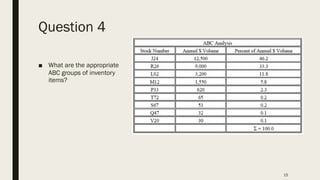
Question 4
■ What are the appropriate
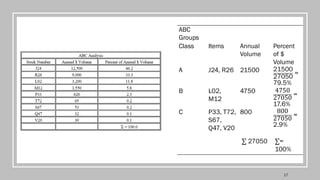
ABC groups of inventory
items?
15
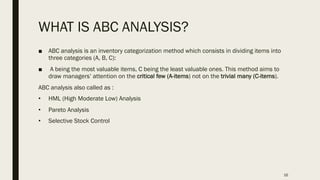
WHAT IS ABC ANALYSIS?
■ ABC analysis is an inventory categorization method which consists in dividing items into
three categories (A, B, C):
■ A being the most valuable items, C being the least valuable ones. This method aims to
draw managers’ attention on the critical few (A-items) not on the trivial many (C-items).
ABC analysis also called as :
• HML (High Moderate Low) Analysis
• Pareto Analysis
• Selective Stock Control
16
ABC
Groups
Class Items Annual
Volume
Percent
of $
Volume
A J24, R26 21500 21500
27050
=
79.5%
B L02,
M12
4750 4750
27050
=
17.6%
C P33, T72,
S67,
Q47, V20
800 800
27050
=
2.9%
∑ 27050 ∑=
100%
17
Question 5
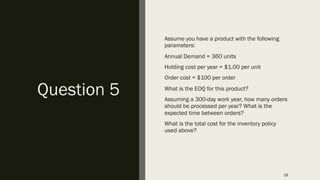
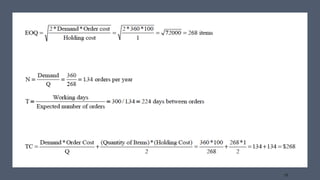
Assume you have a product with the following
parameters:
Annual Demand = 360 units
Holding cost per year = $1.00 per unit
Order cost = $100 per order
What is the EOQ for this product?
Assuming a 300-day work year, how many orders
should be processed per year? What is the
expected time between orders?
What is the total cost for the inventory policy
used above?
18
19
Question 6
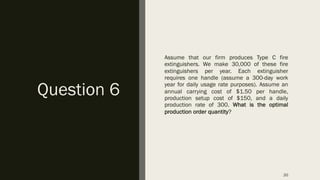
Assume that our firm produces Type C fire
extinguishers. We make 30,000 of these fire
extinguishers per year. Each extinguisher
requires one handle (assume a 300-day work
year for daily usage rate purposes). Assume an
annual carrying cost of $1.50 per handle,
production setup cost of $150, and a daily
production rate of 300. What is the optimal
production order quantity?
20
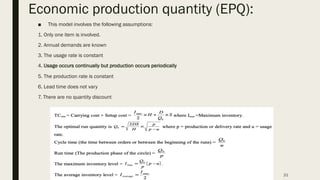
Economic production quantity (EPQ):
■ This model involves the following assumptions:
1. Only one item is involved.
2. Annual demands are known
3. The usage rate is constant
4. Usage occurs continually but production occurs periodically
5. The production rate is constant
6. Lead time does not vary
7. There are no quantity discount
21
22
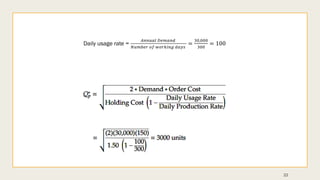
Daily usage rate =
-../01 #230.4
5/3627 $8 9$7:;.< 40=>
=
(*,***
(**
= 100

Inventory management Q&A

  • 1.
  • 2.
    What is inventorymanagement ■ Inventory: an inventory is a stock or a store of goods. ■ Why firms hold inventories: 1. to meet anticipated customer demand (supermarkets) 2. to smooth production requirements (seasonal products) 3. To hedge against price increase 4. To protect against stock outs (hand saintizer now) 2
  • 3.
    Question 1 ■ Alocal distributer for a national tire company expects to sell approximately 9600 steel- belted radial tires next year. Annual carrying costs are $16 per tire, and ordering costs are $75. The distributer operates 288 days a year. a. Determine the economic order quantity. b. How many orders are made annually to satisfy the demand? c. What is the length of an order cycle? d. Calculate the minimum annual inventory costs. 3
  • 4.
    ■ Economic orderquantity EOQ: The order size that minimize total annual costs ■ EOQ models: These models identify the optimal order quantity by minimizing the sum of certain annual costs that vary with order size. Three important models are: (i) The basic EOQ model. (ii) The economic production quantity (EPQ) model (iii) The quantity discount model Economic order quantity EOQ 4
  • 5.
    The basic EOQmodel It is used to identify the optimal order quantity by minimizing the sum of certain annual costs of holding inventory and ordering inventory. This model involves the following assumptions: 1. Only one product is involved. 2. Annual demands are known 3. Demand rate is reasonably constant 4. Each order is received in a single delivery 5. There are no quantity discount 5
  • 6.
    ■ Annual carryingcost = ! " × 𝐻 where Q = order quantity in units and H = carrying cost per unit. ■ Annual ordering cost = # ! × 𝑆 where D = demand in units per year and S = ordering cost. ■ Total annual cost = Annual carrying cost + Annual ordering cost ■ TC = ! " × 𝐻 + # ! × 𝑆 ■ optimal order quantity 𝑄$ = "#% & ■ Length of order cycle = !! # ■ Number of orders per year = # !! 6
  • 7.
  • 8.
    Question 2 ■ ATV manufacturing company purchases 3600 black-and-white picture tubes a year at $65 each. Ordering costs are $31, and annual carrying costs are 20% of the purchase price. a. Construct a table to calculate the total inventory costs for order sizes of 90, 100, 120, 130, 140, and 150 units and graph the holding, ordering, and total costs. b. Does the EOQ fall in this range of quantities? Comment. 8
  • 9.
    D = 3,600tubes per year S = $31 H = 0.20($65) = $13 Q Carrying Costs ! " × 𝐻 Ordering Costs # ! × 𝑆 Total Costs ($) = Carrying costs + Ordering Costs 90 585 1240 1825 100 650 1116 1766 120 780 930 1710 130 845 858.5 1703.5 140 910 797.1 1707.1 150 975 744 1719 9
  • 10.
    Does the EOQfall in this range of quantities? Comment. (b) 𝑄$ = "#% & = "(()**)((,) ,( ≅131 tubes TC = Carrying costs + Ordering costs TC = ! " × 𝐻 + # ! × 𝑆 =( ,(, " )(13)+( ()** ,(, )(31) =$852+852$=$1704 Comment: Yes, as holding and ordering costs are equal at EOQ (intersection of ordering and holding). 10
  • 11.
    Question 3 ■ Asmall manufacturing firm uses roughly 3400 pounds of chemical dye a year. Currently, the firm purchases 300 pounds per order and pays $3 per pound. The supplier has just announced that orders of 1000 pounds or more will be filled at a price of $2 per pound. The manufacturing firm incurs a cost of $100 to submit an order and assigns an annual holding of 17% of the purchase price per pound. a. Determine the order size that will minimize the total cost. b. If the supplier offered the discount at 1500 pounds instead of at 1000 pounds, what order size would minimize total cost? 11
  • 12.
    Quantity discount Model: ■Quantity discounts are prices reductions for large orders offered to customers to induce them to buy in large quantities. ■ TC = Carrying cost + Ordering cost + Purchasing cost ■ TC = ! " × 𝐻 + # ! × 𝑆 + P × D where P = Unit price 12
  • 13.
    13 a. Determine theorder size that will minimize the total cost
  • 14.
  • 15.
    Question 4 ■ Whatare the appropriate ABC groups of inventory items? 15
  • 16.
    WHAT IS ABCANALYSIS? ■ ABC analysis is an inventory categorization method which consists in dividing items into three categories (A, B, C): ■ A being the most valuable items, C being the least valuable ones. This method aims to draw managers’ attention on the critical few (A-items) not on the trivial many (C-items). ABC analysis also called as : • HML (High Moderate Low) Analysis • Pareto Analysis • Selective Stock Control 16
  • 17.
    ABC Groups Class Items Annual Volume Percent of$ Volume A J24, R26 21500 21500 27050 = 79.5% B L02, M12 4750 4750 27050 = 17.6% C P33, T72, S67, Q47, V20 800 800 27050 = 2.9% ∑ 27050 ∑= 100% 17
  • 18.
    Question 5 Assume youhave a product with the following parameters: Annual Demand = 360 units Holding cost per year = $1.00 per unit Order cost = $100 per order What is the EOQ for this product? Assuming a 300-day work year, how many orders should be processed per year? What is the expected time between orders? What is the total cost for the inventory policy used above? 18
  • 19.
  • 20.
    Question 6 Assume thatour firm produces Type C fire extinguishers. We make 30,000 of these fire extinguishers per year. Each extinguisher requires one handle (assume a 300-day work year for daily usage rate purposes). Assume an annual carrying cost of $1.50 per handle, production setup cost of $150, and a daily production rate of 300. What is the optimal production order quantity? 20
  • 21.
    Economic production quantity(EPQ): ■ This model involves the following assumptions: 1. Only one item is involved. 2. Annual demands are known 3. The usage rate is constant 4. Usage occurs continually but production occurs periodically 5. The production rate is constant 6. Lead time does not vary 7. There are no quantity discount 21
  • 22.
    22 Daily usage rate= -../01 #230.4 5/3627 $8 9$7:;.< 40=> = (*,*** (** = 100