LOGISTICS MANAGEMENT
CONTENT:
 Introduction
 Definition
 Phases
 Logistics Function
 Objectives Of Logistics Management
 Logistics Solution
INTRODUCTION:
•The term is derived from Greek word Logistikos and the Latin word
Logisticus, meaning the science of computing and calculating.
•Logistics management is basically an integrative process that optimises
the flow of materials and suppliers through the organisation and its
operations to the customer.
DEFINITION:
 Logistics is referred to as physical distribution. Philip Kotler defines,
"planning, implementing, and controlling the physical flows of material
and finished goods from point of origin to point of use to meet the
customer’s need at a profit.
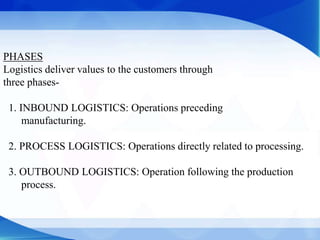
PHASES
Logistics deliver values to the customers through
three phases-
1. INBOUND LOGISTICS: Operations preceding
manufacturing.
2. PROCESS LOGISTICS: Operations directly related to processing.
3. OUTBOUND LOGISTICS: Operation following the production
process.
LOGISTICS FUNCTIONS
LOGISTICS
FUNCTIONS
ORDER
PROCESSING
INVENTORY
MANAGEMENT
WAREHOUSING
TRANSPORTATION
MATERIAL
HANDLING AND
STORAGE
LOGISTICAL
PACKAGING
INFORMATION
LOGISTICS FUNCTIONS
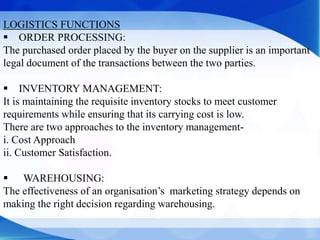
 ORDER PROCESSING:
The purchased order placed by the buyer on the supplier is an important
legal document of the transactions between the two parties.
 INVENTORY MANAGEMENT:
It is maintaining the requisite inventory stocks to meet customer
requirements while ensuring that its carrying cost is low.
There are two approaches to the inventory management-
i. Cost Approach
ii. Customer Satisfaction.
 WAREHOUSING:
The effectiveness of an organisation’s marketing strategy depends on
making the right decision regarding warehousing.
 TRANSPORTATION:
For movement of goods from supplier to buyer, and to customer’s place
transportation is important.
 MATERIAL HANDLING AND STORAGE SYSTEM:
An improper method of material handling will lead to product damage
and delay in deliveries.
 LOGISTICAL PACKAGING:
It helps in damage protection, ease of material handling, and storage
space economy.
 INFORMATION:
Logistics is an information based activity of inventory movement across
the supply chain.
OBJECTIVES
The primary objective of the logistics system is to effectively and
efficiently move the inventory in a supply chain.
1. INVENTORY REDUCTION:
•Inventory is one of the prime factors that can adversely affect the
bottom lines of an enterprise.
•The funds invested are blocked and cannot be used for any other
purpose.
•Hence, inventory is maintain at minimum level.
2. RELIABLE AND CONSISTENT DELIVERY PERFORMANCE:
•Timely delivery is crucial to the customer to keep up his production
schedule.
3. FREIGHT ECONOMY:
•Freight is a major cost element in logistical cost.
•This can be reduced by freight consolidation, transport mode selection,
route planning, load unitising, long distance shipments.
4. MINIMUM PRODUCT DAMAGE:
•The use of mechanised material handling equipment, load unitisation
and proper logistical packaging will reduce product damages.
5. QUICK RESPONSE:
•This aspect is related to the capability of the firm to extend service to
the customer in the shortest time.
LOGISTICS SOLUTION:
•Traditionally, manufacturing organisation used to have their in-house
logistics department.
•But this job needs to be handed over to somebody who can do it with
greater effectiveness and efficiency at a lower cost.
•Today, successful business corporations across the world are
outsourcing logistics.
•A single unit, which can handle all logistic segments to provide hassle
free logistics service to the clients, can provide a complete logistics
solution.
•Today, logistics is widely used in every area.
•The success of a logistics service providing company depends on the
conceptualisation and implementation of the logistics solution and tuning
to the needs of the customer.
THANK YOU
PRESENTATION BY:
ROMANA AND RIDAH

Logistics management

  • 1.
  • 2.
    CONTENT:  Introduction  Definition Phases  Logistics Function  Objectives Of Logistics Management  Logistics Solution
  • 3.
    INTRODUCTION: •The term isderived from Greek word Logistikos and the Latin word Logisticus, meaning the science of computing and calculating. •Logistics management is basically an integrative process that optimises the flow of materials and suppliers through the organisation and its operations to the customer. DEFINITION:  Logistics is referred to as physical distribution. Philip Kotler defines, "planning, implementing, and controlling the physical flows of material and finished goods from point of origin to point of use to meet the customer’s need at a profit.
  • 4.
    PHASES Logistics deliver valuesto the customers through three phases- 1. INBOUND LOGISTICS: Operations preceding manufacturing. 2. PROCESS LOGISTICS: Operations directly related to processing. 3. OUTBOUND LOGISTICS: Operation following the production process.
  • 5.
  • 6.
    LOGISTICS FUNCTIONS  ORDERPROCESSING: The purchased order placed by the buyer on the supplier is an important legal document of the transactions between the two parties.  INVENTORY MANAGEMENT: It is maintaining the requisite inventory stocks to meet customer requirements while ensuring that its carrying cost is low. There are two approaches to the inventory management- i. Cost Approach ii. Customer Satisfaction.  WAREHOUSING: The effectiveness of an organisation’s marketing strategy depends on making the right decision regarding warehousing.
  • 7.
     TRANSPORTATION: For movementof goods from supplier to buyer, and to customer’s place transportation is important.  MATERIAL HANDLING AND STORAGE SYSTEM: An improper method of material handling will lead to product damage and delay in deliveries.  LOGISTICAL PACKAGING: It helps in damage protection, ease of material handling, and storage space economy.  INFORMATION: Logistics is an information based activity of inventory movement across the supply chain.
  • 8.
    OBJECTIVES The primary objectiveof the logistics system is to effectively and efficiently move the inventory in a supply chain. 1. INVENTORY REDUCTION: •Inventory is one of the prime factors that can adversely affect the bottom lines of an enterprise. •The funds invested are blocked and cannot be used for any other purpose. •Hence, inventory is maintain at minimum level. 2. RELIABLE AND CONSISTENT DELIVERY PERFORMANCE: •Timely delivery is crucial to the customer to keep up his production schedule.
  • 9.
    3. FREIGHT ECONOMY: •Freightis a major cost element in logistical cost. •This can be reduced by freight consolidation, transport mode selection, route planning, load unitising, long distance shipments. 4. MINIMUM PRODUCT DAMAGE: •The use of mechanised material handling equipment, load unitisation and proper logistical packaging will reduce product damages. 5. QUICK RESPONSE: •This aspect is related to the capability of the firm to extend service to the customer in the shortest time.
  • 10.
    LOGISTICS SOLUTION: •Traditionally, manufacturingorganisation used to have their in-house logistics department. •But this job needs to be handed over to somebody who can do it with greater effectiveness and efficiency at a lower cost. •Today, successful business corporations across the world are outsourcing logistics. •A single unit, which can handle all logistic segments to provide hassle free logistics service to the clients, can provide a complete logistics solution. •Today, logistics is widely used in every area. •The success of a logistics service providing company depends on the conceptualisation and implementation of the logistics solution and tuning to the needs of the customer.
  • 11.