Inventory Management
Student Name : XXXX
University

1







Objectives
Categories of Inventory
Importance of Accurate Forecasting
Inventory Costs and examples
EOQ Model and Computation
Inventory Management Techniques

2




The main objectives of inventory
management are to achieve maximum
efficiency in production and sales with the
minimum investment in inventory.
It is very difficult to manage each element of
inventory properly due to the following
reasons, forecasting of demands of various
products, abnormal situations like strikes,
other economic conditions and different
Government policies.
3






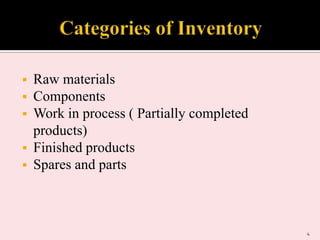
Raw materials
Components
Work in process ( Partially completed
products)
Finished products
Spares and parts

4








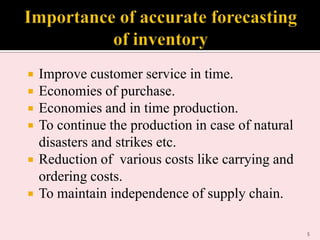
Improve customer service in time.
Economies of purchase.
Economies and in time production.
To continue the production in case of natural
disasters and strikes etc.
Reduction of various costs like carrying and
ordering costs.
To maintain independence of supply chain.
5


1.
2.
3.

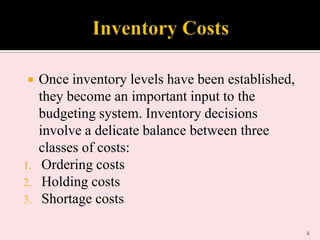
Once inventory levels have been established,
they become an important input to the
budgeting system. Inventory decisions
involve a delicate balance between three
classes of costs:
Ordering costs
Holding costs
Shortage costs
6





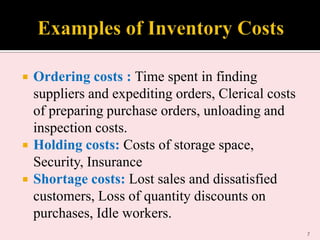
Ordering costs : Time spent in finding
suppliers and expediting orders, Clerical costs
of preparing purchase orders, unloading and
inspection costs.
Holding costs: Costs of storage space,
Security, Insurance
Shortage costs: Lost sales and dissatisfied
customers, Loss of quantity discounts on
purchases, Idle workers.
7
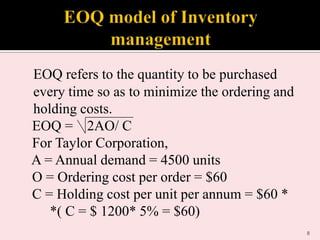
EOQ refers to the quantity to be purchased
every time so as to minimize the ordering and
holding costs.
EOQ = 2AO/ C
For Taylor Corporation,
A = Annual demand = 4500 units
O = Ordering cost per order = $60
C = Holding cost per unit per annum = $60 *
*( C = $ 1200* 5% = $60)
8
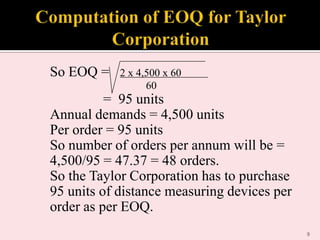
So EOQ =

2 x 4,500 x 60
60

= 95 units
Annual demands = 4,500 units
Per order = 95 units
So number of orders per annum will be =
4,500/95 = 47.37 = 48 orders.
So the Taylor Corporation has to purchase
95 units of distance measuring devices per
order as per EOQ.
9
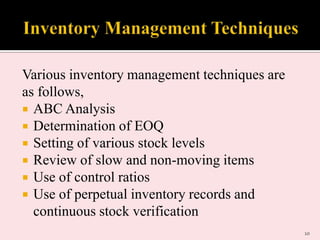
Various inventory management techniques are
as follows,
 ABC Analysis
 Determination of EOQ
 Setting of various stock levels
 Review of slow and non-moving items
 Use of control ratios
 Use of perpetual inventory records and
continuous stock verification
10
Hilton, Maher & Selto (3rd edition). Strategic for
Business Decisions .
 Robert Russell & Bernard W. Taylor (5th edition).
Operations Management .
 Axasater,& Sven (6th edition). Inventory Control .
 Williams, Haka & Bettner (13th edition). Managerial
Accounting


11

inventory management

  • 1.
  • 2.
          Objectives Categories of Inventory Importanceof Accurate Forecasting Inventory Costs and examples EOQ Model and Computation Inventory Management Techniques 2
  • 3.
      The main objectivesof inventory management are to achieve maximum efficiency in production and sales with the minimum investment in inventory. It is very difficult to manage each element of inventory properly due to the following reasons, forecasting of demands of various products, abnormal situations like strikes, other economic conditions and different Government policies. 3
  • 4.
         Raw materials Components Work inprocess ( Partially completed products) Finished products Spares and parts 4
  • 5.
          Improve customer servicein time. Economies of purchase. Economies and in time production. To continue the production in case of natural disasters and strikes etc. Reduction of various costs like carrying and ordering costs. To maintain independence of supply chain. 5
  • 6.
     1. 2. 3. Once inventory levelshave been established, they become an important input to the budgeting system. Inventory decisions involve a delicate balance between three classes of costs: Ordering costs Holding costs Shortage costs 6
  • 7.
       Ordering costs :Time spent in finding suppliers and expediting orders, Clerical costs of preparing purchase orders, unloading and inspection costs. Holding costs: Costs of storage space, Security, Insurance Shortage costs: Lost sales and dissatisfied customers, Loss of quantity discounts on purchases, Idle workers. 7
  • 8.
    EOQ refers tothe quantity to be purchased every time so as to minimize the ordering and holding costs. EOQ = 2AO/ C For Taylor Corporation, A = Annual demand = 4500 units O = Ordering cost per order = $60 C = Holding cost per unit per annum = $60 * *( C = $ 1200* 5% = $60) 8
  • 9.
    So EOQ = 2x 4,500 x 60 60 = 95 units Annual demands = 4,500 units Per order = 95 units So number of orders per annum will be = 4,500/95 = 47.37 = 48 orders. So the Taylor Corporation has to purchase 95 units of distance measuring devices per order as per EOQ. 9
  • 10.
    Various inventory managementtechniques are as follows,  ABC Analysis  Determination of EOQ  Setting of various stock levels  Review of slow and non-moving items  Use of control ratios  Use of perpetual inventory records and continuous stock verification 10
  • 11.
    Hilton, Maher &Selto (3rd edition). Strategic for Business Decisions .  Robert Russell & Bernard W. Taylor (5th edition). Operations Management .  Axasater,& Sven (6th edition). Inventory Control .  Williams, Haka & Bettner (13th edition). Managerial Accounting  11