PURCHASE AND MATERIAL
MANAGEMENT ASSIGNMENT
Topic:- Inventory Management
Submitted to :- Dr. Piyush
Kendurkar Sir
Submitted by :- Nancy Tiwari
Roll no :- 74934
INTRODUCTION
Inventory management is a core operations
management activity. Good inventory
management is important for the successful
operation of most businesses and their supply
chains. Operations marketing, and finance have
interests in good inventory management.
INVENTORY
A stock or store of goods. Firms typically stock
hundreds or even thousands of items in
inventory, ranging from small things such as
pencils, paper clips, screws, nuts, and bolts
to large items such as machines, trucks,
construction equipment, and airplanes,
INDEPENDENT VS.
DEPENDENT DEMAND
Independent-demand/items - Items that
are ready to be sold or used. Example:
computers
Dependent-demand items- these are
components of finished products, rather than
the finished products themselves. Example:
Computer components
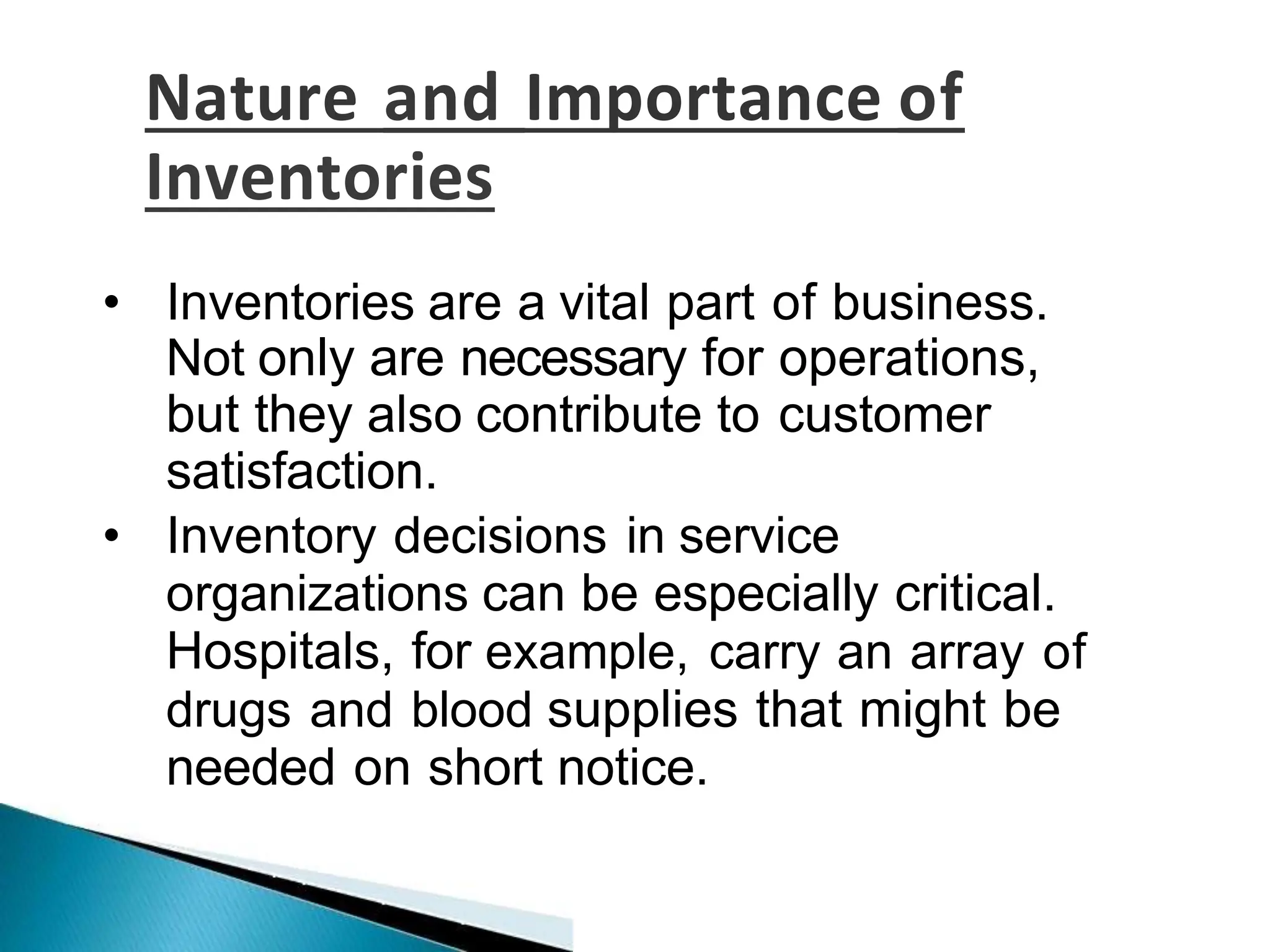
Nature and Importance of
Inventories
• Inventories are a vital part of business.
Not only are necessary for operations,
but they also contribute to customer
satisfaction.
• Inventory decisions in service
organizations can be especially critical.
Hospitals, for example, carry an array of
drugs and blood supplies that might be
needed on short notice.
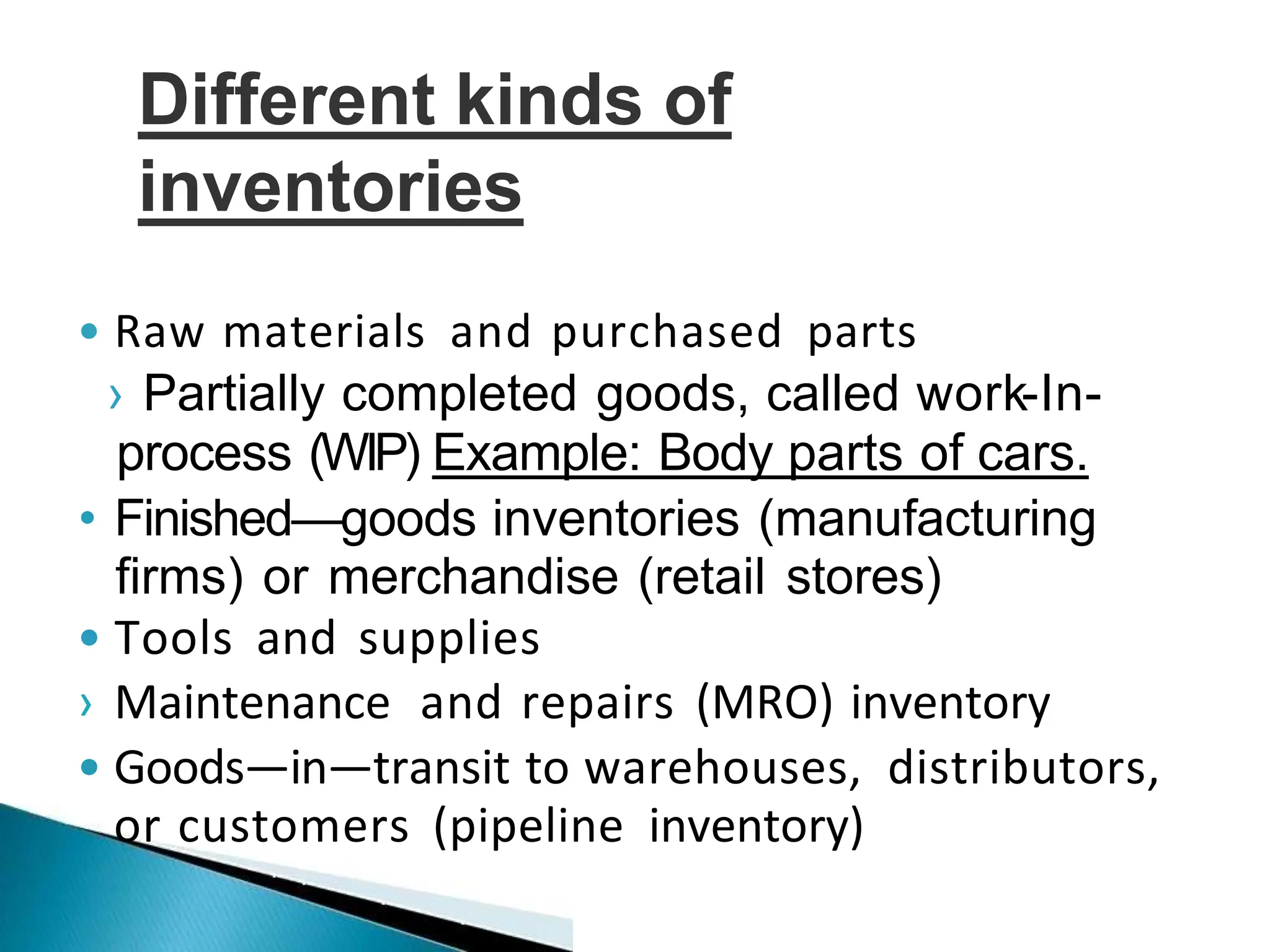
• Raw materials and purchased parts
› Partially completed goods, called work-In-
process (WIP) Example: Body parts of cars.
• Finished—goods inventories (manufacturing
firms) or merchandise (retail stores)
• Tools and supplies
› Maintenance and repairs (MRO) inventory
• Goods—in—transit to warehouses, distributors,
or customers (pipeline inventory)
Different kinds of
inventories
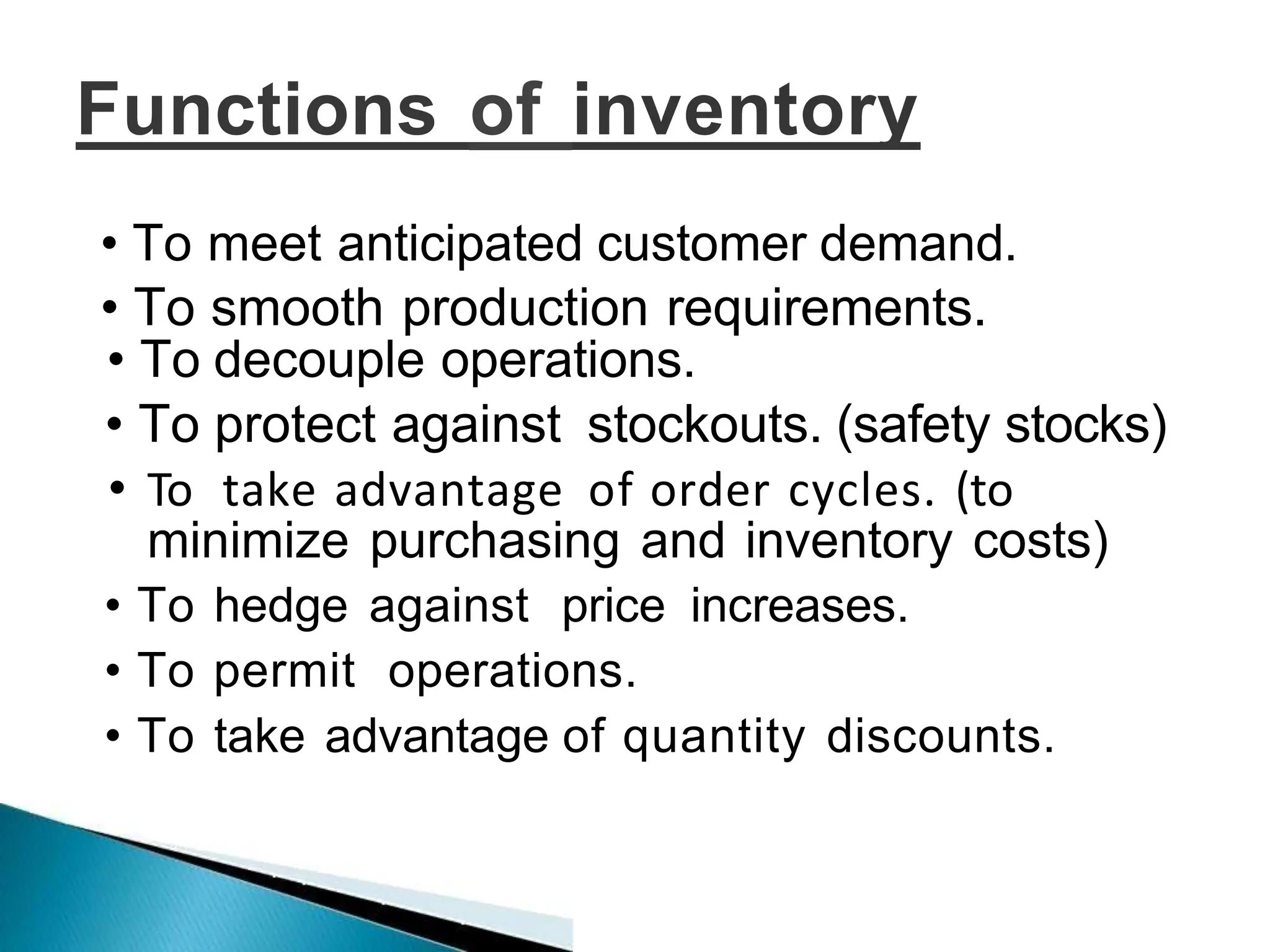
Functions of inventory
• To meet anticipated customer demand.
• To smooth production requirements.
• To decouple operations.
• To protect against stockouts. (safety stocks)
• To take advantage of order cycles. (to
minimize purchasing and inventory costs)
• To hedge against price increases.
• To permit operations.
• To take advantage of quantity discounts.
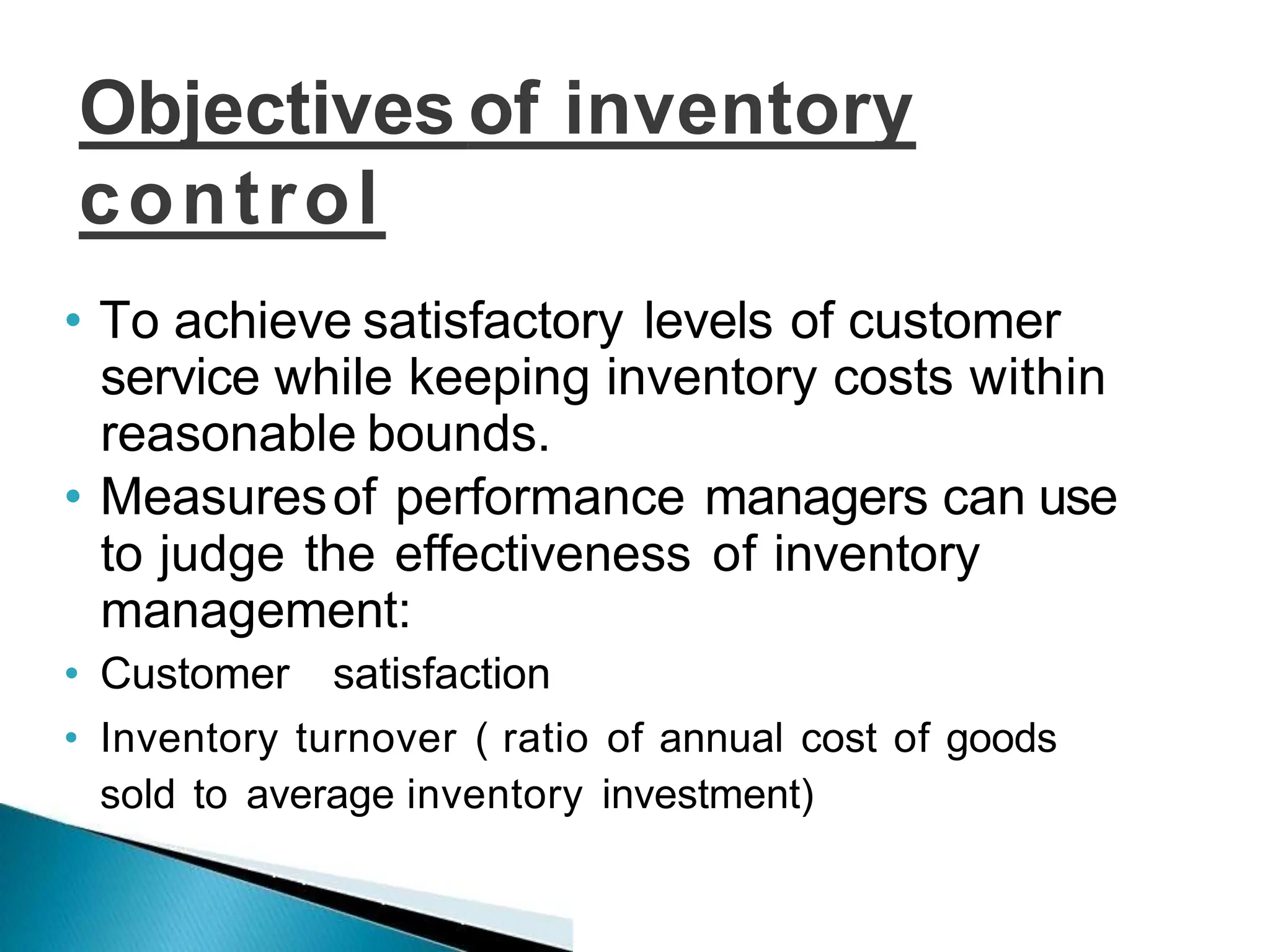
Objectives of inventory
control
• To achieve satisfactory levels of customer
service while keeping inventory costs within
reasonable bounds.
• Measuresof performance managers can use
to judge the effectiveness of inventory
management:
• Customer satisfaction
• Inventory turnover ( ratio of annual cost of goods
sold to average inventory investment)
Requirements for effective
inventory management
• A system to keep track of the inventory on
hand and on order.
• A reliable Forecast ofdemand that includes an
indication of possible Forecast error.
• Knowledge of lead time variability.
• Reasonable estimates of inventory holding cost
and shortage cost.
• A classification system for inventory items.
Inventory Counting System
l Periodic Inventory System - a physical count
of items in inventory is made at periodic
intervals (e.g. Weekly, monthly) in order to
decide how much to order of each item.
Perpetual Inventory System —(also known
as a continual system) keeps trackif
removals from inventory on a continuous
basis, so the system cam provide information
on the current level of inventory for each
item.
2
Perpetual inventory system
• This system can range from very simple to
very sophisticated.
• A two—bin system, a very elementary system,
which uses two containers for inventory. Batch or
online.
• Batch systems, inventory records are collected
periodically and entered into the system.
• Online systems, the transactions are recorded
immediately.
• Supermarkets, discount stores, and
department stores have always been major
users of periodic counting systems.
• Universal product code (UPC) or bar code - bar
code printed on a label that has information about
the item to which is attached.
• RFID (Radio frequency identification tags) are also
used to keep track of inventory in certain
applications
Periodic inventory system
Inventory costs
1. Holding or carrying cost
2. Ordering cost
3. Shortage cost
• Holding, or carrying cost -Cost to carry
an item in inventory for a length of time,
usually a year.
• Costs include interest, insurance, taxes,
depreciation, obsolescence, deterioration,
spoilage, pilferage, breakage, and
warehousing costs (heat, light, rent,
security), opportunity costs.
Ordering Costs
• Ordering costs - Costs of ordering and
receiving inventory.
• They are the costs that vary with the actual
placement of an order. Besides shipping
costs, they include determining how much is
needed, preparing invoices, inspecting goods
upon arrival for quality and quantity, and
moving the goods to temporary storage.
Shortage cost
• Shortage costs- Costs resulting when
demand exceeds the supply of inventory;
often unrealized profit per unit.
• These costs can include the opportunity
cost of not making a sale, loss of
customer goodwill, late charges, and
similar costs. Furthermore, if the
shortage occurs in an item carried for
internal use (e.g., to supply an assembly
line), the cost of lost production or
downtime is considered shortage cost.
How Much to Order : Economic
Order Quantity Models
1. The basic economic order quantity
model.
2. The economic production quantity
model.
3. The quantity discount model.
Basic Economic Order
quantity (EOQ) model
This is the simplest of the three models. It is
used to identify fixed order size that will
minimize the sum of the annual costs of
holding inventory and ordering inventory.
Assumptions of the basic
EOQ model
• Only one product is involved.
• Annual demand requirements are known.
• Demand is spread evenly throughout the
year so that the demand rate is reasonably
constant.
• Lead time does not vary.
• Each order is received in a single delivery
• There are no quantity discounts.
Economic Production
Quantity (EPQ)
Assumptions of EPQ model:
1. Only oneitem is involved.
2. Annual demand is known.
3. The usage rate is constant.
4. Usage occurs continually, but production
occurs periodically.
5. The production rate is constant.
6. Lead time does not vary.
7. There are no quantity discounts.
Quantity Discounts
• These are price reductions for large orders
offered to customers to induce them to buy in
large quantities
When to reorder with EOQ
ordering
There are four determinants of the reorder
point quantity:
1. The rate of demand (usually based on a
forecast)
2. The lead time
3. The extent of demand and/or lead time
variability.
4. The degree of stockout risk acceptable to
management.
Definition of terms
• Reorder point- When the quantity on hand of
an item drops to this amount, the item is
reordered.
• Safety stock —
stock that is held in excess of
expected demand due to variable demand
and/or lead time.
• Lead time —
time interval between ordering
and receiving the order.
• Point–of–sale (POS) systems— record items at
time of sale.

purchase and material management ppt.pptx

  • 1.
    PURCHASE AND MATERIAL MANAGEMENTASSIGNMENT Topic:- Inventory Management Submitted to :- Dr. Piyush Kendurkar Sir Submitted by :- Nancy Tiwari Roll no :- 74934
  • 2.
    INTRODUCTION Inventory management isa core operations management activity. Good inventory management is important for the successful operation of most businesses and their supply chains. Operations marketing, and finance have interests in good inventory management.
  • 3.
    INVENTORY A stock orstore of goods. Firms typically stock hundreds or even thousands of items in inventory, ranging from small things such as pencils, paper clips, screws, nuts, and bolts to large items such as machines, trucks, construction equipment, and airplanes,
  • 4.
    INDEPENDENT VS. DEPENDENT DEMAND Independent-demand/items- Items that are ready to be sold or used. Example: computers Dependent-demand items- these are components of finished products, rather than the finished products themselves. Example: Computer components
  • 5.
    Nature and Importanceof Inventories • Inventories are a vital part of business. Not only are necessary for operations, but they also contribute to customer satisfaction. • Inventory decisions in service organizations can be especially critical. Hospitals, for example, carry an array of drugs and blood supplies that might be needed on short notice.
  • 6.
    • Raw materialsand purchased parts › Partially completed goods, called work-In- process (WIP) Example: Body parts of cars. • Finished—goods inventories (manufacturing firms) or merchandise (retail stores) • Tools and supplies › Maintenance and repairs (MRO) inventory • Goods—in—transit to warehouses, distributors, or customers (pipeline inventory) Different kinds of inventories
  • 7.
    Functions of inventory •To meet anticipated customer demand. • To smooth production requirements. • To decouple operations. • To protect against stockouts. (safety stocks) • To take advantage of order cycles. (to minimize purchasing and inventory costs) • To hedge against price increases. • To permit operations. • To take advantage of quantity discounts.
  • 8.
    Objectives of inventory control •To achieve satisfactory levels of customer service while keeping inventory costs within reasonable bounds. • Measuresof performance managers can use to judge the effectiveness of inventory management: • Customer satisfaction • Inventory turnover ( ratio of annual cost of goods sold to average inventory investment)
  • 9.
    Requirements for effective inventorymanagement • A system to keep track of the inventory on hand and on order. • A reliable Forecast ofdemand that includes an indication of possible Forecast error. • Knowledge of lead time variability. • Reasonable estimates of inventory holding cost and shortage cost. • A classification system for inventory items.
  • 10.
    Inventory Counting System lPeriodic Inventory System - a physical count of items in inventory is made at periodic intervals (e.g. Weekly, monthly) in order to decide how much to order of each item. Perpetual Inventory System —(also known as a continual system) keeps trackif removals from inventory on a continuous basis, so the system cam provide information on the current level of inventory for each item. 2
  • 11.
    Perpetual inventory system •This system can range from very simple to very sophisticated. • A two—bin system, a very elementary system, which uses two containers for inventory. Batch or online. • Batch systems, inventory records are collected periodically and entered into the system. • Online systems, the transactions are recorded immediately.
  • 12.
    • Supermarkets, discountstores, and department stores have always been major users of periodic counting systems. • Universal product code (UPC) or bar code - bar code printed on a label that has information about the item to which is attached. • RFID (Radio frequency identification tags) are also used to keep track of inventory in certain applications Periodic inventory system
  • 13.
    Inventory costs 1. Holdingor carrying cost 2. Ordering cost 3. Shortage cost
  • 14.
    • Holding, orcarrying cost -Cost to carry an item in inventory for a length of time, usually a year. • Costs include interest, insurance, taxes, depreciation, obsolescence, deterioration, spoilage, pilferage, breakage, and warehousing costs (heat, light, rent, security), opportunity costs.
  • 15.
    Ordering Costs • Orderingcosts - Costs of ordering and receiving inventory. • They are the costs that vary with the actual placement of an order. Besides shipping costs, they include determining how much is needed, preparing invoices, inspecting goods upon arrival for quality and quantity, and moving the goods to temporary storage.
  • 16.
    Shortage cost • Shortagecosts- Costs resulting when demand exceeds the supply of inventory; often unrealized profit per unit. • These costs can include the opportunity cost of not making a sale, loss of customer goodwill, late charges, and similar costs. Furthermore, if the shortage occurs in an item carried for internal use (e.g., to supply an assembly line), the cost of lost production or downtime is considered shortage cost.
  • 17.
    How Much toOrder : Economic Order Quantity Models 1. The basic economic order quantity model. 2. The economic production quantity model. 3. The quantity discount model.
  • 18.
    Basic Economic Order quantity(EOQ) model This is the simplest of the three models. It is used to identify fixed order size that will minimize the sum of the annual costs of holding inventory and ordering inventory.
  • 19.
    Assumptions of thebasic EOQ model • Only one product is involved. • Annual demand requirements are known. • Demand is spread evenly throughout the year so that the demand rate is reasonably constant. • Lead time does not vary. • Each order is received in a single delivery • There are no quantity discounts.
  • 20.
    Economic Production Quantity (EPQ) Assumptionsof EPQ model: 1. Only oneitem is involved. 2. Annual demand is known. 3. The usage rate is constant. 4. Usage occurs continually, but production occurs periodically. 5. The production rate is constant. 6. Lead time does not vary. 7. There are no quantity discounts.
  • 21.
    Quantity Discounts • Theseare price reductions for large orders offered to customers to induce them to buy in large quantities
  • 22.
    When to reorderwith EOQ ordering There are four determinants of the reorder point quantity: 1. The rate of demand (usually based on a forecast) 2. The lead time 3. The extent of demand and/or lead time variability. 4. The degree of stockout risk acceptable to management.
  • 23.
    Definition of terms •Reorder point- When the quantity on hand of an item drops to this amount, the item is reordered. • Safety stock — stock that is held in excess of expected demand due to variable demand and/or lead time. • Lead time — time interval between ordering and receiving the order. • Point–of–sale (POS) systems— record items at time of sale.