ENCODING TECHNIQUES
Group Members
• Goriha Naveed
• Maria Banaras
• Naila Naz
• Riffat Yaqoob
Encoding
Encoding is the process of putting a sequence
of characters (letters, numbers, punctuation,
and certain symbols) into a specialized digital
format for efficient transmission or transfer.
Decoding is the opposite process -- the
conversion of a digital signal into a sequence
of characters.
Types of Encoding
 Digital Data , Analog signals
Basis for analog signaling is a continuous, constant-frequency signal known as
the carrier frequency.
By modulating(Amplitude , Frequency , Phase)
 Analog Data ,Digital signals
Analog-to-digital conversion is an electronic process in which a continuously
variable analog signal is changed, without altering its essential content, into a
multi-level digital signal.
 Digital Data , Digital signals
Digital signal –is a sequence of discrete, discontinuous voltage pulses.
Bit duration :: the time it takes for the transmitter to emit the bit.
Digital To Digital Encoding Techniques
In order to transport digital bits of data across carrier
waves, encoding techniques have been developed.
some of the more common techniques are given below
Physical layer
 NRZ( non return to zero)
 NRZI(non return to zero inverted)
 MANCHESTER ENCODING
 4B/5B ENCODING
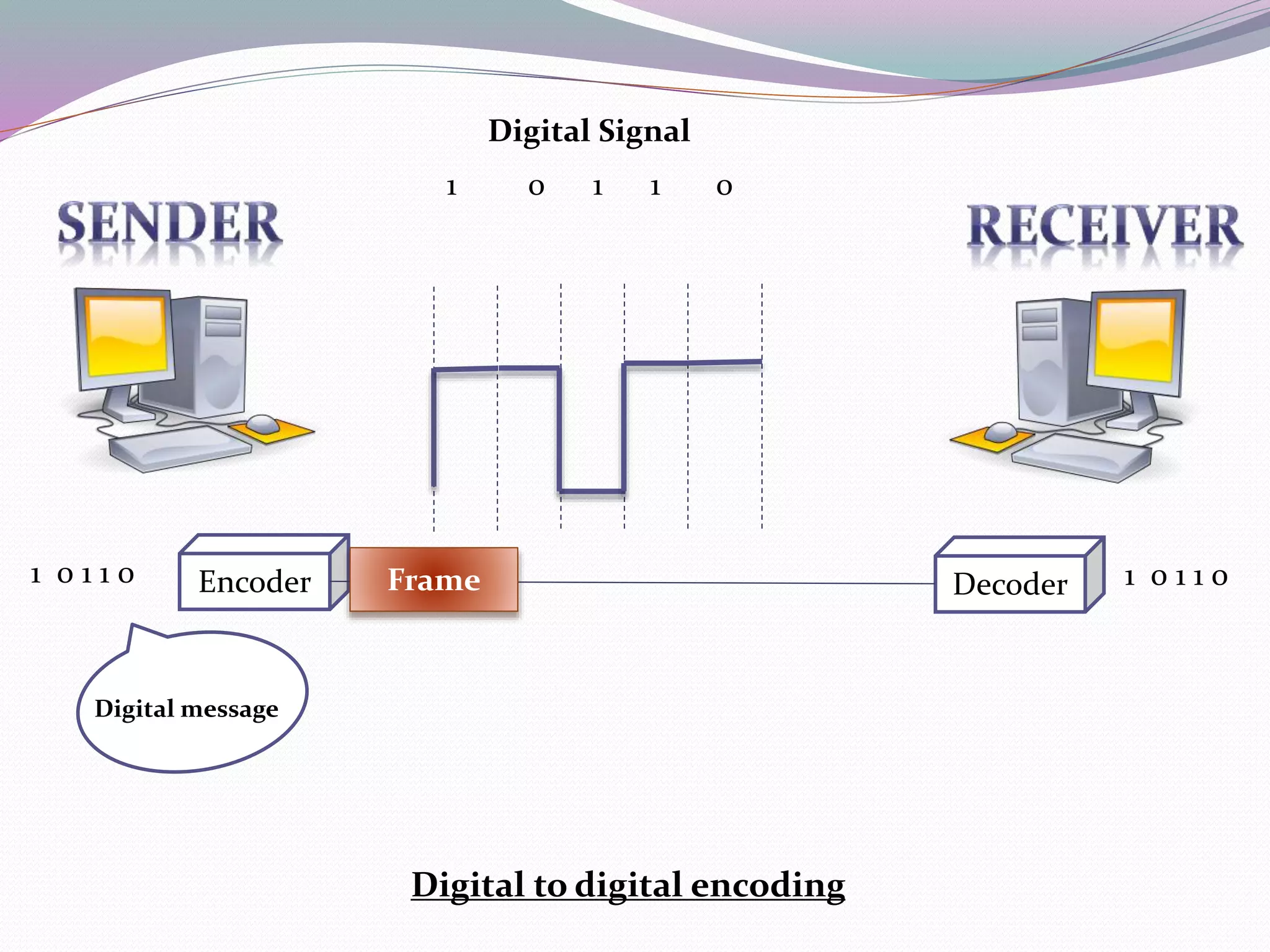
Encoder Decoder 1 0 1 1 01 0 1 1 0
1 0 1 1 0
Digital message
Digital Signal
Digital to digital encoding
Frame
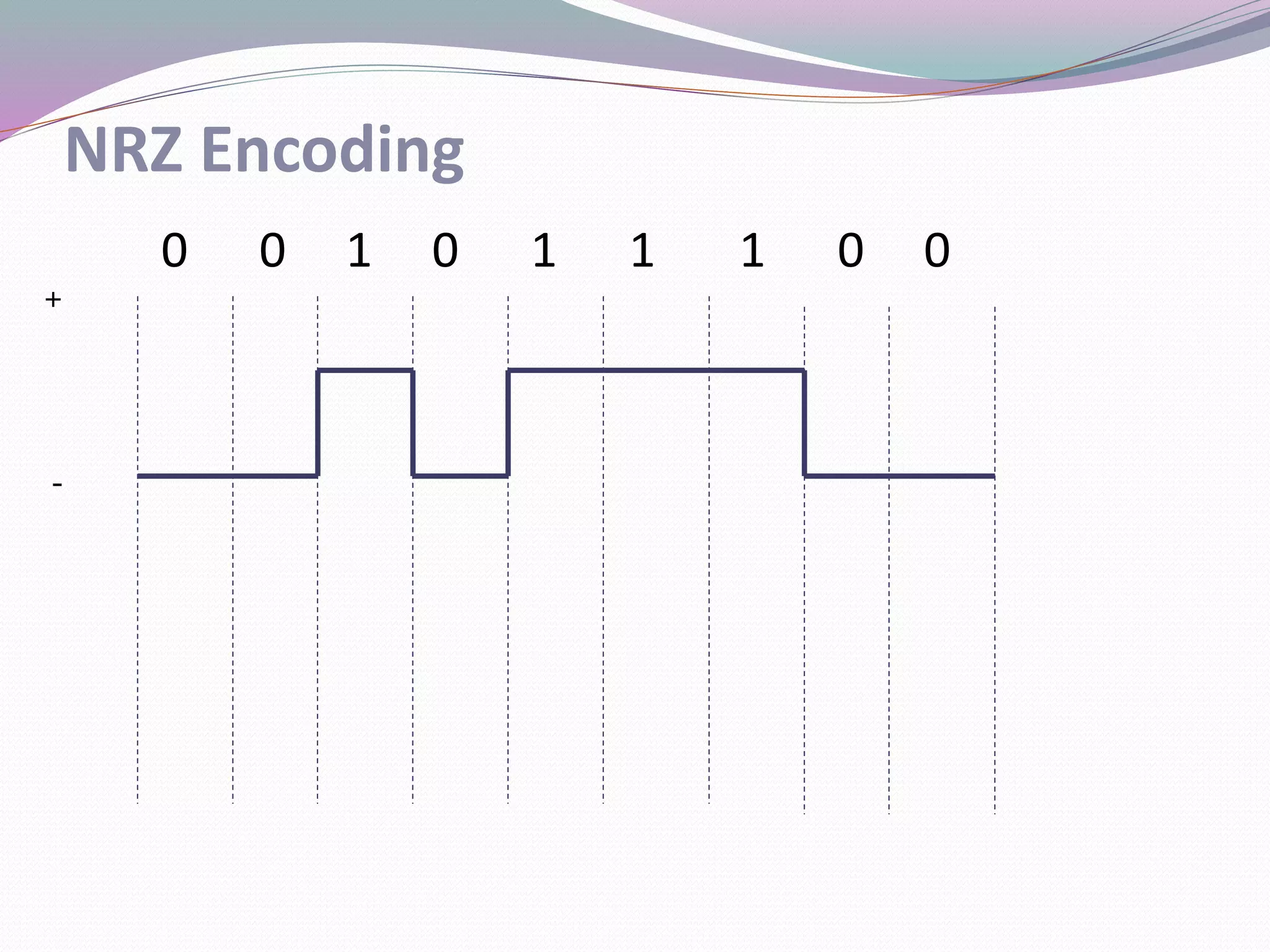
NRZ encoding (Non Return to Zero)
 The most common, and easiest, way to transmit digital signals.
 Uses two different voltage levels (one positive and one negative) as the
signal elements for the two binary digits.
 Voltage does not return to zero during the bit interval.
 The voltage is constant during the bit interval .
0 negative voltage
1  positive voltage
NRZ Encoding
0 0 1 0 1 1 1 0 0
+
-
NRZ Encoding
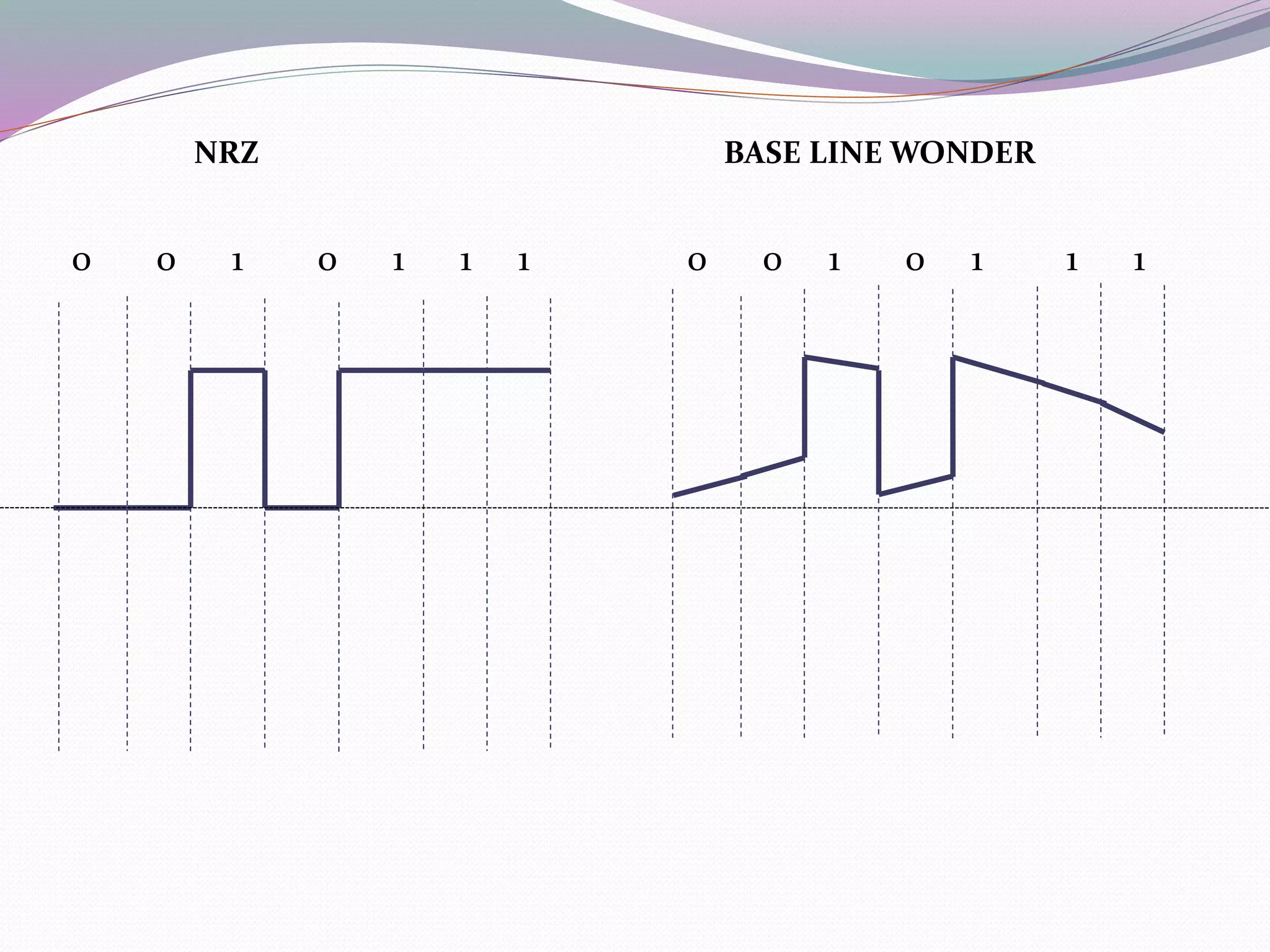
 The problem with this is that it is difficult to distinguish a series of '1's or
'0's.
 Leads to baseline wander
 Sender and Receiver clocks have to highly precise
Reference: Data communication & networking
By Behrouz A. Forouzan
"In decoding a digital signal, the incoming signal
power is evaluated against the baseline (a running
average of the received signal power). A long string
of 0s or 1s can cause baseline wandering (a drift in
the baseline) and make it difficult for the receiver
to decode correctly."
0 0 1 0 1 1 1 0 0 1 0 1 1 1
NRZ BASE LINE WONDER
NRZI ENCODING
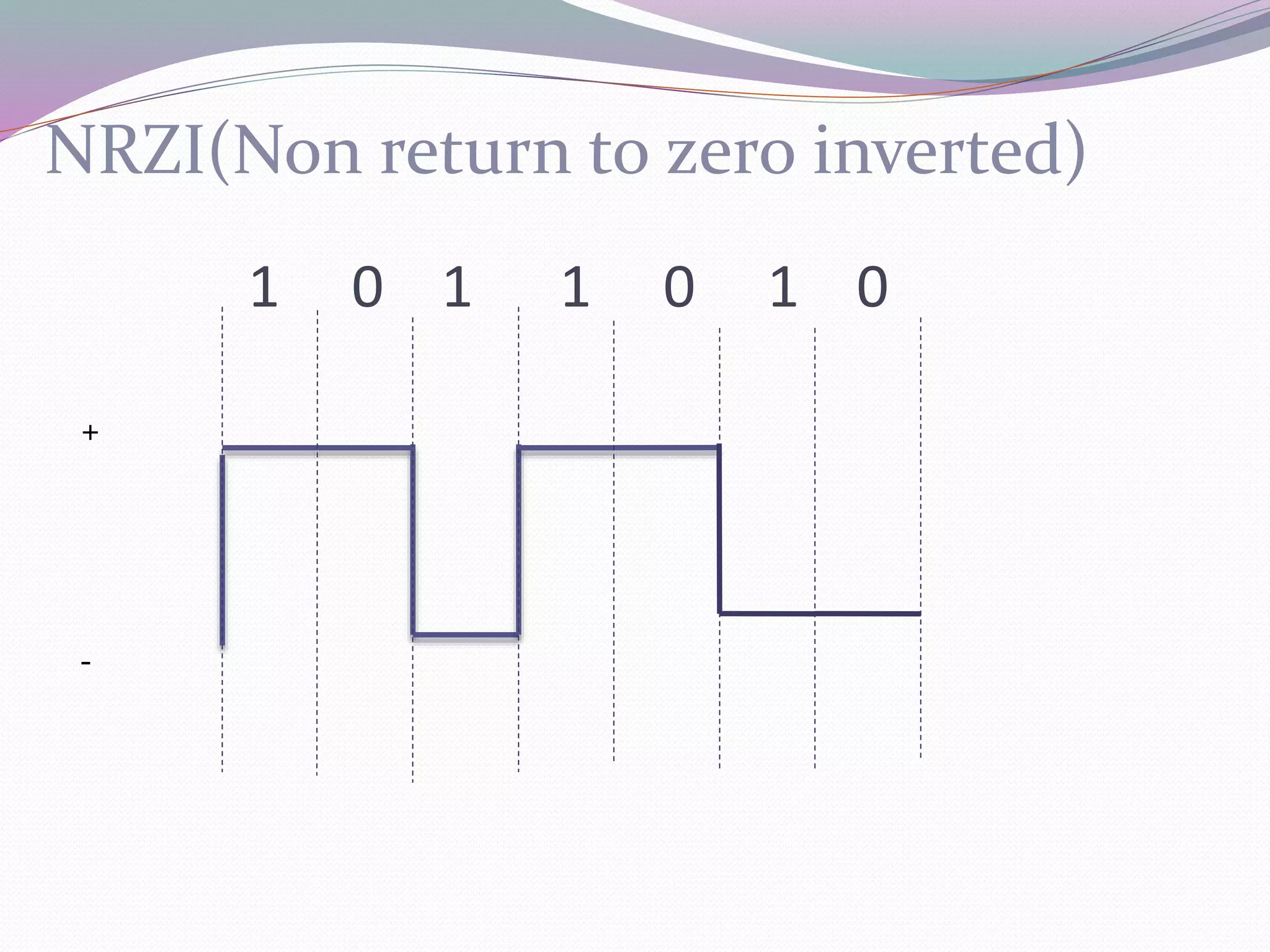
NRZI stands for non return to zero inverted.
 NRZ inverted (NRZI)
 Solve the problem of consecutive 1’s.
 At zero, state of current signal remains same.
 Transition at beginning of bit time
 Transition (either low-to-high or high-to-low)
 denotes a binary 1
 No transition denotes a binary 0.
1 0 1 1 0 1 0
NRZI(Non return to zero inverted)
+
-
Manchester encoding
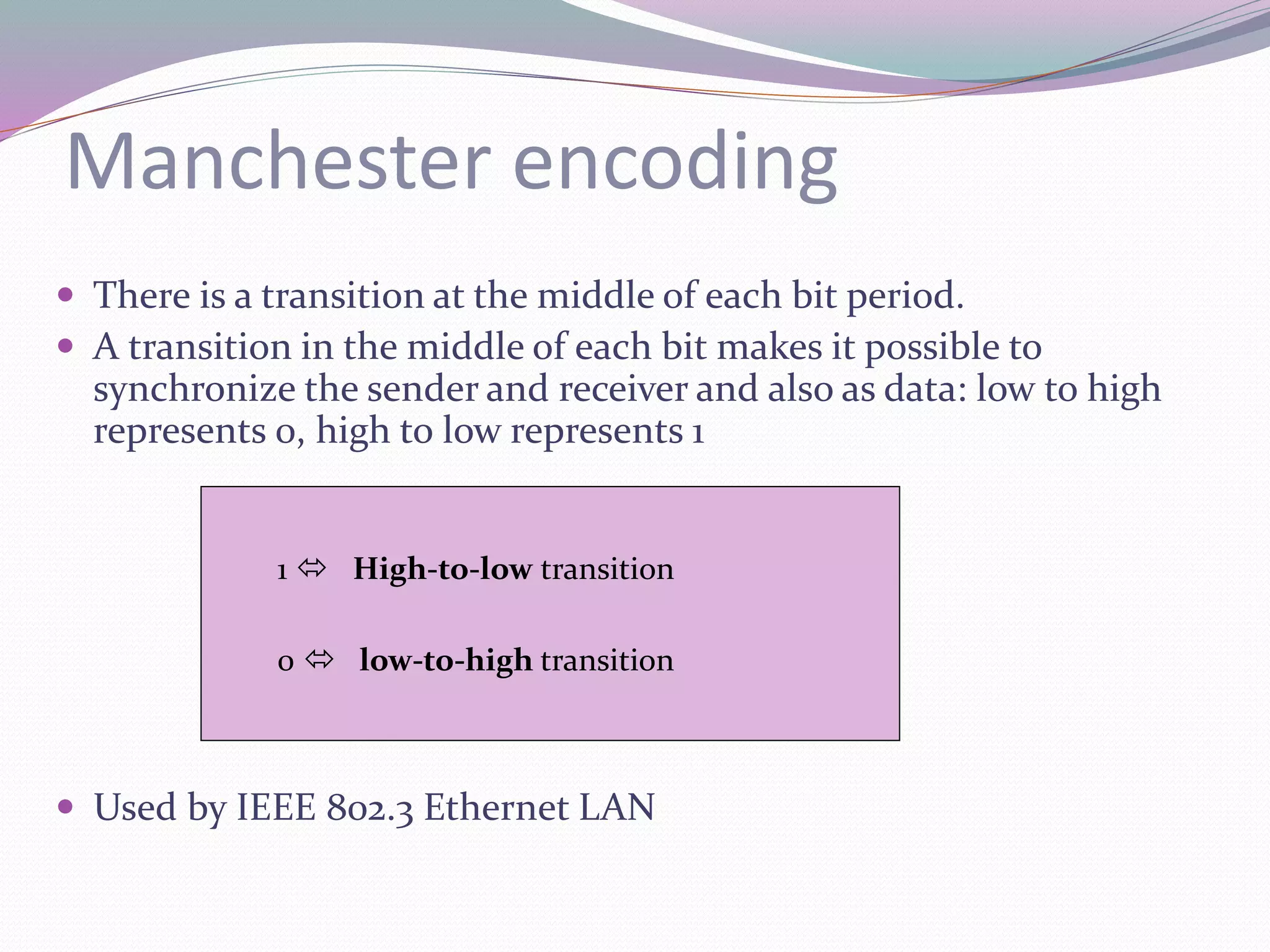
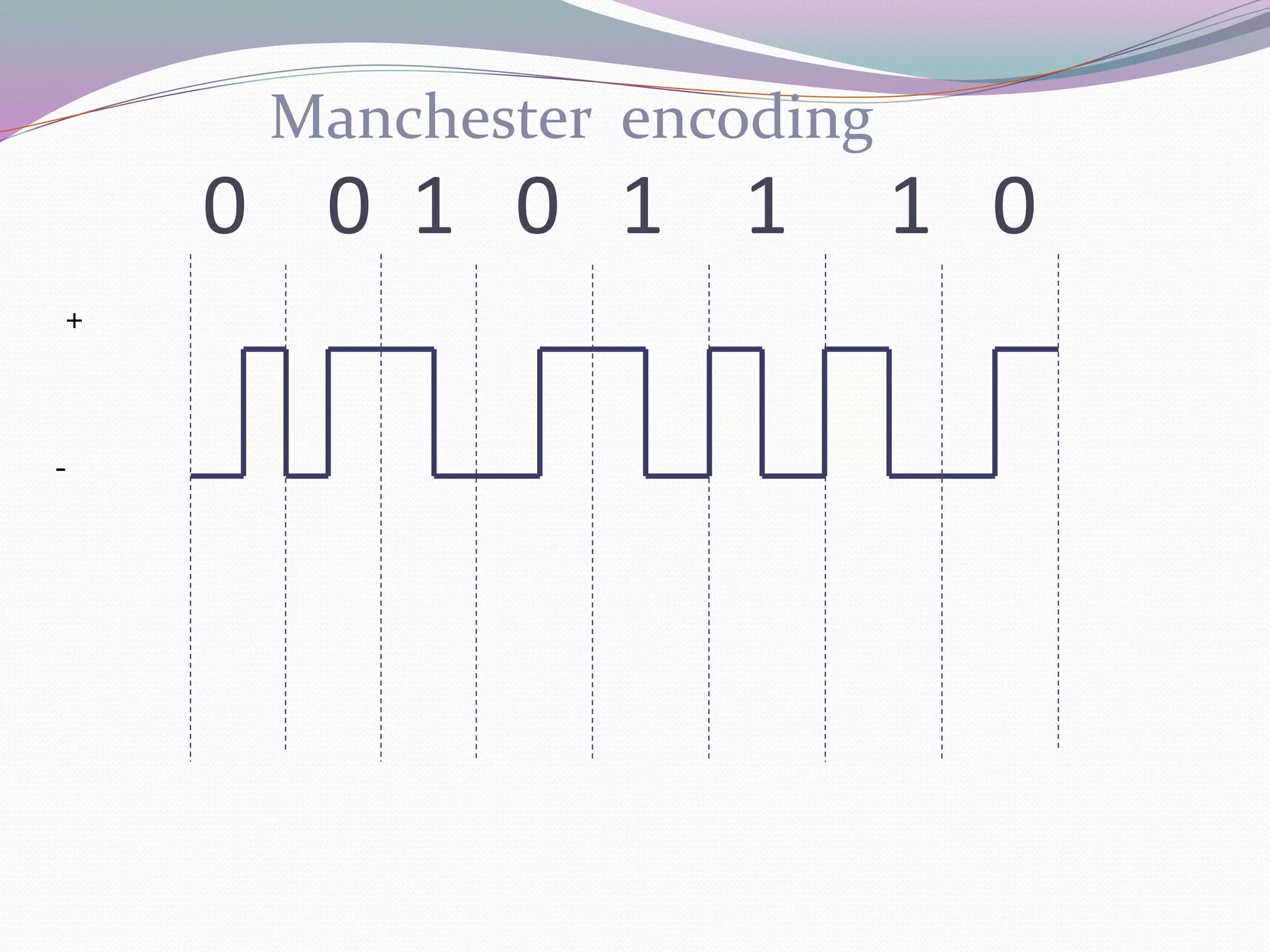
 There is a transition at the middle of each bit period.
 A transition in the middle of each bit makes it possible to
synchronize the sender and receiver and also as data: low to high
represents 0, high to low represents 1
 Used by IEEE 802.3 Ethernet LAN
1  High-to-low transition
0  low-to-high transition
0 0 1 0 1 1 1 0
Manchester encoding
-
+
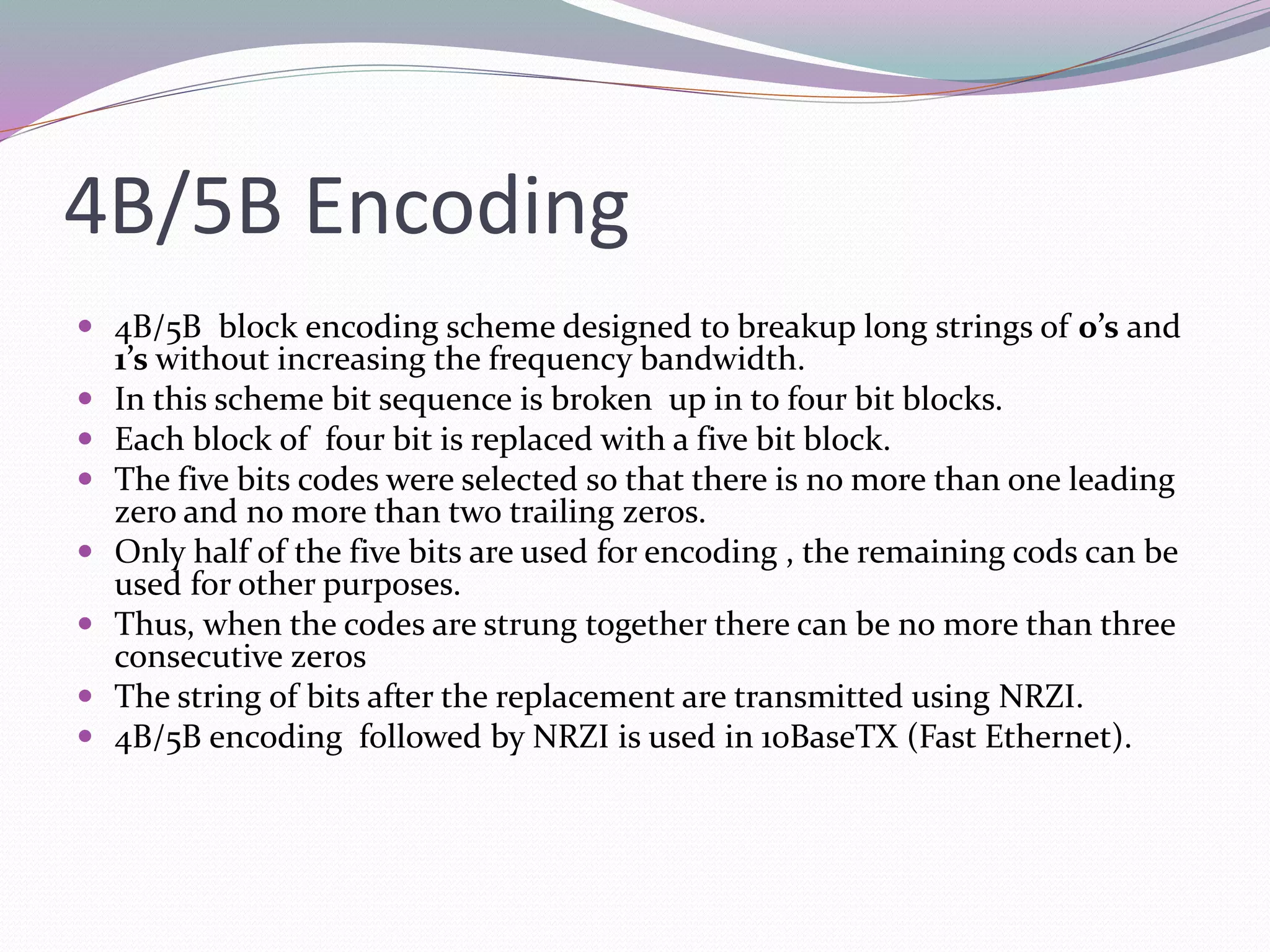
Pros and Cons
 Pros
 Self-clocking: Because there is a predictable transition during
each bit time, the receiver can synchronize on that transition.
 Error detection: the absence of an expected transition can be
used to detect errors
 50% efficient(1/2 bit per transition)
 Cons
 The maximum modulation rate is twice that for NRZ
 Requires more bandwidth
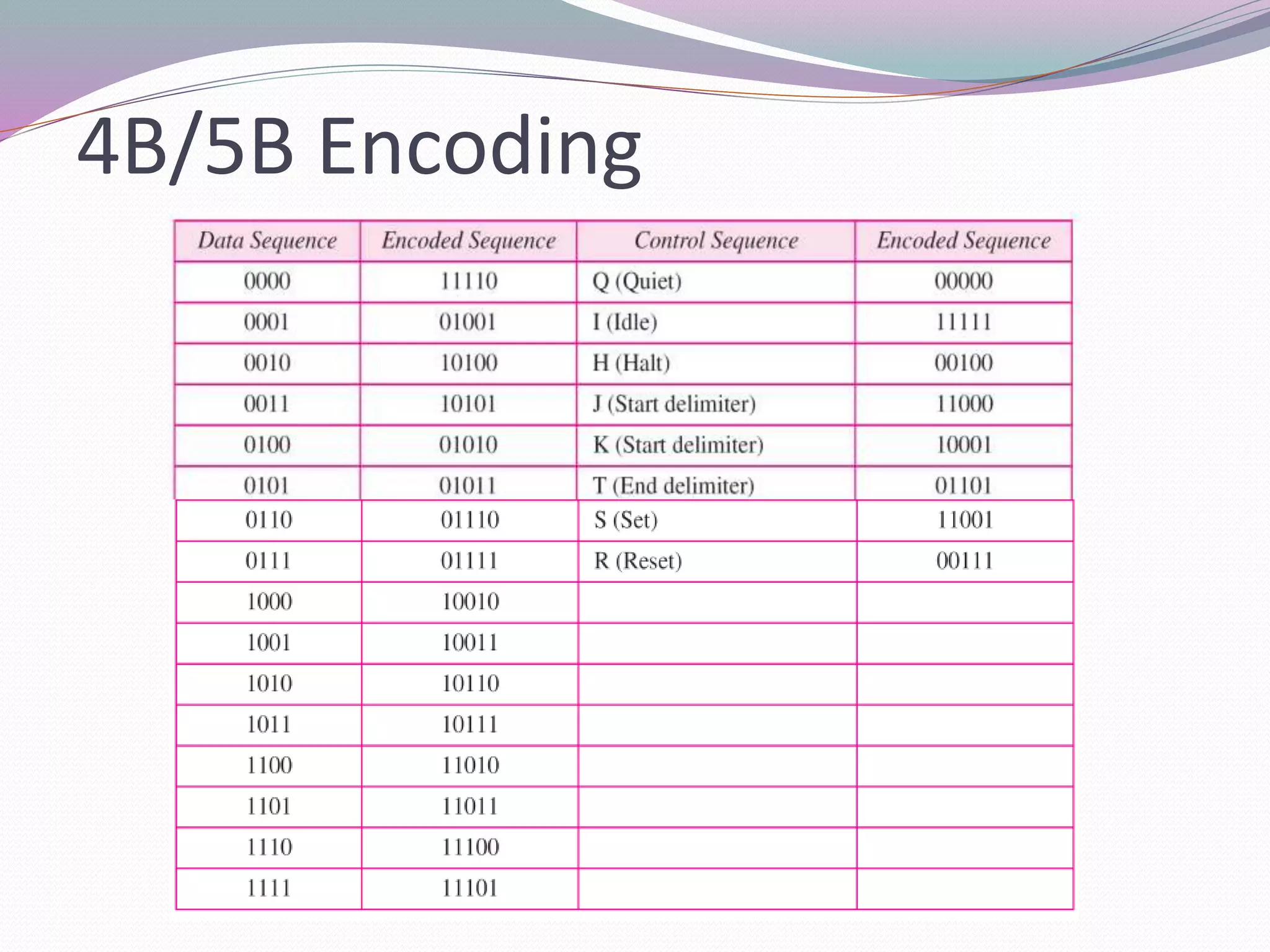
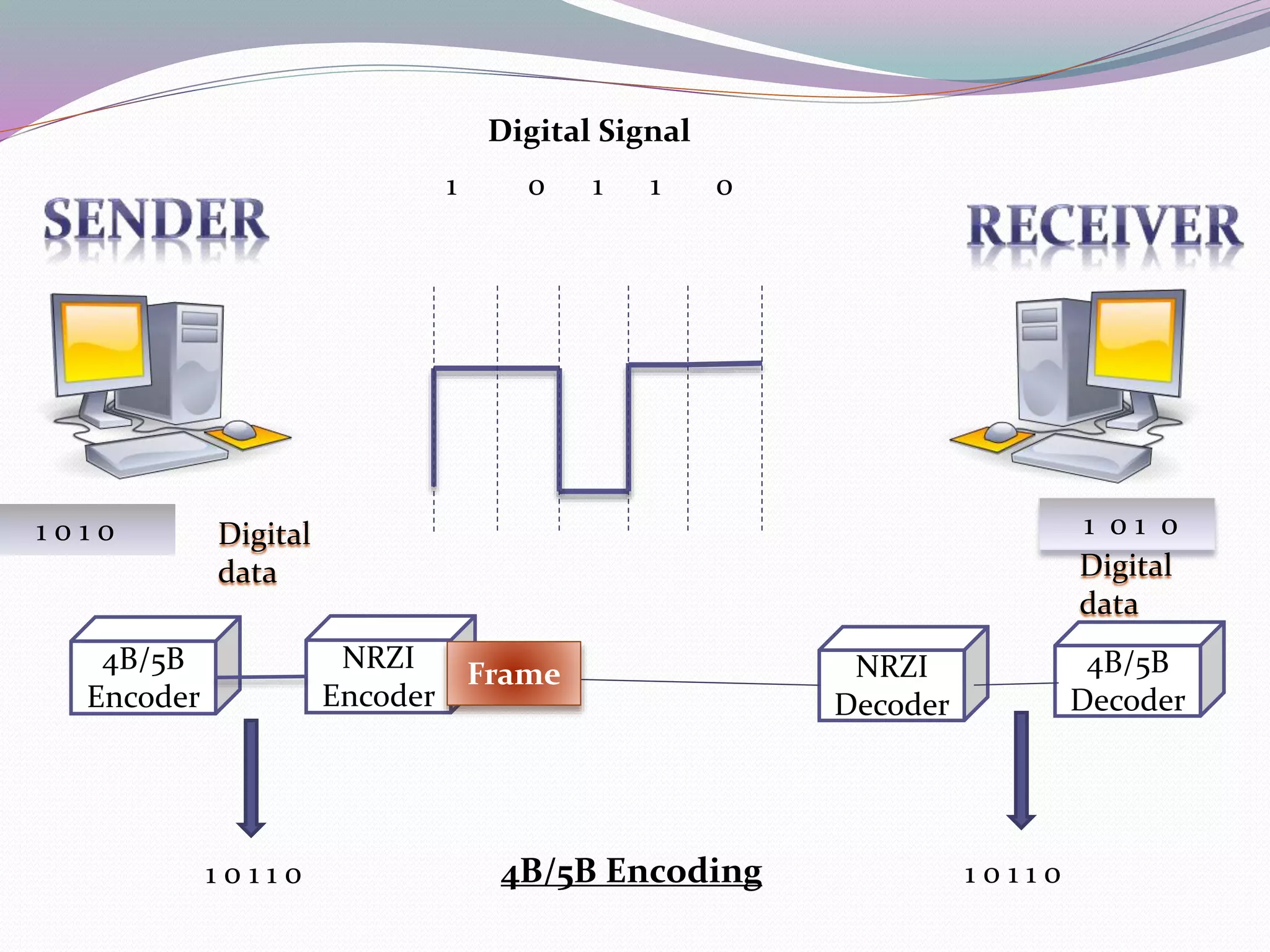
4B/5B Encoding
 4B/5B block encoding scheme designed to breakup long strings of 0’s and
1’s without increasing the frequency bandwidth.
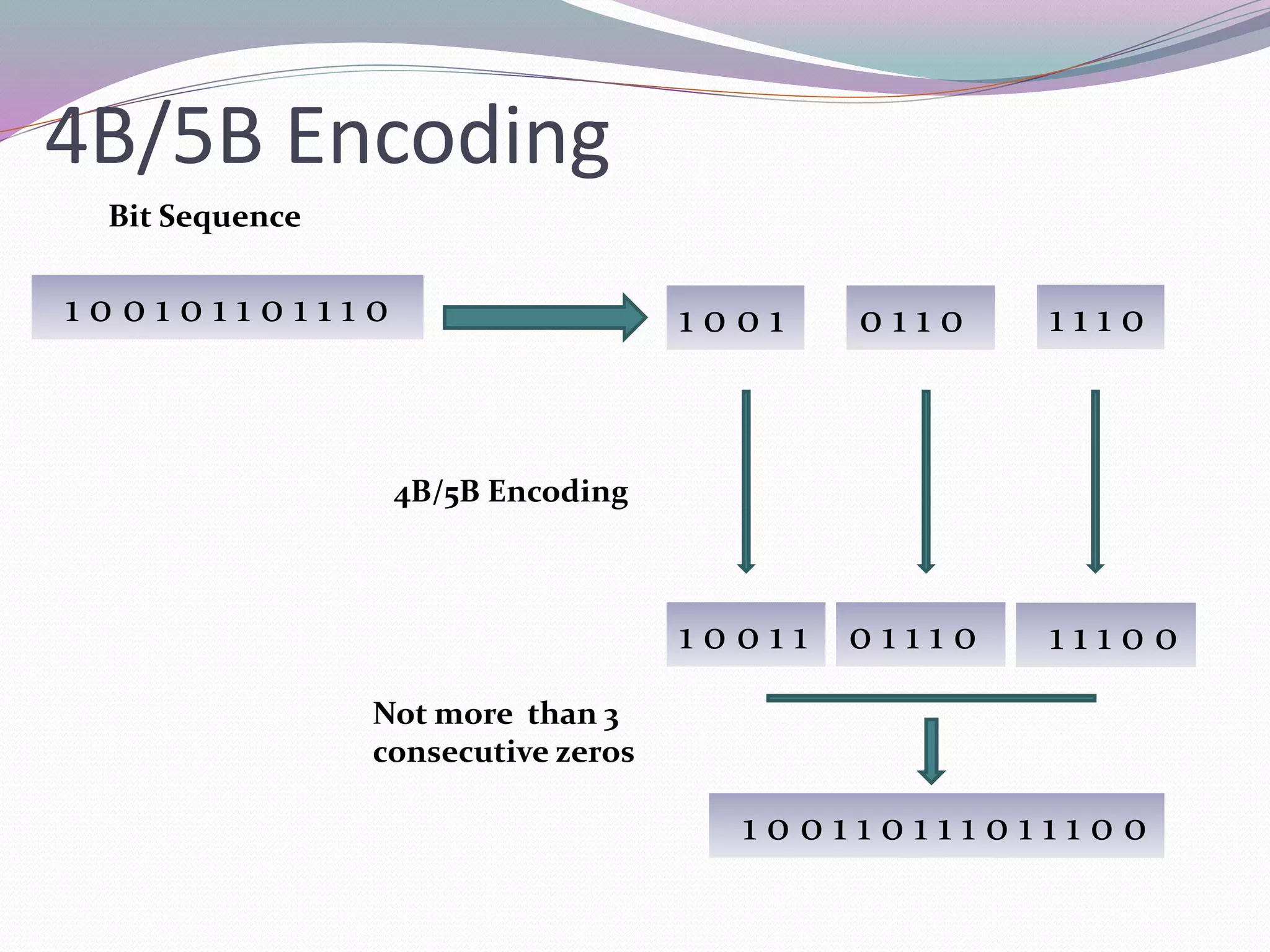
 In this scheme bit sequence is broken up in to four bit blocks.
 Each block of four bit is replaced with a five bit block.
 The five bits codes were selected so that there is no more than one leading
zero and no more than two trailing zeros.
 Only half of the five bits are used for encoding , the remaining cods can be
used for other purposes.
 Thus, when the codes are strung together there can be no more than three
consecutive zeros
 The string of bits after the replacement are transmitted using NRZI.
 4B/5B encoding followed by NRZI is used in 10BaseTX (Fast Ethernet).
4B/5B Encoding
1 0 0 1 0 1 1 0 1 1 1 0
Bit Sequence
1 0 0 1 0 1 1 0 1 1 1 0
1 0 0 1 1 0 1 1 1 0 1 1 1 0 0
1 0 0 1 1 0 1 1 1 0 1 1 1 0 0
4B/5B Encoding
Not more than 3
consecutive zeros
4B/5B Encoding
NRZI
Encoder
NRZI
Decoder
1 0 1 01 0 1 0
1 0 1 1 0
Digital Signal
4B/5B
Encoder
4B/5B
Decoder
1 0 1 1 01 0 1 1 0
Digital
data Digital
data
4B/5B Encoding
Frame
THANK YOU

Encoding Techniques

  • 1.
    ENCODING TECHNIQUES Group Members •Goriha Naveed • Maria Banaras • Naila Naz • Riffat Yaqoob
  • 2.
    Encoding Encoding is theprocess of putting a sequence of characters (letters, numbers, punctuation, and certain symbols) into a specialized digital format for efficient transmission or transfer. Decoding is the opposite process -- the conversion of a digital signal into a sequence of characters.
  • 3.
    Types of Encoding Digital Data , Analog signals Basis for analog signaling is a continuous, constant-frequency signal known as the carrier frequency. By modulating(Amplitude , Frequency , Phase)  Analog Data ,Digital signals Analog-to-digital conversion is an electronic process in which a continuously variable analog signal is changed, without altering its essential content, into a multi-level digital signal.  Digital Data , Digital signals Digital signal –is a sequence of discrete, discontinuous voltage pulses. Bit duration :: the time it takes for the transmitter to emit the bit.
  • 4.
    Digital To DigitalEncoding Techniques In order to transport digital bits of data across carrier waves, encoding techniques have been developed. some of the more common techniques are given below Physical layer  NRZ( non return to zero)  NRZI(non return to zero inverted)  MANCHESTER ENCODING  4B/5B ENCODING
  • 5.
    Encoder Decoder 10 1 1 01 0 1 1 0 1 0 1 1 0 Digital message Digital Signal Digital to digital encoding Frame
  • 6.
    NRZ encoding (NonReturn to Zero)  The most common, and easiest, way to transmit digital signals.  Uses two different voltage levels (one positive and one negative) as the signal elements for the two binary digits.  Voltage does not return to zero during the bit interval.  The voltage is constant during the bit interval . 0 negative voltage 1  positive voltage
  • 7.
    NRZ Encoding 0 01 0 1 1 1 0 0 + -
  • 8.
    NRZ Encoding  Theproblem with this is that it is difficult to distinguish a series of '1's or '0's.  Leads to baseline wander  Sender and Receiver clocks have to highly precise Reference: Data communication & networking By Behrouz A. Forouzan "In decoding a digital signal, the incoming signal power is evaluated against the baseline (a running average of the received signal power). A long string of 0s or 1s can cause baseline wandering (a drift in the baseline) and make it difficult for the receiver to decode correctly."
  • 9.
    0 0 10 1 1 1 0 0 1 0 1 1 1 NRZ BASE LINE WONDER
  • 10.
    NRZI ENCODING NRZI standsfor non return to zero inverted.  NRZ inverted (NRZI)  Solve the problem of consecutive 1’s.  At zero, state of current signal remains same.  Transition at beginning of bit time  Transition (either low-to-high or high-to-low)  denotes a binary 1  No transition denotes a binary 0.
  • 11.
    1 0 11 0 1 0 NRZI(Non return to zero inverted) + -
  • 12.
    Manchester encoding  Thereis a transition at the middle of each bit period.  A transition in the middle of each bit makes it possible to synchronize the sender and receiver and also as data: low to high represents 0, high to low represents 1  Used by IEEE 802.3 Ethernet LAN 1  High-to-low transition 0  low-to-high transition
  • 13.
    0 0 10 1 1 1 0 Manchester encoding - +
  • 14.
    Pros and Cons Pros  Self-clocking: Because there is a predictable transition during each bit time, the receiver can synchronize on that transition.  Error detection: the absence of an expected transition can be used to detect errors  50% efficient(1/2 bit per transition)  Cons  The maximum modulation rate is twice that for NRZ  Requires more bandwidth
  • 15.
    4B/5B Encoding  4B/5Bblock encoding scheme designed to breakup long strings of 0’s and 1’s without increasing the frequency bandwidth.  In this scheme bit sequence is broken up in to four bit blocks.  Each block of four bit is replaced with a five bit block.  The five bits codes were selected so that there is no more than one leading zero and no more than two trailing zeros.  Only half of the five bits are used for encoding , the remaining cods can be used for other purposes.  Thus, when the codes are strung together there can be no more than three consecutive zeros  The string of bits after the replacement are transmitted using NRZI.  4B/5B encoding followed by NRZI is used in 10BaseTX (Fast Ethernet).
  • 16.
  • 17.
    1 0 01 0 1 1 0 1 1 1 0 Bit Sequence 1 0 0 1 0 1 1 0 1 1 1 0 1 0 0 1 1 0 1 1 1 0 1 1 1 0 0 1 0 0 1 1 0 1 1 1 0 1 1 1 0 0 4B/5B Encoding Not more than 3 consecutive zeros 4B/5B Encoding
  • 18.
    NRZI Encoder NRZI Decoder 1 0 101 0 1 0 1 0 1 1 0 Digital Signal 4B/5B Encoder 4B/5B Decoder 1 0 1 1 01 0 1 1 0 Digital data Digital data 4B/5B Encoding Frame
  • 19.