P R E S E N T E D B Y S N E H A B J
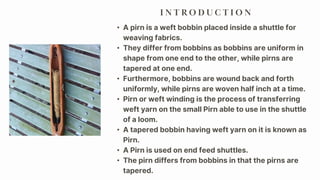
• A pirn is a weft bobbin placed inside a shuttle for
weaving fabrics.
• They differ from bobbins as bobbins are uniform in
shape from one end to the other, while pirns are
tapered at one end.
• Furthermore, bobbins are wound back and forth
uniformly, while pirns are woven half inch at a time.
• Pirn or weft winding is the process of transferring
weft yarn on the small Pirn able to use in the shuttle
of a loom.
• A tapered bobbin having weft yarn on it is known as
Pirn.
• A Pirn is used on end feed shuttles.
• The pirn differs from bobbins in that the pirns are
tapered.
I N T R O D U C T I O N
O B J E C T I V E S
• reduce ballooning effects
• maintain uniform tension
• reduce the possibility of slough-off
B U I L D E R M E C H A N I S M
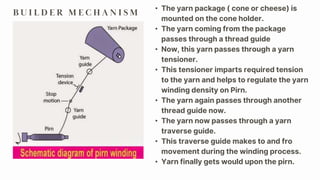
• The yarn package ( cone or cheese) is
mounted on the cone holder.
• The yarn coming from the package
passes through a thread guide
• Now, this yarn passes through a yarn
tensioner.
• This tensioner imparts required tension
to the yarn and helps to regulate the yarn
winding density on Pirn.
• The yarn again passes through another
thread guide now.
• The yarn now passes through a yarn
traverse guide.
• This traverse guide makes to and fro
movement during the winding process.
• Yarn finally gets would upon the pirn.
W O R K I N G P R I N C I P L E
• In the weft winding machine, the Pirn is driven by a spindle.
• In the weft winding process a parallel winding packages results.
• Also, instead of winding them back and forth, the weaver winds them a
half-inch at a time.
• The pirn is mounted on the spindle driven by a mechanism that
consists of gears and cam.
• The pirn rotates at a very high and constant speed.
• When the diameter of Pirn increases. The yarn winding tension
increases up to a little extent due to the less amount of yarn on the
Pirn.
• When it rotates, it drags the yarn and winds on it.
• In the pirn winding process a parallel winding packages results.
W O R K I N G P R I N C I P L E
• This package comprises one or more threads that are laid very nearly
parallel to the layers already existing on the package.
• The yarn receives to fro motion through the yarn traverse guide.
• This yarn guide performs the traversing motion of yarn.
• Yarn traverse guide which makes nearly parallel coils of yarn on the Pirn
• At a time the yarn moves to and fro between half inches distance of Pirn.
• When this half inches distance is filled, the winding of the next half
inches begins, thus the winding of complete Pirn is performed.
• The chasing length get shifted gradually during winding.
• The weft bobbin or Pirn contains a very less amount of yarn length on it
because it is very difficult to throw a shuttle with Pirn containing a high
amount of yarn on it.
D R AW B A C K S
• In the Pirn winding machine, the resulting (output) package is many
times smaller than the supply package.
• It is almost not capable to eliminate objectionable yarn faults during
winding.
• Re-joining of yarn does not take place.
• Traverse has the characteristic of an oscillation in which the package
diameter is controlled continuously.
• It necessitates building a bunch.
• At the time of beginning the winding tension is less. As the diameter
increase, winding tension also rises.
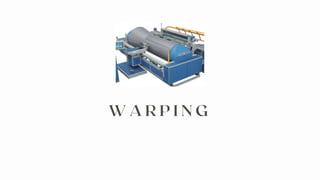
• Warping is the process of combining yarns from
different cones together to form a sheet.
• The important point in the warping is to preserve
the yarn elongation and maintain it at uniform level.
• This is done to achieve a better performance during
weaving in terms of low end breakage rate.
• Warping is a process of collecting a pre determined
number of ends from a set of wound package and
transferring them into a sheet form.
I N T R O D U C T I O N
T Y P E S
• peg warping
• sectional warping
P E G WA R P I N G
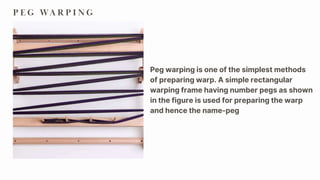
Peg warping is one of the simplest methods
of preparing warp. A simple rectangular
warping frame having number pegs as shown
in the figure is used for preparing the warp
and hence the name-peg
W O R K I N G P R I N C I P L E
• The yarn intended for the warp is wound in the bobbin/spool/ parivattom as the
case may be.
• The starting end of the yarn from the bobbin or any other source is passed
through a pipe which is used as handle cum guide for routing the yarn over pegs.
• The initial end of the yarn is tied in the peg No.1 and is then passed over the peg
No.2 and under peg No.3 (leasing) and passed around peg No.4, and then to left-
passing around 5, and then to right- passing around 6 and then to left- passing
around 7 and then to right- passing around 8 and then to left- passing around 9
and then to right- passing around 10 and then to left- passing around 11 and then
to right- passing around 12 and then to left- passing around 13 and then to right-
passing around 14and then to left- passing around 15 and then to right- passing
under 16 and over 17(leasing) and then again over 18.(With this process of
warping- if the distance from one left side peg to another in the right side is one
meter, a warp with one end having a length on 11 meter is prepared.)
W O R K I N G P R I N C I P L E
• The process of warping is reversed and then moved under 17 and over 16
(leasing) and then to 15, 14, 13, 12, 11, 10, 9, 8, 7, 6, 5, 4, and then over 3
under 2 (leasing) then to 1. (With this process, a warp with two ends having a
length on 22 meters is prepared.)
• The total process of this warping is continued till the required number of
ends is warped. The last end of the warping thread is tied over the peg No 1
or 18 as the case may be.
• Leasing thread is inserted between the pegs 2 and 3 then between pegs 16
and 17
• The warp is then slipped out of pegs and taken for gaiting in the loom
A DVA N TA G E S
• Easy to prepare short length of warp
• Warping machine is too simple
• Warping method is simple
• Possible to produce stripe patterns
• As only one thread is used to prepare a warp, enormous time is taken to
prepare a warp and its laborious
• Restriction in length of warp
• Restriction in more number of ends in the warp
D I S A DVA N TA G E S
S E C T I O N A L WA R P I N G Sectional warping is carried out in a machine
section by section and hence the name. The
sectional warping machine consists of a
warping drum, heck box and creel. The
circumference of the drum varies from the
minimum of 2yds. The heck box is provided
with standard reed, leasing heald, and
change reed and tension rollers. Sectional
warping machine is provided with a
measuring devise which enable to see the
number of rotation made in the drum. The
machine is also provided with a mechanism
which moves the heck box for every one
rotation of the drum. This is to avoid the side
ends from progressive wrapping slipping
down.
W O R K I N G P R I N C I P L E
• Wind the required quantity of yarn in each bobbin
• Mound the bobbin in creel
• Fifty percent of the bobbins to be mounted on each side of the creel, if the creel is
‘V’ shaped
• If pattern warp to be prepared, arrange the bobbin as per color pattern from one
side back of the creel
• Draw the ends through standard reed (standard reed should be coarser than
change reed. This reed condenses the whole of warp threads before it get
condensed to the required width in the change reel
W O R K I N G P R I N C I P L E
• Draw the ends through the leasing healds, the odd ends through the mail eye and
even end between two heald wires
• Draw the ends through the change reed (the count of this reed changes as per
the reed in the loom. However this reed must be at least four numbers more than
the loom reed. For example, if the loom reed is 52s the change reed should be
56s. This is to maintain the width of warp with that of the width of cloth
• woven in the loom as the sections in the drum is likely to spread a little than it in
the change reed )
• Keep the tension roller over the sheet of warp above the wooden roller
• Knot together all the warp threads and hook it on the nail provided in the
horizontal reaper of the drum
• Apply leasing by operating the leasing heald in the starting of the section
W O R K I N G P R I N C I P L E
• Rotate the drum number of times depending upon the length of warp required.
(if the circumference of the drum is two meters, by rotating the drum five times
makes a warp of 10 meters)
• Slip this knot inside the sections in the drum for a temporary locking
• This warping process is continued section by section till the required number of
ends in the warp is attained
• The sectional warping machine is provided with beaming mechanism
• Load the warp beam in the stand provided and unwind the sections from the
drum, put it in the groove provided for the purpose in warp beam
• Wind the sheet of warp from the drum to warp beam
• Load the beam in the loom and proceed with the gaiting process
A DVA N TA G E S
• Suitable for pattern warp
• All folded yarn can be warped
• Hank sized single yarns can be sizes
• Any length of warp can be warped
• Suitable for handloom, decentralized power loom, and mill sector
V E R T I C A L WA R P I N G
Vertical warping is carried out in vertical
warping drum as shown in the picture and
this machine is associated with a creel. The
machine is either four sided or six sided. The
circumference and height varies depending
on the requirement. However the height
should not be more than the reach of the
person working. Vertical warping machines
are available in both fully manually operated
and partially manually operated. The former
one is generally used for fine counts and the
later one for courser counts of yarn.
W O R K I N G P R I N C I P L E
• The yarn package is mounted in the creel
• Odd ends are drawn through the mail eye of the leasing devise and even ends
between two heald wires
• This method is repeated for all the threads in the creel
• Initially, all the warp ends are knotted together and hooked in a peg at the bottom
of the drum
• The machine is rotated laying the rope of warp threads over the circumference of
the drum spirally
• Leasing is inserted either manually or mechanically in all the vertical reapers of
the drum
• On reaching the top, the warping processing continued by turning the drum in the
opposite direction
• Now the rope of warp is kept over the circumference spirally down
W O R K I N G P R I N C I P L E
• On reaching bottom, the warp is turned back and the drum rotation is changed to
other direction
• This process is repeated number of time till the required number ends is attained
and this depend on the number of package in the creel and the total number of
ends required in the warp
• Leasing band is inserted in all the leasing points
• On completion of warp, the warp in rope form is slipped out of leasing pegs and
kept in ball warp form
• This warp is gaited in the loom as ball warp or beamed in a roller by the help of
hand wraith.
A DVA N TA G E S
• Suitable for all counts and material
• Possible to produce stripe patterns
• No limitation in maximum number of ends
• Packages in the creel can be of side delivery or end delivery type
• Generally, the length of warp is limited to 150 meters
• Quality of warp is not comparable to warps prepared in sectional warping
machine
• As the out put of the warp is in the form of ball warp, re beaming is required if
the warp is to be gaited in beam
D I S A DVA N TA G E S
T H A N K Y O U

pirn winding.pptx

  • 1.
    P R ES E N T E D B Y S N E H A B J
  • 2.
    • A pirnis a weft bobbin placed inside a shuttle for weaving fabrics. • They differ from bobbins as bobbins are uniform in shape from one end to the other, while pirns are tapered at one end. • Furthermore, bobbins are wound back and forth uniformly, while pirns are woven half inch at a time. • Pirn or weft winding is the process of transferring weft yarn on the small Pirn able to use in the shuttle of a loom. • A tapered bobbin having weft yarn on it is known as Pirn. • A Pirn is used on end feed shuttles. • The pirn differs from bobbins in that the pirns are tapered. I N T R O D U C T I O N
  • 3.
    O B JE C T I V E S • reduce ballooning effects • maintain uniform tension • reduce the possibility of slough-off
  • 4.
    B U IL D E R M E C H A N I S M • The yarn package ( cone or cheese) is mounted on the cone holder. • The yarn coming from the package passes through a thread guide • Now, this yarn passes through a yarn tensioner. • This tensioner imparts required tension to the yarn and helps to regulate the yarn winding density on Pirn. • The yarn again passes through another thread guide now. • The yarn now passes through a yarn traverse guide. • This traverse guide makes to and fro movement during the winding process. • Yarn finally gets would upon the pirn.
  • 5.
    W O RK I N G P R I N C I P L E • In the weft winding machine, the Pirn is driven by a spindle. • In the weft winding process a parallel winding packages results. • Also, instead of winding them back and forth, the weaver winds them a half-inch at a time. • The pirn is mounted on the spindle driven by a mechanism that consists of gears and cam. • The pirn rotates at a very high and constant speed. • When the diameter of Pirn increases. The yarn winding tension increases up to a little extent due to the less amount of yarn on the Pirn. • When it rotates, it drags the yarn and winds on it. • In the pirn winding process a parallel winding packages results.
  • 6.
    W O RK I N G P R I N C I P L E • This package comprises one or more threads that are laid very nearly parallel to the layers already existing on the package. • The yarn receives to fro motion through the yarn traverse guide. • This yarn guide performs the traversing motion of yarn. • Yarn traverse guide which makes nearly parallel coils of yarn on the Pirn • At a time the yarn moves to and fro between half inches distance of Pirn. • When this half inches distance is filled, the winding of the next half inches begins, thus the winding of complete Pirn is performed. • The chasing length get shifted gradually during winding. • The weft bobbin or Pirn contains a very less amount of yarn length on it because it is very difficult to throw a shuttle with Pirn containing a high amount of yarn on it.
  • 8.
    D R AWB A C K S • In the Pirn winding machine, the resulting (output) package is many times smaller than the supply package. • It is almost not capable to eliminate objectionable yarn faults during winding. • Re-joining of yarn does not take place. • Traverse has the characteristic of an oscillation in which the package diameter is controlled continuously. • It necessitates building a bunch. • At the time of beginning the winding tension is less. As the diameter increase, winding tension also rises.
  • 10.
    • Warping isthe process of combining yarns from different cones together to form a sheet. • The important point in the warping is to preserve the yarn elongation and maintain it at uniform level. • This is done to achieve a better performance during weaving in terms of low end breakage rate. • Warping is a process of collecting a pre determined number of ends from a set of wound package and transferring them into a sheet form. I N T R O D U C T I O N
  • 11.
    T Y PE S • peg warping • sectional warping
  • 12.
    P E GWA R P I N G Peg warping is one of the simplest methods of preparing warp. A simple rectangular warping frame having number pegs as shown in the figure is used for preparing the warp and hence the name-peg
  • 13.
    W O RK I N G P R I N C I P L E • The yarn intended for the warp is wound in the bobbin/spool/ parivattom as the case may be. • The starting end of the yarn from the bobbin or any other source is passed through a pipe which is used as handle cum guide for routing the yarn over pegs. • The initial end of the yarn is tied in the peg No.1 and is then passed over the peg No.2 and under peg No.3 (leasing) and passed around peg No.4, and then to left- passing around 5, and then to right- passing around 6 and then to left- passing around 7 and then to right- passing around 8 and then to left- passing around 9 and then to right- passing around 10 and then to left- passing around 11 and then to right- passing around 12 and then to left- passing around 13 and then to right- passing around 14and then to left- passing around 15 and then to right- passing under 16 and over 17(leasing) and then again over 18.(With this process of warping- if the distance from one left side peg to another in the right side is one meter, a warp with one end having a length on 11 meter is prepared.)
  • 14.
    W O RK I N G P R I N C I P L E • The process of warping is reversed and then moved under 17 and over 16 (leasing) and then to 15, 14, 13, 12, 11, 10, 9, 8, 7, 6, 5, 4, and then over 3 under 2 (leasing) then to 1. (With this process, a warp with two ends having a length on 22 meters is prepared.) • The total process of this warping is continued till the required number of ends is warped. The last end of the warping thread is tied over the peg No 1 or 18 as the case may be. • Leasing thread is inserted between the pegs 2 and 3 then between pegs 16 and 17 • The warp is then slipped out of pegs and taken for gaiting in the loom
  • 15.
    A DVA NTA G E S • Easy to prepare short length of warp • Warping machine is too simple • Warping method is simple • Possible to produce stripe patterns • As only one thread is used to prepare a warp, enormous time is taken to prepare a warp and its laborious • Restriction in length of warp • Restriction in more number of ends in the warp D I S A DVA N TA G E S
  • 16.
    S E CT I O N A L WA R P I N G Sectional warping is carried out in a machine section by section and hence the name. The sectional warping machine consists of a warping drum, heck box and creel. The circumference of the drum varies from the minimum of 2yds. The heck box is provided with standard reed, leasing heald, and change reed and tension rollers. Sectional warping machine is provided with a measuring devise which enable to see the number of rotation made in the drum. The machine is also provided with a mechanism which moves the heck box for every one rotation of the drum. This is to avoid the side ends from progressive wrapping slipping down.
  • 17.
    W O RK I N G P R I N C I P L E • Wind the required quantity of yarn in each bobbin • Mound the bobbin in creel • Fifty percent of the bobbins to be mounted on each side of the creel, if the creel is ‘V’ shaped • If pattern warp to be prepared, arrange the bobbin as per color pattern from one side back of the creel • Draw the ends through standard reed (standard reed should be coarser than change reed. This reed condenses the whole of warp threads before it get condensed to the required width in the change reel
  • 18.
    W O RK I N G P R I N C I P L E • Draw the ends through the leasing healds, the odd ends through the mail eye and even end between two heald wires • Draw the ends through the change reed (the count of this reed changes as per the reed in the loom. However this reed must be at least four numbers more than the loom reed. For example, if the loom reed is 52s the change reed should be 56s. This is to maintain the width of warp with that of the width of cloth • woven in the loom as the sections in the drum is likely to spread a little than it in the change reed ) • Keep the tension roller over the sheet of warp above the wooden roller • Knot together all the warp threads and hook it on the nail provided in the horizontal reaper of the drum • Apply leasing by operating the leasing heald in the starting of the section
  • 19.
    W O RK I N G P R I N C I P L E • Rotate the drum number of times depending upon the length of warp required. (if the circumference of the drum is two meters, by rotating the drum five times makes a warp of 10 meters) • Slip this knot inside the sections in the drum for a temporary locking • This warping process is continued section by section till the required number of ends in the warp is attained • The sectional warping machine is provided with beaming mechanism • Load the warp beam in the stand provided and unwind the sections from the drum, put it in the groove provided for the purpose in warp beam • Wind the sheet of warp from the drum to warp beam • Load the beam in the loom and proceed with the gaiting process
  • 20.
    A DVA NTA G E S • Suitable for pattern warp • All folded yarn can be warped • Hank sized single yarns can be sizes • Any length of warp can be warped • Suitable for handloom, decentralized power loom, and mill sector
  • 21.
    V E RT I C A L WA R P I N G Vertical warping is carried out in vertical warping drum as shown in the picture and this machine is associated with a creel. The machine is either four sided or six sided. The circumference and height varies depending on the requirement. However the height should not be more than the reach of the person working. Vertical warping machines are available in both fully manually operated and partially manually operated. The former one is generally used for fine counts and the later one for courser counts of yarn.
  • 22.
    W O RK I N G P R I N C I P L E • The yarn package is mounted in the creel • Odd ends are drawn through the mail eye of the leasing devise and even ends between two heald wires • This method is repeated for all the threads in the creel • Initially, all the warp ends are knotted together and hooked in a peg at the bottom of the drum • The machine is rotated laying the rope of warp threads over the circumference of the drum spirally • Leasing is inserted either manually or mechanically in all the vertical reapers of the drum • On reaching the top, the warping processing continued by turning the drum in the opposite direction • Now the rope of warp is kept over the circumference spirally down
  • 23.
    W O RK I N G P R I N C I P L E • On reaching bottom, the warp is turned back and the drum rotation is changed to other direction • This process is repeated number of time till the required number ends is attained and this depend on the number of package in the creel and the total number of ends required in the warp • Leasing band is inserted in all the leasing points • On completion of warp, the warp in rope form is slipped out of leasing pegs and kept in ball warp form • This warp is gaited in the loom as ball warp or beamed in a roller by the help of hand wraith.
  • 24.
    A DVA NTA G E S • Suitable for all counts and material • Possible to produce stripe patterns • No limitation in maximum number of ends • Packages in the creel can be of side delivery or end delivery type • Generally, the length of warp is limited to 150 meters • Quality of warp is not comparable to warps prepared in sectional warping machine • As the out put of the warp is in the form of ball warp, re beaming is required if the warp is to be gaited in beam D I S A DVA N TA G E S
  • 25.
    T H AN K Y O U