Research Methodology
An Introduction
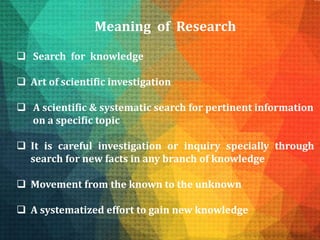
Meaning of Research
 Search for knowledge
 Art of scientific investigation
 A scientific & systematic search for pertinent information
on a specific topic
 It is careful investigation or inquiry specially through
search for new facts in any branch of knowledge
 Movement from the known to the unknown
 A systematized effort to gain new knowledge
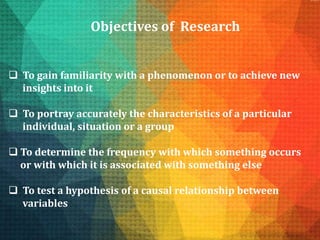
Objectives of Research
 To gain familiarity with a phenomenon or to achieve new
insights into it
 To portray accurately the characteristics of a particular
individual, situation or a group
 To determine the frequency with which something occurs
or with which it is associated with something else
 To test a hypothesis of a causal relationship between
variables
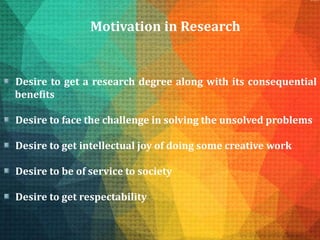
Motivation in Research
Desire to get a research degree along with its consequential
benefits
Desire to face the challenge in solving the unsolved problems
Desire to get intellectual joy of doing some creative work
Desire to be of service to society
Desire to get respectability
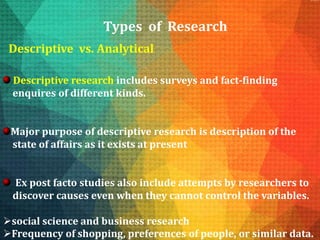
Types of Research
Descriptive vs. Analytical
Descriptive research includes surveys and fact-finding
enquires of different kinds.
Major purpose of descriptive research is description of the
state of affairs as it exists at present
Ex post facto studies also include attempts by researchers to
discover causes even when they cannot control the variables.
social science and business research
Frequency of shopping, preferences of people, or similar data.
Descriptive vs. Analytical
In analytical research, on the other hand, the researcher has
to use facts or information already available, and analyze
these to make a critical evaluation of the material.
Applied vs. Fundamental
Applied research aims at finding a solution for an immediate
problem facing a society or an industrial/business
organization, whereas fundamental research is mainly
concerned with generalizations and with the formulation of
a theory.
 Ebola fever
 New algorithm for optimization of a process
Quantitative vs. Qualitative
Quantitative research is based on the measurement of
quantity or amount. It is applicable to phenomena that can be
expressed in terms of quantity.
Qualitative research, on the other hand, is concerned with
qualitative phenomenon, i.e., phenomena relating to or
involving quality or kind.
Conceptual vs. Empirical
Conceptual research is that related to some abstract idea(s)
or theory. It is generally used by philosophers and thinkers to
develop new concepts or to reinterpret existing ones.
On the ther hand, empirical research relies on experience or
observation alone, often without due regard for system and
theory. It is data-based research, coming up with conclusions
which are capable of being verified by observation or
experiment.
Some Other Types of Research
One-time research or longitudinal research.
Field-setting research or laboratory research
or simulation research
Clinical or diagnostic research
Exploratory
Historical research
conclusion-oriented and decision-oriented
Research Approaches
Quantitative approach :- The generation of data in
quantitative form which can be subjected to rigorous
quantitative analysis in a formal and rigid fashion.
This approach can be further sub-classified into inferential,
experimental and simulation approaches to research
The purpose of inferential approach to research is to form a
data base from which to infer characteristics or relationships
of population.
Research Approaches
Experimental approach is characterised by much greater
control over the research environment and in this case some
variables are manipulated to observe their effect on other
variables.
Simulation approach involves the construction of an artificial
environment within which relevant information and data can
be generated.
Research Approaches
Qualitative approach to research is concerned with subjective
assessment of attitudes, opinions and behaviour. Research in
such a situation is a function of researcher’s insights and
impressions.
Such an approach to research generates results either in non-
quantitative form or in the form which are not subjected to
rigorous quantitative analysis.
Generally, the techniques of focus group interviews,
projective techniques and depth interviews are used.
Significance of Research
“All progress is born of inquiry. Doubt is often better than
overconfidence, for it leads to inquiry, and inquiry leads to
invention”
Research inculcates scientific and inductive thinking and it
promotes the development of logical habits of thinking and
organization.
The role of research in several fields of applied economics,
whether related to business or to the economy as a whole, has
greatly increased in modern times.
Research provides the basis for nearly all government policies
in our economic system.
Significance of Research
Research has its special significance in solving various
operational and planning problems of business and industry
Research is equally important for social scientists in studying
social relationships and in seeking answers to various social
problems.
Significance of Research
The significance of research can also be understood keeping in
view the following points:
(a) To those students who are to write a master’s or Ph.D.
thesis, research may mean a careerism or a way to attain a
high position in the social structure;
(b) To professionals in research methodology, research may
mean a source of livelihood;
(c) To philosophers and thinkers, research may mean the
outlet for new ideas and insights;
(d) To literary men and women, research may mean the
development of new styles and creative work;
(e) To analysts and intellectuals, research may mean the
generalizations of new theories.
Reference:
Research Methodology: Methods and Techniques, C. R. Kothari, New Age
International, 2004
Queries?
Manish T I
E-mail: manishti2004@gmail.com

Research Methodology - Introduction

  • 1.
  • 2.
    Meaning of Research Search for knowledge  Art of scientific investigation  A scientific & systematic search for pertinent information on a specific topic  It is careful investigation or inquiry specially through search for new facts in any branch of knowledge  Movement from the known to the unknown  A systematized effort to gain new knowledge
  • 3.
    Objectives of Research To gain familiarity with a phenomenon or to achieve new insights into it  To portray accurately the characteristics of a particular individual, situation or a group  To determine the frequency with which something occurs or with which it is associated with something else  To test a hypothesis of a causal relationship between variables
  • 4.
    Motivation in Research Desireto get a research degree along with its consequential benefits Desire to face the challenge in solving the unsolved problems Desire to get intellectual joy of doing some creative work Desire to be of service to society Desire to get respectability
  • 5.
    Types of Research Descriptivevs. Analytical Descriptive research includes surveys and fact-finding enquires of different kinds. Major purpose of descriptive research is description of the state of affairs as it exists at present Ex post facto studies also include attempts by researchers to discover causes even when they cannot control the variables. social science and business research Frequency of shopping, preferences of people, or similar data.
  • 6.
    Descriptive vs. Analytical Inanalytical research, on the other hand, the researcher has to use facts or information already available, and analyze these to make a critical evaluation of the material.
  • 7.
    Applied vs. Fundamental Appliedresearch aims at finding a solution for an immediate problem facing a society or an industrial/business organization, whereas fundamental research is mainly concerned with generalizations and with the formulation of a theory.  Ebola fever  New algorithm for optimization of a process
  • 8.
    Quantitative vs. Qualitative Quantitativeresearch is based on the measurement of quantity or amount. It is applicable to phenomena that can be expressed in terms of quantity. Qualitative research, on the other hand, is concerned with qualitative phenomenon, i.e., phenomena relating to or involving quality or kind.
  • 9.
    Conceptual vs. Empirical Conceptualresearch is that related to some abstract idea(s) or theory. It is generally used by philosophers and thinkers to develop new concepts or to reinterpret existing ones. On the ther hand, empirical research relies on experience or observation alone, often without due regard for system and theory. It is data-based research, coming up with conclusions which are capable of being verified by observation or experiment.
  • 10.
    Some Other Typesof Research One-time research or longitudinal research. Field-setting research or laboratory research or simulation research Clinical or diagnostic research Exploratory Historical research conclusion-oriented and decision-oriented
  • 11.
    Research Approaches Quantitative approach:- The generation of data in quantitative form which can be subjected to rigorous quantitative analysis in a formal and rigid fashion. This approach can be further sub-classified into inferential, experimental and simulation approaches to research The purpose of inferential approach to research is to form a data base from which to infer characteristics or relationships of population.
  • 12.
    Research Approaches Experimental approachis characterised by much greater control over the research environment and in this case some variables are manipulated to observe their effect on other variables. Simulation approach involves the construction of an artificial environment within which relevant information and data can be generated.
  • 13.
    Research Approaches Qualitative approachto research is concerned with subjective assessment of attitudes, opinions and behaviour. Research in such a situation is a function of researcher’s insights and impressions. Such an approach to research generates results either in non- quantitative form or in the form which are not subjected to rigorous quantitative analysis. Generally, the techniques of focus group interviews, projective techniques and depth interviews are used.
  • 14.
    Significance of Research “Allprogress is born of inquiry. Doubt is often better than overconfidence, for it leads to inquiry, and inquiry leads to invention” Research inculcates scientific and inductive thinking and it promotes the development of logical habits of thinking and organization. The role of research in several fields of applied economics, whether related to business or to the economy as a whole, has greatly increased in modern times. Research provides the basis for nearly all government policies in our economic system.
  • 15.
    Significance of Research Researchhas its special significance in solving various operational and planning problems of business and industry Research is equally important for social scientists in studying social relationships and in seeking answers to various social problems.
  • 16.
    Significance of Research Thesignificance of research can also be understood keeping in view the following points: (a) To those students who are to write a master’s or Ph.D. thesis, research may mean a careerism or a way to attain a high position in the social structure; (b) To professionals in research methodology, research may mean a source of livelihood; (c) To philosophers and thinkers, research may mean the outlet for new ideas and insights; (d) To literary men and women, research may mean the development of new styles and creative work; (e) To analysts and intellectuals, research may mean the generalizations of new theories.
  • 17.
    Reference: Research Methodology: Methodsand Techniques, C. R. Kothari, New Age International, 2004 Queries? Manish T I E-mail: manishti2004@gmail.com