
SBM Latest trend in School Management

Objective To equip participants with an insight of School-Based Management (SBM) to support schools in their journey to improve School Performance and Student Achievement. Methodology explore 21st Century era Learning and to improve and align school resources to provide for it. Methodology to explore 21st Century era Learning and to improve and align school resources to provide for it. to model School-Based Management(SBM) strategies to improve School Performance and, to apply SBM techniques to improve Student Achievements School Based Management Contents Overview of Resource Management-School Based (SBM) 21st Century Teaching & Learning SBM Assessment Instrument-Six Dimension of SBM Strategies to improve School Performance & Student Achievement Workshop Activity

Recommended
Recommended
More Related Content
What's hot
What's hot (20)
Similar to SBM Latest trend in School Management
Similar to SBM Latest trend in School Management (20)
More from Timothy Wooi
More from Timothy Wooi (20)
Recently uploaded
Recently uploaded (20)
SBM Latest trend in School Management
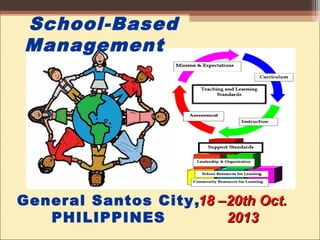
- 1. School-Based Management 18 –20th Oct.18 –20th Oct. 20132013 General Santos City, PHILIPPINES
- 2. Course OutlineCourse Outline Overview of Resource Management -School Based (SBM) 21st Century Teaching & Learning SBM Assessment Instrument -Six Dimension of SBM Strategies to improve School Performance & Student Achievement Workshop Activity 18 –20th Oct. 201318 –20th Oct. 2013 School-Based Management
- 3. IntroductioIntroductio nn Objective To equip participants with an insight of School-Based Management (SBM) to support schools in their journey to improve School Performance and Student Achievement. Methodology explore 21st Century era Learning and to improve and align school resources to provide for it. to model School-Based Management(SBM) strategies to improve School Performance and, to apply SBM techniques to improve Student Achievements This session provides an insight of a recent trend in education reform that stresses decision making on the school level to make their own decisions and policies with:-
- 4. School Based Management (SBM) SBM is a strategy to decentralize decision-making authority to the individual school site of which devolution of authority is the fundamental concept. A recent trend in education reform that stresses decision making on the school level. In the past, school policies were set by the state and the districts. Now the trend is for individual schools to make their own decisions and policies.
- 5. Goal / Vision To be the School of Choice, renownTo be the School of Choice, renown internationally for excellence in Sinternationally for excellence in School Performance and Students Achievements SSchool Performance (quality of instruction ) Students Achievements (equity in areas of student participation including the poorest sector society)
- 6. Overview of Resource Management, School-Based (SBM) 18 –20th Oct. 201318 –20th Oct. 2013
- 7. Resource Management The efficient and effective deployment of an organization's resources in the most efficient way possible , maximizing the utilization of available resources to achieve organization goals. Such resources may include tangible resources such as Information Technology(IT) Facilities Financial resources Ideas… .. Equipmen t It can also include ideas assigned to task that add value. These include… Functional Non Functional Labor (Human Resource)
- 8. Recent resource management trend In the past resource management, a key issue has been how to improve or re-engineer the internal school process as a whole to add value through school effectiveness. The answer:- a new trend in school management, -knowledge based with empowerment re its internal process to maximize its resources for operation and continuous development in management, teaching & learning within the new changing 21st century.. SBM, a key component of Basic Education Sector Reform Agenda or BESRA.
- 9. Added Value - customer focused To add value means, to manage and transform resources, materials, parts or knowledge to products that Customers (students & parents) want and are willing to pay for… to do it right the 1st time all the time, utilizing the least resources within.
- 10. EFFECTIVE Student performance improves when compared to the entry point ADDED VALUES INADDED VALUES IN STUDENT OUTCOMESSTUDENT OUTCOMES Mortimore, P. (1995, July). Key characteristics of effective schools: A review of school effectiveness research. Paper presented at the Effective School Seminar. Ministry of Education Malaysia. -is the quantification of a student's progress during different stage of his/her education. It is measured by quantifying the input (entry point) over output score (performance) and comparing the results from previous to evaluate the progress made. Value added in education
- 11. Why School-Based Management? SBM, a key component of Basic Education Sector Reform Agenda or BESRA. To accelerate the implementation of a key component of Basic Education Sector Reform Agenda or BESRA. With School-based Management (SBM), the school as key provider of education, will be equipped to empower its key officials to make informed and localized decisions based on their unique needs toward improving the educational system.
- 12. SBM- a strategy to decentralize decision-making authority to the individual school site of which devolution of authority is the fundamental concept. A recent trend in education reform that stresses decision making on the school level. In the past, school policies were set by the state and the districts. Now the trend is for individual schools to make their own decisions and policies.
- 13. SCHOOL-BASED MANAGEMENT School-based management (SBM) is the decentralization of decision-making authority from state and district (central, regional, division) levels down to the school level. Responsibility and school operations is transferred to principals, teachers, parents, sometimes students, and other school community members with the intent to unite. The school, however, have to conform to, or operate, within
- 14. Why Decentralization? To provide opportunity to School Leaders to: • boosts the morale of teachers and encourages leadership at all levels • allows participation of the entire school community in making key decisions • has a wider pool of ideas in designing education programs • focuses resources to the goals and needs of each school. According to the National Association of Secondary School Principals (NASSP)
- 15. Why is School-Based Management important? With more responsibilities dissolved to schools through SBM, schools have greater autonomy and flexibility in managing their operations and resources towards school development. Additional autonomy makes schools more transparent in their operations and accountable to the community for their performance and proper use of funds as Quality of school education directly impact students’ learning outcomes. Second, it allows local decision-makers to determine the appropriate mix of inputs and education policies adapted to local realities and needs.
- 16. Finance Physical facilities Student readiness Teacher ability Parental Support School culture Motivation level Instruction Learning Time Leadership OUTPUT Student Achievement INPUT PROCESS
- 17. 4.Integrate School management and instructional reformation for the school effective 1.Empower school heads to lead their teachers and students through reforms that leads to higher learning outcomes 3.Strengthens partnership with communities as well as local government units to invest time, money and effort in making the school a better place to learn 2.Bring resources including funds, down to the control of schools to spur change in line with decentralization SBM OBJECTIVES SBM OBJECTIVES
- 18. The main goal of SBM is to improve School Performance and Student Achievement
- 19. 21st Century Teaching & Learning 18 –20th Oct. 201318 –20th Oct. 2013
- 20. Question to ponder Why do schools use a system of ringing bells to stop or start, Is it,… ....to ensure order? ….to prepare students for a profession which requires clocking in and out? ….in actuality, an acclimatization tool? Was it’s original purpose to provide a means of knowing when to be somewhere when watches were a thing for the middle-classes and affluent adults? We need change to move with the times -look at the building blocks of the system -change for the better to adapt to meeting current demanding needs
- 21. 21st Century Careers - is all about CHANGE, in thinking, strategies and behaviors that work in the new ever-changing and challenging environment to meet the challenges of the times. A need to be current, resilient - continuous learning, connected to your values.
- 22. CHANGE- the Essence to Continuous Improvement This is the first time in the history of business that you can be great at what you’re doing today and be out of business tomorrow if you refuse CHANGE! Change, when occurs, needs to be managed. Teachers,- products of previous education system, before the Digital Revolution. We need to think - how we prepare students to become lifelong learners in these fast pave technological change era- 21st Century!
- 23. Teaching 21st Century Skills •21st Century Skills & Literacy •21st Century Teaching and Learning •Upgrade your Lessons •Incorporating 21st Century skills in the Classroom
- 24. 21st Century Skills & Literacy
- 25. Where are we today? On a piece of paper, browse horizontally across the 21st Century Skill & Literacy. Put a ‘tick’ on the right end of the chart if you are familiar with. Go through the 6 Skills from Information literacy to Communicate/ Collaborate . Sum up the total number of ‘Ticks’ in each and row. Your 21th Century Skills & Literacy score is as below, (Total)19 X 100% 54 Literacy Score = 35%Total: 19
- 26. CHANGE Constant Change -today’s era. To stay competitive, -manage the present and plan the future. -problem is, can’t have the same people doing both jobs. If present time people with operational responsibilities are asked to think about the future, they will kill it. Without Change for the better (Kaizen), there will be no Continuous Improvement to be Competitive in the current Global competition. IMPROVEMENTIMPROVEMENT WITHOUTWITHOUT ENDINGENDING
- 27. 21st Century Teaching & Learning To live and succeed in the present world, students will need for an increased focus on communication, collaboration, and creativity and an emphasis on teaching them to use technology in order to learn how to learn, solve problems, and think creatively.( the new “3 C’s” of education )
- 28. 21st Century Skills Students must be taught how to use technology efficiently and effectively, ethically and appropriately, safely and respectfully to learn how to learn, solve problems, and think creatively.
- 30. Incorporating 21st Century Skills in Classroom Students - develop 21st Century Skills (21st CS) to "survive and thrive” Now, who has time to teach 21st CS with so much to teach in our content areas? Learn-Integrate 21st CS exposure and development into instruction, learning, and assessment inside curriculum, so students can be- productive, resourceful, confident at school, work, and home.
- 31. SBM Assessment Instrument 18 –20th Oct. 20118 –20th Oct. 20133
- 33. SBM DIMENSION 1. SCHOOL LEADERSHIP 2. INTERNAL STAKEHOLDERS 3. EXTERNAL STAKEHOLDER 4. SCHOOL IMPROVEMENT PROCESS 5. SCHOOL-BASED RESOURCES 6. SCHOOL PERFORMANCE ACCOUNTABILITY Dimension of School-Based Management (BESRA) RESPONDENTS School Head Assistant to school head / head Teachers / Teachers / Grade chair / Dept head Parent association representative / Teacher association chair/ Head of student council / Organization Parent association representative / Teacher association chair LGU Barangay chair/representative / SGC chair/representative Chair of any other active groups involved in the school (eg. NGO’s, Alumni association) School Head Parent association representative Teacher association chair / Head of student council School Head Person in charge of school fund (eg.Budget officer/Supply Officer) / SGC chair/representative / PTA chair/representative LGU Barangay chair/representative School Head Parent association representative Teacher association chair / Head of student council SGC chair/representative / LGU Barangay chair/representative
- 34. Dimension 1 SCHOOL LEADERSHIP level 1 (standard) The school head: SBM 1.1 Has an appointment Is aware of his/her basic roles and responsibilities in school improvement 1.2 Has attended SBM related trainings Attended
- 35. Dimension 1 School Leadership • School Head (SH) is designated • SH is trained on basic competencies on instructional leadership • SH is trained on SBM, SIP, ASB, Fiscal Mngt., & ICT related training • SH initiates: Organizing stakeholders, installing appropriate SBM system (e.g. school improvement planning, budgeting and resource management, staffing, performance monitoring and reporting) SH performs fund management duties (e.g. accounting/book keeping functions) level 1 (standard)
- 36. Dimension 2 INTERNAL STAKEHOLDERS level 1 (standard) SBM 2.1 PUPILS/STUDENTS; TEACHERS; PARENTS: Are aware of their rights and responsibilities as primary stakeholders 2.2 Teachers are trained on curriculum content and pedagogy Are aware of their rights and responsibilities as primary stakeholders 2.3 Teachers Apply knowledge, process skills and instructional innovations acquired from participation in trainings 2.4 Parents
- 37. Dimension 2 Internal Stakeholders Participation (teachers, parents, pupils) • Students, teachers, and parents understand their respective roles and responsibilities on SBM; and are organized for participation in SBM process • Teachers are trained on curriculum, content, and pedagogy • Teachers apply knowledge, process skills and instructional innovations acquired from participation in trainings • Parents assume responsibilities as partners in the learning process level 1 (standard)
- 38. Dimension 3 EXTERNAL STAKEHOLDER level 1 (standard) External stakeholders: SBM 3.1 Have a clear and common understanding of their rights, responsibilities and functions in school improvement 3.2 School Community are organized to support / implement SBM 3.3 Are mobilized to support SBM and the implementation of the SIP 3.4 Local Government stakeholders are fully aware of their roles and responsibilities
- 39. Dimension 3 External Stakeholders Participation (alumni, local leaders, retirees, youth leaders, LGO/ NGOs, others) • External stakeholders are organized and made aware of their rights and responsibilities as education stakeholders • Community leaders/People’s Organizations (Po’s)/Non-Government Organizations (NGO’s), others are oriented, organized and mobilized to support SBM • External stakeholders are mobilized to support SBM and the implementation of SIP • Local government stakeholders are fully aware of their roles and responsibilities level 1 (standard)
- 40. Dimension 4 SCHOOL IMPROVEMENT PROCESS level 1 (standard) The School SBM 4.1 Conducts assessment of SBM practices using assessment tool 4.2 Governing Council Is organized 4.3 Has Knowledge-based and participatory SIP/AIP Formulation Stakeholders SBM 4.4 Stakeholders are informed, consulted and engaged in SIP/AIP formulation and Implementation 4.5 Performance-based Incentives and Rewards System for pupils/students and teachers installed in school and supported by the SGC The School SBM 4.6 Emphasizes improvement of school
- 41. SBM Dimension 4 School Improvement Process • School conducts assessment of SBM practice using assessment tool • SGC is organized • The school has: knowledge-based and participatory SIP/AIP formulation • Stakeholders are informed, consulted, and engaged in SIP/AIP formulation, implementation • Performance-based Incentives and Rewards System for pupils and teachers level 1 (standard)
- 42. Dimension 5 SCHOOL BASED RESOURCES level 1 (standard) The school SBM 5.1 Has an Annual School Budget (ASB) aligned with the Annual Improvement Plan (AIP) 5.2 The Annual School Budget (ASB) resulted in the attainment of school targets and desired learning outcomes 5.3 The school manages and controls funds with minimal fiscal authority/ autonomy targets and desired learning outcomes The allocation SBM 5.4 Optimally utilized and disbursement of funds is aligned to SIP/AIP/ASB and recorded, reported and accounted for
- 43. Dimension 5 School-Based Resources • Annual School Budget (ASB) (e.g. DepED (MOOE) is aligned with SIP/AIP) • ASB results in attainment of targets and desired outcomes • The School manages and controls funds with minimal fiscal authority/autonomy • The allocation is: optimally utilized and disbursement of funds is aligned to SIP/AIP/ASB and recorded, reported and accounted for level 1 (standard)
- 44. Dimension 6 SCHOOL PERFORMANCE ACCOUNTABILITY level 1 (standard) The school SBM 6.1 Has mechanisms for transparency and accountability Has installed and operationalize Monitoring and Evaluation System 6.2 Informs and involves major stakeholder in the monitoring and evaluation 6.3 Monitors and evaluates improvements in student performance indicators per class, per student, per subject
- 45. Dimension 6 School Performance Accountability • School introduces transparency and accountability mechanisms • Monitoring and Evaluation (M/E)systems is installed and operational(e.g. data and reports are used in continuing improvement) • Major stakeholders (SGC, PTCA’s, Schools Division Superintendent, LSB) are informed and participate in M/E • Improvements in learning outcomes by Grade/Year level are monitored and evaluated by homeroom and tracked per student/subject level 1 (standard)
- 47. The review mission reports of Dep. Ed’s development partners cite that while most of the schools implemented SBM as reflected in the increase in number of schools with SIP, those receiving grants and MOOE on time, and those who conducted SBM assessment, systemic issues were noted in the operationalization of policies and guidelines at the field level. Among these are: R A T I O N A L E
- 48. Unrealistic targets and inappropriate strategies in the SIPs of many of the schools visited; Too much focus on the SIP templates, which is usually construed as a one-size-fits-all, overlooking the unique condition of their schools, the pupils/students they are providing learning environments for, and the peculiar issues they are confronting; it was observed that there are more schools with School Report Cards than School Improvement Plans which reflects a disconnect of these two SBM
- 49. A process by which members of the school –community conducts a thorough evaluation of their school’s educational programming in the previous school years and the development of a written school plan that: establishes the starting point for ongoing evaluation of efforts and unifies independently organized school improvement efforts from various areas of the total school program into a single, focused process. School Improvement Planning (SIP)
- 50. A need in paradigm shift in education governance, from being school-centered to community- and child- (learner) centered and towards enhancing the principle of shared governance to support the stewardship of children’s learning outcomes. It is also imperative in the review and refinement of SBM to account for the evidence of successful practices. Conclusive findings suggest that the reforms in education governance systems must be linked tightly with the changes in curriculum and instruction. Thus, the inception of K to 12 must be integrated in the organizational change. SBM reform for successful practice
- 51. To better highlight the children/learner as the center of SBM practice. To encompass the diverse realities of learning contexts defined and uniquely occurring within specific geographic, social, cultural, economic, political and environmental make up of the contemporary society. It is along these views that SBM as a reform thrust has been revised and broadened for the following reasons: SBM reform for successful practice
- 52. To effectively carry out reforms in curriculum (Kto12) To assimilate the school to the system and way of life of the community To redirect all efforts to support improvement of learning outcomes SBM reform for successful practice
- 53. The K to 12 Program Kindergarten and 12 years of basic education with six years of primary education, four years of Junior High School, and two years of Senior High School (SHS) Aims to provide sufficient time for mastery of concepts and skills, develop lifelong learners, and prepare graduates for tertiary education, middle-level skills development, employment, and entrepreneurship.
- 54. At the center is the intended output: a functionally- literate citizen who is self-reliant, patriotic, productive and service-oriented. The framework is Systems-oriented. It shows the major components of SBM, their organizational Structure, interrelationships and interdependence, as well as their characteristics and underlying principles. The Revised SBM Framework
- 55. To enhance commitment of education stakeholders at all levels to their responsibilities and accountabilities in realizing the education outcomes for children. To further promote shared governance between the school and the community; To integrate accreditation into SBM for a seamless assessment of a school system; To improve the school system’s capacity to be on rack on achieving the EFA/ MDG and sustain good performance. The Revised SBM Framework
- 56. (PASBE) Philippine Accreditation System for Basic Education
- 57. Accreditation is a proposed system by the Philippines to allow self-renewing of self-regulating schools to achieve ‘autonomous’ status-meaning it recognize the learning community (the school and the community as self-sustaining) with system suitable for their context. This will also rationalized the incentive system initially proposed as ‘higher grant allocation’, ‘fiscal autonomy’ and special allocation for allocation outlay’ (PASBE) Philippine Accreditation System for Basic Education
- 58. The SBM- PASBE Operational Framework
- 59. The Operational Framework presents the key components of the assessment system and how they are organized and interrelated to enhance continuous improvement of learning outcomes and products of learning. The SBM- PASBE Operational Framework
- 60. SBM is access periodically in terms of school performance based on agreed standards. The level of practice would indicate how the school and community transition from centralized to decentralized governance, from dependant to interdependent, form school being nurtured by the community to school nurturing the community. These features plus the sufficient satisfaction of the standards are the bases for classifying the school system as eligible for accreditation- a certification process to quality assure the systems and processes of education delivery. The SBM- PASBE Operational Framework This diagram shows how SBM practice intersects with accreditation.
- 61. Three key components are presented: 1. Guiding principles of the assessment systems; 2. Indicators of SBM practices; and 3. School accreditation The Revised SBM Framework
- 62. The system is guided by four ACCESs principles on 1. leadership and governance, 2. curriculum and learning, 3.resource management and 4.accountability for higher learning outcomes. The Revised SBM Framework
- 63. The Revised SBM Framework
- 64. (A Child & Community Centered Education System) ACCESs
- 65. To further promote shared governance between the school and the community; To integrate accreditation into SBM for a seamless assessment of a school system; To improve the school system’s capacity to be on rack on achieving the EFA/ MDG and sustain good performance. The Revised SBM Framework
- 66. The Revised SBM Framework
- 67. Matrix of SBM Dimensions by Scale of Practice http://depednaga.com.ph/matrix-of-scale-of- Level I (Standard)Beginning Compliance with the minimum requirements for managing inputs, structures & mechanisms, & improving processes effecting student achievement that lead to improved learning outcomes. Level II (Progressive)Developing intensifies mobilization of resources and maximizes efforts of the school to achieve desired learning outcomes. Level III (Mature)Advance - Accredited goes further by maximizing efforts of the school and the community/stakeholders to achieve higher learning outcomes. A three-Scale of Practice has been devised to ensure that SBM works toward improved learning outcomes-ultimate goal of SBM.
- 68. SBM assessment aims to: determine the level of the SBM practices of the school; provide the school a sound basis on which to establish its plan of action; improve the SBM support systems through interventions that the school and other administrative levels of the Department may introduce; and determine the effectiveness of SBM practices in the delivery of basic education services. Purposes of SBM Practices Assessment
- 69. Strategies to improve School Performance & Student Achievements 18 –20th Oct. 201318 –20th Oct. 2013
- 70. FOCUSED CLASSROOM INSTRUCTION for Improved School Performance and Student Achievement
- 71. Coleman et.al (1966) Brophy & Good, (1986), Sanders et. al. (1994) 1960 &1970 1980’s
- 72. Students Performance 50 % 0 % 100 % Age 11Age 8 Students’ age Student with high performing’ teacher Student with low performing’ teacher 90 % 53 % 37 % HOW THE WORLD’S BEST PERFORMING SCHOOL SYSTEMS COMES OUT ON TOPOP McKinsey & Company Sept 2007 UK
- 73. Vision Statement, why?Successful schools have a clear sense of direction through Vision Statement. –shared sense of direction derived through a visioning process involving all members of the school. Once affirmed, it needs to be able to be articulated by all. -when achieved everyone can then align their efforts behind the vision and by a process of self-reference and professional development the school will reach. Translation into reality by means of a Teaching framework or belief system.
- 74. Strategic Review of Dep of Ed- School First
- 75. (Hallinger, 2003) Commu- nicating school goals Supervising & evaluating instruction Providing incentives for teachers Widely used Instructional Leadership model Framing school goals Coordinating curriculum Monitoring student progress Protecting instructional time Promoting professional development Maintaining high visibility Providing incentives for learning
- 76. Improvement Framework How Do We Improve Our School? •Transformations – takes place when school culture permits •Create a culture to sustain Change. • Framework – well defined process for culture of excellence and continuous Improvement 1.Plan- gather and analyze data to determine priorities, -explore possible solutions and assess readiness for Change. 2.Do-Implement plan, create and communicate Improvement. 3.Check-monitor and adjust. 4. Act-realign and correct 4 PDCA stages:
- 77. Introduced in Japan around the 1870s. -case analysis on practice of lessons, to aid development of teachers to learn from each other on real practices at classroom. -three parts: Plan, Observe and Reflect Lesson study Plan, one or group of teachers plan a lesson; Observe, one teacher conducts a lesson based on the plan and colleagues observe the lesson; Reflect , teachers reflect on the observed lesson together
- 78. SBM Community Collaborative Life Stages with community participation.
- 79. WORKSHOP ACTIVITY 18 –20th Oct. 201318 –20th Oct. 2013
- 80. WORKSHOP ‘Lets Squeeze our Brains’ Revised SBM Assessment Tool ACCESs Principles and SBM Indicators SBM level of practice, rating scale and scoring system
- 81. CHANGE at School By implementing change, we can attempt to bridge the educational dichotomy and link the importance of structure with the need for creativity. Change needs to happen continually in small evolutionary steps. Surely, too, there is need for it in education.
- 82. With SBM, the Government devolves more responsibilities to the schools and provides them with greater autonomy and flexibility in managing their operations and resources and planning for school development. As the quality of school education has a direct impact on students’ learning outcomes, the quid pro quo to additional autonomy is that schools have to be more transparent in their operations and accountable to the community for their performance and proper use of funds. Why implement school-based management (SBM)? 1.
- 83. With school-based management, schools will develop a management system to ensure the quality of teaching and learning. This framework of governance is school-based, student-centered and quality-focused. Why implement school-based management (SBM)? 2.
- 84. Introducing a participatory governance framework involving school sponsoring bodies, the principal, teachers, parents, alumni and independent community members is essential, as direct participation in school decision- making and different input of these key stakeholders help enhance transparency and accountability of school governance and contribute to more effective school operation. Why implement school-based management (SBM)? 3.
- 85. To promote quality education, a school should adopt a model of teaching and learning and a management framework that suit the needs of the students and the community. Through school-based management, the school develops its own characteristics, establishes its culture and identity, seeks self-improvement and pursues excellence. Why implement school-based management (SBM)? 4.
- 86. To ensure stakeholders’ direct participation in school management, the Government has introduced legislation to lay down rules and regulations governing its implementation. Under the Education Ordinance (Ordinance), every aided school is required to set up an incorporated management committee (IMC) to manage the school. To protect managers from civil liabilities, the Ordinance also provides that a manager shall not incur any civil liability in respect of anything done by him in good faith in the performance of any function of office as the manager of an IMC school. Moreover, the Education Bureau has offered support measures to help schools put in place this new model of governance. Why implement school-based management (SBM)? 5.
- 87. Participation of stakeholders in school management and policy- making is a world-wide trend. The implementation of SBM brings the education system into a new era to tie in with global developments. It contributes to the personal growth of students, builds a competent workforce to sustain the social, economic and cultural development and further enhances our competiveness internationally. Why implement school-based management (SBM)? 6.
- 88. Timothy Wooi Lean Consultant / Trainer, Hands on certified Kaizen Specialist cum TPM Facilitator. & God bless! The End
Editor's Notes
- ACM Kaizen Leader Certification Course May 6-10, 2002
- 1. Empower school heads to lead their teachers and students through reforms that leads to higher learning outcomes 2.Bring resources including funds, down to the control of schools to spur change in line with decentralization 3.Strengthens partnership with communities as well as local government units to invest time, money and effort in making the school a better place to learn 4.Integrate School management and instructional reformation for the school effectiveness
- ACM Kaizen Leader Certification Course May 6-10, 2002
- ACM Kaizen Leader Certification Course May 6-10, 2002
- ACM Kaizen Leader Certification Course May 6-10, 2002
- ACM Kaizen Leader Certification Course May 6-10, 2002
- ACM Kaizen Leader Certification Course May 6-10, 2002
- ACM Kaizen Leader Certification Course May 6-10, 2002
- B. Rationale The review mission reports of DepEd’s development partners cite that while most of the schools implemented SBM as reflected in the increase in number of schools with SIP, those receiving grants and MOOE on time, and those who conducted SBM assessment, systemic issues were noted in the operationalization of policies and guidelines at the field level. Among these are: Unrealistic targets and inappropriate strategies in the SIPs of many of the schools visited; too much focus on the SIP templates, which is usually construed as a one-size-fits-all form overlooking the unique condition of their schools, the pupils/students they are providing learning environments for, and the peculiar issues they are confronting; Across the four project Missions, it was observed that there are more schools with School Report Cards than School Improvement Plans which reflects a disconnect of these two SBM processes. There is a possibility that the SBM Assessment process may be reduced to “bean counting” that over-emphasizes the collection of prescribed documentation, the compliance to some of which may not be within the control of the schools and are not reflective of a functional system of good practices. While DepED reports that 100% of school heads in many divisions had been oriented on SBM, their practical understanding of the concept is not as palpable. These findings indicate that the system is beset with problems particularly in terms of stakeholders’ appreciation and understanding of SBM. In the assessment process for example, the focus was narrowed to complying with the documents in the SBM Checklist leading to accounting for quantitative scores only to assess the level of practice. Thus practices which may be qualitatively different such as behavior and attitude towards SBM implementation which are not evidenced by a document are
- A Child- and Community – centered Education System which is the “core value” in making education more relevant and child-centered, increasing access and quality, and strengthening partnerships with community stakeholders; and design a seamless framework for SBM-IP Ed-PASBE complementation and harmonize standards, implementation strategies, performance indicators, and measures as well as target outcomes;
- PSBM is development of school-based management with community participation. There are mainly three principles: (1) Adapting bottom up school planning with school committee and community, (2) Showing accountability and transparency regarding school activities and budget, and (3) School committee and community participation in school activities and development. Some examples of PSBM activities are: School makes a annual school plan with the school committee members. School implements educational events cooperating with parents and community. School carries out educational socialization for parents. School receives donation, materials and others from community. School reports its activities to parents and school committee members. School reports its income and expenditure to parents and school committee members.
- One person alone cannot reach each student and help each student succeed. The Framework requires leaders who are able to lead in many different ways and in numerous circumstances. Principal, teacher, and student leadership are invaluable to the effort. Collaboration within grade levels, across grade levels, and across schools provides the backbone for the sustainability of the Framework.