1Marek.Piatkowski@Rogers.com
Pull System
Introduction
Thinkingwin, Win, WIN
Pull System
Introduction
Marek Piatkowski – November 2016
Thinkingwin, Win, WIN
2Marek.Piatkowski@Rogers.com
Pull System
Introduction
Thinkingwin, Win, WIN
Introduction - Marek Piatkowski
 Professional Background
 Toyota Motor Manufacturing Canada (TMMC) - Cambridge, Ontario from
1987-1994
 TPS/Lean Transformation Consulting - since 1994
 Professional Affiliations
 TWI Network – John Shook, Founder
 Lean Enterprise Institute (LEI) – Jim Womack
 Lean Enterprise Academy (LEA) – Daniel Jones
 CCM/CAINTRA – Monterrey, Mexico
 SME, AME, ASQ, CME
 Lean Manufacturing Solutions - Toronto, Canada
http://twi-network.com
3Marek.Piatkowski@Rogers.com
Pull System
Introduction
Thinkingwin, Win, WIN
4Marek.Piatkowski@Rogers.com
Pull System
Introduction
Thinkingwin, Win, WIN
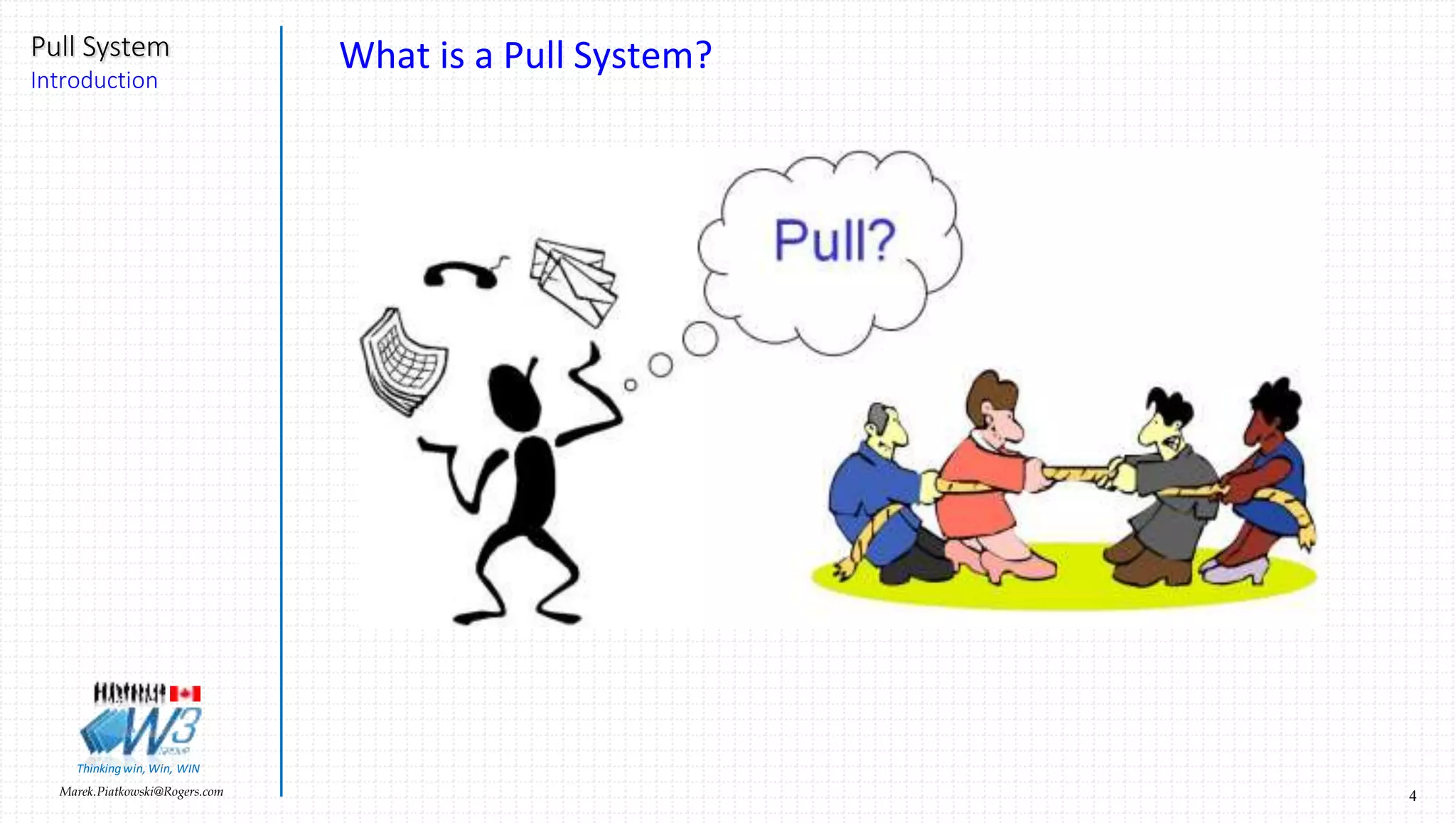
What is a Pull System?
5Marek.Piatkowski@Rogers.com
Pull System
Introduction
Thinkingwin, Win, WIN
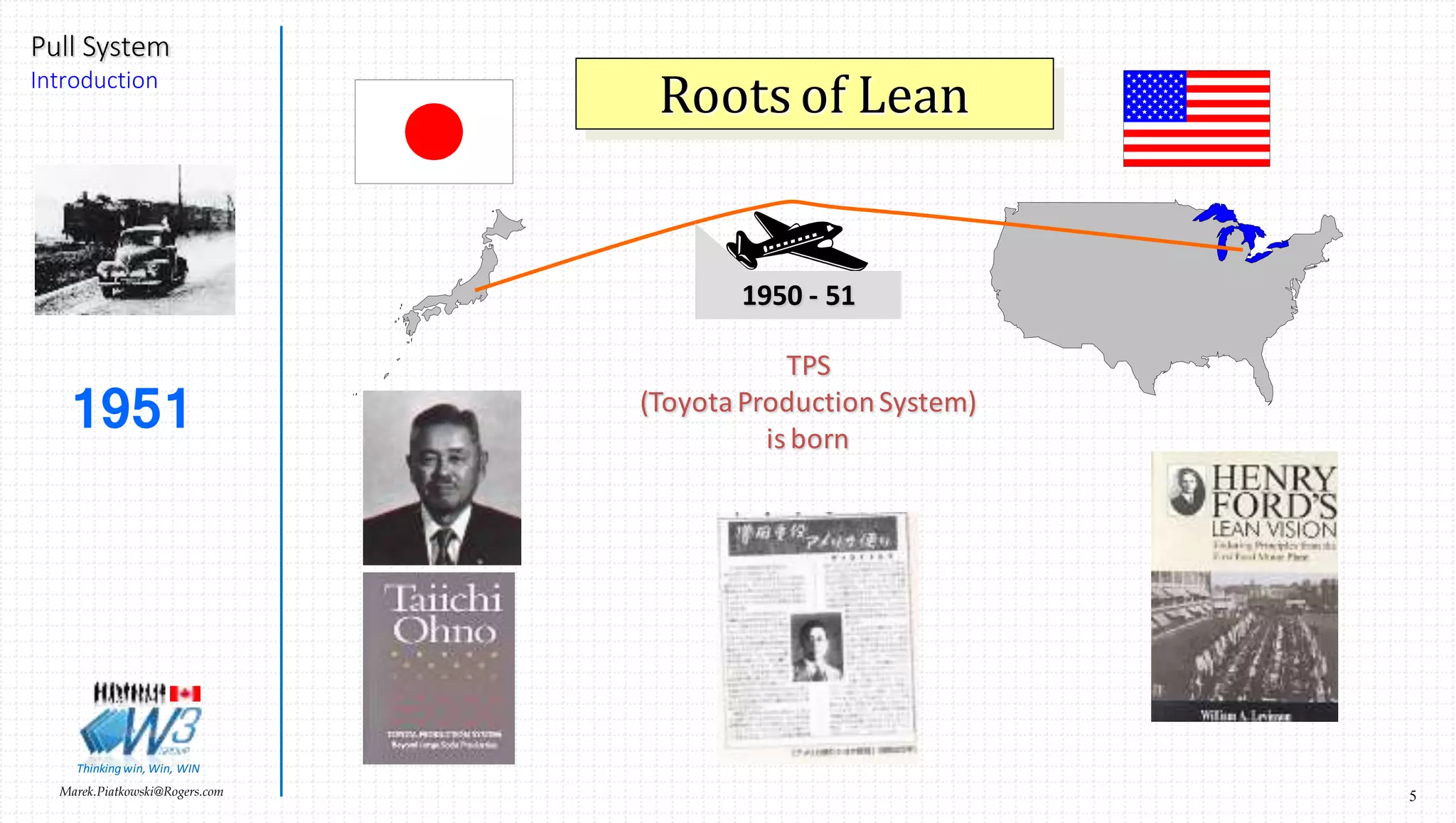
TPS
(ToyotaProductionSystem)
is born
Roots of Lean
1950 - 51
1951
6Marek.Piatkowski@Rogers.com
Pull System
Introduction
Thinkingwin, Win, WIN
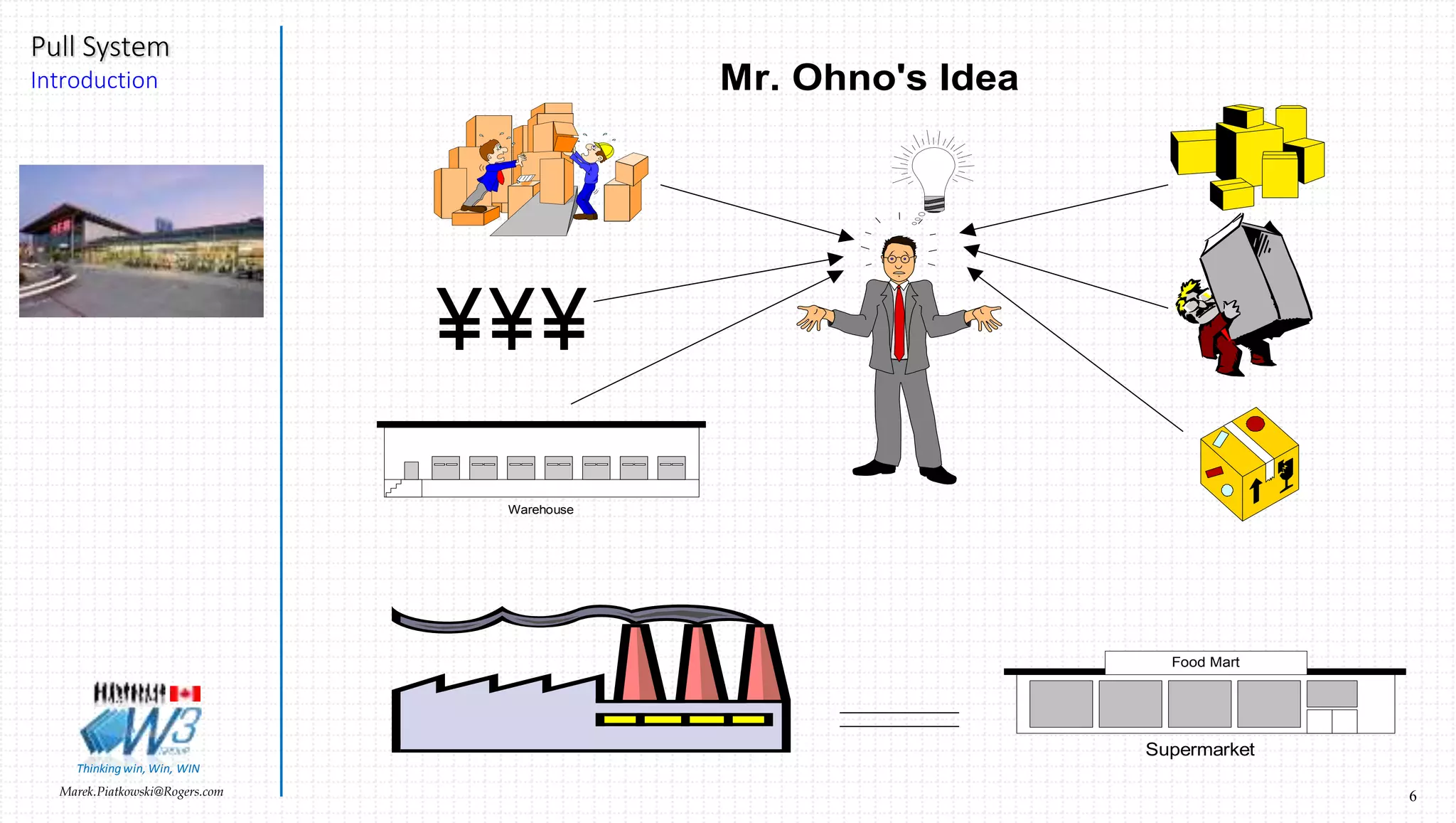
Mr. Ohno's Idea
Food Mart
Supermarket
Warehouse
7Marek.Piatkowski@Rogers.com
Pull System
Introduction
Thinkingwin, Win, WIN
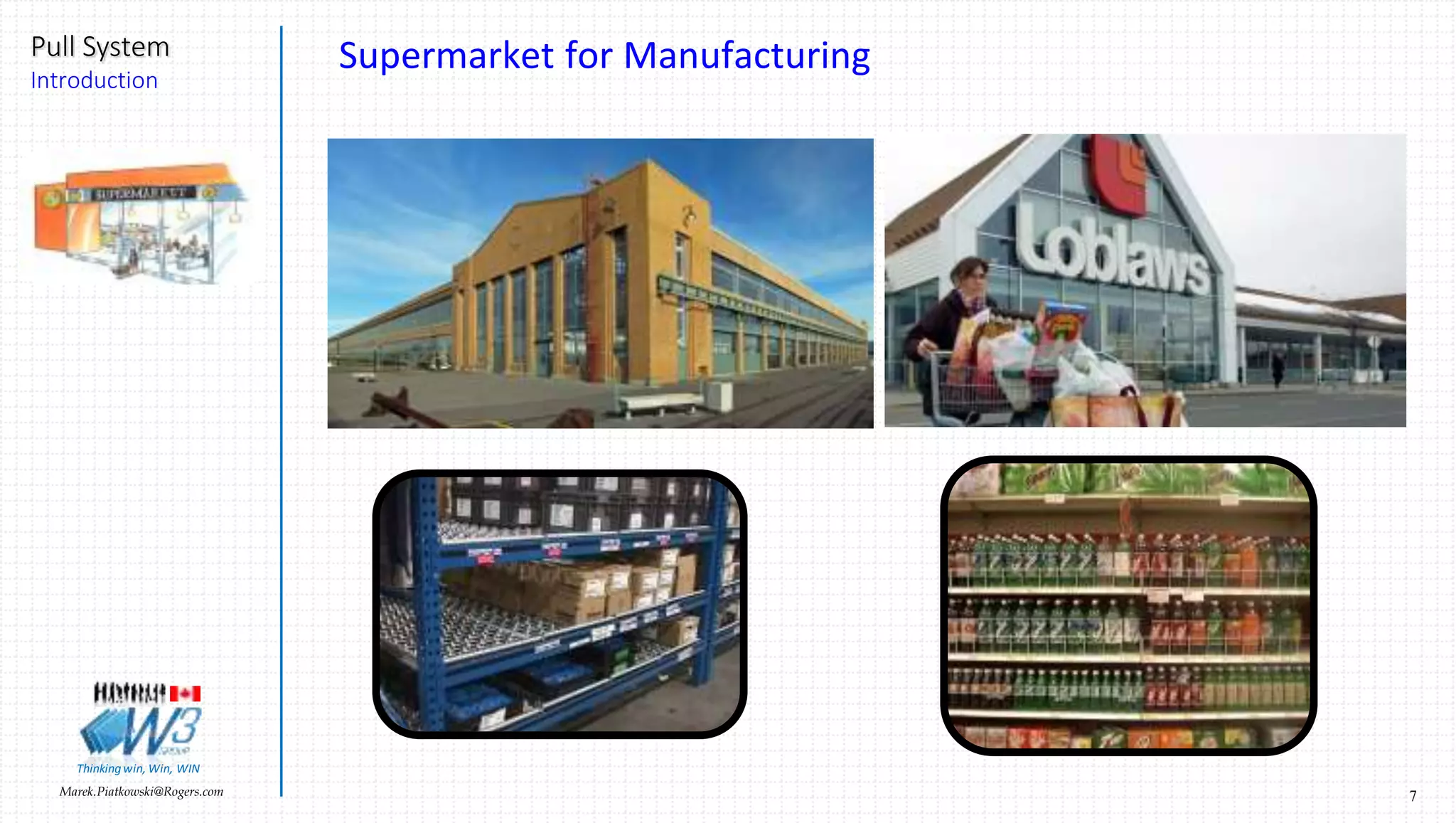
Supermarket for Manufacturing
8Marek.Piatkowski@Rogers.com
Pull System
Introduction
Thinkingwin, Win, WIN
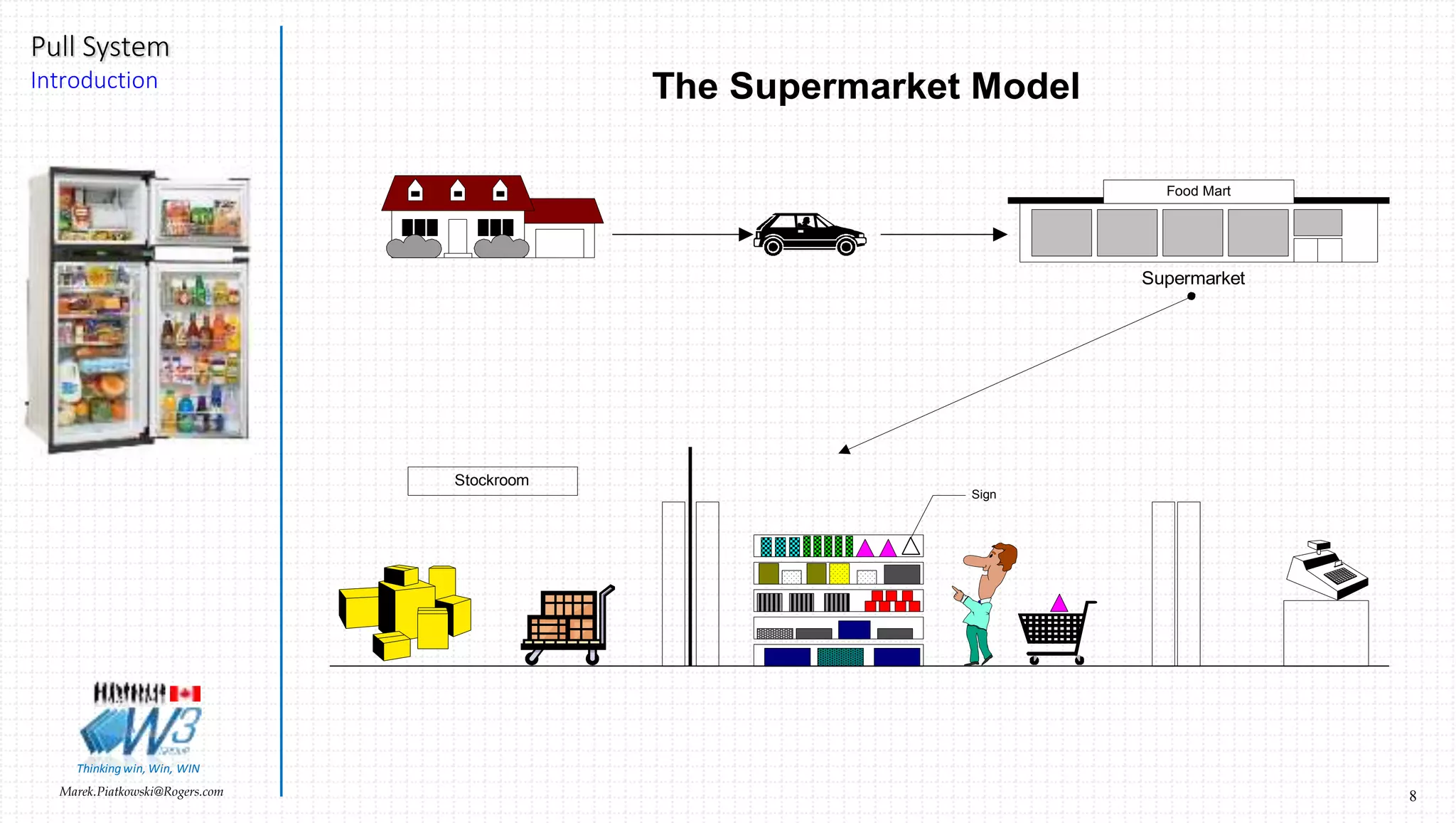
Food Mart
Supermarket
Sign
Stockroom
The Supermarket Model
9Marek.Piatkowski@Rogers.com
Pull System
Introduction
Thinkingwin, Win, WIN
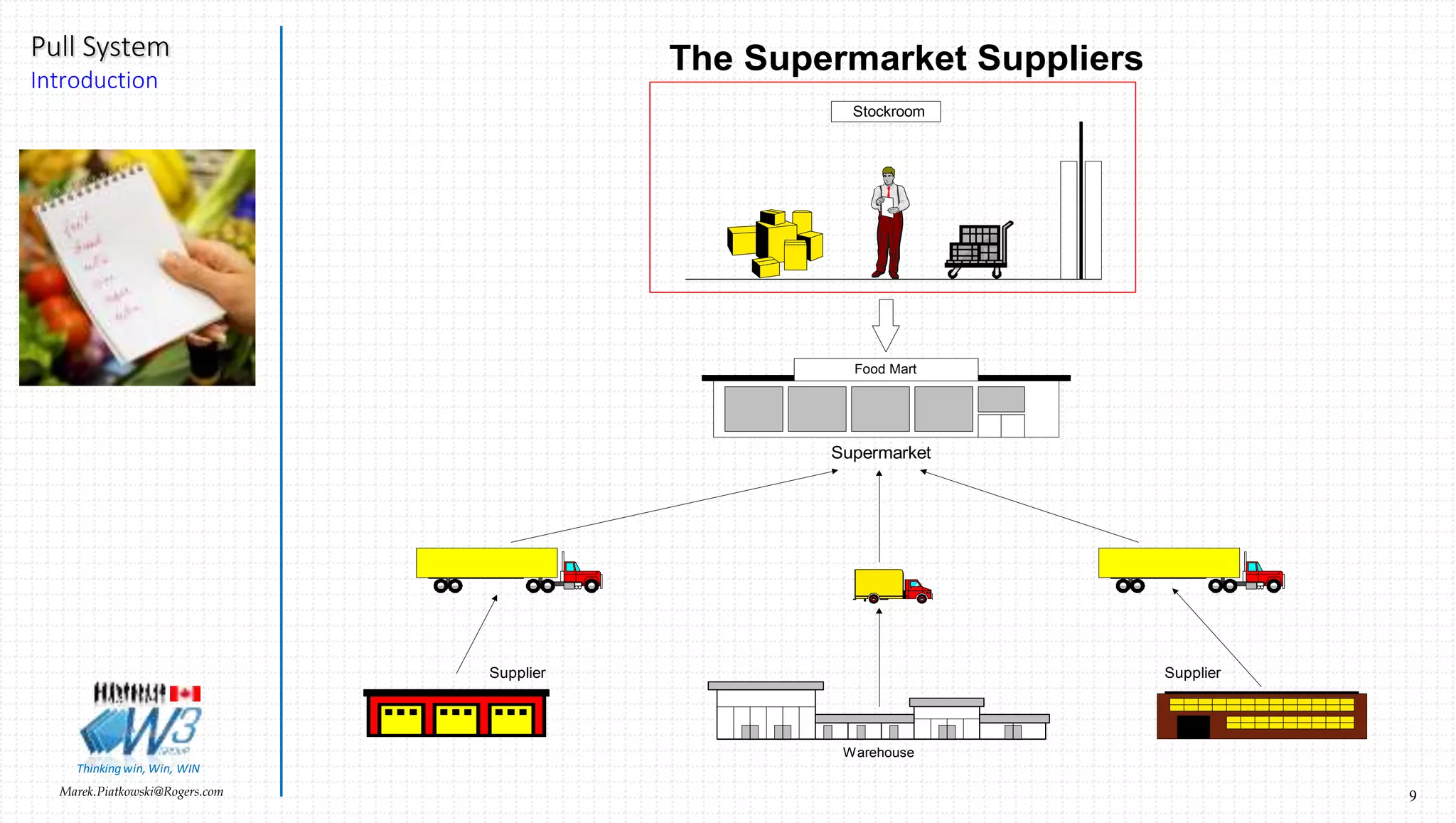
The Supermarket Suppliers
Food Mart
Supermarket
Warehouse
Supplier Supplier
Stockroom
10Marek.Piatkowski@Rogers.com
Pull System
Introduction
Thinkingwin, Win, WIN
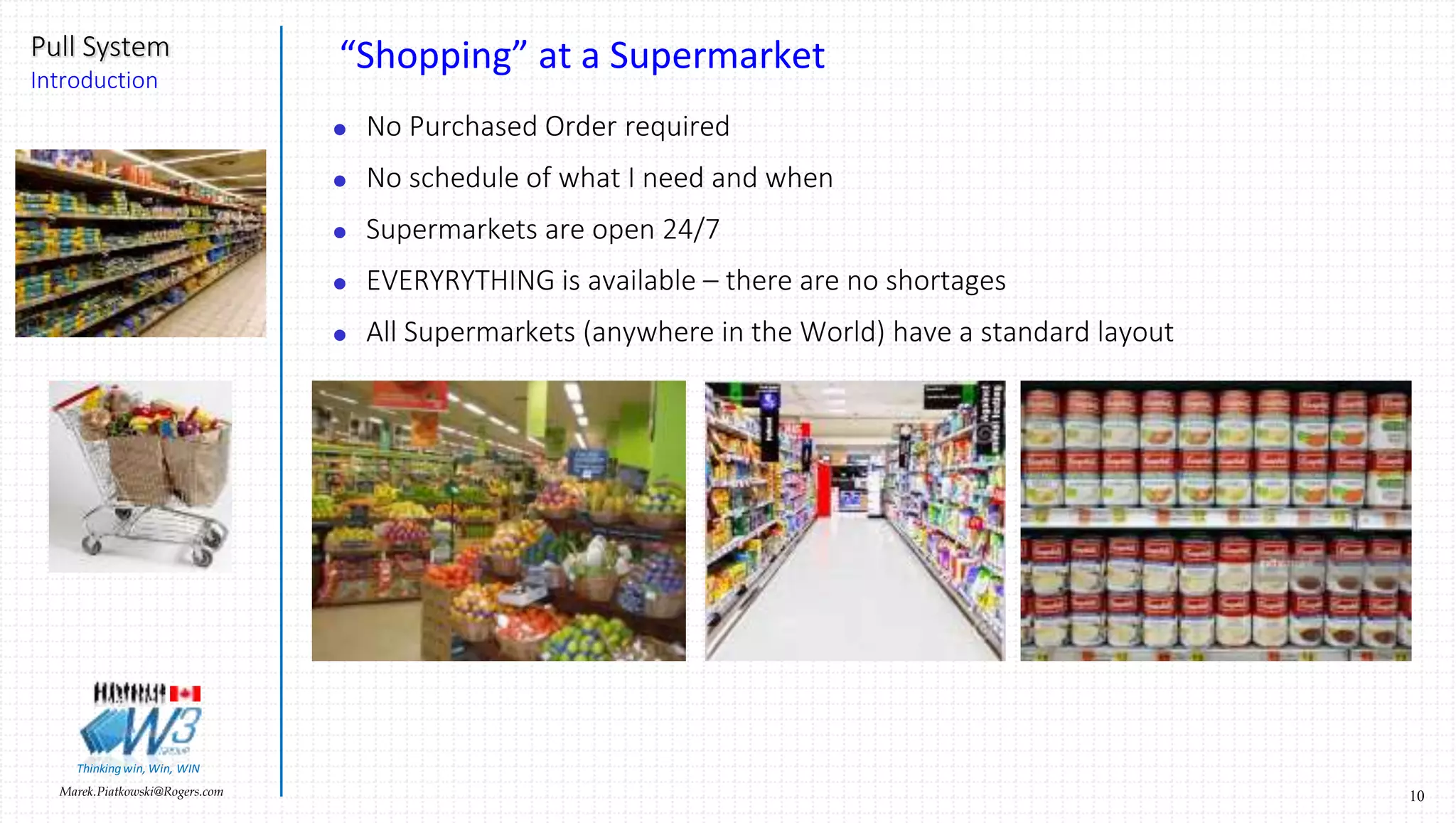
“Shopping” at a Supermarket
 No Purchased Order required
 No schedule of what I need and when
 Supermarkets are open 24/7
 EVERYRYTHING is available – there are no shortages
 All Supermarkets (anywhere in the World) have a standard layout
11Marek.Piatkowski@Rogers.com
Pull System
Introduction
Thinkingwin, Win, WIN
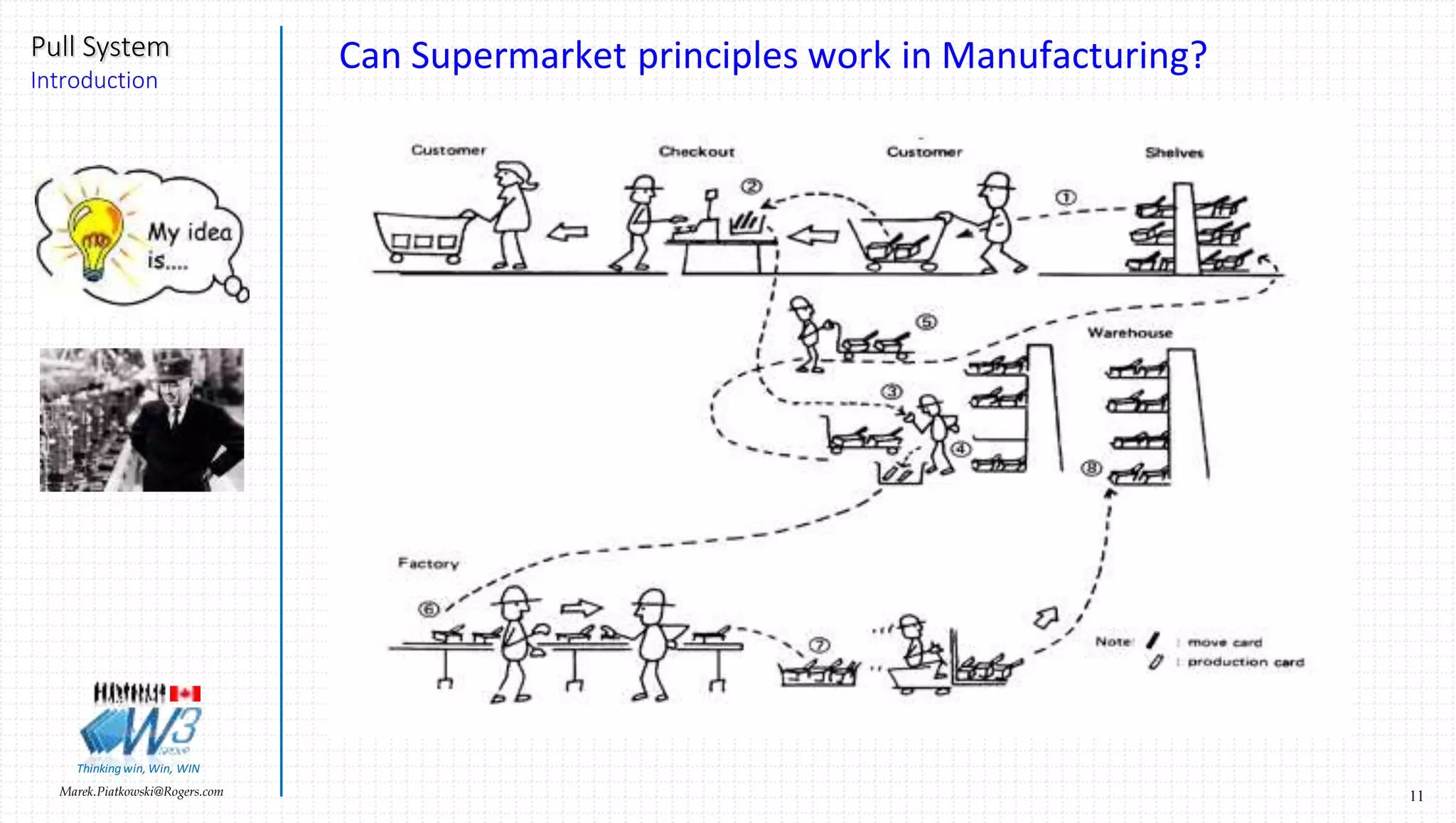
Can Supermarket principles work in Manufacturing?
12Marek.Piatkowski@Rogers.com
Pull System
Introduction
Thinkingwin, Win, WIN
Scheduling Production – Traditional vs Pull
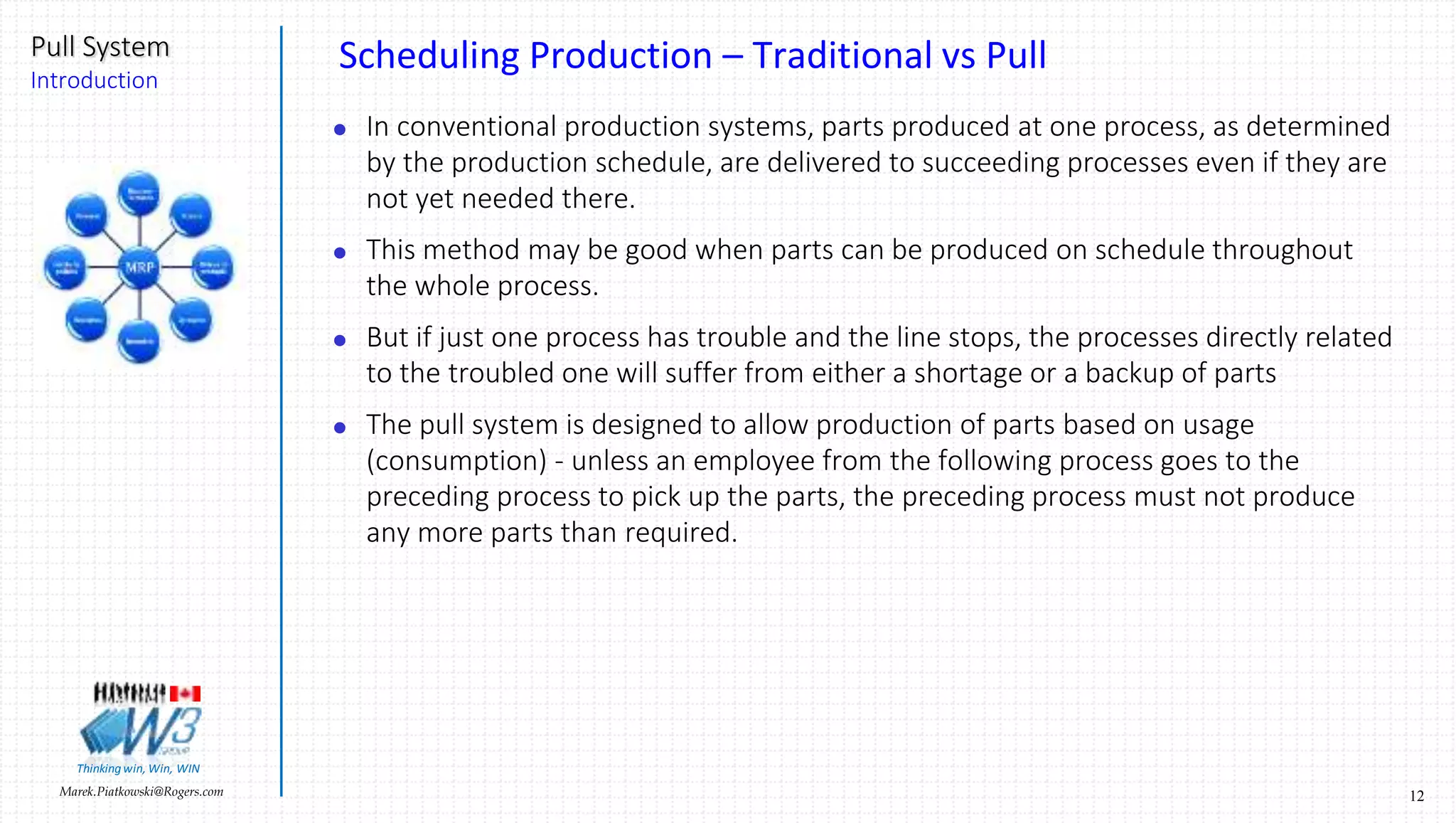
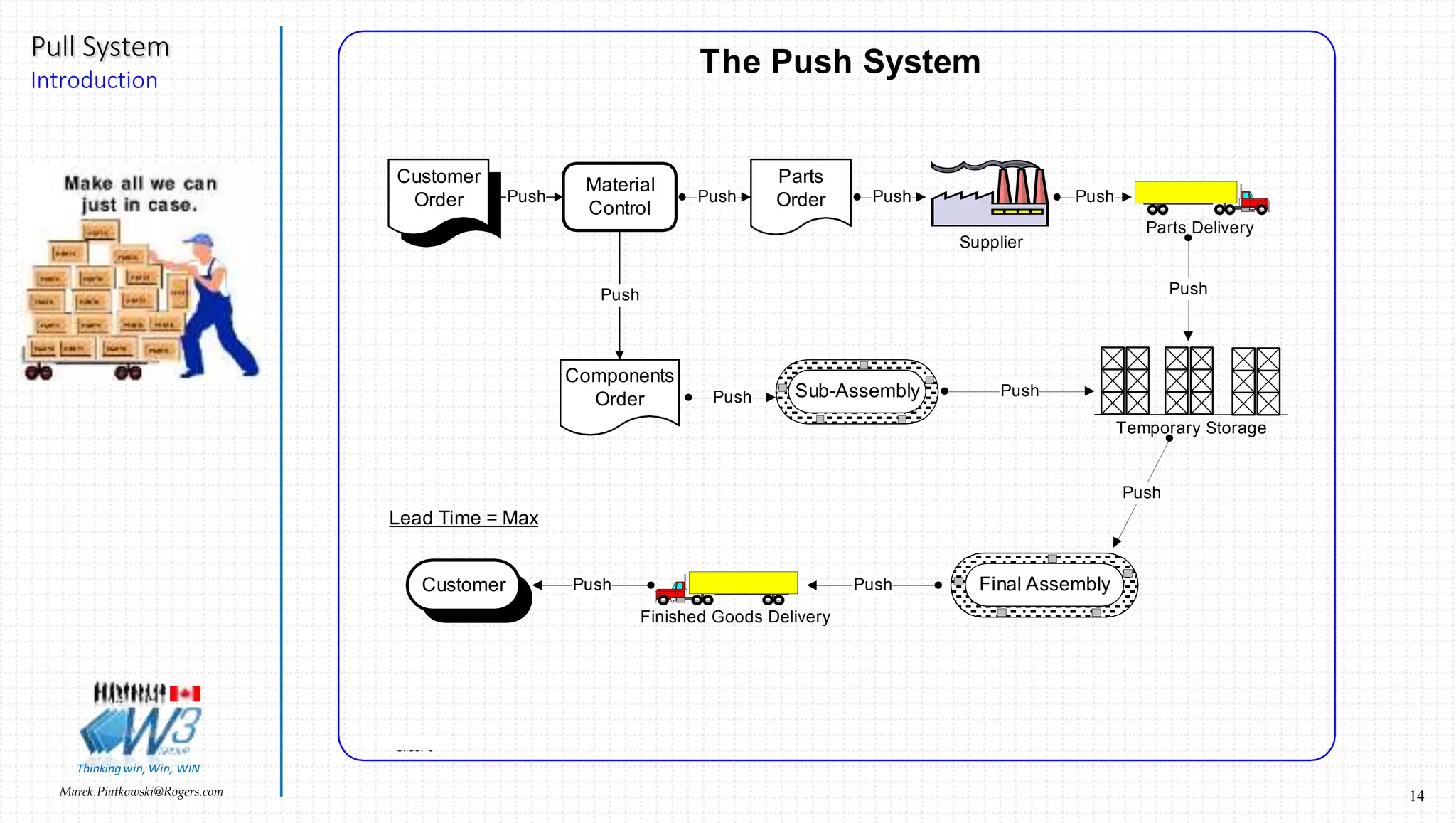
 In conventional production systems, parts produced at one process, as determined
by the production schedule, are delivered to succeeding processes even if they are
not yet needed there.
 This method may be good when parts can be produced on schedule throughout
the whole process.
 But if just one process has trouble and the line stops, the processes directly related
to the troubled one will suffer from either a shortage or a backup of parts
 The pull system is designed to allow production of parts based on usage
(consumption) - unless an employee from the following process goes to the
preceding process to pick up the parts, the preceding process must not produce
any more parts than required.
13Marek.Piatkowski@Rogers.com
Pull System
Introduction
Thinkingwin, Win, WIN
Production Schedule Changes
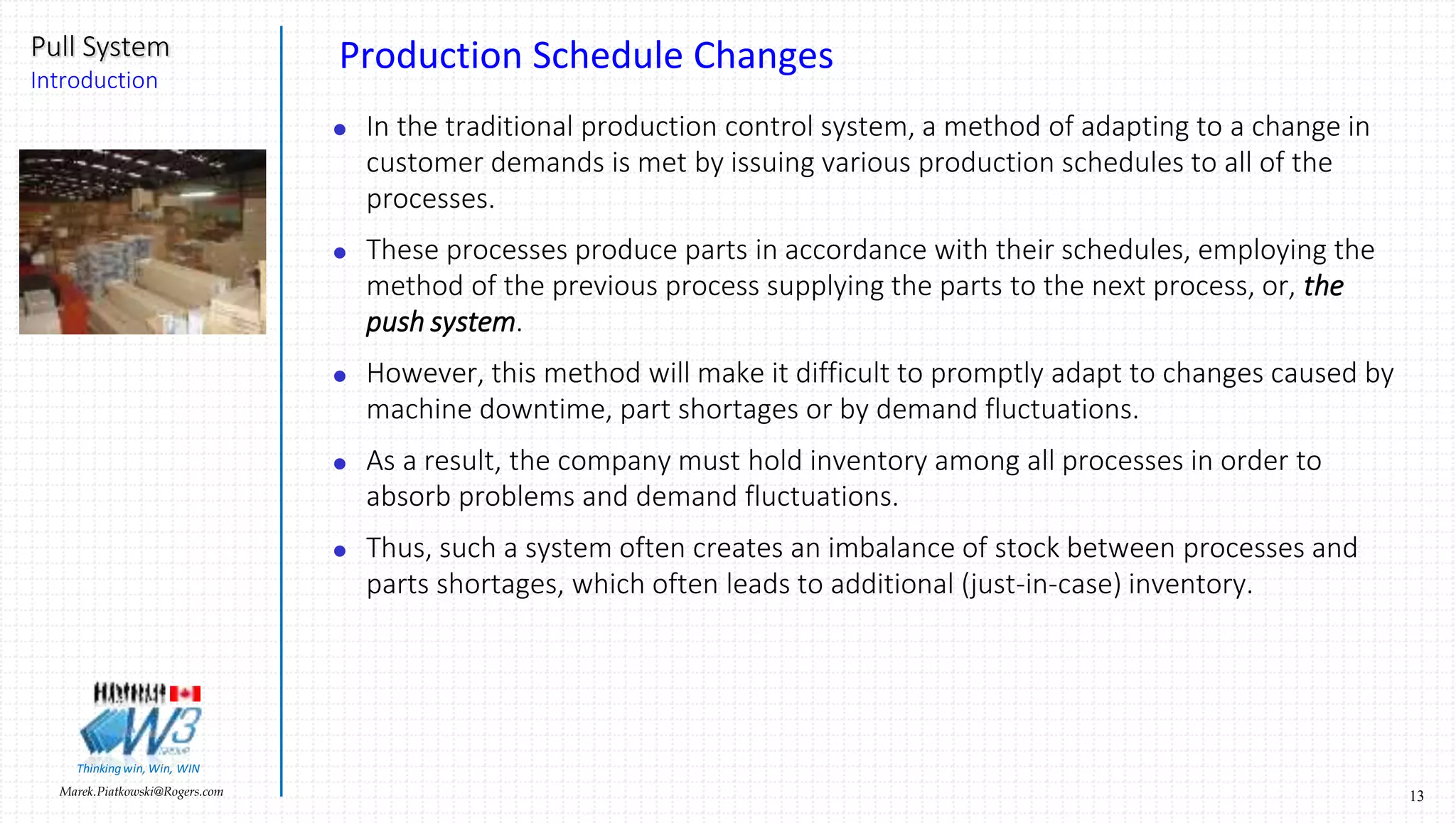
 In the traditional production control system, a method of adapting to a change in
customer demands is met by issuing various production schedules to all of the
processes.
 These processes produce parts in accordance with their schedules, employing the
method of the previous process supplying the parts to the next process, or, the
push system.
 However, this method will make it difficult to promptly adapt to changes caused by
machine downtime, part shortages or by demand fluctuations.
 As a result, the company must hold inventory among all processes in order to
absorb problems and demand fluctuations.
 Thus, such a system often creates an imbalance of stock between processes and
parts shortages, which often leads to additional (just-in-case) inventory.
14Marek.Piatkowski@Rogers.com
Pull System
Introduction
Thinkingwin, Win, WIN
The Push System
Slide: 5
Material
Control
Customer
Order Push
Push
Push
Parts
Order Push
Components
Order
Push
Supplier
Parts Delivery
Temporary Storage
Push
Sub-AssemblyPush Push
Final Assembly
Push
Customer Push
Finished Goods Delivery
Push
Lead Time = Max
15Marek.Piatkowski@Rogers.com
Pull System
Introduction
Thinkingwin, Win, WIN
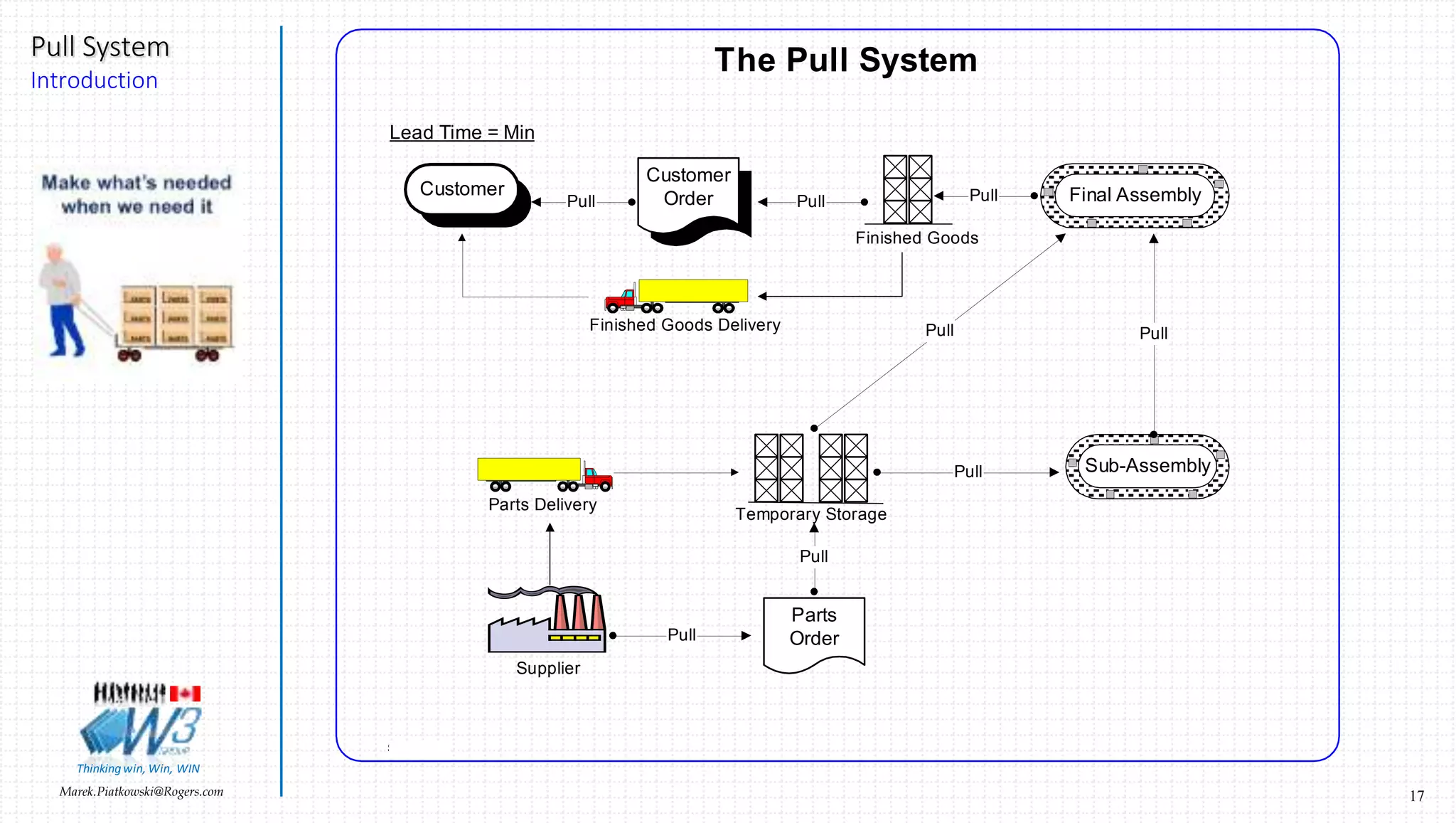
Pull System
 In a traditional operation Production Scheduling department generates
Information by issuing schedules to all departments to produce and to move
material.
 Toyota reversed that process. At Toyota only material movement generates
Information Flow - A Pull Signal (Kanban).
 When parts are “pulled” from the Supermarket, a signal (Kanban) is sent to the
supplying process to produce more.
 Schedule is issued only to the Pacemaker process.
 This is called a Pull System.
16Marek.Piatkowski@Rogers.com
Pull System
Introduction
Thinkingwin, Win, WIN
Pull System
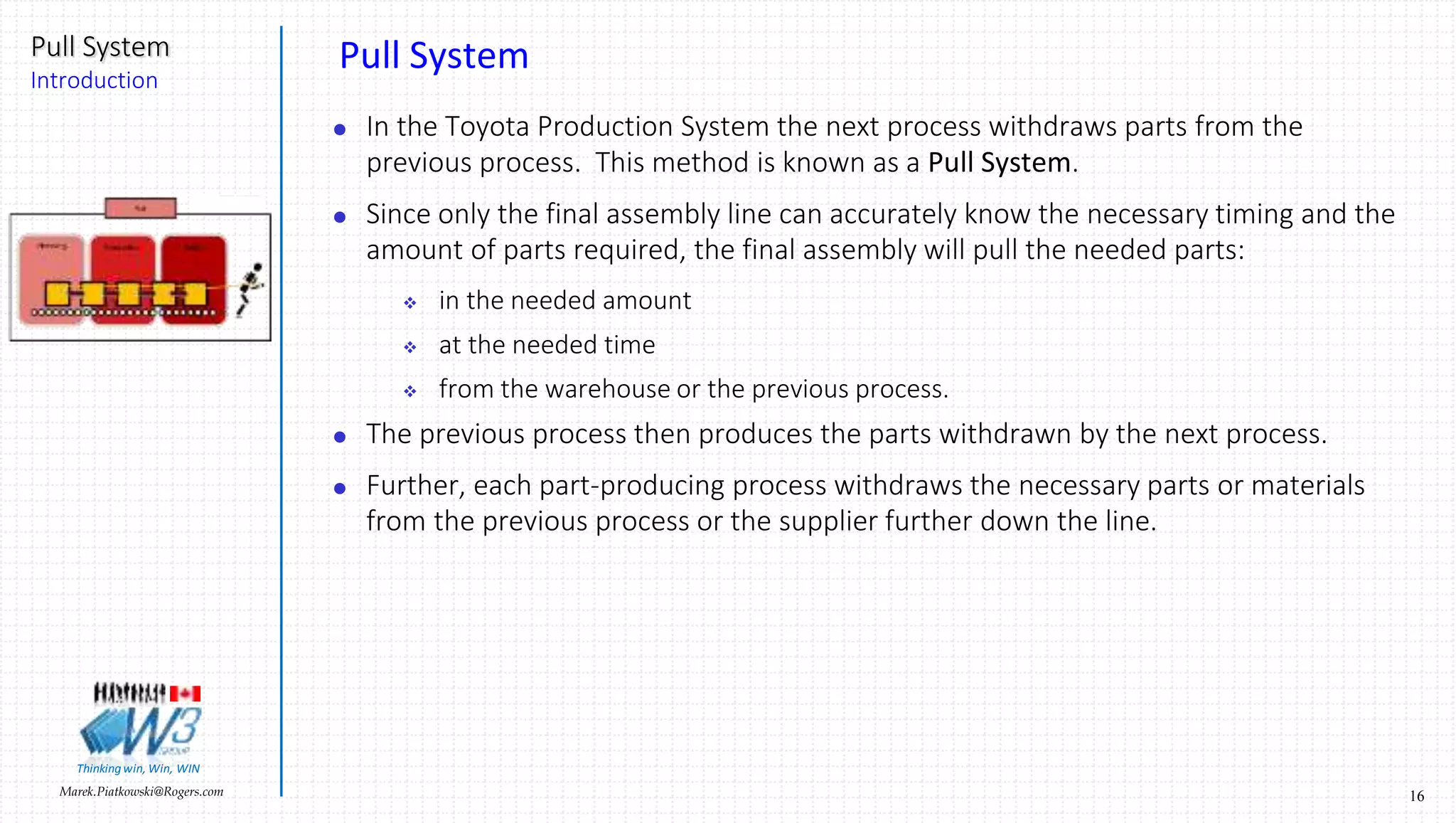
 In the Toyota Production System the next process withdraws parts from the
previous process. This method is known as a Pull System.
 Since only the final assembly line can accurately know the necessary timing and the
amount of parts required, the final assembly will pull the needed parts:
 in the needed amount
 at the needed time
 from the warehouse or the previous process.
 The previous process then produces the parts withdrawn by the next process.
 Further, each part-producing process withdraws the necessary parts or materials
from the previous process or the supplier further down the line.
17Marek.Piatkowski@Rogers.com
Pull System
Introduction
Thinkingwin, Win, WIN
The Pull System
Slide: 6
Customer
Order Pull
Parts
Order
Supplier
Parts Delivery
Sub-Assembly
Final AssemblyCustomer
Finished Goods Delivery
PullPull
Pull
Pull
Pull
Pull
Lead Time = Min
Finished Goods
Pull
Temporary Storage
18Marek.Piatkowski@Rogers.com
Pull System
Introduction
Thinkingwin, Win, WIN
Advantages of a Pull System
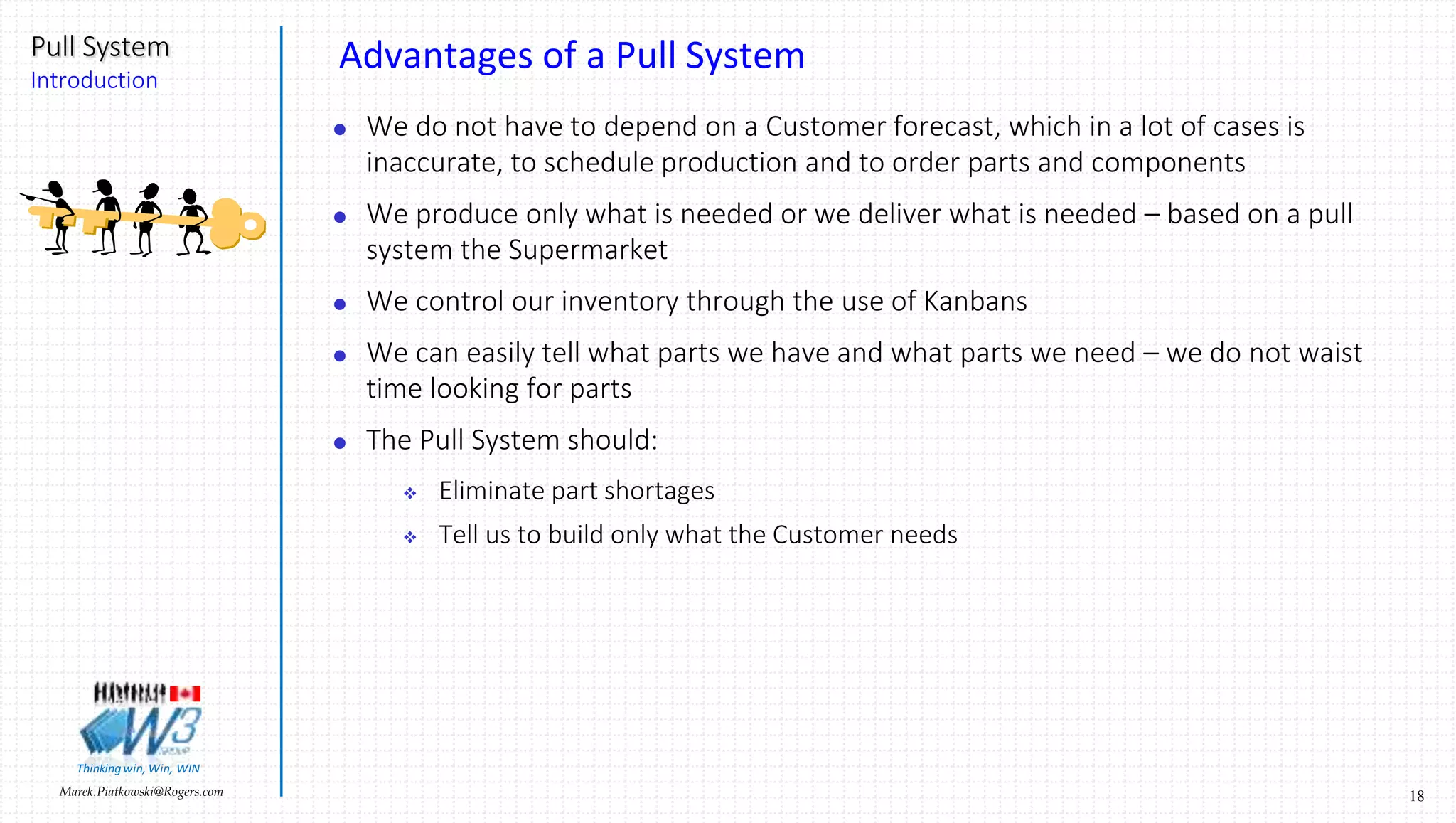
 We do not have to depend on a Customer forecast, which in a lot of cases is
inaccurate, to schedule production and to order parts and components
 We produce only what is needed or we deliver what is needed – based on a pull
system the Supermarket
 We control our inventory through the use of Kanbans
 We can easily tell what parts we have and what parts we need – we do not waist
time looking for parts
 The Pull System should:
 Eliminate part shortages
 Tell us to build only what the Customer needs
19Marek.Piatkowski@Rogers.com
Pull System
Introduction
Thinkingwin, Win, WIN
What is a
Pull System?
20Marek.Piatkowski@Rogers.com
Pull System
Introduction
Thinkingwin, Win, WIN
Kanban
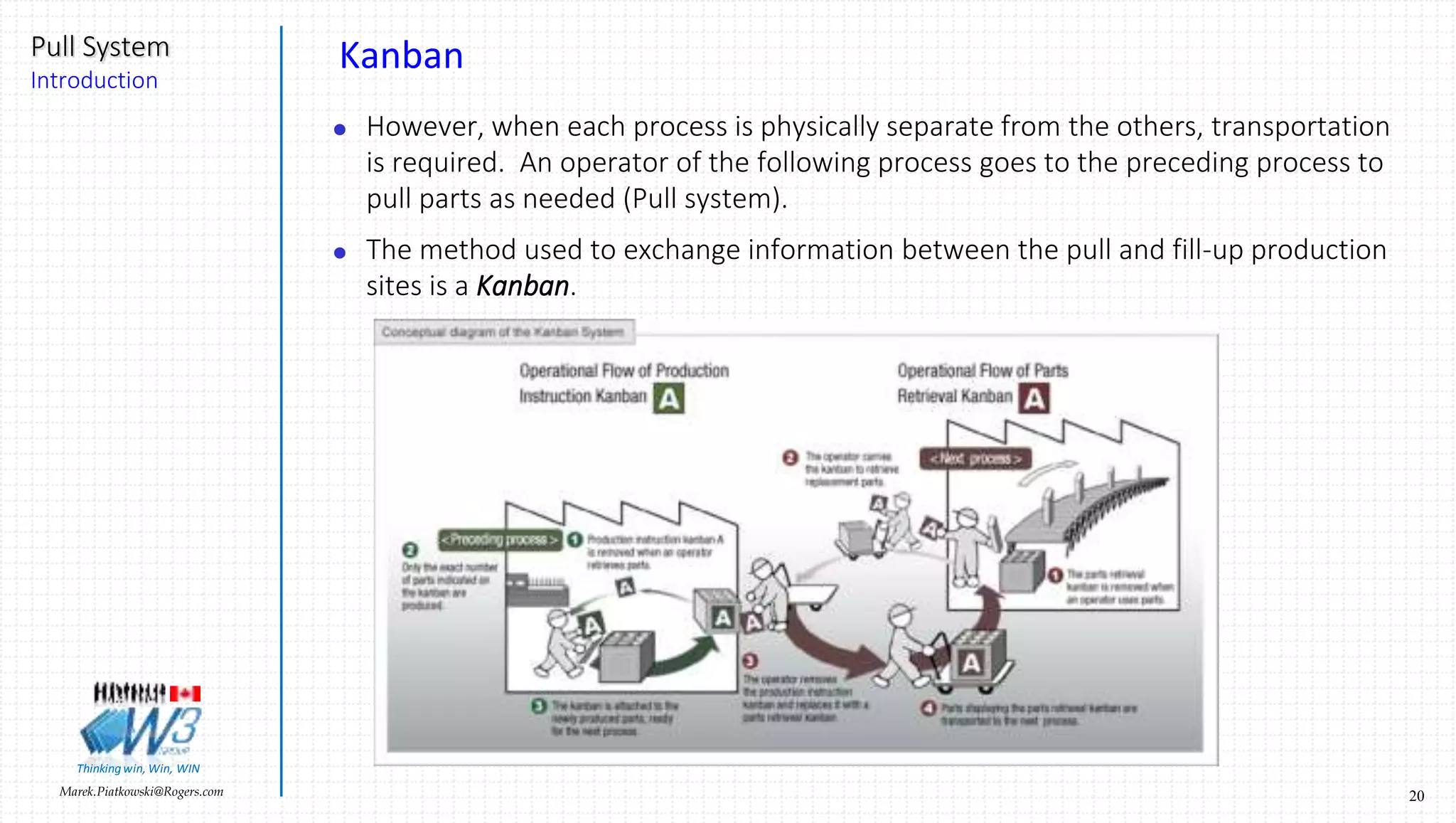
 However, when each process is physically separate from the others, transportation
is required. An operator of the following process goes to the preceding process to
pull parts as needed (Pull system).
 The method used to exchange information between the pull and fill-up production
sites is a Kanban.
21Marek.Piatkowski@Rogers.com
Pull System
Introduction
Thinkingwin, Win, WIN
Changing the World. One Transformation at a time
This presentation is an intellectual property of W3 Group Canada Inc.
No parts of this document can be copied or reproduced
without written permission from:
Marek Piatkowski
W3 Group Canada Inc.
iPhone: 416-235-2631
Cell: 248-207-0416
Marek.Piatkowski@rogers.com
http://twi-network.com
22Marek.Piatkowski@Rogers.com
Pull System
Introduction
Thinkingwin, Win, WIN
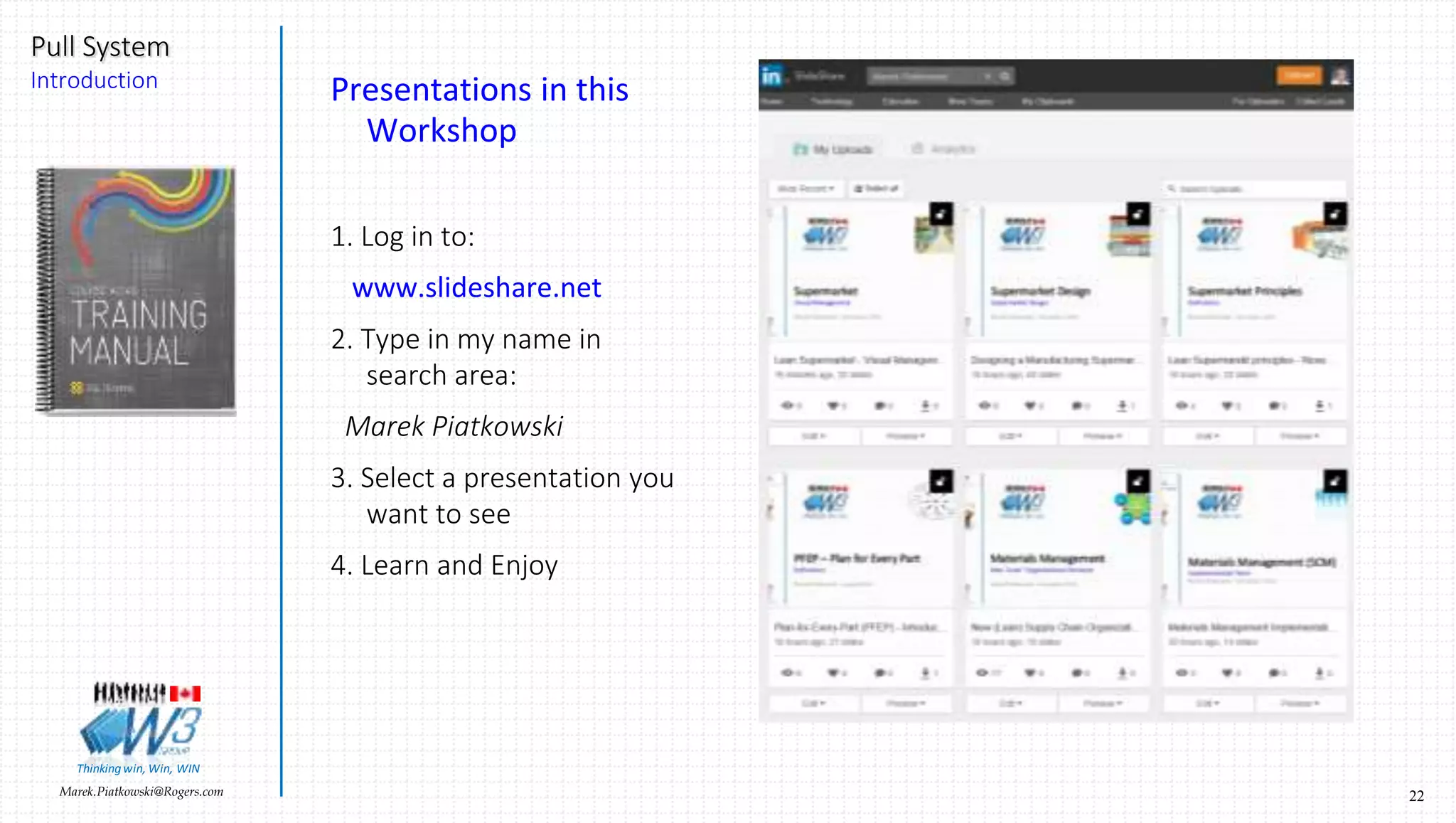
Presentations in this
Workshop
1. Log in to:
www.slideshare.net
2. Type in my name in
search area:
Marek Piatkowski
3. Select a presentation you
want to see
4. Learn and Enjoy

Introduction to Pull system - November 2016