Arif Rahman – The Production Systems 1
Slide 13
Pull System
Arif Rahman
Arif Rahman – The Production Systems
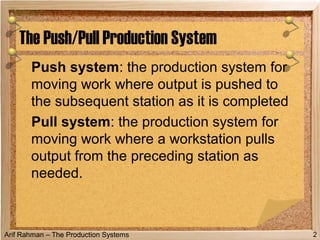
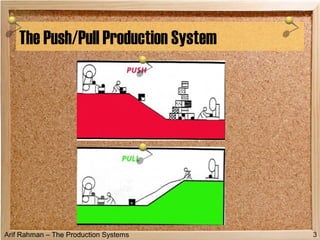
Push system: the production system for
moving work where output is pushed to
the subsequent station as it is completed
Pull system: the production system for
moving work where a workstation pulls
output from the preceding station as
needed.
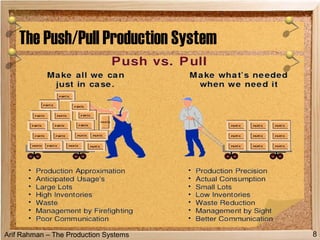
The Push/Pull Production System
2
Arif Rahman – The Production Systems
The Push/Pull Production System
3
Arif Rahman – The Production Systems
The Push/Pull Production System
4
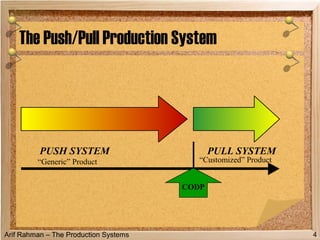
PUSH SYSTEM PULL SYSTEM
“Generic” Product “Customized” Product
CODP
Arif Rahman – The Production Systems
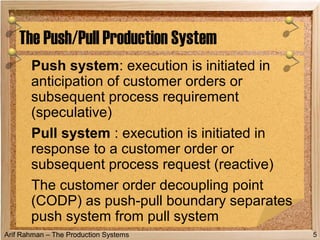
Push system: execution is initiated in
anticipation of customer orders or
subsequent process requirement
(speculative)
Pull system : execution is initiated in
response to a customer order or
subsequent process request (reactive)
The customer order decoupling point
(CODP) as push-pull boundary separates
push system from pull system
The Push/Pull Production System
5
Arif Rahman – The Production Systems
The Push/Pull Production System
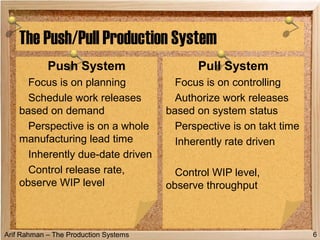
Push System
Focus is on planning
Schedule work releases
based on demand
Perspective is on a whole
manufacturing lead time
Inherently due-date driven
Control release rate,
observe WIP level
Pull System
Focus is on controlling
Authorize work releases
based on system status
Perspective is on takt time
Inherently rate driven
Control WIP level,
observe throughput
6
Arif Rahman – The Production Systems
The Push/Pull Production System
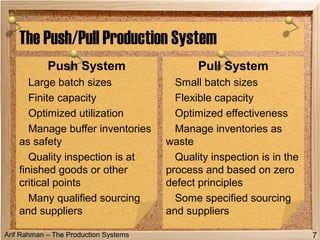
Push System
Large batch sizes
Finite capacity
Optimized utilization
Manage buffer inventories
as safety
Quality inspection is at
finished goods or other
critical points
Many qualified sourcing
and suppliers
Pull System
Small batch sizes
Flexible capacity
Optimized effectiveness
Manage inventories as
waste
Quality inspection is in the
process and based on zero
defect principles
Some specified sourcing
and suppliers
7
Arif Rahman – The Production Systems
The Push/Pull Production System
8
Arif Rahman – The Production Systems
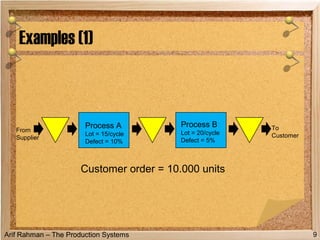
Examples (1)
9
From
Supplier
To
Customer
Process A
Lot = 15/cycle
Defect = 10%
Process B
Lot = 20/cycle
Defect = 5%
Customer order = 10.000 units
Arif Rahman – The Production Systems
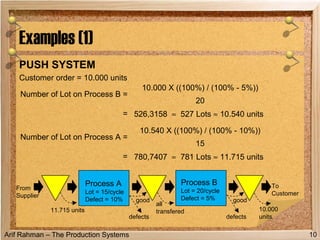
PUSH SYSTEM
Customer order = 10.000 units
Examples (1)
10
From
Supplier
To
Customer
Process A
Lot = 15/cycle
Defect = 10%
Process B
Lot = 20/cycle
Defect = 5%
Number of Lot on Process B =
10.000 X ((100%) / (100% - 5%))
20
= 526,3158 ≈ 527 Lots ≈ 10.540 units
Number of Lot on Process A =
10.540 X ((100%) / (100% - 10%))
15
= 780,7407 ≈ 781 Lots ≈ 11.715 units
11.715 units
defects
good
defects
good
10.000
units
all
transfered
Arif Rahman – The Production Systems
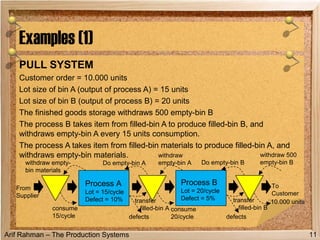
PULL SYSTEM
Customer order = 10.000 units
Lot size of bin A (output of process A) = 15 units
Lot size of bin B (output of process B) = 20 units
The finished goods storage withdraws 500 empty-bin B
The process B takes item from filled-bin A to produce filled-bin B, and
withdraws empty-bin A every 15 units consumption.
The process A takes item from filled-bin materials to produce filled-bin A, and
withdraws empty-bin materials.
Examples (1)
11
From
Supplier
To
Customer
Process A
Lot = 15/cycle
Defect = 10%
Process B
Lot = 20/cycle
Defect = 5%
defects defects
transfer
filled-bin B
10.000 units
consume
20/cycle
transfer
filled-bin Aconsume
15/cycle
Do empty-bin BDo empty-bin A
withdraw 500
empty-bin B
withdraw
empty-bin Awithdraw empty-
bin materials
Arif Rahman – The Production Systems
Pull System
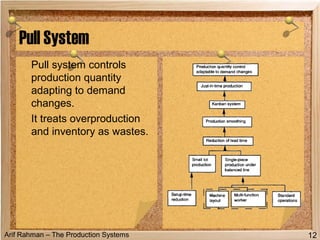
Pull system controls
production quantity
adapting to demand
changes.
It treats overproduction
and inventory as wastes.
12
Arif Rahman – The Production Systems
In the pull system, it is necessary to look at the
production flow conversely.
The people of a certain process go to the
preceding process to withdraw the necessary
units in the necessary quantities at the
necessary time.
The preceding process produces only enough
units to replace those that have been withdrawn.
Pull System
13
Arif Rahman – The Production Systems
There are two types of withdrawal methods:
The later replenishment system (Ato-Hoju
あとほじ ). It is a method of using a Kanban. The
kanban with an empty box will withdraw another
box filled with parts.
The sequenced withdrawal system (Junjo-
Biki 順序引き ). It provides a sequence schedule
for many varieties of finished parts to withdraw
various parts in a sequence conforming to its
sequence schedule for mixed model assembly
line.
Pull System
14
Arif Rahman – The Production Systems
The Later Replenishment System
(Ato-Hoju あとほじ ) and
Kanban ( 看板 )
15
Arif Rahman – The Production Systems
Kanban ( 看板 ) is a signal card applied for
replenishment scheduling by production or
procurement in lean manufacturing.
Two kinds are mainly used: the withdrawal
Kanban and the production-ordering Kanban.
A withdrawal Kanban details the quantity which
the subsequent process should withdraw,
A production-ordering Kanban shows the
quantity which the preceding process must
produce.
Kanban - 看板
16
Arif Rahman – The Production Systems
Kanban - 看板
17
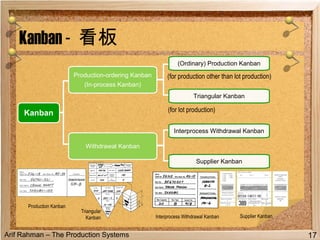
Production-ordering Kanban
(In-process Kanban)
(Ordinary) Production Kanban
Kanban
Withdrawal Kanban
Triangular Kanban
Interprocess Withdrawal Kanban
Supplier Kanban
(for production other than lot production)
(for lot production)
Production Kanban
Interprocess Withdrawal Kanban Supplier Kanban
Triangular
Kanban
Arif Rahman – The Production Systems
Flow of Kanban
18
Arif Rahman – The Production Systems
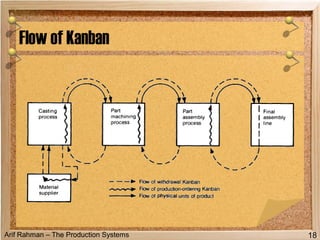
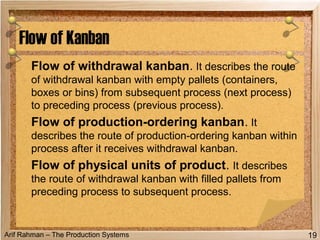
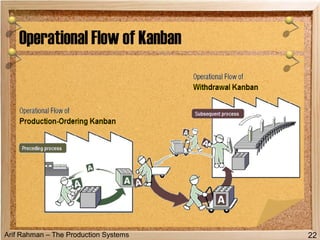
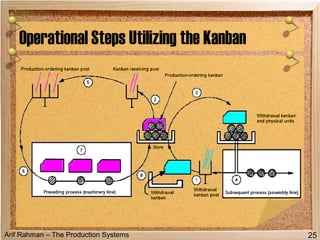
Flow of withdrawal kanban. It describes the route
of withdrawal kanban with empty pallets (containers,
boxes or bins) from subsequent process (next process)
to preceding process (previous process).
Flow of production-ordering kanban. It
describes the route of production-ordering kanban within
process after it receives withdrawal kanban.
Flow of physical units of product. It describes
the route of withdrawal kanban with filled pallets from
preceding process to subsequent process.
Flow of Kanban
19
Arif Rahman – The Production Systems
Express Kanban. An express Kanban is issued
when there is a shortage of a part.
Emergency Kanban. An emergency Kanban
will be issued temporarily when some inventory
is required to make up for defective units,
machine troubles, extra insertions, or a spurt in
a weekend operation.
Job-Order Kanban. A job-order Kanban is
prepared for a job-order production line and is
issued for each job order.
Other Type of Kanban
20
Arif Rahman – The Production Systems
Through Kanban. a through Kanban (or tunnel
Kanban) can be used in those machining lines
where each piece of a product produced at a line
can be conveyed immediately to the next line by
a chute one at a time.
Common Kanban. A withdrawal Kanban can
also be used as a production-ordering Kanban if
the distance between two processes is very
short and one supervisor is supervising both
processes.
Other Type of Kanban
21
Arif Rahman – The Production Systems
Operational Flow of Kanban
22
Arif Rahman – The Production Systems
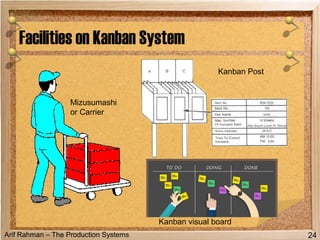
Mizusumashi ( ミズスマシ ) or whirligig beetle
is a carrier who travels between preceding
processes and subsequent processes again and
again at regular predetermined times.
Kanban post is a rack that collects empty
kanban that will trigger next operations.
Kanban visual board ( 看板图 ) is a board that
informs kanban states at the preceding process.
Facilities on Kanban System
23
Arif Rahman – The Production Systems
Facilities on Kanban System
24
Mizusumashi
or Carrier
Kanban Post
Kanban visual board
Arif Rahman – The Production Systems
Operational Steps Utilizing the Kanban
25
Arif Rahman – The Production Systems
Operational Steps Utilizing the Kanban
26
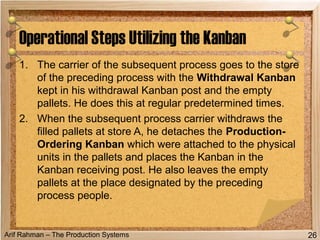
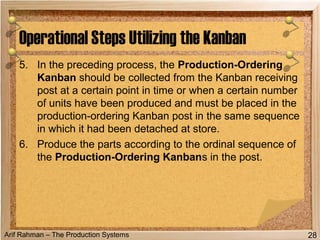
1. The carrier of the subsequent process goes to the store
of the preceding process with the Withdrawal Kanban
kept in his withdrawal Kanban post and the empty
pallets. He does this at regular predetermined times.
2. When the subsequent process carrier withdraws the
filled pallets at store A, he detaches the Production-
Ordering Kanban which were attached to the physical
units in the pallets and places the Kanban in the
Kanban receiving post. He also leaves the empty
pallets at the place designated by the preceding
process people.
Arif Rahman – The Production Systems
Operational Steps Utilizing the Kanban
27
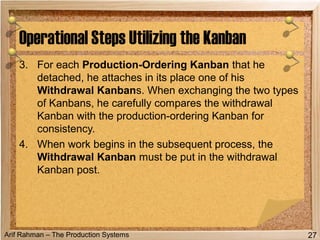
3. For each Production-Ordering Kanban that he
detached, he attaches in its place one of his
Withdrawal Kanbans. When exchanging the two types
of Kanbans, he carefully compares the withdrawal
Kanban with the production-ordering Kanban for
consistency.
4. When work begins in the subsequent process, the
Withdrawal Kanban must be put in the withdrawal
Kanban post.
Arif Rahman – The Production Systems
Operational Steps Utilizing the Kanban
28
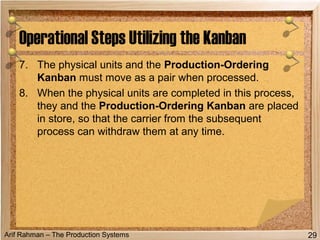
5. In the preceding process, the Production-Ordering
Kanban should be collected from the Kanban receiving
post at a certain point in time or when a certain number
of units have been produced and must be placed in the
production-ordering Kanban post in the same sequence
in which it had been detached at store.
6. Produce the parts according to the ordinal sequence of
the Production-Ordering Kanbans in the post.
Arif Rahman – The Production Systems
Operational Steps Utilizing the Kanban
29
7. The physical units and the Production-Ordering
Kanban must move as a pair when processed.
8. When the physical units are completed in this process,
they and the Production-Ordering Kanban are placed
in store, so that the carrier from the subsequent
process can withdraw them at any time.
Arif Rahman – The Production Systems
Triangular Kanban
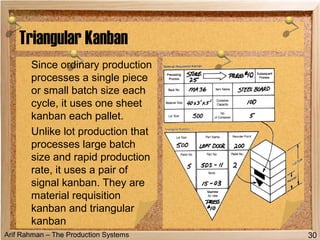
Since ordinary production
processes a single piece
or small batch size each
cycle, it uses one sheet
kanban each pallet.
Unlike lot production that
processes large batch
size and rapid production
rate, it uses a pair of
signal kanban. They are
material requisition
kanban and triangular
kanban
30
Arif Rahman – The Production Systems
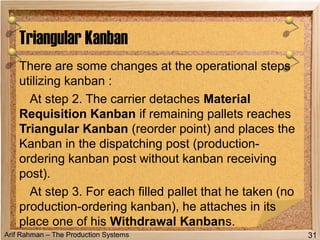
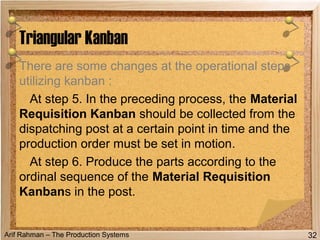
There are some changes at the operational steps
utilizing kanban :
At step 2. The carrier detaches Material
Requisition Kanban if remaining pallets reaches
Triangular Kanban (reorder point) and places the
Kanban in the dispatching post (production-
ordering kanban post without kanban receiving
post).
At step 3. For each filled pallet that he taken (no
production-ordering kanban), he attaches in its
place one of his Withdrawal Kanbans.
Triangular Kanban
31
Arif Rahman – The Production Systems
There are some changes at the operational steps
utilizing kanban :
At step 5. In the preceding process, the Material
Requisition Kanban should be collected from the
dispatching post at a certain point in time and the
production order must be set in motion.
At step 6. Produce the parts according to the
ordinal sequence of the Material Requisition
Kanbans in the post.
Triangular Kanban
32
Arif Rahman – The Production Systems
There are some changes at the operational steps
utilizing kanban :
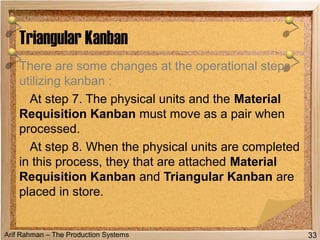
At step 7. The physical units and the Material
Requisition Kanban must move as a pair when
processed.
At step 8. When the physical units are completed
in this process, they that are attached Material
Requisition Kanban and Triangular Kanban are
placed in store.
Triangular Kanban
33
Arif Rahman – The Production Systems
If the manufacturer applied the Kanban system
to its vendors without changing its own
production systems, the Kanban system would
be a demon to the vendors.
If the paternal manufacturer withdraws parts with
large variance in terms of quantity or timing, the
suppliers must necessarily prepare slack
capacities of manpower, facility, and inventory.
The suppliers would suffer if the paternal
manufacturer ordered parts in a fluctuating
manner.
Supplier Kanban
34
Arif Rahman – The Production Systems
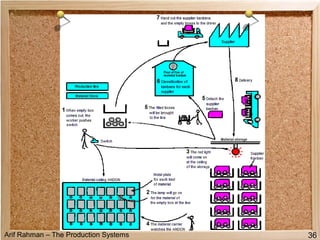
There two kinds of information to its suppliers:
A predetermined monthly production plan, which
is communicated to the supplier in the middle of
the preceding month.
A daily information, which specifies the actual
number of units to be supplied. It takes on two
different forms: a Kanban or a sequence schedule
table.
Supplier Kanban
35
Arif Rahman – The Production Systems 36
Arif Rahman – The Production Systems
Supplier Kanban
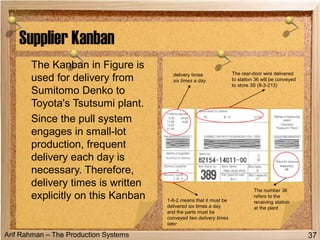
The Kanban in Figure is
used for delivery from
Sumitomo Denko to
Toyota's Tsutsumi plant.
Since the pull system
engages in small-lot
production, frequent
delivery each day is
necessary. Therefore,
delivery times is written
explicitly on this Kanban
37
The number 36
refers to the
receiving station
at the plant
1-6-2 means that it must be
delivered six times a day
and the parts must be
conveyed two delivery times
later
delivery times
six times a day
The rear-door wire delivered
to station 36 will be conveyed
to store 3S (8-3-213)
Arif Rahman – The Production Systems
Supplier Kanban
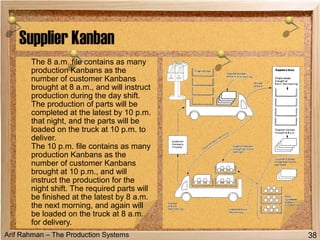
The 8 a.m. file contains as many
production Kanbans as the
number of customer Kanbans
brought at 8 a.m., and will instruct
production during the day shift.
The production of parts will be
completed at the latest by 10 p.m.
that night, and the parts will be
loaded on the truck at 10 p.m. to
deliver.
The 10 p.m. file contains as many
production Kanbans as the
number of customer Kanbans
brought at 10 p.m., and will
instruct the production for the
night shift. The required parts will
be finished at the latest by 8 a.m.
the next morning, and again will
be loaded on the truck at 8 a.m.
for delivery.
38
Arif Rahman – The Production Systems
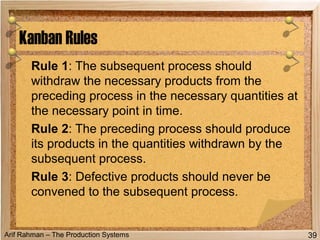
Rule 1: The subsequent process should
withdraw the necessary products from the
preceding process in the necessary quantities at
the necessary point in time.
Rule 2: The preceding process should produce
its products in the quantities withdrawn by the
subsequent process.
Rule 3: Defective products should never be
convened to the subsequent process.
Kanban Rules
39
Arif Rahman – The Production Systems
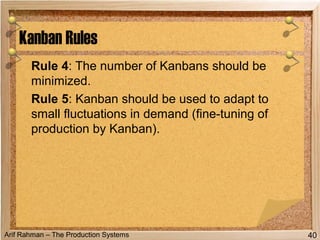
Rule 4: The number of Kanbans should be
minimized.
Rule 5: Kanban should be used to adapt to
small fluctuations in demand (fine-tuning of
production by Kanban).
Kanban Rules
40
Arif Rahman – The Production Systems
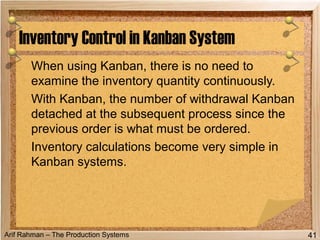
When using Kanban, there is no need to
examine the inventory quantity continuously.
With Kanban, the number of withdrawal Kanban
detached at the subsequent process since the
previous order is what must be ordered.
Inventory calculations become very simple in
Kanban systems.
Inventory Control in Kanban System
41
Arif Rahman – The Production Systems
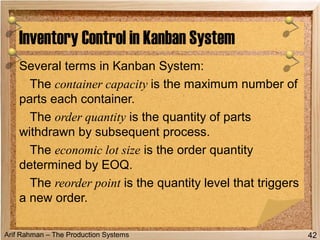
Several terms in Kanban System:
The container capacity is the maximum number of
parts each container.
The order quantity is the quantity of parts
withdrawn by subsequent process.
The economic lot size is the order quantity
determined by EOQ.
The reorder point is the quantity level that triggers
a new order.
Inventory Control in Kanban System
42
Arif Rahman – The Production Systems
Several terms in Kanban System:
The order cycle is the time interval between
instructing a production order to the line and
instructing the next production order.
The lead time is simply the time interval between
placing an order and receiving delivery.
The processing time is the time interval between
placing a production order and completing its
production.
Inventory Control in Kanban System
43
Arif Rahman – The Production Systems
Several terms in Kanban System:
The Kanban collecting time is the time interval
between picking up Kanbans from the post, which
were detached at the subsequent process, and
placing the production order to the preceding
process.
The conveyance time is the time interval to convey
physical units from the preceding process to
subsequent process
Inventory Control in Kanban System
44
Arif Rahman – The Production Systems
Several terms in Kanban System:
The waiting time is the allowance time that spares
for delaying or idling.
The safety coefficient refers to the safety factor in
percentage that is excluded from inventory
availability for various purposes.
The safety inventory period corresponds to the
time interval to keep stock at the store. This
inventory responds to defective products, machine
troubles, etc.
Inventory Control in Kanban System
45
Arif Rahman – The Production Systems
There are two different inventory control systems
in the kanban systems:
The constant quantity, nonconstant cycle
withdrawal system
The constant cycle, nonconstant quantity
withdrawal system
Inventory Control in Kanban System
46
Arif Rahman – The Production Systems
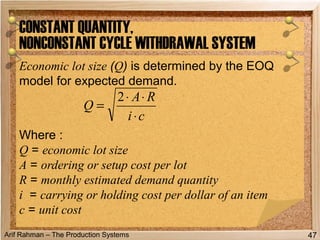
Economic lot size (Q) is determined by the EOQ
model for expected demand.
Where :
Q = economic lot size
A = ordering or setup cost per lot
R = monthly estimated demand quantity
i = carrying or holding cost per dollar of an item
c = unit cost
CONSTANT QUANTITY,
NONCONSTANT CYCLE WITHDRAWAL SYSTEM
47
ci
RA
Q
⋅
⋅⋅
=
2
Arif Rahman – The Production Systems
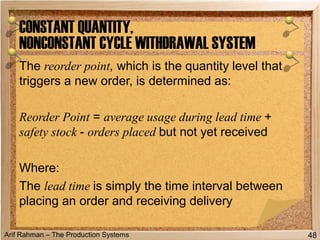
The reorder point, which is the quantity level that
triggers a new order, is determined as:
Reorder Point = average usage during lead time +
safety stock - orders placed but not yet received
Where:
The lead time is simply the time interval between
placing an order and receiving delivery
CONSTANT QUANTITY,
NONCONSTANT CYCLE WITHDRAWAL SYSTEM
48
Arif Rahman – The Production Systems
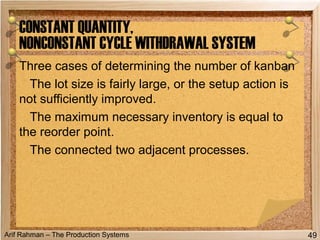
Three cases of determining the number of kanban
The lot size is fairly large, or the setup action is
not sufficiently improved.
The maximum necessary inventory is equal to
the reorder point.
The connected two adjacent processes.
CONSTANT QUANTITY,
NONCONSTANT CYCLE WITHDRAWAL SYSTEM
49
Arif Rahman – The Production Systems
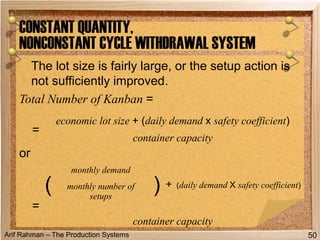
The lot size is fairly large, or the setup action is
not sufficiently improved.
Total Number of Kanban =
or
CONSTANT QUANTITY,
NONCONSTANT CYCLE WITHDRAWAL SYSTEM
50
=
economic lot size + (daily demand x safety coefficient)
container capacity
=
(
monthly demand
) + (daily demand X safety coefficient)monthly number of
setups
container capacity
Arif Rahman – The Production Systems
The lot size is fairly large, or the setup action is
not sufficiently improved.
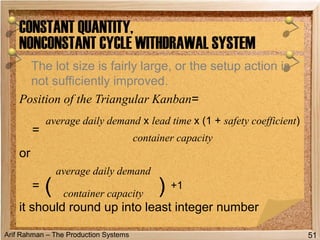
Position of the Triangular Kanban=
or
it should round up into least integer number
CONSTANT QUANTITY,
NONCONSTANT CYCLE WITHDRAWAL SYSTEM
51
=
average daily demand x lead time x (1 + safety coefficient)
container capacity
= (
average daily demand
) +1
container capacity
Arif Rahman – The Production Systems
The maximum necessary inventory is equal to
the reorder point.
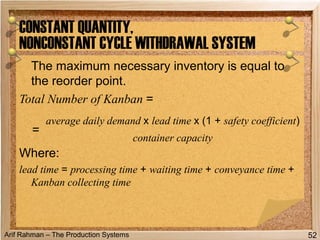
Total Number of Kanban =
Where:
lead time = processing time + waiting time + conveyance time +
Kanban collecting time
CONSTANT QUANTITY,
NONCONSTANT CYCLE WITHDRAWAL SYSTEM
52
=
average daily demand x lead time x (1 + safety coefficient)
container capacity
Arif Rahman – The Production Systems
The connected two adjacent processes.
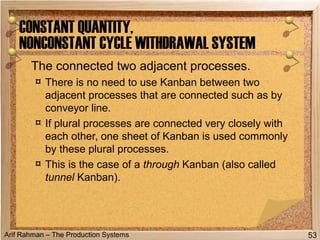
¤ There is no need to use Kanban between two
adjacent processes that are connected such as by
conveyor line.
¤ If plural processes are connected very closely with
each other, one sheet of Kanban is used commonly
by these plural processes.
¤ This is the case of a through Kanban (also called
tunnel Kanban).
CONSTANT QUANTITY,
NONCONSTANT CYCLE WITHDRAWAL SYSTEM
53
Arif Rahman – The Production Systems
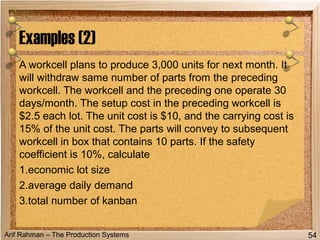
A workcell plans to produce 3,000 units for next month. It
will withdraw same number of parts from the preceding
workcell. The workcell and the preceding one operate 30
days/month. The setup cost in the preceding workcell is
$2.5 each lot. The unit cost is $10, and the carrying cost is
15% of the unit cost. The parts will convey to subsequent
workcell in box that contains 10 parts. If the safety
coefficient is 10%, calculate
1.economic lot size
2.average daily demand
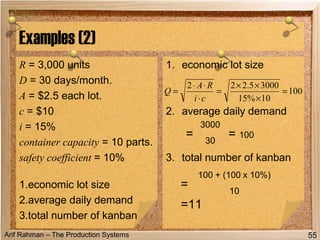
3.total number of kanban
Examples (2)
54
Arif Rahman – The Production Systems
Examples (2)
R = 3,000 units
D = 30 days/month.
A = $2.5 each lot.
c = $10
i = 15%
container capacity = 10 parts.
safety coefficient = 10%
1.economic lot size
2.average daily demand
3.total number of kanban
1. economic lot size
2. average daily demand
3. total number of kanban
55
100
10%15
30005.222
=
×
××
=
⋅
⋅⋅
=
ci
RA
Q
=
100 + (100 x 10%)
10
=11
=
3000
= 100
30
Arif Rahman – The Production Systems
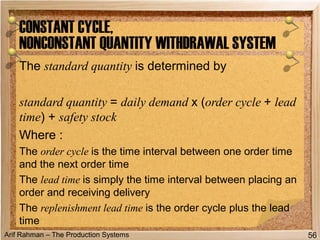
The standard quantity is determined by
standard quantity = daily demand x (order cycle + lead
time) + safety stock
Where :
The order cycle is the time interval between one order time
and the next order time
The lead time is simply the time interval between placing an
order and receiving delivery
The replenishment lead time is the order cycle plus the lead
time
CONSTANT CYCLE,
NONCONSTANT QUANTITY WITHDRAWAL SYSTEM
56
Arif Rahman – The Production Systems
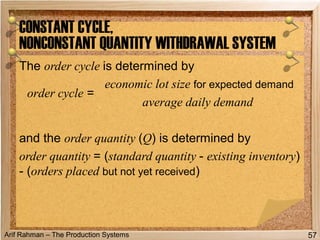
The order cycle is determined by
and the order quantity (Q) is determined by
order quantity = (standard quantity - existing inventory)
- (orders placed but not yet received)
CONSTANT CYCLE,
NONCONSTANT QUANTITY WITHDRAWAL SYSTEM
57
order cycle =
economic lot size for expected demand
average daily demand
Arif Rahman – The Production Systems
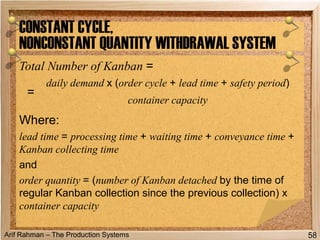
Total Number of Kanban =
Where:
lead time = processing time + waiting time + conveyance time +
Kanban collecting time
and
order quantity = (number of Kanban detached by the time of
regular Kanban collection since the previous collection) x
container capacity
CONSTANT CYCLE,
NONCONSTANT QUANTITY WITHDRAWAL SYSTEM
58
=
daily demand x (order cycle + lead time + safety period)
container capacity
Arif Rahman – The Production Systems
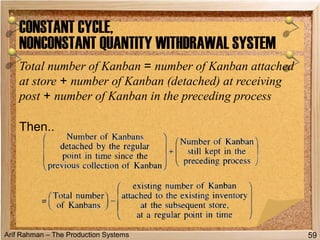
CONSTANT CYCLE,
NONCONSTANT QUANTITY WITHDRAWAL SYSTEM
59
Total number of Kanban = number of Kanban attached
at store + number of Kanban (detached) at receiving
post + number of Kanban in the preceding process
Then..
Arif Rahman – The Production Systems
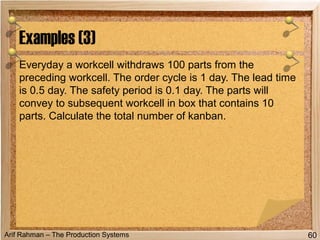
Everyday a workcell withdraws 100 parts from the
preceding workcell. The order cycle is 1 day. The lead time
is 0.5 day. The safety period is 0.1 day. The parts will
convey to subsequent workcell in box that contains 10
parts. Calculate the total number of kanban.
Examples (3)
60
Arif Rahman – The Production Systems
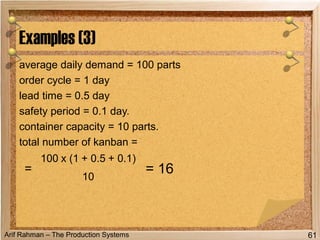
average daily demand = 100 parts
order cycle = 1 day
lead time = 0.5 day
safety period = 0.1 day.
container capacity = 10 parts.
total number of kanban =
Examples (3)
61
=
100 x (1 + 0.5 + 0.1)
= 1610
Arif Rahman – The Production Systems
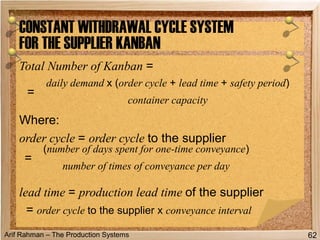
CONSTANT WITHDRAWAL CYCLE SYSTEM
FOR THE SUPPLIER KANBAN
62
Total Number of Kanban =
Where:
order cycle = order cycle to the supplier
lead time = production lead time of the supplier
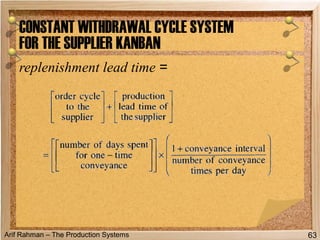
= order cycle to the supplier x conveyance interval
=
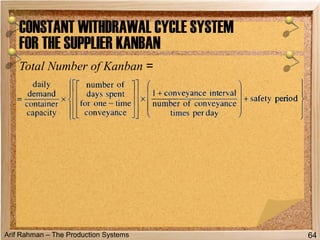
daily demand x (order cycle + lead time + safety period)
container capacity
=
(number of days spent for one-time conveyance)
number of times of conveyance per day
Arif Rahman – The Production Systems
CONSTANT WITHDRAWAL CYCLE SYSTEM
FOR THE SUPPLIER KANBAN
63
replenishment lead time =
Arif Rahman – The Production Systems
CONSTANT WITHDRAWAL CYCLE SYSTEM
FOR THE SUPPLIER KANBAN
64
Total Number of Kanban =
Arif Rahman – The Production Systems
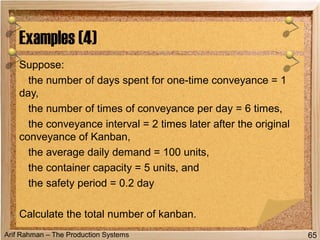
Suppose:
the number of days spent for one-time conveyance = 1
day,
the number of times of conveyance per day = 6 times,
the conveyance interval = 2 times later after the original
conveyance of Kanban,
the average daily demand = 100 units,
the container capacity = 5 units, and
the safety period = 0.2 day
Calculate the total number of kanban.
Examples (4)
65
Arif Rahman – The Production Systems
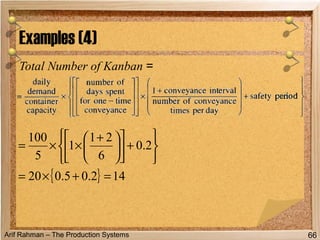
Total Number of Kanban =
Examples (4)
66
{ } 142.05.020
2.0
6
21
1
5
100
=+×=






+










 +
××=
Arif Rahman – The Production Systems
The Sequenced Withdrawal System
(Junjo-Biki 順序引き ) and
Heijunka ( 平準化 )
67
Arif Rahman – The Production Systems
Junjo-biki ( 順序引き ) or Mixed Scheduling
refers to the process of developing one or more
schedules to enable mixed-model production. It
makes different sequence products every day,
according to the daily anticipated demand, to
avoid inventory accumulation.
Junjo-biki - 順序引き
68
Arif Rahman – The Production Systems
There are two phases of the production
smoothing process
Smoothing of the total production quantity
Smoothing of every model's production
quantity.
Production Smoothing Process
69
Arif Rahman – The Production Systems
Smoothing of the total production quantity is
done to minimize the variance in total outputs
between two sequential periods. In short, the
goal of production smoothing is to produce the
same amount of products every period.
Production smoothing allows daily production
volumes to remain constant.
Smoothing of the total production quantity is
meant to level the daily amount of products
flowing as much as possible by anticipating
peaks and valleys in demand.
Smoothing of The Total Production Quantity
70
Arif Rahman – The Production Systems
There are two kinds of waste where the smoothing
is not implemented
Waste arises from uneven periods of demand.
When facilities, people, materials, and other elements are
prepared for peak demand as the standard, but will be
waste during a period of short runs.
Waste occurs between processes. A preceding
process properly prepares its units in quantities
corresponding to the peak quantity withdrawn by the
subsequent process, it follows that excessive works would
occur as waste.
Smoothing of The Total Production Quantity
71
Arif Rahman – The Production Systems
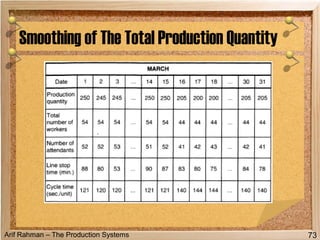
To practice smoothing the total production quantity
without occurrence of waste between processes, the
final assembly line and all processes must produce
products according to the takt time. This means
balancing between processes (synchronization) will be
completely realized if every preceding process finishes
at the same pace within the takt time for all
specifications.
Production capacity plan adapting demand fluctuation.
Adapting to increased demand, the takt time will be
decreased. Adapting to decreased demand, the takt time
will be increased.
Smoothing of The Total Production Quantity
72
Arif Rahman – The Production Systems
Smoothing of The Total Production Quantity
73
Arif Rahman – The Production Systems
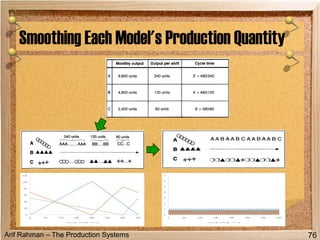
The purpose of smoothing every model's
production quantity is to check variances in the
flow of each product variety between periods
(days).
The aim is to level the quantity of parts
consumed and produced each period because if
great variances existed in the daily consumed
quantity of parts of a specified variety, the
subassembly lines in question would have to
hold huge excess inventories and work force.
Smoothing Each Model's Production Quantity
74
Arif Rahman – The Production Systems
All product varieties can be produced according
to the average cycle time of all varieties as long
as each model's cycle time is considered when
determining the sequence of each model.
Lot (batch) production can cause variances in
the necessary volumes of each subassembly
part.
Many companies are able to achieve smoothing
of production by using a daily production
quantity.
Smoothing Each Model's Production Quantity
75
Arif Rahman – The Production Systems
Smoothing Each Model's Production Quantity
76
Arif Rahman – The Production Systems
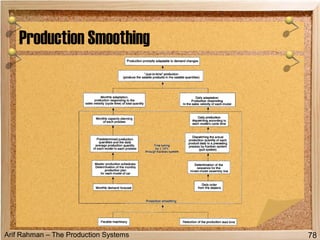
There are two phases of the production smoothing
The first phase shows the adaptation to monthly
demand changes during a year (monthly
adaptation). It will be achieved by monthly
production planning instructing the averaged daily
production level of each process in the plant.
The second phase shows adaptation to daily
demand changes during a month (daily
adaptation). It is made possible by daily production
dispatching.
Production Smoothing
77
Arif Rahman – The Production Systems
Production Smoothing
78
Arif Rahman – The Production Systems
Heijunka ( 平準化 ) refers to smoothed
production. It breakdowns demands into smaller
batches (lot), arrange them into mixed
scheduling, and levels the loads.
Heijunka - 平準化
79
Arif Rahman – The Production Systems
The procedure for designing a mixed-model
assembly line involves the following steps
۞Determination of a cycle time.
۞Computation of a minimum number of processes.
۞Preparation of a diagram of integrated precedence
relationships among elemental jobs.
۞Line balancing.
۞Determination of the sequence schedule for introducing
various products to the line.
۞Determination of the length of the operations range of
each process.
Heijunka - 平準化
80
Arif Rahman – The Production Systems
The goals of the mixed-model assembly line is :
1.Leveling the load (total assembly time) on each
process within the line.
2.Keeping a constant speed in consuming each
part on the line.
Heijunka - 平準化
81
Arif Rahman – The Production Systems
The goals of the mixed-model assembly line is :
1.Leveling the load (total assembly time) on each
process within the line.
2.Keeping a constant speed in consuming each
part on the line.
Heijunka - 平準化
82
Arif Rahman – The Production Systems
The line balancing on the mixed-model line is
made under the condition that the operation time
of each process, which was weighted by each
quantity of mixed models, should not exceed the
cycle time
A product might have a longer operation time
than the predetermined cycle time.
If products with relatively longer operation times
are successively introduced into the line, the
products will cause a delay in completing the
product and may cause line stoppage.
Heijunka – Goal 1: Leveling the load
83
Arif Rahman – The Production Systems
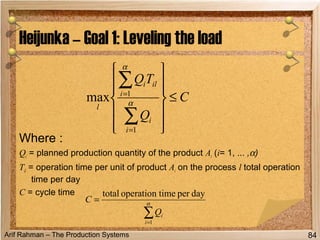
Where :
Qi = planned production quantity of the product Ai (i= 1, ... ,α)
Til = operation time per unit of product Ai on the process l total operation
time per day
C = cycle time
Heijunka – Goal 1: Leveling the load
84
C
Q
TQ
i
i
i
ili
l
≤












∑
∑
=
=
α
α
1
1
max
∑=
= α
1
daypertimeoperationtotal
i
iQ
C
Arif Rahman – The Production Systems
The respective work-in-process inventories must
be minimized. To do so, the quantity used per
hour (Le., consumption speed) for each part in
the mixed-model line must be kept as constant
as possible.
The mixed scheduling or sequencing method is
designed to reach this goal.
There are two sequencing method:
¤ A goal chasing method
¤ A simplified algorithm (goal chasing method II)
Heijunka – Goal 2: Keeping a constant speed
85
Arif Rahman – The Production Systems
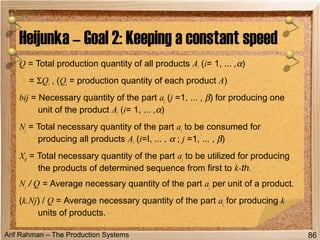
Q = Total production quantity of all products Ai (i= 1, ... ,α)
= ΣQi , (Qi = production quantity of each product A)
bij = Necessary quantity of the part aj (j =1, ... , β) for producing one
unit of the product Ai (i= 1, ... ,α)
Nj = Total necessary quantity of the part aj to be consumed for
producing all products Ai (i=I, ... , α ; j =1, ... , β)
Xjk = Total necessary quantity of the part aj to be utilized for producing
the products of determined sequence from first to k-th.
Nj / Q = Average necessary quantity of the part aj per unit of a product.
(k.Nj) / Q = Average necessary quantity of the part aj for producing k
units of products.
Heijunka – Goal 2: Keeping a constant speed
86
Arif Rahman – The Production Systems
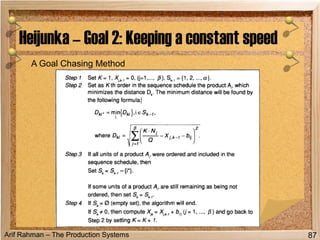
A Goal Chasing Method
Heijunka – Goal 2: Keeping a constant speed
87
Arif Rahman – The Production Systems
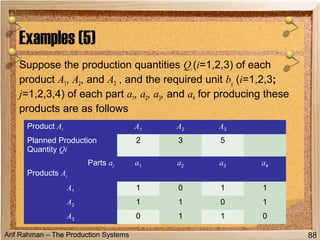
Suppose the production quantities Qi (i=1,2,3) of each
product A1, A2, and A3 , and the required unit bij (i=1,2,3;
j=1,2,3,4) of each part a1, a2, a3, and a4 for producing these
products are as follows
Examples (5)
88
Product Ai A1 A2 A3
Planned Production
Quantity Qi
2 3 5
Parts aj
Products Ai
a1 a2 a3 a4
A1 1 0 1 1
A2 1 1 0 1
A3 0 1 1 0
Arif Rahman – The Production Systems
Then, the total necessary quantity (Nj) of the part aj
(j=1,2,3,4) for producing all products Ai(i=1,2,3) can be
computed as follows:
the total production quantity of all products Ai(i=1,2,3) :
and
untuk (j=1,2,3,4)
Examples (5)
89
[ ] [ ]5785
0110
1011
1101
532
]][[][
=










=
= ijij bQN
10532
3
1
=++=∑=i
iQ [ ]10/510/710/810/5]/[ =QN j
Arif Rahman – The Production Systems
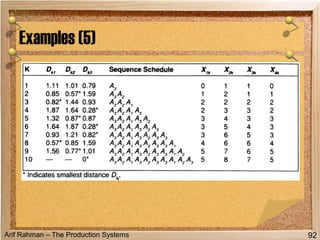
Applying the values of [Nj/Q] and [bij] to the formula in step 2
of the above algorithm,
When K = 1, the distances Dki can be computed as follows:
Thus, D1,i* = min {1.11, 1.01, 0.79) = 0.79
Sequence  A3
Xjk = Xjk-1 + b3j = [0 1 1 0]
Examples (5)
90
( ) ( ) ( ) ( ) 11.110100010,1for
2
10
512
10
712
10
812
10
51
1,1 =−−+−−+−−+−−== ××××
Di
( ) ( ) ( ) ( ) 01.110001010,2for
2
10
512
10
712
10
812
10
51
2,1 =−−+−−+−−+−−== ××××
Di
( ) ( ) ( ) ( ) 79.000101000,3for
2
10
512
10
712
10
812
10
51
3,1 =−−+−−+−−+−−== ××××
Di
Arif Rahman – The Production Systems
When K = 2, the distances Dki can be computed as follows:
Thus, D2,i* = min {0.85, 0.57, 1.59) = 0.57
Sequence  A3 A2
Xjk = Xjk-1 + b2j = [1 2 1 1]
Examples (5)
91
( ) ( ) ( ) ( ) 85.010110110,1for
2
10
522
10
722
10
822
10
52
1,2 =−−+−−+−−+−−== ××××
Di
( ) ( ) ( ) ( ) 57.010011110,2for
2
10
522
10
722
10
822
10
52
2,2 =−−+−−+−−+−−== ××××
Di
( ) ( ) ( ) ( ) 59.100111100,3for
2
10
522
10
722
10
822
10
52
3,2 =−−+−−+−−+−−== ××××
Di
Arif Rahman – The Production Systems
Examples (5)
92
Arif Rahman – The Production Systems
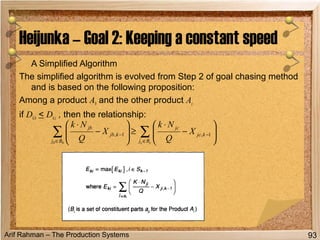
A Simplified Algorithm
The simplified algorithm is evolved from Step 2 of goal chasing method
and is based on the following proposition:
Among a product Ab and the other product Ac
if Dk.b < Dk.c , then the relationship:
Heijunka – Goal 2: Keeping a constant speed
93
∑∑ ∈
−
∈
− 





−
⋅
≥





−
⋅
ccbb Bj
kjc
jc
Bj
kjb
jb
X
Q
Nk
X
Q
Nk
1,1,
Arif Rahman – The Production Systems
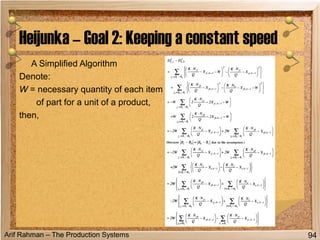
A Simplified Algorithm
Denote:
W = necessary quantity of each item
of part for a unit of a product,
then,
Heijunka – Goal 2: Keeping a constant speed
94
Arif Rahman – The Production Systems
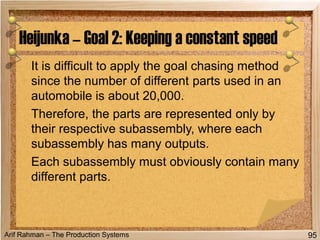
It is difficult to apply the goal chasing method
since the number of different parts used in an
automobile is about 20,000.
Therefore, the parts are represented only by
their respective subassembly, where each
subassembly has many outputs.
Each subassembly must obviously contain many
different parts.
Heijunka – Goal 2: Keeping a constant speed
95
Arif Rahman – The Production Systems 96
It’s end of slides…
… Any question ?
96

13 pull system

  • 1.
    Arif Rahman –The Production Systems 1 Slide 13 Pull System Arif Rahman
  • 2.
    Arif Rahman –The Production Systems Push system: the production system for moving work where output is pushed to the subsequent station as it is completed Pull system: the production system for moving work where a workstation pulls output from the preceding station as needed. The Push/Pull Production System 2
  • 3.
    Arif Rahman –The Production Systems The Push/Pull Production System 3
  • 4.
    Arif Rahman –The Production Systems The Push/Pull Production System 4 PUSH SYSTEM PULL SYSTEM “Generic” Product “Customized” Product CODP
  • 5.
    Arif Rahman –The Production Systems Push system: execution is initiated in anticipation of customer orders or subsequent process requirement (speculative) Pull system : execution is initiated in response to a customer order or subsequent process request (reactive) The customer order decoupling point (CODP) as push-pull boundary separates push system from pull system The Push/Pull Production System 5
  • 6.
    Arif Rahman –The Production Systems The Push/Pull Production System Push System Focus is on planning Schedule work releases based on demand Perspective is on a whole manufacturing lead time Inherently due-date driven Control release rate, observe WIP level Pull System Focus is on controlling Authorize work releases based on system status Perspective is on takt time Inherently rate driven Control WIP level, observe throughput 6
  • 7.
    Arif Rahman –The Production Systems The Push/Pull Production System Push System Large batch sizes Finite capacity Optimized utilization Manage buffer inventories as safety Quality inspection is at finished goods or other critical points Many qualified sourcing and suppliers Pull System Small batch sizes Flexible capacity Optimized effectiveness Manage inventories as waste Quality inspection is in the process and based on zero defect principles Some specified sourcing and suppliers 7
  • 8.
    Arif Rahman –The Production Systems The Push/Pull Production System 8
  • 9.
    Arif Rahman –The Production Systems Examples (1) 9 From Supplier To Customer Process A Lot = 15/cycle Defect = 10% Process B Lot = 20/cycle Defect = 5% Customer order = 10.000 units
  • 10.
    Arif Rahman –The Production Systems PUSH SYSTEM Customer order = 10.000 units Examples (1) 10 From Supplier To Customer Process A Lot = 15/cycle Defect = 10% Process B Lot = 20/cycle Defect = 5% Number of Lot on Process B = 10.000 X ((100%) / (100% - 5%)) 20 = 526,3158 ≈ 527 Lots ≈ 10.540 units Number of Lot on Process A = 10.540 X ((100%) / (100% - 10%)) 15 = 780,7407 ≈ 781 Lots ≈ 11.715 units 11.715 units defects good defects good 10.000 units all transfered
  • 11.
    Arif Rahman –The Production Systems PULL SYSTEM Customer order = 10.000 units Lot size of bin A (output of process A) = 15 units Lot size of bin B (output of process B) = 20 units The finished goods storage withdraws 500 empty-bin B The process B takes item from filled-bin A to produce filled-bin B, and withdraws empty-bin A every 15 units consumption. The process A takes item from filled-bin materials to produce filled-bin A, and withdraws empty-bin materials. Examples (1) 11 From Supplier To Customer Process A Lot = 15/cycle Defect = 10% Process B Lot = 20/cycle Defect = 5% defects defects transfer filled-bin B 10.000 units consume 20/cycle transfer filled-bin Aconsume 15/cycle Do empty-bin BDo empty-bin A withdraw 500 empty-bin B withdraw empty-bin Awithdraw empty- bin materials
  • 12.
    Arif Rahman –The Production Systems Pull System Pull system controls production quantity adapting to demand changes. It treats overproduction and inventory as wastes. 12
  • 13.
    Arif Rahman –The Production Systems In the pull system, it is necessary to look at the production flow conversely. The people of a certain process go to the preceding process to withdraw the necessary units in the necessary quantities at the necessary time. The preceding process produces only enough units to replace those that have been withdrawn. Pull System 13
  • 14.
    Arif Rahman –The Production Systems There are two types of withdrawal methods: The later replenishment system (Ato-Hoju あとほじ ). It is a method of using a Kanban. The kanban with an empty box will withdraw another box filled with parts. The sequenced withdrawal system (Junjo- Biki 順序引き ). It provides a sequence schedule for many varieties of finished parts to withdraw various parts in a sequence conforming to its sequence schedule for mixed model assembly line. Pull System 14
  • 15.
    Arif Rahman –The Production Systems The Later Replenishment System (Ato-Hoju あとほじ ) and Kanban ( 看板 ) 15
  • 16.
    Arif Rahman –The Production Systems Kanban ( 看板 ) is a signal card applied for replenishment scheduling by production or procurement in lean manufacturing. Two kinds are mainly used: the withdrawal Kanban and the production-ordering Kanban. A withdrawal Kanban details the quantity which the subsequent process should withdraw, A production-ordering Kanban shows the quantity which the preceding process must produce. Kanban - 看板 16
  • 17.
    Arif Rahman –The Production Systems Kanban - 看板 17 Production-ordering Kanban (In-process Kanban) (Ordinary) Production Kanban Kanban Withdrawal Kanban Triangular Kanban Interprocess Withdrawal Kanban Supplier Kanban (for production other than lot production) (for lot production) Production Kanban Interprocess Withdrawal Kanban Supplier Kanban Triangular Kanban
  • 18.
    Arif Rahman –The Production Systems Flow of Kanban 18
  • 19.
    Arif Rahman –The Production Systems Flow of withdrawal kanban. It describes the route of withdrawal kanban with empty pallets (containers, boxes or bins) from subsequent process (next process) to preceding process (previous process). Flow of production-ordering kanban. It describes the route of production-ordering kanban within process after it receives withdrawal kanban. Flow of physical units of product. It describes the route of withdrawal kanban with filled pallets from preceding process to subsequent process. Flow of Kanban 19
  • 20.
    Arif Rahman –The Production Systems Express Kanban. An express Kanban is issued when there is a shortage of a part. Emergency Kanban. An emergency Kanban will be issued temporarily when some inventory is required to make up for defective units, machine troubles, extra insertions, or a spurt in a weekend operation. Job-Order Kanban. A job-order Kanban is prepared for a job-order production line and is issued for each job order. Other Type of Kanban 20
  • 21.
    Arif Rahman –The Production Systems Through Kanban. a through Kanban (or tunnel Kanban) can be used in those machining lines where each piece of a product produced at a line can be conveyed immediately to the next line by a chute one at a time. Common Kanban. A withdrawal Kanban can also be used as a production-ordering Kanban if the distance between two processes is very short and one supervisor is supervising both processes. Other Type of Kanban 21
  • 22.
    Arif Rahman –The Production Systems Operational Flow of Kanban 22
  • 23.
    Arif Rahman –The Production Systems Mizusumashi ( ミズスマシ ) or whirligig beetle is a carrier who travels between preceding processes and subsequent processes again and again at regular predetermined times. Kanban post is a rack that collects empty kanban that will trigger next operations. Kanban visual board ( 看板图 ) is a board that informs kanban states at the preceding process. Facilities on Kanban System 23
  • 24.
    Arif Rahman –The Production Systems Facilities on Kanban System 24 Mizusumashi or Carrier Kanban Post Kanban visual board
  • 25.
    Arif Rahman –The Production Systems Operational Steps Utilizing the Kanban 25
  • 26.
    Arif Rahman –The Production Systems Operational Steps Utilizing the Kanban 26 1. The carrier of the subsequent process goes to the store of the preceding process with the Withdrawal Kanban kept in his withdrawal Kanban post and the empty pallets. He does this at regular predetermined times. 2. When the subsequent process carrier withdraws the filled pallets at store A, he detaches the Production- Ordering Kanban which were attached to the physical units in the pallets and places the Kanban in the Kanban receiving post. He also leaves the empty pallets at the place designated by the preceding process people.
  • 27.
    Arif Rahman –The Production Systems Operational Steps Utilizing the Kanban 27 3. For each Production-Ordering Kanban that he detached, he attaches in its place one of his Withdrawal Kanbans. When exchanging the two types of Kanbans, he carefully compares the withdrawal Kanban with the production-ordering Kanban for consistency. 4. When work begins in the subsequent process, the Withdrawal Kanban must be put in the withdrawal Kanban post.
  • 28.
    Arif Rahman –The Production Systems Operational Steps Utilizing the Kanban 28 5. In the preceding process, the Production-Ordering Kanban should be collected from the Kanban receiving post at a certain point in time or when a certain number of units have been produced and must be placed in the production-ordering Kanban post in the same sequence in which it had been detached at store. 6. Produce the parts according to the ordinal sequence of the Production-Ordering Kanbans in the post.
  • 29.
    Arif Rahman –The Production Systems Operational Steps Utilizing the Kanban 29 7. The physical units and the Production-Ordering Kanban must move as a pair when processed. 8. When the physical units are completed in this process, they and the Production-Ordering Kanban are placed in store, so that the carrier from the subsequent process can withdraw them at any time.
  • 30.
    Arif Rahman –The Production Systems Triangular Kanban Since ordinary production processes a single piece or small batch size each cycle, it uses one sheet kanban each pallet. Unlike lot production that processes large batch size and rapid production rate, it uses a pair of signal kanban. They are material requisition kanban and triangular kanban 30
  • 31.
    Arif Rahman –The Production Systems There are some changes at the operational steps utilizing kanban : At step 2. The carrier detaches Material Requisition Kanban if remaining pallets reaches Triangular Kanban (reorder point) and places the Kanban in the dispatching post (production- ordering kanban post without kanban receiving post). At step 3. For each filled pallet that he taken (no production-ordering kanban), he attaches in its place one of his Withdrawal Kanbans. Triangular Kanban 31
  • 32.
    Arif Rahman –The Production Systems There are some changes at the operational steps utilizing kanban : At step 5. In the preceding process, the Material Requisition Kanban should be collected from the dispatching post at a certain point in time and the production order must be set in motion. At step 6. Produce the parts according to the ordinal sequence of the Material Requisition Kanbans in the post. Triangular Kanban 32
  • 33.
    Arif Rahman –The Production Systems There are some changes at the operational steps utilizing kanban : At step 7. The physical units and the Material Requisition Kanban must move as a pair when processed. At step 8. When the physical units are completed in this process, they that are attached Material Requisition Kanban and Triangular Kanban are placed in store. Triangular Kanban 33
  • 34.
    Arif Rahman –The Production Systems If the manufacturer applied the Kanban system to its vendors without changing its own production systems, the Kanban system would be a demon to the vendors. If the paternal manufacturer withdraws parts with large variance in terms of quantity or timing, the suppliers must necessarily prepare slack capacities of manpower, facility, and inventory. The suppliers would suffer if the paternal manufacturer ordered parts in a fluctuating manner. Supplier Kanban 34
  • 35.
    Arif Rahman –The Production Systems There two kinds of information to its suppliers: A predetermined monthly production plan, which is communicated to the supplier in the middle of the preceding month. A daily information, which specifies the actual number of units to be supplied. It takes on two different forms: a Kanban or a sequence schedule table. Supplier Kanban 35
  • 36.
    Arif Rahman –The Production Systems 36
  • 37.
    Arif Rahman –The Production Systems Supplier Kanban The Kanban in Figure is used for delivery from Sumitomo Denko to Toyota's Tsutsumi plant. Since the pull system engages in small-lot production, frequent delivery each day is necessary. Therefore, delivery times is written explicitly on this Kanban 37 The number 36 refers to the receiving station at the plant 1-6-2 means that it must be delivered six times a day and the parts must be conveyed two delivery times later delivery times six times a day The rear-door wire delivered to station 36 will be conveyed to store 3S (8-3-213)
  • 38.
    Arif Rahman –The Production Systems Supplier Kanban The 8 a.m. file contains as many production Kanbans as the number of customer Kanbans brought at 8 a.m., and will instruct production during the day shift. The production of parts will be completed at the latest by 10 p.m. that night, and the parts will be loaded on the truck at 10 p.m. to deliver. The 10 p.m. file contains as many production Kanbans as the number of customer Kanbans brought at 10 p.m., and will instruct the production for the night shift. The required parts will be finished at the latest by 8 a.m. the next morning, and again will be loaded on the truck at 8 a.m. for delivery. 38
  • 39.
    Arif Rahman –The Production Systems Rule 1: The subsequent process should withdraw the necessary products from the preceding process in the necessary quantities at the necessary point in time. Rule 2: The preceding process should produce its products in the quantities withdrawn by the subsequent process. Rule 3: Defective products should never be convened to the subsequent process. Kanban Rules 39
  • 40.
    Arif Rahman –The Production Systems Rule 4: The number of Kanbans should be minimized. Rule 5: Kanban should be used to adapt to small fluctuations in demand (fine-tuning of production by Kanban). Kanban Rules 40
  • 41.
    Arif Rahman –The Production Systems When using Kanban, there is no need to examine the inventory quantity continuously. With Kanban, the number of withdrawal Kanban detached at the subsequent process since the previous order is what must be ordered. Inventory calculations become very simple in Kanban systems. Inventory Control in Kanban System 41
  • 42.
    Arif Rahman –The Production Systems Several terms in Kanban System: The container capacity is the maximum number of parts each container. The order quantity is the quantity of parts withdrawn by subsequent process. The economic lot size is the order quantity determined by EOQ. The reorder point is the quantity level that triggers a new order. Inventory Control in Kanban System 42
  • 43.
    Arif Rahman –The Production Systems Several terms in Kanban System: The order cycle is the time interval between instructing a production order to the line and instructing the next production order. The lead time is simply the time interval between placing an order and receiving delivery. The processing time is the time interval between placing a production order and completing its production. Inventory Control in Kanban System 43
  • 44.
    Arif Rahman –The Production Systems Several terms in Kanban System: The Kanban collecting time is the time interval between picking up Kanbans from the post, which were detached at the subsequent process, and placing the production order to the preceding process. The conveyance time is the time interval to convey physical units from the preceding process to subsequent process Inventory Control in Kanban System 44
  • 45.
    Arif Rahman –The Production Systems Several terms in Kanban System: The waiting time is the allowance time that spares for delaying or idling. The safety coefficient refers to the safety factor in percentage that is excluded from inventory availability for various purposes. The safety inventory period corresponds to the time interval to keep stock at the store. This inventory responds to defective products, machine troubles, etc. Inventory Control in Kanban System 45
  • 46.
    Arif Rahman –The Production Systems There are two different inventory control systems in the kanban systems: The constant quantity, nonconstant cycle withdrawal system The constant cycle, nonconstant quantity withdrawal system Inventory Control in Kanban System 46
  • 47.
    Arif Rahman –The Production Systems Economic lot size (Q) is determined by the EOQ model for expected demand. Where : Q = economic lot size A = ordering or setup cost per lot R = monthly estimated demand quantity i = carrying or holding cost per dollar of an item c = unit cost CONSTANT QUANTITY, NONCONSTANT CYCLE WITHDRAWAL SYSTEM 47 ci RA Q ⋅ ⋅⋅ = 2
  • 48.
    Arif Rahman –The Production Systems The reorder point, which is the quantity level that triggers a new order, is determined as: Reorder Point = average usage during lead time + safety stock - orders placed but not yet received Where: The lead time is simply the time interval between placing an order and receiving delivery CONSTANT QUANTITY, NONCONSTANT CYCLE WITHDRAWAL SYSTEM 48
  • 49.
    Arif Rahman –The Production Systems Three cases of determining the number of kanban The lot size is fairly large, or the setup action is not sufficiently improved. The maximum necessary inventory is equal to the reorder point. The connected two adjacent processes. CONSTANT QUANTITY, NONCONSTANT CYCLE WITHDRAWAL SYSTEM 49
  • 50.
    Arif Rahman –The Production Systems The lot size is fairly large, or the setup action is not sufficiently improved. Total Number of Kanban = or CONSTANT QUANTITY, NONCONSTANT CYCLE WITHDRAWAL SYSTEM 50 = economic lot size + (daily demand x safety coefficient) container capacity = ( monthly demand ) + (daily demand X safety coefficient)monthly number of setups container capacity
  • 51.
    Arif Rahman –The Production Systems The lot size is fairly large, or the setup action is not sufficiently improved. Position of the Triangular Kanban= or it should round up into least integer number CONSTANT QUANTITY, NONCONSTANT CYCLE WITHDRAWAL SYSTEM 51 = average daily demand x lead time x (1 + safety coefficient) container capacity = ( average daily demand ) +1 container capacity
  • 52.
    Arif Rahman –The Production Systems The maximum necessary inventory is equal to the reorder point. Total Number of Kanban = Where: lead time = processing time + waiting time + conveyance time + Kanban collecting time CONSTANT QUANTITY, NONCONSTANT CYCLE WITHDRAWAL SYSTEM 52 = average daily demand x lead time x (1 + safety coefficient) container capacity
  • 53.
    Arif Rahman –The Production Systems The connected two adjacent processes. ¤ There is no need to use Kanban between two adjacent processes that are connected such as by conveyor line. ¤ If plural processes are connected very closely with each other, one sheet of Kanban is used commonly by these plural processes. ¤ This is the case of a through Kanban (also called tunnel Kanban). CONSTANT QUANTITY, NONCONSTANT CYCLE WITHDRAWAL SYSTEM 53
  • 54.
    Arif Rahman –The Production Systems A workcell plans to produce 3,000 units for next month. It will withdraw same number of parts from the preceding workcell. The workcell and the preceding one operate 30 days/month. The setup cost in the preceding workcell is $2.5 each lot. The unit cost is $10, and the carrying cost is 15% of the unit cost. The parts will convey to subsequent workcell in box that contains 10 parts. If the safety coefficient is 10%, calculate 1.economic lot size 2.average daily demand 3.total number of kanban Examples (2) 54
  • 55.
    Arif Rahman –The Production Systems Examples (2) R = 3,000 units D = 30 days/month. A = $2.5 each lot. c = $10 i = 15% container capacity = 10 parts. safety coefficient = 10% 1.economic lot size 2.average daily demand 3.total number of kanban 1. economic lot size 2. average daily demand 3. total number of kanban 55 100 10%15 30005.222 = × ×× = ⋅ ⋅⋅ = ci RA Q = 100 + (100 x 10%) 10 =11 = 3000 = 100 30
  • 56.
    Arif Rahman –The Production Systems The standard quantity is determined by standard quantity = daily demand x (order cycle + lead time) + safety stock Where : The order cycle is the time interval between one order time and the next order time The lead time is simply the time interval between placing an order and receiving delivery The replenishment lead time is the order cycle plus the lead time CONSTANT CYCLE, NONCONSTANT QUANTITY WITHDRAWAL SYSTEM 56
  • 57.
    Arif Rahman –The Production Systems The order cycle is determined by and the order quantity (Q) is determined by order quantity = (standard quantity - existing inventory) - (orders placed but not yet received) CONSTANT CYCLE, NONCONSTANT QUANTITY WITHDRAWAL SYSTEM 57 order cycle = economic lot size for expected demand average daily demand
  • 58.
    Arif Rahman –The Production Systems Total Number of Kanban = Where: lead time = processing time + waiting time + conveyance time + Kanban collecting time and order quantity = (number of Kanban detached by the time of regular Kanban collection since the previous collection) x container capacity CONSTANT CYCLE, NONCONSTANT QUANTITY WITHDRAWAL SYSTEM 58 = daily demand x (order cycle + lead time + safety period) container capacity
  • 59.
    Arif Rahman –The Production Systems CONSTANT CYCLE, NONCONSTANT QUANTITY WITHDRAWAL SYSTEM 59 Total number of Kanban = number of Kanban attached at store + number of Kanban (detached) at receiving post + number of Kanban in the preceding process Then..
  • 60.
    Arif Rahman –The Production Systems Everyday a workcell withdraws 100 parts from the preceding workcell. The order cycle is 1 day. The lead time is 0.5 day. The safety period is 0.1 day. The parts will convey to subsequent workcell in box that contains 10 parts. Calculate the total number of kanban. Examples (3) 60
  • 61.
    Arif Rahman –The Production Systems average daily demand = 100 parts order cycle = 1 day lead time = 0.5 day safety period = 0.1 day. container capacity = 10 parts. total number of kanban = Examples (3) 61 = 100 x (1 + 0.5 + 0.1) = 1610
  • 62.
    Arif Rahman –The Production Systems CONSTANT WITHDRAWAL CYCLE SYSTEM FOR THE SUPPLIER KANBAN 62 Total Number of Kanban = Where: order cycle = order cycle to the supplier lead time = production lead time of the supplier = order cycle to the supplier x conveyance interval = daily demand x (order cycle + lead time + safety period) container capacity = (number of days spent for one-time conveyance) number of times of conveyance per day
  • 63.
    Arif Rahman –The Production Systems CONSTANT WITHDRAWAL CYCLE SYSTEM FOR THE SUPPLIER KANBAN 63 replenishment lead time =
  • 64.
    Arif Rahman –The Production Systems CONSTANT WITHDRAWAL CYCLE SYSTEM FOR THE SUPPLIER KANBAN 64 Total Number of Kanban =
  • 65.
    Arif Rahman –The Production Systems Suppose: the number of days spent for one-time conveyance = 1 day, the number of times of conveyance per day = 6 times, the conveyance interval = 2 times later after the original conveyance of Kanban, the average daily demand = 100 units, the container capacity = 5 units, and the safety period = 0.2 day Calculate the total number of kanban. Examples (4) 65
  • 66.
    Arif Rahman –The Production Systems Total Number of Kanban = Examples (4) 66 { } 142.05.020 2.0 6 21 1 5 100 =+×=       +            + ××=
  • 67.
    Arif Rahman –The Production Systems The Sequenced Withdrawal System (Junjo-Biki 順序引き ) and Heijunka ( 平準化 ) 67
  • 68.
    Arif Rahman –The Production Systems Junjo-biki ( 順序引き ) or Mixed Scheduling refers to the process of developing one or more schedules to enable mixed-model production. It makes different sequence products every day, according to the daily anticipated demand, to avoid inventory accumulation. Junjo-biki - 順序引き 68
  • 69.
    Arif Rahman –The Production Systems There are two phases of the production smoothing process Smoothing of the total production quantity Smoothing of every model's production quantity. Production Smoothing Process 69
  • 70.
    Arif Rahman –The Production Systems Smoothing of the total production quantity is done to minimize the variance in total outputs between two sequential periods. In short, the goal of production smoothing is to produce the same amount of products every period. Production smoothing allows daily production volumes to remain constant. Smoothing of the total production quantity is meant to level the daily amount of products flowing as much as possible by anticipating peaks and valleys in demand. Smoothing of The Total Production Quantity 70
  • 71.
    Arif Rahman –The Production Systems There are two kinds of waste where the smoothing is not implemented Waste arises from uneven periods of demand. When facilities, people, materials, and other elements are prepared for peak demand as the standard, but will be waste during a period of short runs. Waste occurs between processes. A preceding process properly prepares its units in quantities corresponding to the peak quantity withdrawn by the subsequent process, it follows that excessive works would occur as waste. Smoothing of The Total Production Quantity 71
  • 72.
    Arif Rahman –The Production Systems To practice smoothing the total production quantity without occurrence of waste between processes, the final assembly line and all processes must produce products according to the takt time. This means balancing between processes (synchronization) will be completely realized if every preceding process finishes at the same pace within the takt time for all specifications. Production capacity plan adapting demand fluctuation. Adapting to increased demand, the takt time will be decreased. Adapting to decreased demand, the takt time will be increased. Smoothing of The Total Production Quantity 72
  • 73.
    Arif Rahman –The Production Systems Smoothing of The Total Production Quantity 73
  • 74.
    Arif Rahman –The Production Systems The purpose of smoothing every model's production quantity is to check variances in the flow of each product variety between periods (days). The aim is to level the quantity of parts consumed and produced each period because if great variances existed in the daily consumed quantity of parts of a specified variety, the subassembly lines in question would have to hold huge excess inventories and work force. Smoothing Each Model's Production Quantity 74
  • 75.
    Arif Rahman –The Production Systems All product varieties can be produced according to the average cycle time of all varieties as long as each model's cycle time is considered when determining the sequence of each model. Lot (batch) production can cause variances in the necessary volumes of each subassembly part. Many companies are able to achieve smoothing of production by using a daily production quantity. Smoothing Each Model's Production Quantity 75
  • 76.
    Arif Rahman –The Production Systems Smoothing Each Model's Production Quantity 76
  • 77.
    Arif Rahman –The Production Systems There are two phases of the production smoothing The first phase shows the adaptation to monthly demand changes during a year (monthly adaptation). It will be achieved by monthly production planning instructing the averaged daily production level of each process in the plant. The second phase shows adaptation to daily demand changes during a month (daily adaptation). It is made possible by daily production dispatching. Production Smoothing 77
  • 78.
    Arif Rahman –The Production Systems Production Smoothing 78
  • 79.
    Arif Rahman –The Production Systems Heijunka ( 平準化 ) refers to smoothed production. It breakdowns demands into smaller batches (lot), arrange them into mixed scheduling, and levels the loads. Heijunka - 平準化 79
  • 80.
    Arif Rahman –The Production Systems The procedure for designing a mixed-model assembly line involves the following steps ۞Determination of a cycle time. ۞Computation of a minimum number of processes. ۞Preparation of a diagram of integrated precedence relationships among elemental jobs. ۞Line balancing. ۞Determination of the sequence schedule for introducing various products to the line. ۞Determination of the length of the operations range of each process. Heijunka - 平準化 80
  • 81.
    Arif Rahman –The Production Systems The goals of the mixed-model assembly line is : 1.Leveling the load (total assembly time) on each process within the line. 2.Keeping a constant speed in consuming each part on the line. Heijunka - 平準化 81
  • 82.
    Arif Rahman –The Production Systems The goals of the mixed-model assembly line is : 1.Leveling the load (total assembly time) on each process within the line. 2.Keeping a constant speed in consuming each part on the line. Heijunka - 平準化 82
  • 83.
    Arif Rahman –The Production Systems The line balancing on the mixed-model line is made under the condition that the operation time of each process, which was weighted by each quantity of mixed models, should not exceed the cycle time A product might have a longer operation time than the predetermined cycle time. If products with relatively longer operation times are successively introduced into the line, the products will cause a delay in completing the product and may cause line stoppage. Heijunka – Goal 1: Leveling the load 83
  • 84.
    Arif Rahman –The Production Systems Where : Qi = planned production quantity of the product Ai (i= 1, ... ,α) Til = operation time per unit of product Ai on the process l total operation time per day C = cycle time Heijunka – Goal 1: Leveling the load 84 C Q TQ i i i ili l ≤             ∑ ∑ = = α α 1 1 max ∑= = α 1 daypertimeoperationtotal i iQ C
  • 85.
    Arif Rahman –The Production Systems The respective work-in-process inventories must be minimized. To do so, the quantity used per hour (Le., consumption speed) for each part in the mixed-model line must be kept as constant as possible. The mixed scheduling or sequencing method is designed to reach this goal. There are two sequencing method: ¤ A goal chasing method ¤ A simplified algorithm (goal chasing method II) Heijunka – Goal 2: Keeping a constant speed 85
  • 86.
    Arif Rahman –The Production Systems Q = Total production quantity of all products Ai (i= 1, ... ,α) = ΣQi , (Qi = production quantity of each product A) bij = Necessary quantity of the part aj (j =1, ... , β) for producing one unit of the product Ai (i= 1, ... ,α) Nj = Total necessary quantity of the part aj to be consumed for producing all products Ai (i=I, ... , α ; j =1, ... , β) Xjk = Total necessary quantity of the part aj to be utilized for producing the products of determined sequence from first to k-th. Nj / Q = Average necessary quantity of the part aj per unit of a product. (k.Nj) / Q = Average necessary quantity of the part aj for producing k units of products. Heijunka – Goal 2: Keeping a constant speed 86
  • 87.
    Arif Rahman –The Production Systems A Goal Chasing Method Heijunka – Goal 2: Keeping a constant speed 87
  • 88.
    Arif Rahman –The Production Systems Suppose the production quantities Qi (i=1,2,3) of each product A1, A2, and A3 , and the required unit bij (i=1,2,3; j=1,2,3,4) of each part a1, a2, a3, and a4 for producing these products are as follows Examples (5) 88 Product Ai A1 A2 A3 Planned Production Quantity Qi 2 3 5 Parts aj Products Ai a1 a2 a3 a4 A1 1 0 1 1 A2 1 1 0 1 A3 0 1 1 0
  • 89.
    Arif Rahman –The Production Systems Then, the total necessary quantity (Nj) of the part aj (j=1,2,3,4) for producing all products Ai(i=1,2,3) can be computed as follows: the total production quantity of all products Ai(i=1,2,3) : and untuk (j=1,2,3,4) Examples (5) 89 [ ] [ ]5785 0110 1011 1101 532 ]][[][ =           = = ijij bQN 10532 3 1 =++=∑=i iQ [ ]10/510/710/810/5]/[ =QN j
  • 90.
    Arif Rahman –The Production Systems Applying the values of [Nj/Q] and [bij] to the formula in step 2 of the above algorithm, When K = 1, the distances Dki can be computed as follows: Thus, D1,i* = min {1.11, 1.01, 0.79) = 0.79 Sequence  A3 Xjk = Xjk-1 + b3j = [0 1 1 0] Examples (5) 90 ( ) ( ) ( ) ( ) 11.110100010,1for 2 10 512 10 712 10 812 10 51 1,1 =−−+−−+−−+−−== ×××× Di ( ) ( ) ( ) ( ) 01.110001010,2for 2 10 512 10 712 10 812 10 51 2,1 =−−+−−+−−+−−== ×××× Di ( ) ( ) ( ) ( ) 79.000101000,3for 2 10 512 10 712 10 812 10 51 3,1 =−−+−−+−−+−−== ×××× Di
  • 91.
    Arif Rahman –The Production Systems When K = 2, the distances Dki can be computed as follows: Thus, D2,i* = min {0.85, 0.57, 1.59) = 0.57 Sequence  A3 A2 Xjk = Xjk-1 + b2j = [1 2 1 1] Examples (5) 91 ( ) ( ) ( ) ( ) 85.010110110,1for 2 10 522 10 722 10 822 10 52 1,2 =−−+−−+−−+−−== ×××× Di ( ) ( ) ( ) ( ) 57.010011110,2for 2 10 522 10 722 10 822 10 52 2,2 =−−+−−+−−+−−== ×××× Di ( ) ( ) ( ) ( ) 59.100111100,3for 2 10 522 10 722 10 822 10 52 3,2 =−−+−−+−−+−−== ×××× Di
  • 92.
    Arif Rahman –The Production Systems Examples (5) 92
  • 93.
    Arif Rahman –The Production Systems A Simplified Algorithm The simplified algorithm is evolved from Step 2 of goal chasing method and is based on the following proposition: Among a product Ab and the other product Ac if Dk.b < Dk.c , then the relationship: Heijunka – Goal 2: Keeping a constant speed 93 ∑∑ ∈ − ∈ −       − ⋅ ≥      − ⋅ ccbb Bj kjc jc Bj kjb jb X Q Nk X Q Nk 1,1,
  • 94.
    Arif Rahman –The Production Systems A Simplified Algorithm Denote: W = necessary quantity of each item of part for a unit of a product, then, Heijunka – Goal 2: Keeping a constant speed 94
  • 95.
    Arif Rahman –The Production Systems It is difficult to apply the goal chasing method since the number of different parts used in an automobile is about 20,000. Therefore, the parts are represented only by their respective subassembly, where each subassembly has many outputs. Each subassembly must obviously contain many different parts. Heijunka – Goal 2: Keeping a constant speed 95
  • 96.
    Arif Rahman –The Production Systems 96 It’s end of slides… … Any question ? 96