1Marek.Piatkowski@Rogers.com
Standard Work for
Managers
Introduction
Thinkingwin, Win, WIN
Standard Work for Managers and
Supervisor
Definitions
Marek Piatkowski – October 2016
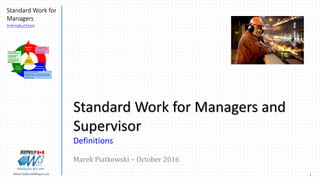
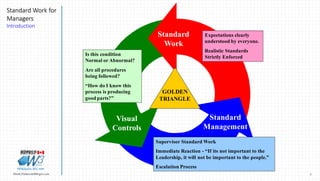
Standard
Work
Visual
Controls
Standard
Management
GOLDEN
TRIANGLE
Is this condition
Normal or Abnormal?
Are all procedures
being followed?
“How do I know this
process is producing
good parts?”
Supervisor Standard Work
Immediate Reaction - “If its not important to the
Leadership, it will not be important to the people.”
Escalation Process
Expectations clearly
understood by everyone.
Realistic Standards
Strictly Enforced
2Marek.Piatkowski@Rogers.com
Standard Work for
Managers
Introduction
Thinkingwin, Win, WIN
Introduction - Marek Piatkowski
 Professional Background
 Toyota Motor Manufacturing Canada (TMMC) - Cambridge, Ontario from
1987-1994
 TPS/Lean Transformation Consulting - since 1994
 Professional Affiliations
 TWI Network – John Shook, Founder
 Lean Enterprise Institute (LEI) – Jim Womack
 Lean Enterprise Academy (LEA) – Daniel Jones
 CCM/CAINTRA – Monterrey, Mexico
 SME, AME, ASQ, CME
 Lean Manufacturing Solutions - Toronto, Canada
http://twi-network.com
3Marek.Piatkowski@Rogers.com
Standard Work for
Managers
Introduction
Thinkingwin, Win, WIN
4Marek.Piatkowski@Rogers.com
Standard Work for
Managers
Introduction
Thinkingwin, Win, WIN
2
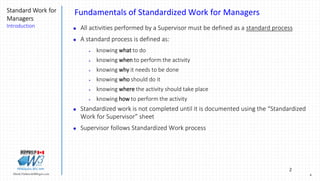
Fundamentals of Standardized Work for Managers
 All activities performed by a Supervisor must be defined as a standard process
 A standard process is defined as:
 knowing what to do
 knowing when to perform the activity
 knowing why it needs to be done
 knowing who should do it
 knowing where the activity should take place
 knowing how to perform the activity
 Standardized work is not completed until it is documented using the “Standardized
Work for Supervisor” sheet
 Supervisor follows Standardized Work process
5Marek.Piatkowski@Rogers.com
Standard Work for
Managers
Introduction
Thinkingwin, Win, WIN
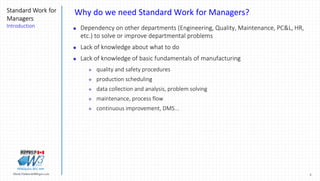
Why do we need Standard Work for Managers?
 Dependency on other departments (Engineering, Quality, Maintenance, PC&L, HR,
etc.) to solve or improve departmental problems
 Lack of knowledge about what to do
 Lack of knowledge of basic fundamentals of manufacturing
 quality and safety procedures
 production scheduling
 data collection and analysis, problem solving
 maintenance, process flow
 continuous improvement, DMS...
6Marek.Piatkowski@Rogers.com
Standard Work for
Managers
Introduction
Thinkingwin, Win, WIN
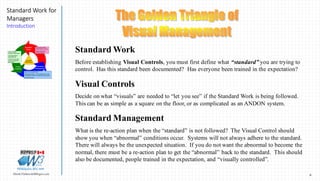
Standard Work
Before establishing Visual Controls, you must first define what “standard” you are trying to
control. Has this standard been documented? Has everyone been trained in the expectation?
Visual Controls
Decide on what “visuals” are needed to “let you see” if the Standard Work is being followed.
This can be as simple as a square on the floor, or as complicated as an ANDON system.
Standard Management
What is the re-action plan when the “standard” is not followed? The Visual Control should
show you when “abnormal” conditions occur. Systems will not always adhere to the standard.
There will always be the unexpected situation. If you do not want the abnormal to become the
normal, there must be a re-action plan to get the “abnormal” back to the standard. This should
also be documented, people trained in the expectation, and “visually controlled”.
Standard
Work
Visual
Controls
Standard
Management
GOLDEN
TRIANGLE
Is this condition
Normal or Abnormal?
Are all procedures
being followed?
“How do I know this
process is producing
good parts?”
Supervisor Standard Work
Immediate Reaction - “If its not important to the
Leadership, it will not be important to the people.”
Escalation Process
Expectations clearly
understood by everyone.
Realistic Standards
Strictly Enforced
7Marek.Piatkowski@Rogers.com
Standard Work for
Managers
Introduction
Thinkingwin, Win, WIN
Standard
Work
Visual
Controls
Standard
Management
GOLDEN
TRIANGLE
Is this condition
Normal or Abnormal?
Are all procedures
being followed?
“How do I know this
process is producing
good parts?”
Supervisor Standard Work
Immediate Reaction - “If its not important to the
Leadership, it will not be important to the people.”
Escalation Process
Expectations clearly
understood by everyone.
Realistic Standards
Strictly Enforced
8Marek.Piatkowski@Rogers.com
Standard Work for
Managers
Introduction
Thinkingwin, Win, WIN
TWI Five Qualities of a Leader
Definitions
Marek Piatkowski – October 2016
9Marek.Piatkowski@Rogers.com
Standard Work for
Managers
Introduction
Thinkingwin, Win, WIN
From TWI Manual
 Select managers on a basis of leadership qualities, and not only on job knowledge
and job skills
 An important aid at the time of selection is the preparation of a written position
description, setting forth clearly the duties and results expected of the incumbent
 See that all members of the executive and managerial group understand the
company’s policies, particularly, employee relations policies
 See that each executive and supervisor is given sufficient authority to carry out the
responsibility assigned to him
10Marek.Piatkowski@Rogers.com
Standard Work for
Managers
Introduction
Thinkingwin, Win, WIN
Five Qualities of a Leader
1. Knowledge of work
- how to perform a job
2. Knowledge of responsibility
- what we need to do by when
3. Skills in instructing
- how to instruct employees to do the job correctly
4. Skill in improvement
- how can we do this better
5. Leadership skills
- behavior and motivation
11Marek.Piatkowski@Rogers.com
Standard Work for
Managers
Introduction
Thinkingwin, Win, WIN
1. Knowledge of work
 In order to properly direct the people under his supervision, the manager himself
must know:
 what doing the particular kind of work involves
 what are the requirements of each job
 what materials and equipment are needed
 how the job is done
 what standards must be met
 Knowledge concerning materials, machinery, processes, methods, and necessary
kinds of technologies concerning fabrication.
 Knowledge of specialized kind of information and skills required to perform the
work in the area.
 Knowledge of production steps
 It requires practical knowledge of the workplace.
12Marek.Piatkowski@Rogers.com
Standard Work for
Managers
Introduction
Thinkingwin, Win, WIN
2. Knowledge of responsibilities
 The manager represents company values
 Unless he clearly knows what management expects him to pass on to the
employees, what company policies control his actions, and where he fits into the
organization, he cannot be an effective manager
 Training managers in company policies and relationships is an important phase of
improving the quality of management
 Knowledge of responsibilities pertains to understanding of goals and objectives of
the company.
 Understanding of your responsibilities and authority as a leader. (company policies,
company strategies, goals and objectives, agreements, safety and regulations).
 It includes an awareness of the need to perform work according to company policy
and a concern to meet the production plan and observe the rules.
 A leader’s knowledge, responsibility and authority is directly related to successful
implementation of Continuous Improvement in the workplace.
13Marek.Piatkowski@Rogers.com
Standard Work for
Managers
Introduction
Thinkingwin, Win, WIN
3. Skills in Instructing
 Teaching skills are necessary for the Leaders in order to provide training for the
employees.
 Leaders must understand how adults learn and when the training is completed.
 These skills require an ability to teach (instruct) people a basic understanding of
tools, such as Standardized Work and Work Instruction, production equipment and
production steps.
 Leaders must foster the development of highly skilled employees and Continuous
Improvement.
 The manager must be able to get an employee to do a job quickly, correctly, and
conscientiously
 There is no time to be wasted on “coming up to standard rate,” and scrap and
delays must be reduced to a minimum
 Managers must understand how adults learn and when the training is completed
14Marek.Piatkowski@Rogers.com
Standard Work for
Managers
Introduction
Thinkingwin, Win, WIN
4. Skills in Improving Methods
 The development of improvements does not require inventive genius—but it does
require the questioning attitude of a supervisor who knows the intimate details.
The skill of improving methods can be learned.
 Many people never question the current method, they just keep on in the old way.
Leaders must be skillful in conducting Continuous Improvement and eliminating
“waste” in the workplace.
 A starting point for making improvements is to determine the working sequence.
The next step would be to systematically analyze, study and simplify work methods.
 Many people never question the current method - they just keep on in the old way
 The development of improvements does not require inventive genius—but it does
require the questioning attitude of a manager who knows the intimate details.
 The skill of improving methods can be learned. It provides a way for tremendous
savings through making more effective use of manpower, machines, and materials
15Marek.Piatkowski@Rogers.com
Standard Work for
Managers
Introduction
Thinkingwin, Win, WIN
5. Leadership Skills
 Full productive effort happens only when the supervisor becomes the leader of his
people, when he organizes them into a team and they work together well.
 Being skillful at handling people is important, especially when trying to encourage
employee participation. Supervisors must quickly learn to lead their people.
 In critical times, the situations which cause misunderstandings and grievances have
multiplied, and the results of these delays are more serious than ever before.
 In the past, supervisors have developed a skill in leadership through experience.
TWI helps management to provide its supervisors with this skill through the Job
Relations program.
 Leadership skills help managers to improve his or her ability in working with people
 Being skillful at handling people is important, especially when trying to encourage
employee participation
 There are basic principles that when applied day in and day out will tend to keep
relationships smooth and prevent problems from arising
16Marek.Piatkowski@Rogers.com
Standard Work for
Managers
Introduction
Thinkingwin, Win, WIN
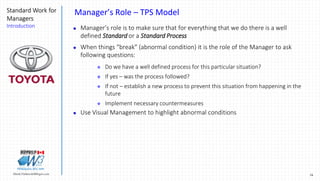
Manager’s Role – TPS Model
 Manager’s role is to make sure that for everything that we do there is a well
defined Standard or a Standard Process
 When things “break” (abnormal condition) it is the role of the Manager to ask
following questions:
 Do we have a well defined process for this particular situation?
 If yes – was the process followed?
 If not – establish a new process to prevent this situation from happening in the
future
 Implement necessary countermeasures
 Use Visual Management to highlight abnormal conditions
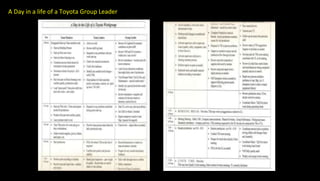
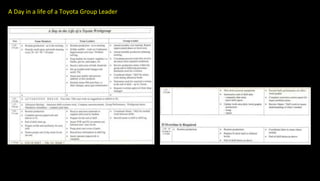
A Day in a life of a Toyota Group Leader
19Marek.Piatkowski@Rogers.com
Standard Work for
Managers
Introduction
Thinkingwin, Win, WIN
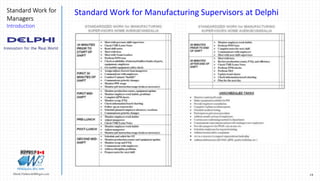
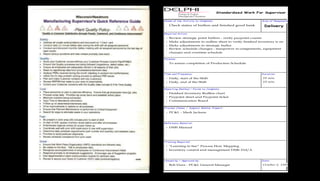
Standard Work for Manufacturing Supervisors at Delphi
20Marek.Piatkowski@Rogers.com
Standard Work for
Managers
Introduction
Thinkingwin, Win, WIN
Roles of General Supervisors and Shop Floor Managers
 Must have practical knowledge of all Standardized Work for Supervisor activities
 Must be able to provide On-the-Job [OJT] Training to all Supervisors
 Coach, advise and support
 Discipline - adhere to standards [one best way]
 Structured daily walk about, review if Standardized Work is being followed - “Show
me”
 Continuously simplify and improve Standardized Work for Supervisors
21Marek.Piatkowski@Rogers.com
Standard Work for
Managers
Introduction
Thinkingwin, Win, WIN
Why do we need Standard Work for Managers?
 “Span-of-Control” is too big
 Managers and Supervisors are responsible for too many people
 Too many activities to perform on a daily basis
 Directions from General Forman and above are not consistent within the
Organization
 Lack of discipline - Supervisors pick and choose what activities to perform
 Performance measurement is not consistent
 Processes (Supervisor activities) poorly defined
Standardized Work For Supervisor
Name of the Activity to Complete: Area of Responsibility
Check status of buffers and finished good bank Delivery
Required Action:
-
-
-
-
Purpose:
Time and Frequency: Duration:
- Daily, start of the Shift 10 min.
- Daily, end of the Shift 10 min.
Reporting Method / Forms to Complete:
-
-
-
Process Owner / Subject Matter Expert:
-
Reference Material:
-
Training Required:
-
-
Issued by / Approved by: Date:
Bob Dura - PC&L General Manager October 5, 1999
To assure completion of Production Schedule
Review strategic point buffers - verify paypoint counts
Review schedule changes - manpower re-assignments, equipment
changes and overtime schedule
Make adjustments to redline sheet to verify finished inventory is on
Make adjustments to strategic buffer.
"Learning to See'" Process Flow Mapping
PC&L - Mark Jackson
Inventory control and management DMS 23d/A
Paypoint sheet and Paypoint ticket
Communication Board
Finished Inventory Redline chart
DMS Manual
23Marek.Piatkowski@Rogers.com
Standard Work for
Managers
Introduction
Thinkingwin, Win, WIN
Time Elements of Supervisor’s Activities
 All daily activities are to be grouped into ten major elements of a work day:
1. Pre-shift activities
2. Shift start-up activities
3. Post start-up activities
4. After 1st Break activities
5. During lunch activities
6. After lunch activities
7. After 2nd break activities
8. Shift to shift review
9. End of shift activities
10. Incidental activities
24Marek.Piatkowski@Rogers.com
Standard Work for
Managers
Introduction
Thinkingwin, Win, WIN
1. Pre-shift activities
 Arrive at least 30 minutes before the start of the shift.
 Check all comments in the Logbook from the previous shift.
 Review all information on the Area Information Board.
 Conduct a quick walk around the area. Check each operation for:
 equipment status
 status of buffers and finished goods banks
 5S and Workplace Organization
 safety requirements
 Discuss issues discovered during your walk with previous shift supervisor.
 Check time attendance and call-ins.
 Prepare for the 5-minute start up meeting.
25Marek.Piatkowski@Rogers.com
Standard Work for
Managers
Introduction
Thinkingwin, Win, WIN
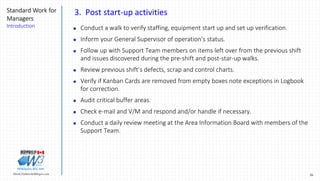
2. Shift start-up activities
 Conduct 5-minute start up meeting at Area Information Board.
 Check attendance and record absentees. Note physical condition of all members of
your group.
 Review with all participants issues and information related to:
 Issues from preceding shift
 Daily schedule and changeovers
 Assign work and responsibilities to all members of your group.
SAFETY QUALITY DELIVERY PRODUCTIVITY COST PEOPLE
26Marek.Piatkowski@Rogers.com
Standard Work for
Managers
Introduction
Thinkingwin, Win, WIN
3. Post start-up activities
 Conduct a walk to verify staffing, equipment start up and set up verification.
 Inform your General Supervisor of operation’s status.
 Follow up with Support Team members on items left over from the previous shift
and issues discovered during the pre-shift and post-star-up walks.
 Review previous shift’s defects, scrap and control charts.
 Verify if Kanban Cards are removed from empty boxes note exceptions in Logbook
for correction.
 Audit critical buffer areas.
 Check e-mail and V/M and respond and/or handle if necessary.
 Conduct a daily review meeting at the Area Information Board with members of the
Support Team.
27Marek.Piatkowski@Rogers.com
Standard Work for
Managers
Introduction
Thinkingwin, Win, WIN
4. After 1st break activities
 Check overall performance and record on information boards.
 Record quality defects on tracking chart.
 Work on countermeasures to quality problems.
 If parts-related problem, discuss with QC engineers for problem solving.
 Check repairs at the inspection and repair stations set up countermeasures to
correct and prevent.
 Review and sign off on all quality and set up verification charts.
 Do a complete walk and observation of your operation. Solicit feedback from
operators on process audit.
 Re-instruct operators on job instructions if any exception to standard practice is
noted.
28Marek.Piatkowski@Rogers.com
Standard Work for
Managers
Introduction
Thinkingwin, Win, WIN
5. During lunch activities
 Take lunch when appropriate.
 Schedule or attend meetings
29Marek.Piatkowski@Rogers.com
Standard Work for
Managers
Introduction
Thinkingwin, Win, WIN
6. After lunch activities
 Monitor work practices, equipment cycle times and give appropriate feedback.
 Review quality audits information and set up verification.
 Perform safety observation tour.
 Check progress of equipment repairs or modifications.
 Check time attendance for call ins and secure backfill.
 Review employee’s work by gauging their parts after them.
 Record and verify hourly production performance.
30Marek.Piatkowski@Rogers.com
Standard Work for
Managers
Introduction
Thinkingwin, Win, WIN
7. After 2nd break activities
 Record and verify hourly production performance.
 Enter information into Supervisor’s logbook as appropriate.
 Review quality audits information and set up verification.
 Review Kanban Pull cards, are employees following Pull card handling rules?
 Check 5S condition of manufacturing area and make appropriate corrections.
 Verify maintenance needs and make appropriate communication or follow up.
 Give feedback on work practices and performance information.
 Audit critical buffers.
 Prepare for shift to shift review. Update all necessary charts on the Area
Information Board.
 Seek appropriate help from support team, i.e. Maintenance Response, Quality,
Production Planning or Engineering.
31Marek.Piatkowski@Rogers.com
Standard Work for
Managers
Introduction
Thinkingwin, Win, WIN
8. Shift to shift review
 Record or verify hourly production performance at the Area Information Board.
 Conduct shift to shift review with the next shift Supervisor.
 Monitor work practices during walk around and document “out of condition” for
the next day’s feedback.
32Marek.Piatkowski@Rogers.com
Standard Work for
Managers
Introduction
Thinkingwin, Win, WIN
9. End of shift activities
 Update green cross and complete safety incident reports as required.
 Verify if data at the Information Board is accurate and complete.
 Document “out of condition” items for the day and follow up required.
 Follow up on any uncompleted tasks of the day
 Check status of buffers and finished goods banks.
 Check inventory of necessary supplies (gloves, safety glasses, aprons, etc.) for your
group. If necessary, get more supplies.
 Check e-mail and V/M and respond and/or handle if necessary.
 Assist as required for next shifts start-up.
33Marek.Piatkowski@Rogers.com
Standard Work for
Managers
Introduction
Thinkingwin, Win, WIN
10. Incidental and on-going daily activities
 Monitor and follow-up on all production delays and line stoppages resulting from
parts shortages, equipment break down and quality problems.
 Immediately respond any quality problems reported by operators.
 Be available at all times to assist operators in solving production related problems.
 Do not leave the production area without notifying key operators of your
destination and estimated time of return. Make a note of your absence on the Area
Information Board.
 Request General Supervisors’ approval to participate in any outside meetings.
 Monitor production results and verify hourly production performance rates on the
Area Information Board throughout shift.
 Monitor any abnormal or any out of control process conditions.
 Observe each operator on regular basis and fully understand the status of your
group.
 Monitor PPE and work habits. Provide appropriate feedback.
34Marek.Piatkowski@Rogers.com
Standard Work for
Managers
Introduction
Thinkingwin, Win, WIN
Standardized Work for Supervisors
Weekly Activities
Daily Themes
35Marek.Piatkowski@Rogers.com
Standard Work for
Managers
Introduction
Thinkingwin, Win, WIN
Monday - Training
 Assist in training for new operators in your area.
 Complete equalization of hours for previous week.
 Complete training records for new employees.
 Update training matrix in Supervisor’s logbook.
 Move training records for employees leaving department to in active file.
 Counsel and manage members of your group on human resources issues.
 Delete employees’ names from certification sheet that have transferred out.
 Place new employees’ names on OJT / certification sheet.
36Marek.Piatkowski@Rogers.com
Standard Work for
Managers
Introduction
Thinkingwin, Win, WIN
Tuesday - Safety
 Verify fork truck / jack-stacker safety checklist compliance.
 Verify condition of safety place cards.
 Review training matrix for safety training to ensure compliance.
 Notify employees of shift preference.
 Conduct housekeeping / safety observation tour and document results.
 Meet with Area Safety Representative.
 Formal meeting with General Supervisor to evaluate previous week’s performance.
37Marek.Piatkowski@Rogers.com
Standard Work for
Managers
Introduction
Thinkingwin, Win, WIN
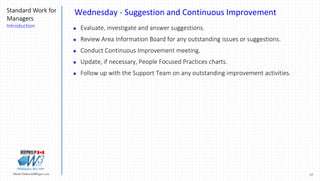
Wednesday - Suggestion and Continuous Improvement
 Evaluate, investigate and answer suggestions.
 Review Area Information Board for any outstanding issues or suggestions.
 Conduct Continuous Improvement meeting.
 Update, if necessary, People Focused Practices charts.
 Follow up with the Support Team on any outstanding improvement activities.
38Marek.Piatkowski@Rogers.com
Standard Work for
Managers
Introduction
Thinkingwin, Win, WIN
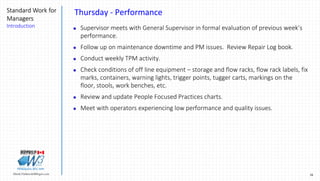
Thursday - Performance
 Supervisor meets with General Supervisor in formal evaluation of previous week’s
performance.
 Follow up on maintenance downtime and PM issues. Review Repair Log book.
 Conduct weekly TPM activity.
 Check conditions of off line equipment – storage and flow racks, flow rack labels, fix
marks, containers, warning lights, trigger points, tugger carts, markings on the
floor, stools, work benches, etc.
 Review and update People Focused Practices charts.
 Meet with operators experiencing low performance and quality issues.
39Marek.Piatkowski@Rogers.com
Standard Work for
Managers
Introduction
Thinkingwin, Win, WIN
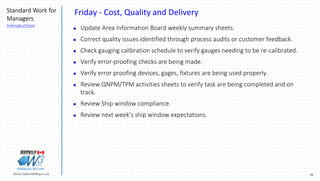
Friday - Cost, Quality and Delivery
 Update Area Information Board weekly summary sheets.
 Correct quality issues identified through process audits or customer feedback.
 Check gauging calibration schedule to verify gauges needing to be re-calibrated.
 Verify error-proofing checks are being made.
 Verify error proofing devices, gages, fixtures are being used properly.
 Review QNPM/TPM activities sheets to verify task are being completed and on
track.
 Review Ship window compliance.
 Review next week’s ship window expectations.
42Marek.Piatkowski@Rogers.com
Standard Work for
Managers
Introduction
Thinkingwin, Win, WIN
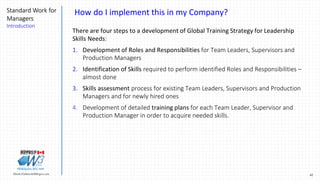
How do I implement this in my Company?
There are four steps to a development of Global Training Strategy for Leadership
Skills Needs:
1. Development of Roles and Responsibilities for Team Leaders, Supervisors and
Production Managers
2. Identification of Skills required to perform identified Roles and Responsibilities –
almost done
3. Skills assessment process for existing Team Leaders, Supervisors and Production
Managers and for newly hired ones
4. Development of detailed training plans for each Team Leader, Supervisor and
Production Manager in order to acquire needed skills.
43Marek.Piatkowski@Rogers.com
Standard Work for
Managers
Introduction
Thinkingwin, Win, WIN
Roles and
Responsibilities
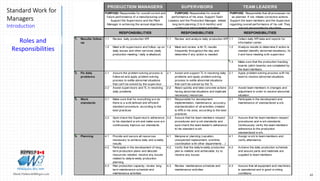
1. Results follow-
up
1.1 Review daily production KPI 1.1 Review and analyze daily production KPI 1.1 Collect daily KPI data and reports for
information center
1.2 Meet w ith supervisors and follow -up on
daily issues and other services (daily
production meeting / daily w alkabout)
1.2 Meet and review w ith TL results
frequently throughout the day and
determine if any action is needed
1.2 Analyze results to determine if action is
needed (identify abnormal situations), fix
it and have meeting w ith supervisor
1.3 Make sure that the production tracking
boards (pitch boards) are completed by
the team members.
2. 2.1 Assure the problem solving process is
follow ed and apply problem solving
process to settle abnormal situations
that can't be solved by the supervisor
2.1 Assist and support TL in resolving daily
problems and apply problem solving
process to settle abnormal situations
that can't be solved by the TL
2.1 Apply problem solving process w ith his
team to resolve abnormal situations
2.2 Assist supervisors and TL in resolving
daily problems
2.2 React quickly and take concrete actions
facing abnormal situations and implicate
necessary resources
2.2 Assist team members in changes and
adjustment in order to resolve abnormal
situation
3. Work
standards
3.1 Make sure that for everything w e do
there is a w ell defined and efficient
standard procedure, according to the
best practices
3.1 Responsible for development,
implementation, maintenance, accuracy,
standardization of all activities (related
to KPI) in his area, according to the best
practices
3.1 Participate in the development and
maintenance of standardized w ork.
3.2 Spot-check the Supervisor's adherence
to his standard w ork and make sure w e
continuously improve our standards.
3.2 Assure that his team members respect
procedures and w ork standards and
spot-check the team leader's adherence
to his standard w ork
3.2 Assure that his team members respect
procedures and w ork standards.
Continuously verify the team members'
adherence to the production
standardized w ork.
4. Planning 4.1 Provide and secure all resources
necessary to achieve daily and w eekly
results
4.1 Manpow er planning (vacation,
unexpected replacement, overtime,
coordination w ith other departments…)
4.1 Assign w ork to team members and
verify attendance
4.2 Participate in the development of long
term production plans and allocate
resources needed, resolve any issues
related to daily/w eekly production
planning
4.2 Verify that the daily/w eekly production
plan is realistic and achievable, try to
resolve any issues
4.2 Achieve the daily production schedule
and assure parts and materials are
supplied to team members
4.3 Plan production capacity, review long
term maintenance schedule and
maintenance activities
4.3 Review maintenance schedule and
maintenance activities
4.3 Assure that all equipment and machinery
is operational and in good w orking
conditions
PURPOSE: Responsible that all processes run
as planned. If not, initiate corrective actions.
Support the team members and the Supervisor
regarding overall performance of his cell. They
are not responsible for discipline.
SUPERVISORS
PURPOSE: Responsible for overall
performance of his area. Support Team
Leaders and the Production Manager. Initiate
long term planning (3 to 6 months) and
continuous improvement activities.
Fix daily
problems
RESPONSIBILITIES
PURPOSE: Responsible for overall current and
future performance of a manufacturing unit.
Support the Supervisors and the Plant
Manager in achieving the annual objectives.
RESPONSIBILITIESRESPONSIBILITIES
PRODUCTION MANAGERS TEAM LEADERS
44Marek.Piatkowski@Rogers.com
Standard Work for
Managers
Introduction
Thinkingwin, Win, WIN
Roles and
Responsibilities
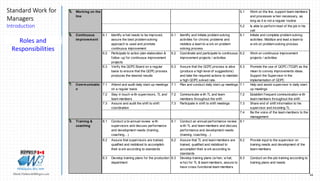
5. Working on the
line
5.1 Work on the line, support team members
and processes w hen necessary, as
long as it is not a regular routine
5.2 Is able to perform most of the job in his
cell
6. Continuous
improvement
6.1 Identify w hat needs to be improved,
assure the best problem solving
approach is used and promote
continuous improvement
6.1 Identify and initiate problem solving
activities for chronic problems and
mobilize a team to w ork on problem
solving process
6.1 Initiate and complete problem solving
activities. Mobilize and lead a team to
w ork on problem solving process
6.2 Participate to action plan elaboration &
follow -up for continuous improvement
projects
6.2 Coordinate and participate to continuous
improvement projects / activities
6.2 Work on continuous improvement
projects / activities
6.3 Verify the QCPC Board on a regular
basis to ensure that the QCPC process
produces the desired results
6.3 Assure that the QCPC process is alive
(produce a high level of suggestions)
and take the required actions to maintain
a high QCPC solved rate.
6.3 Promote the use of QCPC (TCQP) as the
mean to convey improvements ideas.
Support the Supervisor in the
implementation of QCPC
7. 7.1 Attend and audit daily start-up meetings
on a regular basis
7.1 Plan and conduct daily start-up meetings 7.1 Help and assist supervisor in daily start-
up meetings
7.2 Stay in touch w ith supervisors, TL and
team members
7.2 Communicate w ith TL and team
members throughout the shift
7.2 Establish frequent communication w ith
team members throughout the shift
7.3 Assure and audit the shift to shift
coordination
7.3 Participate in shift to shift meetings 7.3 Share end of shift information to his
supervisor and incoming TL
7.4 Be the voice of the team members to the
management
8. Training &
coaching
8.1 Conduct a bi-annual review w ith
supervisors and discuss performance
and development needs (training,
coaching…)
8.1 Conduct an annual performance review
w ith TL and team members and discuss
performance and development needs
(training, coaching…)
8.1
8.2 Assure that supervisors are trained,
qualified and mobilized to accomplish
their w ork according to standards
8.2 Assure that TL and team members are
trained, qualified and mobilized to
accomplish their w ork according to
standards
8.2 Provide input to the supervisor on
training needs and development of the
team members
8.3 Develop training plans for the production
department
8.3 Develop training plans (w hen, w hat,
w ho) for TL & team members, assure to
have cross-functional team members
8.3 Conduct on-the-job training according to
training plans and needs
Communicatio
n
45Marek.Piatkowski@Rogers.com
Standard Work for
Managers
Introduction
Thinkingwin, Win, WIN
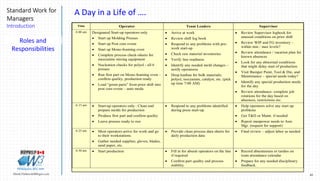
A Day in a Life of ….
Time Operator Team Leaders Supervisor
6:00 am Designated Start-up operators only
 Start up Molding Presses
 Start up Post cure ovens
 Start up Mono-foaming oven
 Complete process check-sheets for
mezzanine mixing equipment
 Nucleation checks for polyol - all 6
presses
 Run first part on Mono-foaming oven –
confirm quality, production ready
 Load “green parts” from prior shift into
post cure ovens – auto mode.
 Arrive at work
 Review shift log book
 Respond to any problems with pre-
work start-up
 Check raw material inventories
 Verify line readiness
 Identify any needed mold changes –
notify operatorss
 Drop kanban for bulk materials;
polyol, isocyanate, catalyst, etc. (pick
up time 7:00 AM)
 Review Supervisor logbook for
unusual conditions on prior shift
 Review WIP and FG inventory –
within min / max levels?
 Review attendance / vacation plan for
known absences
 Look for any abnormal conditions
that might delay start of production
 Visit Bumper Paint, Tool & Die, and
Maintenance – special needs today?
 Identify any special production needs
for the day
 Review attendance- complete job
rotations for the day based on
absences, restrictions etc.
6:15 am  Start-up operators only : Clean and
prepare molds for production
 Produce first part and confirm quality
 Leave presses ready to run
 Respond to any problems identified
during press start-up.
 Help operators solve any start up
problems
 Get T&D or Maint. if needed
 Report manpower needs to Asst.
Mgr. (request for support)
6:25 am  Most operators arrive for work and go
to their workstations.
 Gather needed supplies; gloves, blades,
sand paper, etc.
 Provide clean process data sheets for
daily production data
 Final review – adjust labor as needed
6:30 am  Start production  Fill in for absent operators on the line
if required
 Confirm part quality and process
stability
 Record absenteeism or tardies on
team attendance calendar
 Prepare for any needed disciplinary
feedback.
Roles and
Responsibilities
46Marek.Piatkowski@Rogers.com
Standard Work for
Managers
Introduction
Thinkingwin, Win, WIN
Changing the World. One Kaizen at a time
This presentation is an intellectual property of W3 Group Canada Inc.
No parts of this document can be copied or reproduced
without written permission from:
Marek Piatkowski
W3 Group Canada Inc.
iPhone: 416-235-2631
Cell: 248-207-0416
Marek.Piatkowski@rogers.com
http://twi-network.com
47Marek.Piatkowski@Rogers.com
Standard Work for
Managers
Introduction
Thinkingwin, Win, WIN
Presentations in this
Workshop
1. Log in to:
www.slideshare.net
2. Type in my name in
search area:
Marek Piatkowski
3. Select a presentation you
want to see
4. Learn and Enjoy

Stdw for managers and supervisors october 2016

  • 1.
    1Marek.Piatkowski@Rogers.com Standard Work for Managers Introduction Thinkingwin,Win, WIN Standard Work for Managers and Supervisor Definitions Marek Piatkowski – October 2016 Standard Work Visual Controls Standard Management GOLDEN TRIANGLE Is this condition Normal or Abnormal? Are all procedures being followed? “How do I know this process is producing good parts?” Supervisor Standard Work Immediate Reaction - “If its not important to the Leadership, it will not be important to the people.” Escalation Process Expectations clearly understood by everyone. Realistic Standards Strictly Enforced
  • 2.
    2Marek.Piatkowski@Rogers.com Standard Work for Managers Introduction Thinkingwin,Win, WIN Introduction - Marek Piatkowski  Professional Background  Toyota Motor Manufacturing Canada (TMMC) - Cambridge, Ontario from 1987-1994  TPS/Lean Transformation Consulting - since 1994  Professional Affiliations  TWI Network – John Shook, Founder  Lean Enterprise Institute (LEI) – Jim Womack  Lean Enterprise Academy (LEA) – Daniel Jones  CCM/CAINTRA – Monterrey, Mexico  SME, AME, ASQ, CME  Lean Manufacturing Solutions - Toronto, Canada http://twi-network.com
  • 3.
  • 4.
    4Marek.Piatkowski@Rogers.com Standard Work for Managers Introduction Thinkingwin,Win, WIN 2 Fundamentals of Standardized Work for Managers  All activities performed by a Supervisor must be defined as a standard process  A standard process is defined as:  knowing what to do  knowing when to perform the activity  knowing why it needs to be done  knowing who should do it  knowing where the activity should take place  knowing how to perform the activity  Standardized work is not completed until it is documented using the “Standardized Work for Supervisor” sheet  Supervisor follows Standardized Work process
  • 5.
    5Marek.Piatkowski@Rogers.com Standard Work for Managers Introduction Thinkingwin,Win, WIN Why do we need Standard Work for Managers?  Dependency on other departments (Engineering, Quality, Maintenance, PC&L, HR, etc.) to solve or improve departmental problems  Lack of knowledge about what to do  Lack of knowledge of basic fundamentals of manufacturing  quality and safety procedures  production scheduling  data collection and analysis, problem solving  maintenance, process flow  continuous improvement, DMS...
  • 6.
    6Marek.Piatkowski@Rogers.com Standard Work for Managers Introduction Thinkingwin,Win, WIN Standard Work Before establishing Visual Controls, you must first define what “standard” you are trying to control. Has this standard been documented? Has everyone been trained in the expectation? Visual Controls Decide on what “visuals” are needed to “let you see” if the Standard Work is being followed. This can be as simple as a square on the floor, or as complicated as an ANDON system. Standard Management What is the re-action plan when the “standard” is not followed? The Visual Control should show you when “abnormal” conditions occur. Systems will not always adhere to the standard. There will always be the unexpected situation. If you do not want the abnormal to become the normal, there must be a re-action plan to get the “abnormal” back to the standard. This should also be documented, people trained in the expectation, and “visually controlled”. Standard Work Visual Controls Standard Management GOLDEN TRIANGLE Is this condition Normal or Abnormal? Are all procedures being followed? “How do I know this process is producing good parts?” Supervisor Standard Work Immediate Reaction - “If its not important to the Leadership, it will not be important to the people.” Escalation Process Expectations clearly understood by everyone. Realistic Standards Strictly Enforced
  • 7.
    7Marek.Piatkowski@Rogers.com Standard Work for Managers Introduction Thinkingwin,Win, WIN Standard Work Visual Controls Standard Management GOLDEN TRIANGLE Is this condition Normal or Abnormal? Are all procedures being followed? “How do I know this process is producing good parts?” Supervisor Standard Work Immediate Reaction - “If its not important to the Leadership, it will not be important to the people.” Escalation Process Expectations clearly understood by everyone. Realistic Standards Strictly Enforced
  • 8.
    8Marek.Piatkowski@Rogers.com Standard Work for Managers Introduction Thinkingwin,Win, WIN TWI Five Qualities of a Leader Definitions Marek Piatkowski – October 2016
  • 9.
    9Marek.Piatkowski@Rogers.com Standard Work for Managers Introduction Thinkingwin,Win, WIN From TWI Manual  Select managers on a basis of leadership qualities, and not only on job knowledge and job skills  An important aid at the time of selection is the preparation of a written position description, setting forth clearly the duties and results expected of the incumbent  See that all members of the executive and managerial group understand the company’s policies, particularly, employee relations policies  See that each executive and supervisor is given sufficient authority to carry out the responsibility assigned to him
  • 10.
    10Marek.Piatkowski@Rogers.com Standard Work for Managers Introduction Thinkingwin,Win, WIN Five Qualities of a Leader 1. Knowledge of work - how to perform a job 2. Knowledge of responsibility - what we need to do by when 3. Skills in instructing - how to instruct employees to do the job correctly 4. Skill in improvement - how can we do this better 5. Leadership skills - behavior and motivation
  • 11.
    11Marek.Piatkowski@Rogers.com Standard Work for Managers Introduction Thinkingwin,Win, WIN 1. Knowledge of work  In order to properly direct the people under his supervision, the manager himself must know:  what doing the particular kind of work involves  what are the requirements of each job  what materials and equipment are needed  how the job is done  what standards must be met  Knowledge concerning materials, machinery, processes, methods, and necessary kinds of technologies concerning fabrication.  Knowledge of specialized kind of information and skills required to perform the work in the area.  Knowledge of production steps  It requires practical knowledge of the workplace.
  • 12.
    12Marek.Piatkowski@Rogers.com Standard Work for Managers Introduction Thinkingwin,Win, WIN 2. Knowledge of responsibilities  The manager represents company values  Unless he clearly knows what management expects him to pass on to the employees, what company policies control his actions, and where he fits into the organization, he cannot be an effective manager  Training managers in company policies and relationships is an important phase of improving the quality of management  Knowledge of responsibilities pertains to understanding of goals and objectives of the company.  Understanding of your responsibilities and authority as a leader. (company policies, company strategies, goals and objectives, agreements, safety and regulations).  It includes an awareness of the need to perform work according to company policy and a concern to meet the production plan and observe the rules.  A leader’s knowledge, responsibility and authority is directly related to successful implementation of Continuous Improvement in the workplace.
  • 13.
    13Marek.Piatkowski@Rogers.com Standard Work for Managers Introduction Thinkingwin,Win, WIN 3. Skills in Instructing  Teaching skills are necessary for the Leaders in order to provide training for the employees.  Leaders must understand how adults learn and when the training is completed.  These skills require an ability to teach (instruct) people a basic understanding of tools, such as Standardized Work and Work Instruction, production equipment and production steps.  Leaders must foster the development of highly skilled employees and Continuous Improvement.  The manager must be able to get an employee to do a job quickly, correctly, and conscientiously  There is no time to be wasted on “coming up to standard rate,” and scrap and delays must be reduced to a minimum  Managers must understand how adults learn and when the training is completed
  • 14.
    14Marek.Piatkowski@Rogers.com Standard Work for Managers Introduction Thinkingwin,Win, WIN 4. Skills in Improving Methods  The development of improvements does not require inventive genius—but it does require the questioning attitude of a supervisor who knows the intimate details. The skill of improving methods can be learned.  Many people never question the current method, they just keep on in the old way. Leaders must be skillful in conducting Continuous Improvement and eliminating “waste” in the workplace.  A starting point for making improvements is to determine the working sequence. The next step would be to systematically analyze, study and simplify work methods.  Many people never question the current method - they just keep on in the old way  The development of improvements does not require inventive genius—but it does require the questioning attitude of a manager who knows the intimate details.  The skill of improving methods can be learned. It provides a way for tremendous savings through making more effective use of manpower, machines, and materials
  • 15.
    15Marek.Piatkowski@Rogers.com Standard Work for Managers Introduction Thinkingwin,Win, WIN 5. Leadership Skills  Full productive effort happens only when the supervisor becomes the leader of his people, when he organizes them into a team and they work together well.  Being skillful at handling people is important, especially when trying to encourage employee participation. Supervisors must quickly learn to lead their people.  In critical times, the situations which cause misunderstandings and grievances have multiplied, and the results of these delays are more serious than ever before.  In the past, supervisors have developed a skill in leadership through experience. TWI helps management to provide its supervisors with this skill through the Job Relations program.  Leadership skills help managers to improve his or her ability in working with people  Being skillful at handling people is important, especially when trying to encourage employee participation  There are basic principles that when applied day in and day out will tend to keep relationships smooth and prevent problems from arising
  • 16.
    16Marek.Piatkowski@Rogers.com Standard Work for Managers Introduction Thinkingwin,Win, WIN Manager’s Role – TPS Model  Manager’s role is to make sure that for everything that we do there is a well defined Standard or a Standard Process  When things “break” (abnormal condition) it is the role of the Manager to ask following questions:  Do we have a well defined process for this particular situation?  If yes – was the process followed?  If not – establish a new process to prevent this situation from happening in the future  Implement necessary countermeasures  Use Visual Management to highlight abnormal conditions
  • 17.
    A Day ina life of a Toyota Group Leader
  • 18.
    A Day ina life of a Toyota Group Leader
  • 19.
    19Marek.Piatkowski@Rogers.com Standard Work for Managers Introduction Thinkingwin,Win, WIN Standard Work for Manufacturing Supervisors at Delphi
  • 20.
    20Marek.Piatkowski@Rogers.com Standard Work for Managers Introduction Thinkingwin,Win, WIN Roles of General Supervisors and Shop Floor Managers  Must have practical knowledge of all Standardized Work for Supervisor activities  Must be able to provide On-the-Job [OJT] Training to all Supervisors  Coach, advise and support  Discipline - adhere to standards [one best way]  Structured daily walk about, review if Standardized Work is being followed - “Show me”  Continuously simplify and improve Standardized Work for Supervisors
  • 21.
    21Marek.Piatkowski@Rogers.com Standard Work for Managers Introduction Thinkingwin,Win, WIN Why do we need Standard Work for Managers?  “Span-of-Control” is too big  Managers and Supervisors are responsible for too many people  Too many activities to perform on a daily basis  Directions from General Forman and above are not consistent within the Organization  Lack of discipline - Supervisors pick and choose what activities to perform  Performance measurement is not consistent  Processes (Supervisor activities) poorly defined
  • 22.
    Standardized Work ForSupervisor Name of the Activity to Complete: Area of Responsibility Check status of buffers and finished good bank Delivery Required Action: - - - - Purpose: Time and Frequency: Duration: - Daily, start of the Shift 10 min. - Daily, end of the Shift 10 min. Reporting Method / Forms to Complete: - - - Process Owner / Subject Matter Expert: - Reference Material: - Training Required: - - Issued by / Approved by: Date: Bob Dura - PC&L General Manager October 5, 1999 To assure completion of Production Schedule Review strategic point buffers - verify paypoint counts Review schedule changes - manpower re-assignments, equipment changes and overtime schedule Make adjustments to redline sheet to verify finished inventory is on Make adjustments to strategic buffer. "Learning to See'" Process Flow Mapping PC&L - Mark Jackson Inventory control and management DMS 23d/A Paypoint sheet and Paypoint ticket Communication Board Finished Inventory Redline chart DMS Manual
  • 23.
    23Marek.Piatkowski@Rogers.com Standard Work for Managers Introduction Thinkingwin,Win, WIN Time Elements of Supervisor’s Activities  All daily activities are to be grouped into ten major elements of a work day: 1. Pre-shift activities 2. Shift start-up activities 3. Post start-up activities 4. After 1st Break activities 5. During lunch activities 6. After lunch activities 7. After 2nd break activities 8. Shift to shift review 9. End of shift activities 10. Incidental activities
  • 24.
    24Marek.Piatkowski@Rogers.com Standard Work for Managers Introduction Thinkingwin,Win, WIN 1. Pre-shift activities  Arrive at least 30 minutes before the start of the shift.  Check all comments in the Logbook from the previous shift.  Review all information on the Area Information Board.  Conduct a quick walk around the area. Check each operation for:  equipment status  status of buffers and finished goods banks  5S and Workplace Organization  safety requirements  Discuss issues discovered during your walk with previous shift supervisor.  Check time attendance and call-ins.  Prepare for the 5-minute start up meeting.
  • 25.
    25Marek.Piatkowski@Rogers.com Standard Work for Managers Introduction Thinkingwin,Win, WIN 2. Shift start-up activities  Conduct 5-minute start up meeting at Area Information Board.  Check attendance and record absentees. Note physical condition of all members of your group.  Review with all participants issues and information related to:  Issues from preceding shift  Daily schedule and changeovers  Assign work and responsibilities to all members of your group. SAFETY QUALITY DELIVERY PRODUCTIVITY COST PEOPLE
  • 26.
    26Marek.Piatkowski@Rogers.com Standard Work for Managers Introduction Thinkingwin,Win, WIN 3. Post start-up activities  Conduct a walk to verify staffing, equipment start up and set up verification.  Inform your General Supervisor of operation’s status.  Follow up with Support Team members on items left over from the previous shift and issues discovered during the pre-shift and post-star-up walks.  Review previous shift’s defects, scrap and control charts.  Verify if Kanban Cards are removed from empty boxes note exceptions in Logbook for correction.  Audit critical buffer areas.  Check e-mail and V/M and respond and/or handle if necessary.  Conduct a daily review meeting at the Area Information Board with members of the Support Team.
  • 27.
    27Marek.Piatkowski@Rogers.com Standard Work for Managers Introduction Thinkingwin,Win, WIN 4. After 1st break activities  Check overall performance and record on information boards.  Record quality defects on tracking chart.  Work on countermeasures to quality problems.  If parts-related problem, discuss with QC engineers for problem solving.  Check repairs at the inspection and repair stations set up countermeasures to correct and prevent.  Review and sign off on all quality and set up verification charts.  Do a complete walk and observation of your operation. Solicit feedback from operators on process audit.  Re-instruct operators on job instructions if any exception to standard practice is noted.
  • 28.
    28Marek.Piatkowski@Rogers.com Standard Work for Managers Introduction Thinkingwin,Win, WIN 5. During lunch activities  Take lunch when appropriate.  Schedule or attend meetings
  • 29.
    29Marek.Piatkowski@Rogers.com Standard Work for Managers Introduction Thinkingwin,Win, WIN 6. After lunch activities  Monitor work practices, equipment cycle times and give appropriate feedback.  Review quality audits information and set up verification.  Perform safety observation tour.  Check progress of equipment repairs or modifications.  Check time attendance for call ins and secure backfill.  Review employee’s work by gauging their parts after them.  Record and verify hourly production performance.
  • 30.
    30Marek.Piatkowski@Rogers.com Standard Work for Managers Introduction Thinkingwin,Win, WIN 7. After 2nd break activities  Record and verify hourly production performance.  Enter information into Supervisor’s logbook as appropriate.  Review quality audits information and set up verification.  Review Kanban Pull cards, are employees following Pull card handling rules?  Check 5S condition of manufacturing area and make appropriate corrections.  Verify maintenance needs and make appropriate communication or follow up.  Give feedback on work practices and performance information.  Audit critical buffers.  Prepare for shift to shift review. Update all necessary charts on the Area Information Board.  Seek appropriate help from support team, i.e. Maintenance Response, Quality, Production Planning or Engineering.
  • 31.
    31Marek.Piatkowski@Rogers.com Standard Work for Managers Introduction Thinkingwin,Win, WIN 8. Shift to shift review  Record or verify hourly production performance at the Area Information Board.  Conduct shift to shift review with the next shift Supervisor.  Monitor work practices during walk around and document “out of condition” for the next day’s feedback.
  • 32.
    32Marek.Piatkowski@Rogers.com Standard Work for Managers Introduction Thinkingwin,Win, WIN 9. End of shift activities  Update green cross and complete safety incident reports as required.  Verify if data at the Information Board is accurate and complete.  Document “out of condition” items for the day and follow up required.  Follow up on any uncompleted tasks of the day  Check status of buffers and finished goods banks.  Check inventory of necessary supplies (gloves, safety glasses, aprons, etc.) for your group. If necessary, get more supplies.  Check e-mail and V/M and respond and/or handle if necessary.  Assist as required for next shifts start-up.
  • 33.
    33Marek.Piatkowski@Rogers.com Standard Work for Managers Introduction Thinkingwin,Win, WIN 10. Incidental and on-going daily activities  Monitor and follow-up on all production delays and line stoppages resulting from parts shortages, equipment break down and quality problems.  Immediately respond any quality problems reported by operators.  Be available at all times to assist operators in solving production related problems.  Do not leave the production area without notifying key operators of your destination and estimated time of return. Make a note of your absence on the Area Information Board.  Request General Supervisors’ approval to participate in any outside meetings.  Monitor production results and verify hourly production performance rates on the Area Information Board throughout shift.  Monitor any abnormal or any out of control process conditions.  Observe each operator on regular basis and fully understand the status of your group.  Monitor PPE and work habits. Provide appropriate feedback.
  • 34.
    34Marek.Piatkowski@Rogers.com Standard Work for Managers Introduction Thinkingwin,Win, WIN Standardized Work for Supervisors Weekly Activities Daily Themes
  • 35.
    35Marek.Piatkowski@Rogers.com Standard Work for Managers Introduction Thinkingwin,Win, WIN Monday - Training  Assist in training for new operators in your area.  Complete equalization of hours for previous week.  Complete training records for new employees.  Update training matrix in Supervisor’s logbook.  Move training records for employees leaving department to in active file.  Counsel and manage members of your group on human resources issues.  Delete employees’ names from certification sheet that have transferred out.  Place new employees’ names on OJT / certification sheet.
  • 36.
    36Marek.Piatkowski@Rogers.com Standard Work for Managers Introduction Thinkingwin,Win, WIN Tuesday - Safety  Verify fork truck / jack-stacker safety checklist compliance.  Verify condition of safety place cards.  Review training matrix for safety training to ensure compliance.  Notify employees of shift preference.  Conduct housekeeping / safety observation tour and document results.  Meet with Area Safety Representative.  Formal meeting with General Supervisor to evaluate previous week’s performance.
  • 37.
    37Marek.Piatkowski@Rogers.com Standard Work for Managers Introduction Thinkingwin,Win, WIN Wednesday - Suggestion and Continuous Improvement  Evaluate, investigate and answer suggestions.  Review Area Information Board for any outstanding issues or suggestions.  Conduct Continuous Improvement meeting.  Update, if necessary, People Focused Practices charts.  Follow up with the Support Team on any outstanding improvement activities.
  • 38.
    38Marek.Piatkowski@Rogers.com Standard Work for Managers Introduction Thinkingwin,Win, WIN Thursday - Performance  Supervisor meets with General Supervisor in formal evaluation of previous week’s performance.  Follow up on maintenance downtime and PM issues. Review Repair Log book.  Conduct weekly TPM activity.  Check conditions of off line equipment – storage and flow racks, flow rack labels, fix marks, containers, warning lights, trigger points, tugger carts, markings on the floor, stools, work benches, etc.  Review and update People Focused Practices charts.  Meet with operators experiencing low performance and quality issues.
  • 39.
    39Marek.Piatkowski@Rogers.com Standard Work for Managers Introduction Thinkingwin,Win, WIN Friday - Cost, Quality and Delivery  Update Area Information Board weekly summary sheets.  Correct quality issues identified through process audits or customer feedback.  Check gauging calibration schedule to verify gauges needing to be re-calibrated.  Verify error-proofing checks are being made.  Verify error proofing devices, gages, fixtures are being used properly.  Review QNPM/TPM activities sheets to verify task are being completed and on track.  Review Ship window compliance.  Review next week’s ship window expectations.
  • 42.
    42Marek.Piatkowski@Rogers.com Standard Work for Managers Introduction Thinkingwin,Win, WIN How do I implement this in my Company? There are four steps to a development of Global Training Strategy for Leadership Skills Needs: 1. Development of Roles and Responsibilities for Team Leaders, Supervisors and Production Managers 2. Identification of Skills required to perform identified Roles and Responsibilities – almost done 3. Skills assessment process for existing Team Leaders, Supervisors and Production Managers and for newly hired ones 4. Development of detailed training plans for each Team Leader, Supervisor and Production Manager in order to acquire needed skills.
  • 43.
    43Marek.Piatkowski@Rogers.com Standard Work for Managers Introduction Thinkingwin,Win, WIN Roles and Responsibilities 1. Results follow- up 1.1 Review daily production KPI 1.1 Review and analyze daily production KPI 1.1 Collect daily KPI data and reports for information center 1.2 Meet w ith supervisors and follow -up on daily issues and other services (daily production meeting / daily w alkabout) 1.2 Meet and review w ith TL results frequently throughout the day and determine if any action is needed 1.2 Analyze results to determine if action is needed (identify abnormal situations), fix it and have meeting w ith supervisor 1.3 Make sure that the production tracking boards (pitch boards) are completed by the team members. 2. 2.1 Assure the problem solving process is follow ed and apply problem solving process to settle abnormal situations that can't be solved by the supervisor 2.1 Assist and support TL in resolving daily problems and apply problem solving process to settle abnormal situations that can't be solved by the TL 2.1 Apply problem solving process w ith his team to resolve abnormal situations 2.2 Assist supervisors and TL in resolving daily problems 2.2 React quickly and take concrete actions facing abnormal situations and implicate necessary resources 2.2 Assist team members in changes and adjustment in order to resolve abnormal situation 3. Work standards 3.1 Make sure that for everything w e do there is a w ell defined and efficient standard procedure, according to the best practices 3.1 Responsible for development, implementation, maintenance, accuracy, standardization of all activities (related to KPI) in his area, according to the best practices 3.1 Participate in the development and maintenance of standardized w ork. 3.2 Spot-check the Supervisor's adherence to his standard w ork and make sure w e continuously improve our standards. 3.2 Assure that his team members respect procedures and w ork standards and spot-check the team leader's adherence to his standard w ork 3.2 Assure that his team members respect procedures and w ork standards. Continuously verify the team members' adherence to the production standardized w ork. 4. Planning 4.1 Provide and secure all resources necessary to achieve daily and w eekly results 4.1 Manpow er planning (vacation, unexpected replacement, overtime, coordination w ith other departments…) 4.1 Assign w ork to team members and verify attendance 4.2 Participate in the development of long term production plans and allocate resources needed, resolve any issues related to daily/w eekly production planning 4.2 Verify that the daily/w eekly production plan is realistic and achievable, try to resolve any issues 4.2 Achieve the daily production schedule and assure parts and materials are supplied to team members 4.3 Plan production capacity, review long term maintenance schedule and maintenance activities 4.3 Review maintenance schedule and maintenance activities 4.3 Assure that all equipment and machinery is operational and in good w orking conditions PURPOSE: Responsible that all processes run as planned. If not, initiate corrective actions. Support the team members and the Supervisor regarding overall performance of his cell. They are not responsible for discipline. SUPERVISORS PURPOSE: Responsible for overall performance of his area. Support Team Leaders and the Production Manager. Initiate long term planning (3 to 6 months) and continuous improvement activities. Fix daily problems RESPONSIBILITIES PURPOSE: Responsible for overall current and future performance of a manufacturing unit. Support the Supervisors and the Plant Manager in achieving the annual objectives. RESPONSIBILITIESRESPONSIBILITIES PRODUCTION MANAGERS TEAM LEADERS
  • 44.
    44Marek.Piatkowski@Rogers.com Standard Work for Managers Introduction Thinkingwin,Win, WIN Roles and Responsibilities 5. Working on the line 5.1 Work on the line, support team members and processes w hen necessary, as long as it is not a regular routine 5.2 Is able to perform most of the job in his cell 6. Continuous improvement 6.1 Identify w hat needs to be improved, assure the best problem solving approach is used and promote continuous improvement 6.1 Identify and initiate problem solving activities for chronic problems and mobilize a team to w ork on problem solving process 6.1 Initiate and complete problem solving activities. Mobilize and lead a team to w ork on problem solving process 6.2 Participate to action plan elaboration & follow -up for continuous improvement projects 6.2 Coordinate and participate to continuous improvement projects / activities 6.2 Work on continuous improvement projects / activities 6.3 Verify the QCPC Board on a regular basis to ensure that the QCPC process produces the desired results 6.3 Assure that the QCPC process is alive (produce a high level of suggestions) and take the required actions to maintain a high QCPC solved rate. 6.3 Promote the use of QCPC (TCQP) as the mean to convey improvements ideas. Support the Supervisor in the implementation of QCPC 7. 7.1 Attend and audit daily start-up meetings on a regular basis 7.1 Plan and conduct daily start-up meetings 7.1 Help and assist supervisor in daily start- up meetings 7.2 Stay in touch w ith supervisors, TL and team members 7.2 Communicate w ith TL and team members throughout the shift 7.2 Establish frequent communication w ith team members throughout the shift 7.3 Assure and audit the shift to shift coordination 7.3 Participate in shift to shift meetings 7.3 Share end of shift information to his supervisor and incoming TL 7.4 Be the voice of the team members to the management 8. Training & coaching 8.1 Conduct a bi-annual review w ith supervisors and discuss performance and development needs (training, coaching…) 8.1 Conduct an annual performance review w ith TL and team members and discuss performance and development needs (training, coaching…) 8.1 8.2 Assure that supervisors are trained, qualified and mobilized to accomplish their w ork according to standards 8.2 Assure that TL and team members are trained, qualified and mobilized to accomplish their w ork according to standards 8.2 Provide input to the supervisor on training needs and development of the team members 8.3 Develop training plans for the production department 8.3 Develop training plans (w hen, w hat, w ho) for TL & team members, assure to have cross-functional team members 8.3 Conduct on-the-job training according to training plans and needs Communicatio n
  • 45.
    45Marek.Piatkowski@Rogers.com Standard Work for Managers Introduction Thinkingwin,Win, WIN A Day in a Life of …. Time Operator Team Leaders Supervisor 6:00 am Designated Start-up operators only  Start up Molding Presses  Start up Post cure ovens  Start up Mono-foaming oven  Complete process check-sheets for mezzanine mixing equipment  Nucleation checks for polyol - all 6 presses  Run first part on Mono-foaming oven – confirm quality, production ready  Load “green parts” from prior shift into post cure ovens – auto mode.  Arrive at work  Review shift log book  Respond to any problems with pre- work start-up  Check raw material inventories  Verify line readiness  Identify any needed mold changes – notify operatorss  Drop kanban for bulk materials; polyol, isocyanate, catalyst, etc. (pick up time 7:00 AM)  Review Supervisor logbook for unusual conditions on prior shift  Review WIP and FG inventory – within min / max levels?  Review attendance / vacation plan for known absences  Look for any abnormal conditions that might delay start of production  Visit Bumper Paint, Tool & Die, and Maintenance – special needs today?  Identify any special production needs for the day  Review attendance- complete job rotations for the day based on absences, restrictions etc. 6:15 am  Start-up operators only : Clean and prepare molds for production  Produce first part and confirm quality  Leave presses ready to run  Respond to any problems identified during press start-up.  Help operators solve any start up problems  Get T&D or Maint. if needed  Report manpower needs to Asst. Mgr. (request for support) 6:25 am  Most operators arrive for work and go to their workstations.  Gather needed supplies; gloves, blades, sand paper, etc.  Provide clean process data sheets for daily production data  Final review – adjust labor as needed 6:30 am  Start production  Fill in for absent operators on the line if required  Confirm part quality and process stability  Record absenteeism or tardies on team attendance calendar  Prepare for any needed disciplinary feedback. Roles and Responsibilities
  • 46.
    46Marek.Piatkowski@Rogers.com Standard Work for Managers Introduction Thinkingwin,Win, WIN Changing the World. One Kaizen at a time This presentation is an intellectual property of W3 Group Canada Inc. No parts of this document can be copied or reproduced without written permission from: Marek Piatkowski W3 Group Canada Inc. iPhone: 416-235-2631 Cell: 248-207-0416 Marek.Piatkowski@rogers.com http://twi-network.com
  • 47.
    47Marek.Piatkowski@Rogers.com Standard Work for Managers Introduction Thinkingwin,Win, WIN Presentations in this Workshop 1. Log in to: www.slideshare.net 2. Type in my name in search area: Marek Piatkowski 3. Select a presentation you want to see 4. Learn and Enjoy

Editor's Notes