L E A R N I N G
INTRODUCTION
Learning is a key process in human behavior. It is
the basic to understand behavior. It plays a vital
role in the language, customs, attitudes and
beliefs, our goals, personality characteristics and
even our perception.
DEFINITION
● Learning can be defined as a permanent
change in behavior that occurs on a result of
practice or experience.
DEFINITION
"Any activity can be called learning so far as it
develops the individual and makes him alter
behavior and experiences different from what that
would otherwise have been." - Woodworth
"Learning is the acquisition of new behavior or the
strengthening or weakening of old behavior as the
result of experience." - Henry P. Smith
FEATURES
● Learning brings change in behavior
● Changes take place through practice or
experience and not due to maturation
● The change in behavior should be relatively
permanent lasting for years, months or weeks.
THEORIES OF LEARNING
● Trial and error
● Theory of conditioned reflex
1. Classical conditioning.
2. Operant conditioning.
● Cognitive learning
1. Insight learning
2. Sign learning
● Social learning
1)TRIAL AND ERROR METHOD
● Edward Lee Thorndike (1874-1949), the American
psychologist. conducted a series of experiment
(1911) on trial and error method of learning by
animal (monkeys, dogs, hens, cats and rats were
used).
From the experiment, Thorndike has mentioned the following
salient features of animal learning:
● From trial to trial, the useless movement gradually reduced
● The random movements become more specific .
● Finally, the animal learns the method.
This is known as trial and error learning. Thorndike had
suggested three laws of learning from this study:
● Law of effect
● Law of frequency
● Law of recency
2) THEORY OF CONDITIONED REFLEX
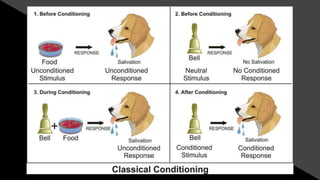
CLASSICAL CONDITIONING
● Classical conditioning is also known as respondent
conditioning, Pavlovian conditioning or associative
learning.
● pavlov decided to see whether a dog could be
taught to associate food with other rings ,such as
light or a tone.
● Classical conditioning is a form of learning in which
people ( or any organism) learns to associate two stimuli
that occur in sequence
● Classical conditioning occurs when a person forms a
mental association between two stimuli, so that
encountering one stimulus means the person think of the
other
Laws of Classical Conditioning:
● Extinction
● Spontaneous recovery
● Generalization
● Discrimination
Uses of Classical Conditioning:
● Used to develop good habits
● Breaking bad habits and elimination
● To train animals
● Used in psychotherapy
● Used to develop attitude.
OPERANT CONDITIONING (INSTRUMENTAL
CONDITIONING)
● The term operant conditioning was coined by B.F.
Skinner to indicate that when a response operates on
the environment, it may have consequences that can
affect the likelihood that response will occur again.
● It operates on the law of effect proposed by Thorndike. If
behavior is rewarded, it persists; if it is punished, it stops.
In the instrumental conditioning, the learner has some
control over his circumstances. This is very useful in:
● Shaping and modification of behavior
● Used in psychotherapy
● Used in learning.
Classical Conditioning Operant Conditioning
● Response is elicited
● Stimulus oriented
● Involuntary response
● Organism is passive
● Reinforcement comes
early
● Response is emitted
● Response oriented
● Voluntary response
● Organism is active
● Reinforcement comes after
the response
DIFFERENCE BETWEEN CLASSICAL AND OPERANT CONDITIONING
3) COGNITIVE LEARNING
According to cognitive theories, learning cannot be
explained in terms of S-R association alone. They
propose that a learner forms a cognitive structure in
memory, which organizes memory information into
relationships and meanings without any known
reinforcement, new associations are formed and new
relationships are perceived along events, simply as a
result of having experienced these events. In this,
stimulus-stimulus associations are learned.
CHARACTERISTICS OF LEARNING BY INSIGHT
● It is sudden
● It is due to understanding
● It alters perception
● New patterns of organization
● Higher species have more insight
● Insight develops usually after some trial and error
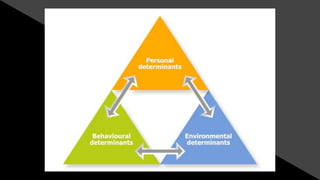
4) SOCIAL LEARNING (THROUGH OBSERVATION)
● Albert Bandura and Richard Walters focused on the
highly efficient form of learning known as
observation learning or imitation.
● Imitation is defined as a response that is like the
stimulus triggering the response, a person or animal
watches or hears another do or say something, then
respond in the same way..
EFFECTIVE WAY OF LEARNING
● Set your goals.setting goals is a very great way to keep
your focused on what you want achieve
● Keep learning and practicing new things
● Learn in multiple ways
● Teach what you have to learned to another person
● Use testings to boost up learning
● self explanation
● Create your own study guides
● concrete examples
● Read more as possible
THANK YOU FOR
LISTENING

Learning in Psychology explained .pptx

  • 1.
    L E AR N I N G
  • 2.
    INTRODUCTION Learning is akey process in human behavior. It is the basic to understand behavior. It plays a vital role in the language, customs, attitudes and beliefs, our goals, personality characteristics and even our perception.
  • 3.
    DEFINITION ● Learning canbe defined as a permanent change in behavior that occurs on a result of practice or experience.
  • 4.
    DEFINITION "Any activity canbe called learning so far as it develops the individual and makes him alter behavior and experiences different from what that would otherwise have been." - Woodworth "Learning is the acquisition of new behavior or the strengthening or weakening of old behavior as the result of experience." - Henry P. Smith
  • 5.
    FEATURES ● Learning bringschange in behavior ● Changes take place through practice or experience and not due to maturation ● The change in behavior should be relatively permanent lasting for years, months or weeks.
  • 6.
    THEORIES OF LEARNING ●Trial and error ● Theory of conditioned reflex 1. Classical conditioning. 2. Operant conditioning. ● Cognitive learning 1. Insight learning 2. Sign learning ● Social learning
  • 7.
    1)TRIAL AND ERRORMETHOD ● Edward Lee Thorndike (1874-1949), the American psychologist. conducted a series of experiment (1911) on trial and error method of learning by animal (monkeys, dogs, hens, cats and rats were used).
  • 8.
    From the experiment,Thorndike has mentioned the following salient features of animal learning: ● From trial to trial, the useless movement gradually reduced ● The random movements become more specific . ● Finally, the animal learns the method. This is known as trial and error learning. Thorndike had suggested three laws of learning from this study: ● Law of effect ● Law of frequency ● Law of recency
  • 9.
    2) THEORY OFCONDITIONED REFLEX CLASSICAL CONDITIONING ● Classical conditioning is also known as respondent conditioning, Pavlovian conditioning or associative learning. ● pavlov decided to see whether a dog could be taught to associate food with other rings ,such as light or a tone.
  • 10.
    ● Classical conditioningis a form of learning in which people ( or any organism) learns to associate two stimuli that occur in sequence ● Classical conditioning occurs when a person forms a mental association between two stimuli, so that encountering one stimulus means the person think of the other
  • 12.
    Laws of ClassicalConditioning: ● Extinction ● Spontaneous recovery ● Generalization ● Discrimination Uses of Classical Conditioning: ● Used to develop good habits ● Breaking bad habits and elimination ● To train animals ● Used in psychotherapy ● Used to develop attitude.
  • 13.
    OPERANT CONDITIONING (INSTRUMENTAL CONDITIONING) ●The term operant conditioning was coined by B.F. Skinner to indicate that when a response operates on the environment, it may have consequences that can affect the likelihood that response will occur again. ● It operates on the law of effect proposed by Thorndike. If behavior is rewarded, it persists; if it is punished, it stops.
  • 15.
    In the instrumentalconditioning, the learner has some control over his circumstances. This is very useful in: ● Shaping and modification of behavior ● Used in psychotherapy ● Used in learning.
  • 16.
    Classical Conditioning OperantConditioning ● Response is elicited ● Stimulus oriented ● Involuntary response ● Organism is passive ● Reinforcement comes early ● Response is emitted ● Response oriented ● Voluntary response ● Organism is active ● Reinforcement comes after the response DIFFERENCE BETWEEN CLASSICAL AND OPERANT CONDITIONING
  • 17.
    3) COGNITIVE LEARNING Accordingto cognitive theories, learning cannot be explained in terms of S-R association alone. They propose that a learner forms a cognitive structure in memory, which organizes memory information into relationships and meanings without any known reinforcement, new associations are formed and new relationships are perceived along events, simply as a result of having experienced these events. In this, stimulus-stimulus associations are learned.
  • 18.
    CHARACTERISTICS OF LEARNINGBY INSIGHT ● It is sudden ● It is due to understanding ● It alters perception ● New patterns of organization ● Higher species have more insight ● Insight develops usually after some trial and error
  • 19.
    4) SOCIAL LEARNING(THROUGH OBSERVATION) ● Albert Bandura and Richard Walters focused on the highly efficient form of learning known as observation learning or imitation. ● Imitation is defined as a response that is like the stimulus triggering the response, a person or animal watches or hears another do or say something, then respond in the same way..
  • 21.
    EFFECTIVE WAY OFLEARNING ● Set your goals.setting goals is a very great way to keep your focused on what you want achieve ● Keep learning and practicing new things ● Learn in multiple ways ● Teach what you have to learned to another person ● Use testings to boost up learning ● self explanation ● Create your own study guides ● concrete examples ● Read more as possible
  • 22.