Chapter I
Introduction to IC Engines
By

Dr. S. Murali
Professor & Head
Dept. of Mechanical Engineering
Thermodynamics
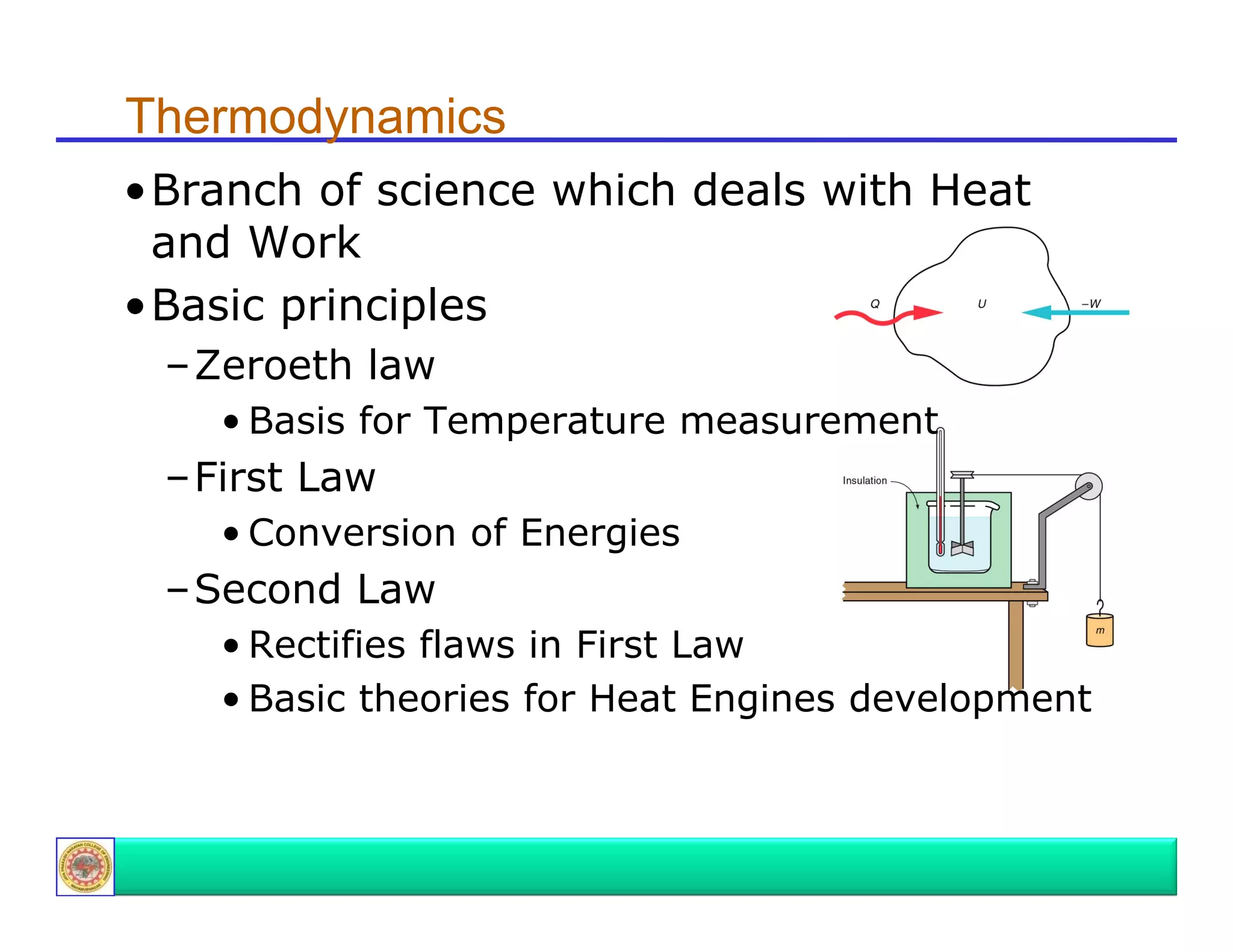
•Branch of science which deals with H t
B
h f i
hi h d l
ith Heat
and Work
•Basic principles
B i
i i l
–Zeroeth law
• Basis for Temperature measurement

–First Law
• Conversion of Energies

–Second Law
• Rectifies flaws in First Law
• Basic theories for Heat Engines development
Engine & Heat Engine
Engine : D i used t convert one form
E i
Device
d to
t
f
of energy another form of energy.
A heat engine diverts some heat as it flows
naturally from hot to cold and converts
that heat into useful work
Heat Engine:
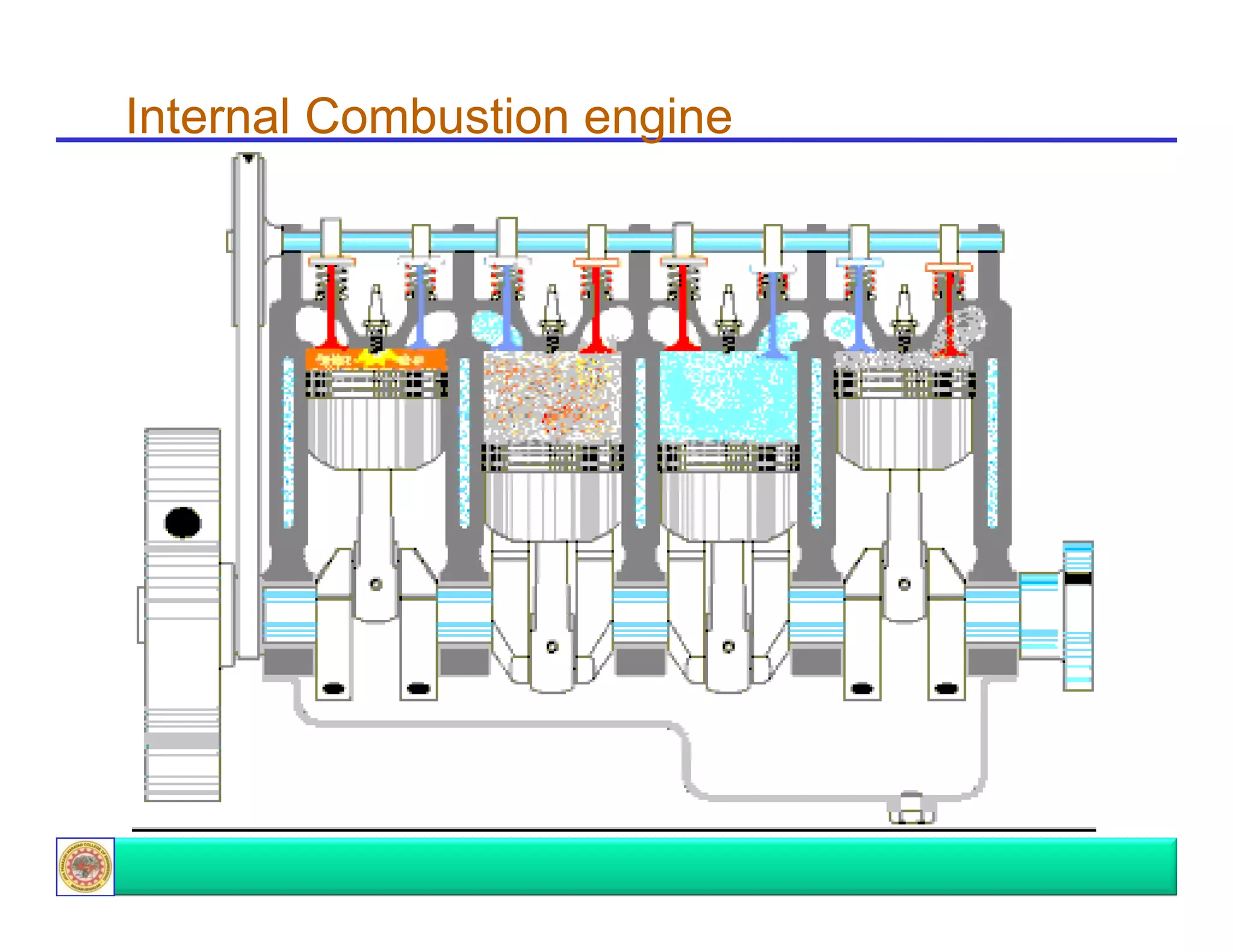
(i) Internal combustion engine
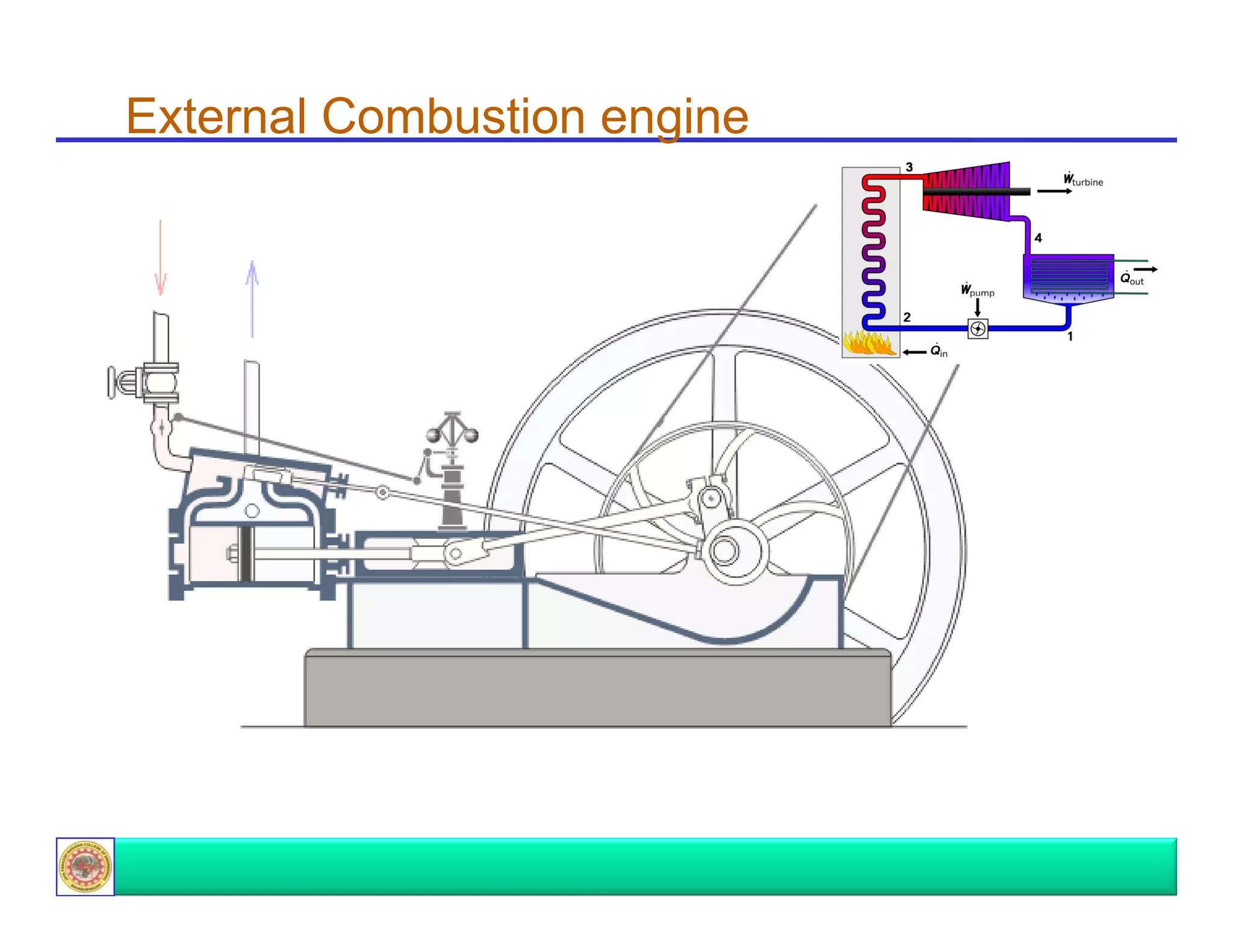
(ii) External combustion engine
Internal Combustion engine
External Combustion engine
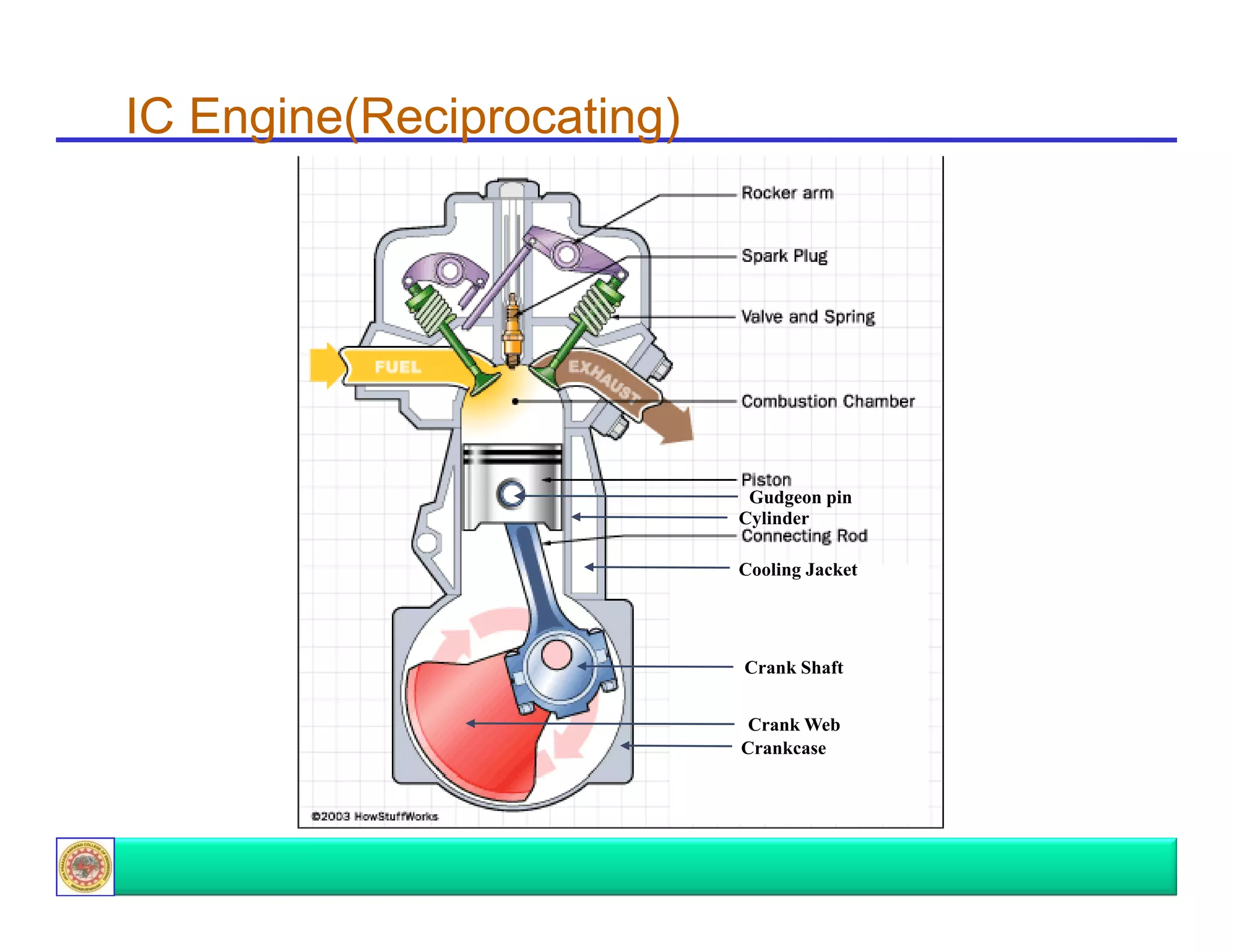
IC Engine(Reciprocating)

Gudgeon pin
Cylinder
Cooling Jacket

Crank Shaft
Crank Web
Crankcase
Reciprocating IC Engine(Parts)
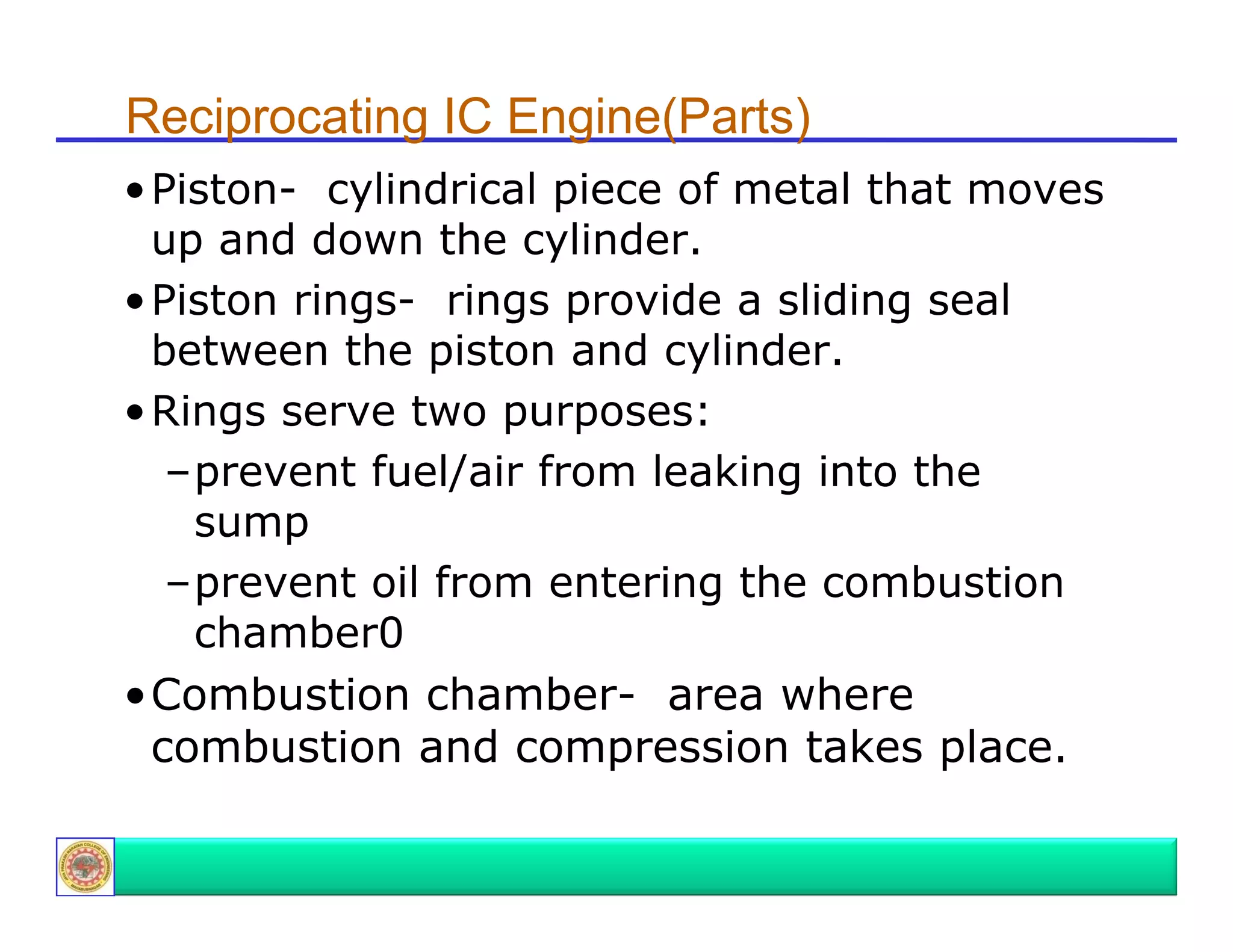
• Pi t
Piston- cylindrical piece of metal th t moves
li d i l i
f
t l that
up and down the cylinder.
• Piston rings rings provide a sliding seal
ringsbetween the piston and cylinder.
• Rings serve two purposes:
–prevent fuel/air from leaking into the
sump
–prevent oil from entering the combustion
chamber0
•Combustion chamber- area where
combustion and compression takes place.
Reciprocating IC Engine(Parts)
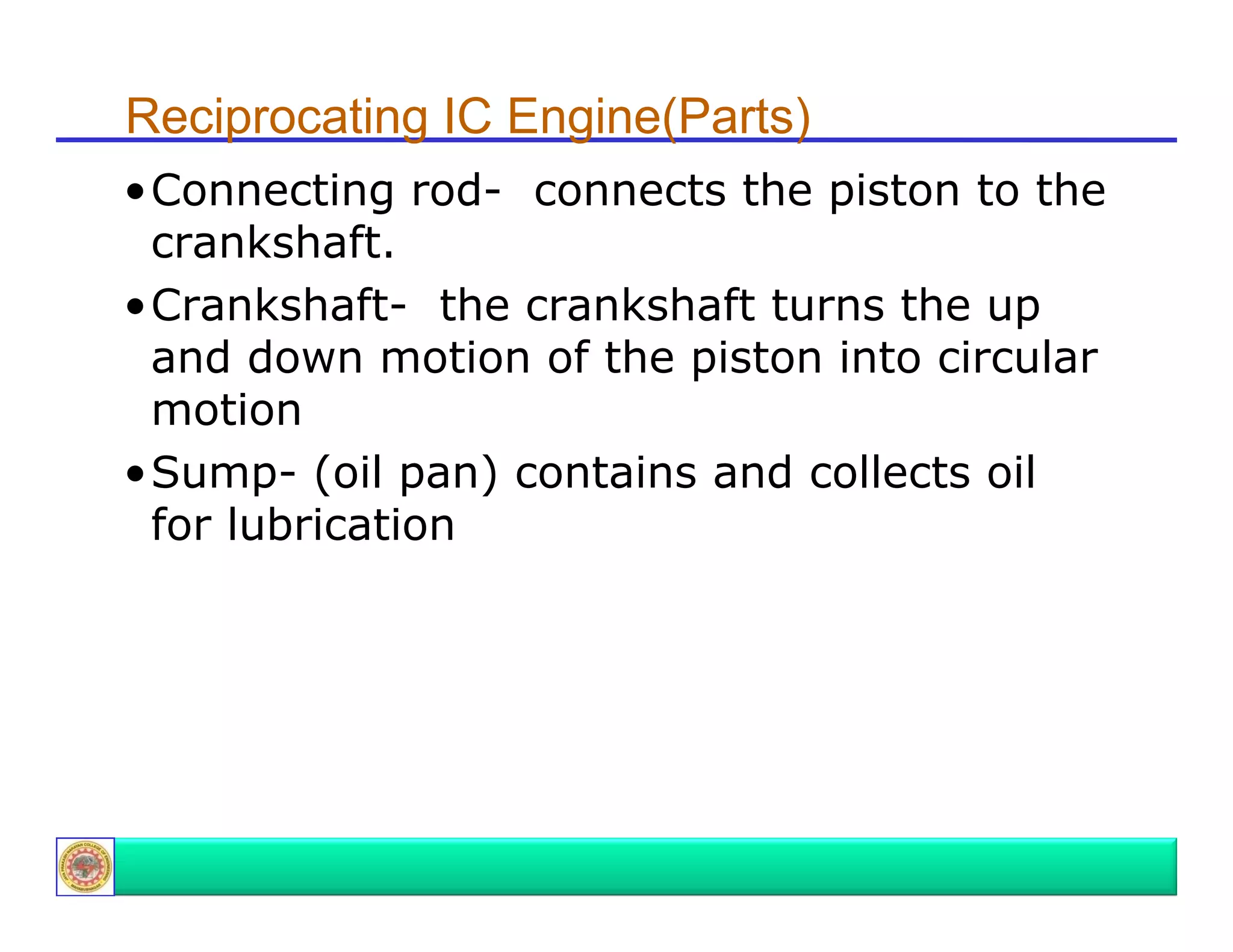
•Connecting rod- connects th piston t the
C
ti
d
t the i t
to th
crankshaft.
•Crankshaft- th crankshaft turns the up
C
k h ft the
k h ft t
th
and down motion of the piston into circular
motion
•Sump- (oil pan) contains and collects oil
for lubrication
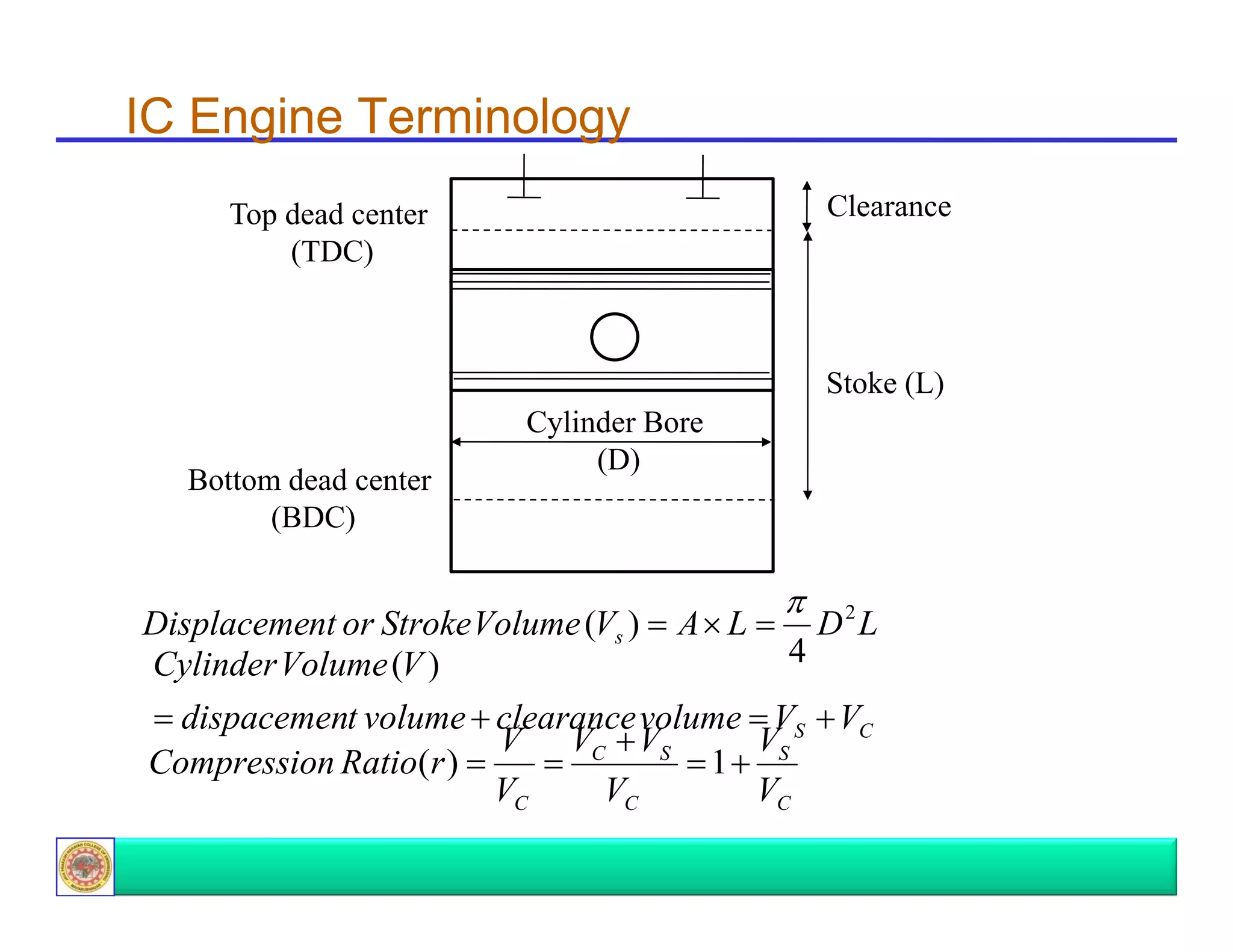
IC Engine Terminology
Clearance

Top dead center
(TDC)

Stoke (L)
Bottom dead center
(BDC)

Cylinder B
C li d Bore
(D)

π

Displacement or Stroke Volume (Vs ) = A × L = D 2 L
4
Cylinder Volume (V )
C li d V l

= dispacement volume + clearance volume = VS + VC
VS
V VC + VS
Compression Ratio(r ) =
p
=
= 1+
VC
VC
VC
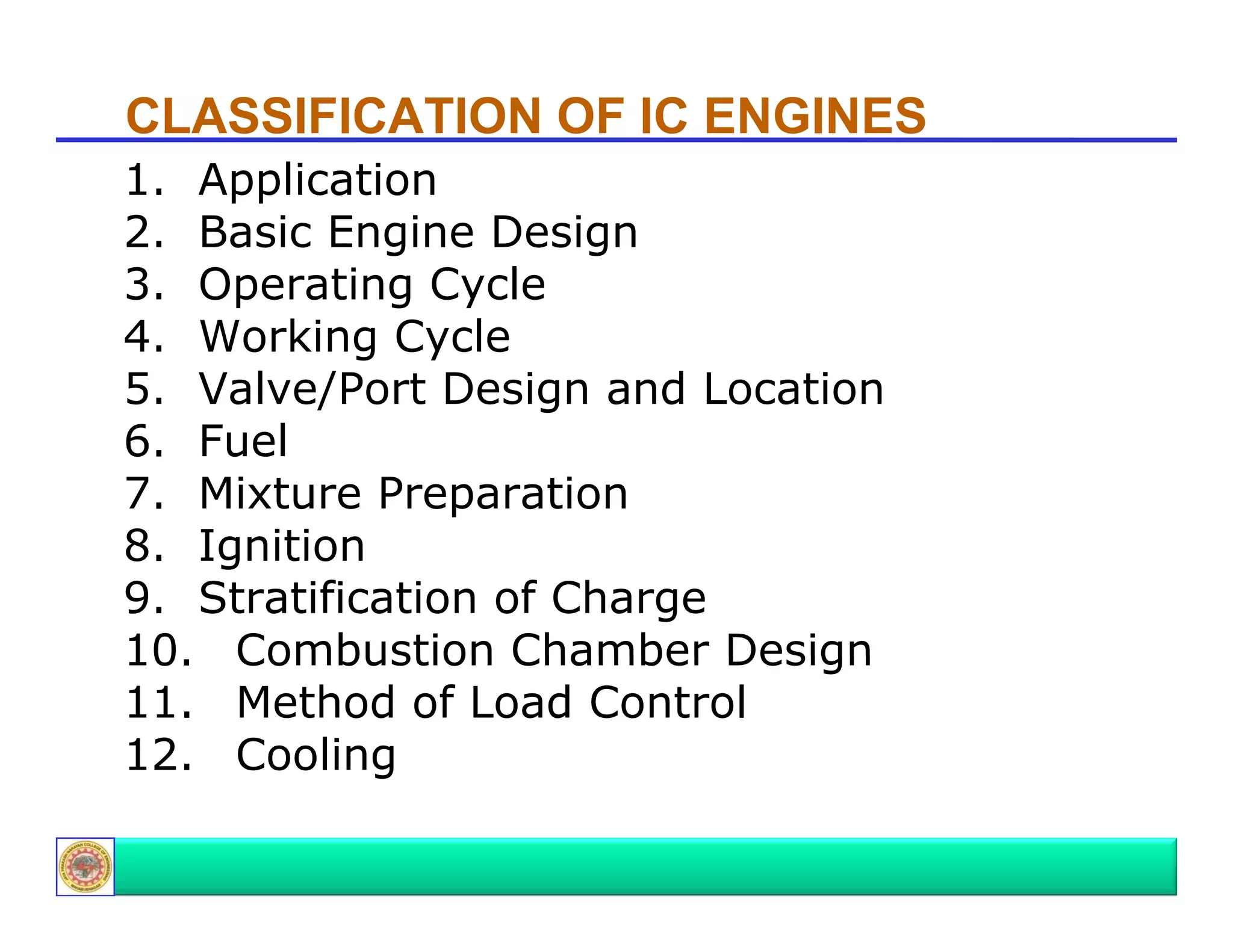
CLASSIFICATION OF IC ENGINES
1.
1 Application
2. Basic Engine Design
3. Operating Cycle
4. Working Cycle
5. Valve/Port Design and Location
6. Fuel
7. Mixture Preparation
8. Ignition
8 I iti
9. Stratification of Charge
10.
10 Combustion Chamber Design
11. Method of Load Control
12. Cooling
g
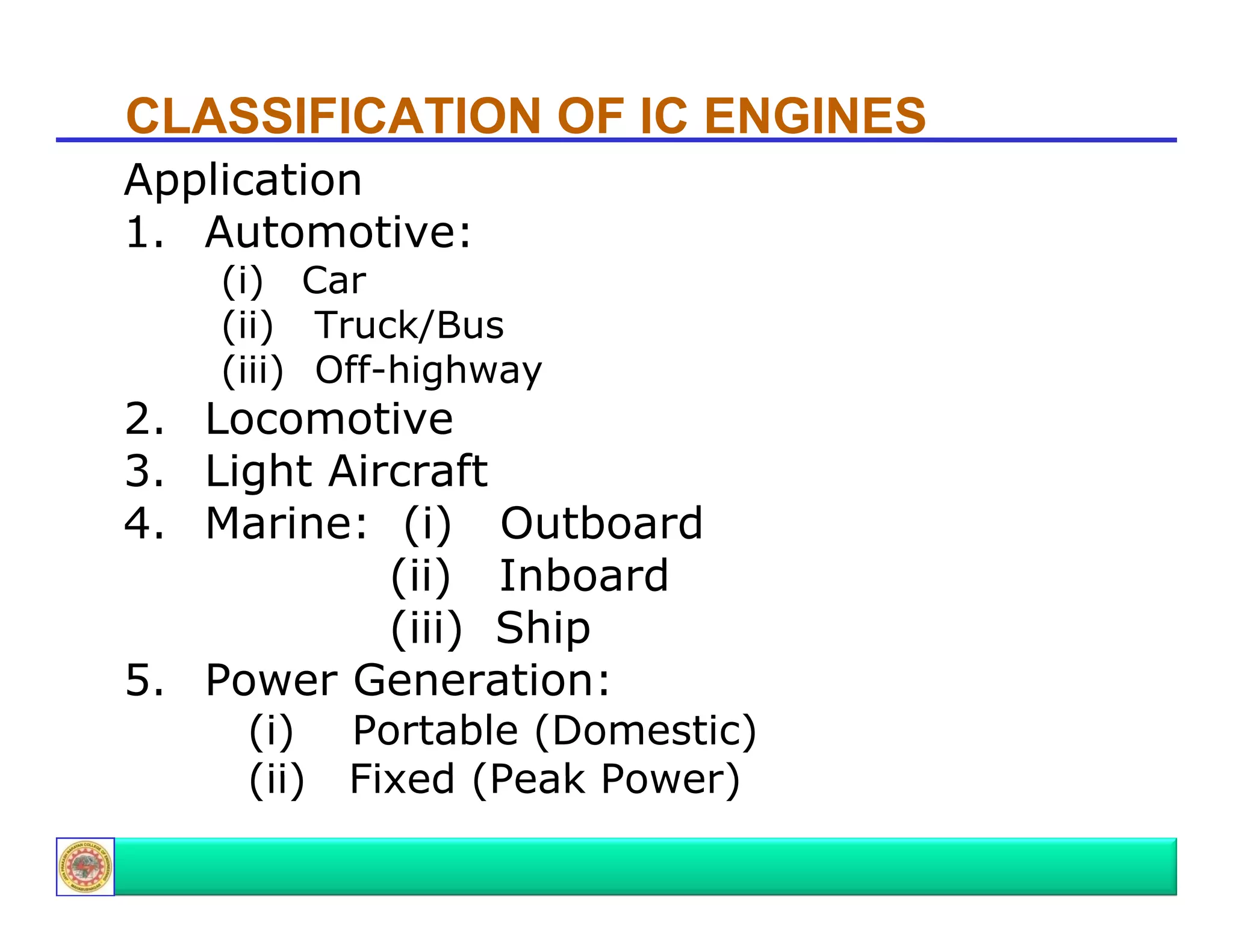
CLASSIFICATION OF IC ENGINES
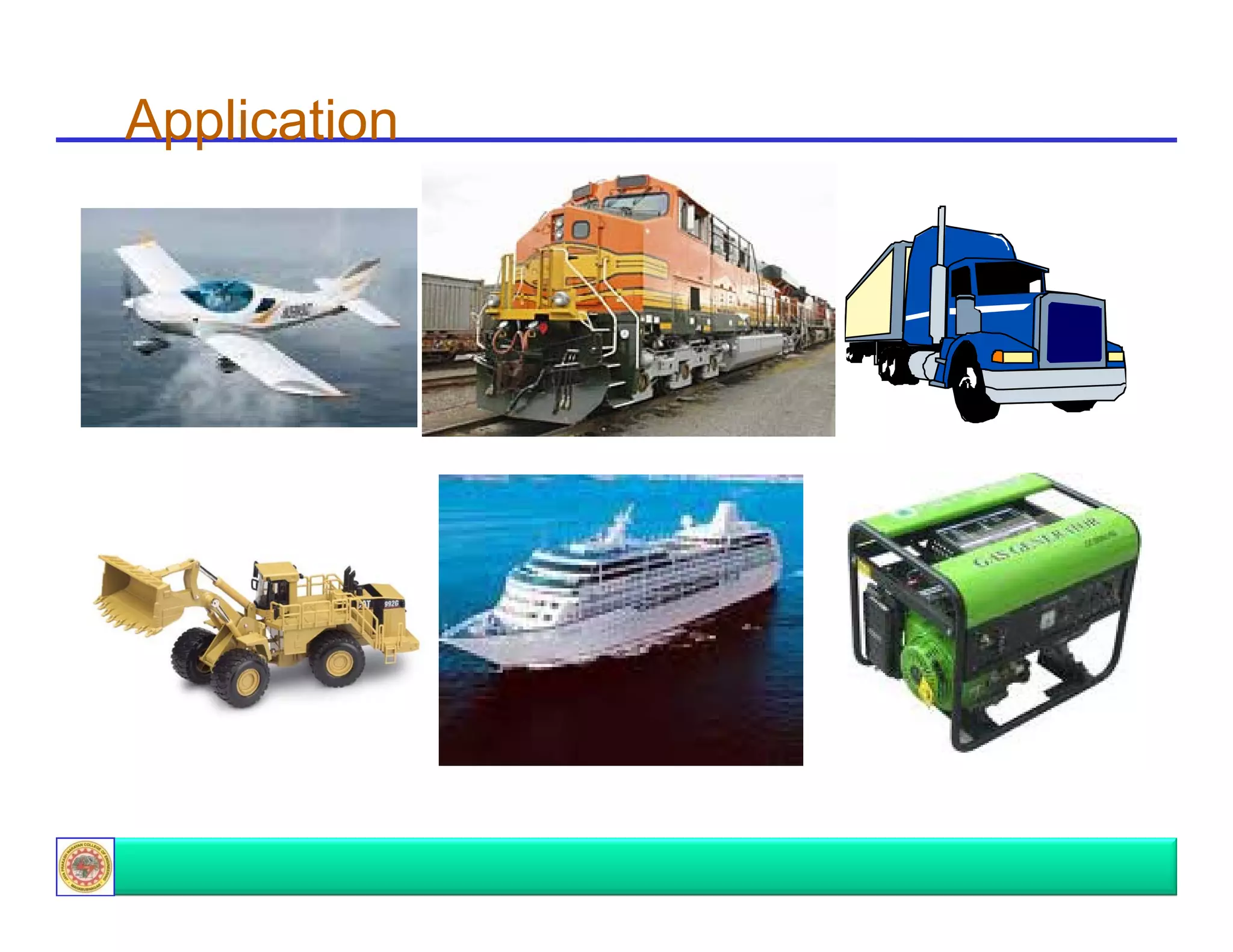
Application
1. Automotive:

()
(i) Car
(ii) Truck/Bus
(iii) Off-highway

2.
2 Locomotive
3. Light Aircraft
4. Marine: (i) Outboard
(ii) Inboard
(iii) Ship
5. Power Generation:
(i)
(ii)

Portable (Domestic)
Fixed (Peak Power)
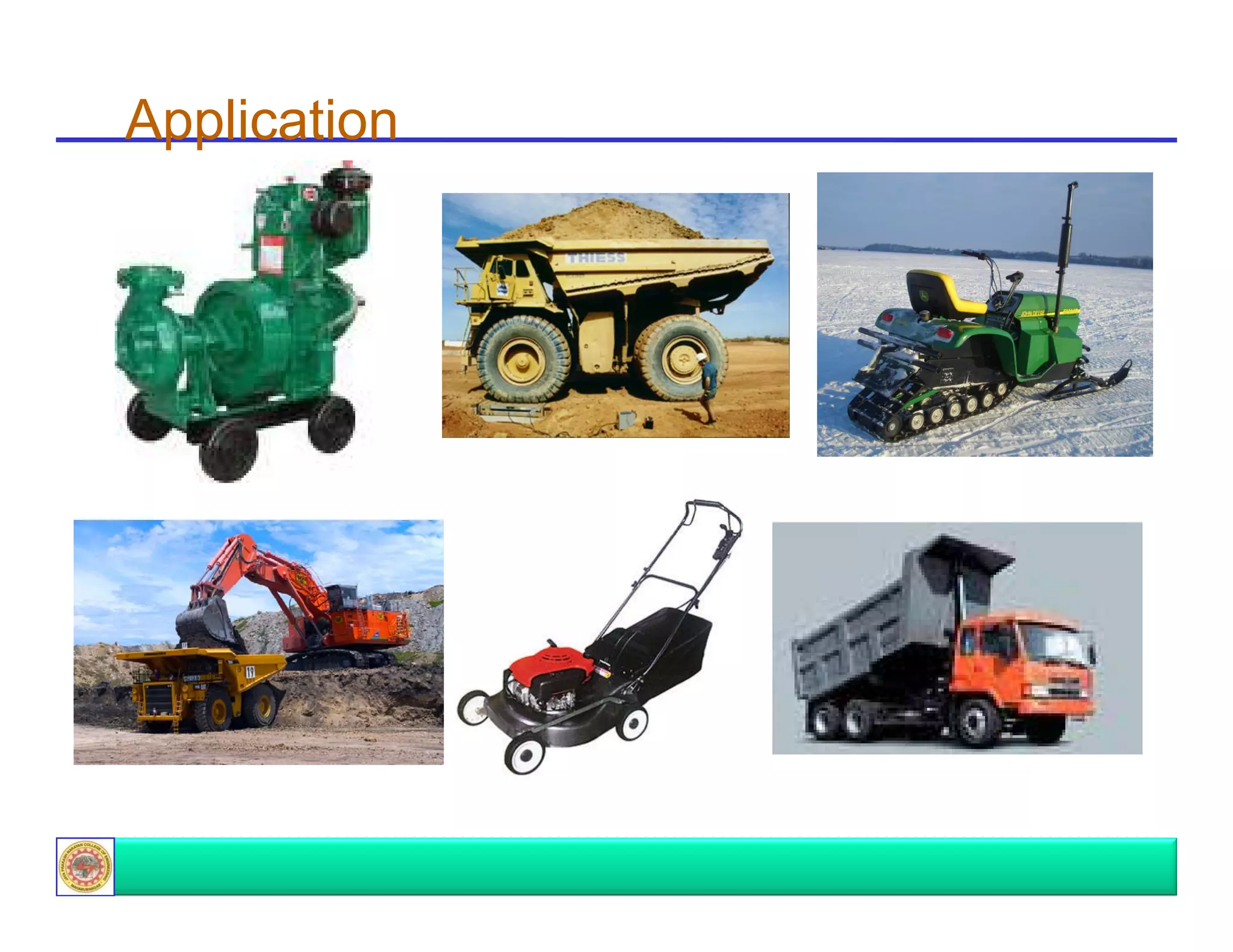
Application
CLASSIFICATION OF IC ENGINES
6.
6 Agricultural:
(i)
(ii)
7. Earthmoving:
(i)
(ii)
(iii)
8. Home U
8 H
Use:
(i)
(ii)
(iii)
9. Others

Tractors
Pump sets
Dumpers
Tippers
Mining Equipment
Lawnmowers
Snow blowers
Tools
Application
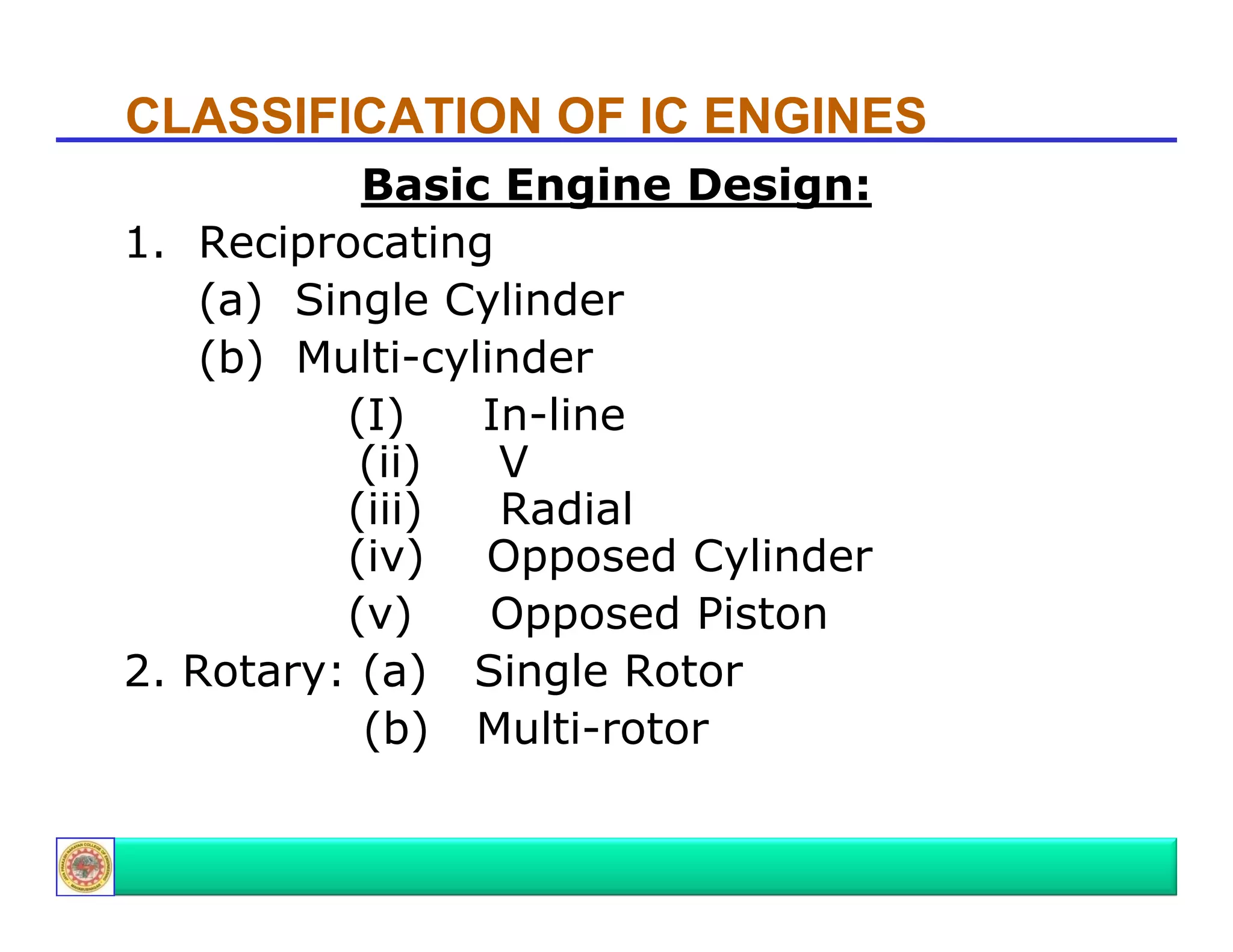
CLASSIFICATION OF IC ENGINES
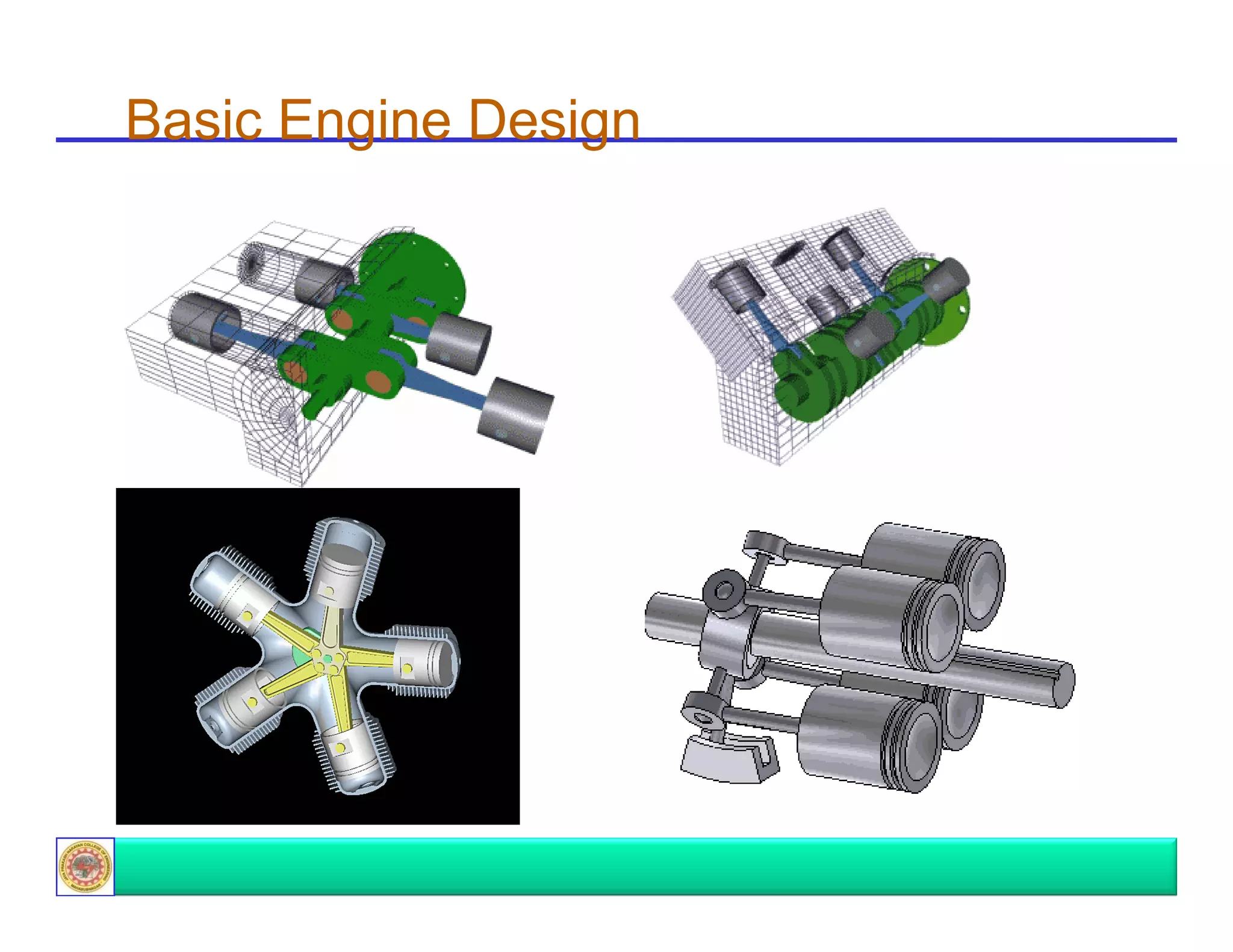
Basic Engine Design
Design:
1. Reciprocating
(a) Single Cylinder
(b) Multi-cylinder
(I)
In-line
(ii)
V
(iii)
Radial
(iv) Opposed Cylinder
(v)
Opposed Piston
2. R t
2 Rotary: (a) Single Rotor
( ) Si l R t
(b) Multi-rotor
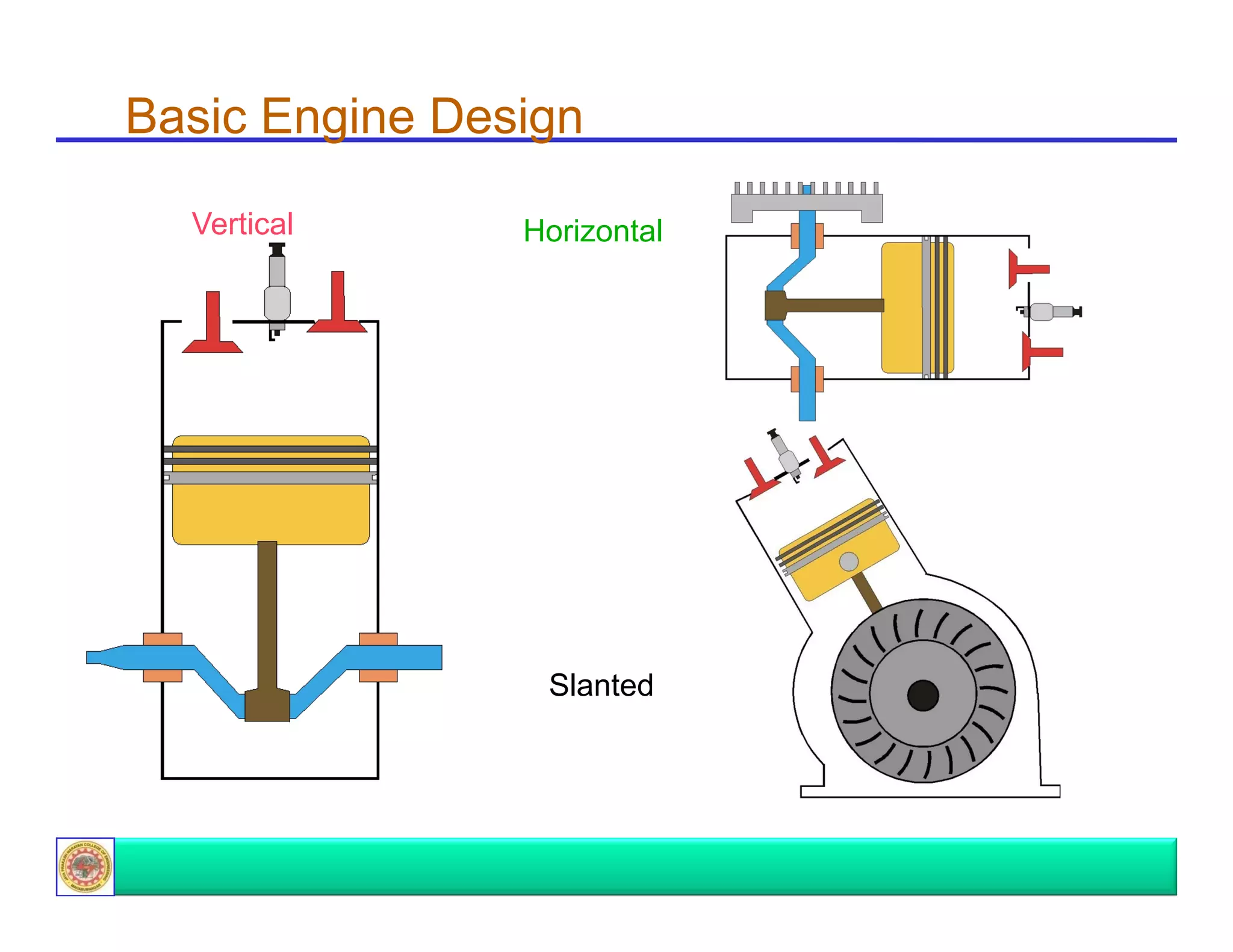
Basic Engine Design
Vertical

Horizontal

Slanted
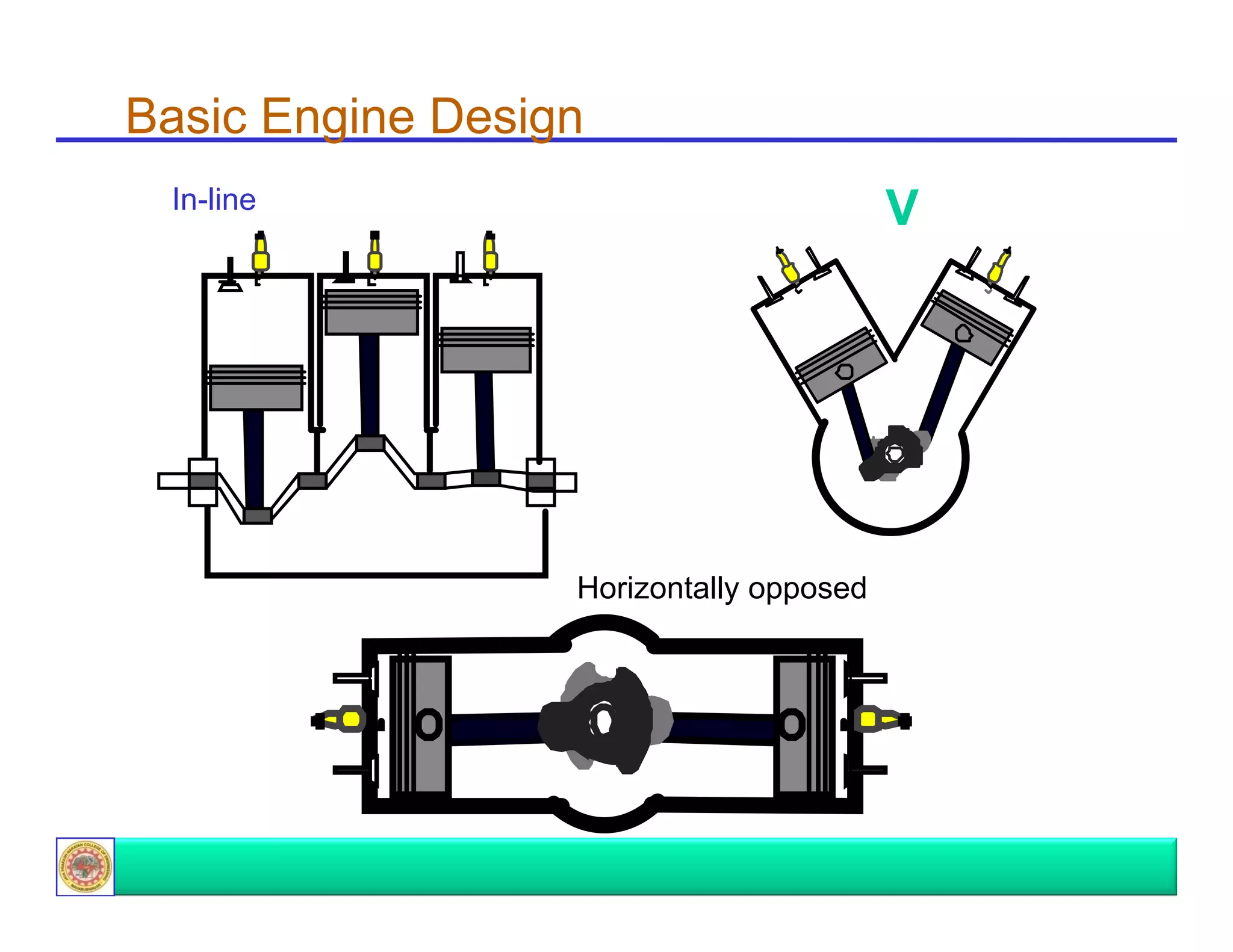
Basic Engine Design
In-line

V

Horizontally opposed
Basic Engine Design
CLASSIFICATION OF IC ENGINES
•
•
•
•
•

Operating Cycle
O
ti
C l
Otto (For the Conventional SI Engine)
Atkinson (For Complete Expansion SI
Engine)
Miller (For Early
Mill (F E l or L t I l t Valve
Late Inlet V l
Closing type SI Engine)
Diesel (For the Ideal Di
Di
l (F th Id l Diesel Engine)
lE i )
Dual (For the Actual Diesel Engine)
CLASSIFICATION OF IC ENGINES
Working C cle (St okes)
Wo king Cycle (Strokes)
1. Four Stroke Cycle:
(a) Naturally Aspirated
(b)Supercharged/Turbocharged
2.
2 Two Stroke Cycle:
(a) Crankcase Scavenged
(b) Uniflow Scavenged
(i) Inlet valve/Exhaust Port
(ii) Inlet Port/Exhaust Valve
(iii) Inlet and Exhaust Valve
ay b
a u a y sp a d
May be Naturally Aspirated
Turbocharged
CLASSIFICATION OF IC ENGINES
1.
2.
2
3.
4.
4
1.
1
2.
3.
4.

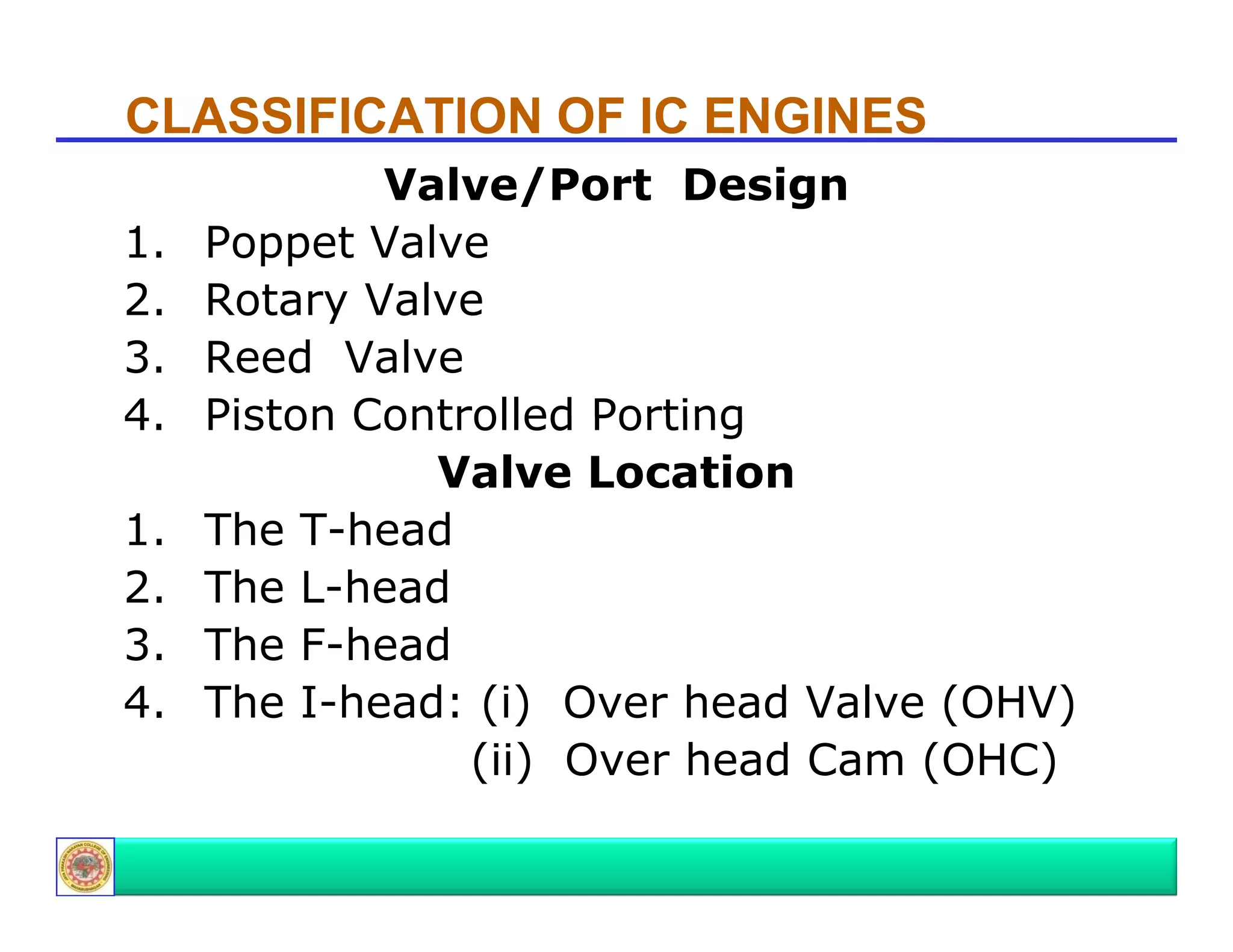
Valve/Port
Val e/Po t Design
Poppet Valve
Rotary Valve
Reed Valve
Piston Controlled Porting
Valve Location
The T-head
T head
The L-head
The F-head
F head
The I-head: (i) Over head Valve (OHV)
(ii) Over head Cam (OHC)
( ) O
ad Ca (O C)
CLASSIFICATION OF IC ENGINES
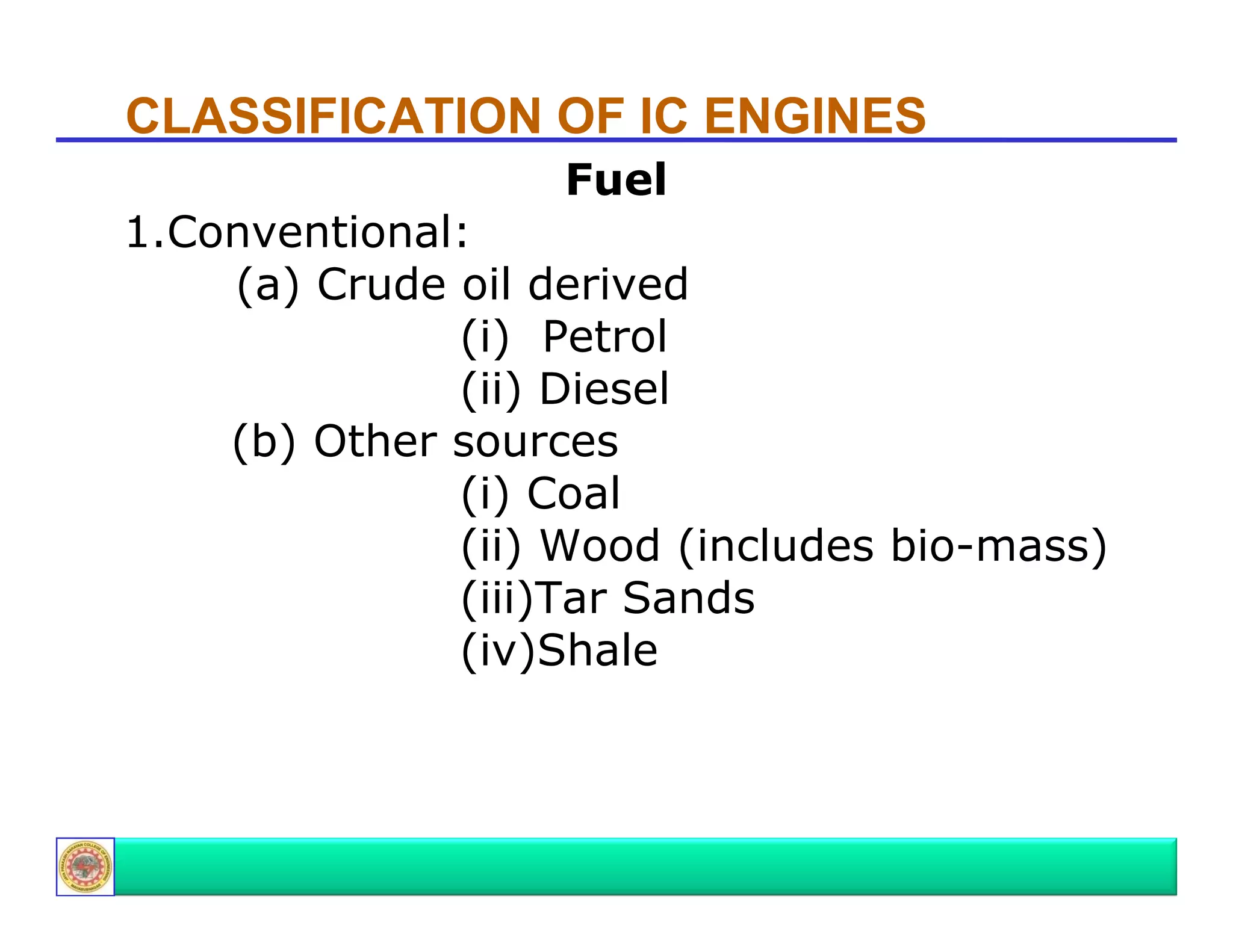
Fuel

1.Conventional:
(a) Crude oil derived
(i) Petrol
(ii) Diesel
(b) Other sources
(i) Coal
(ii) Wood (i l d bi
W d (includes bio-mass)
)
(iii)Tar Sands
(iv)Shale
CLASSIFICATION OF IC ENGINES
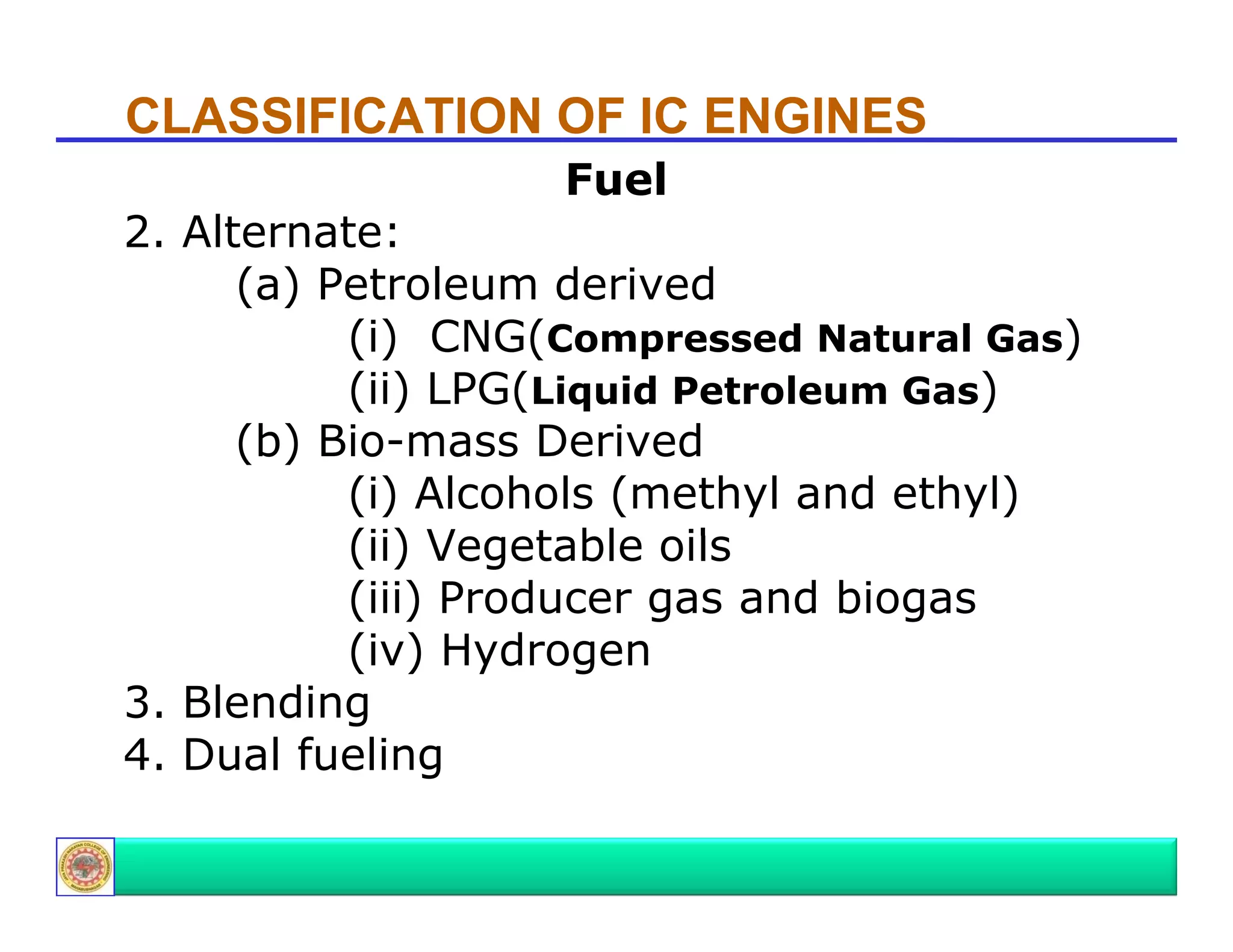
Fuel

2. Alternate:
(a) Petroleum derived
(i) CNG(Compressed Natural Gas)
(ii) LPG(Liquid Petroleum Gas)
(b) Bio-mass Derived
(i) Alcohols (methyl and ethyl)
(ii) Vegetable oils
V
t bl
il
(iii) Producer gas and biogas
(iv) Hydrogen
3. Blending
4. Dual fueling
g
CLASSIFICATION OF IC ENGINES
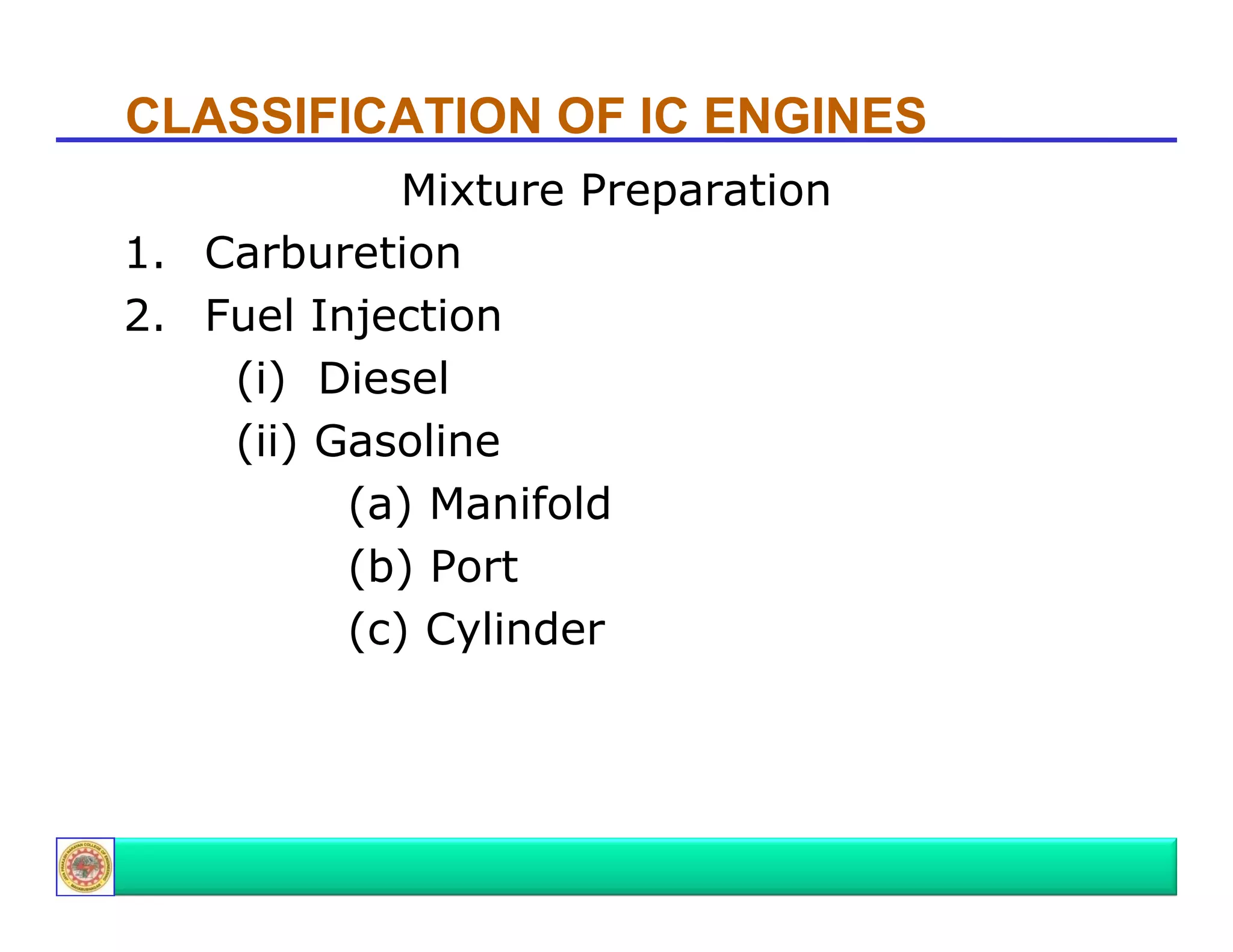
Mixture P
Mi t
Preparation
ti
1. Carburetion
2. Fuel Injection
(i) Diesel
(ii) Gasoline
(a) Manifold
(b) Port
(c) Cylinder
CLASSIFICATION OF IC ENGINES
Ignition
I iti
1. Spark Ignition
(a)
Conventional
(i) Battery
(ii) Magneto
(b)
Other methods
2. Compression Ignition
CLASSIFICATION OF IC ENGINES
Charge Stratification
Ch
St tifi ti
1. Homogeneous Charge (Also Pre-mixed
charge)
2. Stratified Ch
2 St tifi d Charge
(i) With carburetion
(ii) With fuel injection
CLASSIFICATION OF IC ENGINES
1.

2.

Combustion Chambe
Comb stion Chamber Design
Open Chamber
(i) Disc type
(ii) Wedge
(iii) Hemispherical
(iv) Bowl-in-piston
(v) Other design
Divided Chamber
(For CI)
(For SI)
(i) Swirl chamber (i) CVCC
(ii) Pre-chamber
( )
a b
(ii) Other designs
( )O
d sg s
CLASSIFICATION OF IC ENGINES
Method f L d Control
M th d of Load C t l
1. Throttling: (To keep mixture strength
constant) Al called Ch
t t) Also ll d Charge Control
C t l
Used in the Carbureted S.I. Engine
2. Fuel C t l (To
2 F l Control (T vary th mixture
the i t
strength according to load)
Used in th C I E i
U d i the C.I. Engine
3. Combination
Used in the F l i j t d S.I. E i
U d i th Fuel-injected S I Engine.
CLASSIFICATION OF IC ENGINES
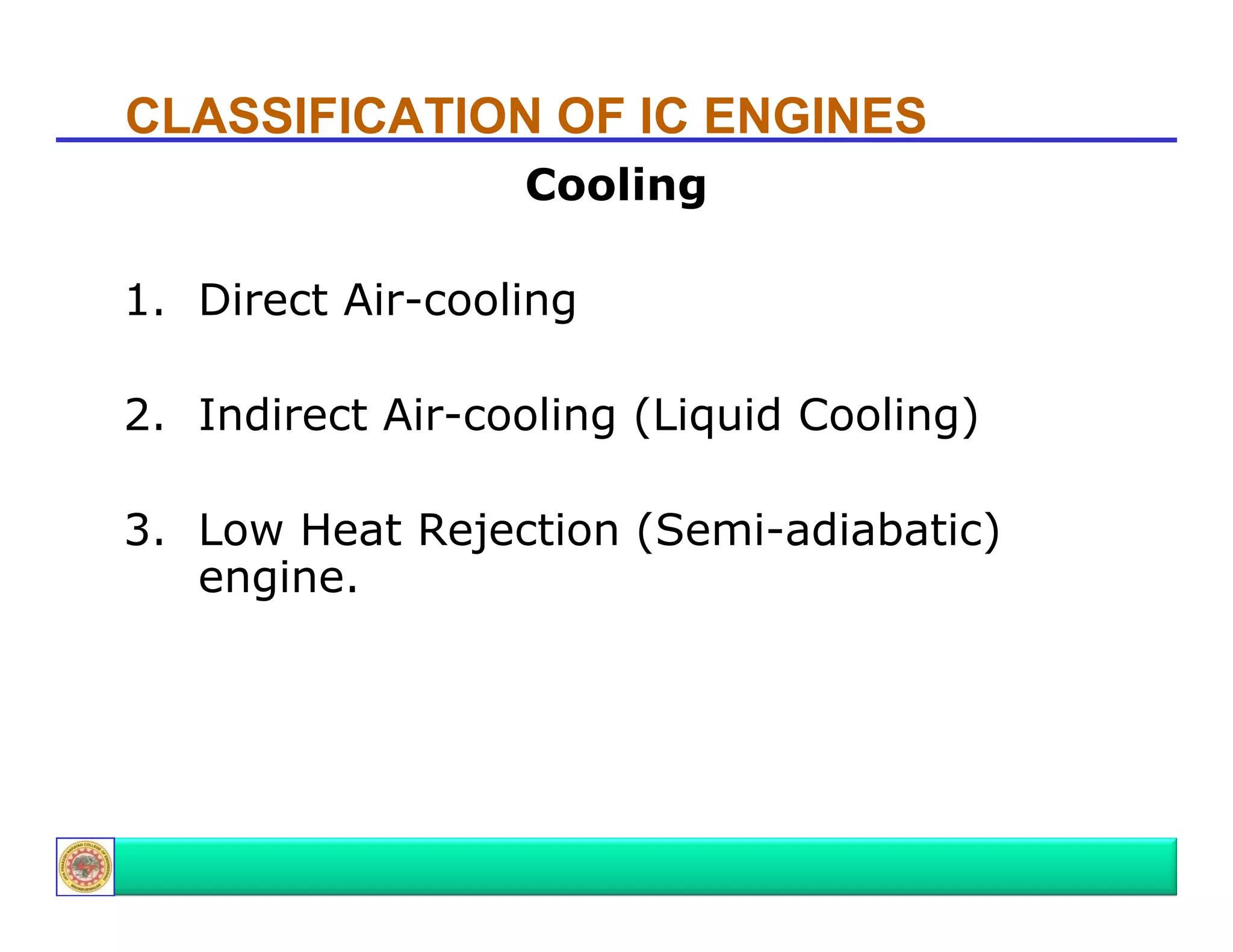
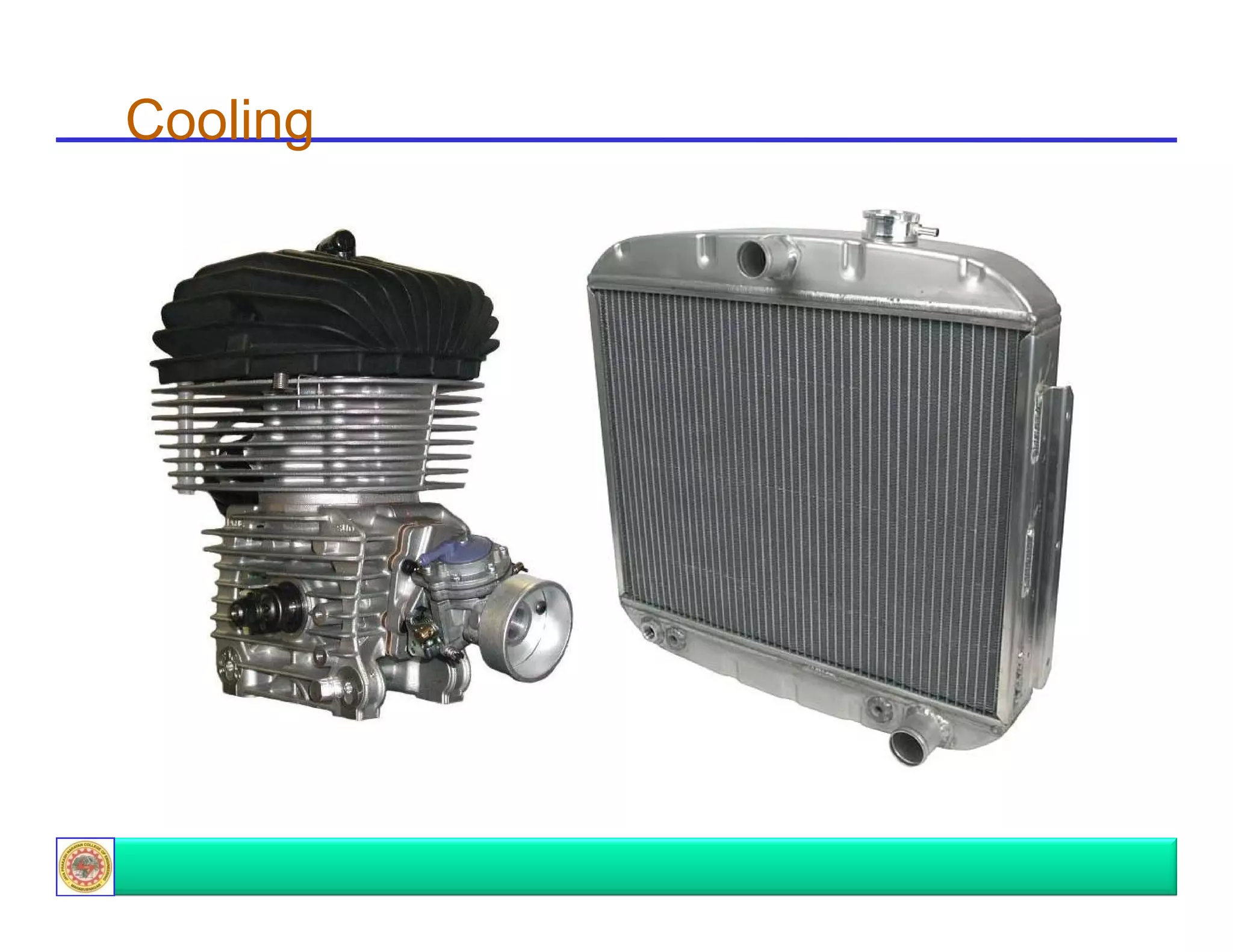
Cooling
1.
1 Direct Air cooling
Air-cooling
2.
2 Indirect Air-cooling (Liquid Cooling)
3.
3 Low Heat Rejection (Semi-adiabatic)
(Semi adiabatic)
engine.
CLASSIFICATION OF IC ENGINES
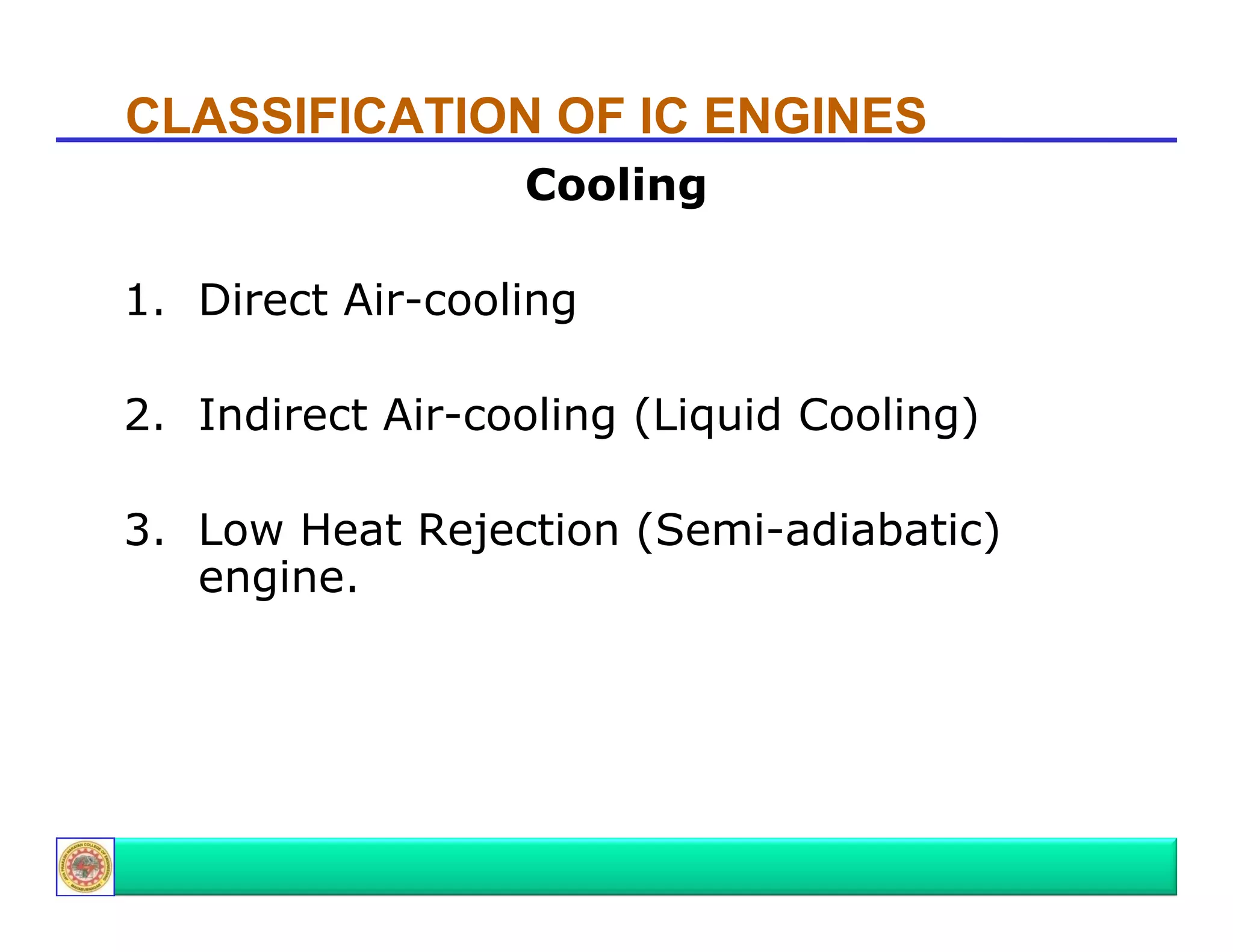
Cooling
1.
1 Direct Air cooling
Air-cooling
2.
2 Indirect Air-cooling (Liquid Cooling)
3.
3 Low Heat Rejection (Semi-adiabatic)
(Semi adiabatic)
engine.
Cooling
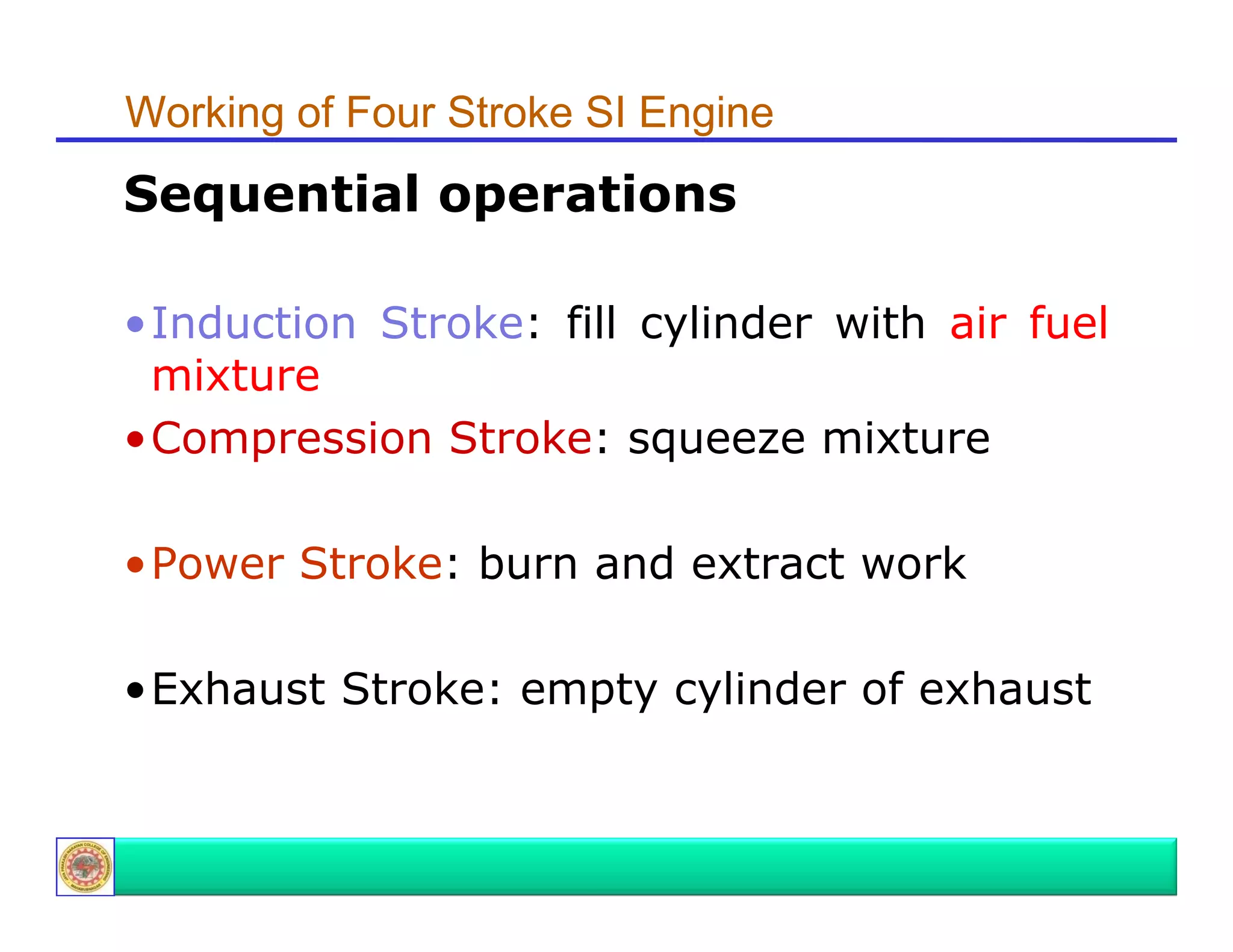
Working of Four Stroke SI Engine

Sequential operations
S
i l
i
•Induction Stroke: fill cylinder with air fuel
mixture
•Compression Stroke: squeeze mixture
•Power Stroke: burn and extract work
•Exhaust Stroke: empty cylinder of exhaust
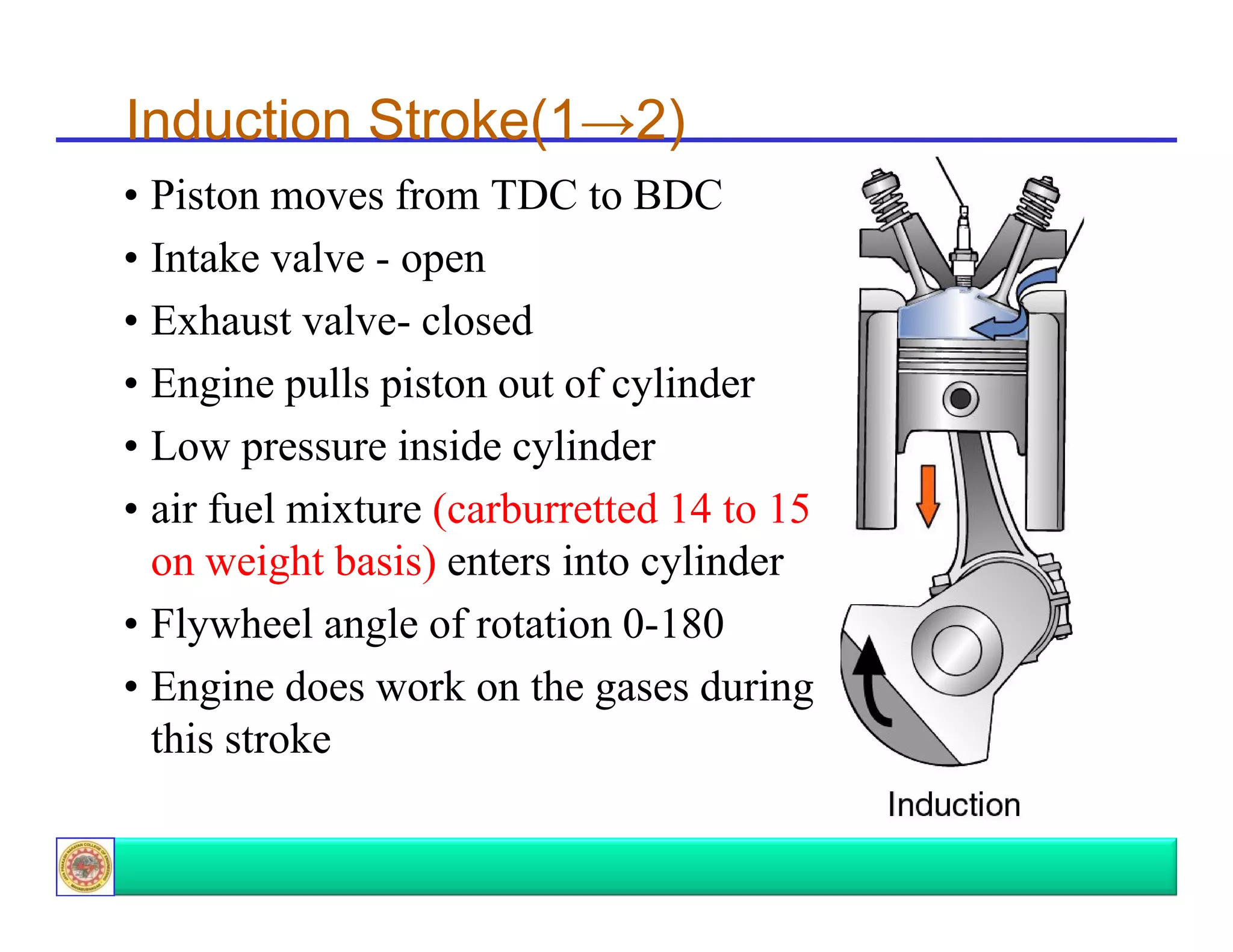
Induction Stroke(1→2)
• Piston moves from TDC to BDC
• Intake valve - open
• Exhaust valve- closed
• Engine pulls piston out of cylinder
• Low pressure inside cylinder
• air fuel mixture (carburretted 14 to 15
on weight basis) enters into cylinder
• Flywheel angle of rotation 0-180
• Engine does work on the gases during
this stroke
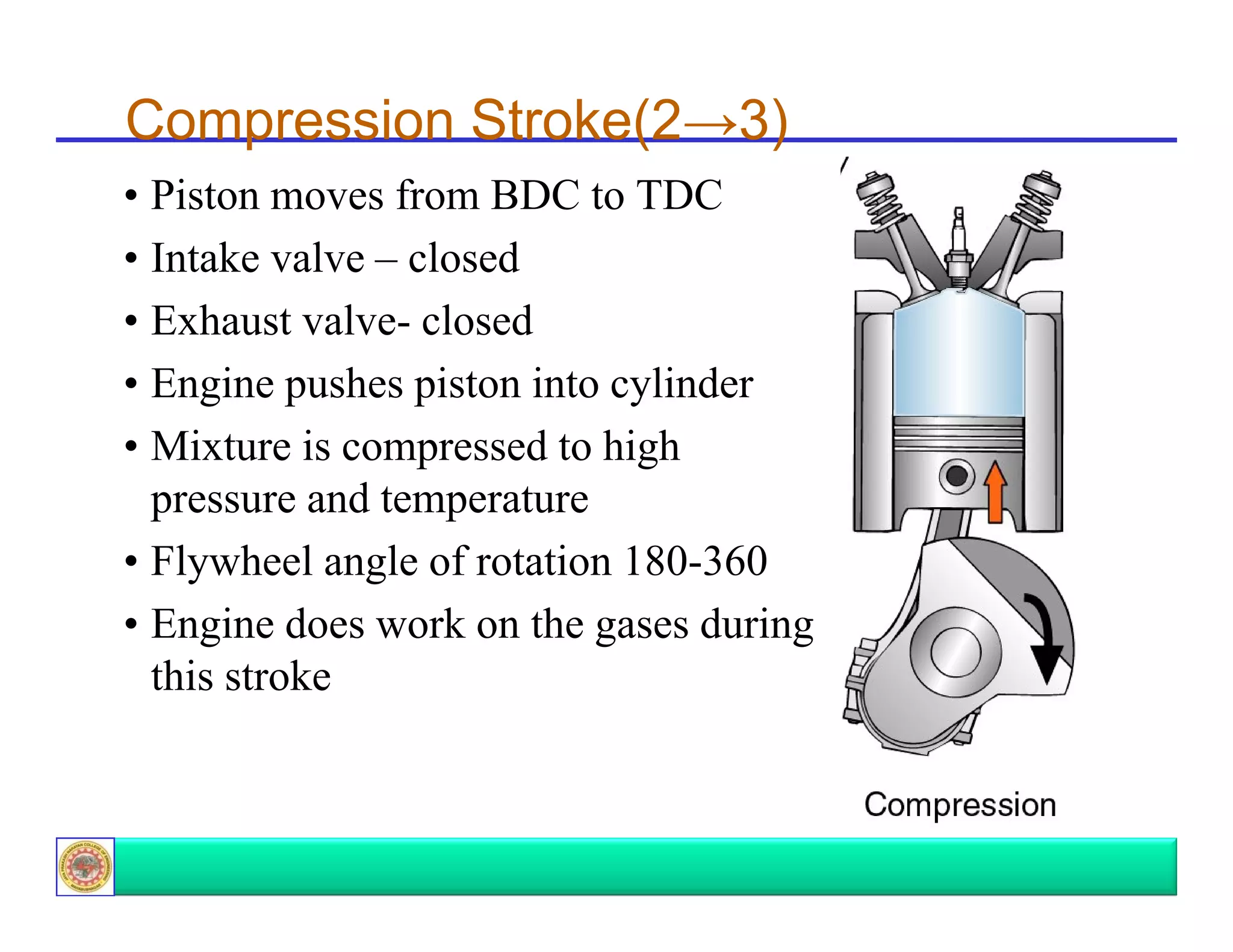
Compression Stroke(2→3)
• Piston moves from BDC to TDC
• Intake valve – closed
• Exhaust valve- closed
• Engine pushes piston into cylinder
• Mixture is compressed to high
pressure and temperature
• Flywheel angle of rotation 180-360
• Engine does work on the gases during
this stroke
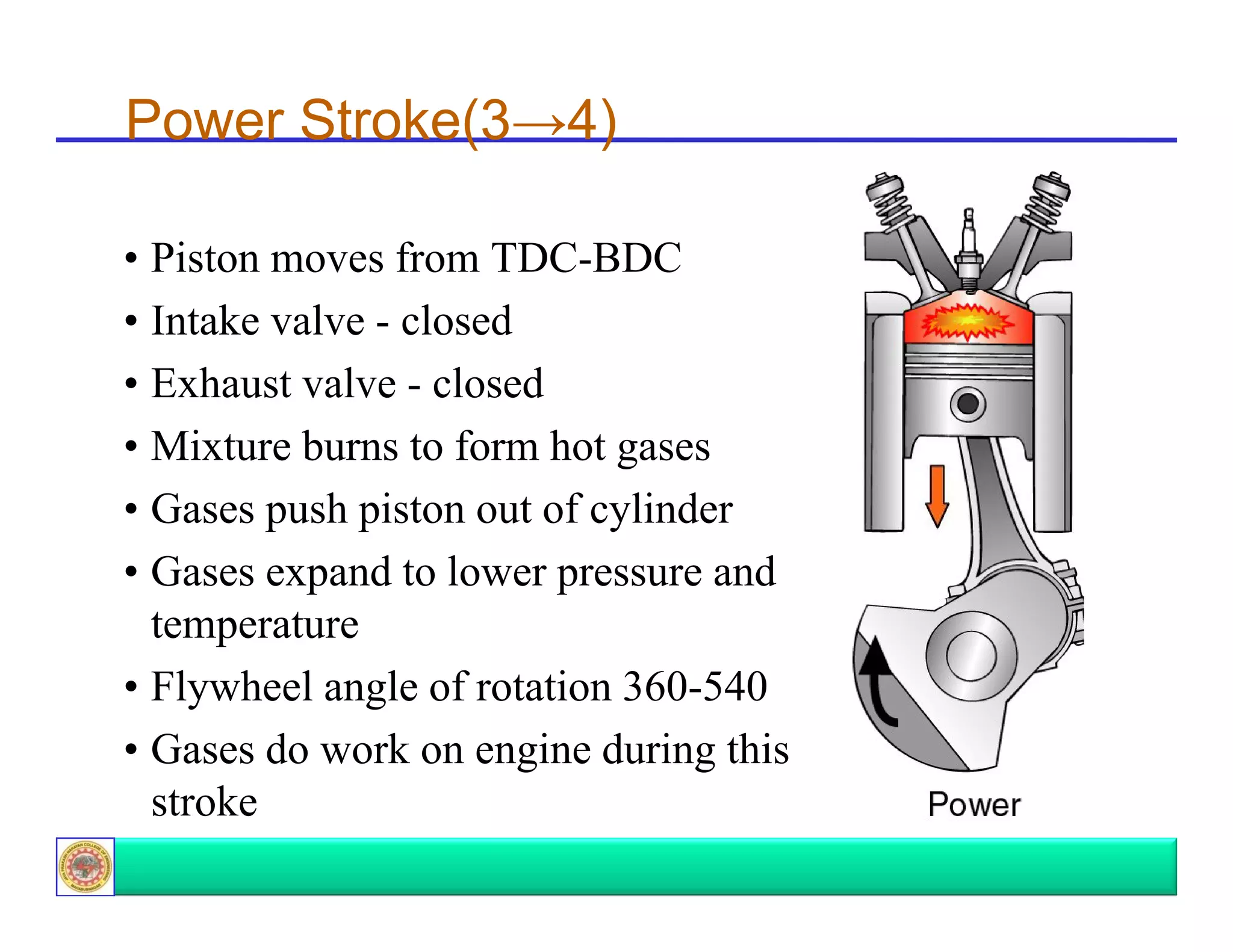
Power Stroke(3→4)
• Piston moves from TDC-BDC
• Intake valve - closed
• Exhaust valve - closed
• Mixture burns to form hot gases
• Gases push piston out of cylinder
• Gases expand to lower pressure and
temperature
• Flywheel angle of rotation 360-540
• Gases do work on engine during this
stroke
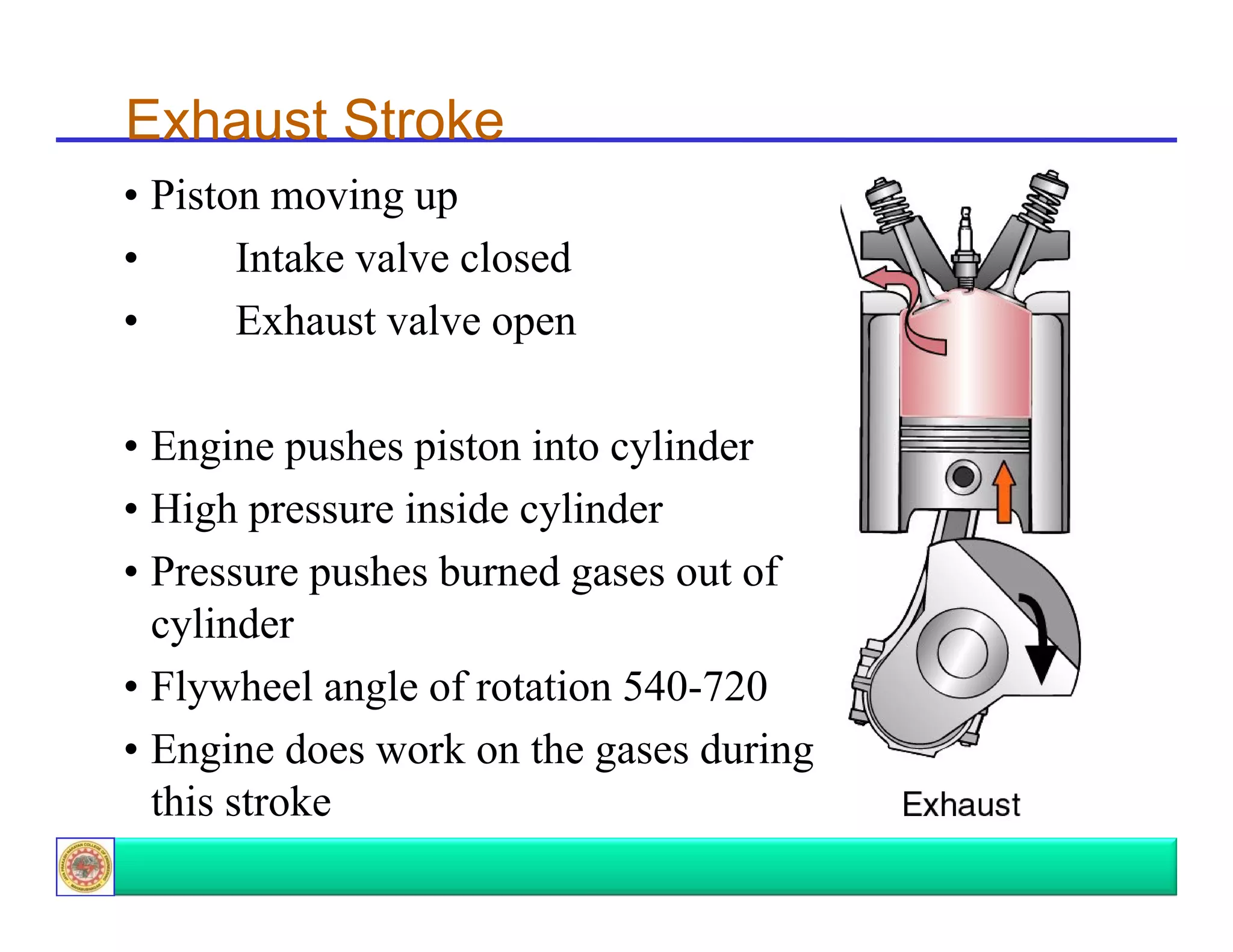
Exhaust Stroke
• Piston moving up
•
Intake valve closed
•
Exhaust valve open
• Engine pushes piston into cylinder
• High pressure inside cylinder
• Pressure pushes burned gases out of
cylinder
• Flywheel angle of rotation 540-720
• Engine does work on the gases during
this stroke
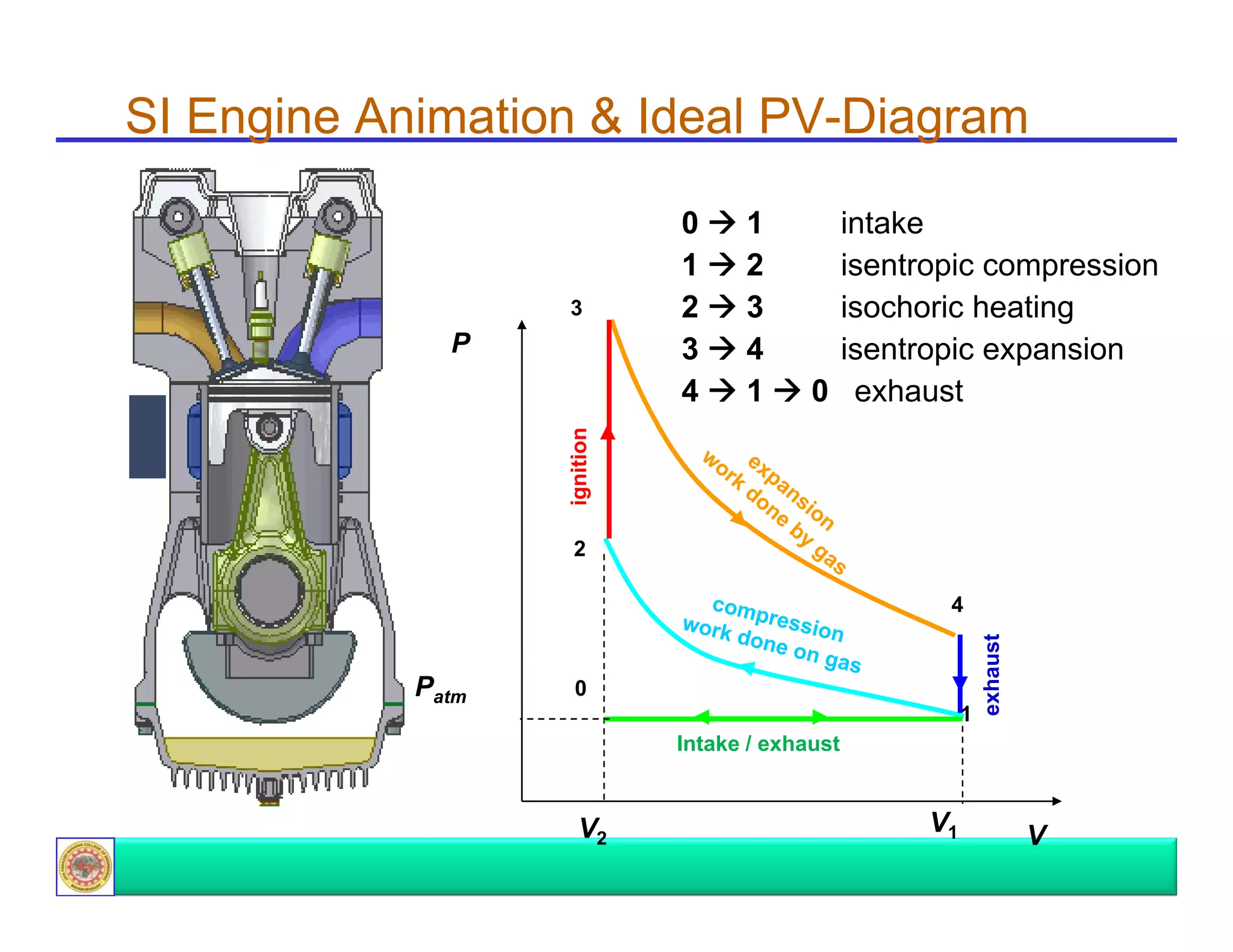
SI Engine Animation & Ideal PV-Diagram

3

1
2
3
4
1

intake
isentropic compression
isochoric h ti
i
h i heating
isentropic expansion
0 exhaust

ignition

P

0
1
2
3
4

2

Patm

0
1

exhau
ust

4

Intake / exhaust

V2

V1

V
Working of 4 stroke CI Engine
• operation i quite similar t SI engine
ti
is
it i il to
i
–However
• F l Injectors are used for
Fuel I j t
df
atomized fuel injection

• Fresh air is entered during induction stroke
g
• Heterogeneous mixture is burned because of
self ignition of the fuel
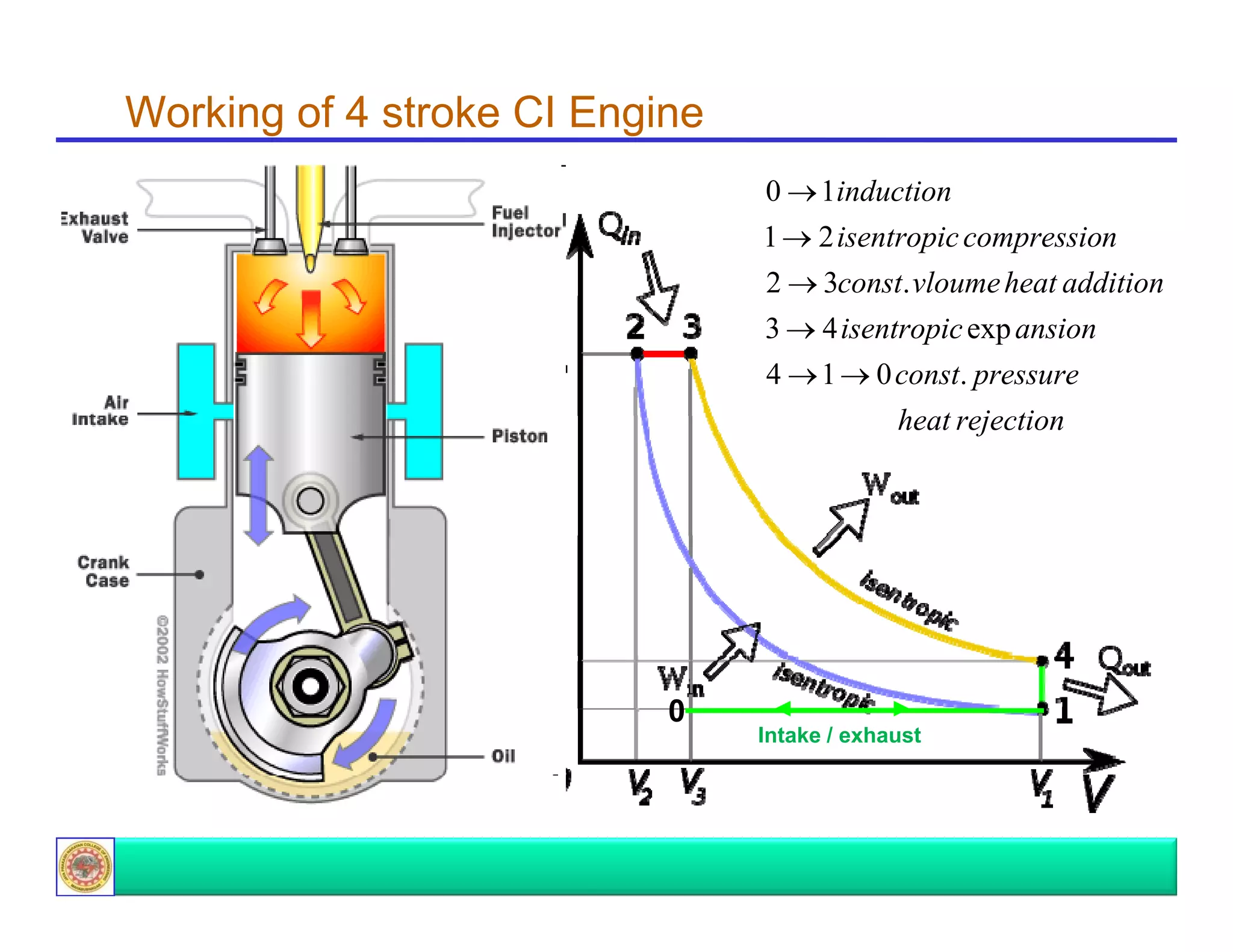
Working of 4 stroke CI Engine
0 → 1induction
1 → 2 isentropic compression
2 → 3const. vloume heat addition
3 → 4 isentropic exp ansion
4 → 1 → 0 const. pressure
heat j ti
h t rejection

0

Intake / exhaust
Salient features of 4 stroke engine
•Provided with valves
P
id d ith
l
•It requires four strokes
•Two revolution of crank shaft
•One power stroke for every four strokes
•Flywheel stores energy during power
stroke and supplies part of energy for idle
strokes
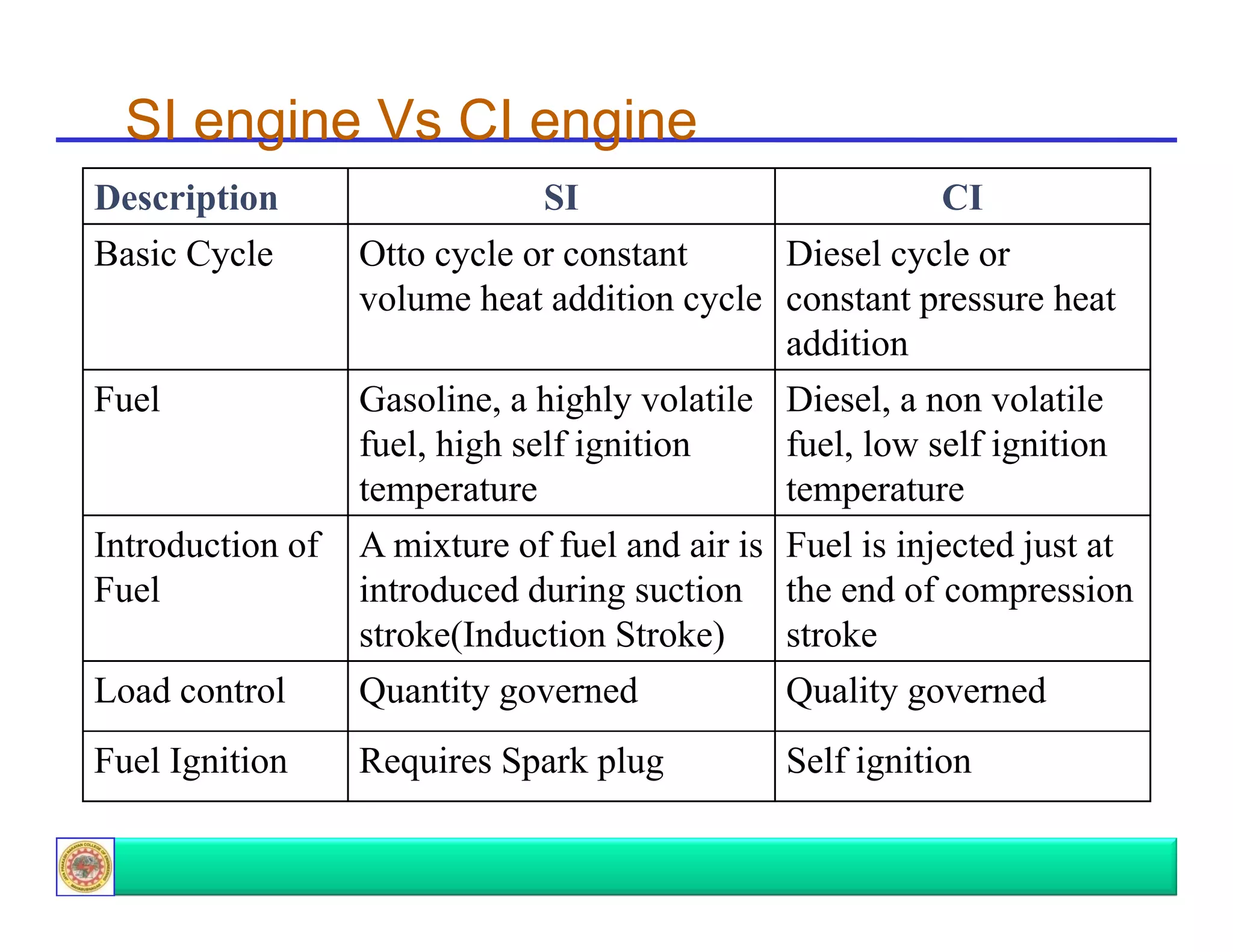
SI engine Vs CI engine
Description
Basic Cycle

Fuel

Introduction f
I t d ti of
Fuel

SI
CI
Otto cycle or constant
Diesel cycle or
volume heat addition cycle constant pressure heat
addition
Gasoline, a highly volatile Diesel, a non volatile
,
g y
,
fuel, high self ignition
fuel, low self ignition
temperature
temperature
A mixture of fuel and air is F l i injected just at
i t
f f l d i i Fuel is i j t d j t t
introduced during suction the end of compression
stroke(Induction Stroke)
stroke

Load control

Quantity governed

Quality governed

Fuel Ignition
g

Requires Spark plug
q
p
p g

Self ignition
g
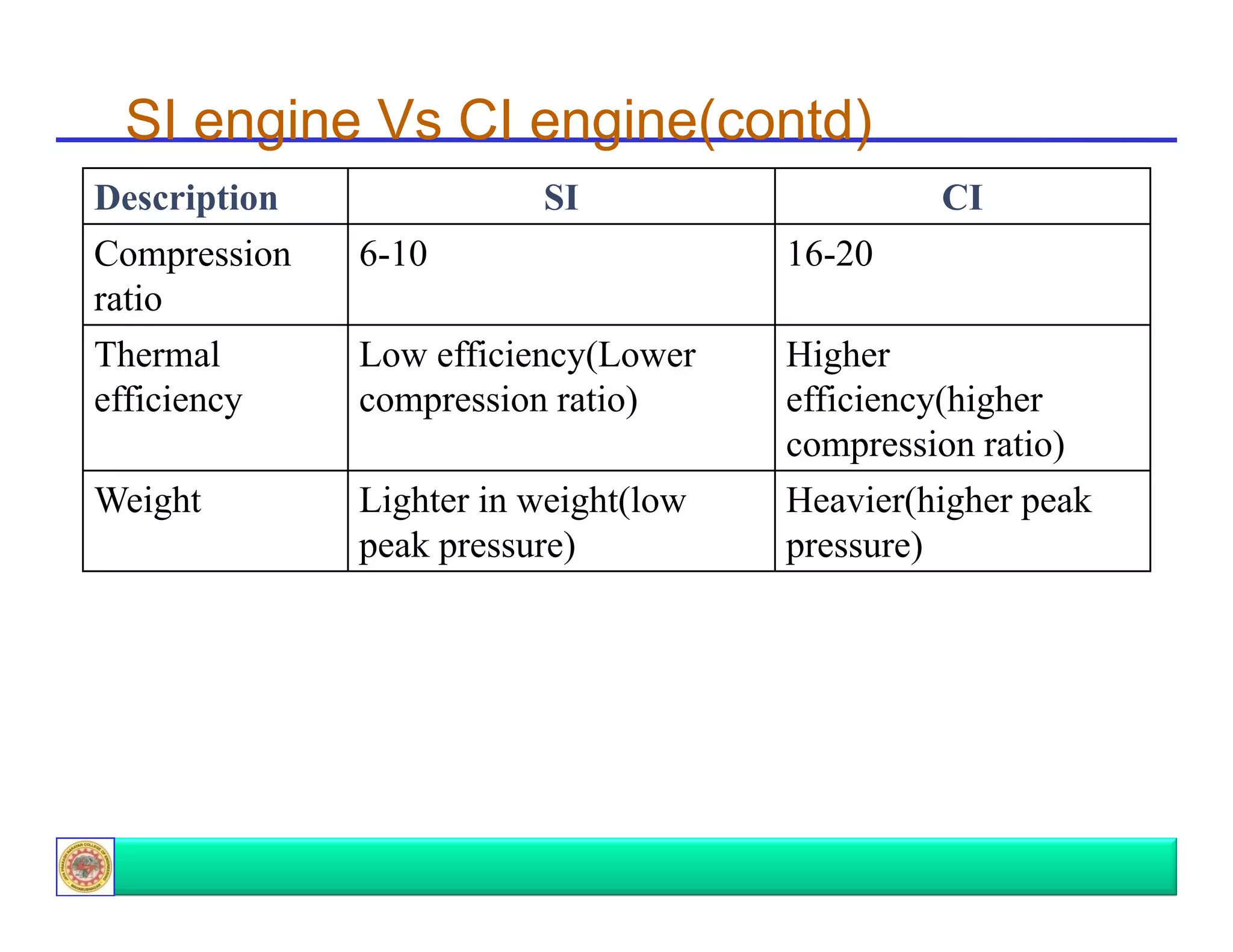
SI engine Vs CI engine(contd)
Description
Compression
ratio
Thermal
efficiency
y
Weight

SI

CI

6-10

16-20

Low efficiency(Lower
compression ratio)
p
)

Higher
efficiency(higher
y( g
compression ratio)
Heavier(higher peak
pressure)
)

Lighter in weight(low
peak pressure)
k
)
Click to edit Master title style

THANK YOU
Contact: smualichinna@gmail.com

Introduction to ic engines

  • 1.
    Chapter I Introduction toIC Engines By Dr. S. Murali Professor & Head Dept. of Mechanical Engineering
  • 2.
    Thermodynamics •Branch of sciencewhich deals with H t B h f i hi h d l ith Heat and Work •Basic principles B i i i l –Zeroeth law • Basis for Temperature measurement –First Law • Conversion of Energies –Second Law • Rectifies flaws in First Law • Basic theories for Heat Engines development
  • 3.
    Engine & HeatEngine Engine : D i used t convert one form E i Device d to t f of energy another form of energy. A heat engine diverts some heat as it flows naturally from hot to cold and converts that heat into useful work Heat Engine: (i) Internal combustion engine (ii) External combustion engine
  • 4.
  • 5.
  • 6.
    IC Engine(Reciprocating) Gudgeon pin Cylinder CoolingJacket Crank Shaft Crank Web Crankcase
  • 7.
    Reciprocating IC Engine(Parts) •Pi t Piston- cylindrical piece of metal th t moves li d i l i f t l that up and down the cylinder. • Piston rings rings provide a sliding seal ringsbetween the piston and cylinder. • Rings serve two purposes: –prevent fuel/air from leaking into the sump –prevent oil from entering the combustion chamber0 •Combustion chamber- area where combustion and compression takes place.
  • 8.
    Reciprocating IC Engine(Parts) •Connectingrod- connects th piston t the C ti d t the i t to th crankshaft. •Crankshaft- th crankshaft turns the up C k h ft the k h ft t th and down motion of the piston into circular motion •Sump- (oil pan) contains and collects oil for lubrication
  • 9.
    IC Engine Terminology Clearance Topdead center (TDC) Stoke (L) Bottom dead center (BDC) Cylinder B C li d Bore (D) π Displacement or Stroke Volume (Vs ) = A × L = D 2 L 4 Cylinder Volume (V ) C li d V l = dispacement volume + clearance volume = VS + VC VS V VC + VS Compression Ratio(r ) = p = = 1+ VC VC VC
  • 10.
    CLASSIFICATION OF ICENGINES 1. 1 Application 2. Basic Engine Design 3. Operating Cycle 4. Working Cycle 5. Valve/Port Design and Location 6. Fuel 7. Mixture Preparation 8. Ignition 8 I iti 9. Stratification of Charge 10. 10 Combustion Chamber Design 11. Method of Load Control 12. Cooling g
  • 11.
    CLASSIFICATION OF ICENGINES Application 1. Automotive: () (i) Car (ii) Truck/Bus (iii) Off-highway 2. 2 Locomotive 3. Light Aircraft 4. Marine: (i) Outboard (ii) Inboard (iii) Ship 5. Power Generation: (i) (ii) Portable (Domestic) Fixed (Peak Power)
  • 12.
  • 13.
    CLASSIFICATION OF ICENGINES 6. 6 Agricultural: (i) (ii) 7. Earthmoving: (i) (ii) (iii) 8. Home U 8 H Use: (i) (ii) (iii) 9. Others Tractors Pump sets Dumpers Tippers Mining Equipment Lawnmowers Snow blowers Tools
  • 14.
  • 15.
    CLASSIFICATION OF ICENGINES Basic Engine Design Design: 1. Reciprocating (a) Single Cylinder (b) Multi-cylinder (I) In-line (ii) V (iii) Radial (iv) Opposed Cylinder (v) Opposed Piston 2. R t 2 Rotary: (a) Single Rotor ( ) Si l R t (b) Multi-rotor
  • 16.
  • 17.
  • 18.
  • 19.
    CLASSIFICATION OF ICENGINES • • • • • Operating Cycle O ti C l Otto (For the Conventional SI Engine) Atkinson (For Complete Expansion SI Engine) Miller (For Early Mill (F E l or L t I l t Valve Late Inlet V l Closing type SI Engine) Diesel (For the Ideal Di Di l (F th Id l Diesel Engine) lE i ) Dual (For the Actual Diesel Engine)
  • 20.
    CLASSIFICATION OF ICENGINES Working C cle (St okes) Wo king Cycle (Strokes) 1. Four Stroke Cycle: (a) Naturally Aspirated (b)Supercharged/Turbocharged 2. 2 Two Stroke Cycle: (a) Crankcase Scavenged (b) Uniflow Scavenged (i) Inlet valve/Exhaust Port (ii) Inlet Port/Exhaust Valve (iii) Inlet and Exhaust Valve ay b a u a y sp a d May be Naturally Aspirated Turbocharged
  • 21.
    CLASSIFICATION OF ICENGINES 1. 2. 2 3. 4. 4 1. 1 2. 3. 4. Valve/Port Val e/Po t Design Poppet Valve Rotary Valve Reed Valve Piston Controlled Porting Valve Location The T-head T head The L-head The F-head F head The I-head: (i) Over head Valve (OHV) (ii) Over head Cam (OHC) ( ) O ad Ca (O C)
  • 22.
    CLASSIFICATION OF ICENGINES Fuel 1.Conventional: (a) Crude oil derived (i) Petrol (ii) Diesel (b) Other sources (i) Coal (ii) Wood (i l d bi W d (includes bio-mass) ) (iii)Tar Sands (iv)Shale
  • 23.
    CLASSIFICATION OF ICENGINES Fuel 2. Alternate: (a) Petroleum derived (i) CNG(Compressed Natural Gas) (ii) LPG(Liquid Petroleum Gas) (b) Bio-mass Derived (i) Alcohols (methyl and ethyl) (ii) Vegetable oils V t bl il (iii) Producer gas and biogas (iv) Hydrogen 3. Blending 4. Dual fueling g
  • 24.
    CLASSIFICATION OF ICENGINES Mixture P Mi t Preparation ti 1. Carburetion 2. Fuel Injection (i) Diesel (ii) Gasoline (a) Manifold (b) Port (c) Cylinder
  • 25.
    CLASSIFICATION OF ICENGINES Ignition I iti 1. Spark Ignition (a) Conventional (i) Battery (ii) Magneto (b) Other methods 2. Compression Ignition
  • 26.
    CLASSIFICATION OF ICENGINES Charge Stratification Ch St tifi ti 1. Homogeneous Charge (Also Pre-mixed charge) 2. Stratified Ch 2 St tifi d Charge (i) With carburetion (ii) With fuel injection
  • 27.
    CLASSIFICATION OF ICENGINES 1. 2. Combustion Chambe Comb stion Chamber Design Open Chamber (i) Disc type (ii) Wedge (iii) Hemispherical (iv) Bowl-in-piston (v) Other design Divided Chamber (For CI) (For SI) (i) Swirl chamber (i) CVCC (ii) Pre-chamber ( ) a b (ii) Other designs ( )O d sg s
  • 28.
    CLASSIFICATION OF ICENGINES Method f L d Control M th d of Load C t l 1. Throttling: (To keep mixture strength constant) Al called Ch t t) Also ll d Charge Control C t l Used in the Carbureted S.I. Engine 2. Fuel C t l (To 2 F l Control (T vary th mixture the i t strength according to load) Used in th C I E i U d i the C.I. Engine 3. Combination Used in the F l i j t d S.I. E i U d i th Fuel-injected S I Engine.
  • 29.
    CLASSIFICATION OF ICENGINES Cooling 1. 1 Direct Air cooling Air-cooling 2. 2 Indirect Air-cooling (Liquid Cooling) 3. 3 Low Heat Rejection (Semi-adiabatic) (Semi adiabatic) engine.
  • 30.
    CLASSIFICATION OF ICENGINES Cooling 1. 1 Direct Air cooling Air-cooling 2. 2 Indirect Air-cooling (Liquid Cooling) 3. 3 Low Heat Rejection (Semi-adiabatic) (Semi adiabatic) engine.
  • 31.
  • 32.
    Working of FourStroke SI Engine Sequential operations S i l i •Induction Stroke: fill cylinder with air fuel mixture •Compression Stroke: squeeze mixture •Power Stroke: burn and extract work •Exhaust Stroke: empty cylinder of exhaust
  • 33.
    Induction Stroke(1→2) • Pistonmoves from TDC to BDC • Intake valve - open • Exhaust valve- closed • Engine pulls piston out of cylinder • Low pressure inside cylinder • air fuel mixture (carburretted 14 to 15 on weight basis) enters into cylinder • Flywheel angle of rotation 0-180 • Engine does work on the gases during this stroke
  • 34.
    Compression Stroke(2→3) • Pistonmoves from BDC to TDC • Intake valve – closed • Exhaust valve- closed • Engine pushes piston into cylinder • Mixture is compressed to high pressure and temperature • Flywheel angle of rotation 180-360 • Engine does work on the gases during this stroke
  • 35.
    Power Stroke(3→4) • Pistonmoves from TDC-BDC • Intake valve - closed • Exhaust valve - closed • Mixture burns to form hot gases • Gases push piston out of cylinder • Gases expand to lower pressure and temperature • Flywheel angle of rotation 360-540 • Gases do work on engine during this stroke
  • 36.
    Exhaust Stroke • Pistonmoving up • Intake valve closed • Exhaust valve open • Engine pushes piston into cylinder • High pressure inside cylinder • Pressure pushes burned gases out of cylinder • Flywheel angle of rotation 540-720 • Engine does work on the gases during this stroke
  • 37.
    SI Engine Animation& Ideal PV-Diagram 3 1 2 3 4 1 intake isentropic compression isochoric h ti i h i heating isentropic expansion 0 exhaust ignition P 0 1 2 3 4 2 Patm 0 1 exhau ust 4 Intake / exhaust V2 V1 V
  • 38.
    Working of 4stroke CI Engine • operation i quite similar t SI engine ti is it i il to i –However • F l Injectors are used for Fuel I j t df atomized fuel injection • Fresh air is entered during induction stroke g • Heterogeneous mixture is burned because of self ignition of the fuel
  • 39.
    Working of 4stroke CI Engine 0 → 1induction 1 → 2 isentropic compression 2 → 3const. vloume heat addition 3 → 4 isentropic exp ansion 4 → 1 → 0 const. pressure heat j ti h t rejection 0 Intake / exhaust
  • 40.
    Salient features of4 stroke engine •Provided with valves P id d ith l •It requires four strokes •Two revolution of crank shaft •One power stroke for every four strokes •Flywheel stores energy during power stroke and supplies part of energy for idle strokes
  • 41.
    SI engine VsCI engine Description Basic Cycle Fuel Introduction f I t d ti of Fuel SI CI Otto cycle or constant Diesel cycle or volume heat addition cycle constant pressure heat addition Gasoline, a highly volatile Diesel, a non volatile , g y , fuel, high self ignition fuel, low self ignition temperature temperature A mixture of fuel and air is F l i injected just at i t f f l d i i Fuel is i j t d j t t introduced during suction the end of compression stroke(Induction Stroke) stroke Load control Quantity governed Quality governed Fuel Ignition g Requires Spark plug q p p g Self ignition g
  • 42.
    SI engine VsCI engine(contd) Description Compression ratio Thermal efficiency y Weight SI CI 6-10 16-20 Low efficiency(Lower compression ratio) p ) Higher efficiency(higher y( g compression ratio) Heavier(higher peak pressure) ) Lighter in weight(low peak pressure) k )
  • 43.
    Click to editMaster title style THANK YOU Contact: smualichinna@gmail.com