27.08.2024
Internal Combustion Engine
1
27.08.2024
Internal Combustion Engine
Contents
1-Introduction (History, Engine classification, Engine component
and Engine emissions)
2-Operating Characteristics (Engine parameters, Torque, Power,
pressure, Efficiency, Volumetric efficiency)
3-Engine cycles (Otto cycle, SI cycle, Diesel cycle, Dual cycle, CI
cycle)
4-Thermochemistry and Fuels (Hydrocarbon Fuels-Gasoline,
Self-Ignition and Octane Number, Diesel Fuel)
5-Air and Fuel induction (Fuel Injectors, Carburetors,
Supercharging and Turbocharging)
6-Emission and air pollutions (Co2 , Co, Nox and solid particles)
2
27.08.2024
Internal Combustion Engine
References:
Internal Combustion Engine Fundamentals
By John B. Heywood
McGraw-Hill Higher Education 1988
Engineering Fundamentals of the Internal Combustion Engine
by Willard W.Pulkrabek
Prentice Hall, 1st
edition,1997.
An Introduction to Combustion : Concepts and Applications w/IBM3.5’ Disk
by Stephen R. Turns
McGraw-Hill Higher Education , Bk & Disk edition,1995
3
27.08.2024
Internal Combustion Engine
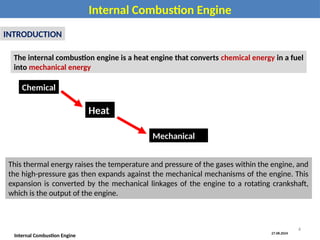
The internal combustion engine is a heat engine that converts chemical energy in a fuel
into mechanical energy
INTRODUCTION
Heat
Mechanical
Chemical
This thermal energy raises the temperature and pressure of the gases within the engine, and
the high-pressure gas then expands against the mechanical mechanisms of the engine. This
expansion is converted by the mechanical linkages of the engine to a rotating crankshaft,
which is the output of the engine.
4
27.08.2024
Internal Combustion Engine
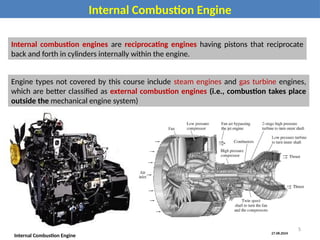
Internal combustion engines are reciprocating engines having pistons that reciprocate
back and forth in cylinders internally within the engine.
Engine types not covered by this course include steam engines and gas turbine engines,
which are better classified as external combustion engines (i.e., combustion takes place
outside the mechanical engine system)
5
27.08.2024
Internal Combustion Engine
Historical Development of the I.C. Engine
• 1862 -- Rochas described the basic principles essential for
efficient engine operation.
• 1878 – Otto built the first successful 4-stroke cycle engine.
• 1891 – Day built an improved 2-stroke cycle engine.
• 1892 – Diesel patented the compression-ignition (diesel)
engine.
• To present – emphasis on improved engine efficiency,
through refinement.
• You
6
27.08.2024
Internal Combustion Engine
ENGINE CLASSIFICATIONS
Internal combustion engines can be classified in a number of different ways:
1. Types of Ignition
(a) Spark Ignition (SI). An SI engine starts the combustion process in each cycle by use of a
spark plug. The spark plug gives a high-voltage electrical discharge between two electrodes
which ignites the air-fuel mixture in the combustion chamber surrounding the plug.
(b) Compression Ignition (CI). The combustion process in a CI engine starts when the air-
fuel mixture self-ignites due to high temperature in the combustion chamber caused by
high compression.
2. Engine Cycle
(a) Four-Stroke Cycle. A four-stroke cycle experiences four piston movements over two
engine revolutions for each cycle.
(b) Two-Stroke Cycle. A two-stroke cycle has two piston movements over one revolution
for each cycle.
7
27.08.2024
Internal Combustion Engine
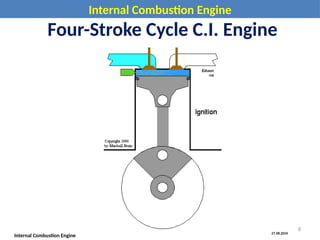
Four-Stroke Cycle C.I. Engine
8
27.08.2024
Internal Combustion Engine
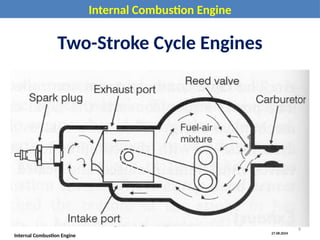
Two-Stroke Cycle Engines
9
27.08.2024
Internal Combustion Engine
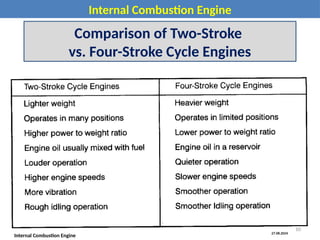
Comparison of Two-Stroke
vs. Four-Stroke Cycle Engines
10
27.08.2024
Internal Combustion Engine
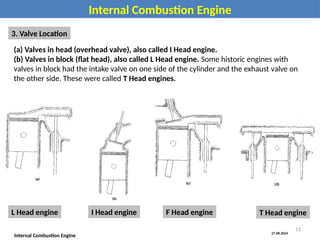
3. Valve Location
(a) Valves in head (overhead valve), also called I Head engine.
(b) Valves in block (flat head), also called L Head engine. Some historic engines with
valves in block had the intake valve on one side of the cylinder and the exhaust valve on
the other side. These were called T Head engines.
I Head engine T Head engine
L Head engine F Head engine
11
27.08.2024
Internal Combustion Engine
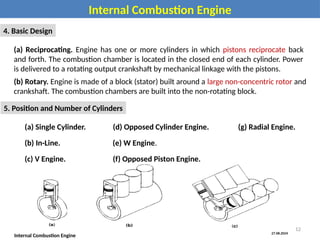
4. Basic Design
(a) Reciprocating. Engine has one or more cylinders in which pistons reciprocate back
and forth. The combustion chamber is located in the closed end of each cylinder. Power
is delivered to a rotating output crankshaft by mechanical linkage with the pistons.
(b) Rotary. Engine is made of a block (stator) built around a large non-concentric rotor and
crankshaft. The combustion chambers are built into the non-rotating block.
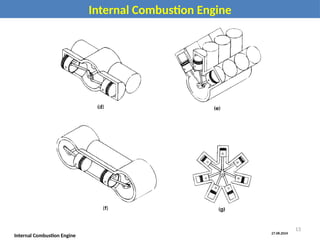
5. Position and Number of Cylinders
(a) Single Cylinder.
(b) In-Line.
(c) V Engine.
(d) Opposed Cylinder Engine.
(e) W Engine.
(f) Opposed Piston Engine.
(g) Radial Engine.
12
27.08.2024
Internal Combustion Engine
13
27.08.2024
Internal Combustion Engine
6. Air Intake Process
(a) Naturally Aspirated. No intake air pressure boost system.
(b) Supercharged. Intake air pressure increased with the compressor driven
off of the engine crankshaft (Fig. 1-8).
(c) Turbocharged. Intake air pressure increased with the turbine-compressor
driven by the engine exhaust gases (Fig. 1-9).
(d) Crankcase Compressed. Two-stroke cycle engine which uses the crankcase as the intake
air compressor. Limited development work has also been done on design and construction
of four-stroke cycle engines with crankcase compression.
7. Method of Fuel Input for SI Engines
(a) Carbureted.
(b) Multipoint Port Fuel Injection. One or more injectors at each cylinder intake.
(c) Throttle Body Fuel Injection. Injectors upstream in intake manifold.
14
27.08.2024
Internal Combustion Engine
8. Fuel Used
(a) Gasoline.
(b) Diesel Oil or Fuel Oil.
(c) Gas, Natural Gas, Methane.
(d) LPG.
(e) Alcohol-Ethyl, Methyl.
(f) Dual Fuel. There are a number of engines that use a combination of two or more
fuels. Some, usually large, CI engines use a combination of methane and diesel fuel.
These are attractive in developing third-world countries because of the high cost of
diesel fuel. Combined gasoline-alcohol fuels are becoming more common as an
alternative to straight gasoline automobile engine fuel.
(g) Gasohol. Common fuel consisting of 90% gasoline and 10% alcohol.
9. Application
(a) Automobile, Truck, Bus.
(b) Locomotive.
(c) Stationary.
(d) Marine.
(e) Aircraft.
(f) Small Portable, Chain Saw, Model Airplane. 15
27.08.2024
Internal Combustion Engine
1O. Type of Cooling
(a) Air Cooled.
(b) Liquid Cooled, Water Cooled.
16
27.08.2024
Internal Combustion Engine
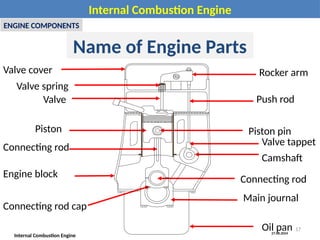
Name of Engine Parts
Valve cover
Valve spring
Valve
Connecting rod
Engine block
Rocker arm
Push rod
Valve tappet
Camshaft
Connecting rod
Main journal
Connecting rod cap
Piston pin
Oil pan
Piston
ENGINE COMPONENTS
17
27.08.2024
Internal Combustion Engine
ENGINE COMPONENTS
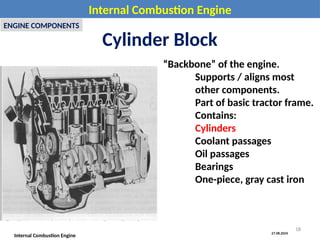
Cylinder Block
“Backbone” of the engine.
Supports / aligns most
other components.
Part of basic tractor frame.
Contains:
Cylinders
Coolant passages
Oil passages
Bearings
One-piece, gray cast iron
18
27.08.2024
Internal Combustion Engine
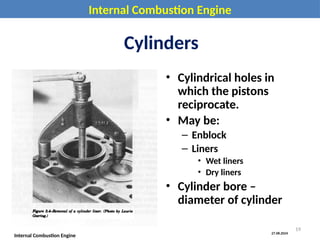
Cylinders
• Cylindrical holes in
which the pistons
reciprocate.
• May be:
– Enblock
– Liners
• Wet liners
• Dry liners
• Cylinder bore –
diameter of cylinder
19
27.08.2024
Internal Combustion Engine
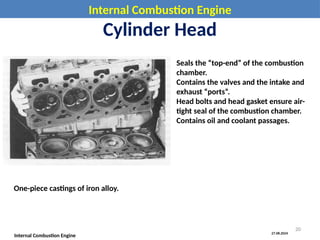
Cylinder Head
Seals the “top-end” of the combustion
chamber.
Contains the valves and the intake and
exhaust “ports”.
Head bolts and head gasket ensure air-
tight seal of the combustion chamber.
Contains oil and coolant passages.
One-piece castings of iron alloy.
20
27.08.2024
Internal Combustion Engine
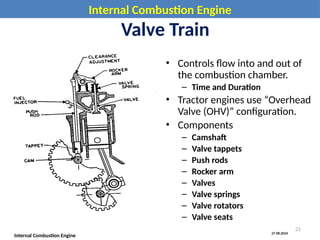
Valve Train
• Controls flow into and out of
the combustion chamber.
– Time and Duration
• Tractor engines use “Overhead
Valve (OHV)” configuration.
• Components
– Camshaft
– Valve tappets
– Push rods
– Rocker arm
– Valves
– Valve springs
– Valve rotators
– Valve seats
21
27.08.2024
Internal Combustion Engine
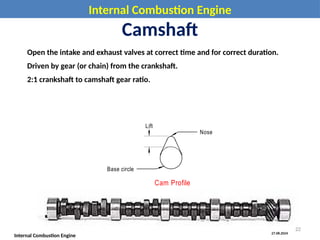
Camshaft
Lift
Base circle
Nose
Cam Profile
Open the intake and exhaust valves at correct time and for correct duration.
Driven by gear (or chain) from the crankshaft.
2:1 crankshaft to camshaft gear ratio.
22
27.08.2024
Internal Combustion Engine
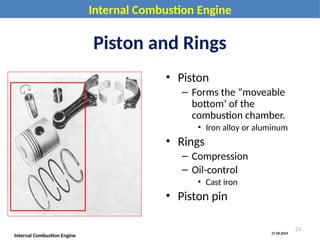
Piston and Rings
• Piston
– Forms the “moveable
bottom’ of the
combustion chamber.
• Iron alloy or aluminum
• Rings
– Compression
– Oil-control
• Cast iron
• Piston pin
23
27.08.2024
Internal Combustion Engine
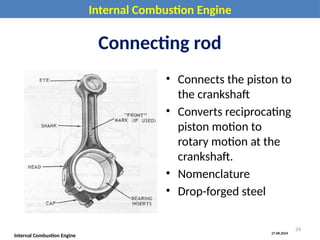
Connecting rod
• Connects the piston to
the crankshaft
• Converts reciprocating
piston motion to
rotary motion at the
crankshaft.
• Nomenclature
• Drop-forged steel
24
27.08.2024
Internal Combustion Engine
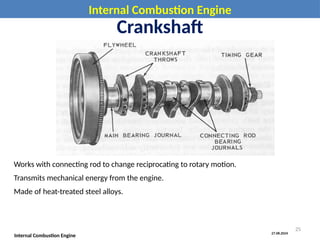
Crankshaft
Works with connecting rod to change reciprocating to rotary motion.
Transmits mechanical energy from the engine.
Made of heat-treated steel alloys.
25
27.08.2024
Internal Combustion Engine
TERMINOLOGY AND ABBREVIATIONS
The following terms and abbreviations are commonly used in engine technology
 Internal Combustion (IC)
 Spark Ignition (SI) An engine in which the combustion process in each cycle is
started by use of a spark plug.
 Compression Ignition (CI) An engine in which the combustion process starts when the
air-fuel mixture self-ignites due to high temperature in the combustion chamber caused
by high compression.
 Top-Dead-Center (TDC) Position of the piston when it stops at the furthest point away
from the crankshaft.
 Bottom-Dead-Center (BDC) Position of the piston when it stops at the point closest to
the crankshaft.
 Direct Injection (DI) Fuel injection into the main combustion chamber of an engine.
 Indirect Injection (IDI) Fuel injection into the secondary chamber of an engine with
a divided combustion chamber.
 Bore Diameter of the cylinder or diameter of the piston face, which is the same
minus a very small clearance.
26
27.08.2024
Internal Combustion Engine
 Stroke Movement distance of the piston from one extreme position to the other:
TDC to BDC or BDC to TDC.
 Clearance Volume Minimum volume in the combustion chamber with piston at TDC.
 Displacement or Displacement Volume Volume displaced by the piston as it travels
through one stroke.
 Smart Engine Engine with computer controls that regulate operating characteristics
such as air-fuel ratio, ignition timing, valve timing, exhaust control, intake tuning, etc.
 Air-Fuel Ratio (AF) Ratio of mass of air to mass of fuel input into engine.
 Fuel-Air Ratio (FA) Ratio of mass of fuel to mass of air input into engine.
 Ignition Delay (ID) Time interval between ignition initiation and the actual start of
Combustion
27
27.08.2024
Internal Combustion Engine
BASIC ENGINE CYCLES
Most internal combustion engines, both spark ignition and compression ignition, operate on
either a four-stroke cycle or a two-stroke cycle.
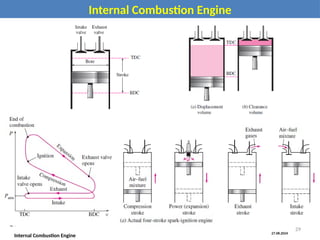
A- Four-Stroke SI Engine Cycle
1. First Stroke: Intake Stroke or Induction The piston travels from TDC to BDC with the
intake valve open and exhaust valve closed. This creates an increasing volume in the
combustion chamber, which in turn creates a vacuum.
2. Second Stroke: Compression Stroke When the piston reaches BDC, the intake valve closes
and the piston travels back to TDC with all valves closed. This compresses the air-fuel
mixture, raising both the pressure and temperature in the cylinder.
3. Combustion: Combustion of the air-fuel mixture occurs in a very short but finite length of
time with the piston near TDC (i.e., nearly constant-volume combustion).
4. Third Stroke: Expansion Stroke or Power Stroke With all valves closed, the high pressure
created by the combustion process pushes the piston away from TDC. This is the stroke which
produces the work output of the engine cycle.
5. Exhaust Blowdown Late in the power stroke, the exhaust valve is opened and exhaust blow
down occurs.
6. Fourth Stroke: Exhaust Stroke By the time the piston reaches BDC, exhaust blowdown is
complete, but the cylinder is still full of exhaust gases at approximately atmospheric pressure.
28
27.08.2024
Internal Combustion Engine
29
27.08.2024
Internal Combustion Engine
B- Four-Stroke CI Engine Cycle
1. First Stroke: Intake Stroke The same as the intake stroke in an SI engine with one
major difference: no fuel is added to the incoming air.
2. Second Stroke: Compression Stroke The same as in an SI engine except that only air is
compressed and compression is to higher pressures and temperature.
3. Combustion Combustion is fully developed by TDC and continues at about constant
pressure until fuel injection is complete and the piston has started towards BDC.
4. Third Stroke: Power Stroke The power stroke continues as combustion ends and the
piston travels towards BDC.
5. Exhaust Blowdown Same as with an SI engine.
6. Fourth Stroke: Exhaust Stroke Same as with an SI engine.
30
27.08.2024
Internal Combustion Engine
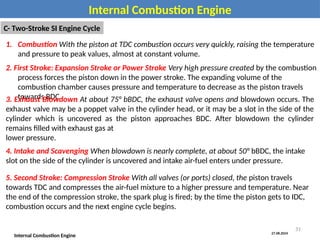
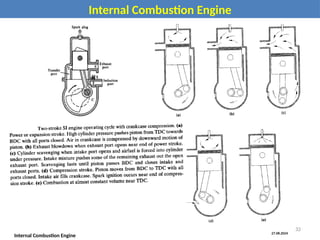
C- Two-Stroke SI Engine Cycle
1. Combustion With the piston at TDC combustion occurs very quickly, raising the temperature
and pressure to peak values, almost at constant volume.
2. First Stroke: Expansion Stroke or Power Stroke Very high pressure created by the combustion
process forces the piston down in the power stroke. The expanding volume of the
combustion chamber causes pressure and temperature to decrease as the piston travels
towards BDC.
3. Exhaust Blowdown At about 75° bBDC, the exhaust valve opens and blowdown occurs. The
exhaust valve may be a poppet valve in the cylinder head, or it may be a slot in the side of the
cylinder which is uncovered as the piston approaches BDC. After blowdown the cylinder
remains filled with exhaust gas at
lower pressure.
4. Intake and Scavenging When blowdown is nearly complete, at about 50° bBDC, the intake
slot on the side of the cylinder is uncovered and intake air-fuel enters under pressure.
5. Second Stroke: Compression Stroke With all valves (or ports) closed, the piston travels
towards TDC and compresses the air-fuel mixture to a higher pressure and temperature. Near
the end of the compression stroke, the spark plug is fired; by the time the piston gets to IDC,
combustion occurs and the next engine cycle begins.
31
27.08.2024
Internal Combustion Engine
32
27.08.2024
Internal Combustion Engine
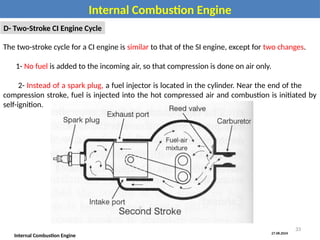
D- Two-Stroke CI Engine Cycle
The two-stroke cycle for a CI engine is similar to that of the SI engine, except for two changes.
1- No fuel is added to the incoming air, so that compression is done on air only.
2- Instead of a spark plug, a fuel injector is located in the cylinder. Near the end of the
compression stroke, fuel is injected into the hot compressed air and combustion is initiated by
self-ignition.
33
27.08.2024
Internal Combustion Engine
ENGINE EMISSIONS AND AIR POLLUTION
The exhaust of automobiles is one of the major contributors to the world's air pollution
problem. Recent research and development has made major reductions in engine
emissions, but a growing population and a greater number of automobiles means that the
problem will exist for many years to come.
Four major emissions produced by internal combustion engines are hydrocarbons (He),
carbon monoxide (CO), oxides of nitrogen (NOx), and solid particulates.
1- Hydrocarbons are fuel molecules which did not get burned and smaller non-equilibrium
particles of partially burned fuel.
2- Carbon monoxide occurs when not enough oxygen is present to fully react all carbon to
CO2 or when incomplete air-fuel mixing occurs due to the very short engine cycle time.
3- Oxides of nitrogen are created in an engine when high combustion temperatures cause
some normally stable N2 to dissociate into monatomic nitrogen N, which then combines with
reacting oxygen.
4- Solid particulates are formed in compression ignition engines and are seen as black smoke
in the exhaust of these engines. Other emissions found in the exhaust of engines include
aldehydes, sulfur, lead, and phosphorus.
34
27.08.2024
Internal Combustion Engine
35

internal combustion engine internal combustion engine

  • 1.
    27.08.2024 Internal Combustion Engine InternalCombustion Engine Internal Combustion Engine 1
  • 2.
    27.08.2024 Internal Combustion Engine InternalCombustion Engine Contents 1-Introduction (History, Engine classification, Engine component and Engine emissions) 2-Operating Characteristics (Engine parameters, Torque, Power, pressure, Efficiency, Volumetric efficiency) 3-Engine cycles (Otto cycle, SI cycle, Diesel cycle, Dual cycle, CI cycle) 4-Thermochemistry and Fuels (Hydrocarbon Fuels-Gasoline, Self-Ignition and Octane Number, Diesel Fuel) 5-Air and Fuel induction (Fuel Injectors, Carburetors, Supercharging and Turbocharging) 6-Emission and air pollutions (Co2 , Co, Nox and solid particles) 2
  • 3.
    27.08.2024 Internal Combustion Engine InternalCombustion Engine References: Internal Combustion Engine Fundamentals By John B. Heywood McGraw-Hill Higher Education 1988 Engineering Fundamentals of the Internal Combustion Engine by Willard W.Pulkrabek Prentice Hall, 1st edition,1997. An Introduction to Combustion : Concepts and Applications w/IBM3.5’ Disk by Stephen R. Turns McGraw-Hill Higher Education , Bk & Disk edition,1995 3
  • 4.
    27.08.2024 Internal Combustion Engine InternalCombustion Engine The internal combustion engine is a heat engine that converts chemical energy in a fuel into mechanical energy INTRODUCTION Heat Mechanical Chemical This thermal energy raises the temperature and pressure of the gases within the engine, and the high-pressure gas then expands against the mechanical mechanisms of the engine. This expansion is converted by the mechanical linkages of the engine to a rotating crankshaft, which is the output of the engine. 4
  • 5.
    27.08.2024 Internal Combustion Engine InternalCombustion Engine Internal combustion engines are reciprocating engines having pistons that reciprocate back and forth in cylinders internally within the engine. Engine types not covered by this course include steam engines and gas turbine engines, which are better classified as external combustion engines (i.e., combustion takes place outside the mechanical engine system) 5
  • 6.
    27.08.2024 Internal Combustion Engine InternalCombustion Engine Historical Development of the I.C. Engine • 1862 -- Rochas described the basic principles essential for efficient engine operation. • 1878 – Otto built the first successful 4-stroke cycle engine. • 1891 – Day built an improved 2-stroke cycle engine. • 1892 – Diesel patented the compression-ignition (diesel) engine. • To present – emphasis on improved engine efficiency, through refinement. • You 6
  • 7.
    27.08.2024 Internal Combustion Engine InternalCombustion Engine ENGINE CLASSIFICATIONS Internal combustion engines can be classified in a number of different ways: 1. Types of Ignition (a) Spark Ignition (SI). An SI engine starts the combustion process in each cycle by use of a spark plug. The spark plug gives a high-voltage electrical discharge between two electrodes which ignites the air-fuel mixture in the combustion chamber surrounding the plug. (b) Compression Ignition (CI). The combustion process in a CI engine starts when the air- fuel mixture self-ignites due to high temperature in the combustion chamber caused by high compression. 2. Engine Cycle (a) Four-Stroke Cycle. A four-stroke cycle experiences four piston movements over two engine revolutions for each cycle. (b) Two-Stroke Cycle. A two-stroke cycle has two piston movements over one revolution for each cycle. 7
  • 8.
    27.08.2024 Internal Combustion Engine InternalCombustion Engine Four-Stroke Cycle C.I. Engine 8
  • 9.
    27.08.2024 Internal Combustion Engine InternalCombustion Engine Two-Stroke Cycle Engines 9
  • 10.
    27.08.2024 Internal Combustion Engine InternalCombustion Engine Comparison of Two-Stroke vs. Four-Stroke Cycle Engines 10
  • 11.
    27.08.2024 Internal Combustion Engine InternalCombustion Engine 3. Valve Location (a) Valves in head (overhead valve), also called I Head engine. (b) Valves in block (flat head), also called L Head engine. Some historic engines with valves in block had the intake valve on one side of the cylinder and the exhaust valve on the other side. These were called T Head engines. I Head engine T Head engine L Head engine F Head engine 11
  • 12.
    27.08.2024 Internal Combustion Engine InternalCombustion Engine 4. Basic Design (a) Reciprocating. Engine has one or more cylinders in which pistons reciprocate back and forth. The combustion chamber is located in the closed end of each cylinder. Power is delivered to a rotating output crankshaft by mechanical linkage with the pistons. (b) Rotary. Engine is made of a block (stator) built around a large non-concentric rotor and crankshaft. The combustion chambers are built into the non-rotating block. 5. Position and Number of Cylinders (a) Single Cylinder. (b) In-Line. (c) V Engine. (d) Opposed Cylinder Engine. (e) W Engine. (f) Opposed Piston Engine. (g) Radial Engine. 12
  • 13.
  • 14.
    27.08.2024 Internal Combustion Engine InternalCombustion Engine 6. Air Intake Process (a) Naturally Aspirated. No intake air pressure boost system. (b) Supercharged. Intake air pressure increased with the compressor driven off of the engine crankshaft (Fig. 1-8). (c) Turbocharged. Intake air pressure increased with the turbine-compressor driven by the engine exhaust gases (Fig. 1-9). (d) Crankcase Compressed. Two-stroke cycle engine which uses the crankcase as the intake air compressor. Limited development work has also been done on design and construction of four-stroke cycle engines with crankcase compression. 7. Method of Fuel Input for SI Engines (a) Carbureted. (b) Multipoint Port Fuel Injection. One or more injectors at each cylinder intake. (c) Throttle Body Fuel Injection. Injectors upstream in intake manifold. 14
  • 15.
    27.08.2024 Internal Combustion Engine InternalCombustion Engine 8. Fuel Used (a) Gasoline. (b) Diesel Oil or Fuel Oil. (c) Gas, Natural Gas, Methane. (d) LPG. (e) Alcohol-Ethyl, Methyl. (f) Dual Fuel. There are a number of engines that use a combination of two or more fuels. Some, usually large, CI engines use a combination of methane and diesel fuel. These are attractive in developing third-world countries because of the high cost of diesel fuel. Combined gasoline-alcohol fuels are becoming more common as an alternative to straight gasoline automobile engine fuel. (g) Gasohol. Common fuel consisting of 90% gasoline and 10% alcohol. 9. Application (a) Automobile, Truck, Bus. (b) Locomotive. (c) Stationary. (d) Marine. (e) Aircraft. (f) Small Portable, Chain Saw, Model Airplane. 15
  • 16.
    27.08.2024 Internal Combustion Engine InternalCombustion Engine 1O. Type of Cooling (a) Air Cooled. (b) Liquid Cooled, Water Cooled. 16
  • 17.
    27.08.2024 Internal Combustion Engine InternalCombustion Engine Name of Engine Parts Valve cover Valve spring Valve Connecting rod Engine block Rocker arm Push rod Valve tappet Camshaft Connecting rod Main journal Connecting rod cap Piston pin Oil pan Piston ENGINE COMPONENTS 17
  • 18.
    27.08.2024 Internal Combustion Engine InternalCombustion Engine ENGINE COMPONENTS Cylinder Block “Backbone” of the engine. Supports / aligns most other components. Part of basic tractor frame. Contains: Cylinders Coolant passages Oil passages Bearings One-piece, gray cast iron 18
  • 19.
    27.08.2024 Internal Combustion Engine InternalCombustion Engine Cylinders • Cylindrical holes in which the pistons reciprocate. • May be: – Enblock – Liners • Wet liners • Dry liners • Cylinder bore – diameter of cylinder 19
  • 20.
    27.08.2024 Internal Combustion Engine InternalCombustion Engine Cylinder Head Seals the “top-end” of the combustion chamber. Contains the valves and the intake and exhaust “ports”. Head bolts and head gasket ensure air- tight seal of the combustion chamber. Contains oil and coolant passages. One-piece castings of iron alloy. 20
  • 21.
    27.08.2024 Internal Combustion Engine InternalCombustion Engine Valve Train • Controls flow into and out of the combustion chamber. – Time and Duration • Tractor engines use “Overhead Valve (OHV)” configuration. • Components – Camshaft – Valve tappets – Push rods – Rocker arm – Valves – Valve springs – Valve rotators – Valve seats 21
  • 22.
    27.08.2024 Internal Combustion Engine InternalCombustion Engine Camshaft Lift Base circle Nose Cam Profile Open the intake and exhaust valves at correct time and for correct duration. Driven by gear (or chain) from the crankshaft. 2:1 crankshaft to camshaft gear ratio. 22
  • 23.
    27.08.2024 Internal Combustion Engine InternalCombustion Engine Piston and Rings • Piston – Forms the “moveable bottom’ of the combustion chamber. • Iron alloy or aluminum • Rings – Compression – Oil-control • Cast iron • Piston pin 23
  • 24.
    27.08.2024 Internal Combustion Engine InternalCombustion Engine Connecting rod • Connects the piston to the crankshaft • Converts reciprocating piston motion to rotary motion at the crankshaft. • Nomenclature • Drop-forged steel 24
  • 25.
    27.08.2024 Internal Combustion Engine InternalCombustion Engine Crankshaft Works with connecting rod to change reciprocating to rotary motion. Transmits mechanical energy from the engine. Made of heat-treated steel alloys. 25
  • 26.
    27.08.2024 Internal Combustion Engine InternalCombustion Engine TERMINOLOGY AND ABBREVIATIONS The following terms and abbreviations are commonly used in engine technology  Internal Combustion (IC)  Spark Ignition (SI) An engine in which the combustion process in each cycle is started by use of a spark plug.  Compression Ignition (CI) An engine in which the combustion process starts when the air-fuel mixture self-ignites due to high temperature in the combustion chamber caused by high compression.  Top-Dead-Center (TDC) Position of the piston when it stops at the furthest point away from the crankshaft.  Bottom-Dead-Center (BDC) Position of the piston when it stops at the point closest to the crankshaft.  Direct Injection (DI) Fuel injection into the main combustion chamber of an engine.  Indirect Injection (IDI) Fuel injection into the secondary chamber of an engine with a divided combustion chamber.  Bore Diameter of the cylinder or diameter of the piston face, which is the same minus a very small clearance. 26
  • 27.
    27.08.2024 Internal Combustion Engine InternalCombustion Engine  Stroke Movement distance of the piston from one extreme position to the other: TDC to BDC or BDC to TDC.  Clearance Volume Minimum volume in the combustion chamber with piston at TDC.  Displacement or Displacement Volume Volume displaced by the piston as it travels through one stroke.  Smart Engine Engine with computer controls that regulate operating characteristics such as air-fuel ratio, ignition timing, valve timing, exhaust control, intake tuning, etc.  Air-Fuel Ratio (AF) Ratio of mass of air to mass of fuel input into engine.  Fuel-Air Ratio (FA) Ratio of mass of fuel to mass of air input into engine.  Ignition Delay (ID) Time interval between ignition initiation and the actual start of Combustion 27
  • 28.
    27.08.2024 Internal Combustion Engine InternalCombustion Engine BASIC ENGINE CYCLES Most internal combustion engines, both spark ignition and compression ignition, operate on either a four-stroke cycle or a two-stroke cycle. A- Four-Stroke SI Engine Cycle 1. First Stroke: Intake Stroke or Induction The piston travels from TDC to BDC with the intake valve open and exhaust valve closed. This creates an increasing volume in the combustion chamber, which in turn creates a vacuum. 2. Second Stroke: Compression Stroke When the piston reaches BDC, the intake valve closes and the piston travels back to TDC with all valves closed. This compresses the air-fuel mixture, raising both the pressure and temperature in the cylinder. 3. Combustion: Combustion of the air-fuel mixture occurs in a very short but finite length of time with the piston near TDC (i.e., nearly constant-volume combustion). 4. Third Stroke: Expansion Stroke or Power Stroke With all valves closed, the high pressure created by the combustion process pushes the piston away from TDC. This is the stroke which produces the work output of the engine cycle. 5. Exhaust Blowdown Late in the power stroke, the exhaust valve is opened and exhaust blow down occurs. 6. Fourth Stroke: Exhaust Stroke By the time the piston reaches BDC, exhaust blowdown is complete, but the cylinder is still full of exhaust gases at approximately atmospheric pressure. 28
  • 29.
  • 30.
    27.08.2024 Internal Combustion Engine InternalCombustion Engine B- Four-Stroke CI Engine Cycle 1. First Stroke: Intake Stroke The same as the intake stroke in an SI engine with one major difference: no fuel is added to the incoming air. 2. Second Stroke: Compression Stroke The same as in an SI engine except that only air is compressed and compression is to higher pressures and temperature. 3. Combustion Combustion is fully developed by TDC and continues at about constant pressure until fuel injection is complete and the piston has started towards BDC. 4. Third Stroke: Power Stroke The power stroke continues as combustion ends and the piston travels towards BDC. 5. Exhaust Blowdown Same as with an SI engine. 6. Fourth Stroke: Exhaust Stroke Same as with an SI engine. 30
  • 31.
    27.08.2024 Internal Combustion Engine InternalCombustion Engine C- Two-Stroke SI Engine Cycle 1. Combustion With the piston at TDC combustion occurs very quickly, raising the temperature and pressure to peak values, almost at constant volume. 2. First Stroke: Expansion Stroke or Power Stroke Very high pressure created by the combustion process forces the piston down in the power stroke. The expanding volume of the combustion chamber causes pressure and temperature to decrease as the piston travels towards BDC. 3. Exhaust Blowdown At about 75° bBDC, the exhaust valve opens and blowdown occurs. The exhaust valve may be a poppet valve in the cylinder head, or it may be a slot in the side of the cylinder which is uncovered as the piston approaches BDC. After blowdown the cylinder remains filled with exhaust gas at lower pressure. 4. Intake and Scavenging When blowdown is nearly complete, at about 50° bBDC, the intake slot on the side of the cylinder is uncovered and intake air-fuel enters under pressure. 5. Second Stroke: Compression Stroke With all valves (or ports) closed, the piston travels towards TDC and compresses the air-fuel mixture to a higher pressure and temperature. Near the end of the compression stroke, the spark plug is fired; by the time the piston gets to IDC, combustion occurs and the next engine cycle begins. 31
  • 32.
  • 33.
    27.08.2024 Internal Combustion Engine InternalCombustion Engine D- Two-Stroke CI Engine Cycle The two-stroke cycle for a CI engine is similar to that of the SI engine, except for two changes. 1- No fuel is added to the incoming air, so that compression is done on air only. 2- Instead of a spark plug, a fuel injector is located in the cylinder. Near the end of the compression stroke, fuel is injected into the hot compressed air and combustion is initiated by self-ignition. 33
  • 34.
    27.08.2024 Internal Combustion Engine InternalCombustion Engine ENGINE EMISSIONS AND AIR POLLUTION The exhaust of automobiles is one of the major contributors to the world's air pollution problem. Recent research and development has made major reductions in engine emissions, but a growing population and a greater number of automobiles means that the problem will exist for many years to come. Four major emissions produced by internal combustion engines are hydrocarbons (He), carbon monoxide (CO), oxides of nitrogen (NOx), and solid particulates. 1- Hydrocarbons are fuel molecules which did not get burned and smaller non-equilibrium particles of partially burned fuel. 2- Carbon monoxide occurs when not enough oxygen is present to fully react all carbon to CO2 or when incomplete air-fuel mixing occurs due to the very short engine cycle time. 3- Oxides of nitrogen are created in an engine when high combustion temperatures cause some normally stable N2 to dissociate into monatomic nitrogen N, which then combines with reacting oxygen. 4- Solid particulates are formed in compression ignition engines and are seen as black smoke in the exhaust of these engines. Other emissions found in the exhaust of engines include aldehydes, sulfur, lead, and phosphorus. 34
  • 35.