Material and technology
 for Automotive engine:
            brief overview


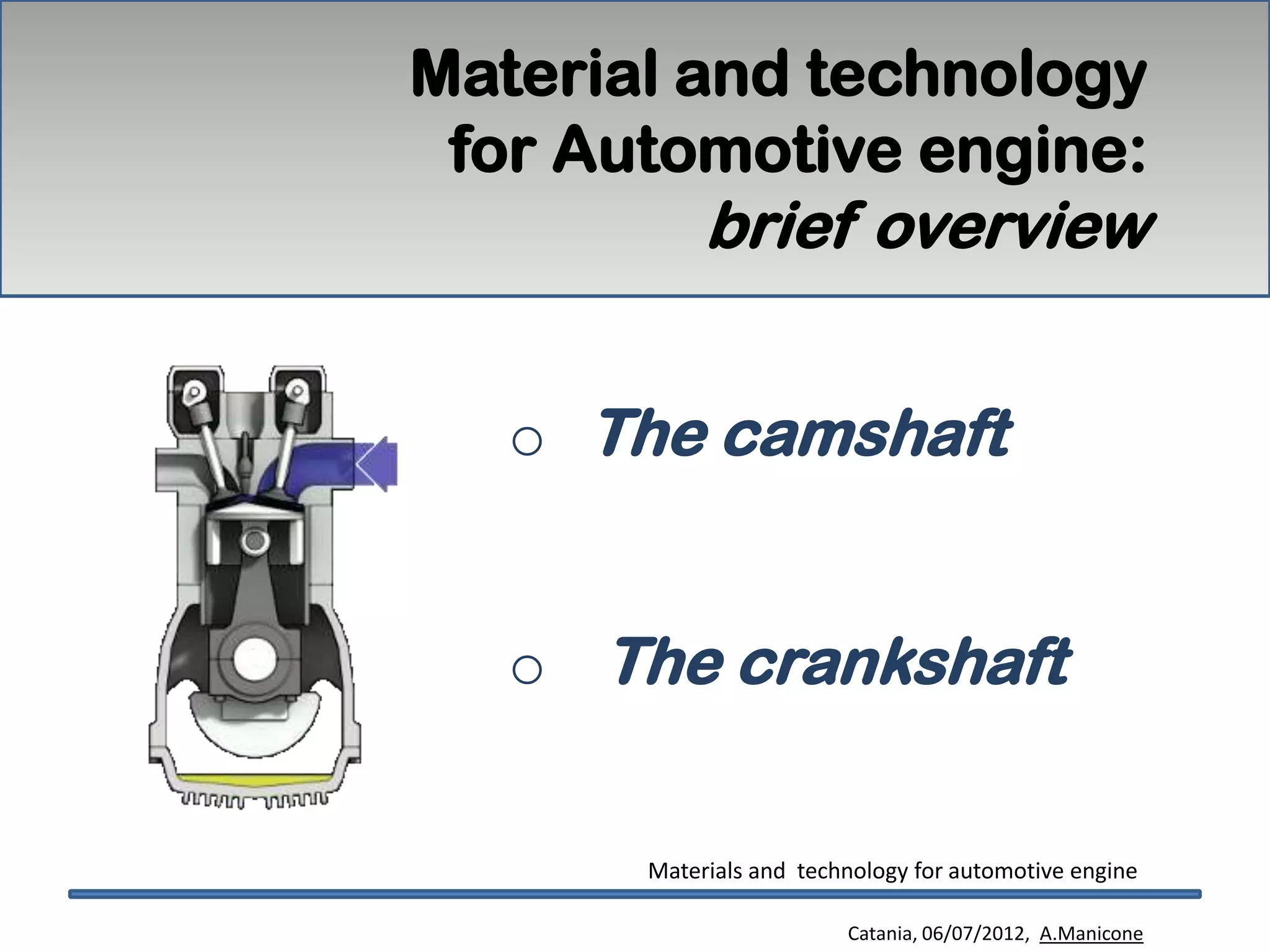
   o The camshaft


   o The crankshaft


       Materials and technology for automotive engine

                         Catania, 06/07/2012, A.Manicone
The camshaft


Materials and technology for automotive engine

               Catania, 06/07/2012, A.Manicone
The camshaft - 1


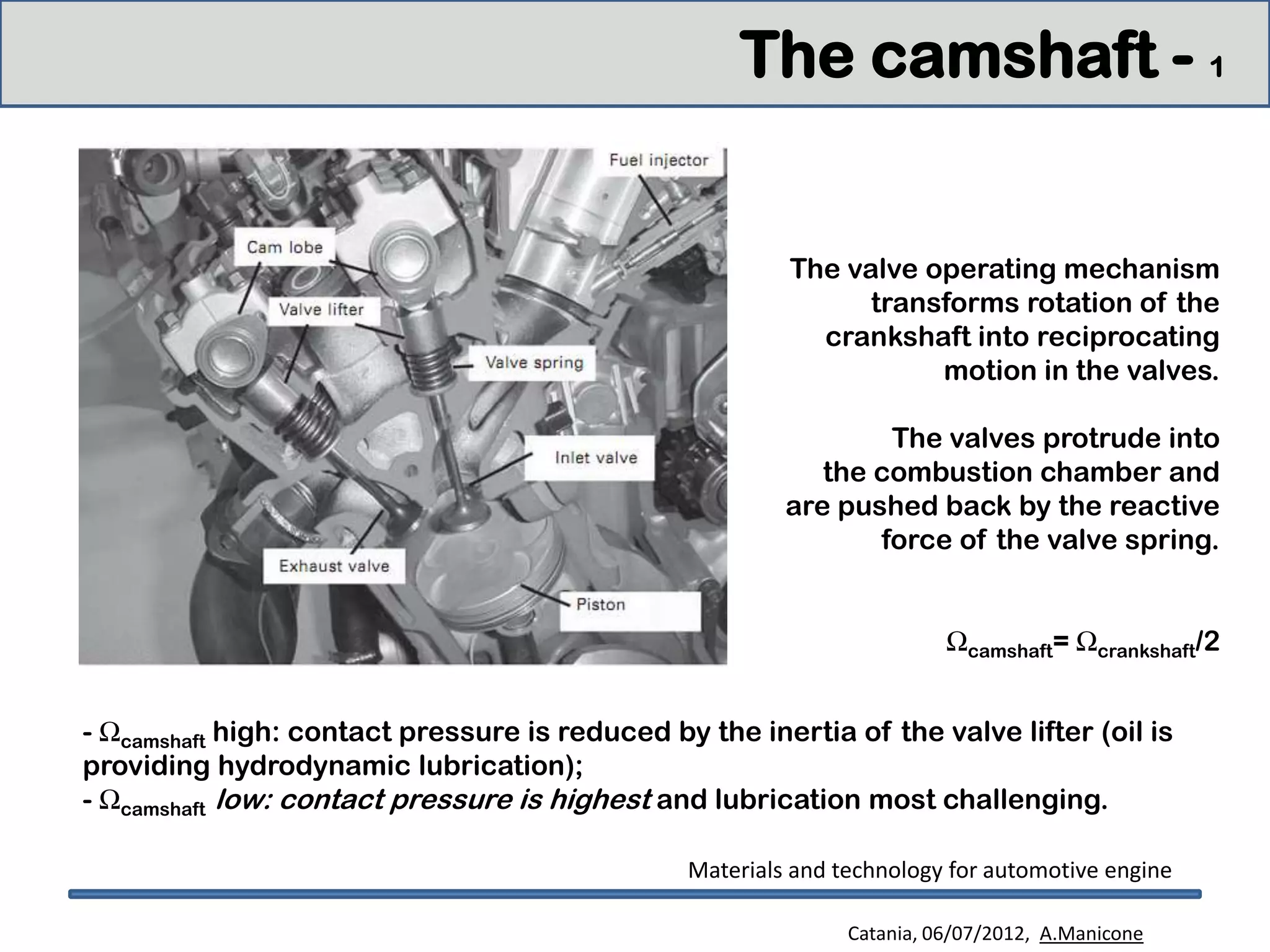
                                                         The valve operating mechanism
                                                               transforms rotation of the
                                                           crankshaft into reciprocating
                                                                    motion in the valves.

                                                                 The valves protrude into
                                                            the combustion chamber and
                                                         are pushed back by the reactive
                                                                force of the valve spring.


                                                                         Ωcamshaft= Ωcrankshaft/2


- Ωcamshaft high: contact pressure is reduced by the inertia of the valve lifter (oil is
providing hydrodynamic lubrication);
- Ωcamshaft low: contact pressure is highest and lubrication most challenging.

                                                Materials and technology for automotive engine

                                                               Catania, 06/07/2012, A.Manicone
The camshaft - 2
     Machining, dimension
     accuracy, clearance, rou
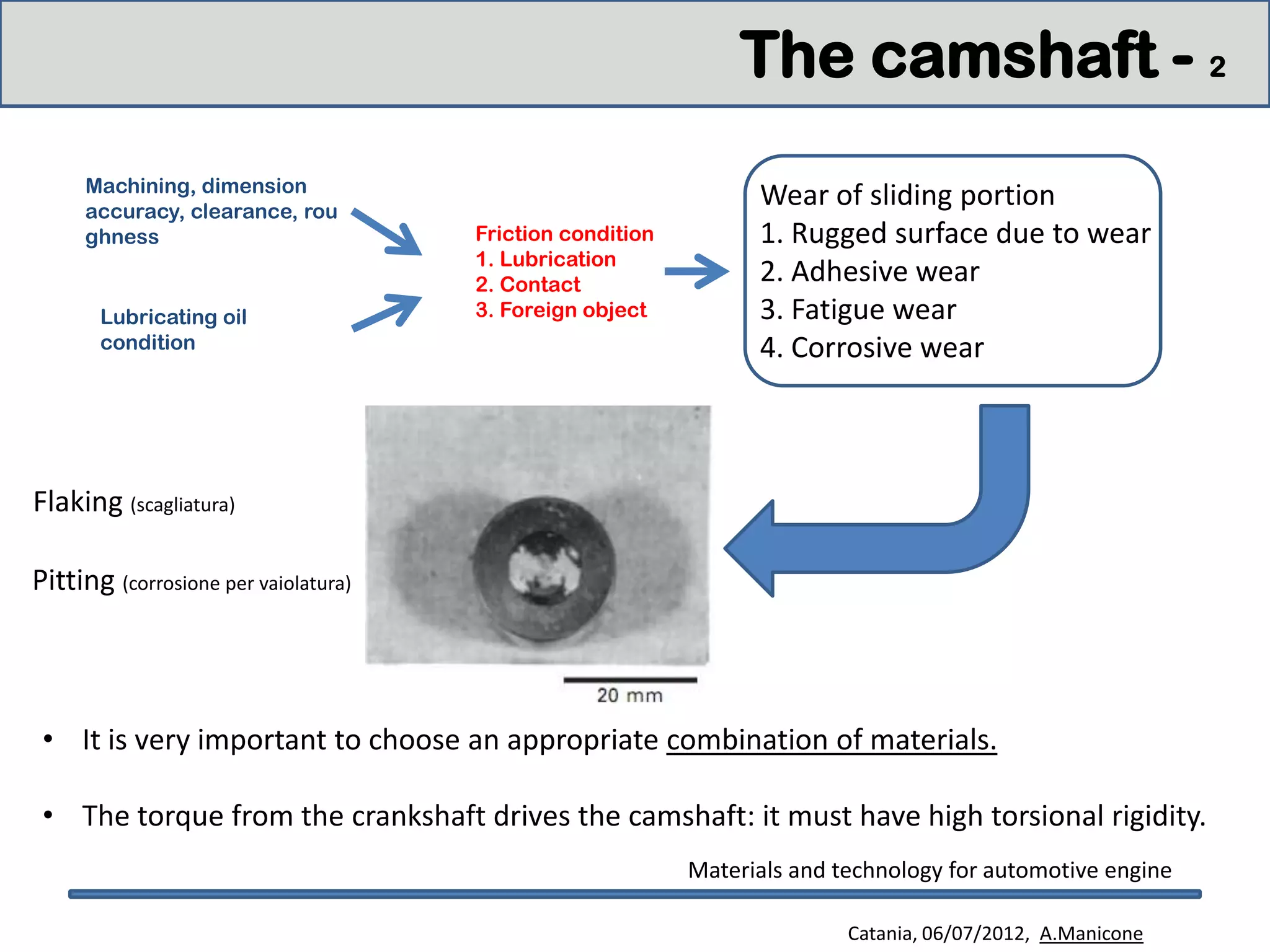
                                                                 Wear of sliding portion
     ghness                           Friction condition         1. Rugged surface due to wear
                                      1. Lubrication
                                      2. Contact                 2. Adhesive wear
       Lubricating oil                3. Foreign object          3. Fatigue wear
       condition                                                 4. Corrosive wear


Flaking (scagliatura)

Pitting (corrosione per vaiolatura)


 • It is very important to choose an appropriate combination of materials.

 • The torque from the crankshaft drives the camshaft: it must have high torsional rigidity.
                                                           Materials and technology for automotive engine

                                                                          Catania, 06/07/2012, A.Manicone
The camshaft - 3


Chill hardening cannot be used where the gap between the cam lobes is narrow because
of the difficulty in using the chiller, so forged camshafts are used.

Tough martensite is more resistant to pitting than the chill microstructure.


                                                Materials and technology for automotive engine

                                                               Catania, 06/07/2012, A.Manicone
The camshaft - 4
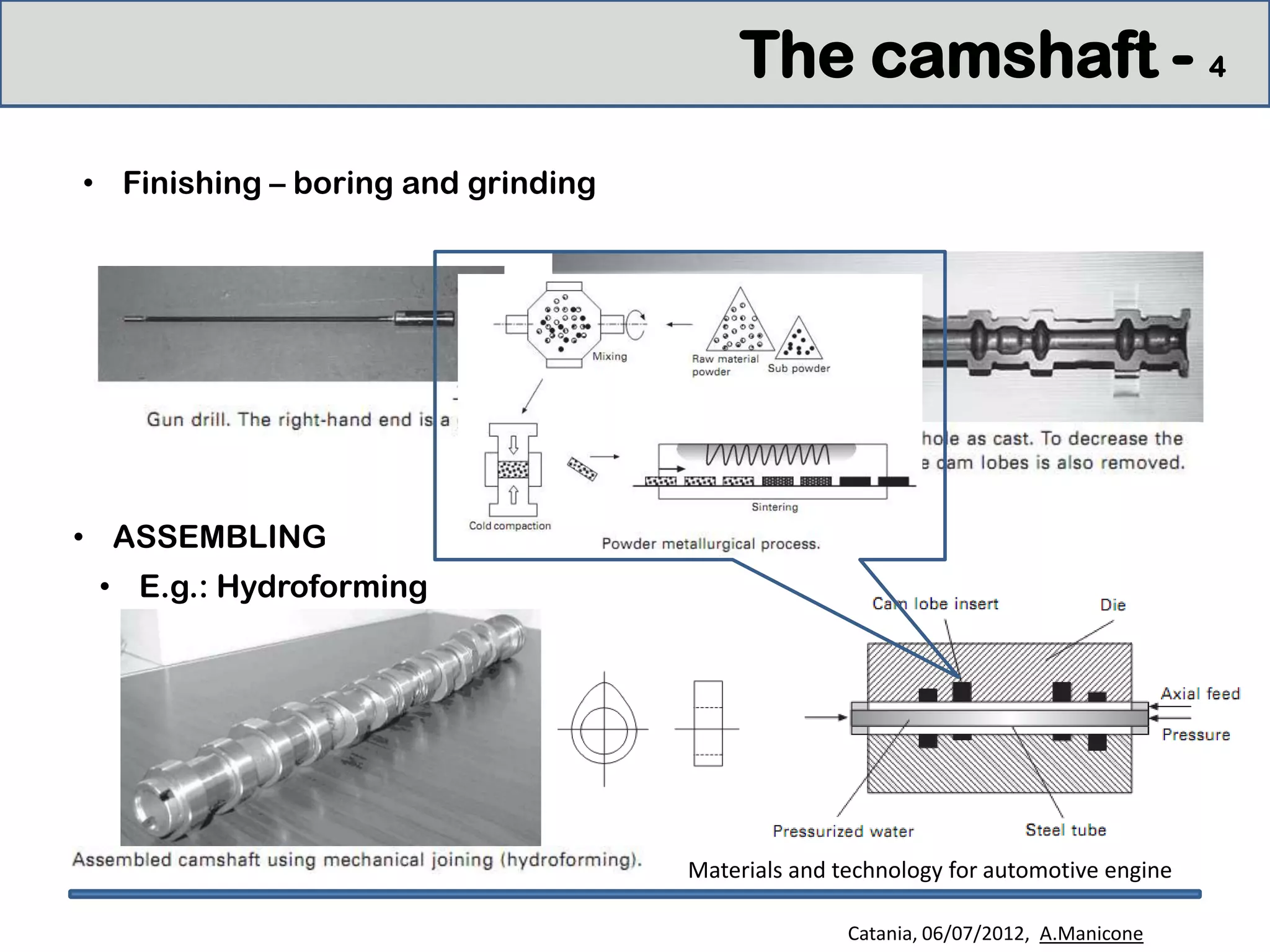
• Finishing – boring and grinding


• ASSEMBLING
 • E.g.: Hydroforming


                                    Materials and technology for automotive engine

                                                   Catania, 06/07/2012, A.Manicone
The crankshaft


Materials and technology for automotive engine

               Catania, 06/07/2012, A.Manicone
The crankshaft - 1
      The crankshaft converts reciprocative motion to rotational motion.


Two types:
• the monolithic type
• the assembled type


                                       Materials and technology for automotive engine

                                                      Catania, 06/07/2012, A.Manicone
The crankshaft - 2

                                                                               Note:
                                                                                Included lead or MnS
         Carbon steel                                                          particles significantly
                                                                               function as a chip
                                                                               breaker and a solid
         Alloyed steel                                                         lubricant and increase
                                                                               machinability.
    Micro Alloyed steel


Typical materials                        •   less expensive
•   nodular cast iron: for high-
    volume, low-load production.         •   lower rigidity: abnormal vibrations (resonance)


                                         •   increases in rigidity of more than 10%
                                         •   reduces noise levels and harshness
•   forged steel: for fuel-efficient     •   makes possible a careful design
    engines requiring a high power-to-
    displacement ratio.                  •   more expensive

                                               Materials and technology for automotive engine

                                                               Catania, 06/07/2012, A.Manicone
The crankshaft - 3
               •   Static: combustion pressure, inertial
                   forces of the piston and con-
                   rod, bearing load and drive torque.
STRESS on
Crankshaft     •   Dynamic: The vibration         causes
                   dynamic stress. If it occurs at the
                   resonating frequency, the deformation      Fatigue fracture of a carbon steel
                   will be very high and will instantly       S50C crankshaft

                   rupture the crankshaft.


             HIGH STATIC AND DYNAMIC RIGIDITY:

             - increasing the crankpin diameter (increasing weight)

             - using forged steel

             - Surface-hardening methods

                                                 Materials and technology for automotive engine

                                                                Catania, 06/07/2012, A.Manicone
Fatigue behaviour: principles and survey

                                      Principi (macro)
                 σa                                            Wöhler [1860]
         Ampiezza
         tensione
         applicata
                                                                   Vita finita            * Legge di Basquin:
                                                                                            σa = σf’ (2Nf)b
                                                 *
                                                                Tipici
                                                               Curva tipica
                                                                acciai
                                                                per acciai
                   σL
                                                                              Leghe di
                                                                              alluminio
                                                                                                 Vita infinita

                            104        105             106             107

                                      Cicli alla rottura, Nf
Dipende da:
•Tipo di materiale           • Concentrazione di                 • Contenuto di inclusioni e
                               tensioni                            impurezze
              • Trattamento termico              • Tensione media e
                superficiale                       tipo di sollecitazione
                                                     Materials and technology for automotive engine

                                                                     Catania, 06/07/2012, A.Manicone
The crankshaft - 4
HOT FORGING PROCESS (for a four-stroke crankshaft)


                     •   The coarse structure is broke down and is
                         replaced, as recrystallisation proceeds, by one
                         which is of relatively fine grain

                     •   Impuritires are redistribuited in a fibrous form

                     •   Introduction of compressive residual stresses


                           Materials and technology for automotive engine

                                          Catania, 06/07/2012, A.Manicone
The crankshaft - 5
                     SURFACE HARDENING
    (carburizing, nitring, carbonitring and nitrocarburizing):
•   CARBURIZING
                                              O: origins

                                              S: a few beachmarks

                                              B: arrest lines

                                              R: ratchet marks

     Pitting observed at a crankpin surface


                                                    Materials and technology for automotive engine

                                                                   Catania, 06/07/2012, A.Manicone
The crankshaft - 6
                     SURFACE HARDENING
    (carburizing, nitring, carbonitring and nitrocarburizing):
•   CARBURIZING


     Compressive residual stress
     generated by carburizing
                                      Materials and technology for automotive engine

                                                     Catania, 06/07/2012, A.Manicone
The crankshaft - 7
Modern carburizing technology: Acetylene Vacuum Carburizing- AvaC


                                                                                 Steel


     Fe
                        Acetilene              Siti di adsorbimento
     Cr
                         C                    H2
     Mn
                                    Materials and technology for automotive engine

          A. Manicone                              Catania, 06/07/2012, A.Manicone
The crankshaft - 7
               Avac - Adsorbimento (T>Taustenitizzazione)


                                                                                Steel


Fe
                   Acetilene                  Siti di adsorbimento
Cr
                    C                        H2
Mn
                                   Materials and technology for automotive engine

     A. Manicone                                  Catania, 06/07/2012, A.Manicone
The crankshaft - 7
              Avac - Decomposizione in radicali


                                                                            Steel


Fe
                   Acetilene              Siti di adsorbimento
Cr
                    C                    H2
Mn
                               Materials and technology for automotive engine

     A. Manicone                              Catania, 06/07/2012, A.Manicone
The crankshaft - 7
           Avac - Inizio cementazione (T>Taustenitizzazione)


                                                                              Steel


Fe
                   Acetilene                Siti di adsorbimento
Cr
                    C                      H2
Mn
                                 Materials and technology for automotive engine

     A. Manicone                                Catania, 06/07/2012, A.Manicone
The crankshaft - 7
           Avac - Inizio cementazione (T>Taustenitizzazione)


                                                                              Steel


Fe
                   Acetilene                Siti di adsorbimento
Cr
                    C                      H2
Mn
                                 Materials and technology for automotive engine

     A. Manicone                                Catania, 06/07/2012, A.Manicone
The crankshaft - 7
            Avac - Inizio cementazione (T>Taustenitizzazione)


                                                                               Steel


Fe
                   Acetilene                 Siti di adsorbimento
Cr
                    C                       H2
Mn
                                  Materials and technology for automotive engine

     A. Manicone                                 Catania, 06/07/2012, A.Manicone
The crankshaft - 7
          Diffusione nell‘acciaio (T>Taustenitizzazione)


                                                                               Steel


Fe
                   Acetilene                 Siti di adsorbimento
Cr
                    C                       H2
Mn
                                  Materials and technology for automotive engine

     A. Manicone                                 Catania, 06/07/2012, A.Manicone
The crankshaft - 7
                         Saturazione


                                                                             Steel


Fe
                   Acetilene               Siti di adsorbimento
Cr
                    C                     H2
Mn
                                Materials and technology for automotive engine

     A. Manicone                               Catania, 06/07/2012, A.Manicone
The crankshaft - 7
                     SURFACE HARDENING
    (carburizing, nitring, carbonitring and nitrocarburizing):
•   NITRING: NH3

      decomposes at the steel surface to catalytically generate elemental nitrogen, which
      diffuses into the material. The nitrogen expands the iron lattice and also forms hard
      compounds (the nitrides Fe4N and Fe3N) with iron atoms.
      Nitridable steel reaches the necessary hardness by forming stable nitrides (Al, Cr, V…)


•   NITROCARBURIZING, CARBONITRURING

                   •   higher hardness surface,
                   •   but lower toughness


•   INDUCTION HARDENING


                                                          Materials and technology for automotive engine

                                                                          Catania, 06/07/2012, A.Manicone
The crankshaft - 8
 RECENT TRENDS: Micro alloyed steel, via plasma ion nitring

Precipitation hardening is the main method for increasing strength at the
cooling stage after hot forging.

Micro-alloyed steel contains a small amount of V, which dissolves in the
matrix during hot forging above 1,200 °C. During air cooling, the dissolved V
combines with carbon and nitrogen to precipitate as vanadium carbide and
nitride at around 900 °C.

              the vanadium
              carbide and nitride will
              be more finely
              dispersed.


                                         Materials and technology for automotive engine

                                                        Catania, 06/07/2012, A.Manicone
The crankshaft - 9
Manufacturing process

             • Trade-off:
               machinability-fatigue
               resistance

             • Surface roughness

                For low and medium loaded bearings: Ra = 15
                microinch max. Rz = 60 microinch max.

                For highly loaded bearings: Ra = 10 microinch
                max. Rz = 30 microinch max.


               Materials and technology for automotive engine

                              Catania, 06/07/2012, A.Manicone
The crankshaft - 10
Conclusions: Methods to strengthen crankshafts


                            Materials and technology for automotive engine

                                           Catania, 06/07/2012, A.Manicone
Material and technology
 for Automotive engine:
         brief overview


                   Thanks for
                   attention

             Materials and technology for automotive engine

                               Catania, 06/07/2012, A.Manicone

Engine materials for camshaft and crankshaft

  • 1.
    Material and technology for Automotive engine: brief overview o The camshaft o The crankshaft Materials and technology for automotive engine Catania, 06/07/2012, A.Manicone
  • 2.
    The camshaft Materials andtechnology for automotive engine Catania, 06/07/2012, A.Manicone
  • 3.
    The camshaft -1 The valve operating mechanism transforms rotation of the crankshaft into reciprocating motion in the valves. The valves protrude into the combustion chamber and are pushed back by the reactive force of the valve spring. Ωcamshaft= Ωcrankshaft/2 - Ωcamshaft high: contact pressure is reduced by the inertia of the valve lifter (oil is providing hydrodynamic lubrication); - Ωcamshaft low: contact pressure is highest and lubrication most challenging. Materials and technology for automotive engine Catania, 06/07/2012, A.Manicone
  • 4.
    The camshaft -2 Machining, dimension accuracy, clearance, rou Wear of sliding portion ghness Friction condition 1. Rugged surface due to wear 1. Lubrication 2. Contact 2. Adhesive wear Lubricating oil 3. Foreign object 3. Fatigue wear condition 4. Corrosive wear Flaking (scagliatura) Pitting (corrosione per vaiolatura) • It is very important to choose an appropriate combination of materials. • The torque from the crankshaft drives the camshaft: it must have high torsional rigidity. Materials and technology for automotive engine Catania, 06/07/2012, A.Manicone
  • 5.
    The camshaft -3 Chill hardening cannot be used where the gap between the cam lobes is narrow because of the difficulty in using the chiller, so forged camshafts are used. Tough martensite is more resistant to pitting than the chill microstructure. Materials and technology for automotive engine Catania, 06/07/2012, A.Manicone
  • 6.
    The camshaft -4 • Finishing – boring and grinding • ASSEMBLING • E.g.: Hydroforming Materials and technology for automotive engine Catania, 06/07/2012, A.Manicone
  • 7.
    The crankshaft Materials andtechnology for automotive engine Catania, 06/07/2012, A.Manicone
  • 8.
    The crankshaft -1 The crankshaft converts reciprocative motion to rotational motion. Two types: • the monolithic type • the assembled type Materials and technology for automotive engine Catania, 06/07/2012, A.Manicone
  • 9.
    The crankshaft -2 Note: Included lead or MnS Carbon steel particles significantly function as a chip breaker and a solid Alloyed steel lubricant and increase machinability. Micro Alloyed steel Typical materials • less expensive • nodular cast iron: for high- volume, low-load production. • lower rigidity: abnormal vibrations (resonance) • increases in rigidity of more than 10% • reduces noise levels and harshness • forged steel: for fuel-efficient • makes possible a careful design engines requiring a high power-to- displacement ratio. • more expensive Materials and technology for automotive engine Catania, 06/07/2012, A.Manicone
  • 10.
    The crankshaft -3 • Static: combustion pressure, inertial forces of the piston and con- rod, bearing load and drive torque. STRESS on Crankshaft • Dynamic: The vibration causes dynamic stress. If it occurs at the resonating frequency, the deformation Fatigue fracture of a carbon steel will be very high and will instantly S50C crankshaft rupture the crankshaft. HIGH STATIC AND DYNAMIC RIGIDITY: - increasing the crankpin diameter (increasing weight) - using forged steel - Surface-hardening methods Materials and technology for automotive engine Catania, 06/07/2012, A.Manicone
  • 11.
    Fatigue behaviour: principlesand survey Principi (macro) σa Wöhler [1860] Ampiezza tensione applicata Vita finita * Legge di Basquin: σa = σf’ (2Nf)b * Tipici Curva tipica acciai per acciai σL Leghe di alluminio Vita infinita 104 105 106 107 Cicli alla rottura, Nf Dipende da: •Tipo di materiale • Concentrazione di • Contenuto di inclusioni e tensioni impurezze • Trattamento termico • Tensione media e superficiale tipo di sollecitazione Materials and technology for automotive engine Catania, 06/07/2012, A.Manicone
  • 12.
    The crankshaft -4 HOT FORGING PROCESS (for a four-stroke crankshaft) • The coarse structure is broke down and is replaced, as recrystallisation proceeds, by one which is of relatively fine grain • Impuritires are redistribuited in a fibrous form • Introduction of compressive residual stresses Materials and technology for automotive engine Catania, 06/07/2012, A.Manicone
  • 13.
    The crankshaft -5 SURFACE HARDENING (carburizing, nitring, carbonitring and nitrocarburizing): • CARBURIZING O: origins S: a few beachmarks B: arrest lines R: ratchet marks Pitting observed at a crankpin surface Materials and technology for automotive engine Catania, 06/07/2012, A.Manicone
  • 14.
    The crankshaft -6 SURFACE HARDENING (carburizing, nitring, carbonitring and nitrocarburizing): • CARBURIZING Compressive residual stress generated by carburizing Materials and technology for automotive engine Catania, 06/07/2012, A.Manicone
  • 15.
    The crankshaft -7 Modern carburizing technology: Acetylene Vacuum Carburizing- AvaC Steel Fe Acetilene Siti di adsorbimento Cr C H2 Mn Materials and technology for automotive engine A. Manicone Catania, 06/07/2012, A.Manicone
  • 16.
    The crankshaft -7 Avac - Adsorbimento (T>Taustenitizzazione) Steel Fe Acetilene Siti di adsorbimento Cr C H2 Mn Materials and technology for automotive engine A. Manicone Catania, 06/07/2012, A.Manicone
  • 17.
    The crankshaft -7 Avac - Decomposizione in radicali Steel Fe Acetilene Siti di adsorbimento Cr C H2 Mn Materials and technology for automotive engine A. Manicone Catania, 06/07/2012, A.Manicone
  • 18.
    The crankshaft -7 Avac - Inizio cementazione (T>Taustenitizzazione) Steel Fe Acetilene Siti di adsorbimento Cr C H2 Mn Materials and technology for automotive engine A. Manicone Catania, 06/07/2012, A.Manicone
  • 19.
    The crankshaft -7 Avac - Inizio cementazione (T>Taustenitizzazione) Steel Fe Acetilene Siti di adsorbimento Cr C H2 Mn Materials and technology for automotive engine A. Manicone Catania, 06/07/2012, A.Manicone
  • 20.
    The crankshaft -7 Avac - Inizio cementazione (T>Taustenitizzazione) Steel Fe Acetilene Siti di adsorbimento Cr C H2 Mn Materials and technology for automotive engine A. Manicone Catania, 06/07/2012, A.Manicone
  • 21.
    The crankshaft -7 Diffusione nell‘acciaio (T>Taustenitizzazione) Steel Fe Acetilene Siti di adsorbimento Cr C H2 Mn Materials and technology for automotive engine A. Manicone Catania, 06/07/2012, A.Manicone
  • 22.
    The crankshaft -7 Saturazione Steel Fe Acetilene Siti di adsorbimento Cr C H2 Mn Materials and technology for automotive engine A. Manicone Catania, 06/07/2012, A.Manicone
  • 23.
    The crankshaft -7 SURFACE HARDENING (carburizing, nitring, carbonitring and nitrocarburizing): • NITRING: NH3 decomposes at the steel surface to catalytically generate elemental nitrogen, which diffuses into the material. The nitrogen expands the iron lattice and also forms hard compounds (the nitrides Fe4N and Fe3N) with iron atoms. Nitridable steel reaches the necessary hardness by forming stable nitrides (Al, Cr, V…) • NITROCARBURIZING, CARBONITRURING • higher hardness surface, • but lower toughness • INDUCTION HARDENING Materials and technology for automotive engine Catania, 06/07/2012, A.Manicone
  • 24.
    The crankshaft -8 RECENT TRENDS: Micro alloyed steel, via plasma ion nitring Precipitation hardening is the main method for increasing strength at the cooling stage after hot forging. Micro-alloyed steel contains a small amount of V, which dissolves in the matrix during hot forging above 1,200 °C. During air cooling, the dissolved V combines with carbon and nitrogen to precipitate as vanadium carbide and nitride at around 900 °C. the vanadium carbide and nitride will be more finely dispersed. Materials and technology for automotive engine Catania, 06/07/2012, A.Manicone
  • 25.
    The crankshaft -9 Manufacturing process • Trade-off: machinability-fatigue resistance • Surface roughness For low and medium loaded bearings: Ra = 15 microinch max. Rz = 60 microinch max. For highly loaded bearings: Ra = 10 microinch max. Rz = 30 microinch max. Materials and technology for automotive engine Catania, 06/07/2012, A.Manicone
  • 26.
    The crankshaft -10 Conclusions: Methods to strengthen crankshafts Materials and technology for automotive engine Catania, 06/07/2012, A.Manicone
  • 27.
    Material and technology for Automotive engine: brief overview Thanks for attention Materials and technology for automotive engine Catania, 06/07/2012, A.Manicone